
Feed aggregator
The Ingredients For Planets Turned Up Astonishingly Early
Planet building was supposed to be one of the universe's slow projects, something that only got going billions of years after the Big Bang. New research suggests otherwise. The raw materials for rocky worlds, and perhaps even the water needed for life, may have been ready to go just 100 million years after the Big Bang, long before the first galaxies had even taken shape.
NASA astronaut Mike Fincke retires after 30 years at the space agency
Prolific NASA astronaut Mike Fincke has announced his retirement from the U.S. space agency after 30 years of public service.
NASA announced Fincke's decision on Wednesday (Aug. 12), celebrating his contributions to spaceflight and long career of accomplishments.
“Few people have had the opportunity to shape as many chapters of NASA’s history as Mike Fincke,” NASA Administrator Jared Isaacman said that day in a statement. Fincke departs as NASA's fourth-most flown astronaut, racking up a cumulative 549 days in space over four separate spaceflights. During those, he performed nine spacewalks and served twice as commander of the International Space Station (ISS). Most recently, he launched as pilot on SpaceX's Crew-11 mission to the ISS, stepping into the role of commander for ISS Expedition 74 from August 2025 to January 2026.
Before his acceptance into NASA's 16th astronaut class in 1996, Fincke earned two bachelor's degrees from the Massachusetts Institute of Technology (MIT), in aeronautics and astronautics as well as Earth science, atmospheric and planetary sciences. Following his time at MIT, he did a summer stint at the Moscow Aviation Institute and later earned master's degrees in aeronautics and astronautics, and in planetary geology from Stanford and the University of Houston-Clear Lake, respectively.
Fincke also served in the U.S. Air Force prior to his career at NASA. He graduated from the U.S. Air Force Test Pilot School in 1994, then was assigned as a space systems engineer and flight test engineer at Edwards and Eglin Air Force bases in California and Florida, respectively. Those stints were followed by his role as U.S. flight-test liaison for the Japanese-U.S. XF-2 fighter program in Japan.
Following his two years of astronaut-candidate training, Fincke was assigned to NASA's Astronaut Office Station Operations Branch's Crew Test Support Team in Russia. There, he served as ISS CAPCOM (Spacecraft Communicator) and ISS crew procedures team lead until he began official spaceflight training in 1999.
His first rocket launch was aboard the Soyuz TMA-4 mission to the ISS in 2004, where he served as science officer and flight engineer for Expedition 9 and completed four EVAs (extravehicular activities, or spacewalks).
Fincke's second launch brought him back to the ISS in 2008, as a member of Soyuz TMA-13. It was then that Fincke took command of the space station for the first time. As Expedition 18 commander, Fincke added two more EVAs to his career total and oversaw the preparation of ISS facilities to begin supporting an increase from three-person to six-person crews.
Fincke was also aboard for the final launch of NASA's space shuttle Endeavour on the STS-134 mission in 2011, which returned him to the ISS for a third time. As mission specialist and robotic-arm operator, he supported the installation of the space station's dark-matter-hunting Alpha Magnetic Spectrometer (AMS) instrument, and performed three additional EVAs that marked the official completion of ISS orbital assembly and were the last-ever spacewalks by a space shuttle crew.
By 2014, Fincke was serving as chief of the Astronaut Office’s Commercial Crew Branch, where he played a key role in the development and testing of the SpaceX Crew Dragon and Boeing Starliner spacecraft. In January 2019, he was assigned to Boeing’s Crew Flight Test (CFT) mission as joint operations commander, and he remained on the prime crew until June 2022, when he transitioned to the CFT backup crew.
Mike Fincke is helped off SpaceX's Crew Dragon after Crew-11 splashdown in the Pacific Ocean on Jan. 15, 2026. (Image credit: NASA/SpaceX)Fincke's most recent mission, Crew-11, launched to the ISS in August 2025. It was the second time he was appointed commander of the space station, this time for Expedition 74, but his stint, and that of the other Crew-11 astronauts, was cut short due to an unexpected medical issue.
Leading up to what would have been his 10th career EVA, NASA abruptly canceled spacewalk prep by Fincke and fellow NASA astronaut Zena Cardman after a "medical concern" arose that took priority over the planned station maintenance. Though not considered an emergency, the episode was deemed serious enough for NASA to return the Crew-11 astronauts to Earth earlier than expected, and Fincke and his fellow crewmates safely splashed down in the Pacific Ocean aboard their SpaceX Crew Dragon a week later.
During the mission, NASA did not reveal the afflicted astronaut's name and condition, citing privacy concerns. A little more than a month after Crew-11's return, however, NASA and Fincke revealed that he was the crew member who experienced the medical issue, which he later described as a temporary inability to speak, according to an Associated Press report. Fincke fully recovered from the episode and is now in good health.
“Mike approached every assignment with experience, humility, and an unwavering focus on the mission,” said Scott Tingle, chief of NASA's Astronaut Office, in the agency's announcement. “Whether flying aboard the station, supporting crews from the ground, or helping shape the spacecraft that future crews will rely on, he consistently strengthened our team. His legacy is woven into the way we fly today.”
NASA did not indicate if Fincke plans to continue his involvement with the space industry through the private sector, but did highlight his dedication to support humanity's drive to explore the cosmos.
"I remain deeply committed to the work of exploration," Fincke said in the statement. “NASA gave me the extraordinary privilege of serving alongside remarkable people, flying and helping develop spacecraft, and contributing to the International Space Station from its earliest days through command in orbit … I am excited to carry those lessons forward and help prepare the next generation of engineers, explorers, and leaders."
Supermassive black hole spews energy 300,000 light years into deep space
Supermassive black holes are best known for their immense gravity, pulling in everything that strays too close, even light. But new research suggests these cosmic giants can also hurl enormous amounts of energy outward, driving powerful disturbances that ripple hundreds of thousands of light-years through space.
A study led by Satoshi Yamada of Tohoku University in Japan found that winds generated by an actively feeding supermassive black hole are about 100 times more powerful than astronomers previously estimated.
These outflows, scientists say, inject an amount of energy comparable to several billion supernova explosions, driving turbulence through hot gas across distances of roughly 300,000 light-years —far beyond the boundaries of the host galaxy itself.
"Black holes are largely known for sucking matter in, but they also eject gas in the form of powerful winds," Yamada said in a statement. "These winds were thought to be contained within the galaxy, but our study revealed that the force is immensely more powerful than previously understood."
To measure the extent of those outflows, Yamada and his colleagues observed H1821+643, a bright quasar in the constellation Draco about 3.4 billion light-years from Earth. The galaxy hosting H1821+643 sits at the center of a dense galaxy cluster and harbors an active supermassive black hole estimated to be three to four billion times the mass of the sun.
During a weeklong observation in September 2024, Yamada and his team used XRISM, the X-ray satellite launched by Japan's space agency in 2023, to track the chemical signature of ionized iron atoms in the surrounding hot gas. By examining how the light from these iron ions stretched and broadened, the researchers were able to determine how fast the gas was moving and how turbulent it had become, according to the statement.
The observations revealed that the turbulence is driven by energy released from the quasar, with its effects reaching distances of about 300,000 light-years from the black hole, the study notes.
The result builds on years of observations of H1821+643, which is, in fact, the closest known quasar to Earth located within a galaxy cluster, according to NASA.
One of the more intriguing discoveries came in 2022, when observations of the black hole's spin using NASA's Chandra X-ray Observatory showed it rotates half as quickly as its smaller peers, which spin close to the speed of light.
"The million-dollar question is, why?" Christopher Reynolds, an astronomer at the University of Cambridge and co-author of the 2022 study, said in a statement at the time.
According to that study, one leading hypothesis is that giants like H1821+643 grew primarily through repeated mergers with other black holes arriving from different directions. Those chaotic collisions may have repeatedly disrupted the black hole's rotation instead of steadily spinning it up through a long-lived accretion disk.
While the exact origin of its sluggish spin remains an open question, the black hole's influence clearly extends far beyond its host galaxy.
"For the first time, we have shown that black holes influence the broader cosmic environment through a shock wave of astonishing power," Yamada said in the statement.
"Black holes are key drivers of gas flows and motion in space, transporting vast amounts of energy to different regions of the cosmos."
This research is also described in a paper published July 28 in the journal Nature Astronomy.
NASA’s 737 Reveals New Paint
1 min read
Preparations for Next Moonwalk Simulations Underway (and Underwater) A newly painted NASA 737 aircraft sits on a ramp in Oklahoma on Thursday, Aug. 13, 2026. NASA/Carla Escamilla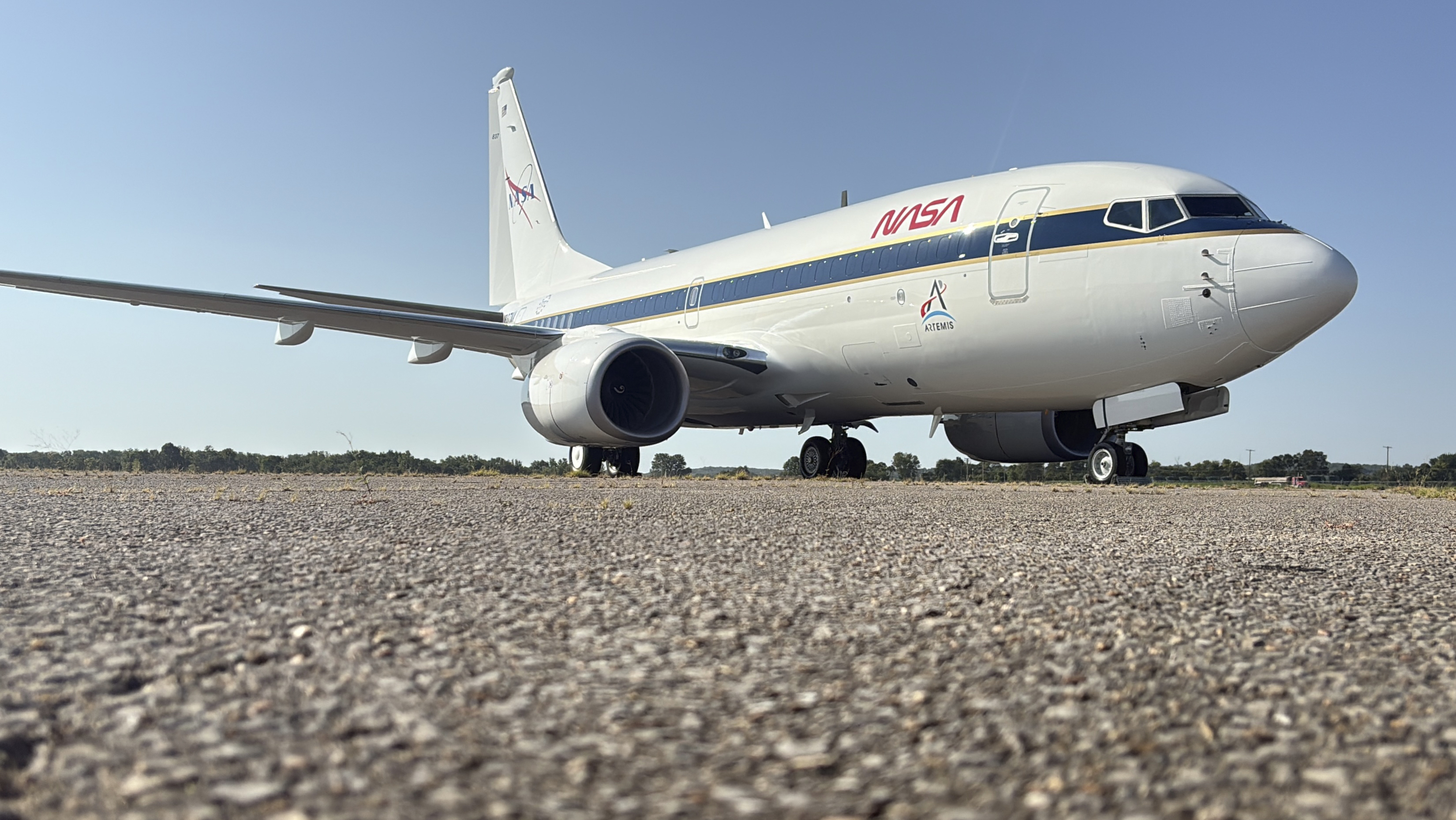
NASA’s 737 aircraft was painted this week in Oklahoma as it progresses with modifications for use as a reduced gravity test aircraft for the agency. NASA’s Armstrong Flight Research Center in Edwards, California, took ownership of the aircraft from the United States Air Force in June.
The aircraft will perform lunar-gravity parabolic flights to validate astronaut lunar suits and associated crew systems required to support Artemis mission objectives. These flights will happen at NASA’s Johnson Space Center in Houston for reduced-gravity operations, with NASA Armstrong oversight.
In addition, the aircraft will serve as a key asset for systems‑integration research for flight testing autonomy, sensors, and other digital systems.
Share Details Last Updated Aug 13, 2026 EditorDede DiniusContactTeresa Whitingteresa.whiting@nasa.gov Related Terms Explore More 5 min read Pursuing a Dream of Working for NASA Article 4 days ago 5 min read NASA Completes Astronaut-Deployed Science Instrument for Lunar SurfaceNASA has declared “wrenches down” on the first completed payload designed for Artemis astronauts to…
Article 5 days ago 4 min read Building the Moon Base: NASA Stories at the Ion Article 5 days ago Keep Exploring Discover More Topics From NASAArmstrong Flight Research Center
Aircraft Flown at Armstrong
Aeronautics
Artemis
NASA’s 737 Reveals New Paint
1 min read
Preparations for Next Moonwalk Simulations Underway (and Underwater) A newly painted NASA 737 aircraft sits on a ramp in Oklahoma on Thursday, Aug. 13, 2026. NASA/Carla EscamillaNASA’s 737 aircraft was painted this week in Oklahoma as it progresses with modifications for use as a reduced gravity test aircraft for the agency. NASA’s Armstrong Flight Research Center in Edwards, California, took ownership of the aircraft from the United States Air Force in June.
The aircraft will perform lunar-gravity parabolic flights to validate astronaut lunar suits and associated crew systems required to support Artemis mission objectives. These flights will happen at NASA’s Johnson Space Center in Houston for reduced-gravity operations, with NASA Armstrong oversight.
In addition, the aircraft will serve as a key asset for systems‑integration research for flight testing autonomy, sensors, and other digital systems.
Share Details Last Updated Aug 13, 2026 EditorDede DiniusContactTeresa Whitingteresa.whiting@nasa.gov Related Terms Explore More 5 min read Pursuing a Dream of Working for NASA Article 4 days ago 5 min read NASA Completes Astronaut-Deployed Science Instrument for Lunar SurfaceNASA has declared “wrenches down” on the first completed payload designed for Artemis astronauts to…
Article 4 days ago 4 min read Building the Moon Base: NASA Stories at the Ion Article 5 days ago Keep Exploring Discover More Topics From NASAArmstrong Flight Research Center
Aircraft Flown at Armstrong
Aeronautics
Artemis
For West Virginia Engineer, Home Is Where the Heart Is… and NASA, Too
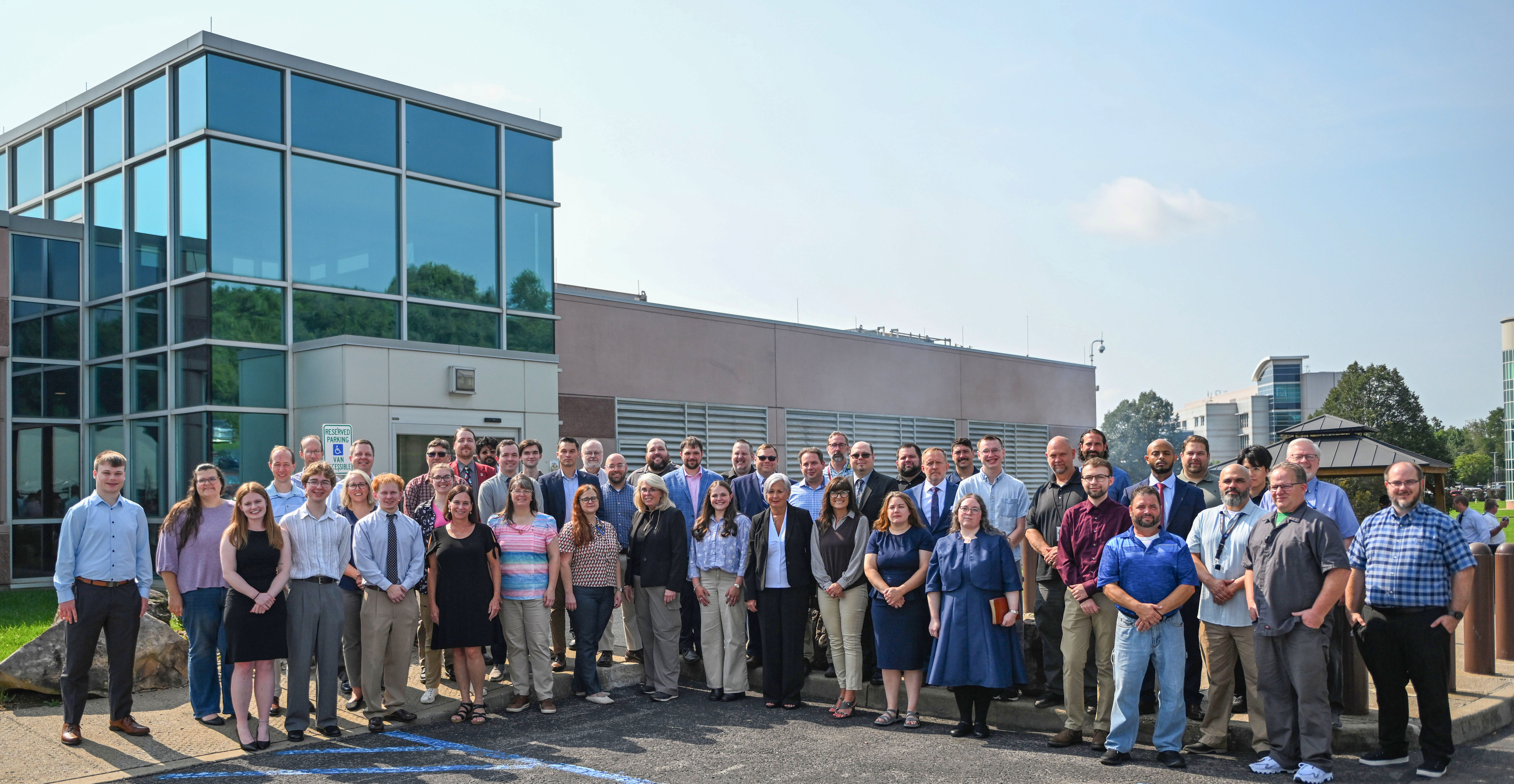
Growing up in Grafton, West Virginia, engrossed in Star Wars and all things science fiction, Fletcher Newell had an early interest in space exploration. That interest only grew when, in 2013, his fourth-grade class took a field trip to a nearby NASA facility he had not yet heard of – NASA’s Katherine Johnson Independent Verification & Validation Facility, located in Fairmont, West Virginia. Thirteen years later, Newell and 48 of his colleagues at the facility were sworn in as NASA civil servants during a ceremony on Aug. 10.
“I had always admired NASA from afar,” said Newell, who started working at IV&V as a systems engineer contractor in early 2025. “To my surprise, the agency was doing impactful work in my backyard.”
During high school, he began cultivating programming skills that would lay the foundation for his future. A self-professed computer aficionado, Newell taught himself how to code. In algebra class, he discovered that his graphing calculator was programmable, leading him to create basic scripts. He quickly moved to popular software applications, learning how they were built in order to develop his own programs. Artificial intelligence was still on the brink of becoming mainstream, but he was already asking himself, “What are the more interesting things we can teach computers to do?” As a junior in 2019, the precocious programmer merged his talents with his passion for space after being accepted into IV&V’s high school internship program.
Newell created a database for engineering methods, processing hundreds of documents to facilitate the work of his colleagues from a procedural aspect.
“Working as a high school intern really elevated my fascination for NASA,” he said.
Following graduation in 2020, Newell headed west to Stanford University in Palo Alto, California, majoring in, naturally, computer science, with a focus on AI and machine learning when both were scaling rapidly across industries and in everyday usage.
Instead of pursuing internships in the neighboring Silicon Valley – widely considered the global center for technological innovation – he returned to West Virginia for three consecutive summers, cutting his teeth at the Fairmont facility.
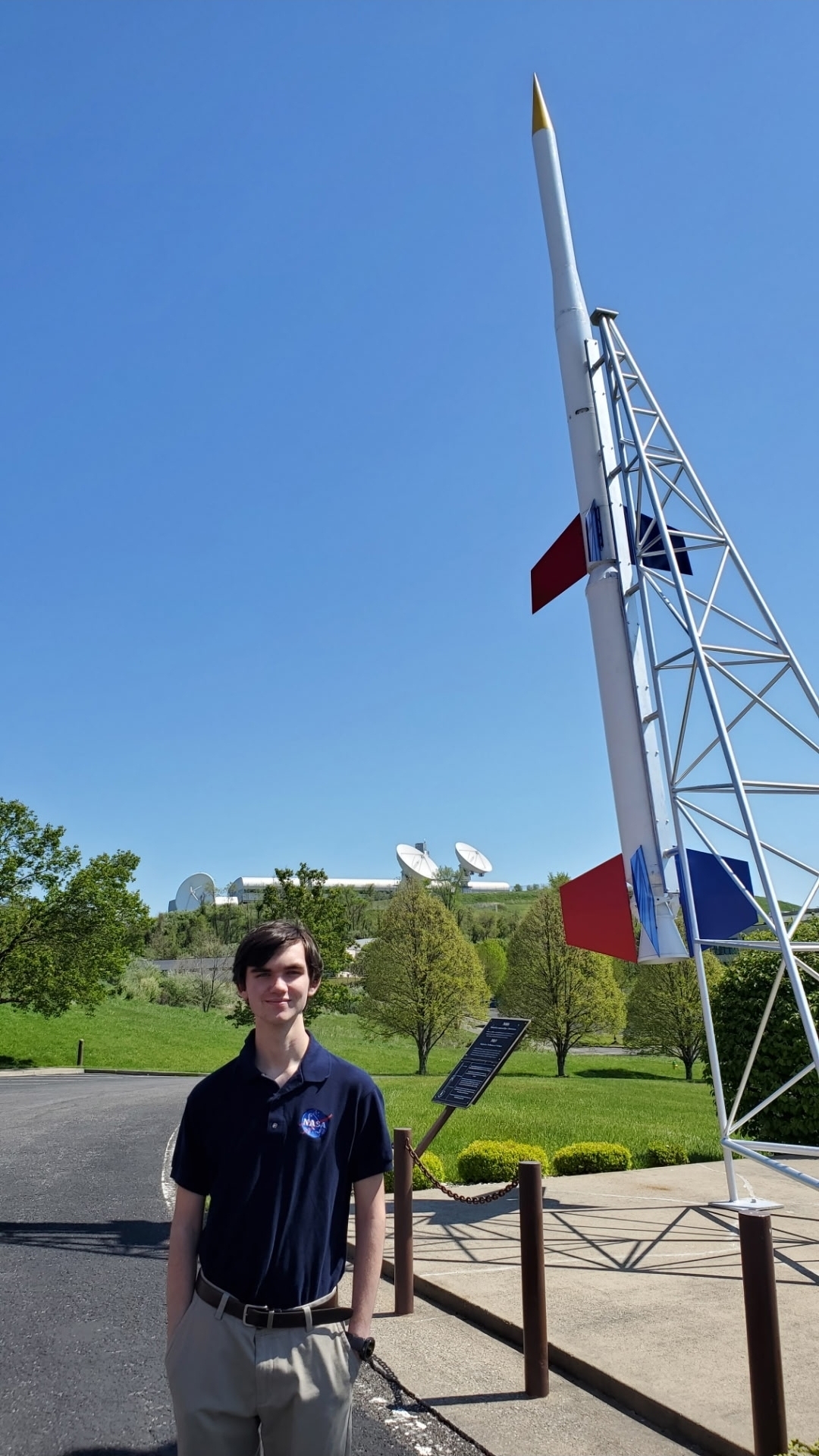
He began researching AI safety as engineers learned how to give spacecraft more onboard autonomy and have them learn on their own. Later, he was on a team responsible for assessing the safety of Terrain Relative Navigation, a vision-based guidance technology that could enable spacecraft to land on planetary surfaces without GPS. During his final internship, generative AI – which creates content based on user prompts – was becoming widespread, and he worked on teams exploring how to responsibly integrate it into mission assurance.
Newell also performed research about autonomous space docking at Stanford’s Center for AI Safety, resulting in two publications. Following his undergraduate education, he remained at Stanford to earn a master’s in computer science.
When it came time to enter the workforce, one organization was atop his list. A contractor opportunity opened up at IV&V, and he leapt at the chance.
“I enjoyed the work at IV&V back in high school and college,” he said. “There’s nothing better than pursuing what aligns with your interests.”
As a systems engineer, he has worked primarily on mission safety and security, identifying and resolving system defects and vulnerabilities for such spacecraft as Space Reactor-1 (SR-1) Freedom, Orion, Gateway, and the Human Landing System, all while helping guide NASA’s responsible adoption and development of AI systems.
His colleagues took notice of their junior member’s contributions, resulting in Newell being named IV&V Engineer of the Year in 2025 less than a year into the job after identifying more than 70 issues in Gateway – and later SR-1 Freedom – with clear mission impact and, as noted in his award citation, developing a reputation for clearly articulating their implications.
“During his internships and now as a full-time engineer, Fletcher has consistently demonstrated exceptional talent, curiosity, and a passion for our mission,” said Wes Deadrick, IV&V director. “He could have gone almost anywhere after Stanford. The fact that he chose to come home to build his career supporting NASA through the IV&V Program makes me incredibly proud.”
The Aug. 10 ceremony for Newell and his colleagues was part of NASA’s workforce directive to bring core, mission-critical positions into the civil service, from early-career professionals to seasoned technical experts.
“It’s an investment in NASA’s future, giving us the opportunity to bring exceptionally talented people into the civil service while strengthening long-term technical capabilities that support our nation’s most challenging missions,” said Deadrick. “At IV&V, initiatives like this help ensure we continue providing independent expertise and mission assurance that our customers depend on.”
For Newell, as he takes this next step in his professional progression as a civil servant computer engineer, he looks forward to expanding on his responsibilities, especially to help NASA return to the Moon. He is currently helping identify safety and security issues, including ones that could impact crew safety and lead to the loss of spacecraft control, related to the agency’s lunar endeavors.
“At IV&V, teams are ensuring every major lunar vehicle and system will be ready to safely embark on their missions, not just for flying around the Moon, but also for putting American boots on the surface and eventually establishing and working on a Moon Base,” he said.
More than a decade after taking that field trip and now working on some of NASA’s high-priority missions, Newell readily admits he didn’t always envision staying in West Virginia.
“It was a little strange coming back, but I was continually getting to do amazing things at an amazing organization in a place I already know,” Newell said. “And that’s really cool.”
For West Virginia Engineer, Home Is Where the Heart Is… and NASA, Too
Growing up in Grafton, West Virginia, engrossed in Star Wars and all things science fiction, Fletcher Newell had an early interest in space exploration. That interest only grew when, in 2013, his fourth-grade class took a field trip to a nearby NASA facility he had not yet heard of – NASA’s Katherine Johnson Independent Verification & Validation Facility, located in Fairmont, West Virginia. Thirteen years later, Newell and 48 of his colleagues at the facility were sworn in as NASA civil servants during a ceremony on Aug. 10.
“I had always admired NASA from afar,” said Newell, who started working at IV&V as a systems engineer contractor in early 2025. “To my surprise, the agency was doing impactful work in my backyard.”
During high school, he began cultivating programming skills that would lay the foundation for his future. A self-professed computer aficionado, Newell taught himself how to code. In algebra class, he discovered that his graphing calculator was programmable, leading him to create basic scripts. He quickly moved to popular software applications, learning how they were built in order to develop his own programs. Artificial intelligence was still on the brink of becoming mainstream, but he was already asking himself, “What are the more interesting things we can teach computers to do?” As a junior in 2019, the precocious programmer merged his talents with his passion for space after being accepted into IV&V’s high school internship program.
Newell created a database for engineering methods, processing hundreds of documents to facilitate the work of his colleagues from a procedural aspect.
“Working as a high school intern really elevated my fascination for NASA,” he said.
Following graduation in 2020, Newell headed west to Stanford University in Palo Alto, California, majoring in, naturally, computer science, with a focus on AI and machine learning when both were scaling rapidly across industries and in everyday usage.
Instead of pursuing internships in the neighboring Silicon Valley – widely considered the global center for technological innovation – he returned to West Virginia for three consecutive summers, cutting his teeth at the Fairmont facility.
He began researching AI safety as engineers learned how to give spacecraft more onboard autonomy and have them learn on their own. Later, he was on a team responsible for assessing the safety of Terrain Relative Navigation, a vision-based guidance technology that could enable spacecraft to land on planetary surfaces without GPS. During his final internship, generative AI – which creates content based on user prompts – was becoming widespread, and he worked on teams exploring how to responsibly integrate it into mission assurance.
Newell also performed research about autonomous space docking at Stanford’s Center for AI Safety, resulting in two publications. Following his undergraduate education, he remained at Stanford to earn a master’s in computer science.
When it came time to enter the workforce, one organization was atop his list. A contractor opportunity opened up at IV&V, and he leapt at the chance.
“I enjoyed the work at IV&V back in high school and college,” he said. “There’s nothing better than pursuing what aligns with your interests.”
As a systems engineer, he has worked primarily on mission safety and security, identifying and resolving system defects and vulnerabilities for such spacecraft as Space Reactor-1 (SR-1) Freedom, Orion, Gateway, and the Human Landing System, all while helping guide NASA’s responsible adoption and development of AI systems.
His colleagues took notice of their junior member’s contributions, resulting in Newell being named IV&V Engineer of the Year in 2025 less than a year into the job after identifying more than 70 issues in Gateway – and later SR-1 Freedom – with clear mission impact and, as noted in his award citation, developing a reputation for clearly articulating their implications.
“During his internships and now as a full-time engineer, Fletcher has consistently demonstrated exceptional talent, curiosity, and a passion for our mission,” said Wes Deadrick, IV&V director. “He could have gone almost anywhere after Stanford. The fact that he chose to come home to build his career supporting NASA through the IV&V Program makes me incredibly proud.”
The Aug. 10 ceremony for Newell and his colleagues was part of NASA’s workforce directive to bring core, mission-critical positions into the civil service, from early-career professionals to seasoned technical experts.
“It’s an investment in NASA’s future, giving us the opportunity to bring exceptionally talented people into the civil service while strengthening long-term technical capabilities that support our nation’s most challenging missions,” said Deadrick. “At IV&V, initiatives like this help ensure we continue providing independent expertise and mission assurance that our customers depend on.”
For Newell, as he takes this next step in his professional progression as a civil servant computer engineer, he looks forward to expanding on his responsibilities, especially to help NASA return to the Moon. He is currently helping identify safety and security issues, including ones that could impact crew safety and lead to the loss of spacecraft control, related to the agency’s lunar endeavors.
“At IV&V, teams are ensuring every major lunar vehicle and system will be ready to safely embark on their missions, not just for flying around the Moon, but also for putting American boots on the surface and eventually establishing and working on a Moon Base,” he said.
More than a decade after taking that field trip and now working on some of NASA’s high-priority missions, Newell readily admits he didn’t always envision staying in West Virginia.
“It was a little strange coming back, but I was continually getting to do amazing things at an amazing organization in a place I already know,” Newell said. “And that’s really cool.”
NASA's canceled lunar space station tech will help build the Artemis moon base
Not every canceled NASA program earns a halo after its demise, but one scrapped project is finding new life by contributing its parts to help the space agency achieve its moon base goals faster.
Northrop Grumman is repurposing hardware and technology from the Habitation and Logistics Outpost (HALO) space station module for use on a new series of Lunar Infrastructure Demo (LID) missions. HALO was originally designed as the habitation module for NASA's since-cancelled moon-orbiting Gateway space station but found itself on the chopping block when the agency restructured the Artemis program architecture earlier this year.
Rather than scrap the unfinished module outright, Northrop Grumman will adapt HALO's electrical and mechanical components to support the development of technologies for a moon base that can survive the cold, weeks-long night at the lunar south pole while sustaining the long-term habitation of astronauts inside.
Part of NASA's reasoning for canceling Gateway was the need for expedience. As the agency's vision for Artemis and the return of astronauts to the lunar surface has evolved, China's plans to land the first taikonauts on the moon have steadily taken shape. Those ambitions, and the continued progression of China's lunar program, have kicked off a new space race in which the U.S. and NASA are intent on maintaining their first-place position.
In March, NASA Administrator Jared Isaacman announced a shakeup to the Artemis program designed to enable a more step-by-step approach toward developing the technologies needed for a next-generation crewed lunar landing, and to achieve that landing on the shortest timeline possible.
That timeline currently puts the first Artemis lunar landing with astronauts on the Artemis IV mission, scheduled for late 2028. Before then, however, NASA is planning nearly two dozen uncrewed missions to the moon to lay the groundwork for the infrastructure needed to precede astronauts' return. And, rather than let HALO rust in a warehouse, Northrop is doubling down on its commitment to the cause.
"To help NASA move faster … HALO’s power, data and mechanical interfaces will enable NASA to move with speed and begin gathering real lunar surface performance data sooner," the company said in a press release on Aug. 4.
Northrop Grumman’s Lunar Infrastructure Demos (LID-1, LID-2 and LID-3) will reuse HALO derived technologies to rapidly mature lunar surface power, thermal, autonomy, communications and hosted payload services that can survive the lunar night and scale into persistent infrastructure near the moon’s south pole. (Image credit: Northrop Grumman)Northrop announced 3 LID missions to "reuse HALO-derived technologies to rapidly mature lunar surface power, thermal, autonomy, communications and hosted payload services," which will help NASA gather data to better protect robotics and crews during long-duration stints near the moon's south pole, where the agency plans to establish its Artemis moon base. Neither the company nor NASA gave a target timeline for these missions.
NASA is targeting the south pole specifically because of the abundance of water ice that scientists have detected in that region on the moon. When harnessed appropriately, such ice concentrations can be used for a variety of applications to enable sustainable habitation on the lunar surface — the ultimate goal of the Artemis program — including potable water, radiation shielding and rocket fuel.
NASA believes that overcoming the technological hurdle of "in-situ resource utilization" (ISRU), or the ability to rely on materials locally available to you in order to sustain your survival, is the gold standard of spaceflight that will open the door to humanity's long-term exploration of the cosmos. Manufacturing propellants off Earth, for example, would mean a substantial increase in the distance any particular mission to space can fly, because nearly 95% of a rocket's mass at launch is fuel. So, the ability to refuel in space, circumventing the burden of launching to orbit fully fueled, would give satellites and crewed spacecraft the ability to fly much farther into the solar system than current launch systems allow.
As much as Artemis is, in itself, a program to establish a permanent human presence on the moon, NASA also sees it as the proving ground for technologies that could one day sustain astronaut missions to Mars. There is worry, however, over the national security and economic consequences that could accompany China beating the U.S. to the moon, so speed is top of mind for those tasked with the country's lunar return.
"As America embarks on the next chapter in human space exploration, our Lunar Infrastructure Demos will help turn the moon into a place where astronauts can stay, work and make discoveries that benefit humanity,” said David Schiller, Northrop Grumman's vice president of civil space and sciences, in a statement. “Our ready‑to‑fly, reliable HALO technologies allow NASA to move faster, putting in place robust infrastructure that can endure the lunar night and establish a strong blueprint for a future moon base.”
A Massive Stream of Gas Tilted This Planet-Forming Disk
Astronomers found evidence that a giant stream of gas flowing into the GW Orionis young triple-star system may have tilted its planet-forming disk, offering a new explanation for why some planetary systems are misaligned. The next step is to search for shock fronts in the system, and to search for more of these massive streams of gas in other systems.
'The X-Files' creator Chris Carter says new director's cut of 'I Want to Believe' is 'the horror movie that we really wanted to make' (interview)
Eighteen years later, it still gives me a jump scare, even though I know it's coming.
Agent Mulder, hot on the trail of a group of murderers who are harvesting their victims' organs, breaks into a makeshift laboratory in an attempt to save an abducted woman. He finds a gruesome scene of bodies on ice and surgeons, scalpels in hand, preparing to transplant the villain's head onto the abducted woman's body. Mulder turns and — there it is! The villain's severed head on ice! And it opens its eyes.
It sounds less like a scene out of a science fiction mystery series and one more suited to a horror film. And that's precisely why Chris Carter, creator of "The X-Files", is revisiting the 2008 film "The X-Files: I Want to Believe" in a new R-rated director's cut coming to Hulu on Aug. 14.
Space.com got the chance to speak with Carter about the upcoming director's cut and the inspiration behind revisiting the standalone "X-Files" film nearly two decades after its release.
"I wanted to make the scary movie that I always had intended to make, intended to direct, and this is more in line with that," Carter told Space.com. "It gave me a chance to remember the making of the movie and what I had intended it to be, and how different it was from that original vision."
The director's cut features a new addition to the film's title — "The X-Files: I Want to Believe — Vrach Frankenshteyn". Carter said the name at the end (Russian for "Doctor Frankenstein") is a way of alluding to the tone and themes that he intended to focus on in the original film.
"It's a Frankenstein story, and the original inspiration for it was a doctor in Cleveland, Ohio, who transplanted the head of a monkey onto another monkey, and I thought that is perfect X-Files territory," Carter said.
Chris Carter on the set of the 2008 film "The X-Files: I Want to Believe." (Image credit: 20th Century Studios/Walt Disney Co.)Carter's original version of the film was re-edited two times in order for it to be released with the PG-13 rating that 20th Century Fox (now 20th Century Studios) insisted upon.
"When we first made the movie, we had a vision, and we tried to bring it to life. And when we took it to the executives at 20th Century Fox, they said, 'This isn't a PG-13 movie. This is torture porn.'
"And so we cut it back to what we thought was a PG-13 movie to placate the executives, and then we gave it to the motion picture censors, and they said this isn't a PG-13 movie."
With many of the horror elements cut or toned down, the 2008 theatrical release ended up focusing quite a bit of time on the relationship between Mulder and Scully — a fan-favorite part of the series for sure, but not one that Carter intended to be so central to "I Want to Believe."
David Duchovny and Gillian Anderson as FBI agents Fox Mulder and Dana Scully in "The X-Files: I Want to Believe — Vrach Frankenshteyn." (Image credit: 20th Century Studios/Walt Disney Co.)The film's plot centers on a group of women who go missing. When a disgraced priest begins having supernatural visions of the missing women, agents Mulder and Scully come out of retirement to take on another case full of mysteries and unexplained events. Their investigation finds them uncovering an illegal organ harvesting operation, bizarre life extension experiments conducted by a murderous mad scientist, and unexplained supernatural occurrences and synchronicities: classic "X-Files" fare.
But despite being rooted in the long-running themes of the nine-season series, the film is accessible for first-time "X-Files" viewers or casual fans (or its underrated spin-off).
Rather than diving into the dense, overlapping conspiracies that form the series' core mythology of alien invasion and the government cover-up that keeps it a secret, "The X-Files: I Want to Believe — Vrach Frankenshteyn" is what is referred to as a "monster of the week" story. It's a standalone plot that doesn't require a deep knowledge of the series or its mythology to enjoy.
David Duchovny, Gillian Anderson and Chris Carter on the set of the 2008 film "The X-Files: I Want to Believe." (Image credit: 20th Century Studios/Walt Disney Co.)Interestingly, the film breaks with the tradition of director's cuts featuring loads of deleted scenes and footage that never made it past the cutting room floor. It actually features a shorter runtime than the theatrical release.
"And everyone asks me that; why is it with most directors' cuts they're always longer because they throw everything in that got cut out. In this case, I felt it could be streamlined a little," Carter said. "I lightened up a little bit on the Mulder and Scully relationship beats and focused more on the horror movie that we really wanted to make."
In keeping with "X-Files" tradition, the director's cut also leaves many of its core mysteries and supernatural elements unresolved. That central theme, the ongoing search for truth and meaning in a sometimes mysterious and unexplainable universe, reflects Carter's own views.
"I really think of science as a search for God, and there are so many big questions that are unanswered, and we are trying to find the answers to those things," Carter said. "And will those answered questions bring us closer to an idea or a how it how it all began? What came before the Big Bang?"
Gillian Anderson as Dana Scully in "The X-Files: I Want to Believe — Vrach Frankenshteyn." (Image credit: 20th Century Studios/Walt Disney Co.)Perhaps in a case of life imitating art, another key theme of "The X-Files" has made its way into the halls of the White House and Capitol Hill in recent years.
The U.S. government has held several congressional hearings discussing disclosure of alleged UFO secrets. The Trump administration has even released dozens of files, images and videos of alleged UFOs, or UAPs, as they're now known. Conspiracy theories of all kinds, particularly when it comes to aliens, have become mainstream.
Does that mean the truth is really out there? It certainly shows that we, as a nation, want to believe. But whatever the case may be, it is that same wonder, the same drive to question authority and probe the unknown, that drives Chris Carter to explore "The X-Files" after more than three decades.
"In every conspiracy is the kernel of truth, and that's interesting to me as a storyteller," Carter said.
"The X-Files: I Want to Believe — Vrach Frankenshteyn" debuts on Hulu on Aug. 14, 2026.
Physicists find major clue to matter’s biggest mystery
Researchers have nailed down an elusive quantity called baryon number, which may be responsible for the cosmic mismatch between matter and antimatter
How to image the planets with a telescope and camera
The night sky holds endless wonders, but few experiences match the thrill of photographing planets in vivid detail. With even a modest telescope and camera setup, you can capture cloud bands on Jupiter, the majestic rings of Saturn or the polar caps of Mars — images once the preserve of professional observatories. This technique, known as lucky imaging, records short video clips at high frame rates to freeze fleeting moments of steady air, then stacks the sharpest frames into one crisp photo.
No advanced skills are required to start. Whether you own a modest backyard telescope or are shopping for your first planetary camera, this guide provides everything needed to succeed. You will learn a complete workflow that takes you from set-up to finished image, explore why certain planets are easier than others and find answers to practical questions that beginners often ask.
Clear skies, patience and practice are your only limits. Soon you will be creating gallery-worthy shots right from home.
Step-by-step tutorial: Imaging planets with a telescope and cameraPlanetary imaging relies on video capture rather than single long exposures. Follow these 12 steps for reliable results with most setups. Planning observations in advance is essential!
1. Check weather conditions(Image: © Damian Peach)
Check conditions and plan your target. Use a planetarium app such as Stellarium or a site like TimeAndDate.com to confirm the planet is visible and high in the sky. Review weather forecasts and seeing predictions on ClearDarkSky.com or Windy.com. Good seeing — stable, calm air — makes all the difference when it comes to this kind of imaging!
2. Set up before night time(Image: © Damian Peach)
Set your telescope up outdoors early. Allow it to cool for at least a couple of hours so that internal air currents do not blur the view. Level the tripod and power on your motorized mount.
3. Use a motorized tracking mount(Image: © Damian Peach)
A motorized tracking mount is essential. For GoTo systems such as Celestron NexStar models, perform a quick two-star alignment and sync directly on the planet. Equatorial mounts need polar alignment for smooth tracking. Alt-az tracking Dobsonians need just a quick one- or two-star alignment to get you underway.
Centering the planets make take a little while, less with a GoTo mount, but it's absolutely essential.
4. Locate and center the planet either manually or via GoTo. Use the finder scope or red-dot finder, then switch to a low-power eyepiece to bring the target into view and center it as best you can.
5. Increase your magnification(Image: © Damian Peach)
Add magnification. Insert a 2x or 3x Barlow lens or Powermate into the focuser. This increases focal length to fill more of the camera sensor with the small planetary disk. Once that’s done, check your telescope collimation on a star – this is essential for this kind of astrophotography. Adjust the collimation screws to give a nice concentric, out-of-focus star pattern that looks like a bullseye.
6. Synchronize your laptopConnect to your laptop. Plug the camera into a USB port and launch capture software such as SharpCap or FireCapture – both programs are freely available for use.
7. Connect the cameraRemove the eyepiece and connect your planetary camera — such as a ZWO ASI224MC,ASI585MC or similar — using the appropriate 1.25-inch nose piece or T-ring. Secure everything firmly.
8. Keep things centralCenter the planet. Spend time focusing carefully on the planet itself. Slowly adjust the focuser while watching surface details sharpen. Many imagers slightly defocus, then refocus through the sweet spot for precision. Do this several times to get the best focus you can. Atmospheric seeing conditions will seriously impact how easy this step is.
9. Setting correct parameters is crucial(Image: © Damian Peach)
Set camera parameters. Choose a high frame rate — 50 to 100 frames per second or more. Keep exposure short and gain moderate, so the planet fills at least 80% of the histogram without clipping highlights. Enable color debayering or monochrome mode as appropriate.
10. Time to shoot video(Image: © Damian Peach)
Record videos. Capture plenty of short videos of 60 to 120 seconds each, aiming for several thousand frames per run. Save in SER format for ease of use in other software.
11. Transfer and preview(Image: © Damian Peach)
When finished, transfer and review files. Preview clips to discard any with obvious drift or poor seeing.
12. Process the data(Image: © Damian Peach)
Process the data. Open your best videos in AutoStakkert! to align and stack the sharpest 20 to 50% of frames from each video. Export the result to LuckyStackWorker or RegiStax. Apply wavelet sharpening in layers, adjust the histogram for contrast and balance the color channels. Export your final image.
Repeat the process on multiple nights. Each session builds skill and yields better data — it can take many attempts before catching some great quality data. Patience is essential.
The best planets to target with your telescope and cameraThe wider the aperture, the more impressive your shots are likely to be. (Image credit: B. Brown)Jupiter ranks as the top choice for beginners – and perhaps even veterans! Its large disk shows colorful cloud bands, the Great Red Spot and orbiting moons even in modest telescopes. The planet’s brightness and size tolerate average seeing well and reward those even with modest equipment.
This image of Saturn was captured through a Celestron C14 telescope (Image credit: Damian Peach)Saturn follows closely. Its iconic rings and subtle atmospheric banding create dramatic images. While significantly dimmer than Jupiter, modest telescopes easily reveal its brilliant rings, and the belts and zones within the planet’s atmosphere.
Again viewed through the Celestron C14, a close-up view of Mars. (Image credit: Damian Peach)Mars delivers excitement during its oppositions every couple of years. At closest approach the planet swells in apparent size, revealing dark surface markings, polar ice caps and occasional dust storms. Again, even small telescopes reveal fascinating detail when the planet is close to opposition.
Venus is harder to see through a telescope, often resembling our own moon from a distance. (Image credit: Damian Peach)Venus offers an easy entry point. Extremely bright and straightforward to locate, it displays clear phases like a miniature moon. Cloud features require ultraviolet filters, but the phases alone impress viewers — even binoculars show these phases clearly.
These four planets share key advantages: They appear large and bright enough for small apertures to record good detail on them. Jupiter, Saturn and Mars are the top three – all are fascinating objects to study for observers of all experience levels.
Handling the more challenging solar system targets, however, requires more advanced equipment and experience levels.
Mercury, Uranus and Neptune present greater challenges. Mercury stays glued to the sun’s glare, visible only briefly at dawn or dusk and best at maximum elongation. Its tiny disk demands exceptional seeing and precise daytime locating skills as well as a decent size telescope.
Uranus and Neptune appear as tiny blue-green disks. Their small apparent sizes require at least an 8-inch aperture telescope, longer focal lengths and higher magnification. Larger apertures gather more light, while monochrome cameras with filters help tease out subtle banding.
Upgrading to a 10-inch or larger telescope, a high-sensitivity monochrome camera and a filter wheel unlocks these distant worlds. Start with the easier quartet before investing further.
Frequently asked questionsTiming can be everything if you're looking to take some superb pictures of planets. (Image credit: Getty)When is the best time to image the planets?
Aim for nights when the target planet rides high in the sky — ideally near the meridian — to minimize atmospheric turbulence. Planets such as Jupiter, Saturn and Mars look largest and brightest around opposition, when Earth lies directly between them and the sun. But good seeing matters more than the calendar: stable air with low turbulence yields sharper frames regardless of season. Check forecasts and look for periods of high pressure with stable weather and calm winds. Planetary imaging works year-round on clear nights, but spring and fall often deliver steadier conditions. Light pollution is also irrelevant to this form of imaging, so it’s something you can easily undertake from urban locations.
What is the most basic setup you need to do this?
A 4- to 6-inch aperture telescope on a motorized mount — such as a Celestron NexStar 6SE or anything similar — provides an ideal starter platform. Pair it with an entry-level planetary camera like the ZWO ASI224MC, plus a 2x Barlow lens and a laptop running free software. Total beginner budget often stays under $800 if you already own the telescope. This kit can capture excellent Jupiter and Saturn images without breaking the bank. Skip expensive cooled cameras or large apertures until you gain experience.
How long does it take to get a good image?
The real key to achieving good image quality is everything you do before pressing the record button: Making sure the telescope is properly cooled down, ensuring it is properly collimated, taking time to focus carefully. All these factors play a huge role. Beyond this, it is largely down to the steadiness of the atmosphere when capturing. The steadier the seeing, the better the result will be!
SummaryWe hope that, with a little practice, this gives you the know-how you need to take stunning images of the planets. If you've yet to purchase the necessary equipment, take a look at our guides to the best telescopes and best dedicated astrophotography cameras.
Virgin Galactic delays next commercial spaceflight to 2027
Virgin Galactic's next customers will have to wait a bit longer to get off the ground.
The suborbital space tourism company hasn't been to the final frontier since June 2024. It had been targeting late 2026 for the resumption of commercial service, but that's not going to happen, we learned on Wednesday (Aug. 12).
"We've moved our first commercial spaceflight to this coming February to allow additional time to complete avionics and systems installations," Virgin Galactic CEO Michael Colglazier said on Wednesday, during a call the company held to discuss its financial results for the second quarter of 2026.
"No single issue is driving the schedule push," he added. "Rather, we have experienced modest time-duration extension across hundreds of relatively small but important installation tasks involved in the first build of our new spaceship."
The coming mission won't be Virgin Galactic's first commercial spaceflight overall. That occurred in June 2023 and was performed by the company's VSS Unity space plane, which was retired a year later following its seventh operational, customer-carrying flight.
Rather, Colglazier was referring to the debut of the company's first "Delta class" vehicle, an advanced iteration that's designed to fly much more frequently than Unity ever did — twice per week, if all goes to plan.
Virgin Galactic is currently building two Delta planes, which will be broadly similar to Unity in most ways. They will be piloted vehicles that seat six passengers, for example, and will take off beneath the wings of a carrier plane. That mothercraft will drop the Delta vehicles at an altitude of about 50,000 feet (15,000 meters), after which they'll ignite their rocket motors and head to suborbital space.
Their suborbital jaunts will likely last 60 to 90 minutes, and they'll end with a landing at the same runway where they started.
The second Delta spaceship is expected to join the first one at Spaceport America in New Mexico — Virgin Galactic's commercial hub — in March 2027, Colglazier said.
The view from Virgin Galactic's VSS Unity vehicle during one of its trips to suborbital space. (Image credit: Virgin Galactic)Colglazier also announced that Virgin Galactic's latest "tranche" of passenger bookings was oversubscribed, demonstrating a continuing strong demand from customers despite the flight hiatus. The per-seat price for that tranche was $750,000 — a number that's no longer available.
"We have retired the $750,000 price point, and we plan to open a new tranche of spaceflight expeditions this fall at higher price points," Colglazier said.
He didn't say what the new price would be. But the jump could be considerable, based on recent history: The ticket price before $750,000 was $600,000, and the one before that was $450,000.
Virgin Galactic lost nearly $56 million in Q2 2026, the company announced in Wednesday's earnings call. That was an improvement over Q2 2025, when the company was about $67 million in the red.
But things should change considerably next year, according to the company.
"With our second [Delta] spaceship entering service, we continue to forecast that we will achieve a flight rate of 10 or more spaceflights per month by the end of the second quarter of 2027," Virgin Galactic Chief Financial Officer Doug Ahrens said during Wednesday's call.
"This flight rate is an unprecedented achievement in human spaceflight, and this is made possible with our highly reusable spaceship design," he added. "Given these flight rate expectations, we continue to forecast quarterly positive cash flow within 2027."
The outlook is even rosier over the long haul, Ahrens stressed.
"We expect each new spaceship to cost approximately $60 million to produce," he said. "Given a conservative lifetime estimate of 500 flights per spaceship, with six astronauts per spaceflight, average pricing of $600,000 per spaceflight expedition, and a contribution margin over 80% per spaceflight, each new spaceship has the potential to generate over $1.4 billion of lifetime contribution margin."
Virgin Galactic will be the only game in town once it gets back up and running. Its chief competitor in the suborbital space tourism business, Jeff Bezos' Blue Origin, recently put its flights on hold to focus on helping NASA return astronauts to the moon.
Blue Origin has never revealed its ticket prices, but Ahrens said they were believed to be in the $1 million to $2 million range.
"I don't think we need to be driving our prices up that quickly," he said. "But there is strong and solid demand, and we do expect each time we release a tranche of tickets, it will be priced higher than the tranche before. And that's appropriate, so I think you'll see us do that for a little bit longer."
Rare Tropical Storm Lala on course for Hawaii, with hurricane conditions possible
This storm, a rarity for this part of the Pacific, is expected to bring heavy rains, strong wind and possibly “life-threatening flooding” to Hawaii this weekend
The Perseid meteor shower peak was spectacular: Here are our favorite photos
The Perseid meteor shower peaked last night in spectacular fashion, dazzling stargazers as countless shooting stars blazed overhead mere hours after a total solar eclipse saw the lunar disk hide the sun over Greenland, Iceland and Spain.
Perseid shooting stars appear as Earth enters the debris trail cast off by the icy comet 109P/Swift-Tuttle. Each year, countless shards of this ancient comet collide with our wandering planet. What follows is truly spectacular.
Most are no larger than a particle of dust, or grain of sand. Yet the incredible velocity at which they strike our atmosphere — 37 miles (59 kilometers) per second on average — sees many carve a fiery path as they disintegrate in Earth's sky, which is easily visible to the naked eye.
Countless photographers were primed and ready to capture this magnificent display as Earth passed through the densest region of Swift-Tuttle debris trail, heralding the appearance of hundreds of shooting stars.
Read on to see a selection of our favorite photos of the 2026 Perseid meteor shower, taken in the beautifully dark nights surrounding the August new moon phase.
Best photos of the 2026 Perseid meteor showerOne of our readers sent in this gorgeous shot. Dimitar Birachoski, from Ohrid, Macedonia caught several Perseid meteors streaking over Galicica National Park on Aug. 12, 2026, using a Nikon Z6iii camera.
"I've got the Pleiades, Andromeda galaxy and Milky Way with the Perseids," Birachoski told Space.com via email.
(Image credit: Dimitar Birachoski)Photographer Morteza Nikoubazl also caught a Perseid meteor streaking beside the famous Pleaides star cluster as seen from Semnan, Iran.
(Image credit: Morteza Nikoubazl/NurPhoto via Getty Images)Meanwhile, a Perseid meteor was spotted as the setting sun illuminated the skies over the Negev Desert in southern Israel, on Aug. 11, 2026.
(Image credit: Mostafa Alkharouf/Anadolu via Getty Images)The Milky Way Galaxy also showed its face during the Perseid meteor shower over the Negev Desert on Aug. 11, 2026.
(Image credit: Mostafa Alkharouf/Anadolu via Getty Images)This long streak left by a Perseid meteor was photographed above Pedernales Falls State Park in Johnson City, Texas on Aug. 12, 2026.
(Image credit: Rick Kern/Getty Images)A meteor (left) lit up the night sky during the Perseid meteor shower just hours after a total solar eclipse was seen from San Asensio, Spain on Aug. 12, 2026.
(Image credit: ANDER GILLENEA / AFP via Getty Images)Farther east, Ismail Aslandag caught a green meteor above Ucayak Church in Kirsehir, Turkiye on Aug. 12, 2026.
(Image credit: Ismail Aslandag/Anadolu via Getty Images)This long exposure captures Earth's rotation in the form of circular star trails. A Perseid "shooting star" lit up the swirling scene above Shaoguan in China's Guangdong Province on Aug. 12, 2026.
(Image credit: Wang Fanlu/VCG via Getty Images)Farther north, photographer Fan Chengzhu saw a Perseid meteor streaking into the distance over Shitan Village in China's Anhui Province on Aug. 13, 2026.
(Image credit: Fan Chengzhu/VCG via Getty Images)Earth won't break free of Swift-Tuttle's debris trail until Aug. 24, so there are still plenty of Perseids to be seen brightening the summer sky if you're a little late to the show. Just be prepared for a significantly lower hourly rate compared to the peak.
Want to try your hand at capturing one? Then be sure to read our guide to photographing shooting stars, along with our roundups of the best cameras and lenses for astrophotography.
Editor's Note: Did you snag a photo of a Perseid and want to share it with Space.com's readers? Then please send your photo(s), comments, name and location to spacephotos@space.com.
NASA Wants to Float Microscopic 'Tracers' on Sunlight to Map the Edge of Space
The atmospheric is a dynamic place, and just how well we understand that dynamism depends on what part of the atmosphere it is. Low altitudes can be reached by traditional balloons, with full suites of sensing equipment. Higher reaches are the domain of satellites, with their zippy orbits allowing them to travel through the less dense regions. But there a section scientists call the “ignorosphere”, between 30-100 kilometers up that still plays a major role in global climate dynamics, but which are only able to reach with temporary sounding rockets that only collect data for a few minutes before falling back to Earth. But a new technology from Benjamin Schafer of Rarefied Technologies that received a NASA Institute for Advanced Concepts (NIAC) grant hopes to solve that problem by inserting a fleet of sensors that can float in that area for months, while providing insight to these hard-to-capture long-term patterns that influence weather everywhere on the globe.
Perseids Meteor Shower
Perseids Meteor Shower
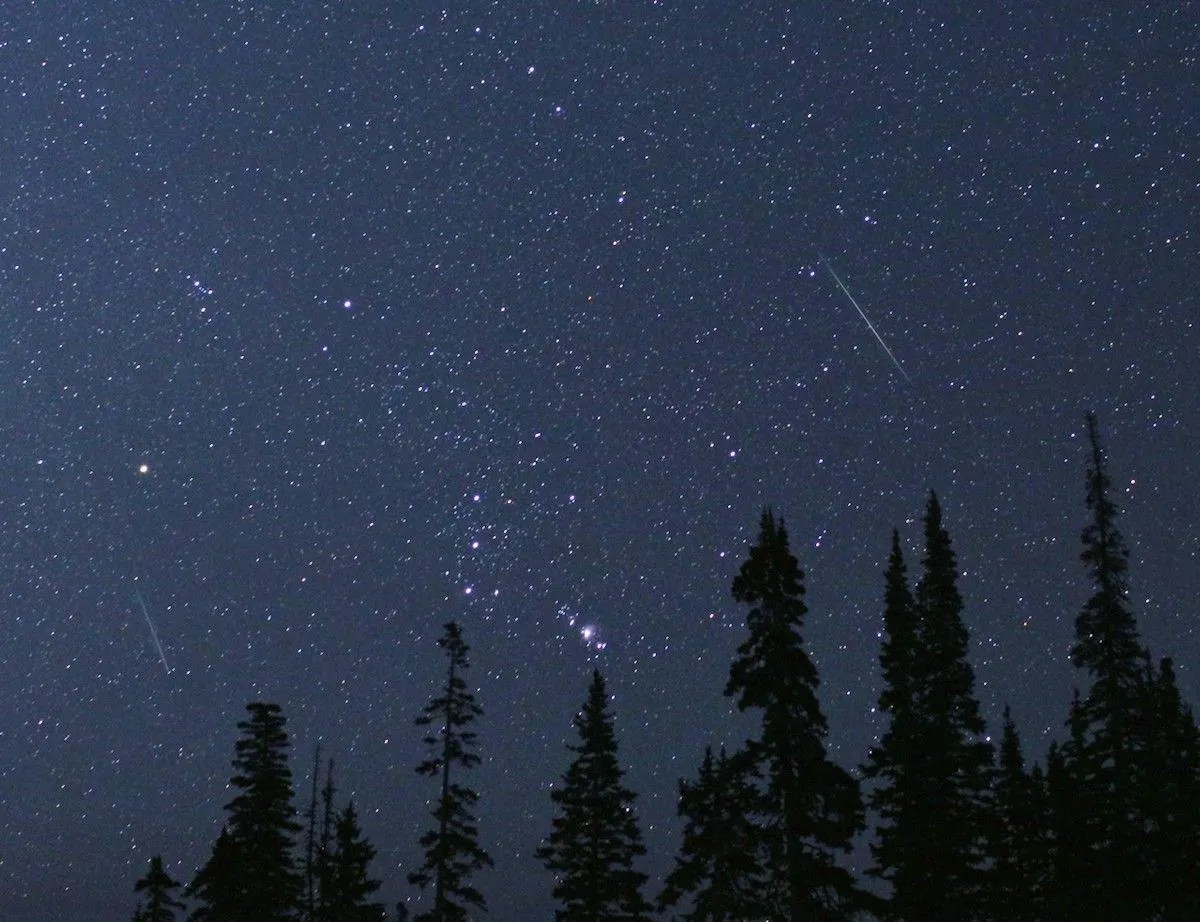
The constellation Orion is framed by two Perseid meteors in this photo from Aug. 12, 2018, in Cedar Breaks National Monument, Utah.
The Perseids – one of the year’s brightest and most popular meteor showers – has been ramping up since early July and will sparkle in the skies through the end of August. The shower reached its peak on the night of Aug. 12 into the early morning of Aug. 13.
Rewatch the Aug. 13 meteor shower.
Image credit: NASA/Bill Dunford
Perseids Meteor Shower
The constellation Orion is framed by two Perseid meteors in this photo from Aug. 12, 2018, in Cedar Breaks National Monument, Utah.
The Perseids – one of the year’s brightest and most popular meteor showers – has been ramping up since early July and will sparkle in the skies through the end of August. The shower reached its peak on the night of Aug. 12 into the early morning of Aug. 13.
Rewatch the Aug. 13 meteor shower.
Image credit: NASA/Bill Dunford