
Feed aggregator
Red-light therapy does have health benefits but not the ones you think
Red-light therapy does have health benefits but not the ones you think
Deforestation could trigger Amazon tipping point in the 2030s
Deforestation could trigger Amazon tipping point in the 2030s
Gas prices are spiking. So why aren’t U.S. oil companies drilling more?
As the U.S. and Iran fight for dominance in the Strait of Hormuz, U.S. gas prices are continuing to rise—and production might not keep up
Closing The Exoplanet Radius Gap
Kepler and TESS showed us that there's a radius gap in the exoplanet population. There are very few planets between 1.5 and 2 Earth radii, according to the data. But new research shows that the gap may not be as significant as thought.
The brain processes overheard words under anesthesia, but it may not remember them
A study of people who underwent surgery to treat epilepsy suggests the hippocampus may process words and speech when people are under general anesthesia, even though the study participants didn’t remember them
Unlocking the Mystery of X-ray Dots
Unlocking the Mystery of X-ray Dots
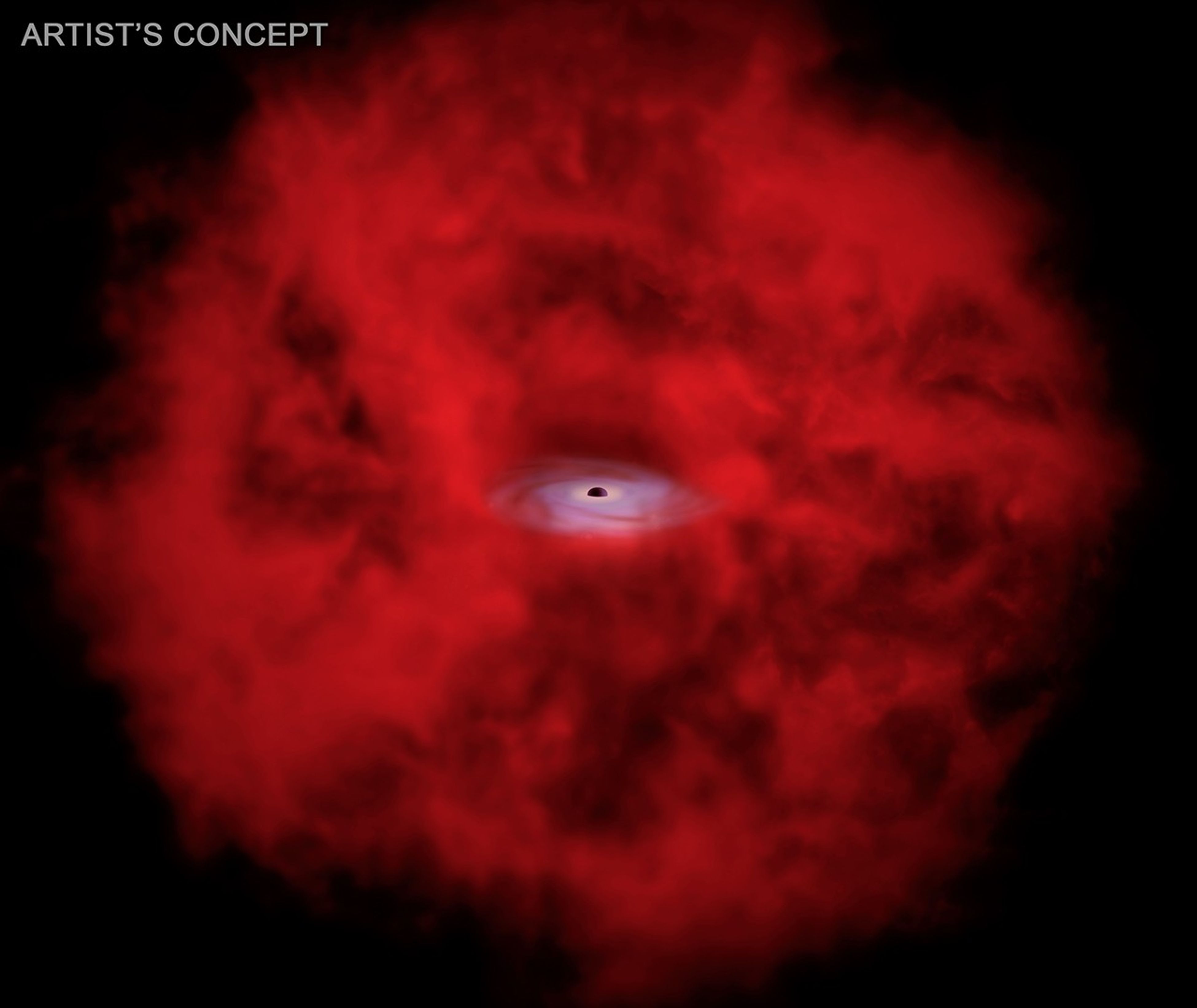
A new “X-ray dot” found by NASA’s Chandra X-ray Observatory – which could look like this artist’s illustration released on April 28, 2026 – could explain what the hundreds or potentially thousands of these objects are.
Shortly after NASA’s James Webb Space Telescope started its science observations, reports of a new class of mysterious objects emerged. Astronomers found small, red objects about 12 billion light-years from Earth or farther, which became known as “little red dots” (LRDs). The dot that Chandra found exhibits most of the features of an LRD, including being small, red, and located at a vast distance, but it glows in X-ray light, unlike other LRDs – hence the name “X-ray dot.”
This object (officially known as 3DHST-AEGIS-12014), which is located about 11.8 billion light-years from Earth, may provide a crucial bridge between black hole stars and typical growing supermassive black holes.
Read more about this mysterious dot.
Image credit: NASA/CXC/SAO/M. Weiss; adapted by K. Arcand & J. Major
Unlocking the Mystery of X-ray Dots
A new “X-ray dot” found by NASA’s Chandra X-ray Observatory – which could look like this artist’s illustration released on April 28, 2026 – could explain what the hundreds or potentially thousands of these objects are.
Shortly after NASA’s James Webb Space Telescope started its science observations, reports of a new class of mysterious objects emerged. Astronomers found small, red objects about 12 billion light-years from Earth or farther, which became known as “little red dots” (LRDs). The dot that Chandra found exhibits most of the features of an LRD, including being small, red, and located at a vast distance, but it glows in X-ray light, unlike other LRDs – hence the name “X-ray dot.”
This object (officially known as 3DHST-AEGIS-12014), which is located about 11.8 billion light-years from Earth, may provide a crucial bridge between black hole stars and typical growing supermassive black holes.
Read more about this mysterious dot.
Image credit: NASA/CXC/SAO/M. Weiss; adapted by K. Arcand & J. Major
To Build a City on Mars, We Might Need to Plunder the Asteroid Belt
Rome wasn’t built in a day, and a city on Mars is likely going to take even longer to build than Rome itself. At the time of the first Martian colonists, it is likely that the entirety of humanity’s industrial capacity, including the infrastructure to make critical materials like metals, will be based in the Earth-Moon system. While Mars has some iron, it also lacks many of the materials needed to make advanced materials, like boron and molybdenum. To alleviate that resource bottleneck, a new study, available in pre-print on arXiv and led by Serena Suriano and a team of researchers, offers a workaround that seems obvious in theory but difficult in practice - mine the necessary material from Main Belt asteroids.
The Trump administration is bringing back flavored vapes. Advocates and lawmakers say the risks outweigh the benefits
The president had vowed to “save vaping” on the campaign trail in 2024, but the decision is already drawing fire from antinicotine advocates and a bipartisan group of lawmakers
First Images From the Pandora Exoplanet Mission
A new mission promises to 'open the box' on exoplanet science. Scientists and engineers recently released the first engineering images from the Pandora exoplanet survey mission. The pictures represent the first ever images from a NASA Astrophysics Pioneers Program mission. Established in 2020, the program looks to test the feasibility of small low cost missions designed to address key questions in astronomy and astrophysics.
NASA’s Roman Poised to Transform Hunt for Elusive Neutron Stars
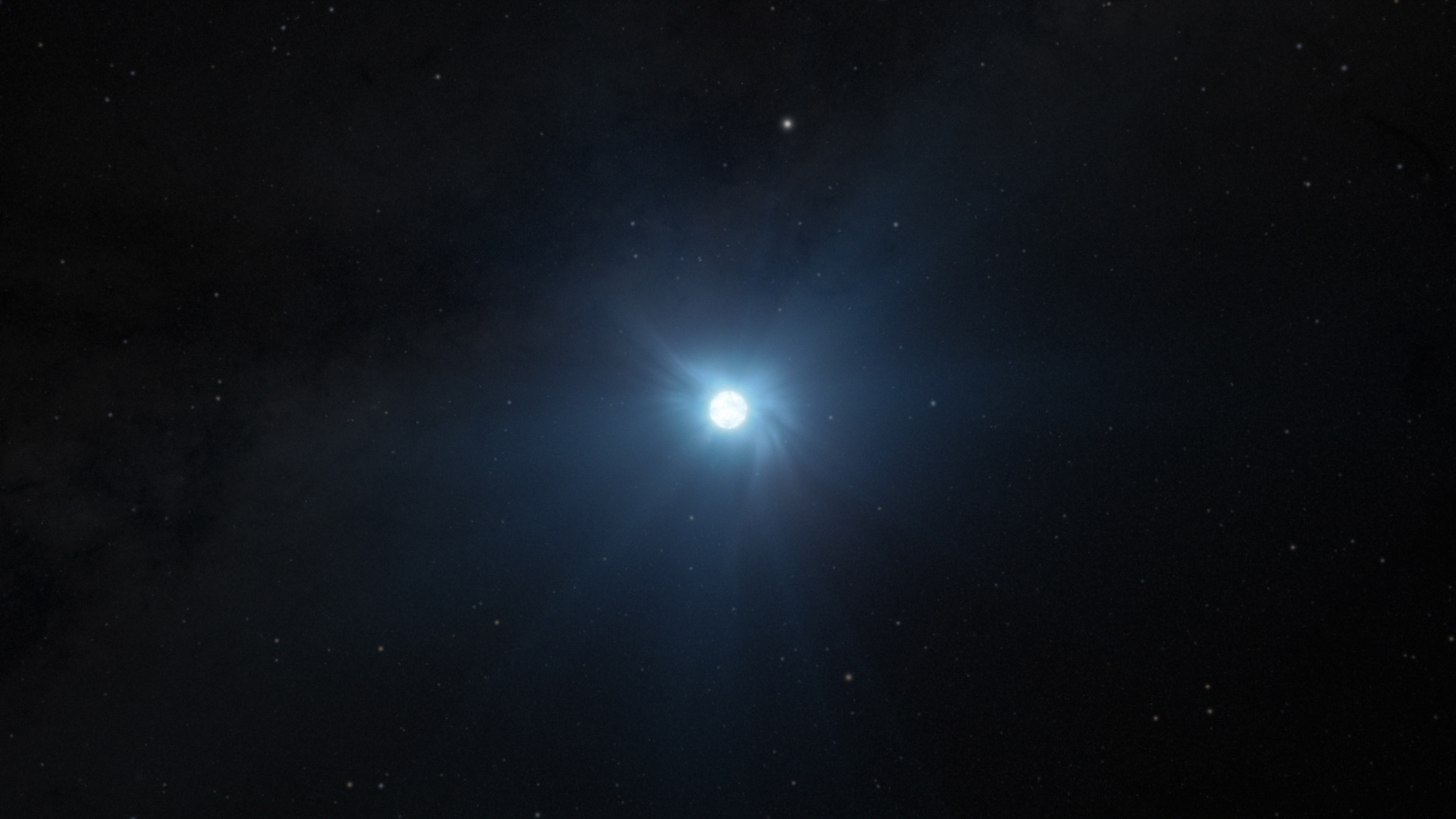
Astronomers have long known that neutron stars, the crushed cores left behind after massive stars explode, should be scattered throughout the Milky Way galaxy. However, most of them are effectively invisible. A new study published in Astronomy and Astrophysics suggests NASA’s upcoming Nancy Grace Roman Space Telescope could spot them anyway.
Using detailed simulations of the Milky Way and Roman’s future observations, researchers showed the flagship observatory may be able to identify and characterize dozens of isolated neutron stars through a subtle effect called gravitational microlensing.
“Most neutron stars are relatively dim and on their own,” said Zofia Kaczmarek of Heidelberg University in Germany, who led the study. “They are incredibly hard to spot without some sort of help.”
Finding what’s invisibleNeutron stars pack more mass than the Sun into a sphere about the size of a city. Studying them helps us understand how stars live, die, and spread heavy elements throughout the universe. They also provide a chance to study what happens under the most extreme conditions (pressures and densities) imaginable.
Yet, unless they are pulsars that beam in radio wavelengths or glow in X-rays, they can remain hidden from even the most powerful telescopes.
Roman can search for them in a different way. When a massive object like a neutron star moves in front of a distant background star, its intense gravity warps spacetime and deflects the background star’s light. This microlensing effect briefly makes the background star brighter and appear offset from its true position in the sky.
While many telescopes can detect the temporary brightening, Roman can measure both the brightening (photometry) and the tiny positional shift (astrometry) of the lensed star with exceptional precision.
Astrometric microlensing occurs when a foreground object, like a neutron star, passes in front of a more distant background star. The neutron star’s gravity bends the distant star’s light, splitting it into multiple paths that reach the telescope. Although these distorted images can’t be resolved, their combined light appears brighter and slightly shifted from the distant star’s true position. As the alignment between the two objects changes over time, this apparent shift traces a small elliptical pattern on the sky. The size of that ellipse depends on how strongly the light is bent, meaning more massive objects produce larger shifts, allowing astronomers to directly measure the mass of the otherwise invisible neutron star.NASA, STScI, Joyce Kang (STScI)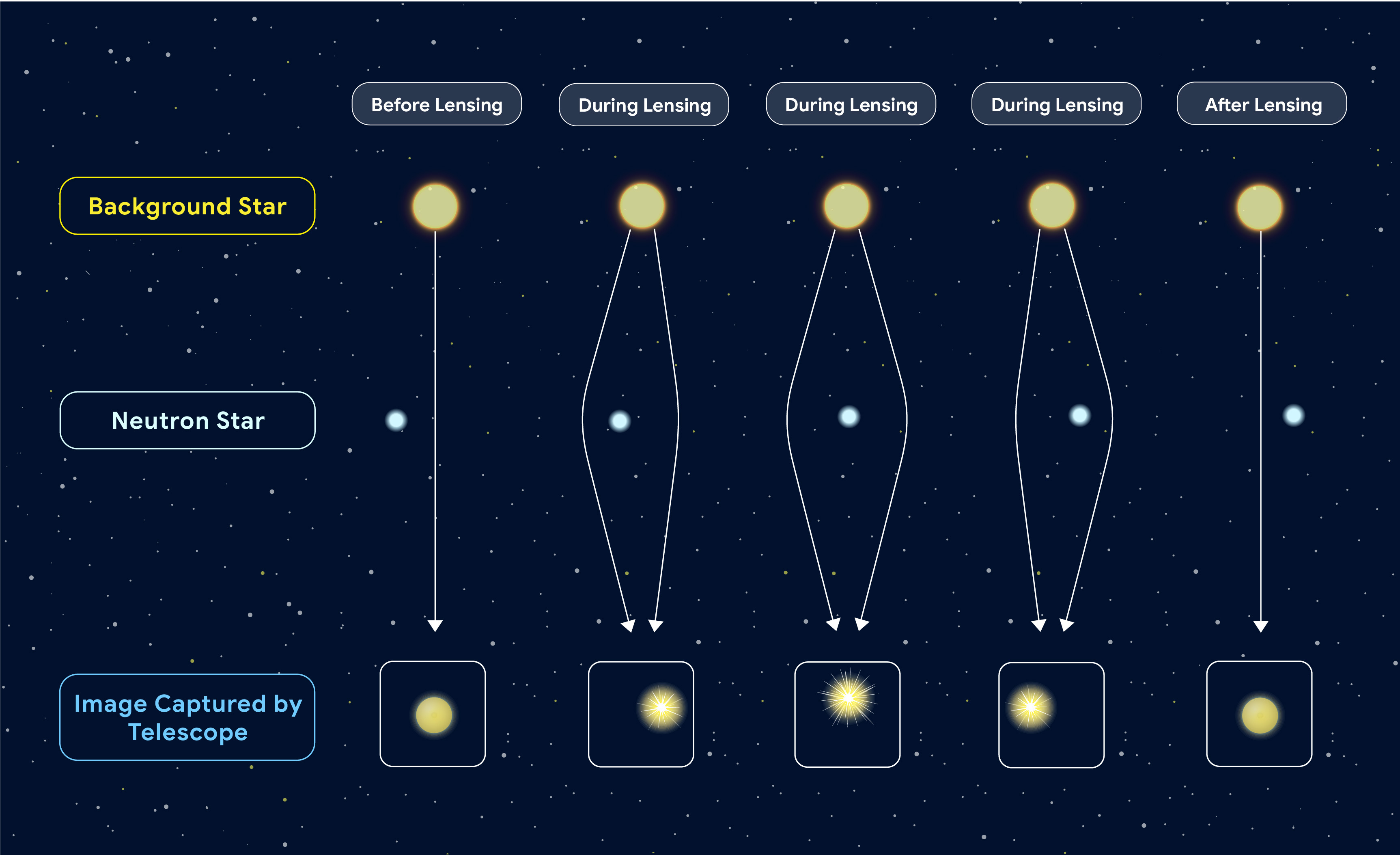
Because neutron stars are relatively massive, they produce a larger astrometric signal than lighter objects, allowing missions like Roman to not only detect them, but also weigh them in some cases, something that is nearly impossible with photometry alone.
“What’s really cool about using microlensing is that you can get direct mass measurements,” said paper co-author Peter McGill of Lawrence Livermore National Laboratory. “Photometry tells us that something passed in front of the star, but it’s the amount the star’s position shifts that tells us how massive that object is. By measuring that tiny deflection on the sky, we can directly weigh something that is otherwise unseen.”
Roman’s measurements could help astronomers determine whether there is a true gap between the masses of neutron stars and black holes and how fast neutron stars are moving.
Scientists are particularly interested in understanding the powerful “kicks” neutron stars receive when they are born in supernova explosions. These kicks can send them racing through the galaxy at hundreds of miles per second.
Huge surveys, high chance of payoffThe research team will utilize Roman’s future Galactic Bulge Time Domain Survey, which will monitor millions of stars at a time in vast images of the sky, taken at a high frequency.
“We’re going to get to work as soon as the data start coming in,” said McGill. “Even in the first months after commissioning, we expect to start identifying promising events.”
Even a relatively small number of confirmed detections could significantly improve models of stellar explosions and extreme matter.
“We don’t know the mass distribution of neutron stars, black holes, or where one ends and the other begins with any certainty,” McGill said. “Roman will really be a breakthrough in that.”
Although only a few thousand neutron stars have been detected so far, mostly as pulsars, scientists estimate there could be tens of millions to hundreds of millions in the Milky Way. Additionally, to date, researchers have only been able to measure the masses of neutron stars in binary pairings.
“We’re seeing a small sample that’s not representative of the big picture,” Kaczmarek said. “Even a single mass measurement would be very powerful. If we found just one isolated neutron star, it would already be incredibly stimulating to our research.”
Looking aheadThe study also highlights a creative use of the mission’s capabilities. While Roman’s survey is designed primarily to find exoplanets using photometric microlensing, its powerful astrometric capabilities open the door to entirely new discoveries with astrometric microlensing.
“This wasn’t part of the original plan,” said McGill. “But it turns out Roman’s astrometric capability is really good at detecting neutron stars and black holes, so we can add a whole new kind of science to Roman’s surveys.”
If the predictions hold true, the mission could provide the first large sample of isolated neutron stars discovered through their gravity alone, revealing a hidden population that has remained out of reach until now. Roman is expected to transform the study of microlensing and the hidden populations of objects in our galaxy, from rogue exoplanets to stellar remnants like neutron stars.
The Nancy Grace Roman Space Telescope is managed at NASA’s Goddard Space Flight Center in Greenbelt, Maryland, with participation by NASA’s Jet Propulsion Laboratory in Southern California; Caltech/IPAC in Pasadena, California; the Space Telescope Science Institute in Baltimore; and a science team comprising scientists from various research institutions. The primary industrial partners are BAE Systems Inc. in Boulder, Colorado; L3Harris Technologies in Rochester, New York; and Teledyne Scientific & Imaging in Thousand Oaks, California.
To learn more about Roman visit:
By Hannah Braun
Space Telescope Science Institute, Baltimore, Md.
hbraun@stsci.edu
Media contacts:
Claire Andreoli
NASA’s Goddard Space Flight Center, Greenbelt, Md.
301-286-1940
Christine Pulliam
Space Telescope Science Institute, Baltimore, Md.
cpulliam@stsci.edu
New NASA Technology Mimics Extreme Cold of the Lunar Night

As NASA looks to explore the Moon, Mars, and beyond, researchers must develop materials capable of withstanding the extreme temperatures found in space and on other planets and their moons. In frigid conditions, rubber can shatter like glass, circuit boards may fail, and electrical connections can freeze and fracture.
Gaining a deeper understanding of how materials respond to these temperature extremes is critical — especially as NASA looks to build its Moon Base at the lunar South Pole, where surface temperatures swing dramatically from blistering heat during the day to bitter cold at night. Researchers developed a ground-breaking method for testing how materials hold up in the extreme cold of space. Engineers at NASA’s Glenn Research Center in Cleveland invented the Lunar Environment Structural Test Rig (LESTR), a machine that can test materials, electronics, and other flight hardware at temperatures as low as 40 Kelvin, or about –388 degrees Fahrenheit.
“Just as no building ever gets built without knowing exactly how the construction materials behave, no space mission is complete without a robust structural design that hinges on knowing how the materials used within it behave,” said Ariel Dimston, technical lead for LESTR at NASA Glenn.
Traditionally, NASA has used a process that involves super-cold liquids — called liquid cryogens — to test how materials respond to extreme cold. These liquids, like nitrogen, hydrogen, and helium, are some of the coldest materials on Earth and are stored in specialized tanks. Engineers use them to chill materials during testing and collect data to see how they perform.
“What makes LESTR special is that the entire rig operates in a completely dry vacuum: no liquid nitrogen, no liquid helium, no liquid anything,” Dimston said. “This is the first mechanical test rig that escapes from all of the challenges involved with cryogenic fluids.”
LESTR takes a new approach by using a high-powered refrigerator, called a cryocooler, to remove heat without using any liquid at all. This creates the first “dry” cryogenic test environment within the mechanical testing industry. This new test rig is safer and more affordable than traditional methods and allows scientists to test materials at a much wider range of temperatures, Dimston said.
“By leaving behind the liquid cryogen, you no longer need specialized handling equipment such as dewers, wet heaters, nor valves,” Dimston said. “You no longer require oxygen displacement sensors and other safety systems that add time, complexity, and cost to the process since without these cryogens they are no longer needed.”
Dimston and his team are working with NASA programs and projects to put materials through their paces using the new apparatus. The team has been testing yarns that may someday be woven into fabrics used for next-generation spacesuits and is looking to develop advanced materials for rover tires, including a new metal that can return to its original shape after being bent, stretched, heated, and cooled. This shape memory alloy technology could help future rovers travel across the uneven, rocky surfaces of the Moon and Mars without the risk of flat tires.
The Lunar Environment Structural Test Rig at NASA’s Glenn Research Center in Cleveland simulates the intense cold of the lunar night on Friday, June 6, 2025.NASA/Steven Logan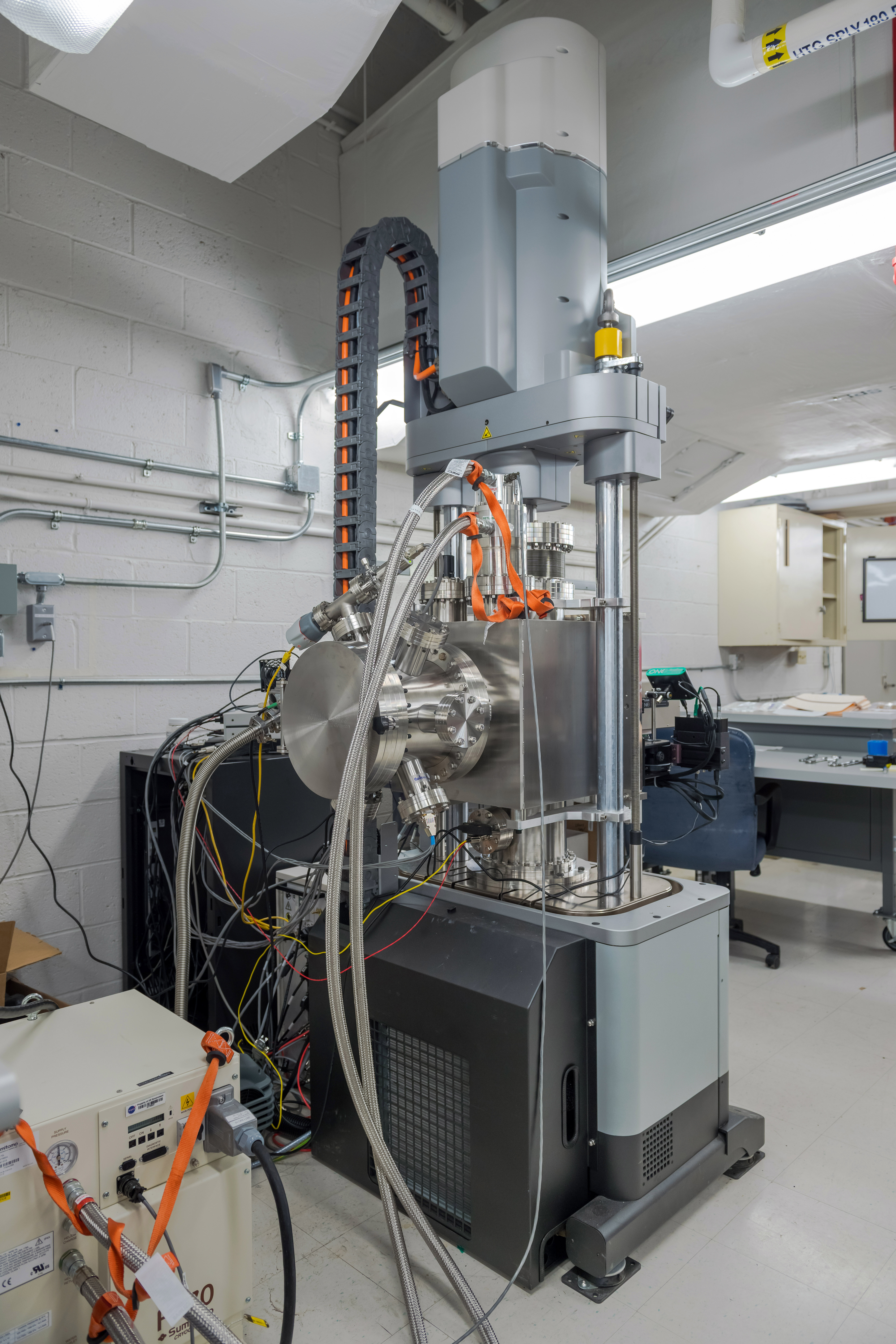
NASA researchers spent more than two years designing and building the first version of the technology — LESTR 1 — and are currently building its twin, LESTR 2. In a partnership with Fort Wayne Metals, NASA delivered LESTR 1 to the company’s facility in Fort Wayne, Indiana, where experts there will use it to test shape memory alloy material for the extreme temperatures present on the Moon.
“We are working to develop a next-generation shape memory alloy that is capable of functioning at temperatures down to 40 Kelvin, one of the coldest regions we could go to with rover capability,” said Dr. Santo Padula II, principal investigator for LESTR at NASA Glenn. “With this rig, we can test how shape memory alloys will behave in the coldest areas of the Moon and Mars. That will be a very big day for us: to be able to see what its properties look like at such low temperatures — something we’ve never seen before.”
Beyond LESTR, NASA Glenn has other world-class ground test facilities that mimic environments like the vacuum of space, the microgravity aboard the International Space Station, the sulfuric pressure cooker that is Venus, or the terrain of the Moon and Mars.
Glenn leads the agency in both advanced materials testing and in-space cryogenic fluid management, playing a vital role in developing technologies for future space exploration.
For more information on Glenn’s new test rig, visit LESTR’s web page.
NASA’s Roman Poised to Transform Hunt for Elusive Neutron Stars
Astronomers have long known that neutron stars, the crushed cores left behind after massive stars explode, should be scattered throughout the Milky Way galaxy. However, most of them are effectively invisible. A new study published in Astronomy and Astrophysics suggests NASA’s upcoming Nancy Grace Roman Space Telescope could spot them anyway.
Using detailed simulations of the Milky Way and Roman’s future observations, researchers showed the flagship observatory may be able to identify and characterize dozens of isolated neutron stars through a subtle effect called gravitational microlensing.
“Most neutron stars are relatively dim and on their own,” said Zofia Kaczmarek of Heidelberg University in Germany, who led the study. “They are incredibly hard to spot without some sort of help.”
Finding what’s invisibleNeutron stars pack more mass than the Sun into a sphere about the size of a city. Studying them helps us understand how stars live, die, and spread heavy elements throughout the universe. They also provide a chance to study what happens under the most extreme conditions (pressures and densities) imaginable.
Yet, unless they are pulsars that beam in radio wavelengths or glow in X-rays, they can remain hidden from even the most powerful telescopes.
Roman can search for them in a different way. When a massive object like a neutron star moves in front of a distant background star, its intense gravity warps spacetime and deflects the background star’s light. This microlensing effect briefly makes the background star brighter and appear offset from its true position in the sky.
While many telescopes can detect the temporary brightening, Roman can measure both the brightening (photometry) and the tiny positional shift (astrometry) of the lensed star with exceptional precision.
Astrometric microlensing occurs when a foreground object, like a neutron star, passes in front of a more distant background star. The neutron star’s gravity bends the distant star’s light, splitting it into multiple paths that reach the telescope. Although these distorted images can’t be resolved, their combined light appears brighter and slightly shifted from the distant star’s true position. As the alignment between the two objects changes over time, this apparent shift traces a small elliptical pattern on the sky. The size of that ellipse depends on how strongly the light is bent, meaning more massive objects produce larger shifts, allowing astronomers to directly measure the mass of the otherwise invisible neutron star.NASA, STScI, Joyce Kang (STScI)Because neutron stars are relatively massive, they produce a larger astrometric signal than lighter objects, allowing missions like Roman to not only detect them, but also weigh them in some cases, something that is nearly impossible with photometry alone.
“What’s really cool about using microlensing is that you can get direct mass measurements,” said paper co-author Peter McGill of Lawrence Livermore National Laboratory. “Photometry tells us that something passed in front of the star, but it’s the amount the star’s position shifts that tells us how massive that object is. By measuring that tiny deflection on the sky, we can directly weigh something that is otherwise unseen.”
Roman’s measurements could help astronomers determine whether there is a true gap between the masses of neutron stars and black holes and how fast neutron stars are moving.
Scientists are particularly interested in understanding the powerful “kicks” neutron stars receive when they are born in supernova explosions. These kicks can send them racing through the galaxy at hundreds of miles per second.
Huge surveys, high chance of payoffThe research team will utilize Roman’s future Galactic Bulge Time Domain Survey, which will monitor millions of stars at a time in vast images of the sky, taken at a high frequency.
“We’re going to get to work as soon as the data start coming in,” said McGill. “Even in the first months after commissioning, we expect to start identifying promising events.”
Even a relatively small number of confirmed detections could significantly improve models of stellar explosions and extreme matter.
“We don’t know the mass distribution of neutron stars, black holes, or where one ends and the other begins with any certainty,” McGill said. “Roman will really be a breakthrough in that.”
Although only a few thousand neutron stars have been detected so far, mostly as pulsars, scientists estimate there could be tens of millions to hundreds of millions in the Milky Way. Additionally, to date, researchers have only been able to measure the masses of neutron stars in binary pairings.
“We’re seeing a small sample that’s not representative of the big picture,” Kaczmarek said. “Even a single mass measurement would be very powerful. If we found just one isolated neutron star, it would already be incredibly stimulating to our research.”
Looking aheadThe study also highlights a creative use of the mission’s capabilities. While Roman’s survey is designed primarily to find exoplanets using photometric microlensing, its powerful astrometric capabilities open the door to entirely new discoveries with astrometric microlensing.
“This wasn’t part of the original plan,” said McGill. “But it turns out Roman’s astrometric capability is really good at detecting neutron stars and black holes, so we can add a whole new kind of science to Roman’s surveys.”
If the predictions hold true, the mission could provide the first large sample of isolated neutron stars discovered through their gravity alone, revealing a hidden population that has remained out of reach until now. Roman is expected to transform the study of microlensing and the hidden populations of objects in our galaxy, from rogue exoplanets to stellar remnants like neutron stars.
The Nancy Grace Roman Space Telescope is managed at NASA’s Goddard Space Flight Center in Greenbelt, Maryland, with participation by NASA’s Jet Propulsion Laboratory in Southern California; Caltech/IPAC in Pasadena, California; the Space Telescope Science Institute in Baltimore; and a science team comprising scientists from various research institutions. The primary industrial partners are BAE Systems Inc. in Boulder, Colorado; L3Harris Technologies in Rochester, New York; and Teledyne Scientific & Imaging in Thousand Oaks, California.
To learn more about Roman visit:
By Hannah Braun
Space Telescope Science Institute, Baltimore, Md.
hbraun@stsci.edu
Media contacts:
Claire Andreoli
NASA’s Goddard Space Flight Center, Greenbelt, Md.
301-286-1940
Christine Pulliam
Space Telescope Science Institute, Baltimore, Md.
cpulliam@stsci.edu
New NASA Technology Mimics Extreme Cold of the Lunar Night
As NASA looks to explore the Moon, Mars, and beyond, researchers must develop materials capable of withstanding the extreme temperatures found in space and on other planets and their moons. In frigid conditions, rubber can shatter like glass, circuit boards may fail, and electrical connections can freeze and fracture.
Gaining a deeper understanding of how materials respond to these temperature extremes is critical — especially as NASA looks to build its Moon Base at the lunar South Pole, where surface temperatures swing dramatically from blistering heat during the day to bitter cold at night. Researchers developed a ground-breaking method for testing how materials hold up in the extreme cold of space. Engineers at NASA’s Glenn Research Center in Cleveland invented the Lunar Environment Structural Test Rig (LESTR), a machine that can test materials, electronics, and other flight hardware at temperatures as low as 40 Kelvin, or about –388 degrees Fahrenheit.
“Just as no building ever gets built without knowing exactly how the construction materials behave, no space mission is complete without a robust structural design that hinges on knowing how the materials used within it behave,” said Ariel Dimston, technical lead for LESTR at NASA Glenn.
Traditionally, NASA has used a process that involves super-cold liquids — called liquid cryogens — to test how materials respond to extreme cold. These liquids, like nitrogen, hydrogen, and helium, are some of the coldest materials on Earth and are stored in specialized tanks. Engineers use them to chill materials during testing and collect data to see how they perform.
“What makes LESTR special is that the entire rig operates in a completely dry vacuum: no liquid nitrogen, no liquid helium, no liquid anything,” Dimston said. “This is the first mechanical test rig that escapes from all of the challenges involved with cryogenic fluids.”
LESTR takes a new approach by using a high-powered refrigerator, called a cryocooler, to remove heat without using any liquid at all. This creates the first “dry” cryogenic test environment within the mechanical testing industry. This new test rig is safer and more affordable than traditional methods and allows scientists to test materials at a much wider range of temperatures, Dimston said.
“By leaving behind the liquid cryogen, you no longer need specialized handling equipment such as dewers, wet heaters, nor valves,” Dimston said. “You no longer require oxygen displacement sensors and other safety systems that add time, complexity, and cost to the process since without these cryogens they are no longer needed.”
Dimston and his team are working with NASA programs and projects to put materials through their paces using the new apparatus. The team has been testing yarns that may someday be woven into fabrics used for next-generation spacesuits and is looking to develop advanced materials for rover tires, including a new metal that can return to its original shape after being bent, stretched, heated, and cooled. This shape memory alloy technology could help future rovers travel across the uneven, rocky surfaces of the Moon and Mars without the risk of flat tires.
The Lunar Environment Structural Test Rig at NASA’s Glenn Research Center in Cleveland simulates the intense cold of the lunar night on Friday, June 6, 2025.NASA/Steven LoganNASA researchers spent more than two years designing and building the first version of the technology — LESTR 1 — and are currently building its twin, LESTR 2. In a partnership with Fort Wayne Metals, NASA delivered LESTR 1 to the company’s facility in Fort Wayne, Indiana, where experts there will use it to test shape memory alloy material for the extreme temperatures present on the Moon.
“We are working to develop a next-generation shape memory alloy that is capable of functioning at temperatures down to 40 Kelvin, one of the coldest regions we could go to with rover capability,” said Dr. Santo Padula II, principal investigator for LESTR at NASA Glenn. “With this rig, we can test how shape memory alloys will behave in the coldest areas of the Moon and Mars. That will be a very big day for us: to be able to see what its properties look like at such low temperatures — something we’ve never seen before.”
Beyond LESTR, NASA Glenn has other world-class ground test facilities that mimic environments like the vacuum of space, the microgravity aboard the International Space Station, the sulfuric pressure cooker that is Venus, or the terrain of the Moon and Mars.
Glenn leads the agency in both advanced materials testing and in-space cryogenic fluid management, playing a vital role in developing technologies for future space exploration.
For more information on Glenn’s new test rig, visit LESTR’s web page.
Huge landslide in Alaska caused 481m-high tsunami
Huge landslide in Alaska caused 481m-high tsunami
Waiting for the Blaze Star
Some celestial events are sure things; it's just a question of when. We're still waiting for T Corona Borealis to go nova — any month now.
The post Waiting for the Blaze Star appeared first on Sky & Telescope.