
Feed aggregator
NASA’s Crawler Preps for Artemis II Rollout
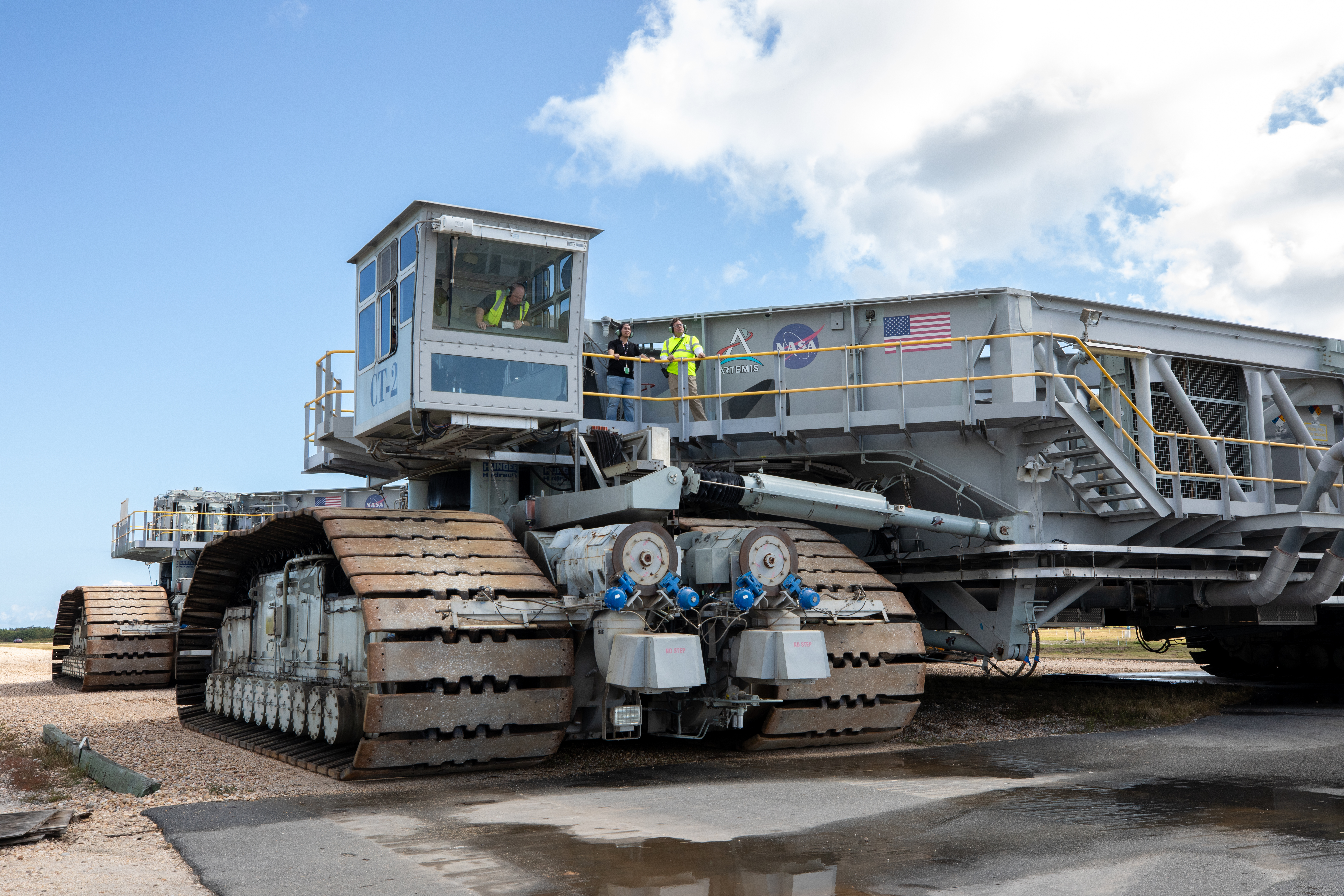
NASA’s Crawler-transporter 2 moves toward the Vehicle Assembly Building at NASA’s Kennedy Space Center in Florida on Friday, Jan. 9, 2026. The crawler will transport NASA’s SLS (Space Launch System) rocket with the Orion spacecraft to Launch Complex 39B ahead of the Artemis II launch which will journey Commander Reid Wiseman, Pilot Victor Glover, and Mission Specialist Christina Koch from NASA, and Mission Specialist Jeremy Hansen from the CSA (Canadian Space Agency), around the Moon and back to Earth no later than April 2026.
The crawler-transporters have carried the load of taking rockets and spacecraft to the launch pad for more than 50 years at NASA’s Kennedy Space Center in Florida. Each the size of a baseball infield and powered by locomotive and large electrical power generator engines, the crawler-transporters stand ready to keep up the work for the next generation of launch vehicles to lift astronauts into space; Crawler-transporter 2 in particular is integral to the Artemis missions.
Image credit: NASA/Ben Smegelsky
NASA’s Crawler Preps for Artemis II Rollout
NASA’s Crawler-transporter 2 moves toward the Vehicle Assembly Building at NASA’s Kennedy Space Center in Florida on Friday, Jan. 9, 2026. The crawler will transport NASA’s SLS (Space Launch System) rocket with the Orion spacecraft to Launch Complex 39B ahead of the Artemis II launch which will journey Commander Reid Wiseman, Pilot Victor Glover, and Mission Specialist Christina Koch from NASA, and Mission Specialist Jeremy Hansen from the CSA (Canadian Space Agency), around the Moon and back to Earth no later than April 2026.
The crawler-transporters have carried the load of taking rockets and spacecraft to the launch pad for more than 50 years at NASA’s Kennedy Space Center in Florida. Each the size of a baseball infield and powered by locomotive and large electrical power generator engines, the crawler-transporters stand ready to keep up the work for the next generation of launch vehicles to lift astronauts into space; Crawler-transporter 2 in particular is integral to the Artemis missions.
Image credit: NASA/Ben Smegelsky
NASA’s Crawler Preps for Artemis II Rollout
Week in images: 12-16 January 2026
Week in images: 12-16 January 2026
Discover our week through the lens
Cancelling plans may be more socially acceptable than you think
Cancelling plans may be more socially acceptable than you think
Hubble Observes Ghostly Cloud Alive with Star Formation
- Hubble Home
- Overview
- Impact & Benefits
- Science
- Observatory
- Team
- Multimedia
- News
- More
2 min read
Hubble Observes Ghostly Cloud Alive with Star Formation A seemingly serene landscape of gas and dust is hopping with star formation behind the scenes.NASA, ESA, and K. Stapelfeldt (Jet Propulsion Laboratory); Processing: Gladys Kober (NASA/Catholic University of America) Download this image (84.5 MB)While this eerie NASA Hubble Space Telescope image may look ghostly, it’s actually full of new life. Lupus 3 is a star-forming cloud about 500 light-years away in the constellation Scorpius.
White wisps of gas swirl throughout the region, and in the lower-left corner resides a dark dust cloud. Bright T Tauri stars shine at the left, bottom right, and upper center, while other young stellar objects dot the image.
T Tauri stars are actively forming stars in a specific stage of formation. In this stage, the enveloping gas and dust dissipates from radiation and stellar winds, or outflows of particles from the emerging star. T Tauri stars are typically less than 10 million years old and vary in brightness both randomly and periodically due to the environment and nature of a forming star. The random variations may be due to instabilities in the accretion disk of dust and gas around the star, material from that disk falling onto the star and being consumed, and flares on the star’s surface. The more regular, periodic changes may be caused by giant sunspots rotating in and out of view.
T Tauri stars are in the process of contracting under the force of gravity as they become main sequence stars which fuse hydrogen to helium in their cores. Studying these stars can help astronomers better understand the star formation process.
New images added every day between January 12-17, 2026! Follow @NASAHubble on social media for the latest Hubble images and news and see Hubble’s Stellar Construction Zones for more images of young stellar objects.
Facebook logo @NASAHubble @NASAHubble Instagram logo @NASAHubble Explore More Exploring the Birth of Stars Hubble’s Nebulae Hubble’s Star ClustersMedia Contact:
Claire Andreoli
NASA’s Goddard Space Flight Center, Greenbelt, MD
claire.andreoli@nasa.gov
Since its 1990 launch, the Hubble Space Telescope has changed our fundamental understanding of the universe.
Hubble’s Stellar Construction Zones
Explore the Night Sky
Hubble News
Hubble Observes Ghostly Cloud Alive with Star Formation
- Hubble Home
- Overview
- Impact & Benefits
- Science
- Observatory
- Team
- Multimedia
- News
- More
2 min read
Hubble Observes Ghostly Cloud Alive with Star Formation A seemingly serene landscape of gas and dust is hopping with star formation behind the scenes.NASA, ESA, and K. Stapelfeldt (Jet Propulsion Laboratory); Processing: Gladys Kober (NASA/Catholic University of America) Download this image (84.5 MB)While this eerie NASA Hubble Space Telescope image may look ghostly, it’s actually full of new life. Lupus 3 is a star-forming cloud about 500 light-years away in the constellation Scorpius.
White wisps of gas swirl throughout the region, and in the lower-left corner resides a dark dust cloud. Bright T Tauri stars shine at the left, bottom right, and upper center, while other young stellar objects dot the image.
T Tauri stars are actively forming stars in a specific stage of formation. In this stage, the enveloping gas and dust dissipates from radiation and stellar winds, or outflows of particles from the emerging star. T Tauri stars are typically less than 10 million years old and vary in brightness both randomly and periodically due to the environment and nature of a forming star. The random variations may be due to instabilities in the accretion disk of dust and gas around the star, material from that disk falling onto the star and being consumed, and flares on the star’s surface. The more regular, periodic changes may be caused by giant sunspots rotating in and out of view.
T Tauri stars are in the process of contracting under the force of gravity as they become main sequence stars which fuse hydrogen to helium in their cores. Studying these stars can help astronomers better understand the star formation process.
New images added every day between January 12-17, 2026! Follow @NASAHubble on social media for the latest Hubble images and news and see Hubble’s Stellar Construction Zones for more images of young stellar objects.
Facebook logo @NASAHubble @NASAHubble Instagram logo @NASAHubble Explore More Exploring the Birth of Stars Hubble’s Nebulae Hubble’s Star ClustersMedia Contact:
Claire Andreoli
NASA’s Goddard Space Flight Center, Greenbelt, MD
claire.andreoli@nasa.gov
Since its 1990 launch, the Hubble Space Telescope has changed our fundamental understanding of the universe.
Hubble’s Stellar Construction Zones
Explore the Night Sky
Hubble News
How Astronauts Will Fix Their Gear Using Thin Air
Additive Manufacturing, more commonly known as 3D printing, will be an absolutely critical technology for any long-term settlement on another world. Its ability to take a generic input, such as plastic strips or metal powder, and turn it into any shape of tool an astronaut will need is an absolute game changer. But the chemistry behind these technologies is complicated, and their applications are extremely varied, ranging from creating bricks for settlements to plastics for everything from cups to toothbrush holders. A new paper available in pre-print on arXiv from Zane Mebruer and Wan Shou of the University of Arkansas, explores one specific aspect of a particularly important type of 3D printing, and realized that they could save millions of dollars on Mars missions by simply using the planet’s atmosphere to help print metal parts.
Earliest ever supernova sheds light on the first stars
Earliest ever supernova sheds light on the first stars
A leading use for quantum computers might not need them after all
A leading use for quantum computers might not need them after all
Astronomers Spot Mysterious Bar-Shaped Cloud of Iron Inside an Iconic Nebula
A distinctive nebula inside the constellation Lyra holds a never-before-seen cloud of iron atoms—and researchers aren’t sure why
Why Are There No Green Stars?
Stars emit lots of green light, but our eyes don’t let us see them that way
What Is Beige Fat, and Is It Healthy?
This mysterious type of fat cell may play an important role in heart health, new research shows
In Venezuela, Big Oil Collides with a Hotter Planet
A break down of why Venezuela’s oil boom is clashing with a hotter, more fragile planet
This Week's Sky at a Glance, January 16 – 25
This winter the biggest planet is the brightest. The brightest star pins the Winter Triangle. And did you know Capella and Rigel march in step?
The post This Week's Sky at a Glance, January 16 – 25 appeared first on Sky & Telescope.