
Feed aggregator
Why the weekend’s winter storm was supercharged by climate change
A warmer atmosphere can hold more moisture, and that’s why last weekend’s winter storm dumped more snow, sleet and freezing rain than similar weather systems might have in the past
NASA Telescopes Spot Surprisingly Mature Cluster in Early Universe
A new discovery captures the cosmic moment when a galaxy cluster – among the largest structures in the universe – started to assemble only about a billion years after the big bang, one or two billion years earlier than previously thought. This result, made using NASA’s Chandra X-ray Observatory and James Webb Space Telescope, will lead astronomers to rethink when and how the largest structures in the universe formed. The findings are described in a paper published [Wednesday] in the journal Nature.
The object, known as JADES-ID1 for its location in the “JWST Advanced Deep Extragalactic Survey” (JADES) has a mass about 20 trillion times that of the Sun. Astronomers classify JADES-ID1 as a “protocluster” because it is currently undergoing an early, violent phase of formation and will one day turn into a galaxy cluster. However, JADES-ID1 is found at a much larger distance – corresponding to a much earlier time in the universe – than astronomers expected for such systems, providing a new mystery of how it could form so quickly.
“This may be the most distant confirmed protocluster ever seen,” said Akos Bogdan of the Center for Astrophysics | Harvard & Smithsonian (CfA) who led the study. “JADES-ID1 is giving us new evidence that the universe was in a huge hurry to grow up.”
Galaxy clusters contain hundreds or even thousands of individual galaxies immersed in enormous pools of superheated gas, along with large amounts of unseen dark matter. Astronomers use galaxy clusters to measure the expansion of the universe and the roles of dark energy and dark matter, among other important cosmic studies.
“It’s very important to actually see when and how galaxy clusters grow,” said co-author Gerrit Schellenberger, also of CfA. “It’s like watching an assembly line make a car, rather than just trying to figure out how a car works by looking at the finished product.”
The Chandra and Webb data reveal that JADES-ID1 contains the two properties that confirm the presence of a protocluster: a large number of galaxies held together by gravity (Webb sees at least 66 potential members) that are also sitting in a huge cloud of hot gas (detected by Chandra). As a galaxy cluster forms, gas falls inward and is heated by shock waves, reaching temperatures of millions of degrees and glowing in X-rays.
What makes JADES-ID1 exceptional is the remarkably early time when it appears in cosmic history. Most models of the universe predict that there likely would not be enough time and a large enough density of galaxies for a protocluster of this size to form only a billion years after the big bang. The previous record holder for a protocluster with X-ray emission is seen much later, about three billion years after the big bang.
“We thought we’d find a protocluster like this two or three billion years after the big bang – not just one billion,” said co-author Qiong Li from the University of Manchester in the UK. “Before, astronomers found surprisingly large galaxies and black holes not long after the big bang, and now we’re finding that clusters of galaxies can also grow rapidly.”
After billions of years JADES-ID1 should evolve from a protocluster into a massive galaxy cluster like those we see much closer to Earth.
To find JADES-ID1, astronomers combined deep observations from both Chandra and Webb. By design, the JADES field overlaps with the Chandra Deep Field South, the site of the deepest X-ray observation ever conducted. This field is thus one of the few in the entire sky where a discovery such as this could be made. In an earlier study, a team of researchers led by Li and Conselice found five other proto-cluster candidates in the JADES field, but only in JADES-ID1 are the galaxies embedded in hot gas. Only JADES-ID1 possesses enough mass for an X-ray signal from hot gas to be expected.
“Discoveries like this are made when two powerful telescopes like Chandra and Webb stare at the same patch of sky at the limit of their observing capabilities,” said co-author Christopher Conselice, also from the University of Manchester. “A challenge for us now is to understand how this protocluster was able to form so quickly.”
NASA’s Marshall Space Flight Center in Huntsville, Alabama, manages the Chandra program. The Smithsonian Astrophysical Observatory’s Chandra X-ray Center controls science operations from Cambridge, Massachusetts, and flight operations from Burlington, Massachusetts.
To learn more about Chandra, visit:
https://science.nasa.gov/chandra
Read more from NASA’s Chandra X-ray Observatory
Learn more about the Chandra X-ray Observatory and its mission here:
Visual DescriptionThis composite image features what may be the most distant protocluster ever found; a region of space where a large number of young galaxies are being held together by gravity and hot gas. The image is presented twice, once with, and once without, annotations.
The image includes scores of glowing dots and specks of light, in white and golden hues, set against the blackness of space. This layer of the composite visual is from a deep infrared imaging project undertaken by the James Webb Space Telescope. The specks range from relatively large oval galaxies with discernible spiral arms, and glowing balls with gleaming diffraction spikes, to minuscule pinpoints of distant light. Several of those pinpoints have been circled in the annotated image, as they are part of the distant protocluster.
Layered onto the center of this image is a neon blue cloud. This cloud represents hot X-ray gas discovered by Chandra in the deepest X-ray observation ever conducted. In the annotated image, a thin white square surrounds the blue cloud. This represents Chandra’s field of observation. The X-rays from the distant protocluster located within this box are included in the composite image.
The protocluster, dubbed JADES-1, has a mass of about 20 trillion suns. It is located some 12.7 billion light-years from Earth, or just a billion years after the big bang. The discovery of a protocluster of this size, at this epoch in the early universe, will lead scientists to re-examine their ideas for how galaxy clusters first appeared in the universe.
News Media ContactMegan Watzke
Chandra X-ray Center
Cambridge, Mass.
617-496-7998
mwatzke@cfa.harvard.edu
Joel Wallace
Marshall Space Flight Center, Huntsville, Alabama
256-544-0034
joel.w.wallace@nasa.gov
Space Telescope
Hubble Space TelescopeSince its 1990 launch, the Hubble Space Telescope has changed our fundamental understanding of the universe.
James Webb Space TelescopeWebb is the premier observatory of the next decade, serving thousands of astronomers worldwide. It studies every phase in the…
Spitzer Space TelescopeSpitzer uses an ultra-sensitive infrared telescope to study asteroids, comets, planets and distant galaxies.
NASA Telescopes Spot Surprisingly Mature Cluster in Early Universe
A new discovery captures the cosmic moment when a galaxy cluster – among the largest structures in the universe – started to assemble only about a billion years after the big bang, one or two billion years earlier than previously thought. This result, made using NASA’s Chandra X-ray Observatory and James Webb Space Telescope, will lead astronomers to rethink when and how the largest structures in the universe formed. The findings are described in a paper published [Wednesday] in the journal Nature.
The object, known as JADES-ID1 for its location in the “JWST Advanced Deep Extragalactic Survey” (JADES) has a mass about 20 trillion times that of the Sun. Astronomers classify JADES-ID1 as a “protocluster” because it is currently undergoing an early, violent phase of formation and will one day turn into a galaxy cluster. However, JADES-ID1 is found at a much larger distance – corresponding to a much earlier time in the universe – than astronomers expected for such systems, providing a new mystery of how it could form so quickly.
“This may be the most distant confirmed protocluster ever seen,” said Akos Bogdan of the Center for Astrophysics | Harvard & Smithsonian (CfA) who led the study. “JADES-ID1 is giving us new evidence that the universe was in a huge hurry to grow up.”
Galaxy clusters contain hundreds or even thousands of individual galaxies immersed in enormous pools of superheated gas, along with large amounts of unseen dark matter. Astronomers use galaxy clusters to measure the expansion of the universe and the roles of dark energy and dark matter, among other important cosmic studies.
“It’s very important to actually see when and how galaxy clusters grow,” said co-author Gerrit Schellenberger, also of CfA. “It’s like watching an assembly line make a car, rather than just trying to figure out how a car works by looking at the finished product.”
The Chandra and Webb data reveal that JADES-ID1 contains the two properties that confirm the presence of a protocluster: a large number of galaxies held together by gravity (Webb sees at least 66 potential members) that are also sitting in a huge cloud of hot gas (detected by Chandra). As a galaxy cluster forms, gas falls inward and is heated by shock waves, reaching temperatures of millions of degrees and glowing in X-rays.
What makes JADES-ID1 exceptional is the remarkably early time when it appears in cosmic history. Most models of the universe predict that there likely would not be enough time and a large enough density of galaxies for a protocluster of this size to form only a billion years after the big bang. The previous record holder for a protocluster with X-ray emission is seen much later, about three billion years after the big bang.
“We thought we’d find a protocluster like this two or three billion years after the big bang – not just one billion,” said co-author Qiong Li from the University of Manchester in the UK. “Before, astronomers found surprisingly large galaxies and black holes not long after the big bang, and now we’re finding that clusters of galaxies can also grow rapidly.”
After billions of years JADES-ID1 should evolve from a protocluster into a massive galaxy cluster like those we see much closer to Earth.
To find JADES-ID1, astronomers combined deep observations from both Chandra and Webb. By design, the JADES field overlaps with the Chandra Deep Field South, the site of the deepest X-ray observation ever conducted. This field is thus one of the few in the entire sky where a discovery such as this could be made. In an earlier study, a team of researchers led by Li and Conselice found five other proto-cluster candidates in the JADES field, but only in JADES-ID1 are the galaxies embedded in hot gas. Only JADES-ID1 possesses enough mass for an X-ray signal from hot gas to be expected.
“Discoveries like this are made when two powerful telescopes like Chandra and Webb stare at the same patch of sky at the limit of their observing capabilities,” said co-author Christopher Conselice, also from the University of Manchester. “A challenge for us now is to understand how this protocluster was able to form so quickly.”
NASA’s Marshall Space Flight Center in Huntsville, Alabama, manages the Chandra program. The Smithsonian Astrophysical Observatory’s Chandra X-ray Center controls science operations from Cambridge, Massachusetts, and flight operations from Burlington, Massachusetts.
To learn more about Chandra, visit:
https://science.nasa.gov/chandra
Read more from NASA’s Chandra X-ray Observatory
Learn more about the Chandra X-ray Observatory and its mission here:
Visual DescriptionThis composite image features what may be the most distant protocluster ever found; a region of space where a large number of young galaxies are being held together by gravity and hot gas. The image is presented twice, once with, and once without, annotations.
The image includes scores of glowing dots and specks of light, in white and golden hues, set against the blackness of space. This layer of the composite visual is from a deep infrared imaging project undertaken by the James Webb Space Telescope. The specks range from relatively large oval galaxies with discernible spiral arms, and glowing balls with gleaming diffraction spikes, to minuscule pinpoints of distant light. Several of those pinpoints have been circled in the annotated image, as they are part of the distant protocluster.
Layered onto the center of this image is a neon blue cloud. This cloud represents hot X-ray gas discovered by Chandra in the deepest X-ray observation ever conducted. In the annotated image, a thin white square surrounds the blue cloud. This represents Chandra’s field of observation. The X-rays from the distant protocluster located within this box are included in the composite image.
The protocluster, dubbed JADES-1, has a mass of about 20 trillion suns. It is located some 12.7 billion light-years from Earth, or just a billion years after the big bang. The discovery of a protocluster of this size, at this epoch in the early universe, will lead scientists to re-examine their ideas for how galaxy clusters first appeared in the universe.
News Media ContactMegan Watzke
Chandra X-ray Center
Cambridge, Mass.
617-496-7998
mwatzke@cfa.harvard.edu
Joel Wallace
Marshall Space Flight Center, Huntsville, Alabama
256-544-0034
joel.w.wallace@nasa.gov
Space Telescope
Hubble Space TelescopeSince its 1990 launch, the Hubble Space Telescope has changed our fundamental understanding of the universe.
James Webb Space TelescopeWebb is the premier observatory of the next decade, serving thousands of astronomers worldwide. It studies every phase in the…
Spitzer Space TelescopeSpitzer uses an ultra-sensitive infrared telescope to study asteroids, comets, planets and distant galaxies.
Google DeepMind unleashes new AI AlphaGenome to investigate DNA’s ‘dark matter’
DeepMind’s AlphaGenome AI model could help solve the problem of predicting how variations in noncoding DNA shape gene expression
Chandra, Webb Catch Twinkling Lights
Chandra, Webb Catch Twinkling Lights
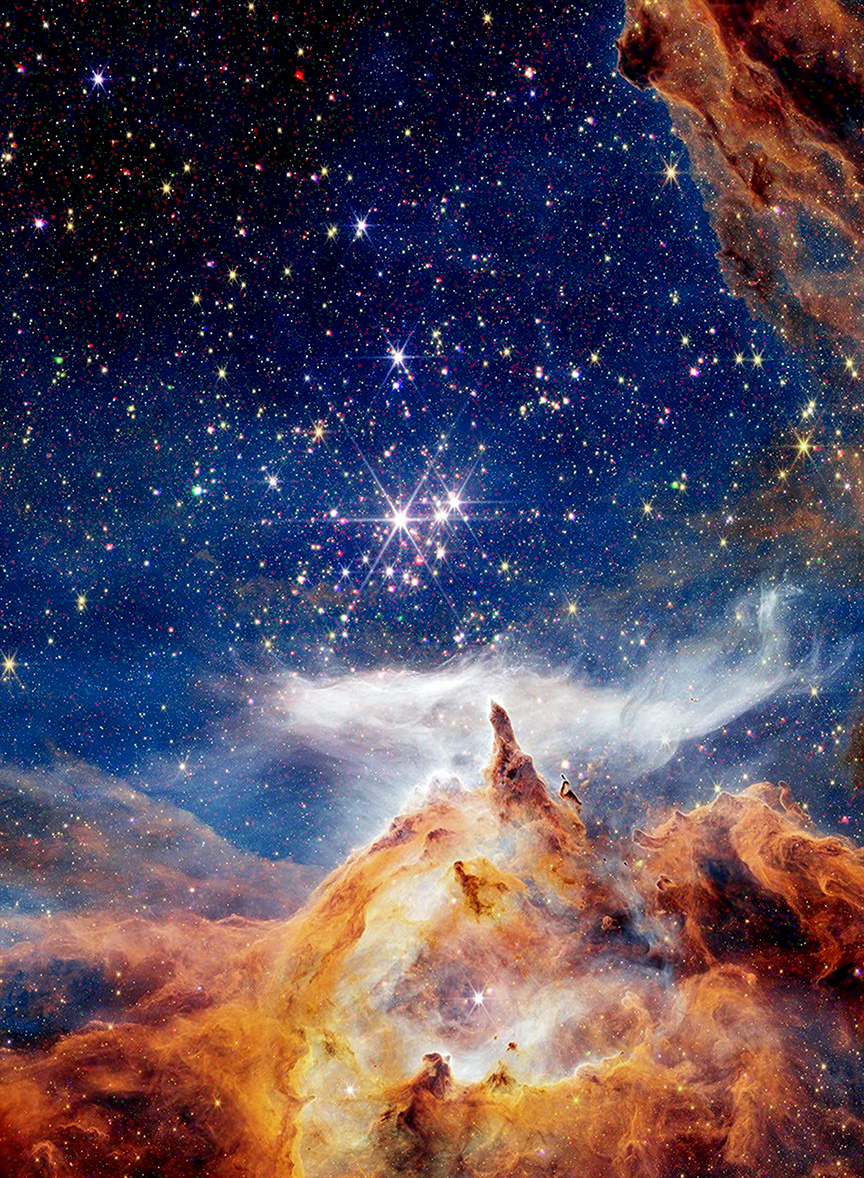
Data from Chandra adds red, green, and blue twinkling lights in this Dec. 22, 2025, image of Pismis 24 from NASA’s James Webb Space Telescope. Pismis 24 is a young cluster of stars in the core of the nearby Lobster Nebula, approximately 5,500 light-years from Earth in the constellation Scorpius. Home to a vibrant stellar nursery and one of the closest sites of massive star birth, Pismis 24 provides rare insight into large and massive stars. This region is one of the best places to explore the properties of hot young stars and how they evolve.
Image credit: Credit: X-ray: NASA/CXC/Penn State/G. Garmire; Infrared: NASA, ESA, CSA, and STScI; Image Processing: NASA/CXC/SAO/L. Frattare and NSA/ESA/CSA/STScI/A. Pagan
Chandra, Webb Catch Twinkling Lights
Data from Chandra adds red, green, and blue twinkling lights in this Dec. 22, 2025, image of Pismis 24 from NASA’s James Webb Space Telescope. Pismis 24 is a young cluster of stars in the core of the nearby Lobster Nebula, approximately 5,500 light-years from Earth in the constellation Scorpius. Home to a vibrant stellar nursery and one of the closest sites of massive star birth, Pismis 24 provides rare insight into large and massive stars. This region is one of the best places to explore the properties of hot young stars and how they evolve.
Image credit: Credit: X-ray: NASA/CXC/Penn State/G. Garmire; Infrared: NASA, ESA, CSA, and STScI; Image Processing: NASA/CXC/SAO/L. Frattare and NSA/ESA/CSA/STScI/A. Pagan
ESA at the European Space Conference - Day 2
Two days of intense discussions and exchanges came to an end at the 18th European Space Conference in Brussels on Wednesday.
This virus infects most of us – but why do only some get very ill?
This virus infects most of us – but why do only some get very ill?
Ancient humans were seafaring far earlier than we realised
Ancient humans were seafaring far earlier than we realised
Huge fossil bonanza preserves 512-million-year-old ecosystem
Huge fossil bonanza preserves 512-million-year-old ecosystem
NASA Webb Pushes Boundaries of Observable Universe Closer to Big Bang
- Webb
- News
- Overview
- Science
- Observatory
- Multimedia
- Team
- More
NASA’s James Webb Space Telescope has topped itself once again, delivering on its promise to push the boundaries of the observable universe closer to cosmic dawn with the confirmation of a bright galaxy that existed 280 million years after the big bang. By now Webb has established that it will eventually surpass virtually every benchmark it sets in these early years, but the newly confirmed galaxy, MoM-z14, holds intriguing clues to the universe’s historical timeline and just how different a place the early universe was than astronomers expected.
“With Webb, we are able to see farther than humans ever have before, and it looks nothing like what we predicted, which is both challenging and exciting,” said Rohan Naidu of the Massachusetts Institute of Technology’s (MIT) Kavli Institute for Astrophysics and Space Research, lead author of a paper on galaxy MoM-z14 published in the Open Journal of Astrophysics.
Due to the expansion of the universe that is driven by dark energy, discussion of physical distances and “years ago” becomes tricky when looking this far. Using Webb’s NIRSpec (Near-Infrared Spectrograph) instrument, astronomers confirmed that MoM-z14 has a cosmological redshift of 14.44, meaning that its light has been travelling through (expanding) space, being stretched and “shifted” to longer, redder wavelengths, for about 13.5 of the universe’s estimated 13.8 billion years of existence.
“We can estimate the distance of galaxies from images, but it’s really important to follow up and confirm with more detailed spectroscopy so that we know exactly what we are seeing, and when,” said Pascal Oesch of the University of Geneva, co-principal investigator of the survey.
Image: COSMOS Field MoM-z14 Galaxy (NIRCam Image) NASA’s James Webb Space Telescope shows galaxy MoM-z14 as it appeared in the distant past, only 280 million years after the universe began in the big bang. Image: NASA, ESA, CSA, STScI, Rohan Naidu (MIT); Image Processing: Joseph DePasquale (STScI) Intriguing Features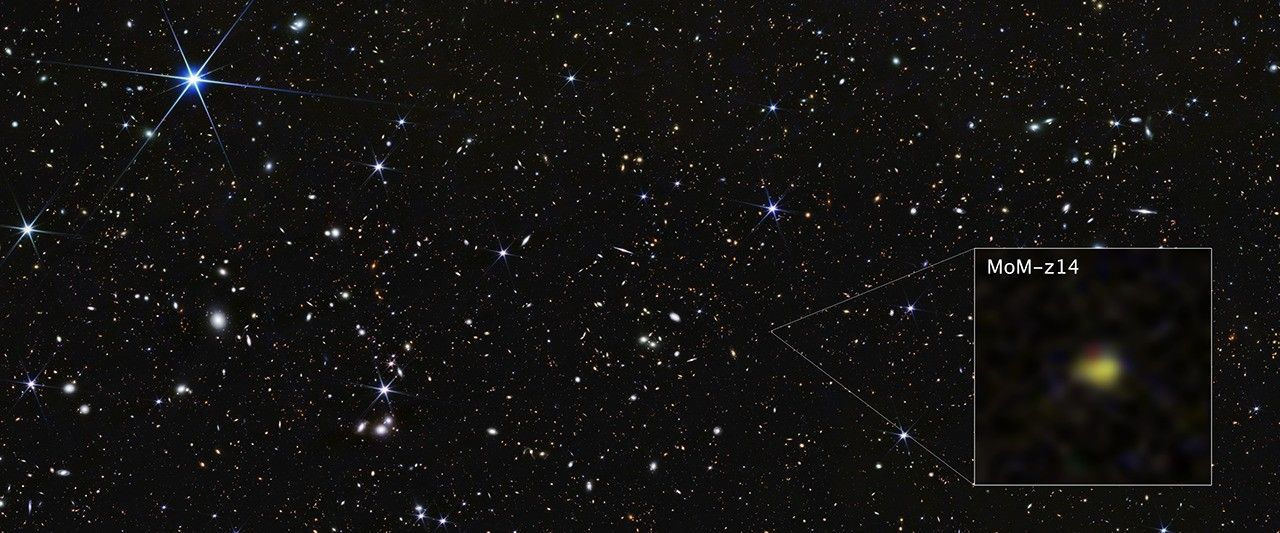
MoM-z14 is one of a growing group of surprisingly bright galaxies in the early universe – 100 times more than theoretical studies predicted before the launch of Webb, according to the research team.
“There is a growing chasm between theory and observation related to the early universe, which presents compelling questions to be explored going forward,” said Jacob Shen, a postdoctoral researcher at MIT and a member of the research team.
One place researchers and theorists can look for answers is the oldest population of stars in the Milky Way galaxy. A small percentage of these stars have shown high amounts of nitrogen, which is also showing up in some of Webb’s observations of early galaxies, including MoM-z14.
“We can take a page from archeology and look at these ancient stars in our own galaxy like fossils from the early universe, except in astronomy we are lucky enough to have Webb seeing so far that we also have direct information about galaxies during that time. It turns out we are seeing some of the same features, like this unusual nitrogen enrichment,” said Naidu.
With galaxy MoM-z14 existing only 280 million years after the big bang, there was not enough time for generations of stars to produce such high amounts of nitrogen in the way that astronomers would expect. One theory the researchers note is that the dense environment of the early universe resulted in supermassive stars capable of producing more nitrogen than any stars observed in the local universe.
The galaxy MoM-z14 also shows signs of clearing out the thick, primordial hydrogen fog of the early universe in the space around itself. One of the reasons Webb was originally built was to define the timeline for this “clearing” period of cosmic history, which astronomers call reionization. This is when early stars produced light of high enough energy to break through the dense hydrogen gas of the early universe and begin travelling through space, eventually making its way to Webb, and us. Galaxy MoM-z14 provides another clue for mapping out the timeline of reionization, work that was not possible until Webb lifted the veil on this era of the universe.
Legacy of Discovery ContinuesEven before Webb’s launch, there were hints that something very unanticipated happened in the early universe, when NASA’s Hubble Space Telescope discovered the bright galaxy GN-z11 400 million years after the big bang. Webb confirmed the galaxy’s distance — at the time the most distant ever. From there Webb has continued to push back farther and farther in space and time, finding more surprisingly bright galaxies like GN-z11.
As Webb continues to uncover more of these unexpectedly luminous galaxies, it’s clear that the first few were not a fluke. Astronomers are eagerly anticipating that NASA’s upcoming Nancy Grace Roman Space Telescope, with its combination of high-resolution infrared imaging and extremely wide field of view, will boost the sample of these bright, compact, chemically enriched early galaxies into the thousands.
“To figure out what is going on in the early universe, we really need more information —more detailed observations with Webb, and more galaxies to see where the common features are, which Roman will be able to provide,” said Yijia Li, a graduate student at the Pennsylvania State University and a member of the research team. “It’s an incredibly exciting time, with Webb revealing the early universe like never before and showing us how much there still is to discover.”
The James Webb Space Telescope is the world’s premier space science observatory. Webb is solving mysteries in our solar system, looking beyond to distant worlds around other stars, and probing the mysterious structures and origins of our universe and our place in it. Webb is an international program led by NASA with its partners, ESA (European Space Agency) and CSA (Canadian Space Agency).
To learn more about Webb, visit:
Downloads & Related InformationThe following sections contain links to download this article’s images and videos in all available resolutions followed by related information links, media contacts, and if available, research paper and Spanish translation links.
Related Images & Videos COSMOS Field MoM-z14 Galaxy (NIRCam Image)NASA’s James Webb Space Telescope shows galaxy MoM-z14 as it appeared in the distant past, only 280 million years after the universe began in the big bang.
COSMOS Field MoM-z14 Galaxy (NIRCam Compass Image)NASA’s James Webb Space Telescope shows galaxy MoM-z14 as it appeared in the distant past, only 280 million years after the universe began in the big bang.
Related LinksRead more: Webb Science: Galaxies Through Time
Explore more: ViewSpace Seeing Farther: Hubble Ultra Deep Field
Video: JADES: GOODS South Fly-Through Visualization
Video: Ultra Deep Field: Looking Out into Space, Looking Back into Time
Explore more: ViewSpace Gathering Light: Hubble Ultra Deep Field
Share Details Last Updated Jan 28, 2026 LocationNASA Goddard Space Flight Center Contact MediaLaura Betz
NASA’s Goddard Space Flight Center
Greenbelt, Maryland
laura.e.betz@nasa.gov
Leah Ramsay
Space Telescope Science Institute
Baltimore, Maryland
Christine Pulliam
Space Telescope Science Institute
Baltimore, Maryland
Webb is the premier observatory of the next decade, serving thousands of astronomers worldwide. It studies every phase in the…
Galaxies
Galaxies Stories
Universe
NASA Webb Pushes Boundaries of Observable Universe Closer to Big Bang
- Webb
- News
- Overview
- Science
- Observatory
- Multimedia
- Team
- More
NASA’s James Webb Space Telescope has topped itself once again, delivering on its promise to push the boundaries of the observable universe closer to cosmic dawn with the confirmation of a bright galaxy that existed 280 million years after the big bang. By now Webb has established that it will eventually surpass virtually every benchmark it sets in these early years, but the newly confirmed galaxy, MoM-z14, holds intriguing clues to the universe’s historical timeline and just how different a place the early universe was than astronomers expected.
“With Webb, we are able to see farther than humans ever have before, and it looks nothing like what we predicted, which is both challenging and exciting,” said Rohan Naidu of the Massachusetts Institute of Technology’s (MIT) Kavli Institute for Astrophysics and Space Research, lead author of a paper on galaxy MoM-z14 published in the Open Journal of Astrophysics.
Due to the expansion of the universe that is driven by dark energy, discussion of physical distances and “years ago” becomes tricky when looking this far. Using Webb’s NIRSpec (Near-Infrared Spectrograph) instrument, astronomers confirmed that MoM-z14 has a cosmological redshift of 14.44, meaning that its light has been travelling through (expanding) space, being stretched and “shifted” to longer, redder wavelengths, for about 13.5 of the universe’s estimated 13.8 billion years of existence.
“We can estimate the distance of galaxies from images, but it’s really important to follow up and confirm with more detailed spectroscopy so that we know exactly what we are seeing, and when,” said Pascal Oesch of the University of Geneva, co-principal investigator of the survey.
Image: COSMOS Field MoM-z14 Galaxy (NIRCam Image) NASA’s James Webb Space Telescope shows galaxy MoM-z14 as it appeared in the distant past, only 280 million years after the universe began in the big bang. Image: NASA, ESA, CSA, STScI, Rohan Naidu (MIT); Image Processing: Joseph DePasquale (STScI) Intriguing FeaturesMoM-z14 is one of a growing group of surprisingly bright galaxies in the early universe – 100 times more than theoretical studies predicted before the launch of Webb, according to the research team.
“There is a growing chasm between theory and observation related to the early universe, which presents compelling questions to be explored going forward,” said Jacob Shen, a postdoctoral researcher at MIT and a member of the research team.
One place researchers and theorists can look for answers is the oldest population of stars in the Milky Way galaxy. A small percentage of these stars have shown high amounts of nitrogen, which is also showing up in some of Webb’s observations of early galaxies, including MoM-z14.
“We can take a page from archeology and look at these ancient stars in our own galaxy like fossils from the early universe, except in astronomy we are lucky enough to have Webb seeing so far that we also have direct information about galaxies during that time. It turns out we are seeing some of the same features, like this unusual nitrogen enrichment,” said Naidu.
With galaxy MoM-z14 existing only 280 million years after the big bang, there was not enough time for generations of stars to produce such high amounts of nitrogen in the way that astronomers would expect. One theory the researchers note is that the dense environment of the early universe resulted in supermassive stars capable of producing more nitrogen than any stars observed in the local universe.
The galaxy MoM-z14 also shows signs of clearing out the thick, primordial hydrogen fog of the early universe in the space around itself. One of the reasons Webb was originally built was to define the timeline for this “clearing” period of cosmic history, which astronomers call reionization. This is when early stars produced light of high enough energy to break through the dense hydrogen gas of the early universe and begin travelling through space, eventually making its way to Webb, and us. Galaxy MoM-z14 provides another clue for mapping out the timeline of reionization, work that was not possible until Webb lifted the veil on this era of the universe.
Legacy of Discovery ContinuesEven before Webb’s launch, there were hints that something very unanticipated happened in the early universe, when NASA’s Hubble Space Telescope discovered the bright galaxy GN-z11 400 million years after the big bang. Webb confirmed the galaxy’s distance — at the time the most distant ever. From there Webb has continued to push back farther and farther in space and time, finding more surprisingly bright galaxies like GN-z11.
As Webb continues to uncover more of these unexpectedly luminous galaxies, it’s clear that the first few were not a fluke. Astronomers are eagerly anticipating that NASA’s upcoming Nancy Grace Roman Space Telescope, with its combination of high-resolution infrared imaging and extremely wide field of view, will boost the sample of these bright, compact, chemically enriched early galaxies into the thousands.
“To figure out what is going on in the early universe, we really need more information —more detailed observations with Webb, and more galaxies to see where the common features are, which Roman will be able to provide,” said Yijia Li, a graduate student at the Pennsylvania State University and a member of the research team. “It’s an incredibly exciting time, with Webb revealing the early universe like never before and showing us how much there still is to discover.”
The James Webb Space Telescope is the world’s premier space science observatory. Webb is solving mysteries in our solar system, looking beyond to distant worlds around other stars, and probing the mysterious structures and origins of our universe and our place in it. Webb is an international program led by NASA with its partners, ESA (European Space Agency) and CSA (Canadian Space Agency).
To learn more about Webb, visit:
Downloads & Related InformationThe following sections contain links to download this article’s images and videos in all available resolutions followed by related information links, media contacts, and if available, research paper and Spanish translation links.
Related Images & Videos COSMOS Field MoM-z14 Galaxy (NIRCam Image)NASA’s James Webb Space Telescope shows galaxy MoM-z14 as it appeared in the distant past, only 280 million years after the universe began in the big bang.
COSMOS Field MoM-z14 Galaxy (NIRCam Compass Image)NASA’s James Webb Space Telescope shows galaxy MoM-z14 as it appeared in the distant past, only 280 million years after the universe began in the big bang.
Related LinksRead more: Webb Science: Galaxies Through Time
Explore more: ViewSpace Seeing Farther: Hubble Ultra Deep Field
Video: JADES: GOODS South Fly-Through Visualization
Video: Ultra Deep Field: Looking Out into Space, Looking Back into Time
Explore more: ViewSpace Gathering Light: Hubble Ultra Deep Field
Share Details Last Updated Jan 28, 2026 LocationNASA Goddard Space Flight Center Contact MediaLaura Betz
NASA’s Goddard Space Flight Center
Greenbelt, Maryland
laura.e.betz@nasa.gov
Leah Ramsay
Space Telescope Science Institute
Baltimore, Maryland
Christine Pulliam
Space Telescope Science Institute
Baltimore, Maryland
Webb is the premier observatory of the next decade, serving thousands of astronomers worldwide. It studies every phase in the…
Galaxies
Galaxies Stories
Universe
European Space Conference in Bruxelles: ESA DG keynote address on the second day
Watch the keynote address by ESA Director General Josef Aschbacher on the second day of the 18th European Space Conference in Brussels.
The European Space Conference is a key strategic event bringing together representatives from ESA, the European Commission, industry, national space agencies and other European institutions to discuss the future of Europe in space.
40 years after Challenger disaster, NASA faces safety fears on Artemis II
Many of the team behind NASA’s Artemis II mission were children 40 years ago, when the space shuttle Challenger disaster reshaped spaceflight
The Magnetic "Birdsong" of the Smallest Planet
BepiColombo is slowly uncovering more and more fun facts about Mercury as it continues its preliminary mission. One of the more interesting things found so far is a magnetic “chorus” that appears similar to a phenomenon found in Earth’s much larger magnetic field. A new paper in Nature Communications from the researchers responsible for the probe’s Mio instrument that is studying Mercury’s magnetic field describes what could be thought of as a form of magnetic birdsong.