

Feed aggregator
Researchers Conduct the Largest Study of Runaway Stars in the Milky Way
Researchers from the Institute of Cosmos Sciences of the University of Barcelona (ICCUB) and the Institute of Space Studies of Catalonia (IEEC), in collaboration with the Institute of Astrophysics of the Canary Islands (IAC), have led the most extensive observational study to date of runaway massive stars, which includes an analysis of the rotation and binarity of these stars in our galaxy.
Is the Universe Older Than We Think? Part 1: The Cosmological Clock
When I say that the universe is 13.77 billion years old, it sounds rather authoritative.
Red Giant Stars Can't Destroy All Gas Giants. Some Are Hardy Survivors
Astronomers haven't found many gas giants orbiting white dwarfs. But is that because they're so difficult to spot? Or is it because their survival rate is so low? New research probes the issue.
Chilean Observatories Saved from Industrial Megaproject
The proposed installation — less than 10 miles from Paranal Observatory — sparked international concern. Now it’s canceled.
The post Chilean Observatories Saved from Industrial Megaproject appeared first on Sky & Telescope.
Dutch air force reads pilots' brainwaves to make training harder
Dutch air force reads pilots' brainwaves to make training harder
The weird rules of temperature get even stranger in the quantum realm
The weird rules of temperature get even stranger in the quantum realm
Hundreds of Bright Streaks Suggest Mercury’s Still Active
An AI search through decades-old spacecraft images reveals that Mercury may still be alive and kicking, geologically speaking.
The post Hundreds of Bright Streaks Suggest Mercury’s Still Active appeared first on Sky & Telescope.
Full Moon over Artemis II
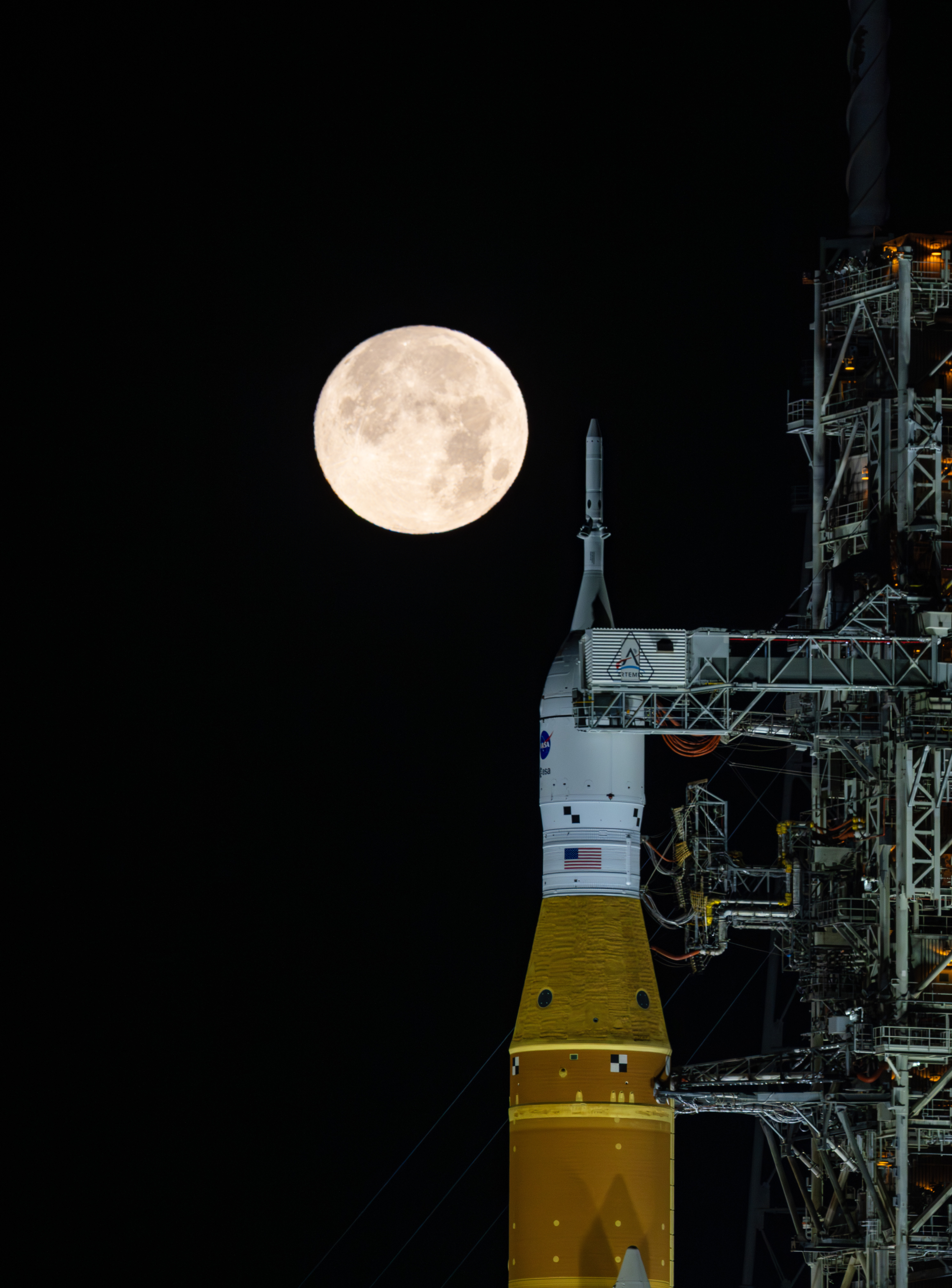
A full moon is seen shining over NASA’s SLS (Space Launch System) and Orion spacecraft, atop the mobile launcher at Launch Pad 39B at NASA’s Kennedy Space Center in Florida in the early hours of February 1, 2026.
The agency concluded a wet dress rehearsal for the agency’s Artemis II test flight early Tuesday morning, successfully loading cryogenic propellant into the SLS (Space Launch System) tanks, sending a team out to the launch pad to closeout Orion, and safely draining the rocket. The wet dress rehearsal was a prelaunch test to fuel the rocket, designed to identify any issues and resolve them before attempting a launch. To allow teams to review data and conduct a second wet dress rehearsal, NASA now will target March as the earliest possible launch opportunity for the flight test.
Read more about the wet dress rehearsal.
Image credit: NASA/Sam Lott
Nobel laureate says he'll build world’s most powerful quantum computer
Nobel laureate says he'll build world’s most powerful quantum computer
NASA Space to Soil Challenge

Rapid advances in commercial space, artificial intelligence, and edge computing are transforming what is possible for Earth observation. By pushing more intelligence onboard, missions can move from passively collecting data to actively interpreting and responding to changing surface conditions in near-real time, enabling more targeted observations and dramatically improving the value of data returned to the ground. Within this context, land-focused applications such as regenerative agriculture, sustainable forestry, and broader land resilience efforts stand to benefit enormously from satellites that can adapt what, when, and how they sense based on dynamic environmental signals and algorithmic insight rather than fixed schedules or static acquisition plans.
NASA Earth Science Technology Office (ESTO) invites participants to design small satellite (SmallSat) mission concepts that leverage adaptive sensing and onboard processing to enhance regenerative agriculture, forestry, or a similar land resilience objective. Participants must work within onboard power, compute, and bandwidth constraints characteristic of SmallSat missions, focusing on how to orchestrate existing land observation algorithms into an efficient, responsive onboard intelligence layer. Both hardware-oriented and software-oriented solutions—or combinations of the two—are encouraged.
NASA’s primary objective for this challenge is to advance computational and systems approaches for adaptive sensing or onboard processing on SmallSat missions. The goal is not to develop new agricultural or forestry science but rather to improve how SmallSats sense, process, and deliver information to enable these applications.
Award: $400,000 in total prizes
Challenge Open Date: January 30, 2026
Submission Close Date: May 4, 2026
For more information, visit: https://nasa-space-to-soil.org/