
Feed aggregator
Trump administration proposes massive budget cuts to science
The White House budget proposal would also curb federal payments for scientific publishing
Where is Artemis II now? NASA mission is now closer to moon than Earth
The third day of the Artemis II mission was relatively quiet, as four astronauts continued on their trek to fly around the moon
The mathematical formula that reveals when Easter is every year
You can track the start of spring and the phases of the moon—or you can turn to a formula by mathematician Carl Friedrich Gauss
An Aerobot With ISRU Capabilities Could Explore Venus' Atmosphere for Years
In a new proposal, a team of scientists explores how aerial robotic platforms (areobots) with in-situ resource utilization (ISRU) capability could operate for years in Venus' atmosphere.
NASA Sets Coverage for Northrop Grumman’s CRS-24 Resupply Launch
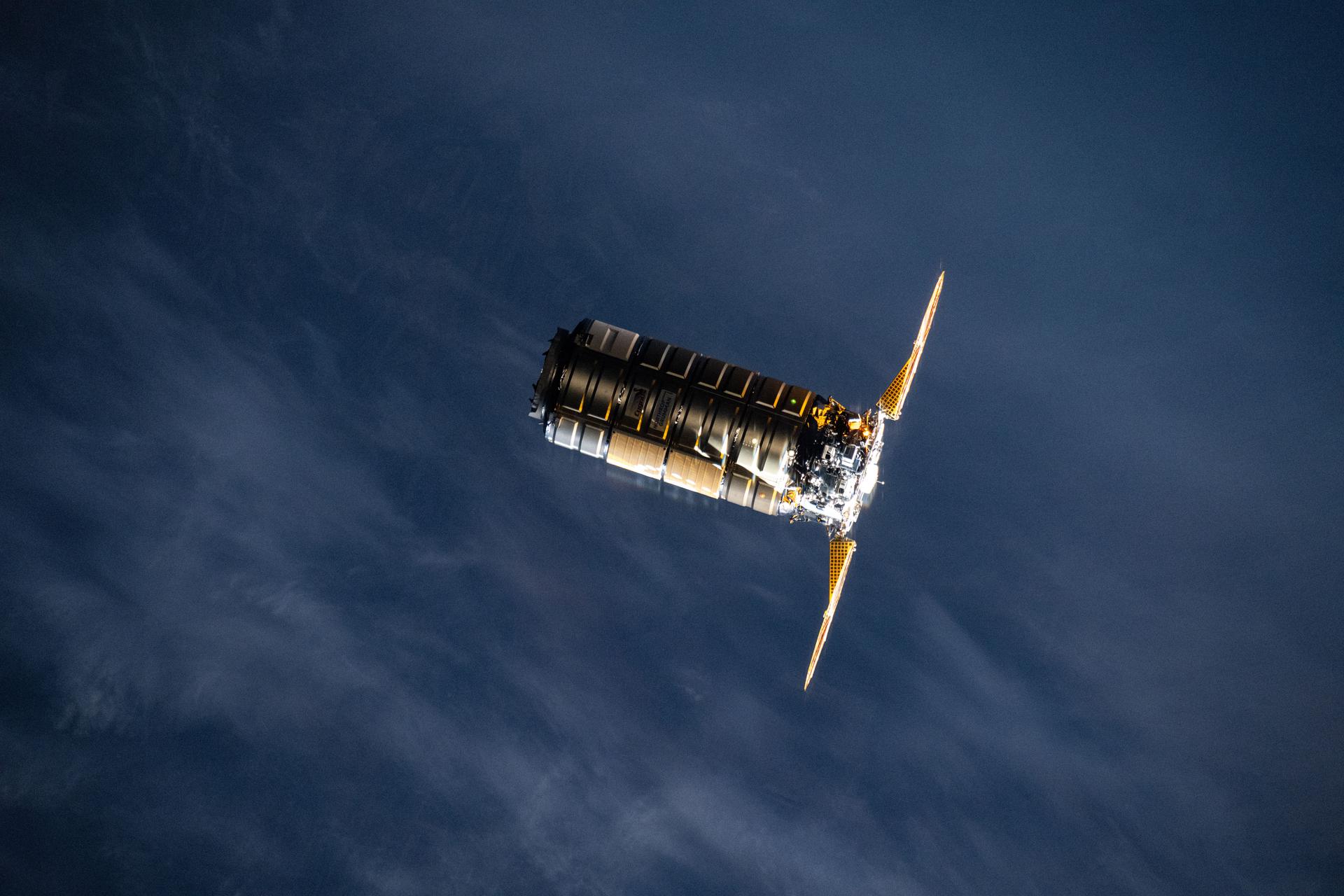
NASA, Northrop Grumman, and SpaceX are targeting no earlier than 8:49 a.m. EDT on Wednesday, April 8, for the next launch delivering science investigations, supplies, and equipment to the International Space Station.
Filled with approximately 11,000 pounds of cargo, the Northrop Grumman Cygnus XL spacecraft, aboard a SpaceX Falcon 9 rocket, will launch from Space Launch Complex 40 at Cape Canaveral Space Force Station in Florida. The mission is known as NASA’s Northrop Grumman Commercial Resupply Services 24, or Northrop Grumman CRS-24.
Watch the agency’s launch and arrival coverage on NASA+, Amazon Prime, and the agency’s YouTube channel. Learn how to watch NASA content through a variety of online platforms, including social media.
Following launch, astronauts aboard the space station will use the Canadarm2 robotic arm to capture the Cygnus XL on Friday, April 10, before ground controllers install it to the Unity module’s Earth-facing port for cargo unloading.
Highlights of space station research and technology demonstrations being delivered aboard this Cygnus XL spacecraft include:
- A new module for the Cold Atom Lab to advance quantum science that could improve computing technology and aid in the search for dark matter
- Hardware to produce a greater number of therapeutic stem cells for blood diseases and cancer
- Model organisms to study the gut microbiome
- A receiver that could enhance space weather models that protect critical space infrastructure such as GPS and radar
Media interested in speaking to a science subject matter expert should contact Sandra Jones at sandra.p.jones@nasa.gov.
The spacecraft is scheduled to remain at the orbiting laboratory until October before departing with several thousand pounds of trash and burning up harmlessly during re-entry.
Northrop Grumman named the spacecraft the S.S. Steven R. Nagel in honor of the former NASA astronaut who flew four space shuttle missions, logging more than 720 hours in space.
NASA’s mission coverage is as follows (all times Eastern; subject to change based on real-time operations):
Wednesday, April 8
8:30 a.m.: Launch coverage begins on NASA+, Amazon Prime, and YouTube.
8:49 a.m.: Launch
Friday, April 10
12:30 a.m.: Arrival coverage begins on NASA+, Amazon Prime, and YouTube.
1:10 a.m.: Capture
NASA website launch coverage
Launch day coverage of the mission will be available on the NASA website. Coverage will include live streaming and blog updates beginning no earlier than 8:30 a.m. April 8 as the countdown milestones occur.
On-demand streaming video on NASA+ and photos of the launch will be available shortly after liftoff. For questions about countdown coverage, contact NASA’s Kennedy Space Center in Florida newsroom at 321-867-2468. Follow countdown coverage on our International Space Station blog for updates.
Attend launch virtually
Members of the public can register to attend this launch virtually. NASA’s virtual guest program for this mission also includes curated launch resources, notifications about related opportunities or changes, and a stamp for the NASA virtual guest passport following launch.
Watch, engage on social media
Let people know you’re watching the mission on X, Facebook, and Instagram by following and tagging these accounts:
X: @NASA, @NASASpaceOps, @NASAKennedy, @Space_Station, @ISS_CASIS
Facebook: NASA, NASAKennedy, ISS, ISS National Lab
Instagram: @NASA, @NASAKennedy, @ISS, @ISSNationalLab
Learn more about the mission at:
https://www.nasa.gov/event/nasas-northrop-grumman-crs-24/
-end-
Josh Finch
Headquarters, Washington
202-358-1100
joshua.a.finch@nasa.gov
Amanda Griffin
Kennedy Space Center, Fla.
321-876-2468
amanda.a.griffin@nasa.gov
Sandra Jones
Johnson Space Center, Houston
281-483-5111
sandra.p.jones@nasa.gov
NASA Sets Coverage for Northrop Grumman’s CRS-24 Resupply Launch
NASA, Northrop Grumman, and SpaceX are targeting no earlier than 8:49 a.m. EDT on Wednesday, April 8, for the next launch delivering science investigations, supplies, and equipment to the International Space Station.
Filled with approximately 11,000 pounds of cargo, the Northrop Grumman Cygnus XL spacecraft, aboard a SpaceX Falcon 9 rocket, will launch from Space Launch Complex 40 at Cape Canaveral Space Force Station in Florida. The mission is known as NASA’s Northrop Grumman Commercial Resupply Services 24, or Northrop Grumman CRS-24.
Watch the agency’s launch and arrival coverage on NASA+, Amazon Prime, and the agency’s YouTube channel. Learn how to watch NASA content through a variety of online platforms, including social media.
Following launch, astronauts aboard the space station will use the Canadarm2 robotic arm to capture the Cygnus XL on Friday, April 10, before ground controllers install it to the Unity module’s Earth-facing port for cargo unloading.
Highlights of space station research and technology demonstrations being delivered aboard this Cygnus XL spacecraft include:
- A new module for the Cold Atom Lab to advance quantum science that could improve computing technology and aid in the search for dark matter
- Hardware to produce a greater number of therapeutic stem cells for blood diseases and cancer
- Model organisms to study the gut microbiome
- A receiver that could enhance space weather models that protect critical space infrastructure such as GPS and radar
Media interested in speaking to a science subject matter expert should contact Sandra Jones at sandra.p.jones@nasa.gov.
The spacecraft is scheduled to remain at the orbiting laboratory until October before departing with several thousand pounds of trash and burning up harmlessly during re-entry.
Northrop Grumman named the spacecraft the S.S. Steven R. Nagel in honor of the former NASA astronaut who flew four space shuttle missions, logging more than 720 hours in space.
NASA’s mission coverage is as follows (all times Eastern; subject to change based on real-time operations):
Wednesday, April 8
8:30 a.m.: Launch coverage begins on NASA+, Amazon Prime, and YouTube.
8:49 a.m.: Launch
Friday, April 10
12:30 a.m.: Arrival coverage begins on NASA+, Amazon Prime, and YouTube.
1:10 a.m.: Capture
NASA website launch coverage
Launch day coverage of the mission will be available on the NASA website. Coverage will include live streaming and blog updates beginning no earlier than 8:30 a.m. April 8 as the countdown milestones occur.
On-demand streaming video on NASA+ and photos of the launch will be available shortly after liftoff. For questions about countdown coverage, contact NASA’s Kennedy Space Center in Florida newsroom at 321-867-2468. Follow countdown coverage on our International Space Station blog for updates.
Attend launch virtually
Members of the public can register to attend this launch virtually. NASA’s virtual guest program for this mission also includes curated launch resources, notifications about related opportunities or changes, and a stamp for the NASA virtual guest passport following launch.
Watch, engage on social media
Let people know you’re watching the mission on X, Facebook, and Instagram by following and tagging these accounts:
X: @NASA, @NASASpaceOps, @NASAKennedy, @Space_Station, @ISS_CASIS
Facebook: NASA, NASAKennedy, ISS, ISS National Lab
Instagram: @NASA, @NASAKennedy, @ISS, @ISSNationalLab
Learn more about the mission at:
https://www.nasa.gov/event/nasas-northrop-grumman-crs-24/
-end-
Josh Finch
Headquarters, Washington
202-358-1100
joshua.a.finch@nasa.gov
Amanda Griffin
Kennedy Space Center, Fla.
321-876-2468
amanda.a.griffin@nasa.gov
Sandra Jones
Johnson Space Center, Houston
281-483-5111
sandra.p.jones@nasa.gov
NASA Artemis II astronauts in ‘great spirits,’ space agency officials say, as mission nears moon
Friday is the Artemis II mission’s third official day as it makes a 10-day journey around the moon and back
What are NASA’s Artemis II astronauts eating? 58 tortillas, 43 cups of coffee and a lot of hot sauce
The menu for NASA’s moon mission has 189 unique items on it and mirrors that of the International Space Station
Meet NASA’s New Artemis II Science Officers
NASA/Josh Valcarcel
Business attire, headsets, and multiple computer monitors are a much different backdrop than hiking gear, rock hammers, and the volcanic fields of Iceland. For Kelsey Young of NASA’s Goddard Space Flight Center in Greenbelt, Maryland, and Trevor Graff and Angela Garcia of NASA’s Johnson Space Center in Houston, comfort and skill across both environments have made them uniquely suited to be certified as NASA’s first Artemis II science officers.
The integration of science operations into human spaceflight dates back to Apollo, but Artemis introduces a new dedicated position in NASA’s Mission Control, marking an evolution of how science is embedded in mission operations.
“The science officer is the senior flight controller responsible for lunar science and geology objectives during Artemis missions,” said Young, who also serves as NASA’s Artemis II lunar science lead. “They will integrate with all the other console disciplines and ensure NASA’s lunar science objectives are seamlessly integrated into mission execution.”
Artemis science officers, from left, Kelsey Young, Trevor Graff, and Angela Garcia stand at the new SCIENCE console in the Mission Control Center at NASA’s Johnson Space Center in Houston. Credits NASA/Josh Valcarcel
The front room of Mission Control is filled with consoles, or workstations, each dedicated to a particular system or function of the mission. Flight controllers at each console monitor areas such as communications, life support, propulsion, and now, science. Many of the console positions are supported by larger teams of experts who work from either different “back rooms” at NASA’s Johnson Space Center in Houston, or other locations.
Young, Garcia, and Graff completed months of flight controller training, testing, and certification simulations in Mission Control, while also executing geology and lunar observation trainings and integrated simulations with the astronauts.
One of the most exciting, challenging, and rewarding components of the process are the simulations, where we tested our skills and knowledge while immersed in very realistic mission scenarios.Trevor Graff
Artemis Science Officer
“One of the most exciting, challenging, and rewarding components of the process are the simulations, where we tested our skills and knowledge while immersed in very realistic mission scenarios,” said Graff.
The simulations often included the Artemis II astronauts and covered the lunar flyby portion of the mission, planned for Monday, April 6, during which time the crew will take photographs of the Moon and record audio of their observations. They will be the eyes of the lunar scientists on Earth and have gone through geology training in the classroom and in the field to be able to capture as much information as possible during their pass around the far side of the Moon. Young said the astronauts have worked incredibly hard at building their lunar science toolboxes, studying lunar geography, traipsing across lunar-like landscapes in Iceland, and cultivating their ability to provide scientifically impactful descriptions of the Moon.
Artemis II science officer Kelsey Young monitors science operations at the new SCIENCE console in NASA’s Mission Control Center. Credits: NASA/Bill Stafford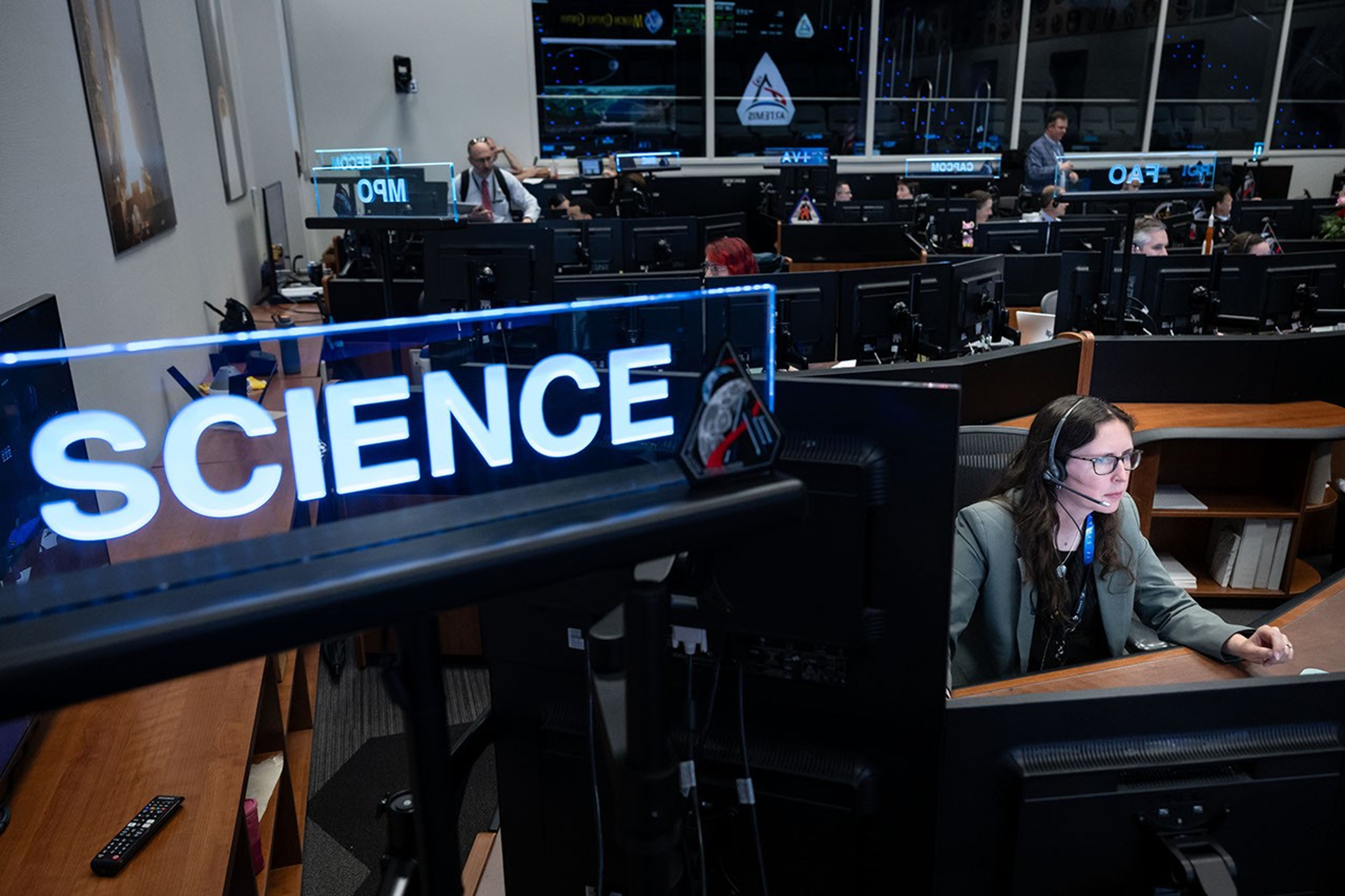
Listen to this audio clip from Kelsey Young talking about how the Artemis II astronauts have studied lunar geography to prepare for their mission. Credit: NASA’s Curious Universe
0:00 / 0:00
Your browser does not support the audio element.
“After so many months of hearing their descriptions of lunar visualizations during simulations, I’m most excited for the very first time I hear them describing the actual Moon out of the Orion windows,” said Young. “Hearing the excitement and scientific meaning behind their descriptions will be an incredible moment.”
Human eyes and brains are highly sensitive to subtle changes in color, texture, and other surface characteristics. Having astronaut eyes observe the lunar surface directly, in combination with the context of all the advances that scientists have made about the Moon over the last several decades, may uncover new discoveries and a more nuanced appreciation for the features on the surface of the Moon. While Artemis II will not land on the lunar surface, its contributions to lunar science are significant.
“The crew will be exploring through observation—a foundational scientific tool,” said Garcia.
To view this video please enable JavaScript, and consider upgrading to a web browser that
supports HTML5 video
As the astronauts make those observations, their photos and recorded audio will be fed down to two science back rooms at NASA Johnson, the Science Evaluation Room and Science Mission Operations Room. Experts in these rooms will provide data analysis and strategic guidance in real time to the science officer in Mission Control. These processes represent a major component of Artemis II as a test flight: refining science mission operations.
This mission will test the lunar science team’s workflows, technical requirements, and integration into Mission Control. Lessons learned during Artemis II will pave the way for lunar science operations for future Artemis missions. Young explained that science integration into human spaceflight has a long, rich history. While there was no science representative in the front room of Mission Control during Apollo, there was a geology back room onsite at Johnson. As Apollo missions progressed, the structure of integrating with the rest of the flight control team evolved and the footprint expanded as the science capability of each mission grew.
Garcia said she is humbled, honored, and grateful to be a part of the flight control team and to have trained the astronauts. The Moon is something everyone, everywhere, can see and connect with, according to Young.
“I hope people all over the world can be inspired by this push away from our planet,” said Young, “I also hope they remember the Moon, how much we still have to learn about our nearest neighbor but also the special place it holds to people everywhere.”
Download high-res images and videos
About the Author Rachel BarryShare
Details Last Updated Apr 03, 2026 Related Terms Explore More 4 min read Barents Sea Tied to Low Arctic Sea IcePatches of open water in the region contributed to low sea ice extent across the…
Article
16 hours ago
3 min read NASA Names Scientists to Support Lunar South Pole Science
Article
1 week ago
3 min read What’s Up: April 2026 Skywatching Tips from NASA
Mercury shines at its brightest for the year, the Lyrid meteor shower peaks, and a…
Article
1 week ago
Keep Exploring Discover More Topics From NASA
Missions
Humans in Space
Climate Change
Solar System
Meet NASA’s New Artemis II Science Officers
NASA/Josh Valcarcel
Business attire, headsets, and multiple computer monitors are a much different backdrop than hiking gear, rock hammers, and the volcanic fields of Iceland. For Kelsey Young of NASA’s Goddard Space Flight Center in Greenbelt, Maryland, and Trevor Graff and Angela Garcia of NASA’s Johnson Space Center in Houston, comfort and skill across both environments have made them uniquely suited to be certified as NASA’s first Artemis II science officers.
The integration of science operations into human spaceflight dates back to Apollo, but Artemis introduces a new dedicated position in NASA’s Mission Control, marking an evolution of how science is embedded in mission operations.
“The science officer is the senior flight controller responsible for lunar science and geology objectives during Artemis missions,” said Young, who also serves as NASA’s Artemis II lunar science lead. “They will integrate with all the other console disciplines and ensure NASA’s lunar science objectives are seamlessly integrated into mission execution.”
Artemis science officers, from left, Kelsey Young, Trevor Graff, and Angela Garcia stand at the new SCIENCE console in the Mission Control Center at NASA’s Johnson Space Center in Houston. Credits NASA/Josh ValcarcelThe front room of Mission Control is filled with consoles, or workstations, each dedicated to a particular system or function of the mission. Flight controllers at each console monitor areas such as communications, life support, propulsion, and now, science. Many of the console positions are supported by larger teams of experts who work from either different “back rooms” at NASA’s Johnson Space Center in Houston, or other locations.
Young, Garcia, and Graff completed months of flight controller training, testing, and certification simulations in Mission Control, while also executing geology and lunar observation trainings and integrated simulations with the astronauts.
One of the most exciting, challenging, and rewarding components of the process are the simulations, where we tested our skills and knowledge while immersed in very realistic mission scenarios.Trevor Graff
Artemis Science Officer
“One of the most exciting, challenging, and rewarding components of the process are the simulations, where we tested our skills and knowledge while immersed in very realistic mission scenarios,” said Graff.
The simulations often included the Artemis II astronauts and covered the lunar flyby portion of the mission, planned for Monday, April 6, during which time the crew will take photographs of the Moon and record audio of their observations. They will be the eyes of the lunar scientists on Earth and have gone through geology training in the classroom and in the field to be able to capture as much information as possible during their pass around the far side of the Moon. Young said the astronauts have worked incredibly hard at building their lunar science toolboxes, studying lunar geography, traipsing across lunar-like landscapes in Iceland, and cultivating their ability to provide scientifically impactful descriptions of the Moon.
Artemis II science officer Kelsey Young monitors science operations at the new SCIENCE console in NASA’s Mission Control Center. Credits: NASA/Bill StaffordListen to this audio clip from Kelsey Young talking about how the Artemis II astronauts have studied lunar geography to prepare for their mission. Credit: NASA’s Curious Universe
0:00 / 0:00
Your browser does not support the audio element.
“After so many months of hearing their descriptions of lunar visualizations during simulations, I’m most excited for the very first time I hear them describing the actual Moon out of the Orion windows,” said Young. “Hearing the excitement and scientific meaning behind their descriptions will be an incredible moment.”
Human eyes and brains are highly sensitive to subtle changes in color, texture, and other surface characteristics. Having astronaut eyes observe the lunar surface directly, in combination with the context of all the advances that scientists have made about the Moon over the last several decades, may uncover new discoveries and a more nuanced appreciation for the features on the surface of the Moon. While Artemis II will not land on the lunar surface, its contributions to lunar science are significant.
“The crew will be exploring through observation—a foundational scientific tool,” said Garcia.
To view this video please enable JavaScript, and consider upgrading to a web browser that
supports HTML5 video
As the astronauts make those observations, their photos and recorded audio will be fed down to two science back rooms at NASA Johnson, the Science Evaluation Room and Science Mission Operations Room. Experts in these rooms will provide data analysis and strategic guidance in real time to the science officer in Mission Control. These processes represent a major component of Artemis II as a test flight: refining science mission operations.
This mission will test the lunar science team’s workflows, technical requirements, and integration into Mission Control. Lessons learned during Artemis II will pave the way for lunar science operations for future Artemis missions. Young explained that science integration into human spaceflight has a long, rich history. While there was no science representative in the front room of Mission Control during Apollo, there was a geology back room onsite at Johnson. As Apollo missions progressed, the structure of integrating with the rest of the flight control team evolved and the footprint expanded as the science capability of each mission grew.
Garcia said she is humbled, honored, and grateful to be a part of the flight control team and to have trained the astronauts. The Moon is something everyone, everywhere, can see and connect with, according to Young.
“I hope people all over the world can be inspired by this push away from our planet,” said Young, “I also hope they remember the Moon, how much we still have to learn about our nearest neighbor but also the special place it holds to people everywhere.”
Download high-res images and videos
About the Author Rachel BarryShare
Details Last Updated Apr 03, 2026 Related Terms Explore More 4 min read Barents Sea Tied to Low Arctic Sea IcePatches of open water in the region contributed to low sea ice extent across the…
Article
16 hours ago
3 min read NASA Names Scientists to Support Lunar South Pole Science
Article
1 week ago
3 min read What’s Up: April 2026 Skywatching Tips from NASA
Mercury shines at its brightest for the year, the Lyrid meteor shower peaks, and a…
Article
1 week ago
Keep Exploring Discover More Topics From NASA
Missions
Humans in Space
Climate Change
Solar System
How NASA’s moon mission could help transform space medicine
Artemis II’s AVATAR experiment will see organs-on-a-chip travel to the moon and back, revealing how such a journey affects the body’s cells
Virgil I. “Gus” Grissom

Today marks the 100th anniversary of the birth of Virgil I. “Gus” Grissom, born April 3, 1926, in Mitchell, Indiana. As one of NASA’s first seven astronauts, he became America’s second astronaut to fly in space when he launched aboard the Liberty Bell 7 spacecraft on July 21, 1961, just weeks after Alan Shepard’s historic first Project Mercury spaceflight.
In this photo, Grissom is seen enjoying a meal aboard the recovery ship, USS Randolph, following his 15-minute suborbital mission. Although the flight itself was smooth, the situation turned dangerous after splashdown when the capsule’s hatch blew prematurely and the spacecraft began flooding with water. Grissom escaped, but his spacesuit also filled with water as the recovery helicopters attempted to save his sinking spacecraft. He was successfully rescued, but the Liberty Bell 7 sank to the ocean floor.
Grissom made history again in March 1965 as the first NASA astronaut to fly in space twice, serving as commander of Gemini III, the first crewed Gemini mission, alongside John Young. Reflecting on this test flight, he wrote, “To our intense satisfaction we were able to carry out these maneuvers almost exactly as planned… The longer we flew, the more jubilant we felt. We had a really fine spacecraft, one we could be proud of in every respect.”
One year later, in March 1966, NASA announced that Grissom had been selected to command the first Apollo mission, with crewmates Edward White and Roger Chaffee. On January 27, 1967, tragedy struck during a preflight test at Cape Kennedy when fire swept through the command module. Grissom, White, and Chaffee lost their lives in an accident that stunned the nation and shook NASA to its core.
Just weeks before the tragedy, Grissom wrote: “There will be risks, as there are in any experimental program, and sooner or later, we’re going to run head-on into the law of averages and lose somebody. I hope this never happens, and… perhaps it never will, but if it does, I hope the American people won’t think it’s too high a price to pay for our space program.”
Virgil I. “Gus” Grissom
Today marks the 100th anniversary of the birth of Virgil I. “Gus” Grissom, born April 3, 1926, in Mitchell, Indiana. As one of NASA’s first seven astronauts, he became America’s second astronaut to fly in space when he launched aboard the Liberty Bell 7 spacecraft on July 21, 1961, just weeks after Alan Shepard’s historic first Project Mercury spaceflight.
In this photo, Grissom is seen enjoying a meal aboard the recovery ship, USS Randolph, following his 15-minute suborbital mission. Although the flight itself was smooth, the situation turned dangerous after splashdown when the capsule’s hatch blew prematurely and the spacecraft began flooding with water. Grissom escaped, but his spacesuit also filled with water as the recovery helicopters attempted to save his sinking spacecraft. He was successfully rescued, but the Liberty Bell 7 sank to the ocean floor.
Grissom made history again in March 1965 as the first NASA astronaut to fly in space twice, serving as commander of Gemini III, the first crewed Gemini mission, alongside John Young. Reflecting on this test flight, he wrote, “To our intense satisfaction we were able to carry out these maneuvers almost exactly as planned… The longer we flew, the more jubilant we felt. We had a really fine spacecraft, one we could be proud of in every respect.”
One year later, in March 1966, NASA announced that Grissom had been selected to command the first Apollo mission, with crewmates Edward White and Roger Chaffee. On January 27, 1967, tragedy struck during a preflight test at Cape Kennedy when fire swept through the command module. Grissom, White, and Chaffee lost their lives in an accident that stunned the nation and shook NASA to its core.
Just weeks before the tragedy, Grissom wrote: “There will be risks, as there are in any experimental program, and sooner or later, we’re going to run head-on into the law of averages and lose somebody. I hope this never happens, and… perhaps it never will, but if it does, I hope the American people won’t think it’s too high a price to pay for our space program.”
Inge Lehmann and Earth’s deepest Secret
Science writer Hanne Strager explores how the trailblazing Danish seismologist Inge Lehmann overcame self-doubt to discover that Earth has a solid inner core, overturning the long-held belief that it was liquid
NASA’s Artemis II astronauts may catch a comet—if it can survive the sun
Amid a journey of celestial spectacles, the Artemis II astronauts may spot a comet—if it survives a dash past the sun
We may have seen a 'dirty fireball' star explosion for the first time
We may have seen a 'dirty fireball' star explosion for the first time
Where is Artemis II now? NASA mission is committed to the moon
The second day of the Artemis II moon mission saw the crew perform a series of maneuvers that put the Orion capsule on course for the lunar far side
Hello, World
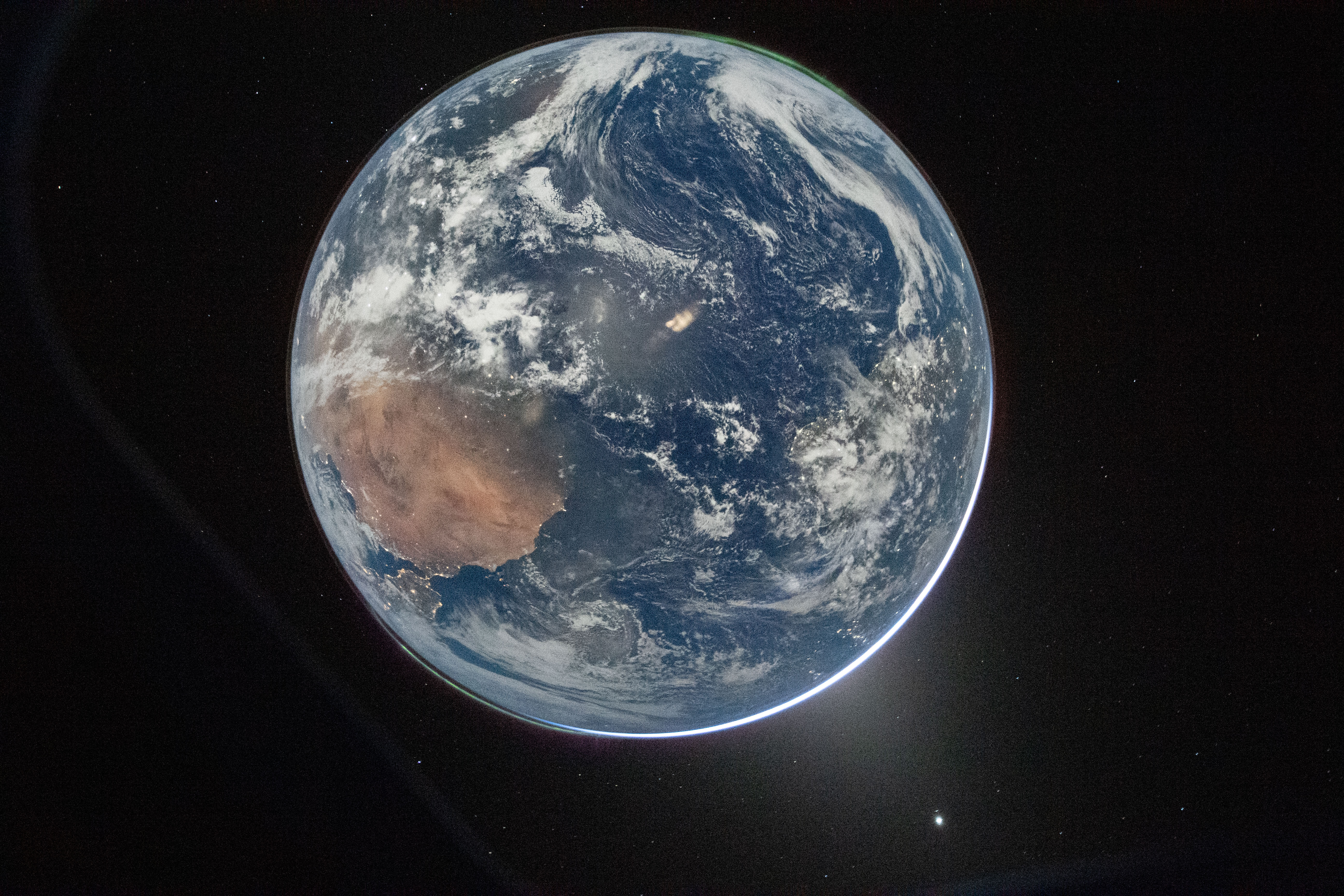
NASA astronaut and Artemis II Commander Reid Wiseman took this picture of Earth from the Orion spacecraft’s window after completing the translunar injection burn. There are two auroras (top right and bottom left) and zodiacal light (bottom right) is visible as the Earth eclipses the Sun.
This and another photo of Earth are the first downlinked images from the Artemis II astronauts. See more photos from Orion as they are shared.
See and hear what the astronauts do with our 24/7 feed.
Image credit: NASA/Reid Wiseman