
Feed aggregator
Hantavirus can persist in semen for years, but that doesn’t mean it remains contagious
Researchers know very little about how long the Andes version of the hantavirus can remain in human hosts
A real Mr. Snuffleupagus? Meet the ocean’s strangest new fish species
A strange, tiny fish that resembles the famous Sesame Street character camouflages amid red algae thanks to its flamboyant reddish “hairs”
NASA Captures Volatile Changes in Earth's Artificial Light
A study of NASA's Black Marble data reveals a pattern of regional volatility in nighttime illumination across the planet.
This startup wants to make drugs in orbit. If it succeeds, it could transform the space economy
Varda’s plan to develop medicines in microgravity has its advantages, but it requires a big up-front cost
How to arm yourself against hantavirus misinformation
Hantavirus misinformation is spreading fast. COVID trauma and social media algorithms may be to blame
A Galaxy Cluster's Wild Youth
The galaxy cluster Abell 2029 is sometimes described as “the most relaxed cluster in the Universe.” This moniker does not arise from some sort of mellow vibe, but rather because of how calm and undisturbed the superheated gas that pervades the cluster appears to be. But new Chandra X-ray observations of the massive cluster highlight a major merger 4 billion years ago that still shape it today.
Can plants have consciousness? The film Silent Friend reimagines the science
The filmmaker behind the newly released movie Silent Friend shares the scientific and historical inspiration for its story of botanical consciousness
Is Earth’s Constant Companion a Stray Asteroid or a Chunk of the Moon?
Earth has a group of cosmic stalkers. Known as “co-orbitals”, these small bits of rock have a 1:1 mean motion resonance with Earth. Basically, they take the exact same amount of time to orbit the Sun as we do. Astronomers have long believed these objects wandered in from the main asteroid belt between Mars and Jupiter, but recent spectral analysis suggests they better match the space-weathered lunar silicates that make up the Moon’s surface. As such, there has been an ongoing debate about whether these cosmic stalkers are actually visitors from the belt or blasted pieces of the Moon. A new study, published in Icarus, from researchers Elisa Alessi and Robert Jedicke provides strong hints that the belt is the more likely source - but pretty soon we’ll get a definitive answer from a spacecraft.
Curiosity Shakes Loose a Pesky Rock
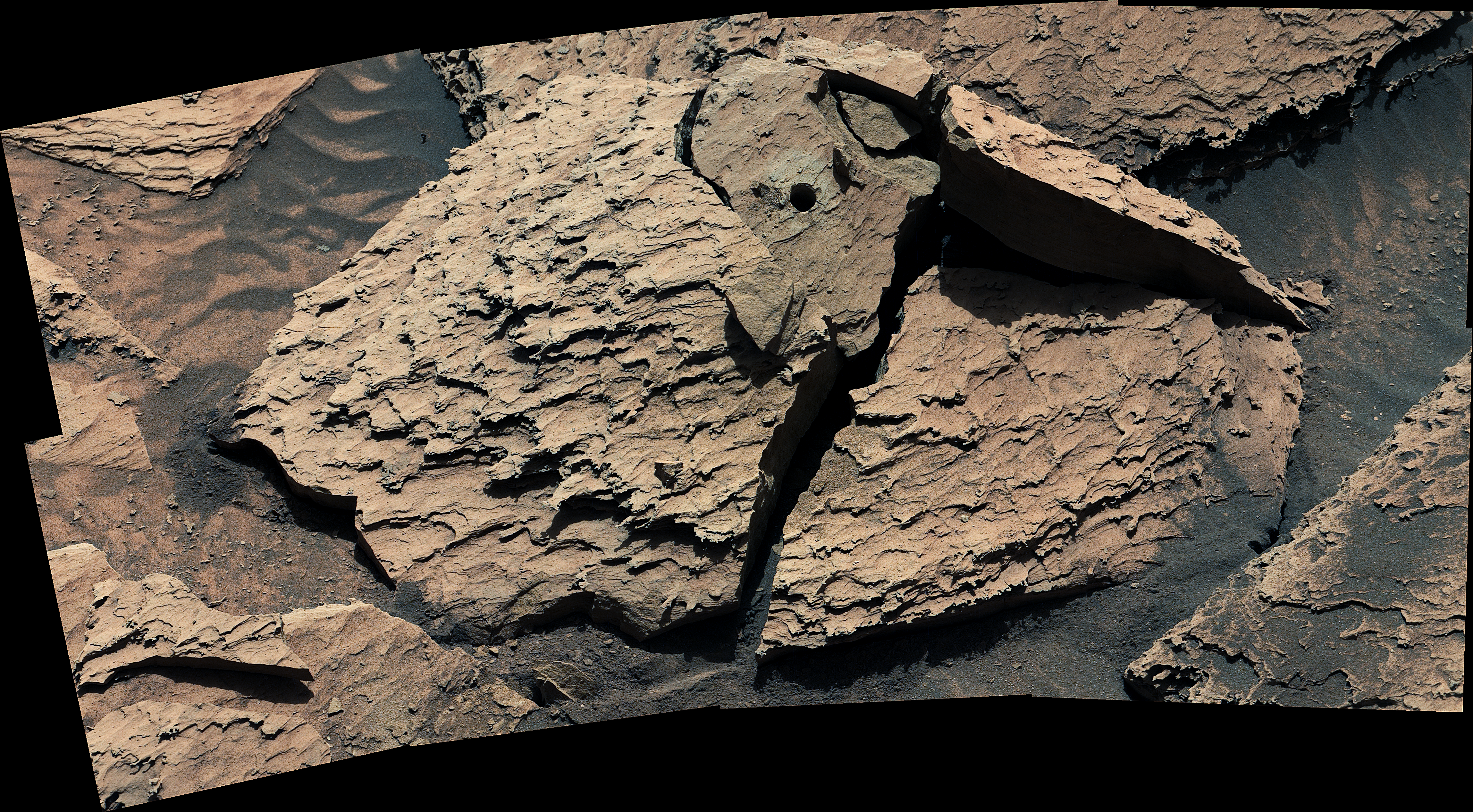
After NASA’s Curiosity Mars rover drilled a sample from this rock on April 25, 2026, it withdrew its robotic arm and pulled the entire rock off the surface with it. Engineers spent several days repositioning the arm and vibrating the drill to try and get the rock loose. When it finally detached on May 1, the rock broke into pieces.
This close-up image of the rock was produced by Curiosity’s Mast Camera, or Mastcam, on May 6. Nicknamed “Atacama,” the rock is estimated to be 1.5 feet in diameter at its base and 6 inches thick. It would weigh roughly 28.6 pounds on Earth (and about a third of that on Mars). The circular hole produced by Curiosity’s drill is visible in the rock.
See Atacama stuck on Curiosity’s drill.
Credit: NASA/JPL-Caltech/MSSS
Curiosity Shakes Loose a Pesky Rock
After NASA’s Curiosity Mars rover drilled a sample from this rock on April 25, 2026, it withdrew its robotic arm and pulled the entire rock off the surface with it. Engineers spent several days repositioning the arm and vibrating the drill to try and get the rock loose. When it finally detached on May 1, the rock broke into pieces.
This close-up image of the rock was produced by Curiosity’s Mast Camera, or Mastcam, on May 6. Nicknamed “Atacama,” the rock is estimated to be 1.5 feet in diameter at its base and 6 inches thick. It would weigh roughly 28.6 pounds on Earth (and about a third of that on Mars). The circular hole produced by Curiosity’s drill is visible in the rock.
See Atacama stuck on Curiosity’s drill.
Credit: NASA/JPL-Caltech/MSSS
Asking AI to explain your medical results? What doctors want you to know
As more people turn to chatbots for medical guidance, the technology is revealing both its promise and its risks
Preparing Smile for space
Before Smile can begin studying how Earth responds to the streams of particles and bursts of radiation from the Sun, the spacecraft had to complete an extraordinary journey here on Earth.
Follow the mission through its final launch preparations at Europe’s Spaceport in French Guiana, from fuelling and encapsulation inside its protective fairing, to meeting the rest of the Vega-C rocket that will take it to space.
Smile is flying to space on Vega-C flight VV29. At 35 m tall, Vega-C weighs 210 tonnes on the launch pad and the rocket will take Smile to orbit with three solid-propellant-powered stages before the fourth liquid-propellant stage takes over for a precise drop-off around Earth.
Smile (the Solar wind Magnetosphere Ionosphere Link Explorer) is a joint European-Chinese mission to study the interaction between the solar wind and Earth’s magnetic environment from a unique highly elliptical orbit. During the next three years, it will go high above the North Pole every two days to collect X-ray and ultraviolet images of Earth’s magnetic shield and the northern lights.
Week in images: 11-15 May 2026
Week in images: 11-15 May 2026
Discover our week through the lens
Hubble Sights Galaxy in Transition
- Hubble Home
- Overview
- Impact & Benefits
- Science
- Observatory
- Team
- Multimedia
- News
- More
3 min read
Hubble Sights Galaxy in Transition This NASA Hubble Space Telescope images reveals the lenticular galaxy, NGC 1266. This enigmatic post-starburst galaxy has a bright center and a face that hints at spiral structure, yet it holds no discernable spiral arms. NASA, ESA, K. Alatalo (STScI); Image Processing: G. Kober (NASA/Catholic University of America)This NASA Hubble Space Telescope image reveals an enigmatic galaxy with a bright center and a face that hints at spiral structure, yet it holds no obvious spiral arms. Reddish-brown clumps and filaments of dust partially obscure the galaxy’s full face, while red, blue, and orange light from distant galaxies shines through its diffuse outer regions and dots the inky-black background.
NGC 1266 is a lenticular galaxy located some 100 million light-years away in the constellation Eridanus (the Celestial River). Astronomers classify lenticulars as transitional galaxies that represent an evolutionary bridge between spirals and ellipticals. Lenticulars are “lens-shaped” and have a bright central bulge and flattened disk like spirals, but they have no spiral arms and little to no star formation like ellipticals.
As interesting as this galaxy’s structure and lenticular classification are, those traits aren’t its most intriguing features. NGC 1266 is a rare post-starburst galaxy that is in transition between a galaxy that experienced a major burst of star formation and a quieter elliptical galaxy. Post-starburst galaxies have a young population of stars but few star-forming regions. Roughly one percent of the local galaxy population is a post-starburst galaxy.
Astronomers think that NGC 1266 had a minor merger with another galaxy some 500 million years ago. The merger spurred the formation of new stars and increased the mass of the galaxy’s central bulge while funneling gas into its supermassive black hole. The additional matter made the black hole much more active, creating an active galactic nucleus or AGN. The black hole’s increased activity would have generated powerful winds and jets of gas along its axis of rotation. Over time, the burst of new stars and the black hole’s powerful jets would deplete the galaxy’s reservoir of star-forming gas, while the turbulence generated in these processes suppressed new stars from forming in the gas that remained.
Observations by Hubble and other observatories reveal a strong outflow of gas from the galaxy and that the space between its stars is shocked or highly disturbed. Researchers found that any remaining stellar nurseries are in the core of the galaxy, and that very little to no star formation happens beyond that core. These observations suggest the supermassive black hole in the galaxy’s heart may be suppressing star birth by stripping or ejecting star-forming gas from the galaxy. The shockwaves from this process would create turbulence that disturbs the gas and dust between stars enough to stop any remaining matter from gravitationally condensing into infant stars.
Post-starburst galaxies like NGC 1266 are ideal subjects for astronomers to study the complex physical processes that suppress star formation. They help us better understand the evolution of galaxies and how supermassive black holes interact with their hosts.
Facebook logo @NASAHubble @NASAHubble Instagram logo @NASAHubbleMedia Contact:
Claire Andreoli
NASA’s Goddard Space Flight Center, Greenbelt, MD
claire.andreoli@nasa.gov
Since its 1990 launch, the Hubble Space Telescope has changed our fundamental understanding of the universe.
Hubble’s Galaxies
Hubble Science
Universe Uncovered
Hubble Sights Galaxy in Transition
- Hubble Home
- Overview
- Impact & Benefits
- Science
- Observatory
- Team
- Multimedia
- News
- More
3 min read
Hubble Sights Galaxy in Transition This NASA Hubble Space Telescope images reveals the lenticular galaxy, NGC 1266. This enigmatic post-starburst galaxy has a bright center and a face that hints at spiral structure, yet it holds no discernable spiral arms. NASA, ESA, K. Alatalo (STScI); Image Processing: G. Kober (NASA/Catholic University of America)This NASA Hubble Space Telescope image reveals an enigmatic galaxy with a bright center and a face that hints at spiral structure, yet it holds no obvious spiral arms. Reddish-brown clumps and filaments of dust partially obscure the galaxy’s full face, while red, blue, and orange light from distant galaxies shines through its diffuse outer regions and dots the inky-black background.
NGC 1266 is a lenticular galaxy located some 100 million light-years away in the constellation Eridanus (the Celestial River). Astronomers classify lenticulars as transitional galaxies that represent an evolutionary bridge between spirals and ellipticals. Lenticulars are “lens-shaped” and have a bright central bulge and flattened disk like spirals, but they have no spiral arms and little to no star formation like ellipticals.
As interesting as this galaxy’s structure and lenticular classification are, those traits aren’t its most intriguing features. NGC 1266 is a rare post-starburst galaxy that is in transition between a galaxy that experienced a major burst of star formation and a quieter elliptical galaxy. Post-starburst galaxies have a young population of stars but few star-forming regions. Roughly one percent of the local galaxy population is a post-starburst galaxy.
Astronomers think that NGC 1266 had a minor merger with another galaxy some 500 million years ago. The merger spurred the formation of new stars and increased the mass of the galaxy’s central bulge while funneling gas into its supermassive black hole. The additional matter made the black hole much more active, creating an active galactic nucleus or AGN. The black hole’s increased activity would have generated powerful winds and jets of gas along its axis of rotation. Over time, the burst of new stars and the black hole’s powerful jets would deplete the galaxy’s reservoir of star-forming gas, while the turbulence generated in these processes suppressed new stars from forming in the gas that remained.
Observations by Hubble and other observatories reveal a strong outflow of gas from the galaxy and that the space between its stars is shocked or highly disturbed. Researchers found that any remaining stellar nurseries are in the core of the galaxy, and that very little to no star formation happens beyond that core. These observations suggest the supermassive black hole in the galaxy’s heart may be suppressing star birth by stripping or ejecting star-forming gas from the galaxy. The shockwaves from this process would create turbulence that disturbs the gas and dust between stars enough to stop any remaining matter from gravitationally condensing into infant stars.
Post-starburst galaxies like NGC 1266 are ideal subjects for astronomers to study the complex physical processes that suppress star formation. They help us better understand the evolution of galaxies and how supermassive black holes interact with their hosts.
Facebook logo @NASAHubble @NASAHubble Instagram logo @NASAHubbleMedia Contact:
Claire Andreoli
NASA’s Goddard Space Flight Center, Greenbelt, MD
claire.andreoli@nasa.gov
Since its 1990 launch, the Hubble Space Telescope has changed our fundamental understanding of the universe.
Hubble’s Galaxies
Hubble Science
Universe Uncovered