
Feed aggregator
Satellites could use magnetic fields to avoid collisions
Hubble Nets Menagerie of Young Stellar Objects
Hubble Nets Menagerie of Young Stellar Objects
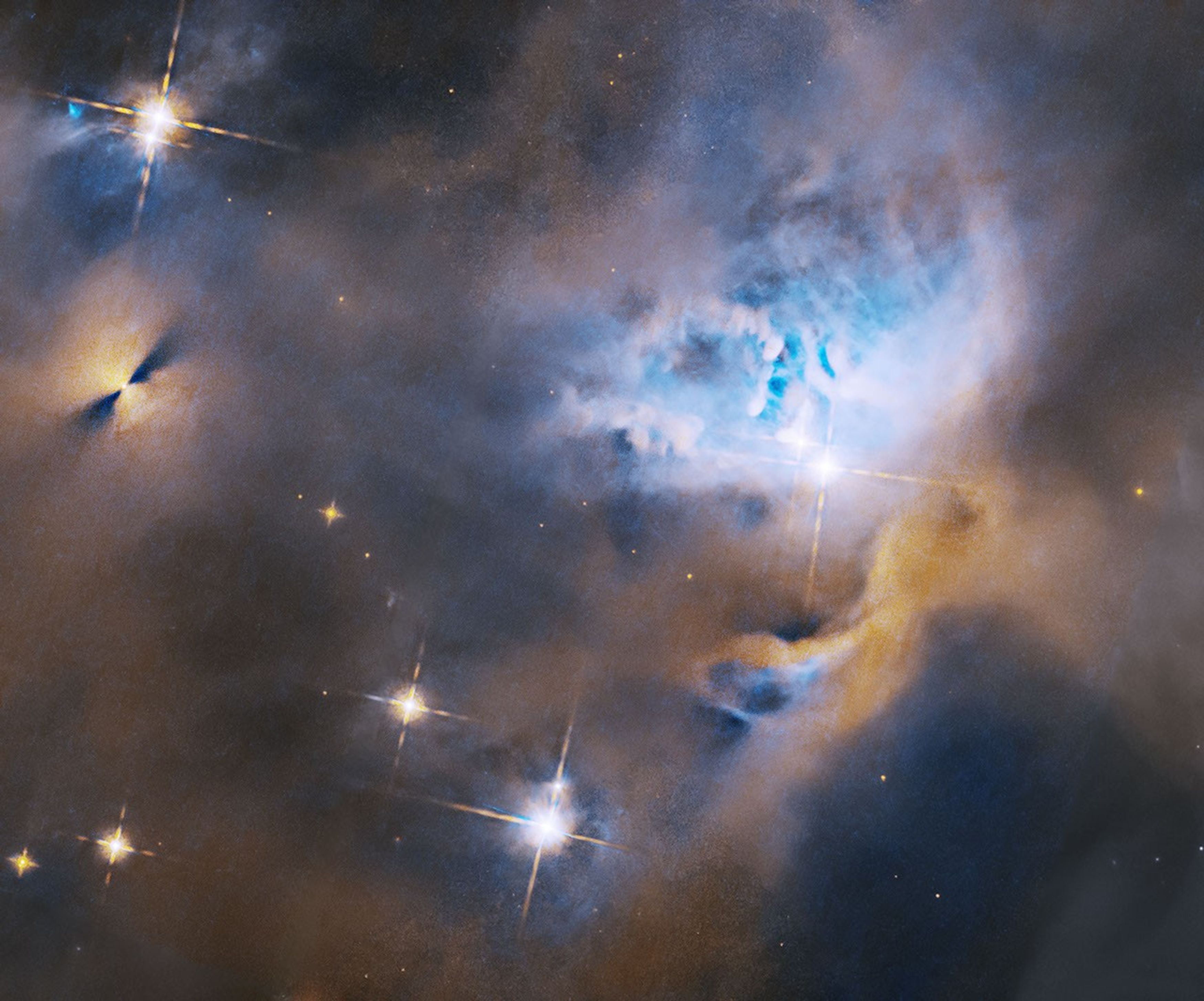
A disparate collection of young stellar objects bejewels a cosmic panorama in the star-forming region NGC 1333 in this new image from NASA’s Hubble Space Telescope. To the left, an actively forming star called a protostar casts its glow on the surrounding gas and dust, creating a reflection nebula. Two dark stripes on opposite sides of the bright point (upper left) are its protoplanetary disk, a region where planets could form, and the disk’s shadow, cast across the large envelope of material around the star. Material accumulates onto the protostar through this rotating disk of gas and dust, a product of the collapsing cloud of gas and dust that gave birth to the star. Where the shadow stops and the disk begins is presently unknown.
To the center right, an outflow cavity reveals a fan-shaped reflection nebula. The two stars at its base, HBC 340 (lower) and HBC 341 (upper), unleash stellar winds, or material flowing from the surface of the star, that clear out the cavity from the surrounding molecular cloud over time. A reflection nebula like this one is illuminated by light from nearby stars that is scattered by the surrounding gas and dust.
This reflection nebula fluctuates in brightness over time, which researchers attribute to variations in brightness of HBC 340 and HBC 341. HBC 340 is the primary source of the fluctuation as the brighter and more variable star.
HBC 340 and HBC 341 are Orion variable stars, a class of forming stars that change in brightness irregularly and unpredictably, possibly due to stellar flares and ejections of matter from their surfaces. Orion variable stars, so named because they are associated with diffuse nebulae like the Orion Nebula, eventually evolve into non-variable stars.
In this image, the four beaming stars near the bottom of the image and one in the top right corner are also Orion variable stars. The rest of the cloudscape is studded with other young stellar objects.
NGC 1333 lies about 950 light-years away in the Perseus molecular cloud, and was imaged by Hubble to learn more about young stellar objects, such as properties of circumstellar disks and outflows in the gas and dust created by these stars.
Hubble Nets Menagerie of Young Stellar Objects
A disparate collection of young stellar objects bejewels a cosmic panorama in the star-forming region NGC 1333 in this new image from NASA’s Hubble Space Telescope. To the left, an actively forming star called a protostar casts its glow on the surrounding gas and dust, creating a reflection nebula. Two dark stripes on opposite sides of the bright point (upper left) are its protoplanetary disk, a region where planets could form, and the disk’s shadow, cast across the large envelope of material around the star. Material accumulates onto the protostar through this rotating disk of gas and dust, a product of the collapsing cloud of gas and dust that gave birth to the star. Where the shadow stops and the disk begins is presently unknown.
To the center right, an outflow cavity reveals a fan-shaped reflection nebula. The two stars at its base, HBC 340 (lower) and HBC 341 (upper), unleash stellar winds, or material flowing from the surface of the star, that clear out the cavity from the surrounding molecular cloud over time. A reflection nebula like this one is illuminated by light from nearby stars that is scattered by the surrounding gas and dust.
This reflection nebula fluctuates in brightness over time, which researchers attribute to variations in brightness of HBC 340 and HBC 341. HBC 340 is the primary source of the fluctuation as the brighter and more variable star.
HBC 340 and HBC 341 are Orion variable stars, a class of forming stars that change in brightness irregularly and unpredictably, possibly due to stellar flares and ejections of matter from their surfaces. Orion variable stars, so named because they are associated with diffuse nebulae like the Orion Nebula, eventually evolve into non-variable stars.
In this image, the four beaming stars near the bottom of the image and one in the top right corner are also Orion variable stars. The rest of the cloudscape is studded with other young stellar objects.
NGC 1333 lies about 950 light-years away in the Perseus molecular cloud, and was imaged by Hubble to learn more about young stellar objects, such as properties of circumstellar disks and outflows in the gas and dust created by these stars.
The 2030 Race for a Moon Reactor
The US’s federally funded space program has been struggling of late. With the recent cancellation of the Mars Sample Return mission, and mass layoffs / resignations taking place at NASA, the general sense of a lack of morale at the agency is palpable, even from a distance. Jared Isaacman, the billionaire software entrepreneur and rocket enthusiast who was recently confirmed as NASA administrator during his second confirmation hearing, hopes to change that, and one of his priorities is pushing the Artemis missions for a permanent human presence on the Moon. However, at least one big technical hurdle remains before being able to do so - how to power a base during the two week long lunar night. A recent press release describes how NASA, and another branch of the federal government (the Department of Energy - DoE) hope to solve that problem - with a lunar-ready nuclear fission reactor
The 3 best ways to tackle anxiety, according to a leading expert
The 3 best ways to tackle anxiety, according to a leading expert
Intricacies of Helix Nebula Revealed With NASA’s Webb
- Webb
- News
- Overview
- Science
- Observatory
- Multimedia
- Team
- More
Image: NASA, ESA, CSA, STScI; Image Processing: Alyssa Pagan (STScI)
NASA’s James Webb Space Telescope has zoomed into the Helix Nebula to give an up-close view of the possible eventual fate of our own Sun and planetary system. In Webb’s high-resolution look, the structure of the gas being shed off by a dying star comes into full focus. The image reveals how stars recycle their material back into the cosmos, seeding future generations of stars and planets, as NASA explores the secrets of the universe and our place in it.
Image: Helix Nebula (NIRCam) This new image of a portion of the Helix Nebula from NASA’s James Webb Space Telescope highlights comet-like knots, fierce stellar winds, and layers of gas shed off by a dying star interacting with its surrounding environment. Image: NASA, ESA, CSA, STScI; Image Processing: Alyssa Pagan (STScI)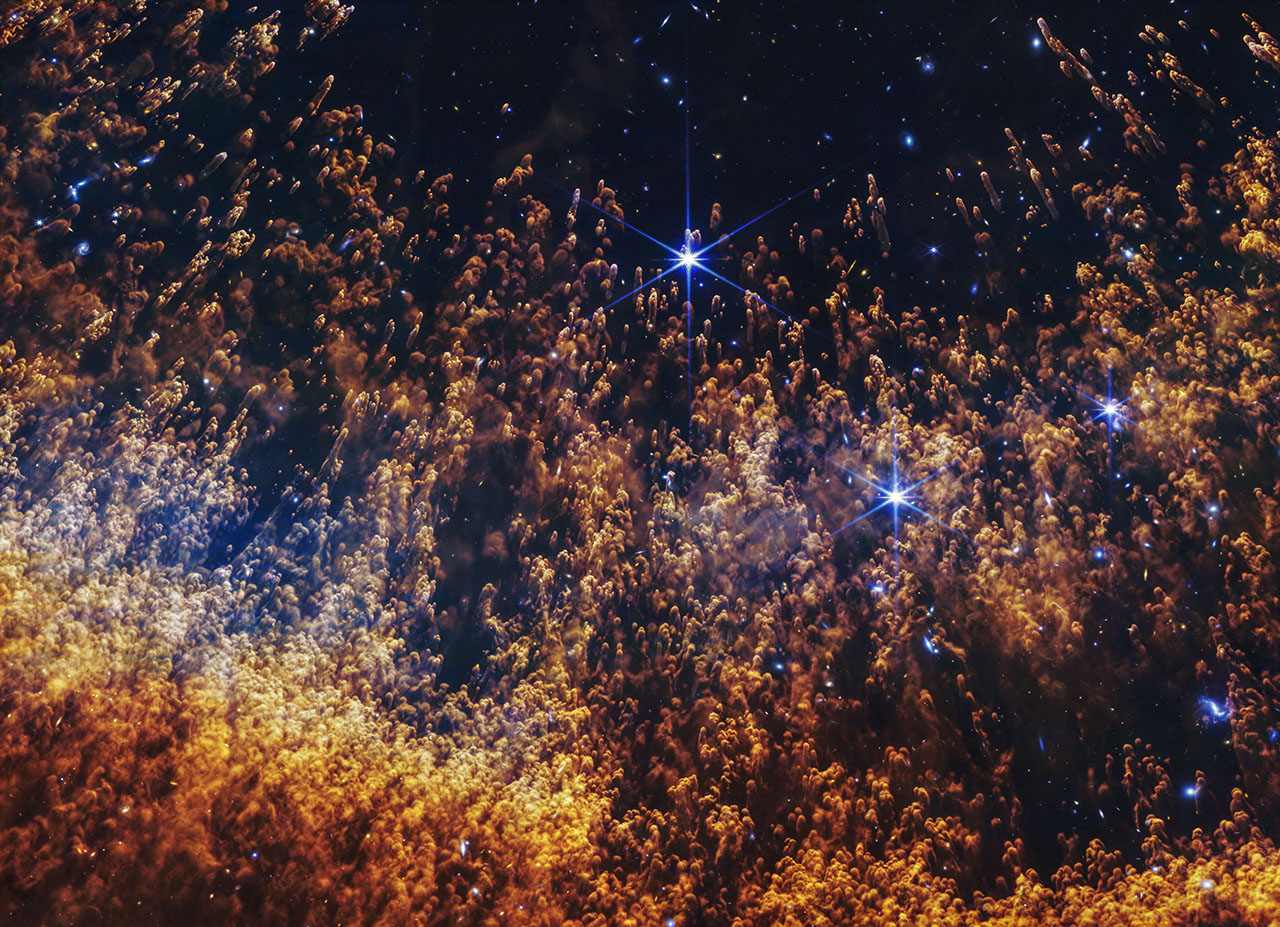
In the image from Webb’s NIRCam (Near-Infrared Camera), pillars that look like comets with extended tails trace the circumference of the inner region of an expanding shell of gas. Here, blistering winds of fast-moving hot gas from the dying star are crashing into slower moving colder shells of dust and gas that were shed earlier in its life, sculpting the nebula’s remarkable structure.
The iconic Helix Nebula has been imaged by many ground- and space-based observatories over the nearly two centuries since it was discovered. Webb’s near-infrared view of the target brings these knots to the forefront compared to the ethereal image from NASA’s Hubble Space Telescope, while its increased resolution sharpens focus from NASA’s retired Spitzer Space Telescope’s snapshot. Additionally, the new near-infrared look shows the stark transition between the hottest gas to the coolest gas as the shell expands out from the central white dwarf.
Image: Helix Nebula Context (VISTA and Webb) This image of the Helix Nebula from the ground-based Visible and Infrared Telescope for Astronomy (left) shows the full view of the planetary nebula, with a box highlighting Webb’s field of view (right). Image: ESO, VISTA, NASA, ESA, CSA, STScI, J. Emerson (ESO); Acknowledgment: CASU
A blazing white dwarf, the leftover core of the dying star, lies right at the heart of the nebula, out of the frame of the Webb image. Its intense radiation lights up the surrounding gas, creating a rainbow of features: hot ionized gas closest to the white dwarf, cooler molecular hydrogen farther out, and protective pockets where more complex molecules can begin to form within dust clouds. This interaction is vital, as it’s the raw material from which new planets may one day form in other star systems.
In Webb’s image of the Helix Nebula, color represents the temperature and chemistry. A touch of a blue hue marks the hottest gas in this field, energized by intense ultraviolet light from the white dwarf. Farther out, the gas cools into the yellow regions where hydrogen atoms join into molecules. At the outer edges, the reddish tones trace the coolest material, where gas begins to thin and dust can take shape. Together, the colors show the star’s final breath transforming into the raw ingredients for new worlds, adding to the wealth of knowledge gained from Webb about the origin of planets.
Spitzer’s studies of the Helix Nebula hinted at the formation of more complex molecules, but Webb’s resolution shows how they form in shielded zones of the scene. In the Webb image, look for dark pockets of space amid the glowing orange and red.
Video: Observatory Comparison (Hubble/Spitzer/Webb)To view this video please enable JavaScript, and consider upgrading to a web browser that
supports HTML5 video
The Helix Nebula is located 650 light-years away from Earth in the constellation Aquarius. It remains a favorite among stargazers and professional astronomers alike due to its relative proximity to Earth, and its similar appearance to the “Eye of Sauron.”
The James Webb Space Telescope is the world’s premier space science observatory. Webb is solving mysteries in our solar system, looking beyond to distant worlds around other stars, and probing the mysterious structures and origins of our universe and our place in it. Webb is an international program led by NASA with its partners, ESA (European Space Agency) and CSA (Canadian Space Agency).
To learn more about Webb, visit:
Downloads & Related InformationThe following sections contain links to download this article’s images and videos in all available resolutions followed by related information links, media contacts, and if available, research paper and Spanish translation links.
Related Images & Videos Helix Nebula (NIRCam)This new image of a portion of the Helix Nebula from NASA’s James Webb Space Telescope highlights comet-like knots, fierce stellar winds, and layers of gas shed off by a dying star interacting with its surrounding environment.
Helix Nebula Context (VISTA and Webb)
This image of the Helix Nebula from the ground-based Visible and Infrared Telescope for Astronomy (left) shows the full view of the planetary nebula, with a box highlighting Webb’s field of view (right).
Helix Nebula (NIRCam Compass Image)
This image of the Helix Nebula, captured by the NIRCam (Near-Infrared Camera) instrument on Webb, includes compass arrows, scale bar, and color key for reference.
Observatory Comparison (Hubble/Spitzer/Webb)
This video compares images of the Helix Nebula from three NASA observatories: Hubble’s image in visible light, Spitzer’s infrared view, and Webb’s high-resolution near-infrared look.
Related Links
Read more: NASA’s Webb Traces Details of Complex Planetary Nebula
Explore more: ViewSpace Star Death: Helix Nebula
Explore more: ViewSpace Celestial Tour: Planetary Nebulae—Sculptures in the Sky
Explore more: Stellar Evolution Flipbook Activity Guide
Contact Media
Laura Betz
NASA’s Goddard Space Flight Center
Greenbelt, Maryland
laura.e.betz@nasa.gov
Hannah Braun
Space Telescope Science Institute
Baltimore, Maryland
Christine Pulliam
Space Telescope Science Institute
Baltimore, Maryland
Related Terms Keep Exploring Related Topics James Webb Space Telescope
Webb is the premier observatory of the next decade, serving thousands of astronomers worldwide. It studies every phase in the…
Stars
Cosmic Origins
Universe
Webb reveals Helix Nebula in glistening detail
The Alien Hunter's Shopping List
We recently discussed the different types of worlds that the Habitable Worlds Observatory (HWO) is expected to find that might have noticeable biosignatures. However, no matter how good the instrumentation on board the observatory is, the data it collects will be useless if scientists don’t know how to interpret it. A paper explaining what data they need to collect before analyzing HWO data was authored by Niki Parenteau, a research biologist at NASA, and her co-authors, which is now available in pre-print on arXiv.
2025 NESC Technical Update
On behalf of the NASA Engineering and Safety Center (NESC), I am pleased to provide you with the 2025 NESC Technical Update. This annual report summarizes the technical work, engineering advancements, and knowledge capture efforts we made in FY25. With support provided by members of our NASA community from across the centers, we focused our efforts on performing value-added independent testing, analysis, and assessments of NASA’s high-risk projects to ensure safety and mission success.
We appreciate the opportunity to share our progress and highlight our FY25 accomplishments. This report and all other NESC knowledge products are available at nasa.gov/nesc. As always, we value your feedback and engagement. Thank you for your continuing support of the NESC.
Timmy R. Wilson
Director, NASA Engineering and Safety Center
Smoke plumes from Chile wildfires seen by Sentinel-3
As the U.S. marks a year of measles outbreaks, is the disease back for good?
The U.S. has held its measles-free status for more than 25 years. Experts say unrelenting outbreaks in the past year may change that
Mars once had a vast sea the size of the Arctic Ocean
Mars once had a vast sea the size of the Arctic Ocean
Is AI really conscious—or are we bringing it to life?
In rethinking whether AI is sentient, we are asking bigger questions about cognition, human-machine interaction and even our own consciousness
Can a ‘brain in a vat’ be conscious?
Consciousness researchers studying “islands of awareness” have found that disconnected brains likely sink into a strange form of deep sleep
How extremophile molds are destroying museum artifacts
Extremophile molds are invading art museums and devouring their collections. Stigma and climate change have fueled their spread
February 2026: Science history from 50, 100 and 150 years ago
Giant atoms; corpses for science
Which dog breed stereotypes are true? Here’s the science
A large dataset shows some dog stereotypes are based in reality, and others might be unfair characterizations