

Feed aggregator
NASA’s Psyche Mission Aces Mars Flyby, Targets Metal-Rich Asteroid
5 min read
Preparations for Next Moonwalk Simulations Underway (and Underwater) This view of a crescent Mars was captured on May 15, 2026, at about 5:03 a.m. PDT by NASA’s Psyche mission as it approached the planet for a gravity assist. The image has been processed into a natural-color view using red, green, and blue data from the multispectral imager instrument.NASA/JPL-Caltech/ASU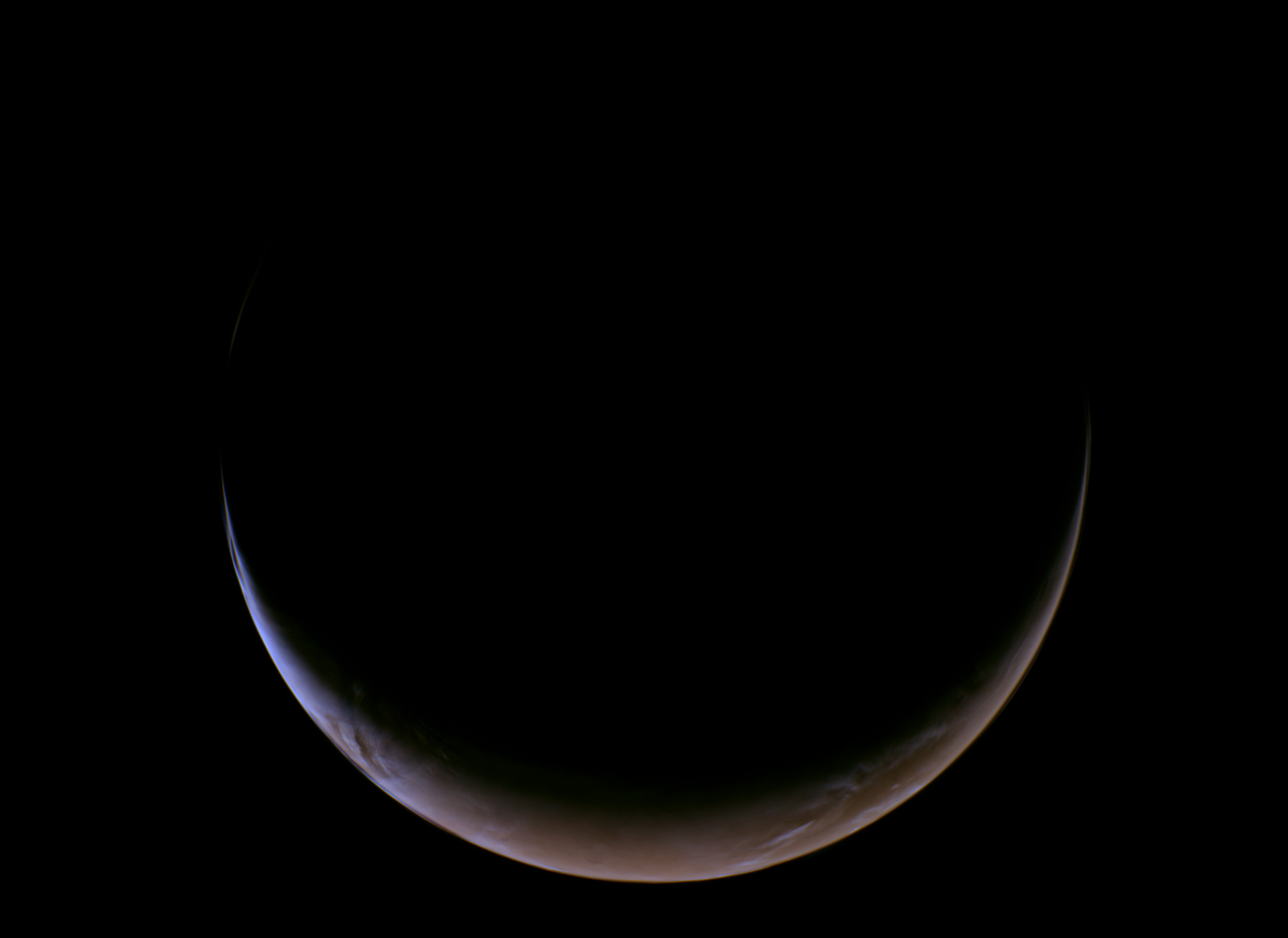
NASA’s Psyche spacecraft completed its close approach of Mars on May 15, coming within 2,864 miles (4,609 kilometers) of the planet’s surface. This flyby used a gravity assist from Mars to provide a critical boost in speed and to adjust the spacecraft’s orbital plane without using any onboard propellant, sending it on its way toward the metal-rich asteroid Psyche.
The spacecraft is now headed directly toward the asteroid, located in the main asteroid belt between Mars and Jupiter. After the Mars flyby, the flight team analyzed radio signals between the spacecraft and NASA’s Deep Space Network (DSN), the agency’s global system for communicating with interplanetary spacecraft, to confirm that Psyche was on the correct trajectory.
“Although we were confident in our calculations and flight plan, monitoring the DSN’s Doppler signal in real time during the flyby was still exciting,” said Don Han, Psyche’s navigation lead at NASA’s Jet Propulsion Laboratory in Southern California. “We’ve confirmed that Mars gave the spacecraft a 1,000 mile‑per‑hour boost and shifted its orbital plane by about 1 degree relative to the Sun. We are now on course for arrival at the asteroid Psyche in summer 2029.”
This is the first view of a nearly “full Mars” as seen by NASA’s Psyche spacecraft shortly after its closest approach to the planet on May 15, 2026. The view extends from the south polar cap northwards to the Valles Marineris canyon system and beyond.NASA/JPL-Caltech/ASU This is the highest-resolution view of the water ice-rich south polar cap of Mars captured by NASA’s Psyche mission after it made its close approach with the planet for a gravity assist. The cap is more than 430 miles (700 kilometers) across.NASA/JPL-Caltech/ASU Unique Martian viewIn the days running up to and during close approach, all of Psyche’s instruments were powered up for calibration efforts, including its imagers, magnetometers, and gamma-ray and neutron spectrometer. The planetary encounter provided the mission a valuable practice run for when it reaches the asteroid Psyche; as a bonus, it captured Mars images from a rare perspective.
Because Psyche approached Mars from a high phase angle, the planet appeared as a thin crescent in the days running up to the close approach, lit by sunlight reflecting off its surface. In observations from the spacecraft’s multispectral imager, the crescent appeared brighter and extended farther around the planet’s disk than anticipated because of the strong scattering of sunlight through the planet’s dusty atmosphere. As Psyche passed from Mars’ nighttime skies to daytime, it took a rapid series of pictures of the surface around the time of closest approach.
“We’ve captured thousands of images of the approach to Mars and of the planet’s surface and atmosphere at close approach. This dataset provides unique and important opportunities for us to calibrate and characterize the performance of the cameras, as well as test the early versions of our image processing tools being developed for use at the asteroid Psyche,” said Jim Bell, the Psyche imager instrument lead at Arizona State University (ASU) in Tempe. “As the spacecraft continues its journey after the flyby, we’ll continue calibration imaging of Mars for the rest of the month as it recedes into the distance.”
Bell also leads the Mastcam-Z imaging investigation on NASA’s Perseverance Mars rover mission team, which was among several missions that provided complementary surface and atmospheric imaging as well as navigation data during the flyby to help with calibration efforts. Other missions involved include NASA’s Mars Reconnaissance Orbiter, 2001 Mars Odyssey orbiter, and Curiosity rover, along with ESA’s (European Space Agency’s) Mars Express and ExoMars Trace Gas Orbiter.
In addition to the imager, early calibration measurements made by Psyche’s magnetometers may have detected Mars’ bow shock as the spacecraft passed the planet. The gamma-ray and neutron spectrometer team was also quickly gathering data to calibrate the instrument by comparing their measurements with the large pool of existing Mars data.
This view of the Martian surface shows streaks that have formed due to wind blowing over impact craters in the Syrtis Major region. The wind streaks extend to about 30 miles (50 kilometers) long, and the large craters near center-bottom of the scene average around 30 miles in diameter.NASA/JPL-Caltech/ASU Captured by Psyche’s multispectral imager instrument, this is an enhanced-color view of the large double-ring crater Huygens (upper right; about 290 miles, or 470 kilometers, in diameter) and the surrounding heavily cratered southern highlands.NASA/JPL-Caltech/ASU Onward to asteroid PsycheWith Mars in the rearview mirror, the spacecraft will soon resume using its solar-electric propulsion system to make a beeline to the main asteroid belt. When it arrives in August 2029, it will insert itself into orbit around the asteroid Psyche, which is thought to be the partial core of a planetesimal, a building block of an early planet. Through a series of circular orbits that go lower and then higher in altitude around Psyche, which is about 173 miles (280 kilometers) across at its widest point, the spacecraft will map the asteroid and gather science data.
If the asteroid proves to be the metallic core of an ancient planetesimal, it could offer a one-of-a-kind window into the interior of rocky planets like Earth.
“We’ve been anticipating the Mars flyby for years, but now it’s complete. We can thank the Red Planet for giving our spacecraft a critical gravitational slingshot farther into the solar system,” said Lindy Elkins-Tanton, principal investigator for Psyche at the University of California, Berkeley. “Onward to the asteroid Psyche!”
More about PsycheThe Psyche mission is led by ASU. A division of Caltech in Pasadena, JPL is responsible for the mission’s overall management, system engineering, integration and test, and mission operations. Intuitive Machines in Palo Alto, California, provided the high-power solar electric propulsion spacecraft chassis. The operations of the imager instrument are led by ASU, collaborating with Malin Space Science Systems in San Diego on the design, fabrication, and testing of the cameras.
Psyche is the 14th mission selected as part of NASA’s Discovery Program, managed by the agency’s Marshall Space Flight Center in Huntsville, Alabama. NASA’s Launch Services Program, based at NASA’s Kennedy Space Center in Florida, managed the launch service.
For more information about NASA’s Psyche mission, visit:
https://science.nasa.gov/mission/psyche/
News Media Contacts
Ian J. O’Neill
Jet Propulsion Laboratory, Pasadena, Calif.
818-354-2649
ian.j.oneill@jpl.nasa.gov
Karen Fox / Molly Wasser
NASA Headquarters, Washington
240-285-5155 / 240-419-1732
karen.c.fox@nasa.gov / molly.l.wasser@nasa.gov
2026-033
Share Details Last Updated May 19, 2026 Related Terms Explore More 1 min read NASA’s Psyche Mission Images Mars’ Huygens CraterDescription Captured by the multispectral imager instrument on NASA’s Psyche mission, this is an enhanced-color…
Article 3 hours ago 1 min read NASA’s Psyche Mission Spies Mars’ Wind-Blown Craters During Close ApproachDescription This view of the Martian surface, captured by NASA’s Psyche spacecraft on May 15,…
Article 3 hours ago 1 min read Psyche’s High-Resolution View of Mars’ South PoleDescription This is the highest-resolution view of the water ice-rich south polar cap of Mars…
Article 3 hours ago Keep Exploring Discover Related Topics Psyche SpacecraftPsyche is a NASA mission to study a metal rich asteroid with the same name located in the main asteroid…
Asteroids, Comets & MeteorsOverview Asteroids, comets, and meteoroids are chunks of rock, ice, and metal left over from the formation of our solar…
Mars ExplorationMars is the only planet we know of inhabited entirely by robots. Learn more about the Mars Missions.
Planetary ScienceNASA’s planetary science program explores the objects in our solar system to better understand its history and the distribution of…
SpaceX punts Starship V3 launch to May 21 as investigation opens into Starbase worker’s death
SpaceX is now targeting the evening of May 21 to launch the latest and largest version of its Starship megarocket for the first time
What it’s like being stuck in a hantavirus quarantine for six weeks
Scientific American spoke to one of the people who are currently being monitored for possible hantavirus infection at the National Quarantine Unit in Nebraska
An Explanation for the Massive Black Holes the JWST Found in the Early Universe
Ever since the JWST found over-massive black holes in the early Universe, researchers have been trying to understand them. Theory showed that black holes and their galaxies grew in synchronization with each other. That can't explain the JWST's findings, but new research might.
Moon-Venus Conjunction
Moon-Venus Conjunction
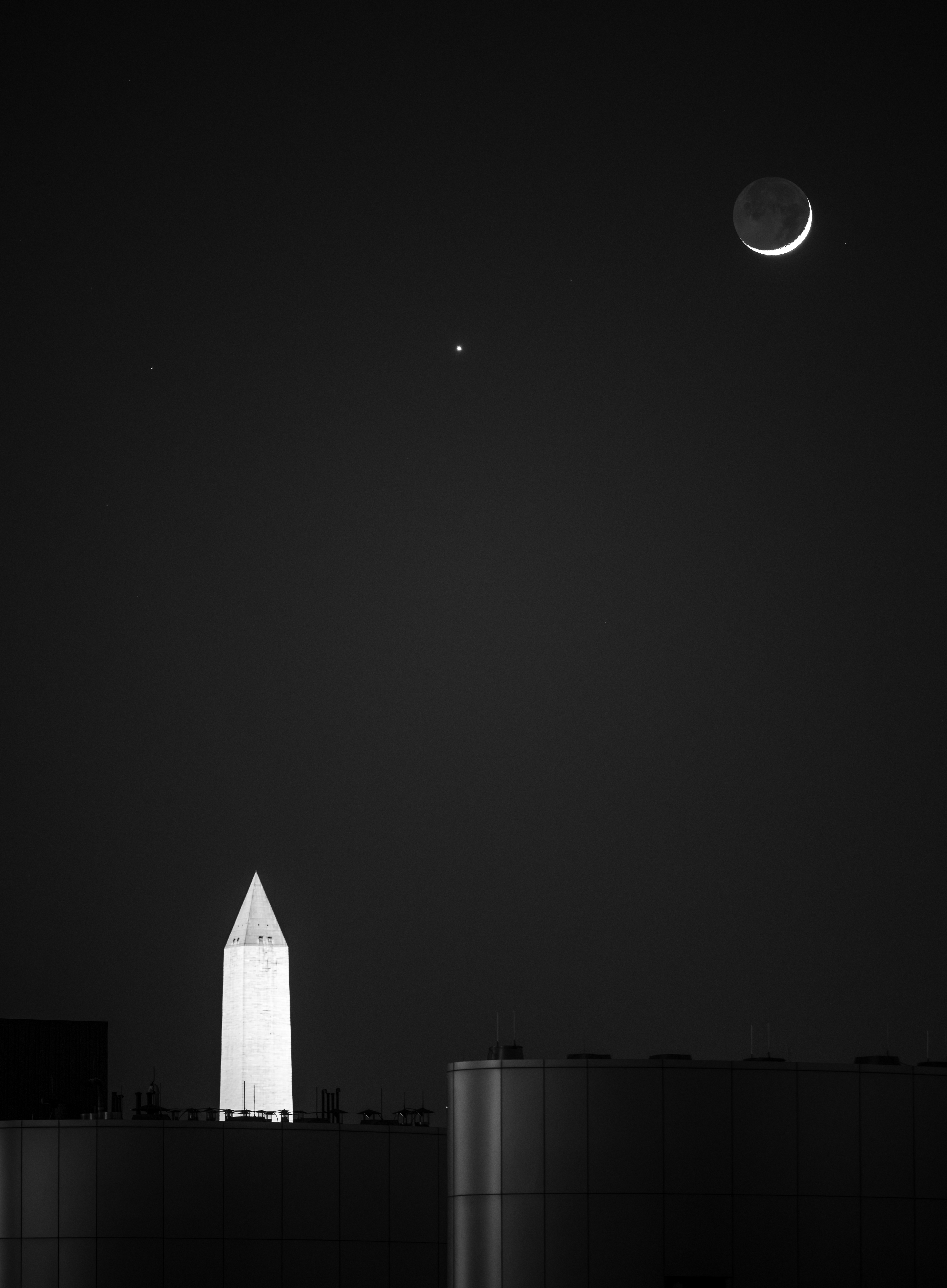
The Moon and Venus, center, are seen in conjunction above the Washington Monument, Monday, May 18, 2026, as viewed from the Mary W. Jackson NASA Headquarters Building in Washington.
The Moon and Venus look close together because they line up from our point of view on Earth. In reality, they are separated by millions of miles in space.
See more photos of the conjunction.
Image credit: NASA/Bill Ingalls
Moon-Venus Conjunction
The Moon and Venus, center, are seen in conjunction above the Washington Monument, Monday, May 18, 2026, as viewed from the Mary W. Jackson NASA Headquarters Building in Washington.
The Moon and Venus look close together because they line up from our point of view on Earth. In reality, they are separated by millions of miles in space.
See more photos of the conjunction.
Image credit: NASA/Bill Ingalls
‘Sensational’ proof topples decades-old geometry problem
The sudden resolution of a well-known conjecture highlights the growing adoption of AI as an assistant in high-level mathematics
The distant world that is our best hope of finding alien life
The distant world that is our best hope of finding alien life
Solar farm on the ocean outperforms land-based solar in Taiwan
Solar farm on the ocean outperforms land-based solar in Taiwan
Johnson’s Cindy Evans Prepares Artemis Teams for Lunar Science
NASA’s Artemis II crew had many technical and operational responsibilities during their historic mission to the Moon, but they also served an important role as scientific ambassadors to Earth’s nearest neighbor.
On their 10-day journey, the crew flew by the far side of the Moon, analyzing and photographing geologic features such as impact craters and ancient lava flows. Their observations will help pave the way for science activities on future Artemis missions to the Moon’s surface and contribute to lunar and planetary science. The crew relied on the extensive geology training they received on Earth to describe nuances in shapes, textures, and colors — the type of information that reveals the geologic history of an area.
Artemis geology training lead at NASA’s Johnson Space Center in Houston, Cindy Evans (left) and NASA astronaut and Artemis II mission specialist Christina Koch study geologic features in Iceland during Artemis II crew geology training in August 2024. NASA/Robert Markowitz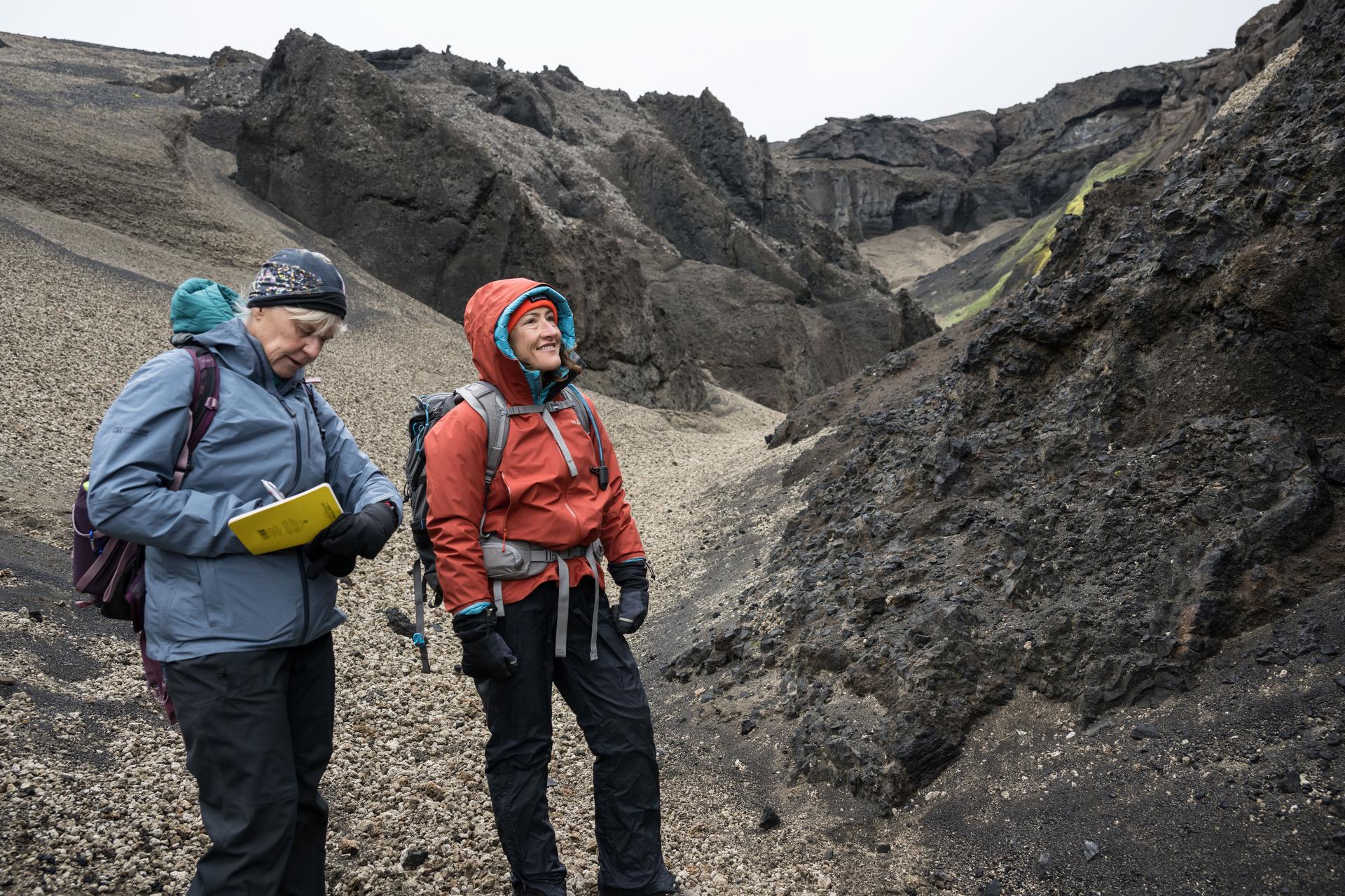
Cindy Evans, Artemis exploration scientist and geology training lead, was one of the crew’s instructors. Based at NASA’s Johnson Space Center in Houston in the Astromaterials Research and Exploration Science (ARES) Division, Evans is part of the Artemis Internal Science Team and spearheads geology training for crew members, mission managers, engineers, and flight controllers. That effort centers around a core curriculum of geology, lunar, and planetary classroom science as well as a progression of geology-focused field classes.
“As the scientists ‘on the ground,’ Artemis crew members require geology and field skills so that they can execute the mission science requirements from lunar orbit and on the surface of the Moon,” Evans explained. “Whether they’re looking out the spacecraft’s windows or walking the surface, Artemis astronauts are working on behalf of all scientists to collect clues to the ancient geologic processes that shaped the Moon and our solar system. They need to have the muscle memory and confidence in their geology knowledge to conduct the geology observations, sampling, and other scientific tasks.”
Cindy Evans during an Artemis II Lunar Science Team simulation at Johnson Space Center. The team used simulations to practice mission operations support for real-time assessment of imagery and observations made by the Artemis II crew. NASA/James Blair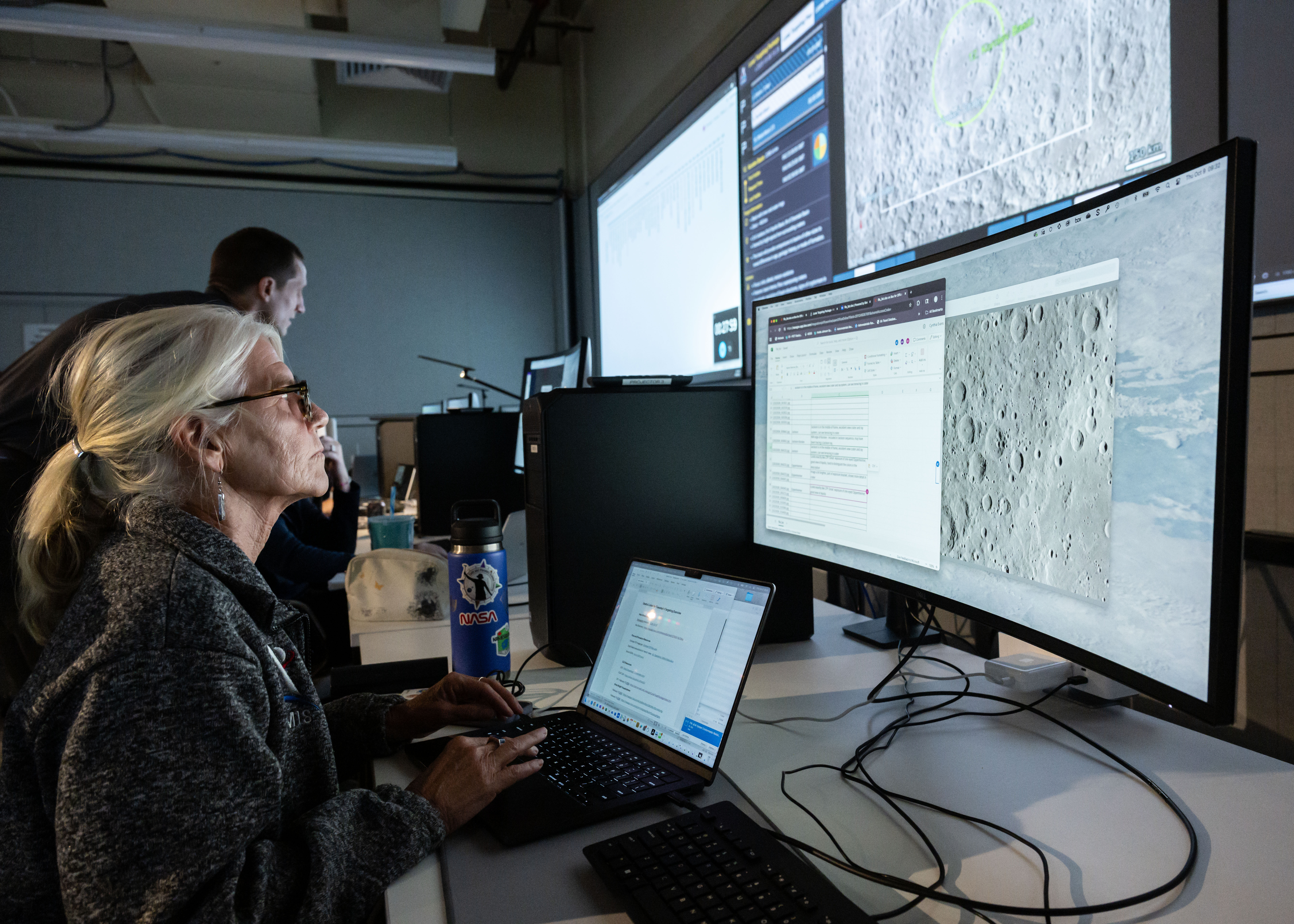
A former oceanographer who studied the rocks comprising oceanic crust, Evans imagined that she would explore the Moon as a NASA astronaut one day. That dream led her to Johnson, even if it did not result in her donning a flight suit.
In her 37 years with the agency, Evans contributed to the Space Shuttle Program, Shuttle-Mir Program, and the International Space Station before transitioning to NASA’s Artemis campaign. Some of her notable achievements include establishing the Crew Earth Observations effort for Shuttle-Mir, which equipped crews to photograph the Earth as it changed below them. As part of the imagery team investigating the Columbia accident, she helped to develop and integrate the space shuttle’s Return to Flight imagery inspection process. “I have been both honored and incredibly fortunate to have participated in a wide variety of human spaceflight programs,” Evans said. “And I am very proud of the work my team is doing right now.”
Evans also had two opportunities to travel to Antarctica to participate in deep-field geology sessions. “Few things in this world are as wonderful as camping on blue ice just a couple hundred miles from Earth’s South Pole and collecting rocks from space,” she said.
Cindy Evans collects a meteorite from the Davis Ward Icefield during a deep-field deployment to Antarctica. Cindy Evans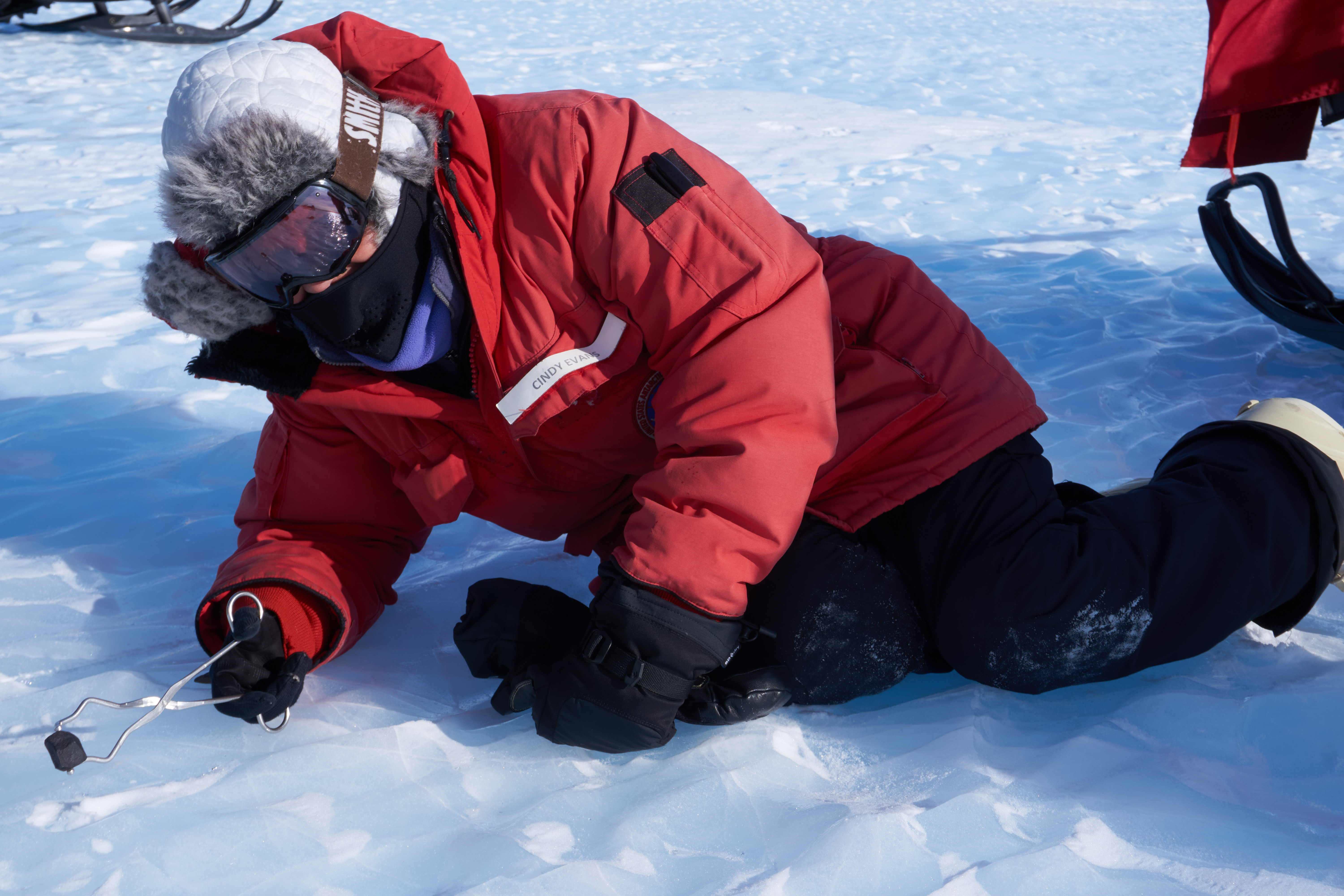
Collaborating with professionals across a variety of fields has been an integral part of Evans’ work since the start of her career. “In graduate school I was trained as an oceanographer – an interdisciplinary field where geology meets biology, chemistry, and physical oceanography,” she said. “As a planetary scientist at Johnson, I am challenged to work in a world of engineers, and embrace the complex teamwork between hardware engineers, operations engineers, management – many of whom are engineers – and scientists. It has been an incredible opportunity.”
Those interdisciplinary experiences taught Evans to embrace flexibility. “Human spaceflight is a dynamic endeavor,” she said. “I have enjoyed many different roles, and each and every position taught me new things and stretched my perspective.”
Cindy Evans mentors NASA astronaut Marcos Berríos in observing and describing rock samples during an in-field geology training in Flagstaff, Arizona. NASA/Riley McClenaghan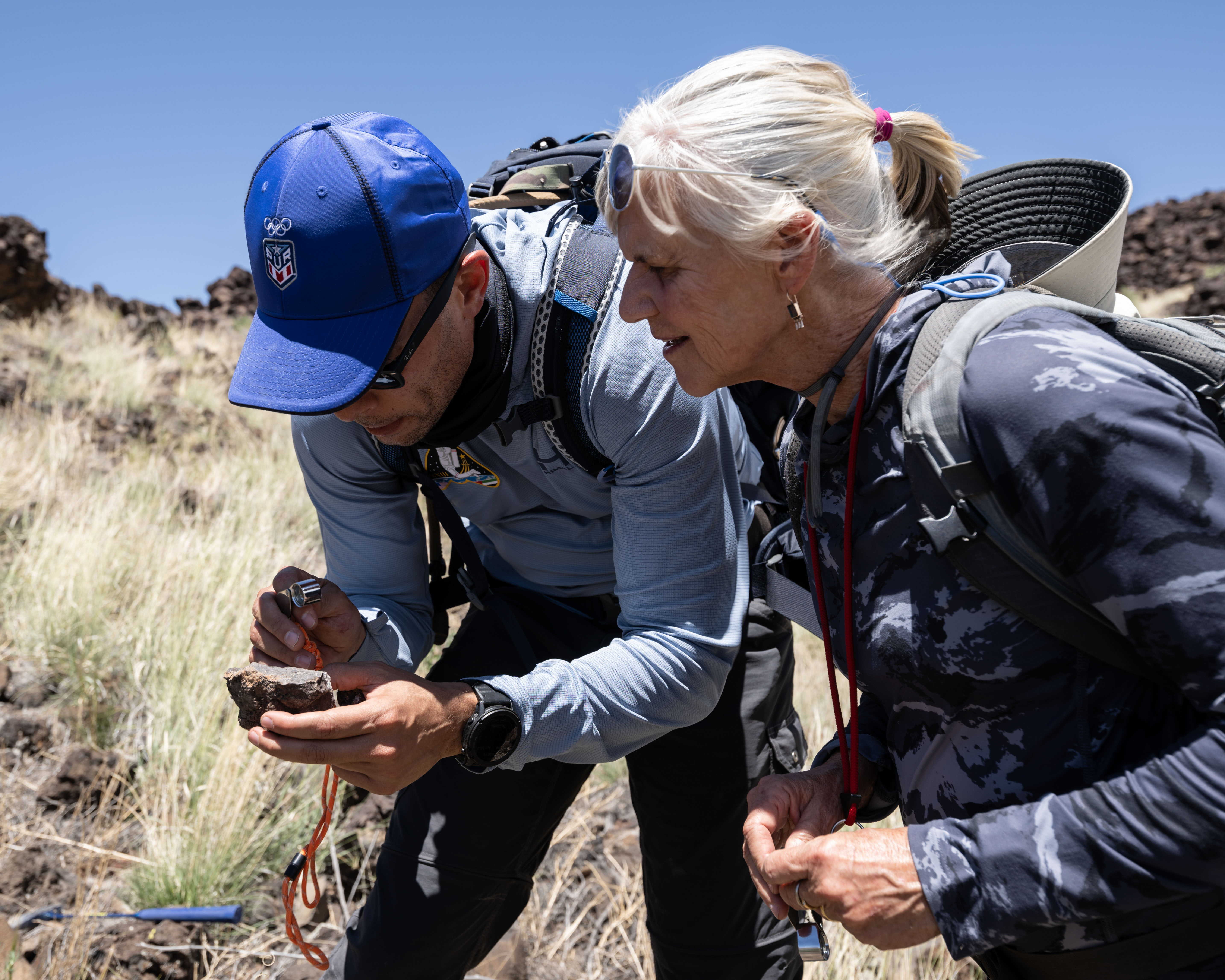
Another important lesson? “As a former lab rat, I have learned that it’s all about the people. A common thread throughout my career at NASA is the professional fulfillment brought by relationships with and the talents of colleagues and teammates,” she said.
Evans encourages early-career and aspiring NASA team members to reach out to colleagues in different organizations to build connections. “You never know where a pathway will lead,” she said. “Plans can change – don’t pass up opportunities! Even if an opportunity isn’t an obvious or intuitive next step, it’s worth your consideration.”
About the AuthorLinda E. Grimm Share Details Last Updated May 19, 2026 Related Terms Explore More 3 min read Johnson Photographers Honored for Award-Winning Portraits Article 1 day ago 4 min read NASA Outlines Preliminary Artemis III Mission Plans Article 6 days ago 6 min read NASA Langley Engineer Attends FAA Training Article 1 week ago Keep Exploring Discover More Topics From NASAMissions
Humans in Space
Climate Change
Solar System
Johnson’s Cindy Evans Prepares Artemis Teams for Lunar Science
NASA’s Artemis II crew had many technical and operational responsibilities during their historic mission to the Moon, but they also served an important role as scientific ambassadors to Earth’s nearest neighbor.
On their 10-day journey, the crew flew by the far side of the Moon, analyzing and photographing geologic features such as impact craters and ancient lava flows. Their observations will help pave the way for science activities on future Artemis missions to the Moon’s surface and contribute to lunar and planetary science. The crew relied on the extensive geology training they received on Earth to describe nuances in shapes, textures, and colors — the type of information that reveals the geologic history of an area.
Artemis geology training lead at NASA’s Johnson Space Center in Houston, Cindy Evans (left) and NASA astronaut and Artemis II mission specialist Christina Koch study geologic features in Iceland during Artemis II crew geology training in August 2024. NASA/Robert MarkowitzCindy Evans, Artemis exploration scientist and geology training lead, was one of the crew’s instructors. Based at NASA’s Johnson Space Center in Houston in the Astromaterials Research and Exploration Science (ARES) Division, Evans is part of the Artemis Internal Science Team and spearheads geology training for crew members, mission managers, engineers, and flight controllers. That effort centers around a core curriculum of geology, lunar, and planetary classroom science as well as a progression of geology-focused field classes.
“As the scientists ‘on the ground,’ Artemis crew members require geology and field skills so that they can execute the mission science requirements from lunar orbit and on the surface of the Moon,” Evans explained. “Whether they’re looking out the spacecraft’s windows or walking the surface, Artemis astronauts are working on behalf of all scientists to collect clues to the ancient geologic processes that shaped the Moon and our solar system. They need to have the muscle memory and confidence in their geology knowledge to conduct the geology observations, sampling, and other scientific tasks.”
Cindy Evans during an Artemis II Lunar Science Team simulation at Johnson Space Center. The team used simulations to practice mission operations support for real-time assessment of imagery and observations made by the Artemis II crew. NASA/James BlairA former oceanographer who studied the rocks comprising oceanic crust, Evans imagined that she would explore the Moon as a NASA astronaut one day. That dream led her to Johnson, even if it did not result in her donning a flight suit.
In her 37 years with the agency, Evans contributed to the Space Shuttle Program, Shuttle-Mir Program, and the International Space Station before transitioning to NASA’s Artemis campaign. Some of her notable achievements include establishing the Crew Earth Observations effort for Shuttle-Mir, which equipped crews to photograph the Earth as it changed below them. As part of the imagery team investigating the Columbia accident, she helped to develop and integrate the space shuttle’s Return to Flight imagery inspection process. “I have been both honored and incredibly fortunate to have participated in a wide variety of human spaceflight programs,” Evans said. “And I am very proud of the work my team is doing right now.”
Evans also had two opportunities to travel to Antarctica to participate in deep-field geology sessions. “Few things in this world are as wonderful as camping on blue ice just a couple hundred miles from Earth’s South Pole and collecting rocks from space,” she said.
Cindy Evans collects a meteorite from the Davis Ward Icefield during a deep-field deployment to Antarctica. Cindy EvansCollaborating with professionals across a variety of fields has been an integral part of Evans’ work since the start of her career. “In graduate school I was trained as an oceanographer – an interdisciplinary field where geology meets biology, chemistry, and physical oceanography,” she said. “As a planetary scientist at Johnson, I am challenged to work in a world of engineers, and embrace the complex teamwork between hardware engineers, operations engineers, management – many of whom are engineers – and scientists. It has been an incredible opportunity.”
Those interdisciplinary experiences taught Evans to embrace flexibility. “Human spaceflight is a dynamic endeavor,” she said. “I have enjoyed many different roles, and each and every position taught me new things and stretched my perspective.”
Cindy Evans mentors NASA astronaut Marcos Berríos in observing and describing rock samples during an in-field geology training in Flagstaff, Arizona. NASA/Riley McClenaghanAnother important lesson? “As a former lab rat, I have learned that it’s all about the people. A common thread throughout my career at NASA is the professional fulfillment brought by relationships with and the talents of colleagues and teammates,” she said.
Evans encourages early-career and aspiring NASA team members to reach out to colleagues in different organizations to build connections. “You never know where a pathway will lead,” she said. “Plans can change – don’t pass up opportunities! Even if an opportunity isn’t an obvious or intuitive next step, it’s worth your consideration.”
About the AuthorLinda E. Grimm Share Details Last Updated May 19, 2026 Related Terms Explore More 3 min read Johnson Photographers Honored for Award-Winning Portraits Article 1 day ago 4 min read NASA Outlines Preliminary Artemis III Mission Plans Article 6 days ago 6 min read NASA Langley Engineer Attends FAA Training Article 1 week ago Keep Exploring Discover More Topics From NASAMissions
Humans in Space
Climate Change
Solar System
New NASA Hubble image captures a rare, turbulent galaxy
The new image shows the galaxy NGC 1266, a transitional object with a clutch of young stars that likely collided with a smaller galaxy 500 million years ago
How Jupiter’s Moon Ganymede Melted Its Core
A new model explains how Ganymede got its molten core — which in turn has given Jupiter's largest moon its magnetic field.
The post How Jupiter’s Moon Ganymede Melted Its Core appeared first on Sky & Telescope.
What If the Universe Had No Beginning? Part 4: The Reckoning
No quantum gravity. The wrong peak in the wave function. Boltzmann Babies. Roger Penrose pointing out that the arrow of time was smuggled in through the back door. The no-boundary proposal is beautiful. It is also possibly wrong in many specific ways.
Scientists race to develop Ebola drugs as outbreak surges
Clinical trials for treatments against Ebola Bundibugyo virus are ‘in a strong position’ to be launched quickly in the Democratic Republic of the Congo and Uganda
NASA’s New Shock Detectives Project Invites Volunteers to Help Study Solar Wind
The Sun sprays an extremely fast stream of charged particles called the solar wind. At approximately 56,000 miles (90,000 kilometers) in front of the Earth toward the Sun, the solar wind collides with the Earth’s protective magnetic field, generating a long-lasting shock wave that stretches for hundreds of thousands of miles. Now, you can help scientists examine data about this “bow shock” to better understand how the solar wind affects the Earth by joining a new research project: Shock Detectives.
At this enormous shock wave boundary, the ever-changing magnetic field can either make the solar wind messy and dynamic (“chaotic”) or leave it smooth and stable (“peaceful”).
When “chaotic” plasma dominates, more energy can reach Earth’s magnetosphere, possibly leading to disruptions in GPS signals, communications, and power grids. Scientists don’t yet fully understand when the plasma changes between “peaceful” and “chaotic” states or how those changes affect energy transfer to Earth.
You can help solve this mystery. NASA’s Magnetospheric Multiscale (MMS) mission has collected more than ten years of data from this zone – more than scientists can analyze alone. As Shock Detectives, you’ll help sort the chaotic from peaceful regions of the data, giving researchers a crucial set of clues.
The value of this new knowledge doesn’t end at Earth – what scientists learn about the Earth-Sun bow shock will help them understand how the solar wind of other stars impacts their orbiting planets. Your contributions may help take Shock Detectives ‘out of this world’!
This project is closely connected to another NASA-supported project, Space Umbrella, which also relies on MMS data and imagery. While Space Umbrella focuses on the broad boundary between Earth’s magnetic shield and the surrounding solar wind, Shock Detectives zooms in just outside that boundary on the transition region, which can be upwards of 10 miles (17 kilometers) in thickness, to better understand how plasma behaves near the shock. Together, these efforts build a more complete picture of Earth’s space environment.
Join Shock Detectives and help crack the case here: https://go.nasa.gov/4wILD6Y
Want a quick overview? Check out the introduction video.
The Earth’s magnetosphere (blue) interacts with the solar wind,, creating a shock wave (red), like a sonic boom in space. Join the Shock Detectives project and help scientists study this region and better understand how the solar wind affects our livesMark Garlick/Science Photo Library via Getty Images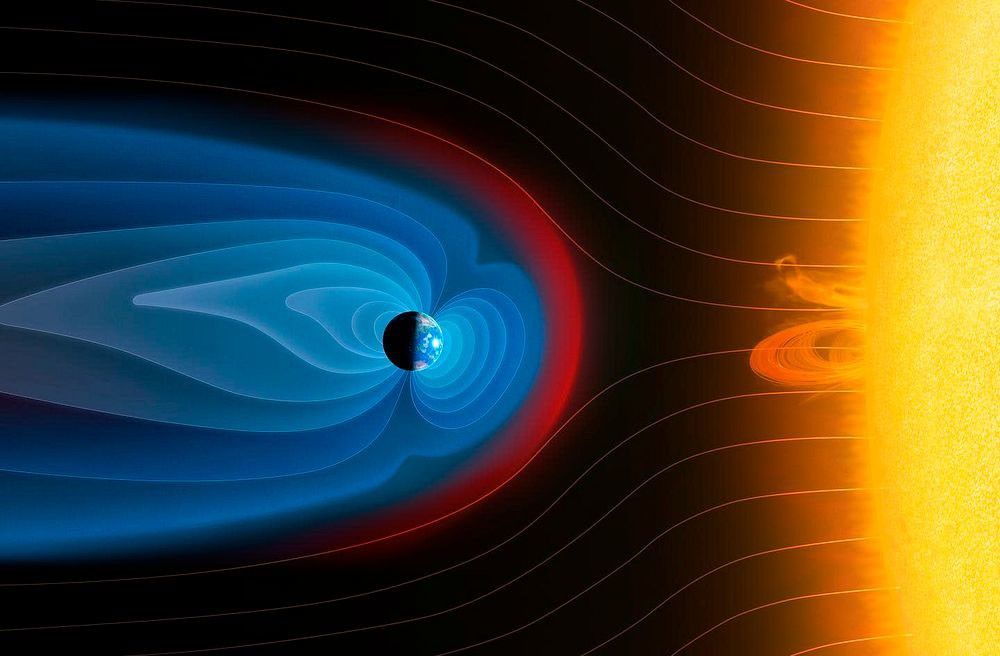
NASA’s New Shock Detectives Project Invites Volunteers to Help Study Solar Wind
The Sun sprays an extremely fast stream of charged particles called the solar wind. At approximately 56,000 miles (90,000 kilometers) in front of the Earth toward the Sun, the solar wind collides with the Earth’s protective magnetic field, generating a long-lasting shock wave that stretches for hundreds of thousands of miles. Now, you can help scientists examine data about this “bow shock” to better understand how the solar wind affects the Earth by joining a new research project: Shock Detectives.
At this enormous shock wave boundary, the ever-changing magnetic field can either make the solar wind messy and dynamic (“chaotic”) or leave it smooth and stable (“peaceful”).
When “chaotic” plasma dominates, more energy can reach Earth’s magnetosphere, possibly leading to disruptions in GPS signals, communications, and power grids. Scientists don’t yet fully understand when the plasma changes between “peaceful” and “chaotic” states or how those changes affect energy transfer to Earth.
You can help solve this mystery. NASA’s Magnetospheric Multiscale (MMS) mission has collected more than ten years of data from this zone – more than scientists can analyze alone. As Shock Detectives, you’ll help sort the chaotic from peaceful regions of the data, giving researchers a crucial set of clues.
The value of this new knowledge doesn’t end at Earth – what scientists learn about the Earth-Sun bow shock will help them understand how the solar wind of other stars impacts their orbiting planets. Your contributions may help take Shock Detectives ‘out of this world’!
This project is closely connected to another NASA-supported project, Space Umbrella, which also relies on MMS data and imagery. While Space Umbrella focuses on the broad boundary between Earth’s magnetic shield and the surrounding solar wind, Shock Detectives zooms in just outside that boundary on the transition region, which can be upwards of 10 miles (17 kilometers) in thickness, to better understand how plasma behaves near the shock. Together, these efforts build a more complete picture of Earth’s space environment.
Join Shock Detectives and help crack the case here: https://go.nasa.gov/4wILD6Y
Want a quick overview? Check out the introduction video.
The Earth’s magnetosphere (blue) interacts with the solar wind,, creating a shock wave (red), like a sonic boom in space. Join the Shock Detectives project and help scientists study this region and better understand how the solar wind affects our livesMark Garlick/Science Photo Library via Getty Images