
Feed aggregator
Six Years of Curiosity’s Wheels on the Move
NASA/JPL-Caltech Photojournal Navigation Downloads PIA26721 Animation
MP4 (47.13 MB)
Description
NASA’s Curiosity Mars rover used its right navigation camera — one of two on the rover’s mast, or head — to capture the images in this timelapse, which spans six years of driving. The images were snapped between Jan. 2, 2020, and March 8, 2026 (the 2,633rd and 4,830th Martian day, or sol, of the mission, respectively). The images were taken when the mast was looking behind the rover to help the science team choose rocks to study.
Curiosity’s team is using this timelapse to watch for sand grains shifting on the rover’s deck. Distinguishing between sand jostled by each drive and wind gusts can provide new information about seasonal changes in the atmosphere.
Curiosity was built by NASA’s Jet Propulsion Laboratory, which is managed by Caltech in Pasadena, California. JPL leads the mission on behalf of NASA’s Science Mission Directorate in Washington as part of NASA’s Mars Exploration Program portfolio.
To learn more about Curiosity, visit:
science.nasa.gov/mission/msl-curiosity
Keep Exploring Discover More Topics From Photojournal
Photojournal
Search Photojournal
Photojournal’s Latest Content
Feedback
Science in Space
Science in Space
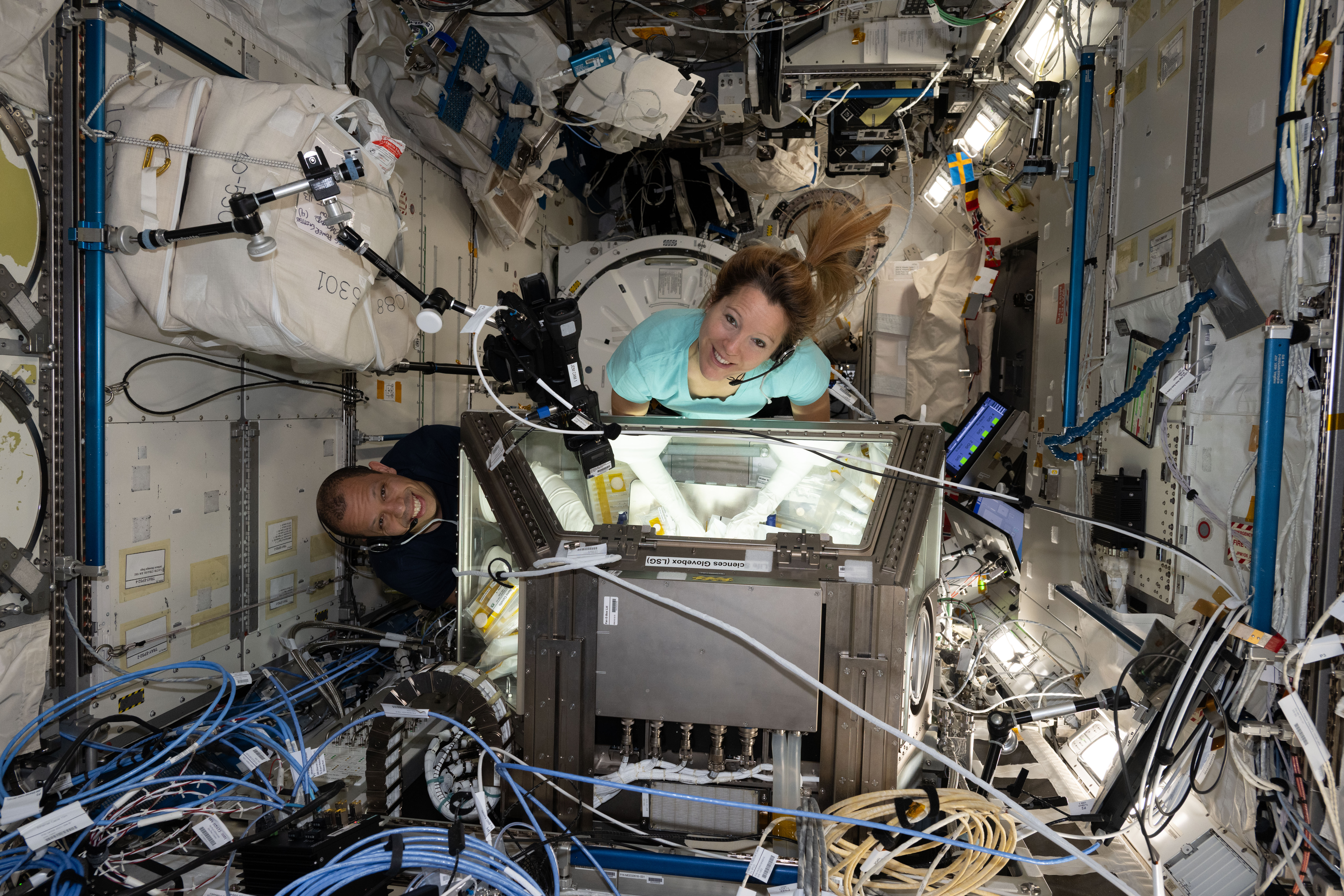
Astronauts Chris Williams of NASA and Sophie Adenot of the European Space Agency work together in the Kibo laboratory module’s Life Science Glovebox, processing genetic-material samples for the DNA Nano Therapeutics‑3 experiment. The investigation is exploring DNA‑inspired assembly techniques as a way to manufacture treatments—such as chemotherapy and immunotherapy—that can kill cancer cells and activate the immune system.
Find out what’s happening on the International Space Station on the blog.
Image credit: NASA/Jessica Meir
Science in Space
Astronauts Chris Williams of NASA and Sophie Adenot of the European Space Agency work together in the Kibo laboratory module’s Life Science Glovebox, processing genetic-material samples for the DNA Nano Therapeutics‑3 experiment. The investigation is exploring DNA‑inspired assembly techniques as a way to manufacture treatments—such as chemotherapy and immunotherapy—that can kill cancer cells and activate the immune system.
Find out what’s happening on the International Space Station on the blog.
Image credit: NASA/Jessica Meir
Watch Astrobotic’s latest record-breaking ‘ring of fire’ rocket engine test
Rotating detonation rocket engines work differently than traditional rockets to maximize thrust while using less fuel—an advantage that could help spacecraft explore farther in the solar system
Tough Fungi Could Survive the Trip to Mars
NASA and other space agencies spend a lot of time and money considering the cleanliness of their missions. Billions of dollars are spent in and on cleanrooms every year, with the express effort of ensuring both that the equipment operates without interference, but also that we don’t accidentally contaminate our exploration target with life from Earth itself. So far, we have primarily focused on bacteria in our efforts to stop this contamination, but according to a new paper by Atul M. Chander of NASA Jet Propulsion Laboratory and his co-authors, we might be missing an entirely different threat - fungi.
Humanoid robots may be about to break the 100-metre sprint record
Humanoid robots may be about to break the 100-metre sprint record
Polycystic ovary syndrome might affect men, too. Here’s how
A condition that affects 10 to 15 percent of women may affect men, too. But many doctors don’t know about it
How I pay almost nothing to power my house and electric car
How I pay almost nothing to power my house and electric car
Could Light Alone Get Us to Another Star?
Using nothing but a laser beam, scientists at Texas A&M University have demonstrated that tiny engineered devices can be lifted and steered in three dimensions without any physical contact. This breakthrough could one day form the basis of a propulsion system capable of reaching our nearest neighbouring stars in decades rather than centuries.
The Ancient Art That Could Transform Space Communication
Researchers at the Institute of Science Tokyo have developed an origami inspired foldable antenna for CubeSat satellites that weighs just 64 grams yet in orbit, it deploys to two and a half times its stowed size. The antenna folds away neatly for launch and deploys automatically in space, achieving high gain communications performance from a package small enough to fit in your pocket and could one day support missions as far away as the Moon.
We may finally have a cure for many different autoimmune conditions
We may finally have a cure for many different autoimmune conditions
War in Iran spotlights the risk to drinking water for millions in the Persian Gulf
Direct attacks, oil spills and the threat of nuclear waste are putting the Gulf region’s desalination plants at risk—here’s why that matters
Space Travel May Impact Human Fertility and Fertilization
Space travel has taught us valuable lessons for living and working in outer space, specifically regarding how microgravity (often mistakenly called zero-gravity) impacts the human body during short- and long-term spaceflight. This includes decreased muscle and bone mass, fluid shifts, reduced heart rate, psychological health, compromised immune system, and radiation exposure. But with agencies like NASA aspiring to build a lunar base and establish a long-term presence on the Moon, and eventually Mars, how could space travel impact potentially having babies in space?
Fiery Fall Color in Southern Chile
- Earth
- Earth Observatory
- Image of the Day
- EO Explorer
- Topics
- More Content
- About
Fiery Fall Color in Southern Chile
- Earth
- Earth Observatory
- Image of the Day
- EO Explorer
- Topics
- More Content
- About