
Feed aggregator
Physicists resolve a long-standing puzzle over the size of a proton
Physicists resolve a long-standing puzzle over the size of a proton
Medieval aurora poetry provided clues to historic solar storms
Medieval poets, including a Japanese noble, provided key descriptions to track down solar events
This Week's Sky at a Glance, April 10 – 19
A thin crescent Moon points the way to super-difficult Mercury and Mars low in the dawn, then the opposite crescent plays with bold Venus and the Pleiades in evening twilight.
The post This Week's Sky at a Glance, April 10 – 19 appeared first on Sky & Telescope.
Earth from Space: Lava flow on Réunion Island
ESA’s Celeste broadcasts first navigation signal from low Earth orbit
The European Space Agency has achieved a European first with Celeste, successfully transmitting a navigation signal from low Earth orbit, following the launch of the mission’s first satellites on March 28.
Earthset From the Lunar Far Side
- Earth
- Earth Observatory
- Image of the Day
- EO Explorer
- Topics
- More Content
- About
Earthset From the Lunar Far Side
- Earth
- Earth Observatory
- Image of the Day
- EO Explorer
- Topics
- More Content
- About
Scientists Spot a Solar Flare With Surprising Spectral Behavior
On August 19, 2022, astronomers using the Daniel K. Inouye Solar Telescope (DKIST) on the Hawaiian island of Maui caught the fading remnants of a C-class solar flare. Their observations showed something unusual: very strong spectral fingerprints of calcium II H and hydrogen-epsilon lines. It was the first time these two light signatures were seen in great detail during a flare. According to computer models, those lines were stronger than expected and play a not well-understood role in how flares heat the solar atmosphere where they occur.
Indoor Testing Facilities available at the NASA Unmanned Autonomy Research Complex (NUARC)
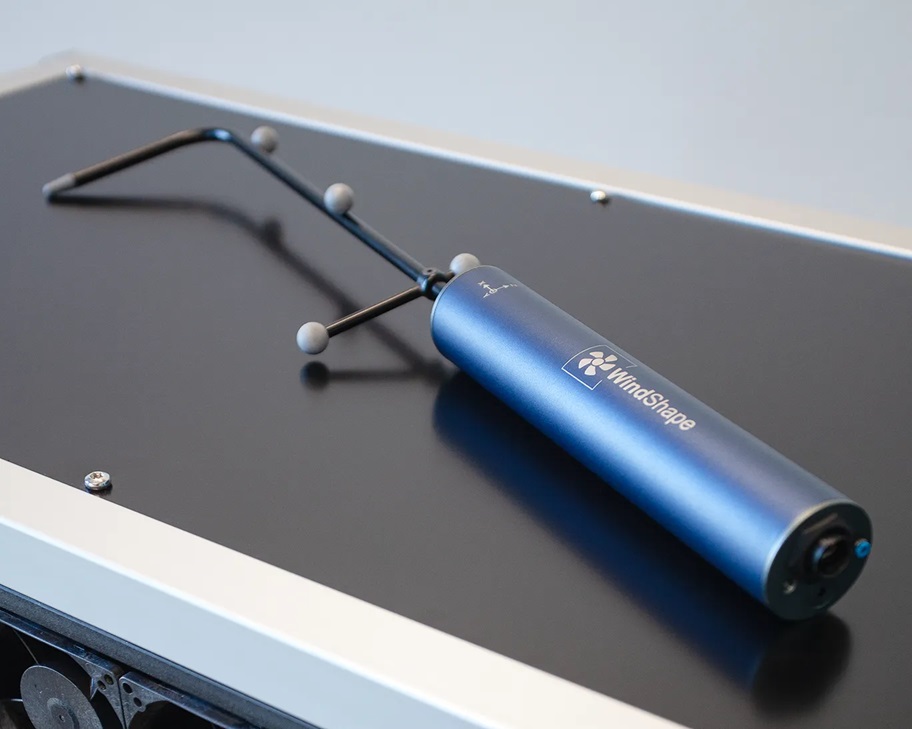
A large WindShaper fan array is available for dynamic low-speed and hovering flight research. The WindShaper is ideal for generating arbitrary wind gradients and wind gusts via a simple Python API. A companion WindProbe is also available for quick surveys of flows. The WindProbe utilizes the lab’s OptiTrack motion capture system to extract the position and orientation of the 5-hole cone probe located on the probe tip.
- Large dynamic fan array: 9’x7’, 1134 fans arranged as 567 ‘wind pixels’
- Wind speeds: 0 to 16 m/s (0 to 36 mph/31 kts)
- Acceleration: 4 m/s2, Deceleration: 2.5 m/s2
- Each fan is programmable via Python scripting
- Replicates steady winds, gusts, and wind gradients
Indoor Testing Facilities available at the NASA Unmanned Autonomy Research Complex (NUARC)
A large WindShaper fan array is available for dynamic low-speed and hovering flight research. The WindShaper is ideal for generating arbitrary wind gradients and wind gusts via a simple Python API. A companion WindProbe is also available for quick surveys of flows. The WindProbe utilizes the lab’s OptiTrack motion capture system to extract the position and orientation of the 5-hole cone probe located on the probe tip.
- Large dynamic fan array: 9’x7’, 1134 fans arranged as 567 ‘wind pixels’
- Wind speeds: 0 to 16 m/s (0 to 36 mph/31 kts)
- Acceleration: 4 m/s2, Deceleration: 2.5 m/s2
- Each fan is programmable via Python scripting
- Replicates steady winds, gusts, and wind gradients
I Am Artemis: Dan Florez
Listen to this audio excerpt from Dan Florez, test director for NASA’s Exploration Ground Systems Program:
0:00 / 0:00
Your browser does not support the audio element.At 1:47 a.m. EST November 16, 2022, as the Artemis I engines ignited, NASA astronaut Reid Wiseman and Dan Florez, NASA test director for the agency’s Exploration Ground Systems, watched from Kennedy’s Launch Control Center roof as the midnight sky turned bright as daylight, the crackle and roar of launch vibrating through them. Little did they know, one of them soon would be the Artemis II commander, and the other would be an important figure in bringing the mission home safely.
Florez is one of the NASA test directors for the Exploration Ground Systems Program. The test directors are a group of 20 engineers at the agency’s Kennedy Space Center in Florida who plan and execute integrated testing for Artemis missions. Their work includes developing timelines and procedures for launch countdown, propellant loading, emergency egress, pad and launch abort scenarios, recovery operations, and more. They help lead the ground systems team in all areas of testing.
Members of the Artemis launch team participate in an Artemis II launch countdown simulation inside Firing Room 1 in the Launch Control Center at NASA’s Kennedy Space Center in Florida on Thursday, May 8, 2025. NASA/Frank Michaux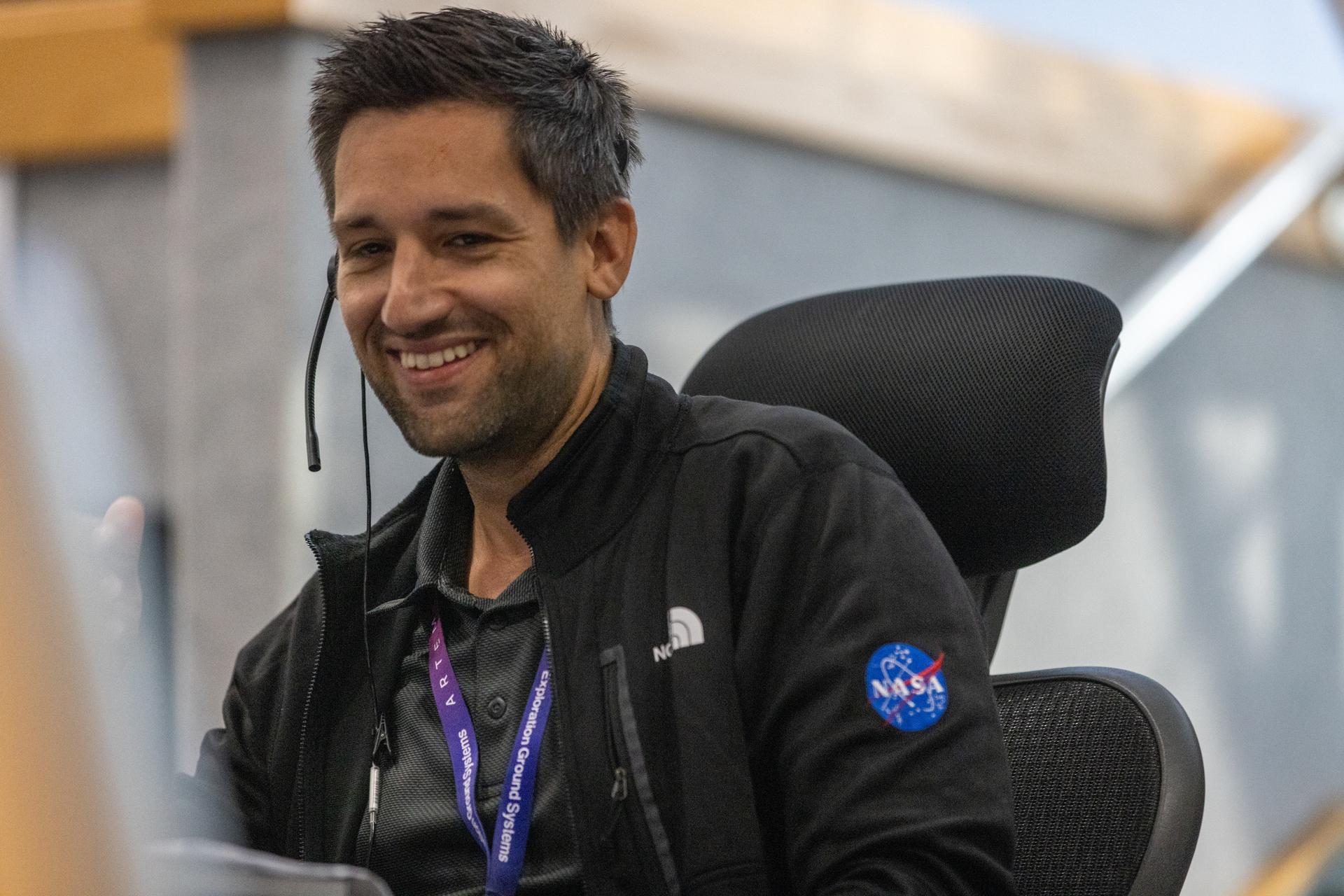
At the time of Artemis I launch, Florez and his fellow test directors had already developed the launch countdown timelines for Artemis II.
“We were really focused on loading that spacecraft with cryogenic propellants and successfully launching it. With Artemis II, we’re going to have to do all that again, but in the middle of that, we’re going to have to embed the crew timeline to get the crew safely inside the spacecraft, get all the systems checked out, and launch them into space,” Florez said. “And we have to do the same thing on the tail end through recovery. So, there’s a lot of complexities when you have the human element thrown into the operation.”
Since Artemis I, Florez has focused his work even more heavily on the human element, taking on rescue and recovery operations.
A wave breaks inside the well deck of USS Somerset as teams work to recover the Crew Module Test Article (CMTA), a full scale replica of the Orion spacecraft, as they practice Artemis recovery operations during Underway Recovery Test-12 off the coast of California, Thursday, March 27, 2025. NASA/Joel Kowsky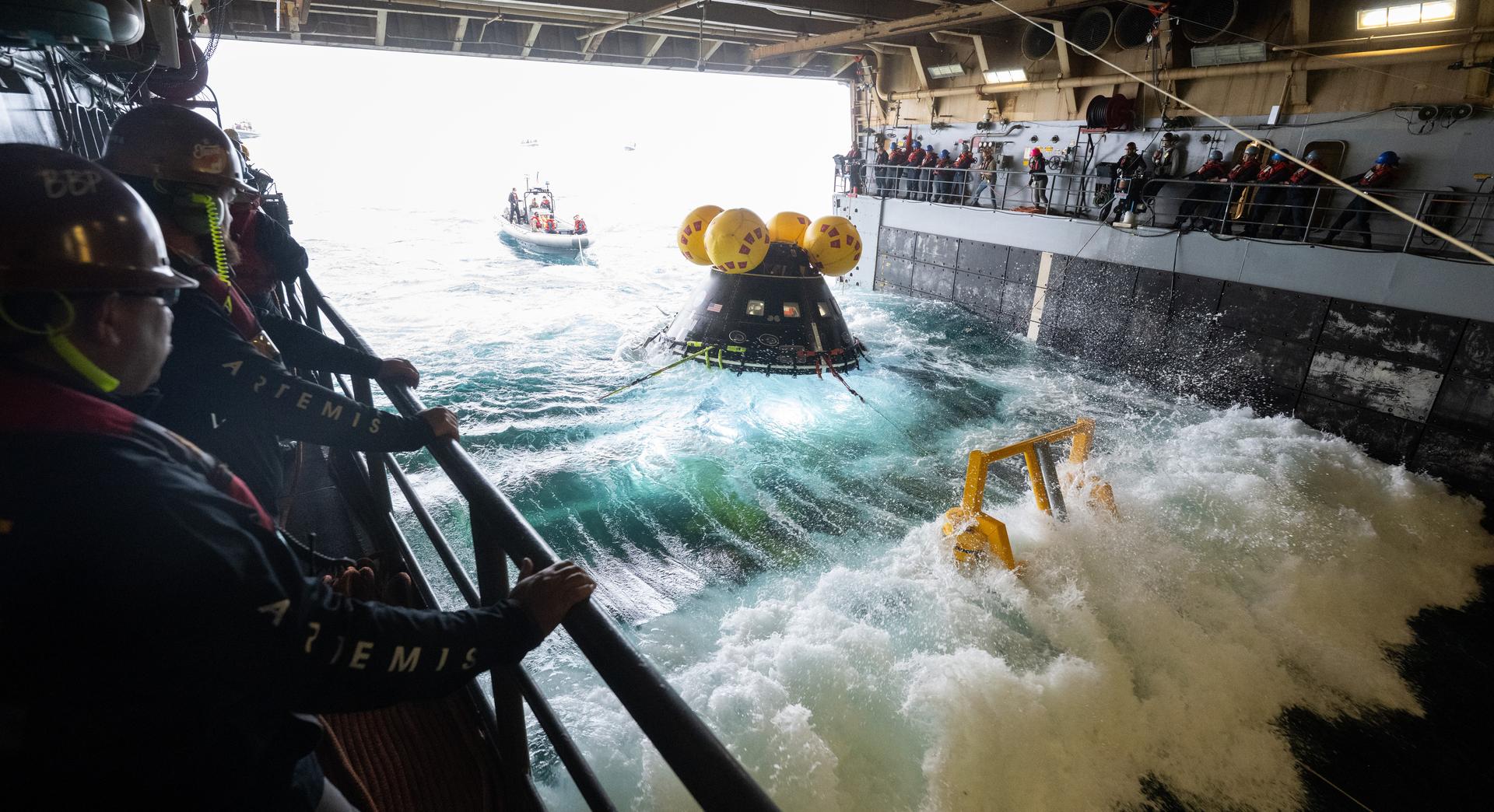
“We have to have a plan to go get to the crew if we have an abort, if we land anywhere in the world within 24 hours,” said Florez. “My role right now is to do a lot of that coordination to make sure we have all the assets and all the resources in place to get to the crew.”
When the Artemis II crew returns to Earth aboard the Orion spacecraft, Florez will be there, prepared and ready with NASA’s Landing and Recovery Team and the U.S. military.
We have a great partnership with the military. We have the Human Spaceflight Support Office within the Air Force that support us directly for not just for recovery operations, but also for any of the rescue operations.Dan Florez
NASA Test Director, Exploration Ground Systems Program
Recovery operations are routinely verified and validated in what is called an underway recovery test. NASA and Navy teams board a U.S. Navy ship and travel off the coast of San Diego to test retrieving the capsule and getting the crew safely on the ship. In late February 2024, the Artemis II crew joined the recovery team’s eleventh iteration of testing called, URT-11.
“It was really great to have that perspective of having astronauts in the loop during our test operations,” said Florez. “Everywhere along the way, we got feedback from them.”
Artemis II launched at 6:35 p.m. EDT April 1, from Launch Complex 39B, sending NASA astronauts Reid Wiseman, Victor Glover, and Christina Koch, and CSA (Canadian Space Agency) astronaut Jeremy Hansen, on their approximately 10-day mission around the Moon.
Florez and his colleagues are prepared and ready to apply everything they tested to recover the crew.
Watching them launch is going to be great. I'm going to be happier when they land.Dan Florez
NASA Test Director, Exploration Ground Systems Program
About the AuthorAdeline Morgan RoeschStrategic Communications Specialist Share Details Last Updated Apr 10, 2026 Related Terms Explore More 1 min read Watching the Artemis II Mission Unfold at JPL’s Space Flight Operations FacilityDescription Staff at NASA’s Jet Propulsion Laboratory in Southern California watch the agency’s Artemis II…
Article 4 days ago 2 min read The Deep Space Network Acquires Artemis II SignalDescription A graphical representation of the Deep Space Network’s radio frequency antennas indicate signal acquisition…
Article 4 days ago 2 min read The Deep Space Network Acquires Artemis II SignalDescription The acquisition of the radio frequency signal from the Artemis II crewed mission to…
Article 4 days ago Keep Exploring Discover More Topics From NASAMissions
Humans in Space
Climate Change
Solar System
I Am Artemis: Dan Florez
Listen to this audio excerpt from Dan Florez, test director for NASA’s Exploration Ground Systems Program:
0:00 / 0:00
Your browser does not support the audio element.At 1:47 a.m. EST November 16, 2022, as the Artemis I engines ignited, NASA astronaut Reid Wiseman and Dan Florez, NASA test director for the agency’s Exploration Ground Systems, watched from Kennedy’s Launch Control Center roof as the midnight sky turned bright as daylight, the crackle and roar of launch vibrating through them. Little did they know, one of them soon would be the Artemis II commander, and the other would be an important figure in bringing the mission home safely.
Florez is one of the NASA test directors for the Exploration Ground Systems Program. The test directors are a group of 20 engineers at the agency’s Kennedy Space Center in Florida who plan and execute integrated testing for Artemis missions. Their work includes developing timelines and procedures for launch countdown, propellant loading, emergency egress, pad and launch abort scenarios, recovery operations, and more. They help lead the ground systems team in all areas of testing.
Members of the Artemis launch team participate in an Artemis II launch countdown simulation inside Firing Room 1 in the Launch Control Center at NASA’s Kennedy Space Center in Florida on Thursday, May 8, 2025. NASA/Frank MichauxAt the time of Artemis I launch, Florez and his fellow test directors had already developed the launch countdown timelines for Artemis II.
“We were really focused on loading that spacecraft with cryogenic propellants and successfully launching it. With Artemis II, we’re going to have to do all that again, but in the middle of that, we’re going to have to embed the crew timeline to get the crew safely inside the spacecraft, get all the systems checked out, and launch them into space,” Florez said. “And we have to do the same thing on the tail end through recovery. So, there’s a lot of complexities when you have the human element thrown into the operation.”
Since Artemis I, Florez has focused his work even more heavily on the human element, taking on rescue and recovery operations.
A wave breaks inside the well deck of USS Somerset as teams work to recover the Crew Module Test Article (CMTA), a full scale replica of the Orion spacecraft, as they practice Artemis recovery operations during Underway Recovery Test-12 off the coast of California, Thursday, March 27, 2025. NASA/Joel Kowsky“We have to have a plan to go get to the crew if we have an abort, if we land anywhere in the world within 24 hours,” said Florez. “My role right now is to do a lot of that coordination to make sure we have all the assets and all the resources in place to get to the crew.”
When the Artemis II crew returns to Earth aboard the Orion spacecraft, Florez will be there, prepared and ready with NASA’s Landing and Recovery Team and the U.S. military.
We have a great partnership with the military. We have the Human Spaceflight Support Office within the Air Force that support us directly for not just for recovery operations, but also for any of the rescue operations.Dan Florez
NASA Test Director, Exploration Ground Systems Program
Recovery operations are routinely verified and validated in what is called an underway recovery test. NASA and Navy teams board a U.S. Navy ship and travel off the coast of San Diego to test retrieving the capsule and getting the crew safely on the ship. In late February 2024, the Artemis II crew joined the recovery team’s eleventh iteration of testing called, URT-11.
“It was really great to have that perspective of having astronauts in the loop during our test operations,” said Florez. “Everywhere along the way, we got feedback from them.”
Artemis II launched at 6:35 p.m. EDT April 1, from Launch Complex 39B, sending NASA astronauts Reid Wiseman, Victor Glover, and Christina Koch, and CSA (Canadian Space Agency) astronaut Jeremy Hansen, on their approximately 10-day mission around the Moon.
Florez and his colleagues are prepared and ready to apply everything they tested to recover the crew.
Watching them launch is going to be great. I'm going to be happier when they land.Dan Florez
NASA Test Director, Exploration Ground Systems Program
About the AuthorAdeline Morgan RoeschStrategic Communications Specialist Share Details Last Updated Apr 10, 2026 Related Terms Explore More 1 min read Watching the Artemis II Mission Unfold at JPL’s Space Flight Operations FacilityDescription Staff at NASA’s Jet Propulsion Laboratory in Southern California watch the agency’s Artemis II…
Article 3 days ago 2 min read The Deep Space Network Acquires Artemis II SignalDescription A graphical representation of the Deep Space Network’s radio frequency antennas indicate signal acquisition…
Article 3 days ago 2 min read The Deep Space Network Acquires Artemis II SignalDescription The acquisition of the radio frequency signal from the Artemis II crewed mission to…
Article 3 days ago Keep Exploring Discover More Topics From NASAMissions
Humans in Space
Climate Change
Solar System
White House budget puts 54 NASA science missions on the chopping block
Experts found that the White House budget request for the upcoming fiscal year could defund 54 NASA science missions, including a spacecraft currently studying Jupiter and two planned Venus missions
Indoor Testing Facilities available at the NASA Unmanned Autonomy Research Complex (NUARC)
A large WindShaper fan array is available for dynamic low-speed and hovering flight research. The WindShaper is ideal for generating arbitrary wind gradients and wind gusts via a simple Python API. A companion WindProbe is also available for quick surveys of flows. The WindProbe utilizes the lab’s OptiTrack motion capture system to extract the position and orientation of the 5-hole cone probe located on the probe tip.
Windshaper fan array for dynamic low-speed and hovering flight research at NASA Ames Research Center.NASA/John Melton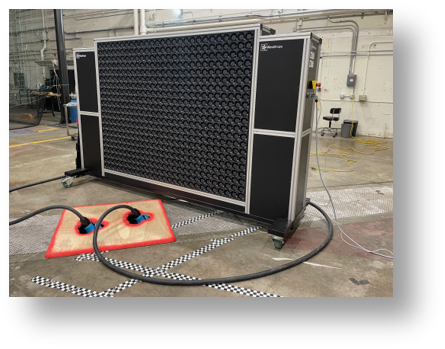
•Large dynamic fan array: 9’x7’, 1134 fans arranged as 567 ‘wind pixels’
•Wind speeds: 0 to 16 m/s (0 to 36 mph/31 kts)
•Acceleration: 4 m/s2, Deceleration: 2.5 m/s2
•Each fan is programmable via Python scripting
•Replicates steady winds, gusts, and wind gradients
WindProbe for handheld mobile wind data collection. WindShaperIndoor Testing Facilities available at the NASA Unmanned Autonomy Research Complex (NUARC)
A large WindShaper fan array is available for dynamic low-speed and hovering flight research. The WindShaper is ideal for generating arbitrary wind gradients and wind gusts via a simple Python API. A companion WindProbe is also available for quick surveys of flows. The WindProbe utilizes the lab’s OptiTrack motion capture system to extract the position and orientation of the 5-hole cone probe located on the probe tip.
Windshaper fan array for dynamic low-speed and hovering flight research at NASA Ames Research Center.NASA/John Melton•Large dynamic fan array: 9’x7’, 1134 fans arranged as 567 ‘wind pixels’
•Wind speeds: 0 to 16 m/s (0 to 36 mph/31 kts)
•Acceleration: 4 m/s2, Deceleration: 2.5 m/s2
•Each fan is programmable via Python scripting
•Replicates steady winds, gusts, and wind gradients
WindProbe for handheld mobile wind data collection. WindShaperNASA’s Artemis II moon mission is on track for Friday splashdown
After a hectic eight days in space, the Artemis II crew—and the many NASA personnel supporting their journey—are ready for the mission’s final milestone
NASA Releases Images of Artemis II's Flight Behind the Moon
The first flyby images of the Moon captured by NASA’s Artemis II astronauts during their historic test flight reveal some regions no human has seen, including a rare in-space solar eclipse. Released Tuesday, astronauts captured the images April 6 during the mission’s seven-hour flyby of the lunar far side, showing humanity’s return to the Moon’s […]