
Feed aggregator
Tiny robot drones learn to navigate the world like honeybees
Mapping their starting point like bees do helps autonomous drones find their way
Studying Pneumonia in Space for Heart Health on Earth
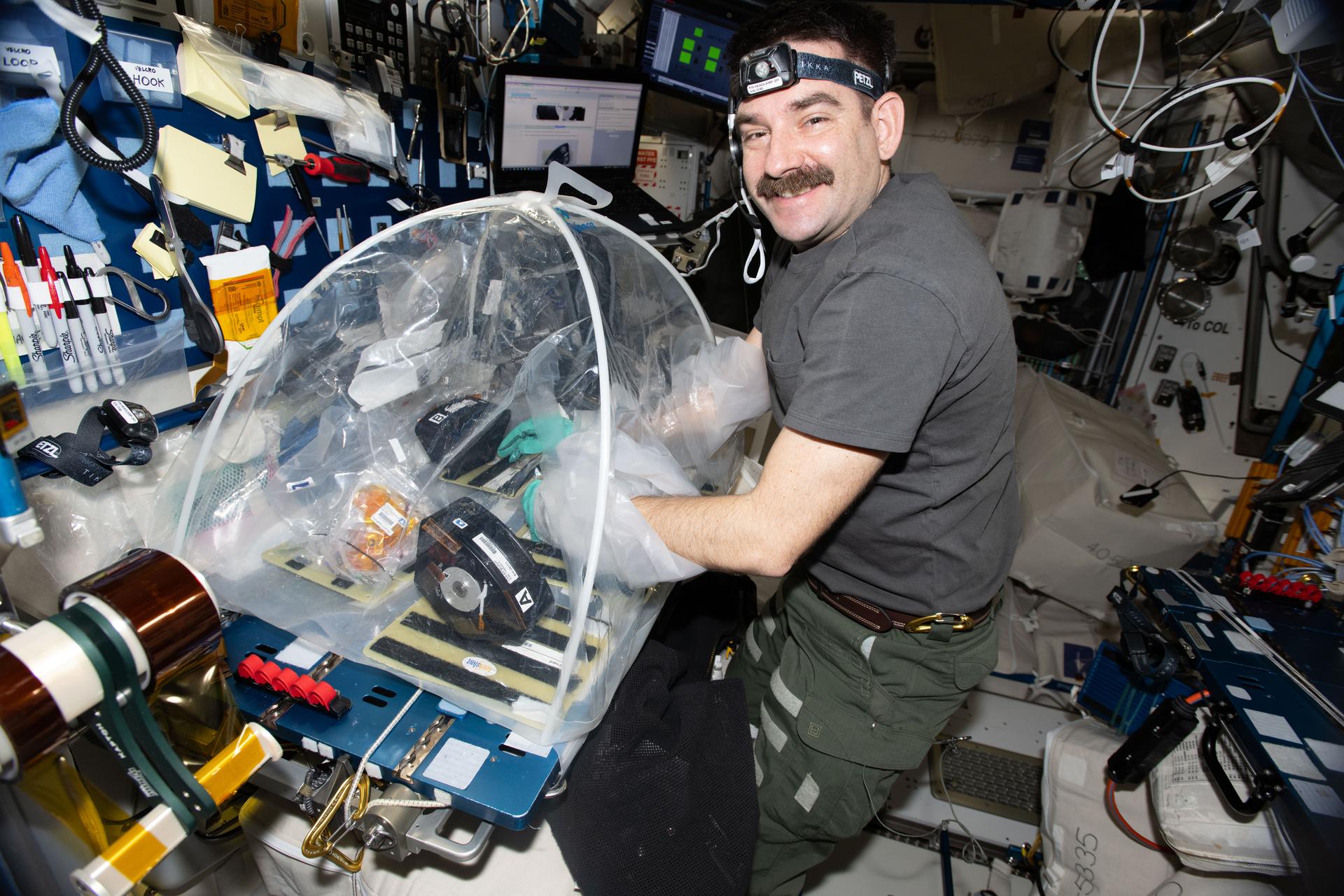
Expedition 74 astronauts aboard the International Space Station are uncovering how bacteria that causes pneumonia can lead to long-term damage in the heart. Researchers are leveraging the space environment to observe how stem cell derived heart tissues respond to bacterial infections, to discover new methods to manage cardiovascular health and infectious diseases.
In space, bacteria tend to be more severe and have enhanced drug resistance. Scientists are harnessing these traits to exaggerate their effect on heart cells and reveal important cellular responses that would be difficult to detect on Earth. Pinpointing the factors that make bacterial infections more severe in space could reveal targets for treatment. Dr. Palaniappan Sethu, professor of Medicine and Biomedical Engineering at the University of Alabama at Birmingham says, “By exacerbating the infection, we anticipate clear separation of the infection and control groups, making it easier to identify subtle factors that promote bacterial virulence”.
Preflight imagery of stem cell derived heart tissue models produced for the MVP Cell-09 investigation.University of Alabama at Birmingham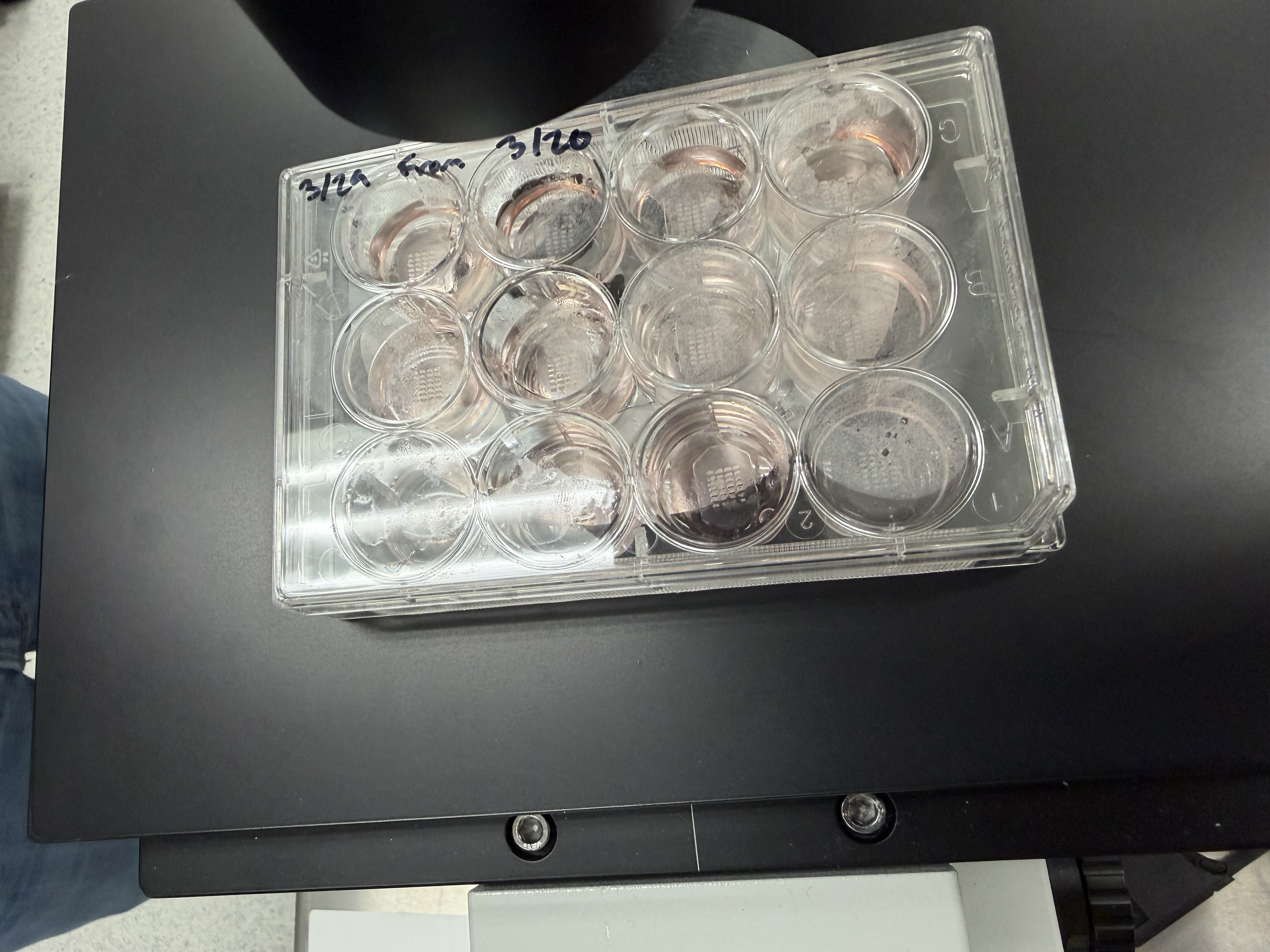
The Streptococcus pneumoniae bacteria is the leading cause of community-acquired pneumonia (CAP), an infection which causes millions of deaths each year. More than a quarter of adults hospitalized for CAP develop heart disease and patients that survive severe cases have an increased risk even after the pneumonia has been fully eradicated.
This research is also important as humans venture further into space. For over 25 years, researchers have utilized the space station to study how the human body and microbes respond to space, and deep space missions will require the strategies and knowledge we gain. “Addressing these questions is essential for ensuring human health during long duration space travel and for enabling sustainable habitation beyond Earth. Our experiments are expected to generate new insights into how space specific factors influence disease progression”, says Dr. Carlos J. Orihuela, professor of Microbiology at the University of Alabama at Birmingham.
From left to right: Redwire Space researchers Grant Vellinger and Dr. Aaron Rogers, and University of Alabama at Birmingham researchers Dr. Vipin Chembilikand and Dr. Ian Berg prepare MVP Cell-09 ahead of launch to the space station.University of Alabama at Birmingham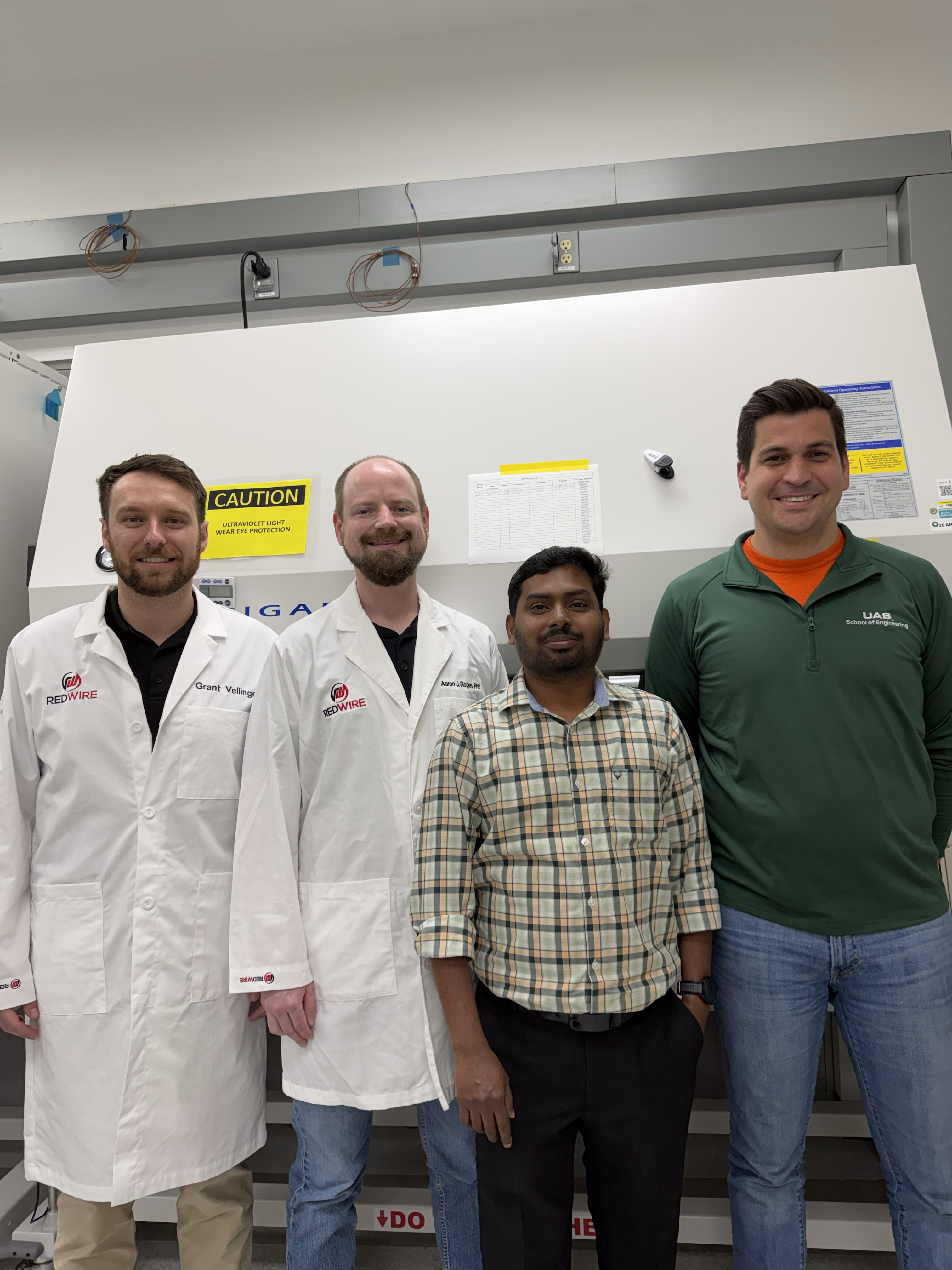
The space station allows researchers from around the world to address complex human health problems on Earth and in space. Using the unique environmental factors aboard the space station allows for advanced study of disease formation, testing drugs and diagnostic tools, and more.
Keep Exploring Discover More Topics From NASALatest News from Space Station Research
International Space Station
Humans In Space
Space Station Research Results
Studying Pneumonia in Space for Heart Health on Earth
Expedition 74 astronauts aboard the International Space Station are uncovering how bacteria that causes pneumonia can lead to long-term damage in the heart. Researchers are leveraging the space environment to observe how stem cell derived heart tissues respond to bacterial infections, to discover new methods to manage cardiovascular health and infectious diseases.
In space, bacteria tend to be more severe and have enhanced drug resistance. Scientists are harnessing these traits to exaggerate their effect on heart cells and reveal important cellular responses that would be difficult to detect on Earth. Pinpointing the factors that make bacterial infections more severe in space could reveal targets for treatment. Dr. Palaniappan Sethu, professor of Medicine and Biomedical Engineering at the University of Alabama at Birmingham says, “By exacerbating the infection, we anticipate clear separation of the infection and control groups, making it easier to identify subtle factors that promote bacterial virulence”.
Preflight imagery of stem cell derived heart tissue models produced for the MVP Cell-09 investigation.University of Alabama at BirminghamThe Streptococcus pneumoniae bacteria is the leading cause of community-acquired pneumonia (CAP), an infection which causes millions of deaths each year. More than a quarter of adults hospitalized for CAP develop heart disease and patients that survive severe cases have an increased risk even after the pneumonia has been fully eradicated.
This research is also important as humans venture further into space. For over 25 years, researchers have utilized the space station to study how the human body and microbes respond to space, and deep space missions will require the strategies and knowledge we gain. “Addressing these questions is essential for ensuring human health during long duration space travel and for enabling sustainable habitation beyond Earth. Our experiments are expected to generate new insights into how space specific factors influence disease progression”, says Dr. Carlos J. Orihuela, professor of Microbiology at the University of Alabama at Birmingham.
From left to right: Redwire Space researchers Grant Vellinger and Dr. Aaron Rogers, and University of Alabama at Birmingham researchers Dr. Vipin Chembilikand and Dr. Ian Berg prepare MVP Cell-09 ahead of launch to the space station.University of Alabama at BirminghamThe space station allows researchers from around the world to address complex human health problems on Earth and in space. Using the unique environmental factors aboard the space station allows for advanced study of disease formation, testing drugs and diagnostic tools, and more.
Keep Exploring Discover More Topics From NASALatest News from Space Station Research
International Space Station
Humans In Space
Space Station Research Results
Citizen Scientists May Have Just Doubled the Number of Known Brown Dwarfs
Brown dwarfs are notoriously difficult to find. These “failed stars” aren’t big enough to sustain nuclear fusion, and therefore aren’t as bright as more traditional main sequence stars. In fact, they’re nearly invisible in optical light, and faintly visible in infrared. But thanks to dozens of citizen scientists combing through archival infrared datasets from the Wide-field Infrared Survey Explorer (WISE), and a paper published in the Astronomical Journal detailing their work, we now have an additional set of over 3,000 candidate new brown dwarfs in our stellar neighborhood, more than doubling the total number found so far.
NASA’s Planet-Hunting TESS Reveals Dazzling Night Sky
3 min read
NASA’s Planet-Hunting TESS Reveals Dazzling Night SkyNASA’s TESS (Transiting Exoplanet Survey Satellite) has released its most complete view of the starry sky to date, filling in gaps from previous observations. Nearly 6,000 colored dots scattered across the image show the locations of either confirmed or candidate exoplanets — worlds beyond our solar system — identified by the mission as of September 2025 at the end of TESS’s second extended mission.
“Over the last eight years, TESS has become a fire hose of exoplanet science,” said Rebekah Hounsell, a TESS associate project scientist at the University of Maryland Baltimore County and NASA’s Goddard Space Flight Center in Greenbelt, Maryland. “It’s helped us find planets of all different sizes, from tiny Mercury-like ones to those larger than Jupiter. Some of them are even in the habitable zone, where liquid water might be possible on the surface, an important factor in our search for life beyond Earth.”
The TESS mission scans a wide swath of the sky, called a sector, for about a month at a time using its four cameras. These long stares allow the spacecraft to track the brightness changes of tens of thousands of stars, looking for variations in their light that might come from orbiting planets.
Researchers assembled an all-sky mosaic made of 96 sectors observed between April 2018, when TESS began its work, and September 2025.
This view of the whole sky was constructed from 96 TESS sectors. By the end of September 2025, when the last image of this mosaic was captured, TESS had discovered 679 exoplanets (blue dots) and 5,165 candidates (orange dots). The glowing arc running through the center is the plane of the Milky Way. The Large Magellanic Cloud can be seen along the bottom edge just left of center. Black areas within the oval indicate regions TESS has not yet imaged. NASA/MIT/TESS and Veselin Kostov (University of Maryland College Park)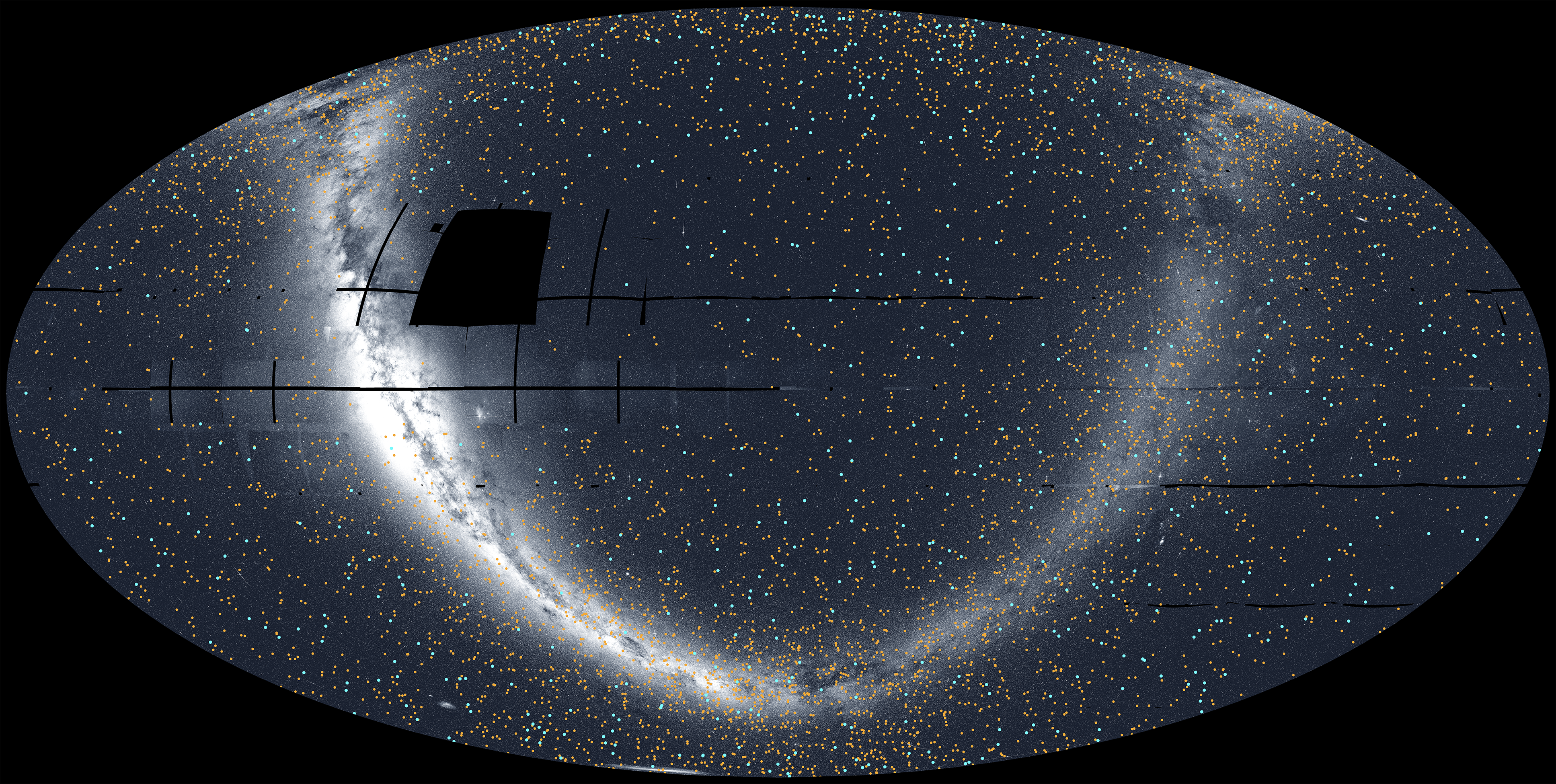
Download high-resolution images from NASA’s Scientific Visualization Studio.
The blue dots in the image mark the locations of nearly 700 confirmed planets, as of September 9. This menagerie includes worlds that may be covered by volcanoes, are being destroyed by their stars, or orbit two stars — experiencing double sunrises and sunsets each day. The orange dots represent more than 5,000 candidate planets that are awaiting verification.
To date, scientists have confirmed over 6,270 exoplanets using missions like TESS, NASA’s retired Kepler Space Telescope, and other facilities.
Also captured in the mosaic is the bright plane of our Milky Way galaxy, seen as a glowing arc through the center. The bright white ovals in the lower left are the Large and Small Magellanic Clouds. These satellite galaxies are located 160,000 and 200,000 light-years away, respectively.
“The more we dig into the large TESS dataset, especially using automated algorithms, the more surprises we find,” said Allison Youngblood, the TESS project scientist at NASA Goddard. “In addition to planets, TESS has helped us study rivers of young stars, observe dynamic galactic behavior, and monitor asteroids near Earth. As TESS fills in more of the night sky, there’s no knowing what it might see next.”
You could discover the next exoplanet! Join the Planet Hunters TESS citizen science project, and you’ll learn how to read light curves — plots of light data from distant stars — to find telltale signals from orbiting exoplanets.
By Jeanette Kazmierczak
NASA’s Goddard Space Flight Center, Greenbelt, Md.
Media Contact:
Claire Andreoli
301-286-1940
NASA’s Goddard Space Flight Center, Greenbelt, Md.
NASA’s Planet-Hunting TESS Reveals Dazzling Night Sky
3 min read
NASA’s Planet-Hunting TESS Reveals Dazzling Night SkyNASA’s TESS (Transiting Exoplanet Survey Satellite) has released its most complete view of the starry sky to date, filling in gaps from previous observations. Nearly 6,000 colored dots scattered across the image show the locations of either confirmed or candidate exoplanets — worlds beyond our solar system — identified by the mission as of September 2025 at the end of TESS’s second extended mission.
“Over the last eight years, TESS has become a fire hose of exoplanet science,” said Rebekah Hounsell, a TESS associate project scientist at the University of Maryland Baltimore County and NASA’s Goddard Space Flight Center in Greenbelt, Maryland. “It’s helped us find planets of all different sizes, from tiny Mercury-like ones to those larger than Jupiter. Some of them are even in the habitable zone, where liquid water might be possible on the surface, an important factor in our search for life beyond Earth.”
The TESS mission scans a wide swath of the sky, called a sector, for about a month at a time using its four cameras. These long stares allow the spacecraft to track the brightness changes of tens of thousands of stars, looking for variations in their light that might come from orbiting planets.
Researchers assembled an all-sky mosaic made of 96 sectors observed between April 2018, when TESS began its work, and September 2025.
This view of the whole sky was constructed from 96 TESS sectors. By the end of September 2025, when the last image of this mosaic was captured, TESS had discovered 679 exoplanets (blue dots) and 5,165 candidates (orange dots). The glowing arc running through the center is the plane of the Milky Way. The Large Magellanic Cloud can be seen along the bottom edge just left of center. Black areas within the oval indicate regions TESS has not yet imaged. NASA/MIT/TESS and Veselin Kostov (University of Maryland College Park)Download high-resolution images from NASA’s Scientific Visualization Studio.
The blue dots in the image mark the locations of nearly 700 confirmed planets, as of September 9. This menagerie includes worlds that may be covered by volcanoes, are being destroyed by their stars, or orbit two stars — experiencing double sunrises and sunsets each day. The orange dots represent more than 5,000 candidate planets that are awaiting verification.
To date, scientists have confirmed over 6,270 exoplanets using missions like TESS, NASA’s retired Kepler Space Telescope, and other facilities.
Also captured in the mosaic is the bright plane of our Milky Way galaxy, seen as a glowing arc through the center. The bright white ovals in the lower left are the Large and Small Magellanic Clouds. These satellite galaxies are located 160,000 and 200,000 light-years away, respectively.
“The more we dig into the large TESS dataset, especially using automated algorithms, the more surprises we find,” said Allison Youngblood, the TESS project scientist at NASA Goddard. “In addition to planets, TESS has helped us study rivers of young stars, observe dynamic galactic behavior, and monitor asteroids near Earth. As TESS fills in more of the night sky, there’s no knowing what it might see next.”
You could discover the next exoplanet! Join the Planet Hunters TESS citizen science project, and you’ll learn how to read light curves — plots of light data from distant stars — to find telltale signals from orbiting exoplanets.
By Jeanette Kazmierczak
NASA’s Goddard Space Flight Center, Greenbelt, Md.
Media Contact:
Claire Andreoli
301-286-1940
NASA’s Goddard Space Flight Center, Greenbelt, Md.
Psyche Spacecraft Spies Mars Ahead of May 15th Gravitational Assist
A close flyby past the Red Planet this week will send NASA’s Psyche mission on its way towards its final destination. The mission’s closest approach to Mars occurs on Friday, May 15th, when the spacecraft passes only 4,500 kilometers (2,800 miles) from the surface of the Red Planet. That’s just 1.3 Mars radii distant, inside the orbits of Phobos and Deimos.
WHO warns the world is falling short of and even reversing its health targets
Malaria incidence is increasing, progress on maternal mortality is stalling, and some childhood vaccine rates are plateauing or have dipped below the threshold for herd immunity
New rules confirm public has a right to see how UK government uses AI
New rules confirm public has a right to see how UK government uses AI
Why hantavirus takes so long to show symptoms and what that means for containment
People exposed to the Andes strain of the hantavirus may not develop symptoms for up to 42 days, a delay that makes tracing infections more difficult
Quitting weight-loss drugs or a diet can cause weight regain—two strategies could help prevent that
With millions of people now using GLP-1 drugs such as Wegovy and Zepbound, scientists are racing to find ways to help people retain their weight loss after they stop taking the medication
Each atom in the universe might be unique
Long-held assumptions tell us that atoms with the same number of protons, neutrons and electrons are indistinguishable, but one physicist wants to put this idea to the test
Do you need more protein? What science says about high-protein diets
Are we really falling short on protein—or is the high-protein craze overblown?
The Night is Disappearing and We're All Paying the Price
Step outside on a clear night almost anywhere in Britain and look up. Chances are you won't see much. An orange coloured washed out glow hangs over every town and city, drowning the stars in a tide of misdirected light. Now the Royal Astronomical Society is demanding that tide be turned back, not just for the sake of astronomy, but because the evidence of what artificial light at night is doing to our health, our wildlife, and our ecosystems has become impossible to ignore. The night, it turns out, isn't just a backdrop. It's a habitat that’s more entwined with our very wellbeing and health than you can possibly imagine. And we're destroying it.
Waterworn chaos on Mars
This month, ESA’s Mars Express takes us to Shalbatana Vallis: a fascinating martian valley surrounded by signs of water, lava, craters and chaos.
What Your Kitchen Sink Has in Common With Venus
Turn on your kitchen tap and watch the water hit the sink. That split second where fast, shallow water suddenly slows and spreads is known as a hydraulic jump. Now imagine the same thing happening in the atmosphere of Venus, but stretched across 6,000 kilometres of sulphuric acid cloud. Researchers at the University of Tokyo have just revealed that this extraordinary phenomenon, the largest hydraulic jump ever identified in the Solar System, is responsible for a mysterious wave that has been sweeping around our neighbouring planet for years.
Four People in a Pixel
When NASA's Artemis II spacecraft carried four astronauts around the Moon earlier this year, the world's largest fully steerable radio telescope was quietly watching from a quiet valley in West Virginia. The Green Bank Telescope tracked the Orion capsule across 213,000 miles of empty space with a precision that would embarrass most speedometers and what it produced isn't just an engineering triumph. It's a glimpse of how the world's most sensitive ears are becoming indispensable to the future of human spaceflight.
America’s Emerald Isle
- Earth
- Earth Observatory
- Image of the Day
- EO Explorer
- Topics
- More Content
- About