

Feed aggregator
Famous System Has a Third Star: Beta Pictoris d
Two teams of astronomers independently discovered a third giant gas planet orbiting in the famous Beta Pictoris system.
The post Famous System Has a Third Star: Beta Pictoris d appeared first on Sky & Telescope.
How NASA’s Artemis III Lander Test Will Pave Way for Moon Landings
Before Artemis astronauts land on the Moon’s surface in 2028, NASA will conduct the Artemis III demonstration mission in 2027, allowing teams on Earth and in orbit to practice rendezvous and docking operations between commercial human landing systems and the Orion spacecraft. Data from that mission, along with future uncrewed demonstration missions at the Moon, will support astronaut safety and mission success for crewed lunar landings.
NASA is working with two American companies to develop the human landing systems that will safely transport astronauts from lunar orbit to the Moon’s surface and back for future Artemis missions. For Artemis III, both SpaceX and Blue Origin will fly test versions, or test articles, of the crewed landers that will be used for future Moon landings. The lander test articles will launch by commercial rockets, while the Artemis III crew will launch to low Earth orbit in Orion atop the agency’s SLS (Space Launch System) rocket.
Stage setting for crewed flightsNASA and the human landing system providers have been working closely together to plan and determine capabilities for the Artemis III mission. With missions fast approaching, both SpaceX and Blue Origin are optimizing hardware availability and capability. SpaceX plans to use the company’s latest version of Starship and basis of the future Starship HLS, called Version 3, while Blue Origin will test their planned HLS crew cabin, allowing each company to apply lessons learned prior to uncrewed and crewed missions on the Moon.
“Each human landing system provider has taken a different approach to the Artemis III mission,” said Steve Creech, program manager, Human Landing System Program, NASA’s Marshall Space Flight Center in Huntsville, Alabama. “Ultimately, SpaceX and Blue Origin have put forward a list of aggressive objectives and goals intended to complement upcoming uncrewed demonstration missions at the Moon so that we can gain both understanding and confidence in the spacecraft and launch vehicles prior to a crewed landing. The lander prototype designs will inform future development efforts and will continue to mature over the next year.”
For the Artemis III mission, the Blue Moon test lander will be based on Blue Origin’s current architecture for its Mark 2 crew lander, incorporating all the major avionics and flight software and control systems to ensure flight operations from this demonstration mission can directly translate to crewed lunar flights. Up to two crew members, donning orange Orion crew survival system suits, will open the hatch to enter the Blue Origin test lander. The production hardware must incorporate many of the same systems and subsystems, including an Environmental Control and Life Support System (ECLSS), a crew cabin, and avionics.
These artist’s concepts depict Blue Origin’s Blue Moon Mark 2 human landing system test article in Earth orbit and docked with NASA’s Orion spacecraft as part of NASA’s upcoming Artemis III demonstration mission in low Earth orbit. Blue Origin These artist’s concepts depict Blue Origin’s Blue Moon Mark 2 human landing system test article in Earth orbit and docked with NASA’s Orion spacecraft as part of NASA’s upcoming Artemis III demonstration mission in low Earth orbit. Blue OriginThe Blue Origin lander also will fly with an instrumented lunar surface spacesuit mass simulator. Like the suited “Moonikin” manikin that flew aboard Orion during the uncrewed Artemis I test flight, the low-fidelity spacesuit mass simulator will provide real-time feedback about the environment within the Blue Moon crew cabin.
SpaceX’s Starship lander test article will use a Starship Version 3, currently in production and testing, with an added docking system installed on the nose of the 171-foot (52-m) spacecraft, enabling NASA and SpaceX to evaluate how the entire integrated stack of Orion and the Starship test lander interact. NASA and SpaceX are identifying controllability and communications tests for the Artemis III mission. Astronauts will not enter the Starship test lander during Artemis III.
These artist’s concepts depict NASA’s Orion spacecraft and SpaceX’s Starship human landing system test article during docking operations as part of NASA’s upcoming Artemis III demonstration mission in low Earth orbit. SpaceX These artist’s concepts depict NASA’s Orion spacecraft and SpaceX’s Starship human landing system test article during docking operations as part of NASA’s upcoming Artemis III demonstration mission in low Earth orbit. SpaceX Launch cadenceNASA, SpaceX, and Blue Origin will launch three of the world’s most powerful rockets within a short timeframe of one another, exercising ground processing, launch crews, and facilities as well as control centers, networking, and data exchange at key sites across the country during two separate, back-to-back rendezvous and docking maneuvers between Orion and the lander test articles, before a safe splashdown of the Artemis III crew in Orion.
“Artemis III will be a highly choreographed dance with a demanding launch sequence across multiple launch pads and equally demanding mission operations for our ground and flight crews, making it one of the most complex and ambitious missions NASA has ever undertaken,” said Jeremy Parsons, Artemis program manager. “The demonstration mission will set the stage before our next giant leap. NASA’s expertise in systems engineering and integration, as well as launch and mission operations in low Earth orbit, will bring the mission together.”
For future crewed missions to the Moon, NASA and one of the commercial lander partners will execute a “dual launch campaign,” prepositioning the lander in orbit to await a crewed Orion, launched on SLS. Launching the three rockets in succession of one another for Artemis III offers a unique opportunity to practice launch processing and operations.
Blue Origin’s lander test article is planned to launch first and will be able to loiter in space for up to 30 days, allowing for checkouts in orbit prior to the launch of SLS and Orion from Launch Complex 39B at NASA’s Kennedy Space Center in Florida. The Blue Origin test article will launch at a set trajectory to meet a designated “parking” orbit for these systems checks.
Artemis III will be a highly choreographed dance with a demanding launch sequence across multiple launch pads and equally demanding mission operations for our ground and flight crews, making it one of the most complex and ambitious missions NASA has ever undertaken.Jeremy Parsons
Artemis program manager
Following the completion of Blue Origin’s rendezvous and docking operations testing and the Artemis III crewed launch on SLS, SpaceX will launch its Starship lander test article to rendezvous with Orion and its crew for its phase of on-orbit testing.
Throughout the Artemis III mission, Orion will fly in a circular orbit. All three rockets will have more launch opportunities than are available for a lunar mission and will be able to reach the designated mission altitude in a single launch.
Docking operationsDuring docking and undocking operations, Orion and the Artemis III crew will use the lander test articles as the targets, while Orion will operate as the chaser spacecraft. This is the same configuration planned for future crew landing mission to the Moon.
NASA will ensure both test landers are mission ready and crew safe prior to Artemis III. These verifications will be based on functional and performance requirements for the test lander designs and hazard controls for hardware and software, ensuring the Artemis III astronauts inside Orion are safe throughout both docking phases of the mission.
SpaceX and Blue Origin have already tested their docking capabilities for their respective landers on the ground. SpaceX’s docking capability was qualified in 2023; Blue Origin conducted development ground testing on its pressurized docking system earlier this year.
A key difference between the docking capabilities of both lander test articles will be the location of docking. Orion will dock along the side of the Blue Moon test lander, adjacent to the crew cabin. Later, Orion will dock nose-to-nose with the giant SpaceX test lander.
Software testing between spacecrafts will help demonstrate that the commercial human landing system prototypes and Orion can meet at a precise time and location in space. When Orion docks with the Blue Moon test lander, the Orion spacecraft’s software will control the docked spacecraft. Meanwhile, the SpaceX test article will control the docked spacecraft for the second portion of the mission. During the docking phases, teams with NASA and the commercial partners will be able to test hardware and software interoperability, as well as dynamics of how the integrated lander-Orion spacecraft moves in space.
Through the Artemis program, NASA will send astronauts to explore the Moon for scientific discovery, economic benefits, and to build the foundation for the first crewed missions to Mars – for the benefit of all.
News Media ContactAmberJacobson
Headquarters, Washington
240.298.1832
amber.c.jacobson@nasa.gov
Corinne Beckinger
Marshall Space Flight Center, Huntsville, Ala.
256-544-0034
corinne.m.beckinger@nasa.gov
Human Landing System
Artemis III
Artemis
Space Launch System (SLS)
How NASA’s Artemis III Lander Test Will Pave Way for Moon Landings
Before Artemis astronauts land on the Moon’s surface in 2028, NASA will conduct the Artemis III demonstration mission in 2027, allowing teams on Earth and in orbit to practice rendezvous and docking operations between commercial human landing systems and the Orion spacecraft. Data from that mission, along with future uncrewed demonstration missions at the Moon, will support astronaut safety and mission success for crewed lunar landings.
NASA is working with two American companies to develop the human landing systems that will safely transport astronauts from lunar orbit to the Moon’s surface and back for future Artemis missions. For Artemis III, both SpaceX and Blue Origin will fly test versions, or test articles, of the crewed landers that will be used for future Moon landings. The lander test articles will launch by commercial rockets, while the Artemis III crew will launch to low Earth orbit in Orion atop the agency’s SLS (Space Launch System) rocket.
Stage setting for crewed flightsNASA and the human landing system providers have been working closely together to plan and determine capabilities for the Artemis III mission. With missions fast approaching, both SpaceX and Blue Origin are optimizing hardware availability and capability. SpaceX plans to use the company’s latest version of Starship and basis of the future Starship HLS, called Version 3, while Blue Origin will test their planned HLS crew cabin, allowing each company to apply lessons learned prior to uncrewed and crewed missions on the Moon.
“Each human landing system provider has taken a different approach to the Artemis III mission,” said Steve Creech, program manager, Human Landing System Program, NASA’s Marshall Space Flight Center in Huntsville, Alabama. “Ultimately, SpaceX and Blue Origin have put forward a list of aggressive objectives and goals intended to complement upcoming uncrewed demonstration missions at the Moon so that we can gain both understanding and confidence in the spacecraft and launch vehicles prior to a crewed landing. The lander prototype designs will inform future development efforts and will continue to mature over the next year.”
For the Artemis III mission, the Blue Moon test lander will be based on Blue Origin’s current architecture for its Mark 2 crew lander, incorporating all the major avionics and flight software and control systems to ensure flight operations from this demonstration mission can directly translate to crewed lunar flights. Up to two crew members, donning orange Orion crew survival system suits, will open the hatch to enter the Blue Origin test lander. The production hardware must incorporate many of the same systems and subsystems, including an Environmental Control and Life Support System (ECLSS), a crew cabin, and avionics.
These artist’s concepts depict Blue Origin’s Blue Moon Mark 2 human landing system test article in Earth orbit and docked with NASA’s Orion spacecraft as part of NASA’s upcoming Artemis III demonstration mission in low Earth orbit. Blue Origin These artist’s concepts depict Blue Origin’s Blue Moon Mark 2 human landing system test article in Earth orbit and docked with NASA’s Orion spacecraft as part of NASA’s upcoming Artemis III demonstration mission in low Earth orbit. Blue OriginThe Blue Origin lander also will fly with an instrumented lunar surface spacesuit mass simulator. Like the suited “Moonikin” manikin that flew aboard Orion during the uncrewed Artemis I test flight, the low-fidelity spacesuit mass simulator will provide real-time feedback about the environment within the Blue Moon crew cabin.
SpaceX’s Starship lander test article will use a Starship Version 3, currently in production and testing, with an added docking system installed on the nose of the 171-foot (52-m) spacecraft, enabling NASA and SpaceX to evaluate how the entire integrated stack of Orion and the Starship test lander interact. NASA and SpaceX are identifying controllability and communications tests for the Artemis III mission. Astronauts will not enter the Starship test lander during Artemis III.
These artist’s concepts depict NASA’s Orion spacecraft and SpaceX’s Starship human landing system test article during docking operations as part of NASA’s upcoming Artemis III demonstration mission in low Earth orbit. SpaceX These artist’s concepts depict NASA’s Orion spacecraft and SpaceX’s Starship human landing system test article during docking operations as part of NASA’s upcoming Artemis III demonstration mission in low Earth orbit. SpaceX Launch cadenceNASA, SpaceX, and Blue Origin will launch three of the world’s most powerful rockets within a short timeframe of one another, exercising ground processing, launch crews, and facilities as well as control centers, networking, and data exchange at key sites across the country during two separate, back-to-back rendezvous and docking maneuvers between Orion and the lander test articles, before a safe splashdown of the Artemis III crew in Orion.
“Artemis III will be a highly choreographed dance with a demanding launch sequence across multiple launch pads and equally demanding mission operations for our ground and flight crews, making it one of the most complex and ambitious missions NASA has ever undertaken,” said Jeremy Parsons, Artemis program manager. “The demonstration mission will set the stage before our next giant leap. NASA’s expertise in systems engineering and integration, as well as launch and mission operations in low Earth orbit, will bring the mission together.”
For future crewed missions to the Moon, NASA and one of the commercial lander partners will execute a “dual launch campaign,” prepositioning the lander in orbit to await a crewed Orion, launched on SLS. Launching the three rockets in succession of one another for Artemis III offers a unique opportunity to practice launch processing and operations.
Blue Origin’s lander test article is planned to launch first and will be able to loiter in space for up to 30 days, allowing for checkouts in orbit prior to the launch of SLS and Orion from Launch Complex 39B at NASA’s Kennedy Space Center in Florida. The Blue Origin test article will launch at a set trajectory to meet a designated “parking” orbit for these systems checks.
Artemis III will be a highly choreographed dance with a demanding launch sequence across multiple launch pads and equally demanding mission operations for our ground and flight crews, making it one of the most complex and ambitious missions NASA has ever undertaken.Jeremy Parsons
Artemis program manager
Following the completion of Blue Origin’s rendezvous and docking operations testing and the Artemis III crewed launch on SLS, SpaceX will launch its Starship lander test article to rendezvous with Orion and its crew for its phase of on-orbit testing.
Throughout the Artemis III mission, Orion will fly in a circular orbit. All three rockets will have more launch opportunities than are available for a lunar mission and will be able to reach the designated mission altitude in a single launch.
Docking operationsDuring docking and undocking operations, Orion and the Artemis III crew will use the lander test articles as the targets, while Orion will operate as the chaser spacecraft. This is the same configuration planned for future crew landing mission to the Moon.
NASA will ensure both test landers are mission ready and crew safe prior to Artemis III. These verifications will be based on functional and performance requirements for the test lander designs and hazard controls for hardware and software, ensuring the Artemis III astronauts inside Orion are safe throughout both docking phases of the mission.
SpaceX and Blue Origin have already tested their docking capabilities for their respective landers on the ground. SpaceX’s docking capability was qualified in 2023; Blue Origin conducted development ground testing on its pressurized docking system earlier this year.
A key difference between the docking capabilities of both lander test articles will be the location of docking. Orion will dock along the side of the Blue Moon test lander, adjacent to the crew cabin. Later, Orion will dock nose-to-nose with the giant SpaceX test lander.
Software testing between spacecrafts will help demonstrate that the commercial human landing system prototypes and Orion can meet at a precise time and location in space. When Orion docks with the Blue Moon test lander, the Orion spacecraft’s software will control the docked spacecraft. Meanwhile, the SpaceX test article will control the docked spacecraft for the second portion of the mission. During the docking phases, teams with NASA and the commercial partners will be able to test hardware and software interoperability, as well as dynamics of how the integrated lander-Orion spacecraft moves in space.
Through the Artemis program, NASA will send astronauts to explore the Moon for scientific discovery, economic benefits, and to build the foundation for the first crewed missions to Mars – for the benefit of all.
News Media ContactAmberJacobson
Headquarters, Washington
240.298.1832
amber.c.jacobson@nasa.gov
Corinne Beckinger
Marshall Space Flight Center, Huntsville, Ala.
256-544-0034
corinne.m.beckinger@nasa.gov
Human Landing System
Artemis III
Artemis
Space Launch System (SLS)
Anil Menon Launches to Space Station
Anil Menon Launches to Space Station
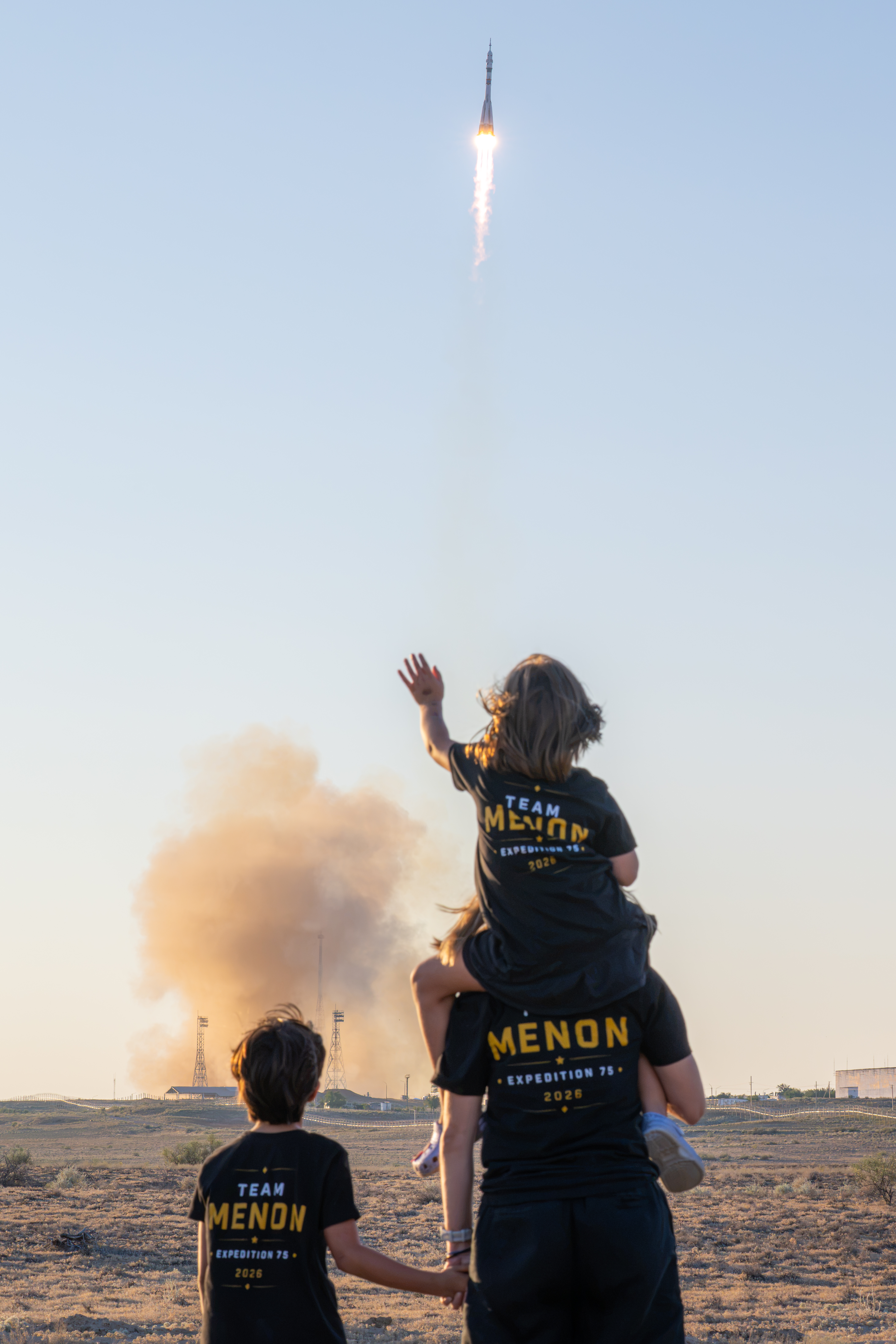
NASA astronaut candidate Anna Menon and her children watch as a Soyuz rocket launches to the International Space Station with NASA astronaut Anil Menon and Roscosmos cosmonauts Pyotr Dubrov and Anna Kikina, Tuesday, July 14, 2026, at the Baikonur Cosmodrome in Kazakhstan. The trio lifted off for the Soyuz MS-29 mission at 7:47 p.m. local time to begin their long-duration stay aboard the orbital outpost.
During his stay on the station, Menon will conduct scientific research and technology demonstrations aimed at advancing human space exploration and benefiting life on Earth.
Image credit: NASA/John Kraus
Anil Menon Launches to Space Station
NASA astronaut candidate Anna Menon and her children watch as a Soyuz rocket launches to the International Space Station with NASA astronaut Anil Menon and Roscosmos cosmonauts Pyotr Dubrov and Anna Kikina, Tuesday, July 14, 2026, at the Baikonur Cosmodrome in Kazakhstan. The trio lifted off for the Soyuz MS-29 mission at 7:47 p.m. local time to begin their long-duration stay aboard the orbital outpost.
During his stay on the station, Menon will conduct scientific research and technology demonstrations aimed at advancing human space exploration and benefiting life on Earth.
Image credit: NASA/John Kraus
Curiosity Finds Evidence of an Ancient Sandstorm
PNG (7.32 MB)
DescriptionBillions of years ago, an hours-long Martian sandstorm blew so intensely that sand ripples began to climb upon one another as they moved across the surface. These layers of sediment eventually hardened into the multilayered rocks seen in this image, which was taken by NASA’s Curiosity rover on Dec. 12, 2024, the 4,391st Martian day, or sol, of the mission.
Scientists believe this is the first evidence of climbing wind ripple strata on the Red Planet. Spotted at a location nicknamed “Jawbone Canyon,” these rocks are a rare time capsule preserving a dramatic wind event early in Martian history. A paper detailing the discovery was featured on the cover of the journal Geology on July 1, 2026.
Keep Exploring Discover More Topics From PhotojournalPhotojournal
Search Photojournal
Photojournal’s Latest Content
Feedback
Curiosity Finds Evidence of an Ancient Sandstorm
PNG (7.32 MB)
DescriptionBillions of years ago, an hours-long Martian sandstorm blew so intensely that sand ripples began to climb upon one another as they moved across the surface. These layers of sediment eventually hardened into the multilayered rocks seen in this image, which was taken by NASA’s Curiosity rover on Dec. 12, 2024, the 4,391st Martian day, or sol, of the mission.
Scientists believe this is the first evidence of climbing wind ripple strata on the Red Planet. Spotted at a location nicknamed “Jawbone Canyon,” these rocks are a rare time capsule preserving a dramatic wind event early in Martian history. A paper detailing the discovery was featured on the cover of the journal Geology on July 1, 2026.
Keep Exploring Discover More Topics From PhotojournalPhotojournal
Search Photojournal
Photojournal’s Latest Content
Feedback
Scientists discover a ‘remarkable’ new monkey species with orange lips and a froglike roar
The new species, Colobus congoensis, may already be endangered
NASA’s Perseverance Rover Provides Sweeping View of Broom Point
PNG (16.27 MB)
PIA26755 Figure APNG (16.15 MB)
DescriptionThis view looking back up at the outside lip of the 490-foot-tall (150-meter-tall) rim of Jezero Crater was taken by the Mastcam-Z instrument aboard NASA’s Perseverance on May 15, 2025, the 1,505th day, or sol, of the rover’s mission to Mars.
The bright-colored rocks exposed across the slope, running from middle left to middle right of the image, belong to a formation the science team calls the “Broom Point member,” a 245-foot-thick (75-meter-thick) stack of ancient rock. This sequence of layered bedrock is likely more than 3.9 billion years old, making it among the oldest terrain ever examined by a Mars rover. Evidence uncovered by Perseverance indicates this thick section of rock was built by repeated asteroid strikes, with layers tilting at nearly vertical angles exceeding 80 degrees due to the subsequent colossal impacts that created the Isidis Basin and Jezero Crater.
The rover’s tracks are visible in the image, showing Perseverance’s descent of the steep crater rim slope.
Figure A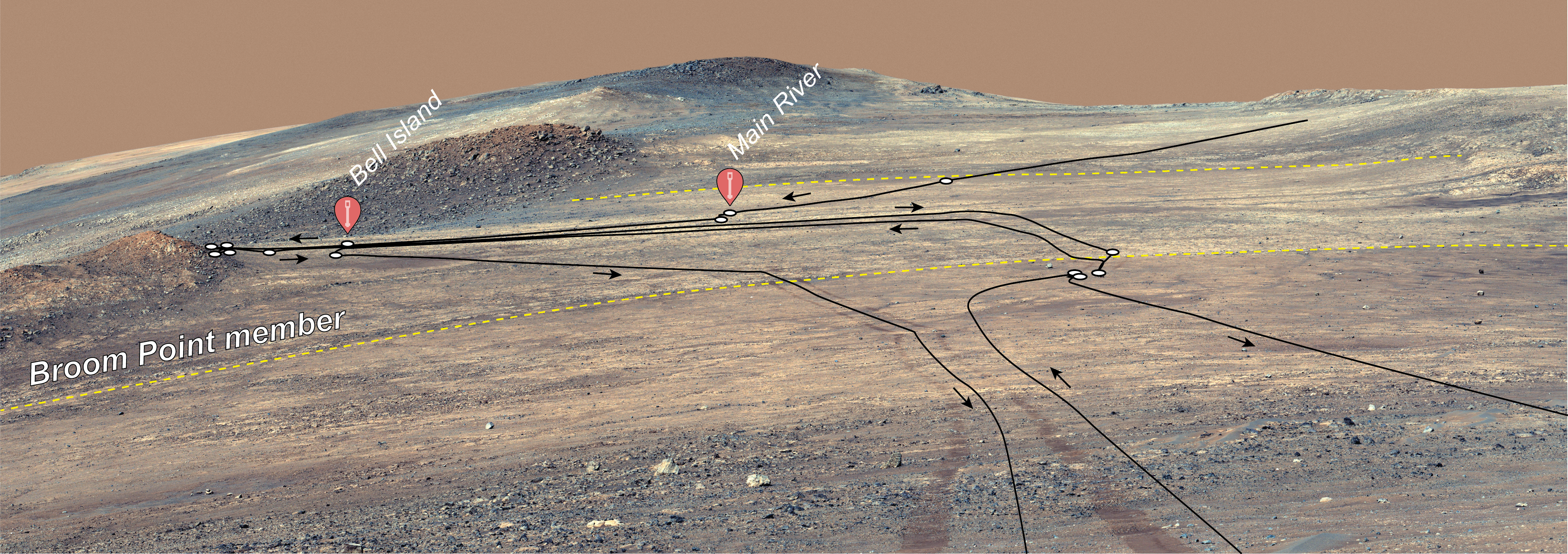
Figure A includes annotations:
- Dashed yellow lines indicate upper and lower boundaries of the Broom Point member
- Black lines indicate rover traverses
- White circles indicate locations rover stopped for science collection
- Red icons indicate locations of cored samples collected by Perseverance: “Bell Island” on April 22, 2025 (Sol 1,483) and “Main River” on March 10, 2025 (Sol 1,441)
NASA’s Jet Propulsion Laboratory, which is managed for the agency by Caltech in Pasadena, California, built and manages operations of the Perseverance rover. Arizona State University leads the operations of the Mastcam-Z instrument, working in collaboration with Malin Space Science Systems in San Diego, on the design, fabrication, testing, and operation of the cameras, and in collaboration with the Niels Bohr Institute of the University of Copenhagen on the design, fabrication, and testing of the calibration targets.
For more about Perseverance: science.nasa.gov/mission/mars-2020-perseverance/
Keep Exploring Discover More Topics From PhotojournalPhotojournal
Search Photojournal
Photojournal’s Latest Content
Feedback
NASA’s Perseverance Rover Provides Sweeping View of Broom Point
PNG (16.27 MB)
PIA26755 Figure APNG (16.15 MB)
DescriptionThis view looking back up at the outside lip of the 490-foot-tall (150-meter-tall) rim of Jezero Crater was taken by the Mastcam-Z instrument aboard NASA’s Perseverance on May 15, 2025, the 1,505th day, or sol, of the rover’s mission to Mars.
The bright-colored rocks exposed across the slope, running from middle left to middle right of the image, belong to a formation the science team calls the “Broom Point member,” a 245-foot-thick (75-meter-thick) stack of ancient rock. This sequence of layered bedrock is likely more than 3.9 billion years old, making it among the oldest terrain ever examined by a Mars rover. Evidence uncovered by Perseverance indicates this thick section of rock was built by repeated asteroid strikes, with layers tilting at nearly vertical angles exceeding 80 degrees due to the subsequent colossal impacts that created the Isidis Basin and Jezero Crater.
The rover’s tracks are visible in the image, showing Perseverance’s descent of the steep crater rim slope.
Figure AFigure A includes annotations:
- Dashed yellow lines indicate upper and lower boundaries of the Broom Point member
- Black lines indicate rover traverses
- White circles indicate locations rover stopped for science collection
- Red icons indicate locations of cored samples collected by Perseverance: “Bell Island” on April 22, 2025 (Sol 1,483) and “Main River” on March 10, 2025 (Sol 1,441)
NASA’s Jet Propulsion Laboratory, which is managed for the agency by Caltech in Pasadena, California, built and manages operations of the Perseverance rover. Arizona State University leads the operations of the Mastcam-Z instrument, working in collaboration with Malin Space Science Systems in San Diego, on the design, fabrication, testing, and operation of the cameras, and in collaboration with the Niels Bohr Institute of the University of Copenhagen on the design, fabrication, and testing of the calibration targets.
For more about Perseverance: science.nasa.gov/mission/mars-2020-perseverance/
Keep Exploring Discover More Topics From PhotojournalPhotojournal
Search Photojournal
Photojournal’s Latest Content
Feedback
How to avoid getting cyclosporiasis—and why washing lettuce may not be enough
Case numbers of this parasite-caused illness have exploded in the last week. An expert explains how to try and stay safe
Perseverance’s Trip to ‘Broom Point’
PNG (16.62 MB)
DescriptionThis orbital map shows the path NASA’s Perseverance Mars rover took to get to a location the science team has dubbed the “Broom Point member,” a sequence of layered bedrock likely more than 3.9 billion years old. As planned, the rover landed inside Jezero Crater on Feb. 18, 2021. It investigated the crater’s western delta and inlet river valley, Neretva Vallis, before summiting the crater rim in December 2024 following a rim-to-crest climb of 2,620 feet (800 meters).
The Broom Point region is situated on the outer edge of the crater rim and was visited by the rover in mid-2025. The yellow dot indicates location where the rover took a selfie.
NASA’s Jet Propulsion Laboratory, which is managed for the agency by Caltech in Pasadena, California, built and manages operations of the Perseverance rover. Arizona State University leads the operations of the Mastcam-Z instrument, working in collaboration with Malin Space Science Systems in San Diego, on the design, fabrication, testing, and operation of the cameras, and in collaboration with the Niels Bohr Institute of the University of Copenhagen on the design, fabrication, and testing of the calibration targets.
For more about Perseverance: science.nasa.gov/mission/mars-2020-perseverance/
JPL manages the Mars Reconnaissance Orbiter for NASA’s Science Mission Directorate in Washington as part of NASA’s Mars Exploration Program portfolio. Lockheed Martin Space in Denver built MRO and supports its operations. The University of Arizona, in Tucson, operates HiRISE, which was built by Ball Aerospace & Technologies Corp., in Boulder, Colorado.
For more information, visit:
science.nasa.gov/mission/mars-reconnaissance-orbiter
Keep Exploring Discover More Topics From PhotojournalPhotojournal
Search Photojournal
Photojournal’s Latest Content
Feedback