

Feed aggregator
NASA Welcomes Ireland as Newest Artemis Accords Signatory
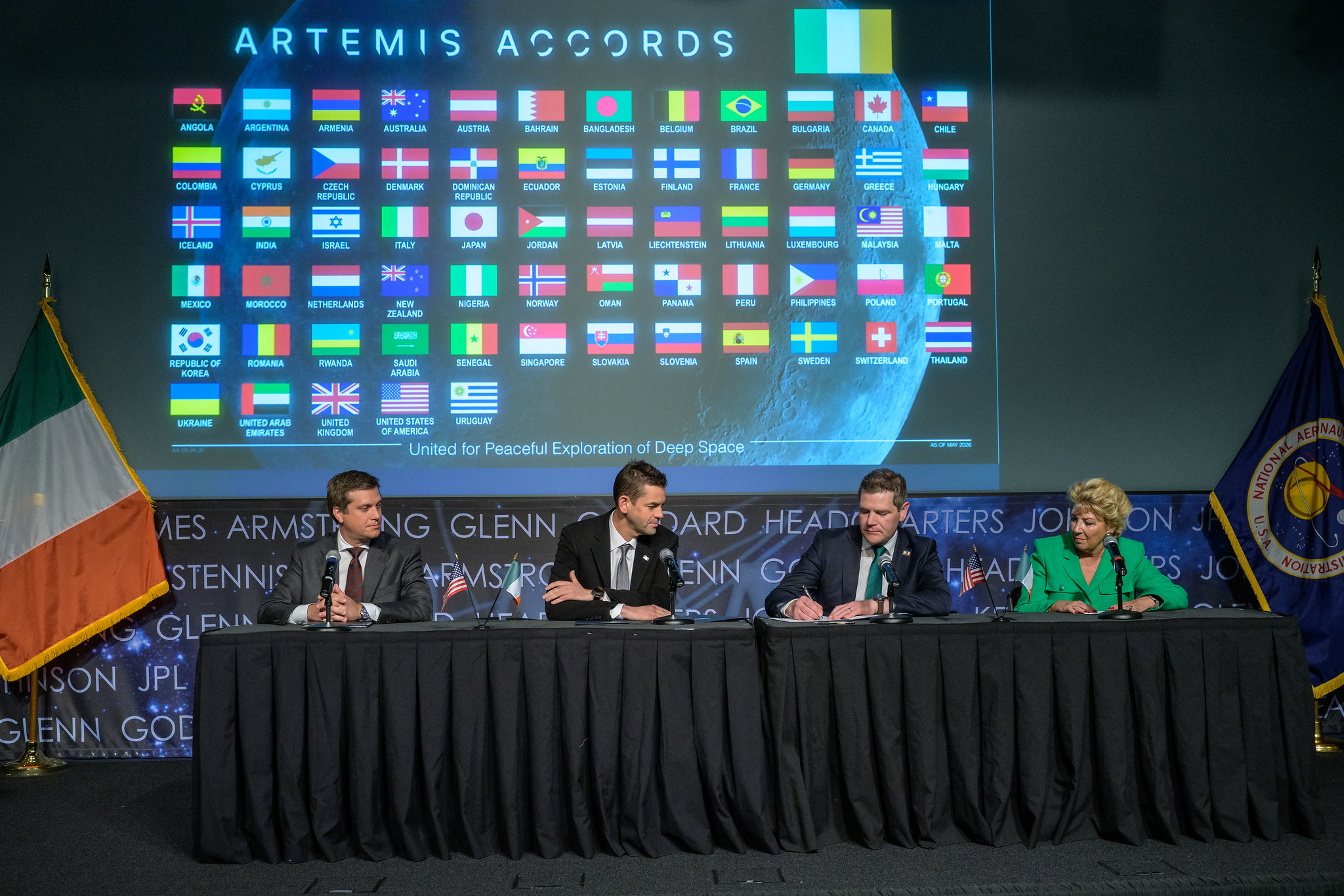
Ireland signed the Artemis Accords Monday during a signing ceremony hosted by NASA, becoming the latest nation to commit to the responsible exploration of space for all humanity.
Ireland, a longstanding member of ESA (European Space Agency) and a valued international partner for NASA, now joins all 23 ESA member states as a signatory of the Artemis Accords.
“It is my privilege to welcome Ireland as the 66th and newest signatory to the Artemis Accords,” said NASA Administrator Jared Isaacman during remarks. “The Emerald Isle is now part of a growing community of like-minded nations committed to the peaceful, transparent, and responsible exploration of space. Ireland joins at a pivotal moment. Artemis II was the opening act in humanity’s return to the Moon. What comes next is a sustained campaign of missions that will take us back to the lunar surface, not just for flags and footprints, but to build a base and stay.”
Underscoring the longstanding cultural ties and shared heritage between the United States and Ireland, the signing was celebrated during a ceremony at NASA Headquarters in Washington attended by U.S. Congressional staffers and interagency representatives.
Ireland’s Minister for Enterprise, Tourism and Employment Peter Burke, T.D., signed on behalf of the country.
“From an island shaped by the sea, whose people have always looked beyond the horizon and journeyed across the world, forging connections far beyond our shores, Ireland is proud to bring that same spirit to a new frontier and to join a global community committed to the peaceful exploration of space,” said Burke.
Ambassador of Ireland to the United States of America Geraldine Byrne Nason and Chief of Staff in the Office of the Under Secretary for Economic Affairs William Cappelletti, U.S. Department of State, participated in the event. U.S. Ambassador to Ireland Edward Walsh also attended.
In 2020, during the first Trump Administration, the United States, led by NASA and the U.S. Department of State, joined with seven other founding nations to establish the Artemis Accords, responding to the growing interest in lunar activities by both governments and private companies.
The Artemis Accords introduced the first set of practical principles aimed at enhancing the safety and coordination between like-minded nations as they explore the Moon, Mars, and beyond.
Signing the Artemis Accords means committing to explore peaceably and transparently, to render aid to those in need, to enable access to scientific data that all of humanity can learn from, to ensure activities do not interfere with those of others, and to preserve historically significant sites and artifacts by developing best practices for space exploration for the benefit of all.
More countries are expected to sign the Artemis Accords in the months and years ahead, as NASA continues its work to establish a safe, peaceful, and prosperous future in space.
Learn more about the Artemis Accords at:
https://www.nasa.gov/artemis-accords
Share Details Last Updated May 04, 2026 LocationNASA Headquarters Related TermsNASA Fosters Development of Lunar Resource-Seeking Technologies
To support long-duration missions to the Moon and Mars, NASA and industry are developing technologies that can extract resources such as hydrogen and helium-3 from lunar soil, known as regolith. This capability, known as in-situ resource utilization (ISRU), allows explorers to use what is already available on other planetary bodies, from water ice to minerals. These resources could eventually support propulsion, energy production, life support systems, and other needs for astronauts living and working in deep space.
To advance ISRU technologies, NASA has awarded a firm‑fixed‑price contract of $6.9 million over the next year and a half to Interlune of Seattle, a company focused on developing natural resources beyond Earth.
Funded through a Phase III NASA Small Business Innovation Research (SBIR) award, a contracting mechanism focused on transitioning technology into NASA missions or the private sector, the company will pursue validation of critical resource‑prospecting tools to make future lunar missions more self‑sufficient, reducing the need to transport supplies from Earth.
This effort builds on prior work with NASA’s Flight Opportunities program, in which Interlune built and tested payload prototypes on parabolic flights that replicated lunar gravity.
Under the SBIR Phase III contract, Interlune will design, build, and test engineering development units and flight hardware. The payload is designed to collect lunar regolith samples, sort particles by size, extract solar wind volatile gases, and measure their quantities. The company’s design includes a mass spectrometer inspired by NASA’s Mass Spectrometer Observing Lunar Operations (MSOLO) technology to measure the concentration of gases released from lunar soil.
Developed at NASA’s Kennedy Space Center in Florida, MSOLO is a compact, rugged mass spectrometer designed to analyze gases and the chemical makeup of landing sites on the Moon. The MSOLO technology, developed by NASA’s Game Changing Development program, demonstrated its hardware in lunar conditions during the Intuitive Machines 2 mission to the lunar South Pole in 2025.
“A major goal of NASA is to mature transformative technologies so they can be confidently adopted by industry,” said Michael Johansen, Deputy Program Manager for NASA’s Game Changing Development Program. “The evolution of MSOLO into a robust, flight-ready instrument is a perfect example of that success. We are thrilled to see this proven technology leveraged by an industry effort, marking a significant step forward in commercial resource prospecting.”
NASA’s MSOLO technology is available for commercial use and adaptable for ground tests and variable flight configurations. The instrument’s internal architecture includes a hybrid computer for onboard processing and a calibration gas system that allows the device to check and adjust its readings directly on the lunar surface. This data can benefit both commercial developers and NASA’s Artemis program. Its software has already been adapted to interface with four different CLPS (Commercial Lunar Payload Services) lander designs, reflecting its flexibility and increasing applicability to commercial lunar missions.
Investments by the agency in lunar surface technology from commercial partners represents an important step toward establishing a sustainable presence on the lunar surface. By advancing resource‑prospecting instruments and maturing technologies that enable the use of lunar materials, these efforts will help reduce the cost and complexity of future exploration missions.
NASA’s Small Business Innovation Research (SBIR) and Small Business Technology Transfer (STTR) program is managed by the agency’s Space Technology Mission Directorate. Through this program, entrepreneurs, startups, and small businesses with fewer than 500 employees can receive funding and non-monetary support to build, mature, and commercialize their technologies, advancing NASA missions and helping solve important challenges facing our nation.
This year, NASA’s SBIR/STTR program is adopting a Broad Agency Announcement framework to increase opportunities for small businesses while enhancing agility for the agency. The 2026-2027 BAA appendices, outlining topics and subtopics for desired technology proposals, closes May 21. Interested businesses and institutions are encouraged to visit the information hub for helpful details on applying.
To learn more about working with NASA Technology, visit
https://www.nasa.gov/stmd-solicitations-and-opportunities/
Explore More 4 min read Liquid Lifeline: NASA Tech Could Create IV Fluid In Space Article 2 weeks ago 4 min read NASA Space Tech’s Favorite Place to Travel in 2025: The Moon! Article 1 year ago 3 min read The Robotics of Sampling RegolithThe Perseverance rover recently collected its first two samples of Martian regolith!
Article 3 years ago Share Details Last Updated May 04, 2026 EditorLoura HallLocationNASA Headquarters Related TermsNASA Fosters Development of Lunar Resource-Seeking Technologies
To support long-duration missions to the Moon and Mars, NASA and industry are developing technologies that can extract resources such as hydrogen and helium-3 from lunar soil, known as regolith. This capability, known as in-situ resource utilization (ISRU), allows explorers to use what is already available on other planetary bodies, from water ice to minerals. These resources could eventually support propulsion, energy production, life support systems, and other needs for astronauts living and working in deep space.
To advance ISRU technologies, NASA has awarded a firm‑fixed‑price contract of $6.9 million over the next year and a half to Interlune of Seattle, a company focused on developing natural resources beyond Earth.
Funded through a Phase III NASA Small Business Innovation Research (SBIR) award, a contracting mechanism focused on transitioning technology into NASA missions or the private sector, the company will pursue validation of critical resource‑prospecting tools to make future lunar missions more self‑sufficient, reducing the need to transport supplies from Earth.
This effort builds on prior work with NASA’s Flight Opportunities program, in which Interlune built and tested payload prototypes on parabolic flights that replicated lunar gravity.
Under the SBIR Phase III contract, Interlune will design, build, and test engineering development units and flight hardware. The payload is designed to collect lunar regolith samples, sort particles by size, extract solar wind volatile gases, and measure their quantities. The company’s design includes a mass spectrometer inspired by NASA’s Mass Spectrometer Observing Lunar Operations (MSOLO) technology to measure the concentration of gases released from lunar soil.
Developed at NASA’s Kennedy Space Center in Florida, MSOLO is a compact, rugged mass spectrometer designed to analyze gases and the chemical makeup of landing sites on the Moon. The MSOLO technology, developed by NASA’s Game Changing Development program, demonstrated its hardware in lunar conditions during the Intuitive Machines 2 mission to the lunar South Pole in 2025.
“A major goal of NASA is to mature transformative technologies so they can be confidently adopted by industry,” said Michael Johansen, Deputy Program Manager for NASA’s Game Changing Development Program. “The evolution of MSOLO into a robust, flight-ready instrument is a perfect example of that success. We are thrilled to see this proven technology leveraged by an industry effort, marking a significant step forward in commercial resource prospecting.”
NASA’s MSOLO technology is available for commercial use and adaptable for ground tests and variable flight configurations. The instrument’s internal architecture includes a hybrid computer for onboard processing and a calibration gas system that allows the device to check and adjust its readings directly on the lunar surface. This data can benefit both commercial developers and NASA’s Artemis program. Its software has already been adapted to interface with four different CLPS (Commercial Lunar Payload Services) lander designs, reflecting its flexibility and increasing applicability to commercial lunar missions.
Investments by the agency in lunar surface technology from commercial partners represents an important step toward establishing a sustainable presence on the lunar surface. By advancing resource‑prospecting instruments and maturing technologies that enable the use of lunar materials, these efforts will help reduce the cost and complexity of future exploration missions.
NASA’s Small Business Innovation Research (SBIR) and Small Business Technology Transfer (STTR) program is managed by the agency’s Space Technology Mission Directorate. Through this program, entrepreneurs, startups, and small businesses with fewer than 500 employees can receive funding and non-monetary support to build, mature, and commercialize their technologies, advancing NASA missions and helping solve important challenges facing our nation.
This year, NASA’s SBIR/STTR program is adopting a Broad Agency Announcement framework to increase opportunities for small businesses while enhancing agility for the agency. The 2026-2027 BAA appendices, outlining topics and subtopics for desired technology proposals, closes May 21. Interested businesses and institutions are encouraged to visit the information hub for helpful details on applying.
To learn more about working with NASA Technology, visit
https://www.nasa.gov/stmd-solicitations-and-opportunities/
Explore More 4 min read Liquid Lifeline: NASA Tech Could Create IV Fluid In Space Article 2 weeks ago 4 min read NASA Space Tech’s Favorite Place to Travel in 2025: The Moon! Article 1 year ago 3 min read The Robotics of Sampling RegolithThe Perseverance rover recently collected its first two samples of Martian regolith!
Article 3 years ago Share Details Last Updated May 04, 2026 EditorLoura HallLocationNASA Headquarters Related TermsNASA just dropped more than 12,000 Artemis II photos—here’s how to see them
Want to go to the moon? Travel vicariously through the more than 12,000 photos NASA just posted from the Artemis II mission
How a Greenland shark’s heart can beat for centuries
Greenland sharks have hearts that can function normally for more than a century
NASA Welcomes Malta as Newest Artemis Accords Signatory
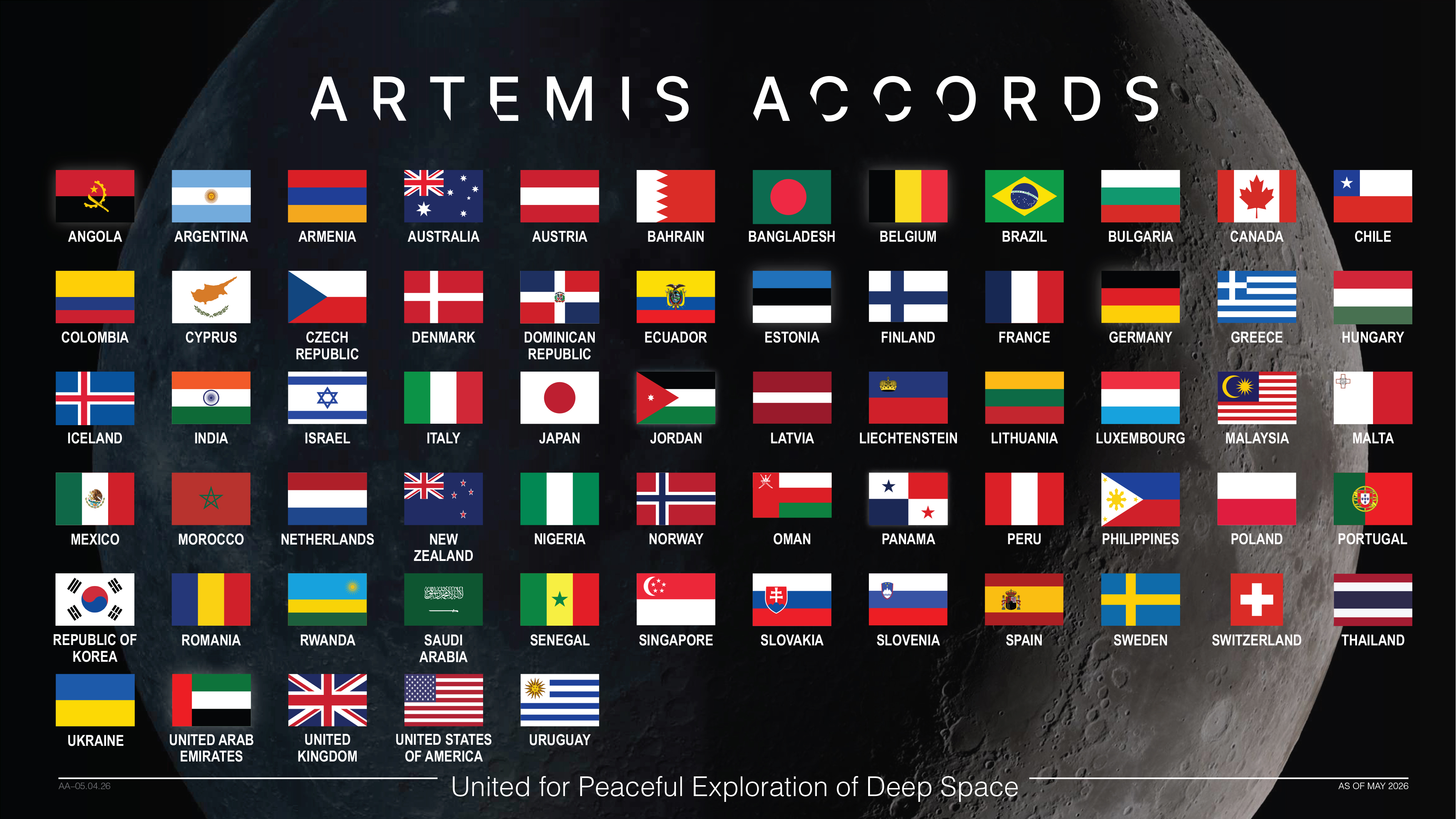
The Republic of Malta became the 65th signatory to the Artemis Accords on Monday during a ceremony in the town of Kalkara with NASA and U.S. Department of State officials present.
“Today, it’s my pleasure to welcome the Republic of Malta to the Artemis Accords community,” NASA Administrator Jared Isaacman said in recorded remarks. “By joining this growing coalition, Malta affirms shared commitments to peaceful, transparent, and responsible space exploration. These commitments safeguard against chaos and confusion, and they chart a responsible path forward for every nation that dares to accomplish the near-impossible in space.”
Malta’s Minister for Education, Youth, Sports, Research and Innovation Clifton Grima signed the Artemis Accords on behalf of the country.
“Malta is taking a deliberate step to position itself within a high-value, innovation-driven global sector,” said Grima. “This initiative strengthens our governance framework, enhances Malta’s international credibility and creates new opportunities to attract investment, build expertise and generate quality employment within the space economy.”
U.S. Ambassador to Malta Somers W. Farkas and NASA Europe Representative Gregory Mann witnessed the signing together with Deputy Prime Minister and Minister for Foreign Affairs and Tourism Ian Borg.
The United States and Malta have a long history of shared values and common interests, dating back to the American Revolution. NASA looks forward to future engagement on the Artemis Accords and recently outlined new opportunities for signatory countries to deepen their participation in NASA’s Artemis program.
In 2020, during the first Trump Administration, the United States, led by NASA and the U.S. Department of State, joined with seven other founding nations to establish the Artemis Accords, responding to the growing interest in lunar activities by both governments and private companies.
The Artemis Accords introduced the first set of practical principles aimed at enhancing the safety and coordination between like-minded nations as they explore the Moon, Mars, and beyond.
Signing the Artemis Accords means committing to explore peaceably and transparently, to render aid to those in need, to enable access to scientific data that all of humanity can learn from, to ensure activities do not interfere with those of others, and to preserve historically significant sites and artifacts by developing best practices for space exploration for the benefit of all.
More countries are expected to sign the Artemis Accords in the months and years ahead, as NASA continues its work to establish a safe, peaceful, and prosperous future in space.
Learn more about the Artemis Accords at:
https://www.nasa.gov/artemis-accords
Share Details Last Updated May 04, 2026 LocationNASA Headquarters Related TermsNASA Welcomes Malta as Newest Artemis Accords Signatory
The Republic of Malta became the 65th signatory to the Artemis Accords on Monday during a ceremony in the town of Kalkara with NASA and U.S. Department of State officials present.
“Today, it’s my pleasure to welcome the Republic of Malta to the Artemis Accords community,” NASA Administrator Jared Isaacman said in recorded remarks. “By joining this growing coalition, Malta affirms shared commitments to peaceful, transparent, and responsible space exploration. These commitments safeguard against chaos and confusion, and they chart a responsible path forward for every nation that dares to accomplish the near-impossible in space.”
Malta’s Minister for Education, Youth, Sports, Research and Innovation Clifton Grima signed the Artemis Accords on behalf of the country.
“Malta is taking a deliberate step to position itself within a high-value, innovation-driven global sector,” said Grima. “This initiative strengthens our governance framework, enhances Malta’s international credibility and creates new opportunities to attract investment, build expertise and generate quality employment within the space economy.”
U.S. Ambassador to Malta Somers W. Farkas and NASA Europe Representative Gregory Mann witnessed the signing together with Deputy Prime Minister and Minister for Foreign Affairs and Tourism Ian Borg.
The United States and Malta have a long history of shared values and common interests, dating back to the American Revolution. NASA looks forward to future engagement on the Artemis Accords and recently outlined new opportunities for signatory countries to deepen their participation in NASA’s Artemis program.
In 2020, during the first Trump Administration, the United States, led by NASA and the U.S. Department of State, joined with seven other founding nations to establish the Artemis Accords, responding to the growing interest in lunar activities by both governments and private companies.
The Artemis Accords introduced the first set of practical principles aimed at enhancing the safety and coordination between like-minded nations as they explore the Moon, Mars, and beyond.
Signing the Artemis Accords means committing to explore peaceably and transparently, to render aid to those in need, to enable access to scientific data that all of humanity can learn from, to ensure activities do not interfere with those of others, and to preserve historically significant sites and artifacts by developing best practices for space exploration for the benefit of all.
More countries are expected to sign the Artemis Accords in the months and years ahead, as NASA continues its work to establish a safe, peaceful, and prosperous future in space.
Learn more about the Artemis Accords at:
https://www.nasa.gov/artemis-accords
Share Details Last Updated May 04, 2026 LocationNASA Headquarters Related TermsSupreme Court reinstates access to abortion drug mifepristone by mail
On Monday the Supreme Court paused a ruling by a federal appeals court that prevented health care providers from prescribing mifepristone by telemedicine, setting the stage for further action from the nation’s highest court
School cell phone bans may boost student well-being—but not test scores, new study suggests
Banning cell phones in schools has been touted as a silver bullet for poor test scores and low student well-being and attendance, but new research suggests the results are more mixed
Breaking Barriers at 3rd Annual Findings from the Field Symposium

On March 30, 2026, the Gulf of Maine Research Institute (GMRI) and the NASA Science Activation program’s Learning Ecosystems Northeast (LENE) project hosted the third installment of the Findings from the Field Student Research Symposium. This annual event and associated Findings from the Field journal are where students are the experts and the usual “white coat” barriers associated with science communication come down. This year’s event welcomed 106 students, grades four through eight, 29 educators, and 15 Subject Matter Experts, and it featured 68 research posters, 14 lightning talks, and 5 discussion sessions.
To continue to foster a sense of belonging, the 2026 symposium introduced several shifts in how students interacted with science experts, data, and each other. In a move that subverted the traditional “look but don’t touch” rule of science, the first part of the day had students engaging in an activity inspired by the Data Vandals art group. They marked up visuals and treated data as a living, breathing conversation rather than a static fact. Another shift occurred within small discussion groups – the physical layout helped position the student scientists as the professionals. Students sat at the main table, while adults and Subject Matter Experts (SMEs) sat behind them. This put the youth, and their findings, at the center of the room.
A keynote speech given by Dr. Dave Reidmiller, Chief Impact Officer at the Gulf of Maine Research Institute, delivered what became the day’s unofficial mantra – “Science is a team sport”. This idea was reinforced in discussion groups with youth where they realized that scientific inquiry isn’t isolated. Students from different schools discovered they were essentially colleagues working on the same problems.
In the “Ash and Hemlock” groups, students who had only read about invasive pests found themselves swapping notes with students who had actually identified them in the field. Guiding questions posed by facilitators helped bridge any gaps in their knowledge and move the conversation forward:
- What happened?
- How do we know?
- Why does it matter?
These three questions allowed youth and adults to speak the same language, connecting the dots between their local data and the broader community issues they impact.
A new addition to the “Team Sport” this year was the increased presence of undergraduate students. Serving as a middle ground between the younger students and the career scientists, these mentors made the path to a scientific career feel reachable.
The second part of the day featured the students’ poster presentations. Here, they practiced communicating their work to an audience of peers and professional scientists, including leaders from the Maine Forest Service and NASA-affiliated researchers.
Perhaps the most defining moment of the symposium didn’t come from a keynote or a professional scientist. It happened in a breakout room during a discussion about environmental data. When a question was posed by another student toward a SME, a student leaned forward and jumped in to answer instead. This wasn’t just confidence; it was the manifestation of the symposium’s primary goal. Youth are experts too.
In the two previous iterations, the Symposium was hosted throughout the entire GMRI building, with posters lining the hallways and every conference room booked with lightning talks. When planning began for 2026, it quickly became clear that we had outgrown the space. Community supporters at GMRI corporate partner, Unum, graciously offered their office to host the growing number of students interested in participating. With the immediate feedback received, 2027 should be even bigger:
“I really enjoyed being able to connect with others on the cool science topics, and being able to share what I’ve learned.”
“I’ve never done something like this before… I might want to research more.”
“Hopefully, I get to do this next year.”
The 3rd Annual Findings Symposium proved that when you give young people a platform, and a sense of agency, they don’t just participate in science, they lead it. After all, they are the experts in the room.
The Learning Ecosystems Northeast project is supported by NASA under cooperative agreement award number NNX16AB94A and is part of NASA’s Science Activation Portfolio. Learn more about how Science Activation connects NASA science experts, real content, and experiences with community leaders to do science in ways that activate minds and promote deeper understanding of our world and beyond: https://science.nasa.gov/learn/about-science-activation/
Breaking Barriers at 3rd Annual Findings from the Field Symposium
On March 30, 2026, the Gulf of Maine Research Institute (GMRI) and the NASA Science Activation program’s Learning Ecosystems Northeast (LENE) project hosted the third installment of the Findings from the Field Student Research Symposium. This annual event and associated Findings from the Field journal are where students are the experts and the usual “white coat” barriers associated with science communication come down. This year’s event welcomed 106 students, grades four through eight, 29 educators, and 15 Subject Matter Experts, and it featured 68 research posters, 14 lightning talks, and 5 discussion sessions.
To continue to foster a sense of belonging, the 2026 symposium introduced several shifts in how students interacted with science experts, data, and each other. In a move that subverted the traditional “look but don’t touch” rule of science, the first part of the day had students engaging in an activity inspired by the Data Vandals art group. They marked up visuals and treated data as a living, breathing conversation rather than a static fact. Another shift occurred within small discussion groups – the physical layout helped position the student scientists as the professionals. Students sat at the main table, while adults and Subject Matter Experts (SMEs) sat behind them. This put the youth, and their findings, at the center of the room.
A keynote speech given by Dr. Dave Reidmiller, Chief Impact Officer at the Gulf of Maine Research Institute, delivered what became the day’s unofficial mantra – “Science is a team sport”. This idea was reinforced in discussion groups with youth where they realized that scientific inquiry isn’t isolated. Students from different schools discovered they were essentially colleagues working on the same problems.
In the “Ash and Hemlock” groups, students who had only read about invasive pests found themselves swapping notes with students who had actually identified them in the field. Guiding questions posed by facilitators helped bridge any gaps in their knowledge and move the conversation forward:
- What happened?
- How do we know?
- Why does it matter?
These three questions allowed youth and adults to speak the same language, connecting the dots between their local data and the broader community issues they impact.
A new addition to the “Team Sport” this year was the increased presence of undergraduate students. Serving as a middle ground between the younger students and the career scientists, these mentors made the path to a scientific career feel reachable.
The second part of the day featured the students’ poster presentations. Here, they practiced communicating their work to an audience of peers and professional scientists, including leaders from the Maine Forest Service and NASA-affiliated researchers.
Perhaps the most defining moment of the symposium didn’t come from a keynote or a professional scientist. It happened in a breakout room during a discussion about environmental data. When a question was posed by another student toward a SME, a student leaned forward and jumped in to answer instead. This wasn’t just confidence; it was the manifestation of the symposium’s primary goal. Youth are experts too.
In the two previous iterations, the Symposium was hosted throughout the entire GMRI building, with posters lining the hallways and every conference room booked with lightning talks. When planning began for 2026, it quickly became clear that we had outgrown the space. Community supporters at GMRI corporate partner, Unum, graciously offered their office to host the growing number of students interested in participating. With the immediate feedback received, 2027 should be even bigger:
“I really enjoyed being able to connect with others on the cool science topics, and being able to share what I’ve learned.”
“I’ve never done something like this before… I might want to research more.”
“Hopefully, I get to do this next year.”
The 3rd Annual Findings Symposium proved that when you give young people a platform, and a sense of agency, they don’t just participate in science, they lead it. After all, they are the experts in the room.
The Learning Ecosystems Northeast project is supported by NASA under cooperative agreement award number NNX16AB94A and is part of NASA’s Science Activation Portfolio. Learn more about how Science Activation connects NASA science experts, real content, and experiences with community leaders to do science in ways that activate minds and promote deeper understanding of our world and beyond: https://science.nasa.gov/learn/about-science-activation/
Blue Origin Moon Lander Completes Testing at NASA Vacuum Chamber
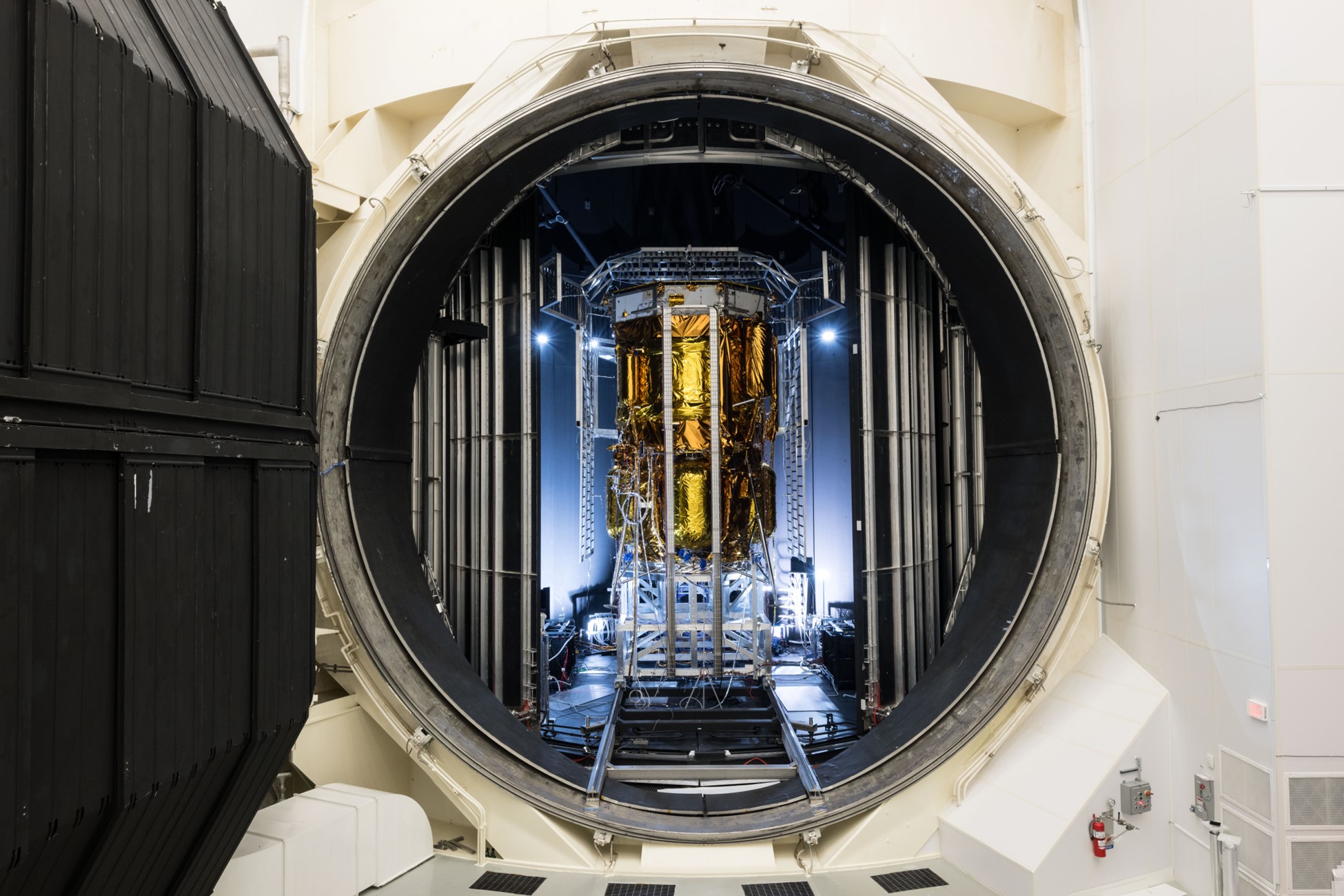
Also known as Endurance, MK1 is an uncrewed cargo lander funded by Blue Origin as a commercial demonstration mission to advance Human Landing System capabilities in support of NASA’s Artemis program. The tests in Chamber A represent a public-private partnership model, with Blue Origin conducting work through a reimbursable Space Act Agreement.
Endurance will demonstrate precision landing, cryogenic propulsion, and autonomous guidance, navigation, and control capabilities in support of future lunar surface operations. In addition to its primary objectives, MK1 will carry two NASA science and technology payloads under the CLPS (Commercial Lunar Payload Services) initiative to the lunar South Pole region this year: the Stereo Cameras for Lunar Plume-Surface Studies, an array of high-resolution cameras that will collect imagery of the interaction between the lander’s engine plume and the lunar surface during descent and landing, and the Laser Retroreflective Array, which helps orbiting spacecraft determine a more precise location using reflected laser light.
Through CLPS, NASA partners with American companies to deliver science investigations and technology demonstrations to the Moon, advancing understanding of the lunar environment and supporting future crewed missions as part of the agency’s Artemis campaign.
Testing in NASA Johnson’s Chamber A, one of the world’s largest thermal vacuum test facilities, enabled engineers to model the vacuum of space and the extreme temperature conditions the spacecraft would experience during flight. By recreating these conditions on the ground, teams evaluated system performance and verified structural and thermal integrity prior to launch. NASA and Blue Origin will incorporate lessons learned from MK1’s design, integration, and testing to support NASA’s future Artemis missions that will return American astronauts to the Moon.
MK1’s development contributes to technology maturation and risk reduction for future human-class systems, including Blue Moon Mark 2 (MK2), a larger crewed landing system designed to safely transport astronauts from lunar orbit to the surface and back, enabling sustained human exploration at the Moon’s South Pole region.
Testing of MK1 at NASA Johnson is enabled through the agency’s “front door” approach — a coordinated process that provides commercial partners access to NASA facilities and technical expertise while maintaining safety, mission assurance, and alignment with agency objectives.
More information about Thermal Vacuum Chamber A is available at https://www.nasa.gov/setmo/facilities/thermal-vacuum-chamber-a/
Blue Origin Moon Lander Completes Testing at NASA Vacuum Chamber
Also known as Endurance, MK1 is an uncrewed cargo lander funded by Blue Origin as a commercial demonstration mission to advance Human Landing System capabilities in support of NASA’s Artemis program. The tests in Chamber A represent a public-private partnership model, with Blue Origin conducting work through a reimbursable Space Act Agreement.
Endurance will demonstrate precision landing, cryogenic propulsion, and autonomous guidance, navigation, and control capabilities in support of future lunar surface operations. In addition to its primary objectives, MK1 will carry two NASA science and technology payloads under the CLPS (Commercial Lunar Payload Services) initiative to the lunar South Pole region this year: the Stereo Cameras for Lunar Plume-Surface Studies, an array of high-resolution cameras that will collect imagery of the interaction between the lander’s engine plume and the lunar surface during descent and landing, and the Laser Retroreflective Array, which helps orbiting spacecraft determine a more precise location using reflected laser light.
Through CLPS, NASA partners with American companies to deliver science investigations and technology demonstrations to the Moon, advancing understanding of the lunar environment and supporting future crewed missions as part of the agency’s Artemis campaign.
Testing in NASA Johnson’s Chamber A, one of the world’s largest thermal vacuum test facilities, enabled engineers to model the vacuum of space and the extreme temperature conditions the spacecraft would experience during flight. By recreating these conditions on the ground, teams evaluated system performance and verified structural and thermal integrity prior to launch. NASA and Blue Origin will incorporate lessons learned from MK1’s design, integration, and testing to support NASA’s future Artemis missions that will return American astronauts to the Moon.
MK1’s development contributes to technology maturation and risk reduction for future human-class systems, including Blue Moon Mark 2 (MK2), a larger crewed landing system designed to safely transport astronauts from lunar orbit to the surface and back, enabling sustained human exploration at the Moon’s South Pole region.
Testing of MK1 at NASA Johnson is enabled through the agency’s “front door” approach — a coordinated process that provides commercial partners access to NASA facilities and technical expertise while maintaining safety, mission assurance, and alignment with agency objectives.
More information about Thermal Vacuum Chamber A is available at https://www.nasa.gov/setmo/facilities/thermal-vacuum-chamber-a/
We Might Have Massively Underestimated Io's Thermal Output
Io is a world of extremes. It is by far the most volcanically active world in our solar system. Being continually squeezed in the never-ending tug-of-war between Jupiter and its larger satellites will do that to a moon. As a result, Io has over 400 “paterae” - volcanic depressions that spew lava up onto its surface. And, according to a new paper available in pre-print on arXiv and utilizing data from Juno’s Jupiter InfraRed Auroral Mapper (JIRAM) tool, we have been massively underestimating the power output of those paterae for decades.
Airborne microplastics could be making climate change worse
Tiny plastic particles drifting in Earth’s atmosphere could have a significant warming effect, a new study finds