
Feed aggregator
Roman soldiers defending Hadrian’s Wall had intestinal parasites
Roman soldiers defending Hadrian’s Wall had intestinal parasites
Moon Mascot: NASA Artemis II ZGI Design Challenge
4 min read
Preparations for Next Moonwalk Simulations Underway (and Underwater) A graphic for the Moon Mascot: NASA Artemis II ZGI Design Challenge.Freelancer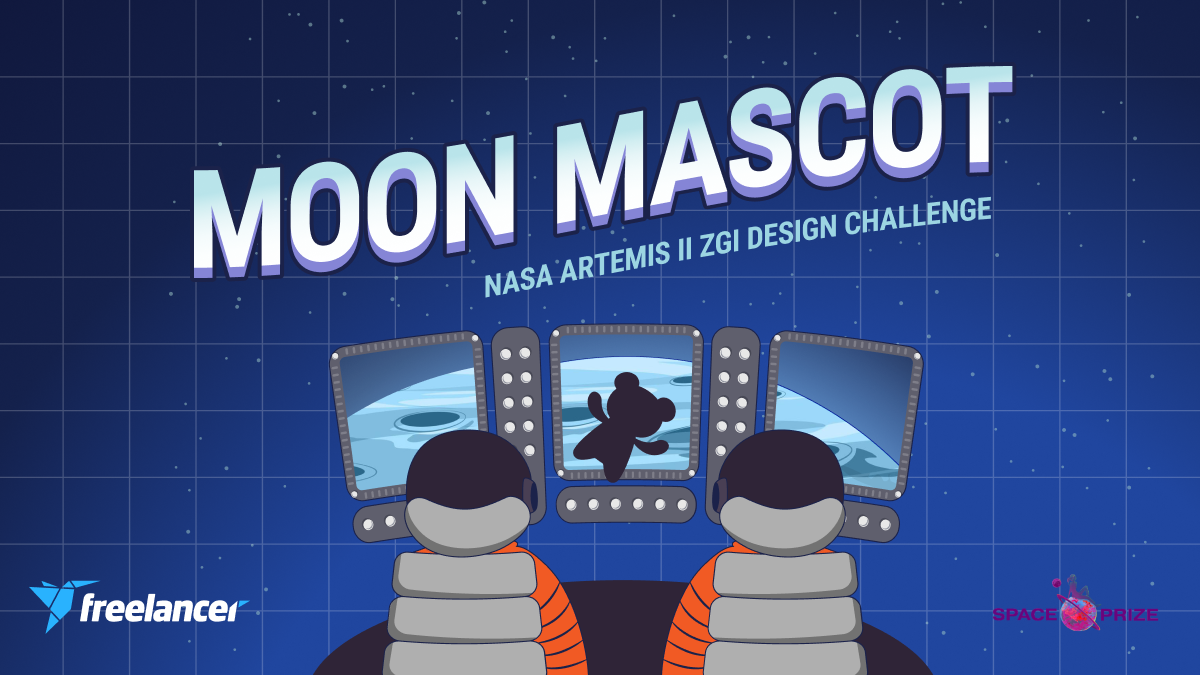
Whose Moon Mascot design will join the Artemis II astronauts on their historic voyage around the Moon in early 2026?
Between March 7 and Jun. 16, 2025, NASA worked with crowdsourcing company Freelancer to seek design ideas from global creators for a zero gravity indicator that will fly aboard the agency’s Artemis II test flight.
Zero gravity indicators are small, plush items carried aboard spacecraft to provide a visual indication of when the spacecraft and its crew reach space.
For the first eight minutes after liftoff, the crew and their indicator nearby will still be pushed into their seats by gravity, and the force of the climb into space. When the main engines of the SLS (Space Launch System) rocket’s core stage cut off, gravity’s restraints are lifted, but the crew will still be strapped safely into their seats – their zero gravity indicator’s ability to float will provide proof that they’ve made it into space.
Artemis II marks the first time that the public has had a hand in creating a crew’s mascot.
The MissionOver the course of about ten days, four astronauts will travel approximately 685,000 miles from Earth, venture around the Moon, and return home. The flight will—for the first time with astronauts—test NASA’s human deep space exploration capabilities, including the agency’s Exploration Ground Systems, SLS (Space Launch System) rocket, and Orion spacecraft.
NASA has a long history of flying zero gravity indicators for human spaceflight missions. Many missions to the International Space Station include a plush item. A plush Snoopy rode inside Orion during NASA’s uncrewed Artemis I mission.
NASA astronauts Reid Wiseman, Victor Glover, and Christina Koch, and CSA (Canadian Space Agency) astronaut Jeremy Hansen will venture around the Moon and back. The mission is the first crewed flight under NASA’s Artemis campaign and is another step toward missions on the lunar surface and helping the agency prepare for future human missions to Mars.
The ContestThe Artemis II astronauts attended SXSW 2025 on March 7, 2025, and sat on a panel to discuss their upcoming mission around the Moon and answer questions from the audience. During the panel, commander Reid Wiseman showed the audience his zero gravity indicator from his Expedition 40 mission to the International Space Station. His zero gravity indicator was a toy giraffe named Giraffiti. Wiseman’s mother gifted Giraffiti to his oldest daughter when she was born. When Wiseman embarked on his first mission to space, his kids gave him Giraffiti to take with him to space.
“This little guy spent every day with me in my crew quarters,” said Wiseman. “It was a connection back home to my kids.”
June 4, 2014NASA Astronaut Reid Wiseman photographed in front of the Cupola windows during his Expedition 40 mission with his zero gravity indicator, Giraffiti.NASA March 7, 2025NASA astronaut Reid Wiseman shows the zero gravity indicator, “Giraffiti” used during his launch to the International Space Station as he and fellow Artemis II astronauts announce that NASA is seeking design ideas from global creators for a zero gravity indicator that will fly aboard the agency’s Artemis II test flight, Friday, March 7, 2025, at SXSW in Austin, Texas.NASA/Bill Ingalls March 7, 2025NASA astronaut Reid Wiseman shows the zero gravity indicator, “Giraffiti” used during his launch to the International Space Station as he and fellow Artemis II astronauts announce that NASA is seeking design ideas from global creators for a zero gravity indicator that will fly aboard the agency’s Artemis II test flight, Friday, March 7, 2025, at SXSW in Austin, Texas.NASA/Bill IngallsThen, Wiseman and the other crew members revealed that they were opening up the opportunities to people of all ages from all over the world to design the zero gravity indicator for the Artemis II mission around the Moon.
What better way to fly a mission around the Moon than to invite the public inside NASA’s Orion spacecraft with us and ask for help in designing our zero gravity indicator?Reid Wiseman
NASA Astronaut and Commander of the Artemis II Mission
The Moon Mascot contest was hosted by the freelancing and crowdsourcing company Freelancer on behalf of the agency through the NASA Tournament Lab. The contest lasted about three months and received thousands of submissions from over 50 countries. Over the course of the contest, the agency hosted a Twitch stream on NASA’s Twitch channel to discuss zero gravity indicators and practice creating a design with a live artist. Adobe also released an Adobe Express template to help participants with their designs.
An Adobe Express template for the Moon Mascot competition. Adobe The Finalists
On Aug. 22, NASA and Freelancer announced the 25 finalists of the contest. These designs – ideas spanning from Moon-related twists on Earthly creatures to creative visions of exploration and discovery – were selected from more than 2,600 submissions from over 50 countries, including from K-12 students. The finalists represent 10 countries including the United States, Canada, Colombia, Finland, France, Germany, Japan, Peru, Singapore, and Wales.
Lucas Ye | Mountain View, California“Rise” Kenan Ziyan | Canyon, Texas“Zappy Zebra” Royal School, SKIES Space Club | Winnipeg, Manitoba, Canada“Luna the Space Polar Bear” Garden County Schools | Oshkosh, Nebraska“Team GarCo” Richellea Quinn Wijaya | Singapore“Parsec – The Bird That Flew to the Moon” Anzhelika Iudakova | Finland“Big Steps of Little Octopus” Congressional School | Falls Church, Virginia“Astra-Jelly” Congressional School | Falls Church, Virginia“Harper, Chloe, and Mateo’s ZGI” Alexa Pacholyk | Madison, Connecticut“Artemis” Leila Fleury | Rancho Palos Verdes, California“Beeatrice” Oakville Trafalgar School | Oakville, Ontario, Canada“Lepus the Moon Rabbit” Avon High School | Avon, Connecticut“Sal the Salmon” Daniela Colina | Lima, Peru“Corey the Explorer” Caroline Goyer-Desrosiers | St. Eustache, Quebec, Canada“Flying Squirrel Ready for Its Take Off to Space!” Giulia Bona | Berlin, Germany“Art & the Giant” Tabitha Ramsey | Frederick, Maryland“Lunar Crust-acean” Gabriela Hadas | Plano, Texas“Celestial Griffin” Savon Blanchard | Pearland, Texas“Soluna Flier” Ayako Moriyama | Kyoto, Japan“MORU: A Cloud Aglow with Moonlight and Hope” Johanna Beck | McPherson, Kansas“Creation Mythos” Guillaume Truong | Toulouse, France“Space Mola-mola (aka Moon Fish) Plushie” Arianna Robins | Rockledge, Florida“Terra the Titanosaurus” Sandy Moya | Madrid, Colombia“MISI: Guardian of the Journey” Bekah Crowmer | Mooresville, Indiana“Mona the Moon Moth” Courtney John | Llanelli, Wales“Past, Present, Future” The WinnerOnce the crew has selected a final design, NASA’s Thermal Blanket Lab will fabricate it for flight. The indicator will be tethered inside the Orion spacecraft before launch.
The winner of the contest and the design that will accompany the astronauts on their historic mission will be unveiled closer to launch. Launch is currently targeted for early next year, with launch opportunities as soon as February 2026.
About the AuthorThalia K. Patrinos Share Details Last Updated Dec 18, 2025 Related Terms Explore More 9 min read 2025 in Review: Highlights from NASA in Silicon Valley Article 2 days ago 3 min read NASA’s DiskSat Technology Demo Launches to Low Earth Orbit Article 2 days ago 10 min read NASA Langley Research Center: 2025 Year in Review Article 3 days ago Keep Exploring Discover More Topics From NASAMissions
Humans in Space
Climate Change
Solar System
Moon Mascot: NASA Artemis II ZGI Design Challenge
4 min read
Preparations for Next Moonwalk Simulations Underway (and Underwater) A graphic for the Moon Mascot: NASA Artemis II ZGI Design Challenge.FreelancerWhose Moon Mascot design will join the Artemis II astronauts on their historic voyage around the Moon in early 2026?
Between March 7 and Jun. 16, 2025, NASA worked with crowdsourcing company Freelancer to seek design ideas from global creators for a zero gravity indicator that will fly aboard the agency’s Artemis II test flight.
Zero gravity indicators are small, plush items carried aboard spacecraft to provide a visual indication of when the spacecraft and its crew reach space.
For the first eight minutes after liftoff, the crew and their indicator nearby will still be pushed into their seats by gravity, and the force of the climb into space. When the main engines of the SLS (Space Launch System) rocket’s core stage cut off, gravity’s restraints are lifted, but the crew will still be strapped safely into their seats – their zero gravity indicator’s ability to float will provide proof that they’ve made it into space.
Artemis II marks the first time that the public has had a hand in creating a crew’s mascot.
The MissionOver the course of about ten days, four astronauts will travel approximately 685,000 miles from Earth, venture around the Moon, and return home. The flight will—for the first time with astronauts—test NASA’s human deep space exploration capabilities, including the agency’s Exploration Ground Systems, SLS (Space Launch System) rocket, and Orion spacecraft.
NASA has a long history of flying zero gravity indicators for human spaceflight missions. Many missions to the International Space Station include a plush item. A plush Snoopy rode inside Orion during NASA’s uncrewed Artemis I mission.
NASA astronauts Reid Wiseman, Victor Glover, and Christina Koch, and CSA (Canadian Space Agency) astronaut Jeremy Hansen will venture around the Moon and back. The mission is the first crewed flight under NASA’s Artemis campaign and is another step toward missions on the lunar surface and helping the agency prepare for future human missions to Mars.
The ContestThe Artemis II astronauts attended SXSW 2025 on March 7, 2025, and sat on a panel to discuss their upcoming mission around the Moon and answer questions from the audience. During the panel, commander Reid Wiseman showed the audience his zero gravity indicator from his Expedition 40 mission to the International Space Station. His zero gravity indicator was a toy giraffe named Giraffiti. Wiseman’s mother gifted Giraffiti to his oldest daughter when she was born. When Wiseman embarked on his first mission to space, his kids gave him Giraffiti to take with him to space.
“This little guy spent every day with me in my crew quarters,” said Wiseman. “It was a connection back home to my kids.”
June 4, 2014NASA Astronaut Reid Wiseman photographed in front of the Cupola windows during his Expedition 40 mission with his zero gravity indicator, Giraffiti.NASA March 7, 2025NASA astronaut Reid Wiseman shows the zero gravity indicator, “Giraffiti” used during his launch to the International Space Station as he and fellow Artemis II astronauts announce that NASA is seeking design ideas from global creators for a zero gravity indicator that will fly aboard the agency’s Artemis II test flight, Friday, March 7, 2025, at SXSW in Austin, Texas.NASA/Bill Ingalls March 7, 2025NASA astronaut Reid Wiseman shows the zero gravity indicator, “Giraffiti” used during his launch to the International Space Station as he and fellow Artemis II astronauts announce that NASA is seeking design ideas from global creators for a zero gravity indicator that will fly aboard the agency’s Artemis II test flight, Friday, March 7, 2025, at SXSW in Austin, Texas.NASA/Bill IngallsThen, Wiseman and the other crew members revealed that they were opening up the opportunities to people of all ages from all over the world to design the zero gravity indicator for the Artemis II mission around the Moon.
What better way to fly a mission around the Moon than to invite the public inside NASA’s Orion spacecraft with us and ask for help in designing our zero gravity indicator?Reid Wiseman
NASA Astronaut and Commander of the Artemis II Mission
The Moon Mascot contest was hosted by the freelancing and crowdsourcing company Freelancer on behalf of the agency through the NASA Tournament Lab. The contest lasted about three months and received thousands of submissions from over 50 countries. Over the course of the contest, the agency hosted a Twitch stream on NASA’s Twitch channel to discuss zero gravity indicators and practice creating a design with a live artist. Adobe also released an Adobe Express template to help participants with their designs.
An Adobe Express template for the Moon Mascot competition. Adobe The FinalistsOn Aug. 22, NASA and Freelancer announced the 25 finalists of the contest. These designs – ideas spanning from Moon-related twists on Earthly creatures to creative visions of exploration and discovery – were selected from more than 2,600 submissions from over 50 countries, including from K-12 students. The finalists represent 10 countries including the United States, Canada, Colombia, Finland, France, Germany, Japan, Peru, Singapore, and Wales.
Lucas Ye | Mountain View, California“Rise” Kenan Ziyan | Canyon, Texas“Zappy Zebra” Royal School, SKIES Space Club | Winnipeg, Manitoba, Canada“Luna the Space Polar Bear” Garden County Schools | Oshkosh, Nebraska“Team GarCo” Richellea Quinn Wijaya | Singapore“Parsec – The Bird That Flew to the Moon” Anzhelika Iudakova | Finland“Big Steps of Little Octopus” Congressional School | Falls Church, Virginia“Astra-Jelly” Congressional School | Falls Church, Virginia“Harper, Chloe, and Mateo’s ZGI” Alexa Pacholyk | Madison, Connecticut“Artemis” Leila Fleury | Rancho Palos Verdes, California“Beeatrice” Oakville Trafalgar School | Oakville, Ontario, Canada“Lepus the Moon Rabbit” Avon High School | Avon, Connecticut“Sal the Salmon” Daniela Colina | Lima, Peru“Corey the Explorer” Caroline Goyer-Desrosiers | St. Eustache, Quebec, Canada“Flying Squirrel Ready for Its Take Off to Space!” Giulia Bona | Berlin, Germany“Art & the Giant” Tabitha Ramsey | Frederick, Maryland“Lunar Crust-acean” Gabriela Hadas | Plano, Texas“Celestial Griffin” Savon Blanchard | Pearland, Texas“Soluna Flier” Ayako Moriyama | Kyoto, Japan“MORU: A Cloud Aglow with Moonlight and Hope” Johanna Beck | McPherson, Kansas“Creation Mythos” Guillaume Truong | Toulouse, France“Space Mola-mola (aka Moon Fish) Plushie” Arianna Robins | Rockledge, Florida“Terra the Titanosaurus” Sandy Moya | Madrid, Colombia“MISI: Guardian of the Journey” Bekah Crowmer | Mooresville, Indiana“Mona the Moon Moth” Courtney John | Llanelli, Wales“Past, Present, Future” The WinnerOnce the crew has selected a final design, NASA’s Thermal Blanket Lab will fabricate it for flight. The indicator will be tethered inside the Orion spacecraft before launch.
The winner of the contest and the design that will accompany the astronauts on their historic mission will be unveiled closer to launch. Launch is currently targeted for early next year, with launch opportunities as soon as February 2026.
About the AuthorThalia K. Patrinos Share Details Last Updated Dec 18, 2025 Related Terms Explore More 9 min read 2025 in Review: Highlights from NASA in Silicon Valley Article 2 days ago 3 min read NASA’s DiskSat Technology Demo Launches to Low Earth Orbit Article 2 days ago 10 min read NASA Langley Research Center: 2025 Year in Review Article 3 days ago Keep Exploring Discover More Topics From NASAMissions
Humans in Space
Climate Change
Solar System
NASA Announces 2025 International Space Apps Challenge Global Winners
NASA Space Apps announced Thursday 10 winners of the 2025 NASA Space Apps Challenge. During this two-day hackathon, participants gathered at 551 local events across 167 countries and territories to showcase their STEM skills and proposed ways to transform NASA’s open data into actionable tools.
Participants work on their projects at the NASA Space Apps Challenge in Austin, Texas, at one of more than 50 local events held in the United States.NASA Space Apps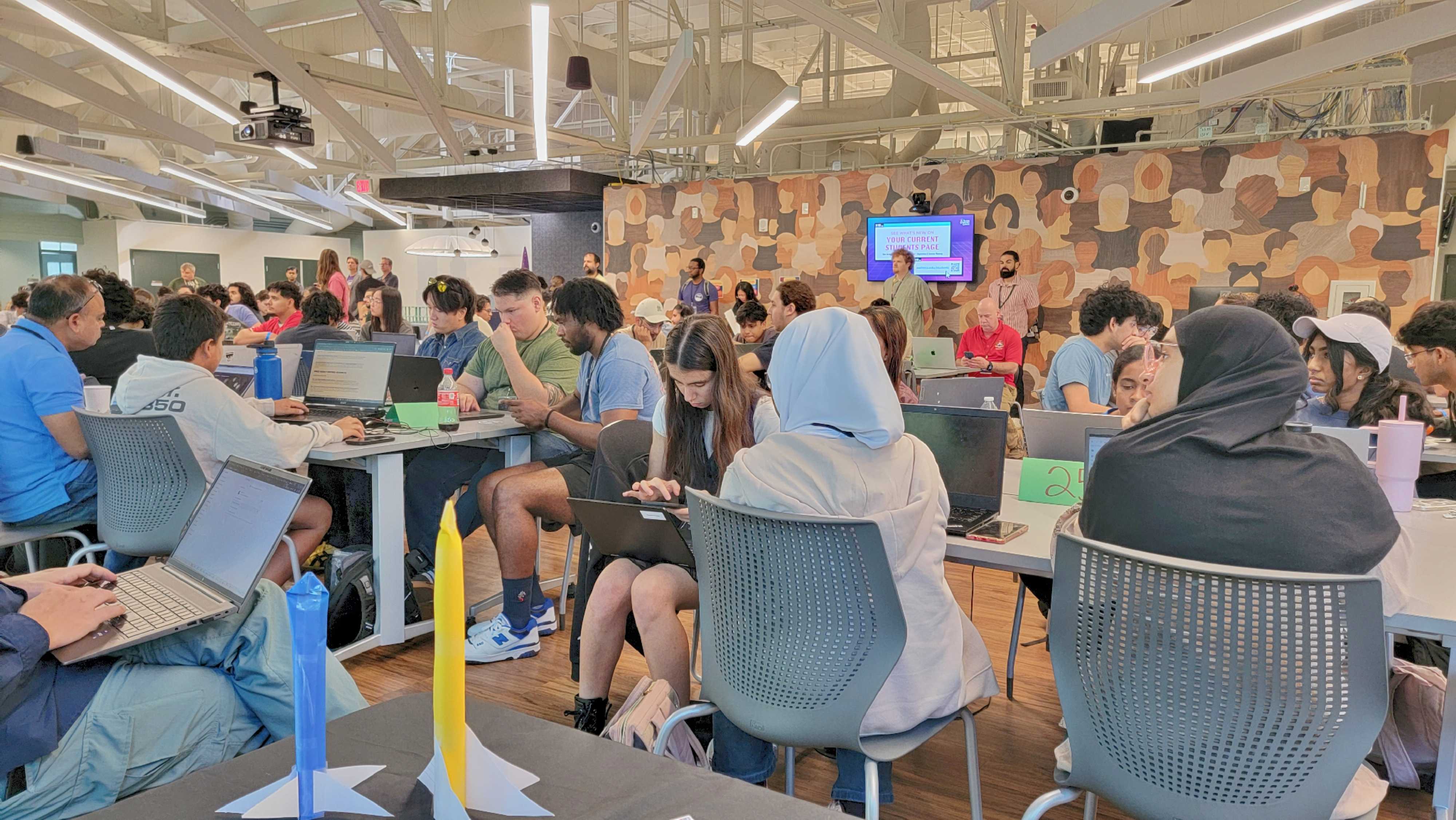
More than 114,000 participants came together to address challenges created by NASA subject matter experts. These challenges ranged in complexity and topic, tasking participants with everything from leveraging artificial intelligence, to improving access to NASA research, and developing tools to evaluate air quality.
“The Space Apps Challenge puts NASA’s free and open data into the hands of explorers around the world,” said Karen St. Germain, director, NASA Earth Science Division at NASA Headquarters in Washington. “With participants as varied as NASA enthusiasts, future scientists, regional decision-makers and members of the public, this challenge demonstrates the excitement of discovery and the real-world applications of agency data. Space apps also fosters a global community of creative and innovative ideas.”
The winners were determined from more than 11,500 project submissions and judged by subject matter experts from NASA and agency partners:
Best Use of Science Award: SpaceGenes+
Team Members: Saloni T.
Challenge: Build a Space Biology Knowledge Engine
Country/Territory: Germany
Team SpaceGenes+ created an interactive dashboard designed to help researchers uncover how radiation and microgravity together impact astronaut health at the molecular level. It gives researchers and mission planners an easy way to identify important molecular changes, supporting more effective protection strategies for long-duration spaceflight.
Learn more about SpaceGenes+’ project
Best Use of Data Award: Resonant Exoplanets
Team Members: Adhvaidh S., Gabriel S., Jack A., Sahil S.
Challenge: A World Away: Hunting for Exoplanets with AI
Country/Territory: United States
Team Resonant Exoplanets developed an AI-powered system that ingests large sets of telescope and satellite data, including spectra from missions like the James Webb Space Telescope. This tool automatically analyzes data for exoplanets and detects possible biosignatures, rather than identifying them manually.
Learn more about Resonant Exoplanets’ project
Best Use of Technology Award: Twisters
Team Members: Fernando A., Marcelo T., Mariana D., Regina R., Regina F.
Challenge: Will It Rain on My Parade?
Country/Territory: Mexico
Team Twisters developed SkySense, a web-app platform that uses NASA Earth observation data and AI analysis to provide ultra-local, personalized weather predictions and to analyze weather variables such as rain, wind, temperature, humidity, and visibility, generating real-time risk assessments and suggesting the safest time windows for activities.
Learn more about Twisters’ project
Galactic Impact Award: Astro Sweepers: We Catch What Space Leaves Behind
Team Members: Harshiv T., Pragathy S., Pratik J., Sherlin D., Yousra H., Zienab E.
Challenge: Commercializing Low Earth Orbit (LEO)
Country/Territory: Universal Event
Team Astro Sweepers developed an end-to-end orbital debris compliance and risk intelligence platform that automatically ingests public orbital data to generate Debris Assessment Software reports and compute the Astro Sweepers Risk Index for every resident space object. This project considers the operational, regulatory, and environmental challenges of commercialized space travel.
Learn more about Astro Sweepers’ project
Best Mission Concept Award: PureFlow
Team Members: Esthefany M., João F., Laiza L., Lara D., Pedro H., Thayane D.
Challenge: Your Home in Space: The Habitat Layout Creator
Country/Territory: Brazil
PureFlow developed an interactive systems engineering platform that allows users to design, model in 3D, and validate space habitats, and then test the design against real space-weather threats, such as solar storms. This system considers the critical functions required for living in space, including waste management, power, life support, communications, and more.
Learn more about PureFlows’ project
Most Inspirational Award: Photonics Odyssey
Team Members: Manish D., M. K., Prasanth G., Rajalingam N., Rashi M., Sakthi R.
Challenge: Commercializing Low Earth Orbit (LEO)
Country/Territory: India
Photonics Odyssey reimagined satellite internet as a sovereign national infrastructure rather than a private service, proposing a phased-array antenna approach that reduces ground dependency and expands broadband access to remote regions of India. The concept aims to help connect more than 700 million people who lack access to broadband internet.
Learn more about Photonics Odysseys’ project
Best Use of Storytelling Award: HerCode Space
Team Members: Alice R., Joselyn R., Paula C., Pierina J.
Challenge: Stellar Stories: Space Weather Through the Eyes of Earthlings
Country/Territory: Universal Event
HerCode Space combined NASA data and heliophysics concepts with powerful storytelling and vibrant illustrations to teach kids how space weather affects daily life and why it matters. HerCode Science hopes their story, “A Solar Tale,” can bridge science and imagination, and bring heliophysics to life in classrooms, libraries, and outreach programs.
Learn more about HerCode Spaces’ project
Global Connection Award: Gaia+LEO
Team Members: Adam H., Katia L., Prajwal S., Upendra K.
Challenge: Commercializing Low Earth Orbit (LEO)
Country/Territory: United States
Team Gaia+LEO developed a mixed-integer optimization framework that co-designs orbital and terrestrial data-center networks to support large-scale AI training and climate modeling in orbit. Their goal is to reduce the power, and water demands of Earth-based systems and help accelerate the shift toward space-based, green computing within the emerging orbital economy.
Learn more about Gaia+LEOs’ project
Art & Technology Award: Zumorroda-X
Team Members: Alaa A., Esraa A., Malak S., Mennatulla E.
Challenge: NASA Farm Navigators: Using NASA Data Exploration in Agriculture
Country/Territory: Egypt
Team Zumorroda-X created mini games that allow players to step into the shoes of a farmer who sets off on an epic journey around the world. Through this game, players can learn how farmers globally adapt to heat waves, flooding, and other environmental challenges.
Learn more about Zumorroda-Xs’ project
Local Impact Award: QUEÑARIS
Team Members: Borax Q., Carlos Y., Marcelo S., Máximo S., Oscar M., Pamela P.
Challenge: BloomWatch: An Earth Observation Application for Global Flowering Phenology
Country/Territory: Peru
Team QUEÑARIS’ project addresses critical water scarcity in Peru’s second-largest city, Arequipa, caused by the degradation of queñua forests, which are vital for water retention. Their platform combines native microorganisms, NASA satellite data, drones, and artificial intelligence to accelerate tree growth, identify the best areas for reforestation, and monitor ecosystem health.
Learn more about QUEÑARIS’ project
Stay up to date with #SpaceApps by following these accounts:
X: @SpaceApps
Instagram: @nasa_spaceapps
Facebook: @spaceappschallenge
YouTube: @NASASpaceAppsChallenge
NASA Space Apps is funded by NASA’s Earth Science Division through a contract with Booz Allen Hamilton, Mindgrub, and SecondMuse.
To learn more about what inspired these winning projects, visit:
https://www.spaceappschallenge.org
Explore More 6 min read NASA International Space Apps Challenge Announces 2024 Global Winners Article 11 months ago 5 min read 2023 NASA International Space Apps Challenge Announces 10 Global WinnersTen teams from around the world have been named the Global Winners of the 2023…
Article 2 years ago Share Details Last Updated Dec 18, 2025 Related TermsNASA Announces 2025 International Space Apps Challenge Global Winners
NASA Space Apps announced Thursday 10 winners of the 2025 NASA Space Apps Challenge. During this two-day hackathon, participants gathered at 551 local events across 167 countries and territories to showcase their STEM skills and proposed ways to transform NASA’s open data into actionable tools.
Participants work on their projects at the NASA Space Apps Challenge in Austin, Texas, at one of more than 50 local events held in the United States.NASA Space AppsMore than 114,000 participants came together to address challenges created by NASA subject matter experts. These challenges ranged in complexity and topic, tasking participants with everything from leveraging artificial intelligence, to improving access to NASA research, and developing tools to evaluate air quality.
“The Space Apps Challenge puts NASA’s free and open data into the hands of explorers around the world,” said Karen St. Germain, director, NASA Earth Science Division at NASA Headquarters in Washington. “With participants as varied as NASA enthusiasts, future scientists, regional decision-makers and members of the public, this challenge demonstrates the excitement of discovery and the real-world applications of agency data. Space apps also fosters a global community of creative and innovative ideas.”
The winners were determined from more than 11,500 project submissions and judged by subject matter experts from NASA and agency partners:
Best Use of Science Award: SpaceGenes+
Team Members: Saloni T.
Challenge: Build a Space Biology Knowledge Engine
Country/Territory: Germany
Team SpaceGenes+ created an interactive dashboard designed to help researchers uncover how radiation and microgravity together impact astronaut health at the molecular level. It gives researchers and mission planners an easy way to identify important molecular changes, supporting more effective protection strategies for long-duration spaceflight.
Learn more about SpaceGenes+’ project
Best Use of Data Award: Resonant Exoplanets
Team Members: Adhvaidh S., Gabriel S., Jack A., Sahil S.
Challenge: A World Away: Hunting for Exoplanets with AI
Country/Territory: United States
Team Resonant Exoplanets developed an AI-powered system that ingests large sets of telescope and satellite data, including spectra from missions like the James Webb Space Telescope. This tool automatically analyzes data for exoplanets and detects possible biosignatures, rather than identifying them manually.
Learn more about Resonant Exoplanets’ project
Best Use of Technology Award: Twisters
Team Members: Fernando A., Marcelo T., Mariana D., Regina R., Regina F.
Challenge: Will It Rain on My Parade?
Country/Territory: Mexico
Team Twisters developed SkySense, a web-app platform that uses NASA Earth observation data and AI analysis to provide ultra-local, personalized weather predictions and to analyze weather variables such as rain, wind, temperature, humidity, and visibility, generating real-time risk assessments and suggesting the safest time windows for activities.
Learn more about Twisters’ project
Galactic Impact Award: Astro Sweepers: We Catch What Space Leaves Behind
Team Members: Harshiv T., Pragathy S., Pratik J., Sherlin D., Yousra H., Zienab E.
Challenge: Commercializing Low Earth Orbit (LEO)
Country/Territory: Universal Event
Team Astro Sweepers developed an end-to-end orbital debris compliance and risk intelligence platform that automatically ingests public orbital data to generate Debris Assessment Software reports and compute the Astro Sweepers Risk Index for every resident space object. This project considers the operational, regulatory, and environmental challenges of commercialized space travel.
Learn more about Astro Sweepers’ project
Best Mission Concept Award: PureFlow
Team Members: Esthefany M., João F., Laiza L., Lara D., Pedro H., Thayane D.
Challenge: Your Home in Space: The Habitat Layout Creator
Country/Territory: Brazil
PureFlow developed an interactive systems engineering platform that allows users to design, model in 3D, and validate space habitats, and then test the design against real space-weather threats, such as solar storms. This system considers the critical functions required for living in space, including waste management, power, life support, communications, and more.
Learn more about PureFlows’ project
Most Inspirational Award: Photonics Odyssey
Team Members: Manish D., M. K., Prasanth G., Rajalingam N., Rashi M., Sakthi R.
Challenge: Commercializing Low Earth Orbit (LEO)
Country/Territory: India
Photonics Odyssey reimagined satellite internet as a sovereign national infrastructure rather than a private service, proposing a phased-array antenna approach that reduces ground dependency and expands broadband access to remote regions of India. The concept aims to help connect more than 700 million people who lack access to broadband internet.
Learn more about Photonics Odysseys’ project
Best Use of Storytelling Award: HerCode Space
Team Members: Alice R., Joselyn R., Paula C., Pierina J.
Challenge: Stellar Stories: Space Weather Through the Eyes of Earthlings
Country/Territory: Universal Event
HerCode Space combined NASA data and heliophysics concepts with powerful storytelling and vibrant illustrations to teach kids how space weather affects daily life and why it matters. HerCode Science hopes their story, “A Solar Tale,” can bridge science and imagination, and bring heliophysics to life in classrooms, libraries, and outreach programs.
Learn more about HerCode Spaces’ project
Global Connection Award: Gaia+LEO
Team Members: Adam H., Katia L., Prajwal S., Upendra K.
Challenge: Commercializing Low Earth Orbit (LEO)
Country/Territory: United States
Team Gaia+LEO developed a mixed-integer optimization framework that co-designs orbital and terrestrial data-center networks to support large-scale AI training and climate modeling in orbit. Their goal is to reduce the power, and water demands of Earth-based systems and help accelerate the shift toward space-based, green computing within the emerging orbital economy.
Learn more about Gaia+LEOs’ project
Art & Technology Award: Zumorroda-X
Team Members: Alaa A., Esraa A., Malak S., Mennatulla E.
Challenge: NASA Farm Navigators: Using NASA Data Exploration in Agriculture
Country/Territory: Egypt
Team Zumorroda-X created mini games that allow players to step into the shoes of a farmer who sets off on an epic journey around the world. Through this game, players can learn how farmers globally adapt to heat waves, flooding, and other environmental challenges.
Learn more about Zumorroda-Xs’ project
Local Impact Award: QUEÑARIS
Team Members: Borax Q., Carlos Y., Marcelo S., Máximo S., Oscar M., Pamela P.
Challenge: BloomWatch: An Earth Observation Application for Global Flowering Phenology
Country/Territory: Peru
Team QUEÑARIS’ project addresses critical water scarcity in Peru’s second-largest city, Arequipa, caused by the degradation of queñua forests, which are vital for water retention. Their platform combines native microorganisms, NASA satellite data, drones, and artificial intelligence to accelerate tree growth, identify the best areas for reforestation, and monitor ecosystem health.
Learn more about QUEÑARIS’ project
Stay up to date with #SpaceApps by following these accounts:
X: @SpaceApps
Instagram: @nasa_spaceapps
Facebook: @spaceappschallenge
YouTube: @NASASpaceAppsChallenge
NASA Space Apps is funded by NASA’s Earth Science Division through a contract with Booz Allen Hamilton, Mindgrub, and SecondMuse.
To learn more about what inspired these winning projects, visit:
https://www.spaceappschallenge.org
Explore More 6 min read NASA International Space Apps Challenge Announces 2024 Global Winners Article 11 months ago 5 min read 2023 NASA International Space Apps Challenge Announces 10 Global WinnersTen teams from around the world have been named the Global Winners of the 2023…
Article 2 years ago Share Details Last Updated Dec 18, 2025 Related TermsHere’s How Much Practice You Need to Become the Best in the World
Are you a specialist or a generalist? The answer could reveal something about how well you learn and perfect a skill
NASA Lab Completes Engine Checks on New Aircraft
NASA Lab Completes Engine Checks on New Aircraft
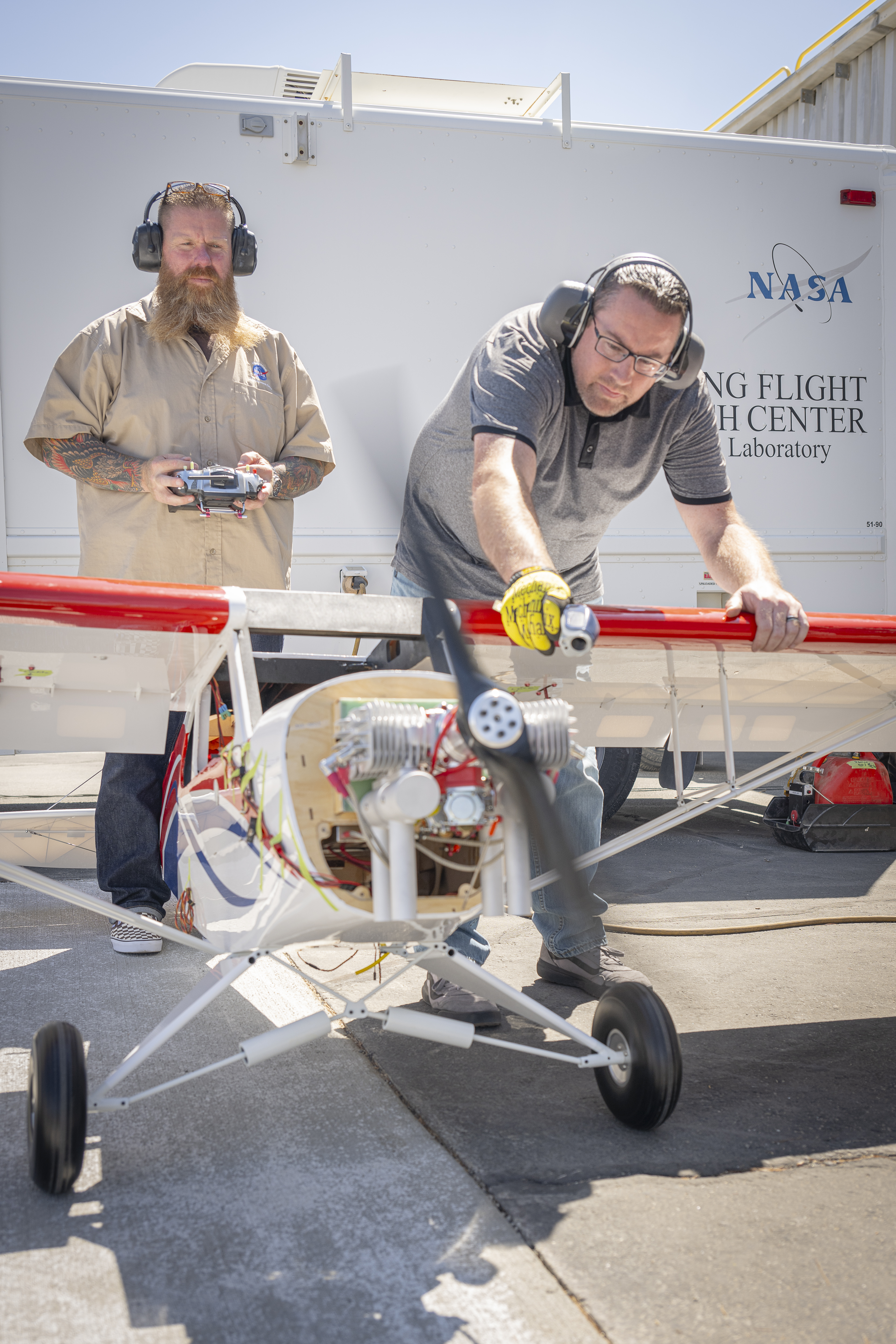
Justin Hall, left, controls a subscale aircraft as Justin Link holds the aircraft in place during preliminary engine tests on Friday, Sept. 12, 2025, at NASA’s Armstong Flight Research Center in Edwards, California.
Hall, chief pilot at the center’s Dale Reed Subscale Flight Research Laboratory, and Link, a pilot for small uncrewed aircraft systems, are building the large subscale aircraft to support increasingly complex flight research, offering a more flexible and cost-effective alternative to crewed missions. Once ready, the aircraft will help evaluate new concepts, technologies, and flight controls to support NASA missions on Earth and beyond.
Image Credit: NASA/Christopher LC Clark
NASA Lab Completes Engine Checks on New Aircraft
Justin Hall, left, controls a subscale aircraft as Justin Link holds the aircraft in place during preliminary engine tests on Friday, Sept. 12, 2025, at NASA’s Armstong Flight Research Center in Edwards, California.
Hall, chief pilot at the center’s Dale Reed Subscale Flight Research Laboratory, and Link, a pilot for small uncrewed aircraft systems, are building the large subscale aircraft to support increasingly complex flight research, offering a more flexible and cost-effective alternative to crewed missions. Once ready, the aircraft will help evaluate new concepts, technologies, and flight controls to support NASA missions on Earth and beyond.
Image Credit: NASA/Christopher LC Clark
Two asteroids crashed around a nearby star, solving a cosmic mystery
Two asteroids crashed around a nearby star, solving a cosmic mystery
NASA’s Hubble Sees Asteroids Colliding at Nearby Star for First Time
- Hubble Home
- Overview
- Impact & Benefits
- Science
- Observatory
- Team
- Multimedia
- News
- More
Like a game of cosmic bumper cars, scientists think the early days of our solar system were a time of violent turmoil, with planetesimals, asteroids, and comets smashing together and pelting the Earth, Moon, and the other inner planets with debris. Now, in a historical milestone, NASA’s Hubble Space Telescope has directly imaged similar catastrophic collisions in a nearby planetary system around another star, Fomalhaut.
“This is certainly the first time I’ve ever seen a point of light appear out of nowhere in an exoplanetary system,” said principal investigator Paul Kalas of the University of California, Berkeley. “It’s absent in all of our previous Hubble images, which means that we just witnessed a violent collision between two massive objects and a huge debris cloud unlike anything in our own solar system today. Amazing!”
Just 25 light-years from Earth, Fomalhaut is one of the brightest stars in the night sky. Located in the constellation Piscis Austrinus, also known as the Southern Fish, it is more massive and brighter than the Sun and is encircled by several belts of dusty debris.
This composite Hubble Space Telescope image shows the debris ring and dust clouds cs1 and cs2 around the star Fomalhaut. Fomalhaut itself is masked out to allow the fainter features to be seen. Its location is marked by the white star.Image: NASA, ESA, Paul Kalas (UC Berkeley); Image Processing: Joseph DePasquale (STScI)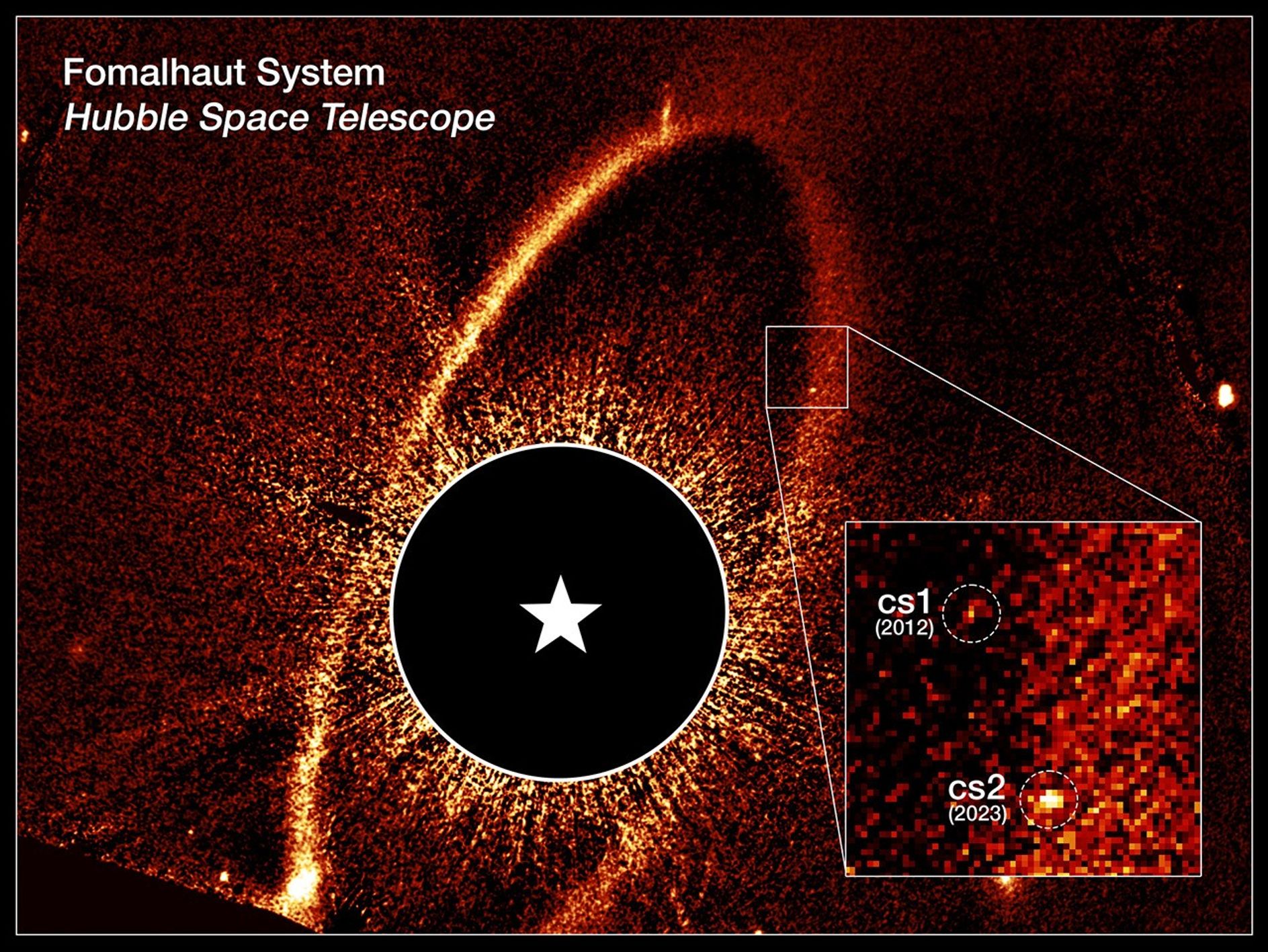
In 2008, scientists used Hubble to discover a candidate planet around Fomalhaut, making it the first stellar system with a possible planet found using visible light. That object, called Fomalhaut b, now appears to be a dust cloud masquerading as a planet—the result of colliding planetesimals. While searching for Fomalhaut b in recent Hubble observations, scientists were surprised to find a second point of light at a similar location around the star. They call this object “circumstellar source 2” or “cs2” while the first object is now known as “cs1.”
Tackling Mysteries of Colliding PlanetesimalsWhy astronomers are seeing both of these debris clouds so physically close to each other is a mystery. If the collisions between asteroids and planetesimals were random, cs1 and cs2 should appear by chance at unrelated locations. Yet, they are positioned intriguingly near each other along the inner portion of Fomalhaut’s outer debris disk.
Another mystery is why scientists have witnessed these two events within such a short timeframe. “Previous theory suggested that there should be one collision every 100,000 years, or longer. Here, in 20 years, we’ve seen two,” explained Kalas. “If you had a movie of the last 3,000 years, and it was sped up so that every year was a fraction of a second, imagine how many flashes you’d see over that time. Fomalhaut’s planetary system would be sparkling with these collisions.”
Collisions are fundamental to the evolution of planetary systems, but they are rare and difficult to study.
This artist’s concept shows the sequence of events leading up to the creation of dust cloud cs2 around the star Fomalhaut. In Panel 1, the star Fomalhaut appears in the top left corner. Two white dots, located in the bottom right corner, represent the two massive objects in orbit around Fomalhaut. In Panel 2, the objects approach each other. Panel 3 shows the violent collision of these two objects. In Panel 4, the resulting dust cloud cs2 becomes visible and starlight pushes the dust grains away from the star.Artwork: NASA, ESA, STScI, Ralf Crawford (STScI)“The exciting aspect of this observation is that it allows researchers to estimate both the size of the colliding bodies and how many of them there are in the disk, information which is almost impossible to get by any other means,” said co-author Mark Wyatt at the University of Cambridge in England. “Our estimates put the planetesimals that were destroyed to create cs1 and cs2 at just 37 miles or 60 kilometers across, and we infer that there are 300 million such objects orbiting in the Fomalhaut system.”
“The system is a natural laboratory to probe how planetesimals behave when undergoing collisions, which in turn tells us about what they are made of and how they formed,” explained Wyatt.
Cautionary TaleThe transient nature of Fomalhaut cs1 and cs2 poses challenges for future space missions aiming to directly image exoplanets. Such telescopes may mistake dust clouds like cs1 and cs2 for actual planets.
“Fomalhaut cs2 looks exactly like an extrasolar planet reflecting starlight,” said Kalas. “What we learned from studying cs1 is that a large dust cloud can masquerade as a planet for many years. This is a cautionary note for future missions that aim to detect extrasolar planets in reflected light.”
Looking to FutureKalas and his team have been granted Hubble time to monitor cs2 over the next three years. They want to see how it evolves—does it fade, or does it get brighter? Being closer to the dust belt than cs1, the expanding cs2 cloud is more likely to start encountering other material in the belt. This could lead to a sudden avalanche of more dust in the system, which could cause the whole surrounding area to get brighter.
Credit: NASA’s Goddard Space Flight Center; Lead Producer: Paul Morris“We will be tracing cs2 for any changes in its shape, brightness, and orbit over time,” said Kalas, “It’s possible that cs2 will start becoming more oval or cometary in shape as the dust grains are pushed outward by the pressure of starlight.”
The team also will use the NIRCam (Near-Infrared Camera) instrument on NASA’s James Webb Space Telescope to observe cs2. Webb’s NIRCam has the ability to provide color information that can reveal the size of the cloud’s dust grains and their composition. It can even determine if the cloud contains water ice.
Hubble and Webb are the only observatories capable of this kind of imaging. While Hubble primarily sees in visible wavelengths, Webb could view cs2 in the infrared. These different, complementary wavelengths are needed to provide a broad multi-spectral investigation and a more complete picture of the mysterious Fomalhaut system and its rapid evolution.
This research appears in the December 18 issue of Science.
The Hubble Space Telescope has been operating for over three decades and continues to make ground-breaking discoveries that shape our fundamental understanding of the universe. Hubble is a project of international cooperation between NASA and ESA (European Space Agency). NASA’s Goddard Space Flight Center in Greenbelt, Maryland, manages the telescope and mission operations. Lockheed Martin Space, based in Denver, also supports mission operations at Goddard. The Space Telescope Science Institute in Baltimore, which is operated by the Association of Universities for Research in Astronomy, conducts Hubble science operations for NASA.
Facebook logo @NASAHubble @NASAHubble Instagram logo @NASAHubble Related Images, Videos, & Resources Fomalhaut cs2This composite Hubble Space Telescope image shows the debris ring and dust clouds cs1 and cs2 around the star Fomalhaut. Fomalhaut itself is masked out to allow the fainter features to be seen. Its location is marked by the white star.
Fomalhaut cs2 IllustrationThis artist’s concept shows the sequence of events leading up to the creation of dust cloud cs2 around the star Fomalhaut.
Fomalhaut cs2 VideoHubble captured the violent collision of two massive objects around the star Fomalhaut. This extraordinary event is unlike anything in our own present-day solar system. The video shows the sequence of events leading up to the creation of dust cloud cs2 around the star Fomalhaut. …
Hubble Captures Destruction of Worlds VideoNASA’s Hubble Space Telescope captured a rare and violent event unfolding around the nearby star Fomalhaut. This discovery sheds light on the chaotic processes that may have shaped our own solar system billions of years ago. With support from both Hubble and the James Webb Space Telescope, astronomers are now closely monitoring the aftermath.
From 2020:Exoplanet Apparently Disappears in Latest Hubble Observations
What astronomers thought was a planet beyond our solar system has now seemingly vanished from sight.
From 2013:Hubble Reveals Rogue Planetary Orbit for Fomalhaut b
Newly released Hubble Space Telescope images of a vast debris disk encircling the nearby star Fomalhaut, and of a mysterious planet circling it, may provide forensic evidence of a titanic planetary disruption in the system.
From 2008:Hubble Directly Observes Planet Orbiting Fomalhaut
NASA’s Hubble Space Telescope has taken the first visible-light snapshot of a planet circling another star.
From 2005:Elusive Planet Reshapes a Ring Around Neighboring Star
NASA Hubble Space Telescope’s most detailed visible-light image ever taken of a narrow, dusty ring around the nearby star Fomalhaut (HD 216956), offers the strongest evidence yet that an unruly and unseen planet may be gravitationally tugging on the ring.
Share Details Last Updated Dec 18, 2025 EditorAndrea GianopoulosLocationNASA Goddard Space Flight Center Contact MediaClaire Andreoli
NASA’s Goddard Space Flight Center
Greenbelt, Maryland
claire.andreoli@nasa.gov
Ann Jenkins, Christine Pulliam
Space Telescope Science Institute
Baltimore, Maryland
- Release on ESA website
- Release on ESA/Hubble website
- Science Paper: A second planetesimal collision in the Fomalhaut system, PDF (4.09 MB)
Since its 1990 launch, the Hubble Space Telescope has changed our fundamental understanding of the universe.
Hubble Science Highlights
Hubble Images
Hubble News
NASA’s Hubble Sees Asteroids Colliding at Nearby Star for First Time
- Hubble Home
- Overview
- Impact & Benefits
- Science
- Observatory
- Team
- Multimedia
- News
- More
Like a game of cosmic bumper cars, scientists think the early days of our solar system were a time of violent turmoil, with planetesimals, asteroids, and comets smashing together and pelting the Earth, Moon, and the other inner planets with debris. Now, in a historical milestone, NASA’s Hubble Space Telescope has directly imaged similar catastrophic collisions in a nearby planetary system around another star, Fomalhaut.
“This is certainly the first time I’ve ever seen a point of light appear out of nowhere in an exoplanetary system,” said principal investigator Paul Kalas of the University of California, Berkeley. “It’s absent in all of our previous Hubble images, which means that we just witnessed a violent collision between two massive objects and a huge debris cloud unlike anything in our own solar system today. Amazing!”
Just 25 light-years from Earth, Fomalhaut is one of the brightest stars in the night sky. Located in the constellation Piscis Austrinus, also known as the Southern Fish, it is more massive and brighter than the Sun and is encircled by several belts of dusty debris.
This composite Hubble Space Telescope image shows the debris ring and dust clouds cs1 and cs2 around the star Fomalhaut. Fomalhaut itself is masked out to allow the fainter features to be seen. Its location is marked by the white star.Image: NASA, ESA, Paul Kalas (UC Berkeley); Image Processing: Joseph DePasquale (STScI)In 2008, scientists used Hubble to discover a candidate planet around Fomalhaut, making it the first stellar system with a possible planet found using visible light. That object, called Fomalhaut b, now appears to be a dust cloud masquerading as a planet—the result of colliding planetesimals. While searching for Fomalhaut b in recent Hubble observations, scientists were surprised to find a second point of light at a similar location around the star. They call this object “circumstellar source 2” or “cs2” while the first object is now known as “cs1.”
Tackling Mysteries of Colliding PlanetesimalsWhy astronomers are seeing both of these debris clouds so physically close to each other is a mystery. If the collisions between asteroids and planetesimals were random, cs1 and cs2 should appear by chance at unrelated locations. Yet, they are positioned intriguingly near each other along the inner portion of Fomalhaut’s outer debris disk.
Another mystery is why scientists have witnessed these two events within such a short timeframe. “Previous theory suggested that there should be one collision every 100,000 years, or longer. Here, in 20 years, we’ve seen two,” explained Kalas. “If you had a movie of the last 3,000 years, and it was sped up so that every year was a fraction of a second, imagine how many flashes you’d see over that time. Fomalhaut’s planetary system would be sparkling with these collisions.”
Collisions are fundamental to the evolution of planetary systems, but they are rare and difficult to study.
This artist’s concept shows the sequence of events leading up to the creation of dust cloud cs2 around the star Fomalhaut. In Panel 1, the star Fomalhaut appears in the top left corner. Two white dots, located in the bottom right corner, represent the two massive objects in orbit around Fomalhaut. In Panel 2, the objects approach each other. Panel 3 shows the violent collision of these two objects. In Panel 4, the resulting dust cloud cs2 becomes visible and starlight pushes the dust grains away from the star.Artwork: NASA, ESA, STScI, Ralf Crawford (STScI)“The exciting aspect of this observation is that it allows researchers to estimate both the size of the colliding bodies and how many of them there are in the disk, information which is almost impossible to get by any other means,” said co-author Mark Wyatt at the University of Cambridge in England. “Our estimates put the planetesimals that were destroyed to create cs1 and cs2 at just 37 miles or 60 kilometers across, and we infer that there are 300 million such objects orbiting in the Fomalhaut system.”
“The system is a natural laboratory to probe how planetesimals behave when undergoing collisions, which in turn tells us about what they are made of and how they formed,” explained Wyatt.
Cautionary TaleThe transient nature of Fomalhaut cs1 and cs2 poses challenges for future space missions aiming to directly image exoplanets. Such telescopes may mistake dust clouds like cs1 and cs2 for actual planets.
“Fomalhaut cs2 looks exactly like an extrasolar planet reflecting starlight,” said Kalas. “What we learned from studying cs1 is that a large dust cloud can masquerade as a planet for many years. This is a cautionary note for future missions that aim to detect extrasolar planets in reflected light.”
Looking to FutureKalas and his team have been granted Hubble time to monitor cs2 over the next three years. They want to see how it evolves—does it fade, or does it get brighter? Being closer to the dust belt than cs1, the expanding cs2 cloud is more likely to start encountering other material in the belt. This could lead to a sudden avalanche of more dust in the system, which could cause the whole surrounding area to get brighter.
Credit: NASA’s Goddard Space Flight Center; Lead Producer: Paul Morris“We will be tracing cs2 for any changes in its shape, brightness, and orbit over time,” said Kalas, “It’s possible that cs2 will start becoming more oval or cometary in shape as the dust grains are pushed outward by the pressure of starlight.”
The team also will use the NIRCam (Near-Infrared Camera) instrument on NASA’s James Webb Space Telescope to observe cs2. Webb’s NIRCam has the ability to provide color information that can reveal the size of the cloud’s dust grains and their composition. It can even determine if the cloud contains water ice.
Hubble and Webb are the only observatories capable of this kind of imaging. While Hubble primarily sees in visible wavelengths, Webb could view cs2 in the infrared. These different, complementary wavelengths are needed to provide a broad multi-spectral investigation and a more complete picture of the mysterious Fomalhaut system and its rapid evolution.
This research appears in the December 18 issue of Science.
The Hubble Space Telescope has been operating for over three decades and continues to make ground-breaking discoveries that shape our fundamental understanding of the universe. Hubble is a project of international cooperation between NASA and ESA (European Space Agency). NASA’s Goddard Space Flight Center in Greenbelt, Maryland, manages the telescope and mission operations. Lockheed Martin Space, based in Denver, also supports mission operations at Goddard. The Space Telescope Science Institute in Baltimore, which is operated by the Association of Universities for Research in Astronomy, conducts Hubble science operations for NASA.
Facebook logo @NASAHubble @NASAHubble Instagram logo @NASAHubble Related Images, Videos, & Resources Fomalhaut cs2This composite Hubble Space Telescope image shows the debris ring and dust clouds cs1 and cs2 around the star Fomalhaut. Fomalhaut itself is masked out to allow the fainter features to be seen. Its location is marked by the white star.
Fomalhaut cs2 IllustrationThis artist’s concept shows the sequence of events leading up to the creation of dust cloud cs2 around the star Fomalhaut.
Fomalhaut cs2 VideoHubble captured the violent collision of two massive objects around the star Fomalhaut. This extraordinary event is unlike anything in our own present-day solar system. The video shows the sequence of events leading up to the creation of dust cloud cs2 around the star Fomalhaut. …
Hubble Captures Destruction of Worlds VideoNASA’s Hubble Space Telescope captured a rare and violent event unfolding around the nearby star Fomalhaut. This discovery sheds light on the chaotic processes that may have shaped our own solar system billions of years ago. With support from both Hubble and the James Webb Space Telescope, astronomers are now closely monitoring the aftermath.
From 2020:Exoplanet Apparently Disappears in Latest Hubble Observations
What astronomers thought was a planet beyond our solar system has now seemingly vanished from sight.
From 2013:Hubble Reveals Rogue Planetary Orbit for Fomalhaut b
Newly released Hubble Space Telescope images of a vast debris disk encircling the nearby star Fomalhaut, and of a mysterious planet circling it, may provide forensic evidence of a titanic planetary disruption in the system.
From 2008:Hubble Directly Observes Planet Orbiting Fomalhaut
NASA’s Hubble Space Telescope has taken the first visible-light snapshot of a planet circling another star.
From 2005:Elusive Planet Reshapes a Ring Around Neighboring Star
NASA Hubble Space Telescope’s most detailed visible-light image ever taken of a narrow, dusty ring around the nearby star Fomalhaut (HD 216956), offers the strongest evidence yet that an unruly and unseen planet may be gravitationally tugging on the ring.
Share Details Last Updated Dec 18, 2025 EditorAndrea GianopoulosLocationNASA Goddard Space Flight Center Contact MediaClaire Andreoli
NASA’s Goddard Space Flight Center
Greenbelt, Maryland
claire.andreoli@nasa.gov
Ann Jenkins, Christine Pulliam
Space Telescope Science Institute
Baltimore, Maryland
- Release on ESA website
- Release on ESA/Hubble website
- Science Paper: A second planetesimal collision in the Fomalhaut system, PDF (4.09 MB)
Since its 1990 launch, the Hubble Space Telescope has changed our fundamental understanding of the universe.
Hubble Science Highlights
Hubble Images
Hubble News
NASA, Boeing Test How to Improve Performance of Longer, Narrower Aircraft Wings
5 min read
Preparations for Next Moonwalk Simulations Underway (and Underwater) The Integrated Adaptive Wing Technology Maturation wind-tunnel model installed in the Transonic Dynamics Tunnel at NASA Langley Research Center in Hampton, Virginia.NASA / Mark Knopp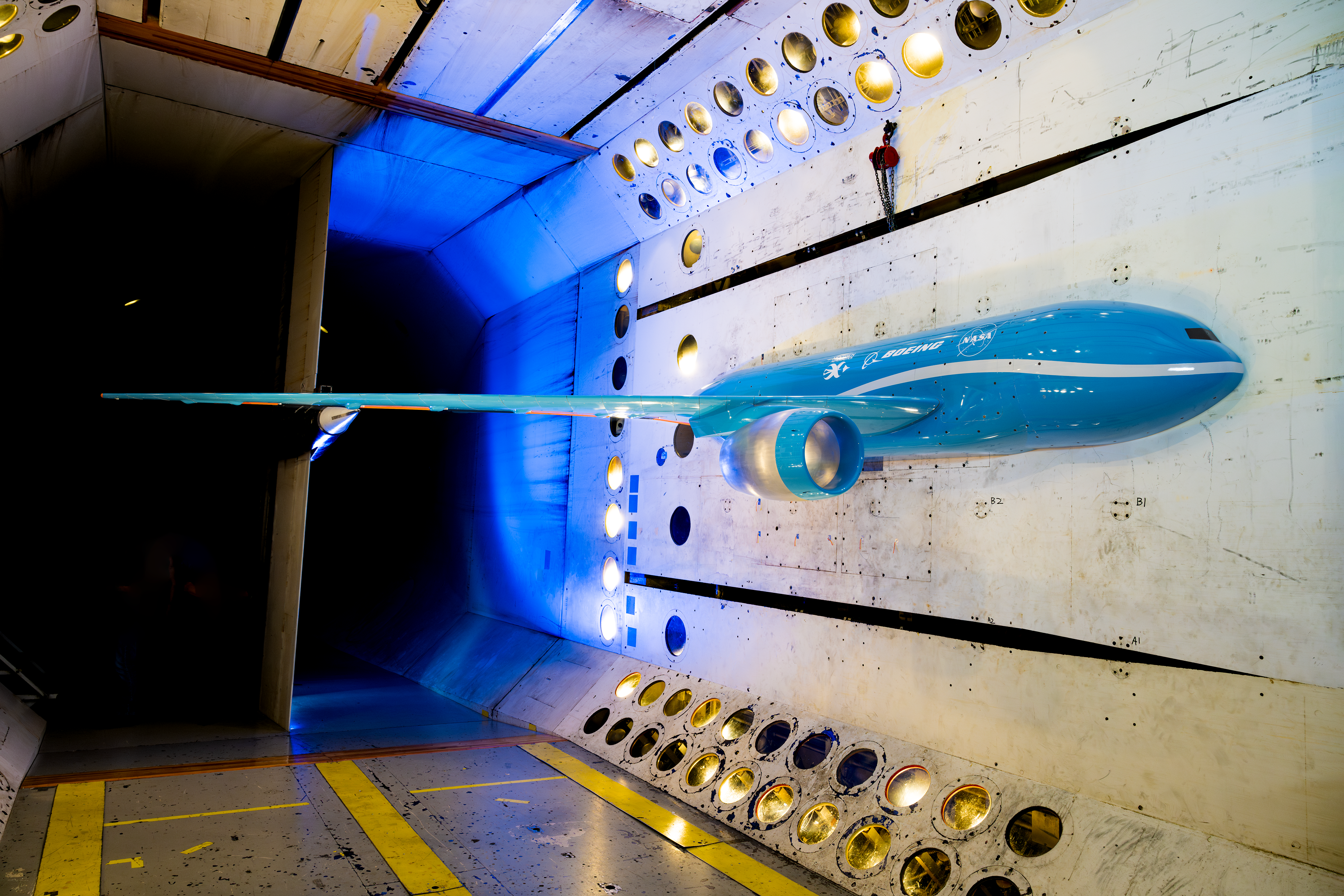
The airliner you board in the future could look a lot different from today’s, with longer, thinner wings that provide a smoother ride while saving fuel.
Those wings would be a revolutionary design for commercial aircraft, but like any breakthrough technology, they come with their own development challenges – which experts from NASA and Boeing are now working to solve.
When creating lift, longer, thinner wings can reduce drag, making them efficient. However, they can become very flexible in flight.
Through their Integrated Adaptive Wing Technology Maturation collaboration, NASA and Boeing recently completed wind tunnel tests of a “higher aspect ratio wing model” looking for ways to get the efficiency gains without the potential issues these kinds of wings can experience.
“When you have a very flexible wing, you’re getting into greater motions,” said Jennifer Pinkerton, a NASA aerospace engineer at NASA Langley Research Center in Hampton, Virginia. “Things like gust loads and maneuver loads can cause even more of an excitation than with a smaller aspect ratio wing. Higher aspect ratio wings also tend to be more fuel efficient, so we’re trying to take advantage of that while simultaneously controlling the aeroelastic response.”
Take a minute to watch this video about the testing NASA and Boeing are doing on longer, narrower aircraft wings.
Without the right engineering, long, thin wings could potentially bend or experience a condition known as wing flutter, causing aircraft to vibrate and shake in gusting winds.
“Flutter is a very violent interaction,” Pinkerton said. “When the flow over a wing interacts with the aircraft structure and the natural frequencies of the wing are excited, wing oscillations are amplified and can grow exponentially, leading to potentially catastrophic failure. Part of the testing we do is to characterize aeroelastic instabilities like flutter for aircraft concepts so that in actual flight, those instabilities can be safely avoided.”
To help demonstrate and understand this, researchers from NASA and Boeing sought to soften the impacts of wind gusts on the aircraft, lessen the wing loads from aircraft turns and movements, and suppress wing flutter.
Reducing or controlling those factors can have a significant impact on an aircraft’s performance, fuel efficiency, and passenger comfort.
Testing for this in a controlled environment is impossible with a full-sized commercial airliner, as no wind tunnel could accommodate one.
However, NASA Langley’s Transonic Dynamics Tunnel, which has been contributing to the design of U.S. commercial transports, military aircraft, launch vehicles, and spacecraft for over 60 years, features a test section 16 feet high by 16 feet wide, big enough for large-scale models.
To shrink a full-size plane down to scale, NASA and Boeing worked with NextGen Aeronautics, which designed and fabricated a complex model resembling an aircraft divided down the middle, with one 13-foot wing.
Mounted to the wall of the wind tunnel, the model was outfitted with 10 control surfaces – moveable panels – along the wing’s rear edge. Researchers adjusted those control surfaces to control airflow and reduce the forces that were causing the wing to vibrate.
Instruments and sensors mounted inside the model measured the forces acting on the model, as well as the vehicle’s responses.
Another view of the Integrated Adaptive Wing Technology Maturation wind-tunnel model installed in the Transonic Dynamics Tunnel at NASA Langley Research Center in Hampton, Virginia.NASA / Mark Knopp
The model wing represented a leap in sophistication from a smaller one developed during a previous NASA-Boeing collaboration called the Subsonic Ultra Green Aircraft Research (SUGAR).
“The SUGAR model had two active control surfaces,” said Patrick S. Heaney, principal investigator at NASA for the Integrated Adaptive Wing Technology Maturation collaboration. “And now on this particular model we have ten. We’re increasing the complexity as well as expanding what our control objectives are.”
A first set of tests, conducted in 2024, gave experts baseline readings that they compared to NASA computational simulations, allowing them to refine their models. A second set of tests in 2025 used the additional control surfaces in new configurations.
The most visible benefits of these new capabilities appeared during testing to alleviate the forces from gusting winds, when researchers saw the wing’s shaking greatly reduced.
With testing completed, NASA and Boeing experts are analyzing data and preparing to share their results with the aviation community. Airlines and original equipment manufacturers can learn and benefit from the lessons learned, deciding which to apply to the next generation of aircraft.
“Initial data analyses have shown that controllers developed by NASA and Boeing and used during the test demonstrated large performance improvements,” Heaney said. “We’re excited to continue analyzing the data and sharing results in the months to come.”
NASA’s Advanced Air Transport Technology project works to advance aircraft design and technology under the agency’s Advanced Air Vehicles program, which studies, evaluates, and develops technologies and capabilities for new aircraft systems. The project and program fall within NASA’s Aeronautics Research Mission Directorate.
Facebook logo @NASA@NASAaero@NASA_es @NASA@NASAaero@NASA_es Instagram logo @NASA@NASAaero@NASA_es Linkedin logo @NASA Explore More 9 min read 2025 in Review: Highlights from NASA in Silicon Valley Article 17 hours ago 10 min read NASA Langley Research Center: 2025 Year in Review Article 2 days ago 3 min read NASA Works with Boeing, Other Collaborators Toward More Efficient Global Flights Article 1 week ago Keep Exploring Discover More Topics From NASAMissions
Artemis
Aeronautics STEM
Explore NASA’s History
Share Details Last Updated Dec 18, 2025 EditorJim BankeContactRobert Margettarobert.j.margetta@nasa.gov Related TermsNASA, Boeing Test How to Improve Performance of Longer, Narrower Aircraft Wings
5 min read
Preparations for Next Moonwalk Simulations Underway (and Underwater) The Integrated Adaptive Wing Technology Maturation wind-tunnel model installed in the Transonic Dynamics Tunnel at NASA Langley Research Center in Hampton, Virginia.NASA / Mark KnoppThe airliner you board in the future could look a lot different from today’s, with longer, thinner wings that provide a smoother ride while saving fuel.
Those wings would be a revolutionary design for commercial aircraft, but like any breakthrough technology, they come with their own development challenges – which experts from NASA and Boeing are now working to solve.
When creating lift, longer, thinner wings can reduce drag, making them efficient. However, they can become very flexible in flight.
Through their Integrated Adaptive Wing Technology Maturation collaboration, NASA and Boeing recently completed wind tunnel tests of a “higher aspect ratio wing model” looking for ways to get the efficiency gains without the potential issues these kinds of wings can experience.
“When you have a very flexible wing, you’re getting into greater motions,” said Jennifer Pinkerton, a NASA aerospace engineer at NASA Langley Research Center in Hampton, Virginia. “Things like gust loads and maneuver loads can cause even more of an excitation than with a smaller aspect ratio wing. Higher aspect ratio wings also tend to be more fuel efficient, so we’re trying to take advantage of that while simultaneously controlling the aeroelastic response.”
Take a minute to watch this video about the testing NASA and Boeing are doing on longer, narrower aircraft wings.
Without the right engineering, long, thin wings could potentially bend or experience a condition known as wing flutter, causing aircraft to vibrate and shake in gusting winds.
“Flutter is a very violent interaction,” Pinkerton said. “When the flow over a wing interacts with the aircraft structure and the natural frequencies of the wing are excited, wing oscillations are amplified and can grow exponentially, leading to potentially catastrophic failure. Part of the testing we do is to characterize aeroelastic instabilities like flutter for aircraft concepts so that in actual flight, those instabilities can be safely avoided.”
To help demonstrate and understand this, researchers from NASA and Boeing sought to soften the impacts of wind gusts on the aircraft, lessen the wing loads from aircraft turns and movements, and suppress wing flutter.
Reducing or controlling those factors can have a significant impact on an aircraft’s performance, fuel efficiency, and passenger comfort.
Testing for this in a controlled environment is impossible with a full-sized commercial airliner, as no wind tunnel could accommodate one.
However, NASA Langley’s Transonic Dynamics Tunnel, which has been contributing to the design of U.S. commercial transports, military aircraft, launch vehicles, and spacecraft for over 60 years, features a test section 16 feet high by 16 feet wide, big enough for large-scale models.
To shrink a full-size plane down to scale, NASA and Boeing worked with NextGen Aeronautics, which designed and fabricated a complex model resembling an aircraft divided down the middle, with one 13-foot wing.
Mounted to the wall of the wind tunnel, the model was outfitted with 10 control surfaces – moveable panels – along the wing’s rear edge. Researchers adjusted those control surfaces to control airflow and reduce the forces that were causing the wing to vibrate.
Instruments and sensors mounted inside the model measured the forces acting on the model, as well as the vehicle’s responses.
Another view of the Integrated Adaptive Wing Technology Maturation wind-tunnel model installed in the Transonic Dynamics Tunnel at NASA Langley Research Center in Hampton, Virginia.NASA / Mark KnoppThe model wing represented a leap in sophistication from a smaller one developed during a previous NASA-Boeing collaboration called the Subsonic Ultra Green Aircraft Research (SUGAR).
“The SUGAR model had two active control surfaces,” said Patrick S. Heaney, principal investigator at NASA for the Integrated Adaptive Wing Technology Maturation collaboration. “And now on this particular model we have ten. We’re increasing the complexity as well as expanding what our control objectives are.”
A first set of tests, conducted in 2024, gave experts baseline readings that they compared to NASA computational simulations, allowing them to refine their models. A second set of tests in 2025 used the additional control surfaces in new configurations.
The most visible benefits of these new capabilities appeared during testing to alleviate the forces from gusting winds, when researchers saw the wing’s shaking greatly reduced.
With testing completed, NASA and Boeing experts are analyzing data and preparing to share their results with the aviation community. Airlines and original equipment manufacturers can learn and benefit from the lessons learned, deciding which to apply to the next generation of aircraft.
“Initial data analyses have shown that controllers developed by NASA and Boeing and used during the test demonstrated large performance improvements,” Heaney said. “We’re excited to continue analyzing the data and sharing results in the months to come.”
NASA’s Advanced Air Transport Technology project works to advance aircraft design and technology under the agency’s Advanced Air Vehicles program, which studies, evaluates, and develops technologies and capabilities for new aircraft systems. The project and program fall within NASA’s Aeronautics Research Mission Directorate.
Facebook logo @NASA@NASAaero@NASA_es @NASA@NASAaero@NASA_es Instagram logo @NASA@NASAaero@NASA_es Linkedin logo @NASA Explore More 9 min read 2025 in Review: Highlights from NASA in Silicon Valley Article 17 hours ago 10 min read NASA Langley Research Center: 2025 Year in Review Article 2 days ago 3 min read NASA Works with Boeing, Other Collaborators Toward More Efficient Global Flights Article 1 week ago Keep Exploring Discover More Topics From NASAMissions
Artemis
Aeronautics STEM
Explore NASA’s History
Share Details Last Updated Dec 18, 2025 EditorJim BankeContactRobert Margettarobert.j.margetta@nasa.gov Related TermsLuminous Fast Blue Optical Transients Are Likely Large Black Holes Shredding Their Massive Companions
In 2024, astronomers discovered the brightest Luminous Fast Blue Optical Transient (LFBOT) ever observed. LFBOTs are extremely bright flashes of blue light that shine for brief periods before fading away. New analysis of this record-breaking burst, which includes observations from the International Gemini Observatory, funded in part by the U.S. National Science Foundation, challenges all prior understanding of these rare explosive events.
NASA’s SPHEREx Observatory Completes First Cosmic Map Like No Other
6 min read
Preparations for Next Moonwalk Simulations Underway (and Underwater) This panoramic view of SPHEREx’s first all-sky map shows how the sky looks to the telescope. It transitions between observations of colors emitted by hot hydrogen gas (blue) and cosmic dust (red), and those primarily emitted by stars.Credit: NASA/JPL-Caltech
Launched in March, NASA’s SPHEREx space telescope has completed its first infrared map of the entire sky in 102 colors. While not visible to the human eye, these 102 infrared wavelengths of light are prevalent in the cosmos, and observing the entire sky this way enables scientists to answer big questions, including how a dramatic event that occurred in the first billionth of a trillionth of a trillionth of a second after the big bang influenced the 3D distribution of hundreds of millions of galaxies in our universe. In addition, scientists will use the data to study how galaxies have changed over the universe’s nearly 14 billion-year history and learn about the distribution of key ingredients for life in our own galaxy.
“It’s incredible how much information SPHEREx has collected in just six months — information that will be especially valuable when used alongside our other missions’ data to better understand our universe,” said Shawn Domagal-Goldman, director of the Astrophysics Division at NASA Headquarters in Washington. “We essentially have 102 new maps of the entire sky, each one in a different wavelength and containing unique information about the objects it sees. I think every astronomer is going to find something of value here, as NASA’s missions enable the world to answer fundamental questions about how the universe got its start, and how it changed to eventually create a home for us in it.”
Circling Earth about 14½ times a day, SPHEREx (which stands for Spectro-Photometer for the History of the Universe, Epoch of Reionization, and Ices Explorer) travels from north to south, passing over the poles. Each day it takes about 3,600 images along one circular strip of the sky, and as the days pass and the planet moves around the Sun, SPHEREx’s field of view shifts as well. After six months, the observatory has looked out into space in every direction, capturing the entire sky in 360 degrees.
Managed by NASA’s Jet Propulsion Laboratory in Southern California, the mission began mapping the sky in May and completed its first all-sky mosaic in December. It will complete three additional all-sky scans during its two-year primary mission, and merging those maps together will increase the sensitivity of the measurements. The entire dataset is freely available to scientists and the public.
“SPHEREx is a mid-sized astrophysics mission delivering big science,” said JPL Director Dave Gallagher. “It’s a phenomenal example of how we turn bold ideas into reality, and in doing so, unlock enormous potential for discovery.”
NASA’s SPHEREx has mapped the entire sky in 102 infrared colors, which are invisible to the human eye but can be used to reveal different features of the cosmos. This image features a selection of colors emitted primarily by stars (blue, green, and white), hot hydrogen gas (blue), and cosmic dust (red). NASA/JPL-Caltech This SPHEREx image shows a selection of the infrared colors primarily emitted by stars and galaxies. The space telescope is observing hundreds of millions of distant galaxies across the sky. Its multiwavelength view will help astronomers measure the distance to those galaxies. NASA/JPL-Caltech The infrared colors emitted primarily by dust (red) and hot gas (blue), key ingredients for forming new stars and planets, are seen in this SPHEREx image. Though these clouds of material cover a massive portion of the sky, they are invisible in most wavelengths of light, including those the human eye can detect. NASA/JPL-Caltech Superpowered telescopeEach of the 102 colors detected by SPHEREx represents a wavelength of infrared light, and each wavelength provides unique information about the galaxies, stars, planet-forming regions, and other cosmic features therein. For example, dense clouds of dust in our galaxy where stars and planets form radiate brightly in certain wavelengths but emit no light (and are therefore totally invisible) in others. The process of separating the light from a source into its component wavelengths is called spectroscopy.
And while a handful of previous missions has also mapped the entire sky, such as NASA’s Wide-field Infrared Survey Explorer, none have done so in nearly as many colors as SPHEREx. By contrast, NASA’s James Webb Space Telescope can do spectroscopy with significantly more wavelengths of light than SPHEREx, but with a field of view thousands of times smaller. The combination of colors and such a wide field of view is why SPHEREx is so powerful.
“The superpower of SPHEREx is that it captures the whole sky in 102 colors about every six months. That’s an amazing amount of information to gather in a short amount of time,” said Beth Fabinsky, the SPHEREx project manager at JPL. “I think this makes us the mantis shrimp of telescopes, because we have an amazing multicolor visual detection system and we can also see a very wide swath of our surroundings.”
To accomplish this feat, SPHEREx uses six detectors, each paired with a specially designed filter that contains a gradient of 17 colors. That means every image taken with those six detectors contains 102 colors (six times 17). It also means that every all-sky map that SPHEREx produces is really 102 maps, each in a different color.
The observatory will use those colors to measure the distance to hundreds of millions of galaxies. Though the positions of most of those galaxies have already been mapped in two dimensions by other observatories, SPHEREx’s map will be in 3D, enabling scientists to measure subtle variations in the way galaxies are clustered and distributed across the universe.
Each frame of this movie shows the entire sky in a different infrared wavelength, indicated by the color bar in the top right corner. Taken by NASA’s SPHEREx observatory, the maps illustrate how viewing the universe in different wavelengths of light can reveal unique cosmic features.Credit: NASA/JPL-Caltech
Those measurements will offer insights into an event that took place in the first billionth of a trillionth of a trillionth of a second after the big bang. In this moment, called inflation, the universe expanded by a trillion-trillionfold. Nothing like it has occurred in the universe since, and scientists want to understand it better. The SPHEREx mission’s approach is one way to help in that effort.
More about SPHERExThe SPHEREx mission is managed by JPL for NASA’s Astrophysics Division within the Science Mission Directorate in Washington. The telescope and the spacecraft bus were built by BAE Systems. The science analysis of the SPHEREx data is being conducted by a team of scientists at 10 institutions across the U.S., and in South Korea and Taiwan. Data is processed and archived at IPAC at Caltech in Pasadena, which manages JPL for NASA. The mission’s principal investigator is based at Caltech with a joint JPL appointment. The SPHEREx dataset is publicly available.
For more information about the SPHEREx mission visit:
https://science.nasa.gov/mission/spherex/
News Media Contacts
Calla Cofield
Jet Propulsion Laboratory, Pasadena, Calif.
626-808-2469
calla.e.cofield@jpl.nasa.gov
2025-144
Share Details Last Updated Dec 18, 2025 Related Terms Explore More 5 min read NASA’s Hubble Sees Asteroids Colliding at Nearby Star for First TimeLike a game of cosmic bumper cars, scientists think the early days of our solar…
Article 14 hours ago 4 min read NASA’s Fermi Spots Young Star Cluster Blowing Gamma-Ray BubblesFor the first time, astronomers using NASA’s Fermi Gamma-ray Space Telescope have traced a budding…
Article 18 hours ago 6 min read NASA’s Perseverance Mars Rover Ready to Roll for Miles in Years Ahead Article 2 days ago Keep Exploring Discover Related TopicsSPHEREx
Big Bang and the Evolution of the UniversePrecisely measure the cosmological parameters governing the evolution of the universe and test the inflation hypothesis of the Big Bang…
GalaxiesGalaxies consist of stars, planets, and vast clouds of gas and dust, all bound together by gravity. The largest contain…
Astrobiology
NASA’s SPHEREx Observatory Completes First Cosmic Map Like No Other
6 min read
Preparations for Next Moonwalk Simulations Underway (and Underwater) This panoramic view of SPHEREx’s first all-sky map shows how the sky looks to the telescope. It transitions between observations of colors emitted by hot hydrogen gas (blue) and cosmic dust (red), and those primarily emitted by stars.Credit: NASA/JPL-Caltech
Launched in March, NASA’s SPHEREx space telescope has completed its first infrared map of the entire sky in 102 colors. While not visible to the human eye, these 102 infrared wavelengths of light are prevalent in the cosmos, and observing the entire sky this way enables scientists to answer big questions, including how a dramatic event that occurred in the first billionth of a trillionth of a trillionth of a second after the big bang influenced the 3D distribution of hundreds of millions of galaxies in our universe. In addition, scientists will use the data to study how galaxies have changed over the universe’s nearly 14 billion-year history and learn about the distribution of key ingredients for life in our own galaxy.
“It’s incredible how much information SPHEREx has collected in just six months — information that will be especially valuable when used alongside our other missions’ data to better understand our universe,” said Shawn Domagal-Goldman, director of the Astrophysics Division at NASA Headquarters in Washington. “We essentially have 102 new maps of the entire sky, each one in a different wavelength and containing unique information about the objects it sees. I think every astronomer is going to find something of value here, as NASA’s missions enable the world to answer fundamental questions about how the universe got its start, and how it changed to eventually create a home for us in it.”
Circling Earth about 14½ times a day, SPHEREx (which stands for Spectro-Photometer for the History of the Universe, Epoch of Reionization, and Ices Explorer) travels from north to south, passing over the poles. Each day it takes about 3,600 images along one circular strip of the sky, and as the days pass and the planet moves around the Sun, SPHEREx’s field of view shifts as well. After six months, the observatory has looked out into space in every direction, capturing the entire sky in 360 degrees.
Managed by NASA’s Jet Propulsion Laboratory in Southern California, the mission began mapping the sky in May and completed its first all-sky mosaic in December. It will complete three additional all-sky scans during its two-year primary mission, and merging those maps together will increase the sensitivity of the measurements. The entire dataset is freely available to scientists and the public.
“SPHEREx is a mid-sized astrophysics mission delivering big science,” said JPL Director Dave Gallagher. “It’s a phenomenal example of how we turn bold ideas into reality, and in doing so, unlock enormous potential for discovery.”
NASA’s SPHEREx has mapped the entire sky in 102 infrared colors, which are invisible to the human eye but can be used to reveal different features of the cosmos. This image features a selection of colors emitted primarily by stars (blue, green, and white), hot hydrogen gas (blue), and cosmic dust (red). NASA/JPL-Caltech This SPHEREx image shows a selection of the infrared colors primarily emitted by stars and galaxies. The space telescope is observing hundreds of millions of distant galaxies across the sky. Its multiwavelength view will help astronomers measure the distance to those galaxies. NASA/JPL-Caltech The infrared colors emitted primarily by dust (red) and hot gas (blue), key ingredients for forming new stars and planets, are seen in this SPHEREx image. Though these clouds of material cover a massive portion of the sky, they are invisible in most wavelengths of light, including those the human eye can detect. NASA/JPL-Caltech Superpowered telescopeEach of the 102 colors detected by SPHEREx represents a wavelength of infrared light, and each wavelength provides unique information about the galaxies, stars, planet-forming regions, and other cosmic features therein. For example, dense clouds of dust in our galaxy where stars and planets form radiate brightly in certain wavelengths but emit no light (and are therefore totally invisible) in others. The process of separating the light from a source into its component wavelengths is called spectroscopy.
And while a handful of previous missions has also mapped the entire sky, such as NASA’s Wide-field Infrared Survey Explorer, none have done so in nearly as many colors as SPHEREx. By contrast, NASA’s James Webb Space Telescope can do spectroscopy with significantly more wavelengths of light than SPHEREx, but with a field of view thousands of times smaller. The combination of colors and such a wide field of view is why SPHEREx is so powerful.
“The superpower of SPHEREx is that it captures the whole sky in 102 colors about every six months. That’s an amazing amount of information to gather in a short amount of time,” said Beth Fabinsky, the SPHEREx project manager at JPL. “I think this makes us the mantis shrimp of telescopes, because we have an amazing multicolor visual detection system and we can also see a very wide swath of our surroundings.”
To accomplish this feat, SPHEREx uses six detectors, each paired with a specially designed filter that contains a gradient of 17 colors. That means every image taken with those six detectors contains 102 colors (six times 17). It also means that every all-sky map that SPHEREx produces is really 102 maps, each in a different color.
The observatory will use those colors to measure the distance to hundreds of millions of galaxies. Though the positions of most of those galaxies have already been mapped in two dimensions by other observatories, SPHEREx’s map will be in 3D, enabling scientists to measure subtle variations in the way galaxies are clustered and distributed across the universe.
Each frame of this movie shows the entire sky in a different infrared wavelength, indicated by the color bar in the top right corner. Taken by NASA’s SPHEREx observatory, the maps illustrate how viewing the universe in different wavelengths of light can reveal unique cosmic features.Credit: NASA/JPL-Caltech
Those measurements will offer insights into an event that took place in the first billionth of a trillionth of a trillionth of a second after the big bang. In this moment, called inflation, the universe expanded by a trillion-trillionfold. Nothing like it has occurred in the universe since, and scientists want to understand it better. The SPHEREx mission’s approach is one way to help in that effort.
More about SPHERExThe SPHEREx mission is managed by JPL for NASA’s Astrophysics Division within the Science Mission Directorate in Washington. The telescope and the spacecraft bus were built by BAE Systems. The science analysis of the SPHEREx data is being conducted by a team of scientists at 10 institutions across the U.S., and in South Korea and Taiwan. Data is processed and archived at IPAC at Caltech in Pasadena, which manages JPL for NASA. The mission’s principal investigator is based at Caltech with a joint JPL appointment. The SPHEREx dataset is publicly available.
For more information about the SPHEREx mission visit:
https://science.nasa.gov/mission/spherex/
News Media Contacts
Calla Cofield
Jet Propulsion Laboratory, Pasadena, Calif.
626-808-2469
calla.e.cofield@jpl.nasa.gov
2025-144
Share Details Last Updated Dec 18, 2025 Related Terms Explore More 5 min read NASA’s Hubble Sees Asteroids Colliding at Nearby Star for First TimeLike a game of cosmic bumper cars, scientists think the early days of our solar…
Article 14 hours ago 4 min read NASA’s Fermi Spots Young Star Cluster Blowing Gamma-Ray BubblesFor the first time, astronomers using NASA’s Fermi Gamma-ray Space Telescope have traced a budding…
Article 18 hours ago 6 min read NASA’s Perseverance Mars Rover Ready to Roll for Miles in Years Ahead Article 2 days ago Keep Exploring Discover Related TopicsSPHEREx
Big Bang and the Evolution of the UniversePrecisely measure the cosmological parameters governing the evolution of the universe and test the inflation hypothesis of the Big Bang…
GalaxiesGalaxies consist of stars, planets, and vast clouds of gas and dust, all bound together by gravity. The largest contain…
Astrobiology