
Feed aggregator
NASA Marshall Removes 2 Historic Test Stands
To view this video please enable JavaScript, and consider upgrading to a web browser that supports HTML5 video
NASA’s Marshall Space Flight Center in Huntsville, Alabama, removed two of its historic test stands – the Propulsion and Structural Test Facility and the Dynamic Test Facility – with carefully coordinated implosions on Jan. 10, 2026. The demolition of these historic structures is part of a larger project at Marshall that began in spring 2022, targeting several inactive structures and building a dynamic, interconnected campus ready for the next era of space exploration. Crews began demolition in December 2025 at the Neutral Buoyancy Simulator. Learn more about these iconic facilities.
Credits: NASA
A New Study Finds a Subtle Dance Between Dark Matter and Neutrinos
Scientists are a step closer to solving one of the universe's biggest mysteries as new research finds evidence that dark matter and neutrinos may be interacting, offering a rare window into the darkest recesses of the cosmos.
NASA Announces Return Date for ISS Astronauts after Medical Evacuation Announcement
Four ISS crew members are set to touch down on Thursday after NASA announced the first medical evacuation in the space station’s history
This System Reveals How Super-Earths Are Born
One of the best things about being able to see thousands of exoplanetary systems is that we’re able to track them in different stages of development. Scientists still have so many questions about how planets form, and comparing notes between systems of different ages is one way to answer them. A new paper recently published in Nature by John Livingston of the National Astronomical Observatory of Japan and his co-authors details one particularly interesting system, known as V1298, which is only around 30 million years old, and hosts an array of four “cotton candy” planets, which represent some of the earliest stages of planet formation yet seen.
Why 2026 Is a Mathematically Special Number
Neither a square nor prime number, 2026 is still intriguing
Is the Universe Made of Math? Part 1: The Unreasonable Tool
Imagine you walk into a parking lot full of cars. You have in your pocket one single key. It’s the key to your car. The same key you’ve always used, the same key you’ve always trusted, the same key that you always manage to realize that you’ve lost right when you’re rushing out the door.
Final Steps Underway for NASA’s First Crewed Artemis Moon Mission

As NASA moves closer to launch of the Artemis II test flight, the agency soon will roll its SLS (Space Launch System) rocket and Orion spacecraft to the launch pad for the first time at the agency’s Kennedy Space Center in Florida to begin final integration, testing, and launch rehearsals.
NASA is targeting no earlier than Saturday, Jan. 17, to begin the multi-hour trek from the Vehicle Assembly Building to Launch Pad 39B. The four-mile journey on the crawler-transporter-2 will take up to 12 hours. Teams are working around the clock to close out all tasks ahead of rollout. However, this target date is subject to change if additional time is needed for technical preparations or weather.
“We are moving closer to Artemis II, with rollout just around the corner,” said Lori Glaze, acting associate administrator for NASA’s Exploration Systems Development Mission Directorate. “We have important steps remaining on our path to launch and crew safety will remain our top priority at every turn, as we near humanity’s return to the Moon.”
As with all new developments of complex systems, engineers have been troubleshooting several items in recent days and weeks. During final checkouts before rollout, technicians found a cable involved in the flight termination system was bent out of specifications. Teams are replacing it and will test the new cable over the weekend. Additionally, a valve associated with Orion’s hatch pressurization exhibited issues leading up to a Dec. 20 countdown demonstration test. On Jan. 5, the team successfully replaced and tested it. Engineers also worked to resolve leaky ground support hardware required to load gaseous oxygen into Orion for breathing air.
Rollout
Once the integrated rocket and spacecraft reach the launch pad, NASA will immediately begin a long checklist of launch pad preparations, including connecting ground support equipment such as electrical lines, fuel environmental control system ducts, and cryogenic propellant feeds. Teams will power up all integrated systems at the pad for the first time to ensure flight hardware components are functioning properly with each other, the mobile launcher, and ground infrastructure systems.
Once complete, the Artemis II astronauts, NASA’s Reid Wiseman, Victor Glover, and Christina Koch, and CSA (Canadian Space Agency) astronaut Jeremy Hansen, will conduct a final walkdown at the pad.
Wet dress rehearsal, tanking
At the end of January, NASA will conduct a wet dress rehearsal, which is a prelaunch test to fuel the rocket. During wet dress, teams demonstrate the ability to load more than 700,000 gallons of cryogenic propellants into the rocket, conduct a launch countdown, and practice safely removing propellant from the rocket without astronauts onsite.
During launch, a closeout crew will be responsible for securing astronauts in Orion and closing its hatches. The closeout crew also will use this rehearsal to practice their procedures safely without astronauts aboard the spacecraft.
The wet dress rehearsal will include several “runs” to demonstrate the launch team’s ability to hold, resume, and recycle to several different times in the final 10 minutes of the countdown, known as terminal count.
The first run will begin approximately 49 hours before launch when launch teams are called to their stations, to 1 minute 30 seconds before launch, followed by a planned three-minute hold and then countdown resumption to 33 seconds before launch – the point at which the rocket’s automatic launch sequencer will control the final seconds of the countdown. Teams then will recycle back to T-10 minutes and hold, then resume down to 30 seconds before launch as part of a second run.
While NASA has integrated lessons learned from Artemis I into the launch countdown procedures, the agency will pause to address any issues during the test or at any other point should technical challenges arise. Engineers will have a close eye on propellant loading of liquid hydrogen and liquid oxygen into the rocket, after challenges encountered with liquid hydrogen loading during Artemis I wet dress rehearsals. Teams also will pay close attention to the effectiveness of recently updated procedures to limit how much gaseous nitrogen accumulates in the space between Orion’s crew module and launch abort system hatches, which could pose an issue for the closeout crew.
Additional wet dress rehearsals may be required to ensure the vehicle is completely checked out and ready for flight.
If needed, NASA may rollback SLS and Orion to the Vehicle Assembly Building for additional work ahead of launch after the wet dress rehearsal.
Next steps toward launch
Following a successful wet dress rehearsal, NASA will convene a flight readiness review where the mission management team will assess the readiness of all systems, including flight hardware, infrastructure, and launch, flight, and recovery teams before committing to a launch date.
While the Artemis II launch window opens as early as Friday, Feb. 6, the mission management team will assess flight readiness after the wet dress rehearsal across the spacecraft, launch infrastructure, and the crew and operations teams before selecting a launch date.
To determine potential launch dates, engineers identified key constraints required to accomplish the mission and keep the crew inside Orion safe. The resulting launch periods are the days or weeks where the spacecraft and rocket can meet mission objectives. These launch periods account for the complex orbital mechanics involved in launching on a precise trajectory toward the Moon while the Earth is rotating on its axis and the Moon is orbiting Earth each month in its lunar cycle. This results in a pattern of approximately one week of launch opportunities, followed by three weeks without launch opportunities.
There are several primary parameters that dictate launch availability within these periods. Because of its unique trajectory relative to subsequent lunar landing missions, these key constraints are unique to the Artemis II test flight.
- The launch day and time must allow SLS to be able to deliver Orion into a high Earth orbit where the crew and ground teams will evaluate the spacecraft’s life support systems before the crew ventures to the Moon.
- Orion also must be in the proper alignment with the Earth and Moon at the time of the trans-lunar injection burn. The Artemis II trans-lunar injection burn places Orion on course to flyby the Moon, and also sets it on a free return trajectory, in which the spacecraft uses the Moon’s gravity to send the spacecraft back to Earth without additional major propulsive maneuvers.
- The trajectory for a given day must ensure Orion is not in darkness for more than 90 minutes at a time so that the solar array wings can receive and convert sunlight to electricity, and the spacecraft can maintain an optimal temperature range. Mission planners eliminate potential launch dates that would send Orion into extended eclipses during the flight.
- The launch date must support a trajectory that allows for the proper entry profile planned during Orion’s return to Earth.
The periods below show launch availability through April 2026. Mission planners refine the periods based on updated analysis approximately two months before they begin and are subject to change.
Launch Period Jan. 31 – Feb. 14
- Launch opportunities February 6, 7, 8, 10, and 11
Launch Period Feb. 28 – March 13
- Launch opportunities March 6, 7, 8, 9, 11
Launch Period March 27 – April 10
- Launch opportunities April 1, 3, 4, 5, 6
In addition to the launch opportunities based on orbital mechanics and performance requirements, there are also limitations on which days within a launch period can be viable based on commodity replenishment, weather, and other users on the Eastern Range schedule. As a general rule, up to four launch attempts may be attempted within the approximate week of opportunities that exist within a launch period.
As the agency prepares for its first crewed mission beyond Earth orbit in more than 50 years, NASA expects to learn along the way, both on the ground and in flight, and will let the readiness and performance of its systems dictate when the agency is ready to launch.
As part of a Golden Age of innovation and exploration, the approximately 10-day Artemis II test flight is the first crewed flight under NASA’s Artemis campaign. It is another step toward new U.S.-crewed missions to the Moon’s surface, leading to a sustained presence on the Moon that will help the agency prepare to send the first astronauts – Americans – to Mars.
Learn more about NASA’s Artemis campaign:
Share Details Last Updated Jan 09, 2026 LocationNASA Headquarters Related TermsShaken, Not Stirred: NASA’s StarBurst Aces Extreme Temperature Tests
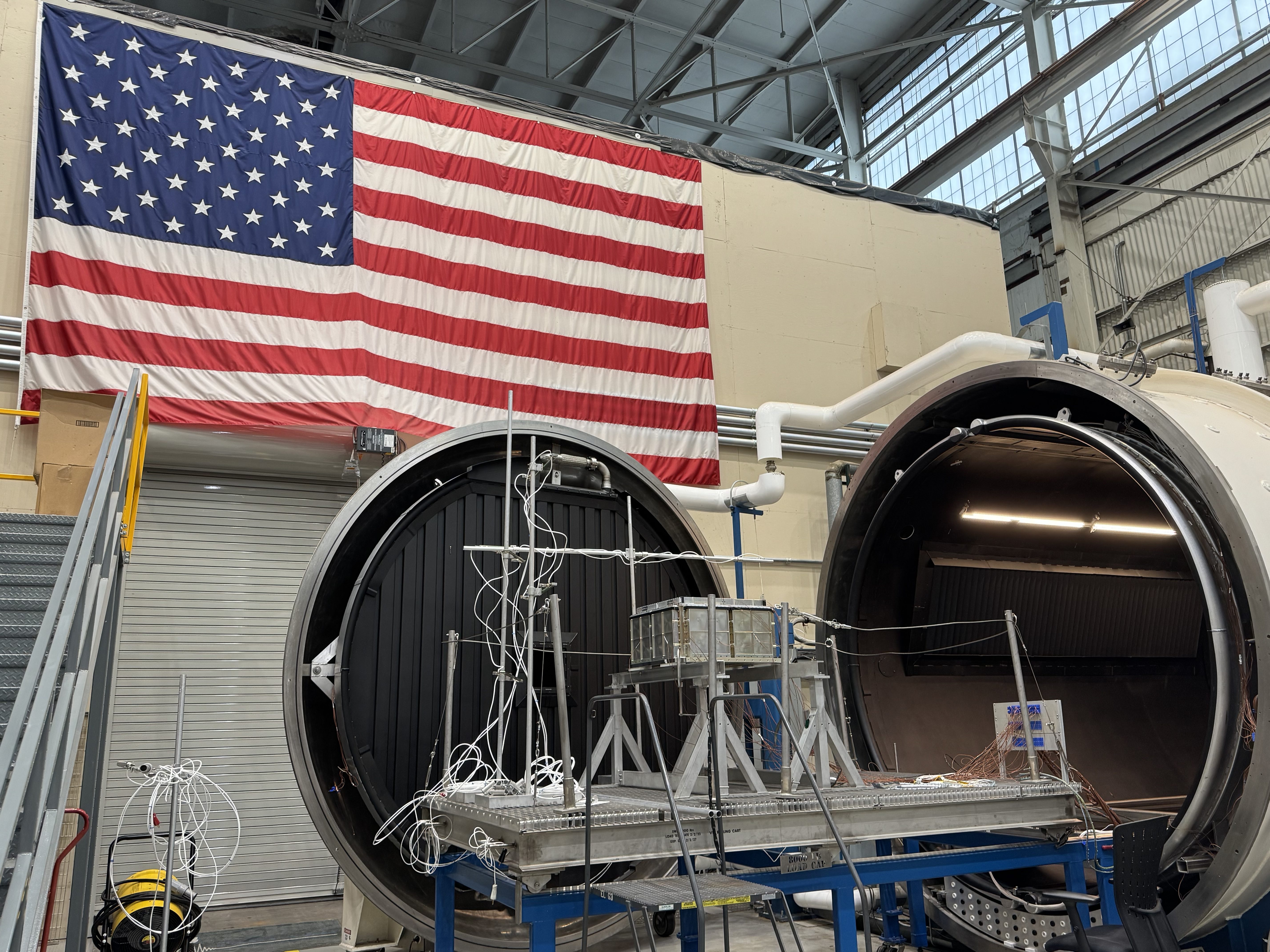
Heated, cooled, shaken, and settled – NASA’s StarBurst instrument is several steps closer to being ready for launch. The small satellite is now awaiting instrument calibration following a successful integration in Canada and rigorous testing by engineers at the agency’s Marshall Space Flight Center in Huntsville, Alabama.
StarBurst is designed to detect the initial emission of short gamma-ray bursts, some of the most powerful explosions in the universe and a key indicator of neutron star mergers. This would provide valuable insight into such events, which are also detected through gravitational waves by observatories on Earth. These events are where most of the heavy metals in the universe, such as gold and platinum, are formed. To date, only one such event has been observed simultaneously in gravitational waves and gamma-rays; StarBurst is expected to find up to 10 per year.
StarBurst arrived at NASA Marshall in March 2025. During its time at the center, the instrument underwent thermal testing in a vacuum chamber and flight vibration testing.
The team held StarBurst’s nonstop thermal testing in a vacuum chamber, 24 hours a day for 18 days. Technicians placed radioactive material into the vacuum chamber, giving StarBurst the ability to detect gamma-ray signals during the tests.
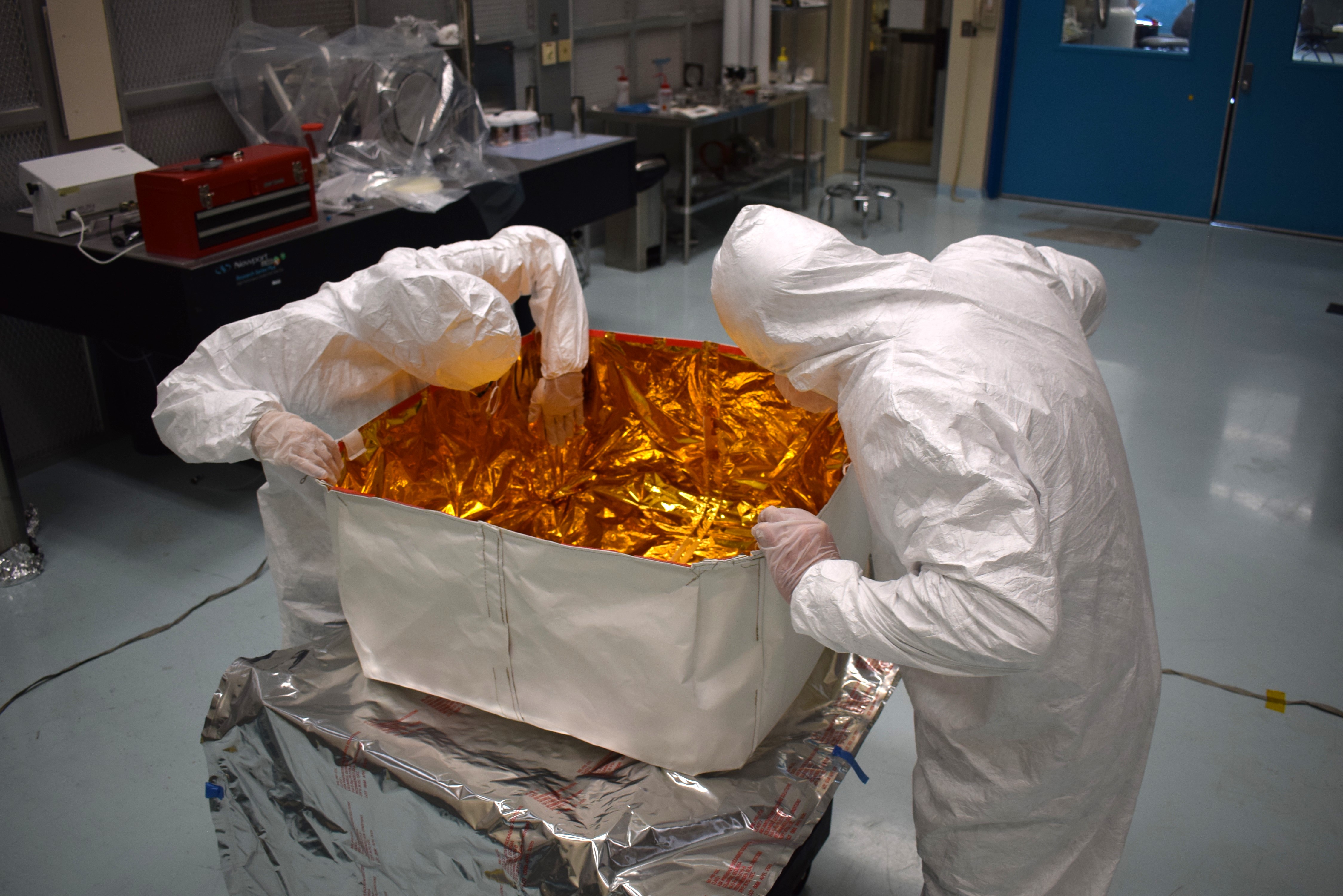
NASA Marshall test engineers fit test the multi-layer insulation blanket in early August at Marshall’s Stray Light Facility. The thermal blanket will insulate the crystal detector units. NASA/Michael Allen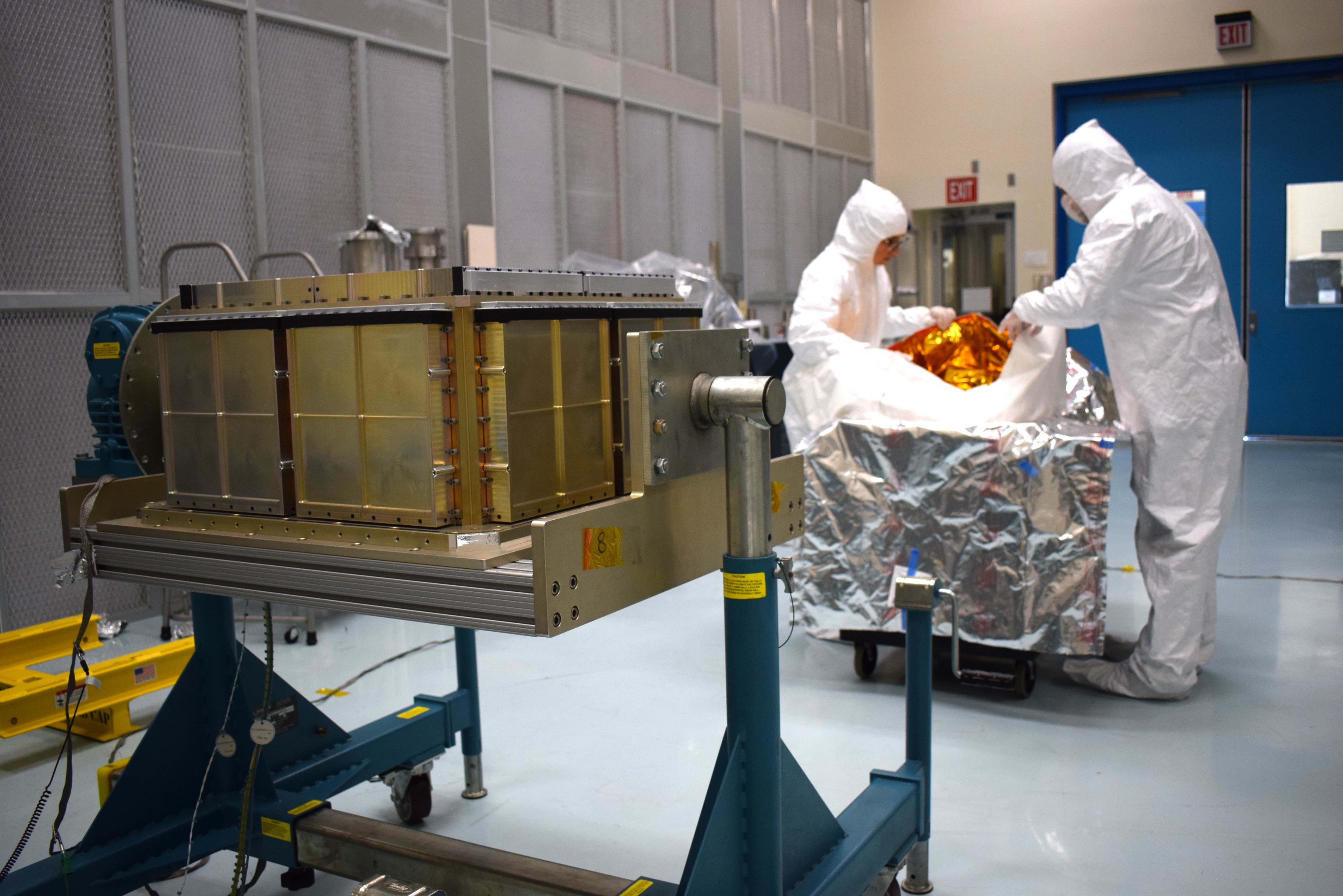
Test teams conducted thermal balance testing to simulate the hottest and coldest situations the instrument will operate under in space. Data from these tests improves thermal models used by NASA engineers, while also ensuring the satellite can handle these temperatures in orbit.
NASA engineers also completed a 24-hour “bake-out,” a process that removes unwanted gas or vapor from the instrument using extreme heat in a vacuum.
“NASA’s StarBurst mission is ready for its next stage of assembly and is one step closer to flight,” said Daniel Kocevski, principal investigator at NASA Marshall. “Testing at NASA Marshall has verified engineering models, adding our understanding of how StarBurst will operate in space as it observes gamma ray emission from merging neutron stars to help us better understand the building blocks of Earth—and the universe.”
Outside of the vacuum chamber, a “vibe test” bolted the instrument to a special “shaker table” to simulate the vibrations and turbulence StarBurst will experience during launch.
While at NASA Marshall, StarBurst underwent a series of tests in a vacuum chamberNASA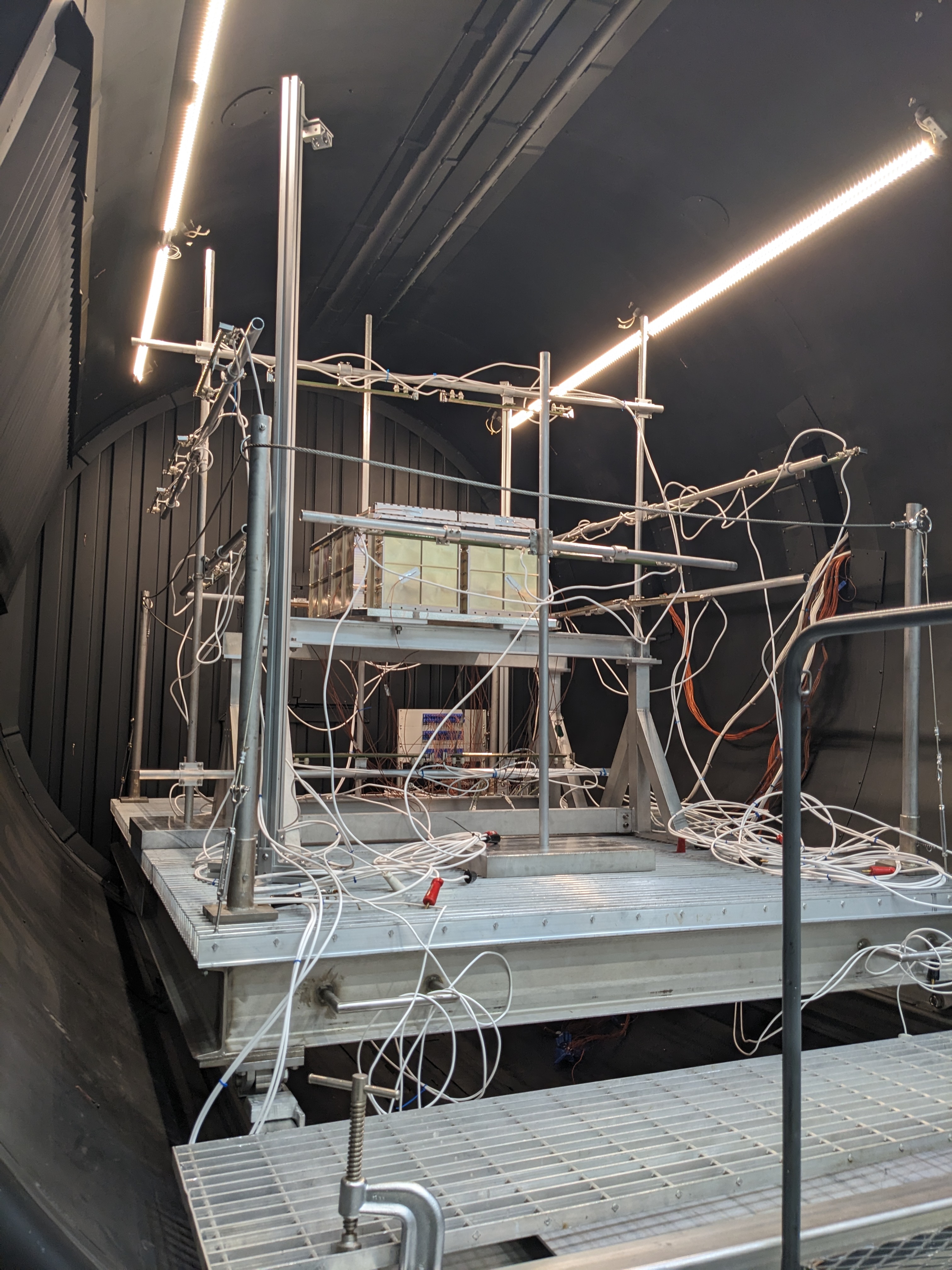
The Marshall team shipped the StarBurst instrument to Space Flight Laboratory at the University of Toronto, which manufactured the spacecraft bus, in August.
Prior to shipment, teams at Marshall’s Stray Light Facility fit-tested the multi-layer insulation blanket needed to insulate the crystal detector units from the harsh space environment. StarBurst is equipped with 12 of these detectors, which serve as the main gamma-ray detection system on the spacecraft.
Marshall team members traveled to Toronto and were on hand to help integrate the instrument with the spacecraft bus in early September. Testing at Marshall set the stage for planned post-integration testing, which included functional testing and electromagnetic compatibility testing. StarBurst is scheduled to undergo additional calibration, vibration, and thermal vacuum testing in the spring.
Integration teams intend to have StarBurst launch-ready by June 2026. NASA plans to launch the satellite as early as 2027 during the next run of the Laser-Interferometer Gravitational Wave Observatory to maximize the chance of detecting gamma-ray bursts that coincide with gravitational wave events. To date, such a joint gamma-ray and gravitational-wave detection has been observed only once.
StarBurst was successfully integrated with the spacecraft bus Marshall team members were on hand to help integrate the instrument with the spacecraft bus at the Space Flight Laboratory at the University of Toronto in early September. NASA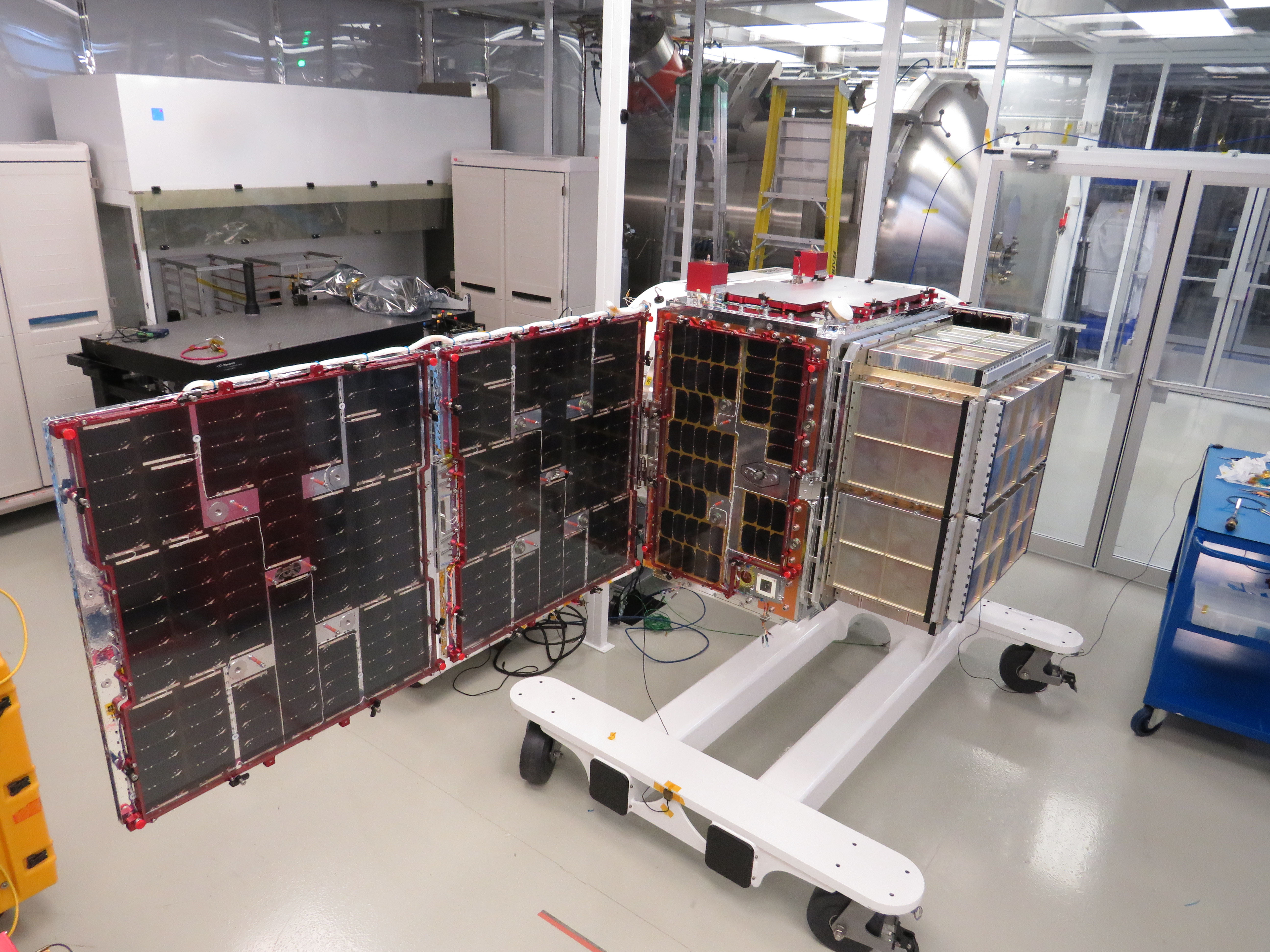
StarBurst is a collaborative effort led by NASA’s Marshall Space Flight Center, with partnerships with the U.S. Naval Research Laboratory, the University of Alabama Huntsville, the Universities Space Research Association, and the University of Toronto Institute for Aerospace Studies Space Flight Laboratory. StarBurst was selected for development as part of the NASA Astrophysics Pioneers program, which supports lower-cost, smaller hardware missions to conduct compelling astrophysics science.
To learn more about StarBurst visit:
https://science.nasa.gov/mission/starburst/
Share Details Last Updated Jan 09, 2026 EditorLee MohonContactCorinne M. Beckingercorinne.m.beckinger@nasa.govJoel Wallacejoel.w.wallace@nasa.govLocationMarshall Space Flight Center Related Terms