

Feed aggregator
What NASA’s Artemis II tells us about the ‘overview effect,’ moon joy and awe
Artemis II’s views from space trigger a special type of awe. Psychologists suggest holding onto it
Artemis II Recovery
Artemis II Splashes Down
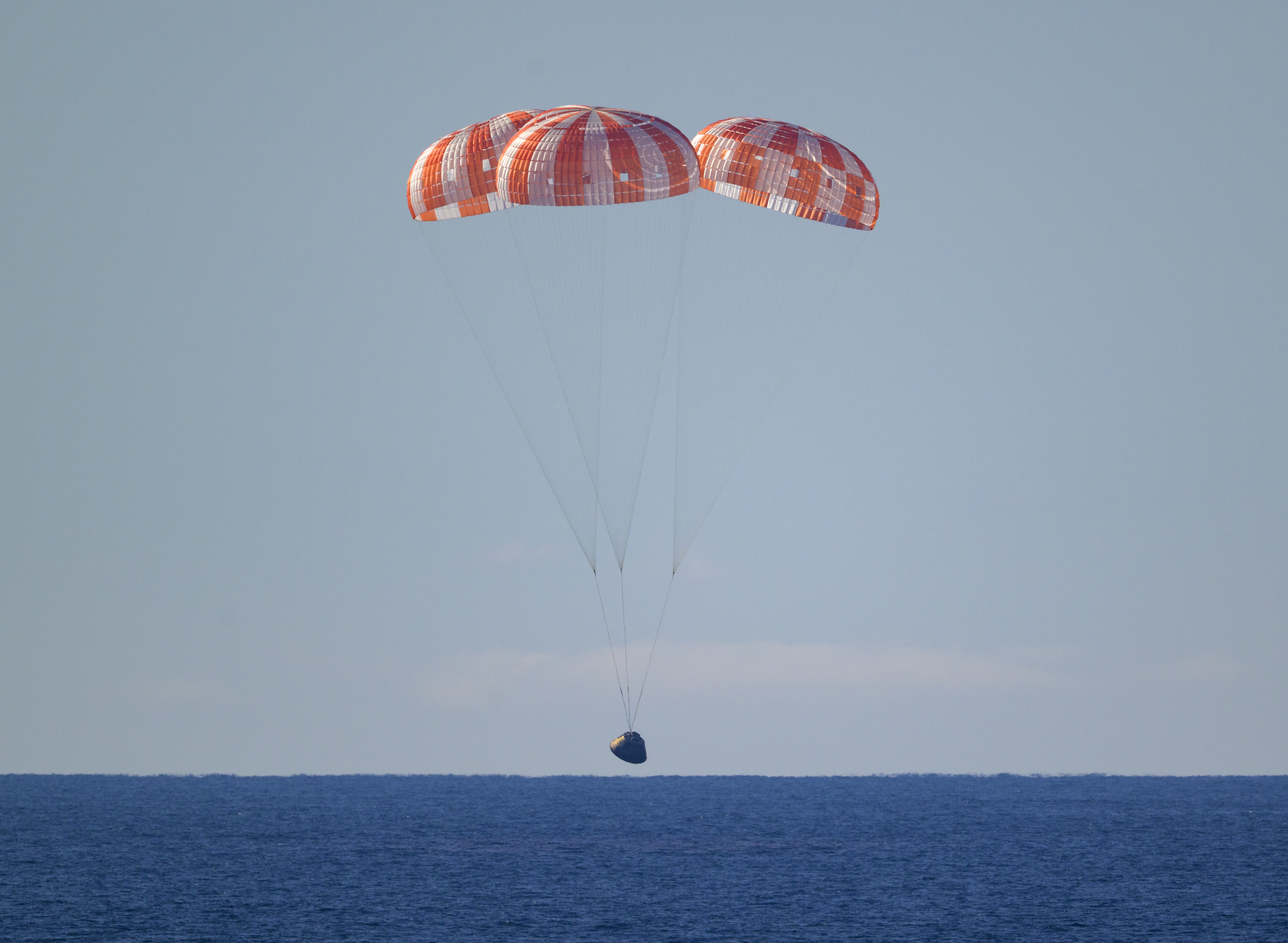
This image from April 10, 2026, captures NASA’s Orion spacecraft, with its parachutes deployed, seconds before splashdown in the Pacific Ocean. The Artemis II crew accomplished many milestones on their nearly 10-day mission, surpassing the Apollo 13 record for farthest crewed spaceflight and capturing views of the far side of the Moon.
Under Artemis, NASA will send astronauts on increasingly difficult missions to explore more of the Moon for scientific discovery, economic benefits, and to build on our foundation for the first crewed missions to Mars.
See more photos from the mission. (Link to https://www.nasa.gov/artemis-ii-multimedia/)
Artemis II Splashes Down
This image from April 10, 2026, captures NASA’s Orion spacecraft, with its parachutes deployed, seconds before splashdown in the Pacific Ocean. The Artemis II crew accomplished many milestones on their nearly 10-day mission, surpassing the Apollo 13 record for farthest crewed spaceflight and capturing views of the far side of the Moon.
Under Artemis, NASA will send astronauts on increasingly difficult missions to explore more of the Moon for scientific discovery, economic benefits, and to build on our foundation for the first crewed missions to Mars.
See more photos from the mission. (Link to https://www.nasa.gov/artemis-ii-multimedia/)
New metal with triple copper’s heat conduction challenges fundamental physics
With performance three times better than copper’s, this new material could substantially improve heat management of electronics, data centers and energy systems
NASA’s Artemis II reveals why humans still love the moon
The triumph of NASA’s first crewed lunar mission in a half-century is a reminder of what the moon really means for Earth—and why we’re going back
#789: What Happens When a Planet’s Star Dies
A star like the Sun only lasts about 10 billion years and it becomes a red giant and finally a white dwarf. This is catastrophic for some of the planets, consumed by the expanding red giant star. But most survive. What happens next in the long, slow cooling to the background temperature of the Universe?
Show Notes- Stellar lifecycle: Sun → red giant → planetary nebula → white dwarf
- Fate of Earth: likely engulfed or stripped to a molten core
- Mass loss reshapes planetary orbits (planets may drift outward)
- Planetary nebula: gas, radiation, and drag affect surviving worlds
- White dwarfs: hot, dense cores supported by electron degeneracy
- Second-generation planets can form from debris disks
- Possible habitable zones near white dwarfs (tidally locked planets)
- White dwarf evolution: cooling, crystallization (“diamond core”)
- Observations: debris, planetesimals, and planets around white dwarfs
- Long-term future: shrinking habitable zone, fading system
- Ultimate fate: cold stars, lost planets, and a dark, cooling universe
Fraser Cain:
AstronomyCast, episode 789, what happens to planets when the stars die? Welcome to AstronomyCast, our weekly facts-based journey through the cosmos, where we help you understand not only what we know, but how we know what we know. I'm Fraser Cain.
I'm the publisher of Universe Today. With me, as always, is Dr. Pamela Gay, a senior scientist for the Planetary Science Institute and the director of Cosmic Quest.
Dr. Pamela Gay:
Hey, Pamela, how are you doing? I am doing well, and I glitched it exactly the way it drives you crazy.
Fraser Cain:
No, no, no, just to be clear, it does not drive me crazy at all. I never even noticed until one of our viewers mentioned this exact tick that you have. And now, as a supportive co-host, I had been mixing it up just to sort of kick you off of your routine, and clearly, we go back to the standard, and you're back on your routine.
So we need to go deeper, I think. I need to make the introduction and me asking you how you are more complicated. Things are going to get weird, and that's fine.
We need to pass through the valley of fire before we can come out the other side. New, reforged, refreshed. So we've both seen Project Hail Mary.
Dr. Pamela Gay:
Yes, I found it deeply endearing. I am not going to buy the Lego set, but I may 3D print my own Rocky, because Rocky is the best.
Fraser Cain:
I mean, when you see the making of, and you see them running that guy around as a puppet, that's crazy how much of that movie is practical. Are you going to love this movie? Yes.
Are you going to have some scientific quibbles if it runs across something that you're actually very good at? Yes. But that's fine.
It's a good movie. I really enjoyed it. Anywhere can do no wrong.
Keep it up, Andy. I hope you get your Star Trek series. A star like the sun only lasts about 10 billion years, and then it becomes a red giant, and finally a white dwarf.
This is catastrophic for some of the planets consumed by the expanding red giant star, but most survive. What happens next in the long, slow cooling to the background temperature of the Universe? Alright, the Sun.
Give us the future history of the Sun.
Dr. Pamela Gay:
I love that concept. Our Sun, oh man, it's going to shed a whole lot of mass, and exactly what happens depends on how much mass gets shed. So we know for certain that it's eventually going to shed its outer layers, form a planetary nebula.
The remaining part of the core is going to collapse down, get supported through what's called electron degeneracy pressure, which is basically all of the electrons going, poly exclusion principle, poly exclusion principle, and pushing each other out.
Fraser Cain:
You can hear them. Literally, you can hear them yelling out if you're close enough to a neutron star.
Dr. Pamela Gay:
I don't recommend it. Not a neutron star. A white dwarf.
Neutron star have neutron degeneracy pressure, so they're yelling something different.
Fraser Cain:
Different sound.
Dr. Pamela Gay:
Yeah, yeah.
Fraser Cain:
Exactly.
Dr. Pamela Gay:
So one of the problems with the mass loss is depending on how much mass loss occurs, you have planets moving different amounts. So it is entirely possible that the Earth will be consumed when the Sun bloats up into a red giant star, or due to mass loss, it might move outward and escape that fate. Now the problem is you now have all of this material all over the place, and it's going to create drag.
And so now you have a new problem. You have hopefully escaped the red giant stage. You are now living within a planetary nebula.
You're now living within the shredded outskirts of your star. And what is left over is a white dwarf that shines very brightly in the ultraviolet. And ultraviolet can vaporize rock.
Fraser Cain:
Right. And I know that the temperature, like when the, like the core of the Sun, the temperatures are in the millions of Kelvin. And then the star dies, blasts out those outer layers, bloats up as a red giant, consumes definitely Mercury and Venus.
Maybe Earth, we're still not sure. Mars will probably survive. The ice moons of Jupiter will enter the habitable zone, which I always think is so cool.
And then it will, you know, puff out a layer, shrink back down, and then it'll do it again, puff out a layer, shrink back down. And then, as you said, you get that planetary nebula that's around it that is always so cool. What sort of, what decides the final orbit of the planets?
Dr. Pamela Gay:
It is a combination of what is the final mass of the white dwarf, what is the final velocity of each planet, and is their orbit stable or is it decaying as they interact with material around them?
Fraser Cain:
Right. So if you, if you decreased the mass of planet Earth, like if you just opened up a wormhole and just started siphoning away mass from Earth to some other part of the Universe, what would happen to the orbits? Our orbit would not noticeably change.
No, no, but what happened to the orbits of the satellites? Because now they're orbiting something with less mass.
Dr. Pamela Gay:
So it's GMM over R squared there, so the total force goes, hold on, you asked me a question and my brain just broke. So if their velocities stay constant, so they move outward.
Fraser Cain:
Right, their velocities stay constant, so they move outward.
Dr. Pamela Gay:
Yes.
Fraser Cain:
Right, yeah. So there is less gravity that is pulling on them, or there is less distortion of space time that they are maneuvering through, and they still have that same velocity, therefore they will spiral outward.
Dr. Pamela Gay:
Yes, and this is where the mass loss of the Sun means if it loses enough mass, we move far enough outwards that we escape the expansion. However, if there's drag on our system, depending on the amount of drag compared to the amount of mass loss, we can move back inward. This is one of the ways they consider for creating hot Jupiters, and so these are things we need to think about.
Now, in general, the interplay between mass loss and the orbital velocity of planets is considered second order to the amount of mass lost by that star, but these are still things that keep me awake at night.
Fraser Cain:
Right, and I think it's really important to say that we are not unharmed. In the best case scenario, we are the planet Earth is mangled, believe, right? It is, you have spent maybe 4 billion years, 5 billion years in a temperature regime that is beyond the boiling point of water on the surface of the Earth, all of the oceans have boiled away, that you have now, you have spent time maybe in the atmosphere of the star as it was expanding as a red giant.
That wasn't fun.
Dr. Pamela Gay:
Our world is a crispy critter.
Fraser Cain:
Yeah, yeah. So it may still exist as a sphere of rock, but it is not unharmed. That's why we have all moved out to the ice moons of Jupiter to watch the mayhem unfold.
So then we settle into what is this long future balance, and what does that look like?
Dr. Pamela Gay:
So that little tiny Earth-sized basically star in the center, dead star in the center, while it screams electron degeneracy pressure, it starts out super hot, but it's not generating heat any longer, which means that over time, it's going to cool off. And there's going to be this really neat evolution of what's going on close to that star. So some really cool work came out last year, I think.
Fraser Cain:
I think I reported on this. I was going to bring this up, but you weren't going to.
Dr. Pamela Gay:
Yeah, Jordan Stekloff led the work where a really hot white dwarf vaporizes the rock around it. But then as it cools, that rock reforms a new dust disk. And so you have this disk that ends up forming.
It's not like protoplanetary disk the way we think of protoplanetary disks. But as we look for objects around white dwarfs, we don't find anything around hot young ones. We find dust disks around medium-aged ones.
And as they cool, we start to find these planetesimals. And that is just super cool to me.
Fraser Cain:
Right. It's planetary formation round two, that the material is following the same laws of physics that cause the dust to come together into larger and larger objects. And then eventually you get, as you say, planetesimals forming around the white dwarf.
And so it is another chance. So there's hope. One other piece of research that I found really interesting that I also reported on was that there appears to be this pause that white dwarfs go through in their cooling process.
Yeah. That kicks in. They crystallize.
Yeah. They crystallize. And then that sort of crystallization, it's changing.
I forget what exactly it is. It's like the boron in it is like changing the shape of the crystallization. And so it's cooling halts for billions of years before finally it kicks off again.
And so you actually end up with a long lived habitable zone that it does appear to match this sort of process of planets forming around it that will last you for quite a while. So it's interesting that you can, and like the habitable zone around the white dwarf is like four times the distance from the earth to the moon. So it is very close, like a million kilometers away from the star.
You will be tidally locked. Yes. And yet the habitable zone is there.
Dr. Pamela Gay:
And what gets me about this process is we're starting to learn of all these weird crystalline things that go through metamorphic changes. And we see the same thing with water ice where there's different kinds of water ice and energy will go to phase changes in how the water ice is formed at various temperatures. And so this idea that you have to think through how does the crystalline structure mediate cooling processes is something that I never learned to wrap my head around.
Now, admittedly, I was in school as an astrophysicist, we have hydrogen, helium and everything else. But when we discussed white dwarf cooling, this wasn't something we were considering in the 90s. This is a new concept.
And it's really cool to see how it plays into our understanding of the evolution of stars around us.
Fraser Cain:
And this isn't theoretical work at this point, like we are seeing examples of white dwarfs with the signs that we're talking about around them. We are seeing them with planetesimals. We are seeing there are white dwarfs with planets.
There are white dwarfs with clouds of debris around them that have been detected and observed with James Webb and others. So this is not just a theoretical possibility. This is confirmed in some of the white dwarf systems that have been observed so far.
So what do you think is kind of the best case scenario for the future of a star system like the sun?
Dr. Pamela Gay:
I mean, it depends on best case to whom. If you're asking for humanity...
Fraser Cain:
No, we're cooked.
Dr. Pamela Gay:
We're cooked. Yeah. Yeah.
Fraser Cain:
We've moved to Proxima Centauri. That's the best case for us.
Dr. Pamela Gay:
Right. Exactly. Yeah.
And so, I mean, Proxima Centauri is tiny. It's going to have its own different issues, but it will live forever. But it's going to last five trillion years.
Yeah. Yeah. Yeah.
Yeah. I think massive amounts of mass loss making a truly beautiful planetary nebula that the remnants of humanity can study the formation of would be pretty cool.
Fraser Cain:
From inside?
Dr. Pamela Gay:
Yeah. Yeah.
Fraser Cain:
Or from Proxima Centauri?
Dr. Pamela Gay:
From Proxima Centauri. And what gets me about things like planetary nebulae is they can be huge. They can be light years across.
And so, this is a nebula that would reach out and touch someone. And Proxima Centauri will no longer be the closest star at that point. Our separations will radically change.
So, we could be on some completely different star, just to be entirely clear. But this idea of humanity getting to watch the evolution of a planetary nebula, and so all the mass you can possibly lose, please do it and let future scientists enjoy.
Fraser Cain:
Yeah. I mean, we definitely have some questions about what are the conditions that are required to give you those really cool planetary nebulae. Is it a binary system?
Like, do you need a second star to whip up the material to create those interesting shapes? Or do you just get it with a single star that's just puffing out those outer layers?
Dr. Pamela Gay:
And planets, what kinds of planets are necessary? And yeah, it's complicated. And we want to know all the things.
Fraser Cain:
And what happens to the outer planets? I mean, we're obviously focused on Earth. It's cooked, crispy critter.
What happens to the outer planets, the Jupiters, the Saturns, Uranus, Neptunes?
Dr. Pamela Gay:
So, they migrate outwards. And so, Jupiter will end up being stripped of some material because it's gassy. It doesn't hold on to its outer layers extraordinarily well when it's getting blasted and the temperatures are changing.
Fraser Cain:
So, it might go through mass loss as well.
Dr. Pamela Gay:
Yeah. Yeah. More like mass stripping.
Fraser Cain:
Right. Which would have repercussions for its moons.
Dr. Pamela Gay:
So, it's complicated. The outer planets are all gassy, icy objects that can undergo structural changes in the process. So, we will have asteroids that are probably okay.
They will just get melty on the surface. We have Mars, which any ices it's still got are going to be gone. It'll probably lose what little atmosphere it has left.
The icy moons will cease to be icy moons out at the distance of Jupiter. I'm not sure about Saturn. I'd have to run the maths to see just where Saturn lands in the equations.
Fraser Cain:
Right. But this migration, and I mean, can this migration cause mayhem in the universe? We know early on in the solar system there appears to be a migration.
This is the Nice model. Do we go through this second phase where what was once this sort of perfect clockwork balance now gets out of balance again and there's another chance for mayhem?
Dr. Pamela Gay:
There is another chance for mayhem. There will definitely be additional mayhem, but luckily there are fewer worlds available for that mayhem. So, early on we had at least a few extra planets that we no longer have.
The one that smashed into Earth to form the Earth moon as it is today.
Fraser Cain:
Yeah, whatever happened to Uranus? Yeah, yeah.
Dr. Pamela Gay:
Yeah. Venus is another one that had something bad happen. Jupiter's core is fluffier than it should be, so something creamed into it.
Fraser Cain:
Yep. And who knows what went into the sun?
Dr. Pamela Gay:
Yeah. And so there were a lot more objects around to create mayhem in the first iteration. In the second iteration we will have had a lot of stuff obliterated, we'll have a lot of stuff made smaller.
So yes, mayhem will occur at a smaller scale.
Fraser Cain:
All right. So the sun has died, gone into its red giant phase, gone to its white dwarf phase. Now it is cooling down.
There's a cloud of debris around it that has maybe formed into some kind of planetesimal, maybe even within the habitable zone. And so a future Proxima Centauri expedition will be able to build a base and examine what it's like to live inside a white dwarf system down in the future. But the sun has died, but now what happens to the sun and what happens to the planets that are around it from this point on?
Dr. Pamela Gay:
So anything that snuggled in at that kind of Earth-Moon distance to this new white dwarf will have formed there out of the dust debris cloud and is going to be tiny. So sure, that group from Proxima Centauri can set a cup of water on it and watch as it sublimates away into pure gas because there's no atmosphere on that little tiny world. Right.
So habitable only refers to the temperature. It doesn't pay attention to things like pressure that also matter if you want to have life outside of spacesuits.
Fraser Cain:
They're solar system engineers. Okay. They drag something inward.
And are able to import, yeah, they've imported a whole bunch of comets and have dumped them onto the world and built up, thickened the atmosphere.
Dr. Pamela Gay:
And added mass.
Fraser Cain:
And added, well, I mean, I know that even, this was like a paper that I reported on that even like 1.5 meters per second is enough escape velocity for you to be able to hold on to an atmosphere. I'm not sure.
Dr. Pamela Gay:
Right. But those planetesimals are probably smaller than that.
Fraser Cain:
So as you say, they add mass, they mash a bunch of them together, they do some solar system engineering. I guess where I'm going with this is if you did have the right kind of world, would it be a stable, habitable place that you could live on for now billions of years?
Dr. Pamela Gay:
I wouldn't say billions of years. These things do cool down over time where your ultraviolet heated white dwarf has to cool down to allow those planetesimals to form. But that cooling is just going to keep going and keep going until eventually you're no longer, that habitable zone is going to snuggle up closer and closer and closer until you can touch the surface of the star.
I do not recommend doing this.
Fraser Cain:
Yeah.
Dr. Pamela Gay:
Because the gravity is still there. Yeah, yeah. So, but ignoring the gravity, the white dwarf in the fullness of time will cool off and it will also evaporate in the fullness of time if we're correct about protons not being stable.
Fraser Cain:
Right. Right. Or even Hawking radiation.
Right. We talked about that, right? Yeah.
That it appears that if Hawking radiation works for black holes, it probably works for anything and everything.
Dr. Pamela Gay:
Yeah. That has energy.
Fraser Cain:
And that in a roughly the same time scale, you'll get all of the white dwarfs evaporating away and, you know, any planet, anything, right, anything with mass will evaporate. But before that, like we've got this white dwarf that is cooling down, but you still have the interactions between the solar system and the rest of the galaxy. So what happens next?
Dr. Pamela Gay:
So you're getting dragged around as you get colder and colder and you literally end up being a source of darkness except for gravitationally lensing things you happen to pass in front of.
Fraser Cain:
Right.
Dr. Pamela Gay:
And, and there's, I mean, this is as boring as it gets. You have cold planets orbiting a cold star. Everything is cold and your only ability to, to raise excitement and make your existence known is through gravitationally lensing background objects.
Fraser Cain:
Well, so, so the thing that's, that I think people don't realize is that you're still experiencing these gravitational interactions with the other stars in the, in the galaxy and they are going to be plucking away your planets one by one. Yes. And it takes about a hundred billion years and you will lose all of your planets but one.
So whichever one, yeah, yeah, this was a, this was a paper that I report on. So you'll lose all your planet. It takes about 10 billion years, I'm sorry, a hundred billion years.
And then you're down to one planet. And this process is going to happen in all of the star systems. So they're all going to use up their star forming material.
They're all going to die. They're all going to then give up their planets. And then over even deeper time, all of those stars will be kicked out through three body interactions of the galaxy itself.
And so eventually you'll just be left with the supermassive black hole and all the stars have just been all kicked out and all of their planets have all been kicked out. And then it takes about five trillion years for the, for the white dwarf to just cool down to the background temperature of the universe.
Dr. Pamela Gay:
I love this story of the universe building structure, building structure, building structure, removing the structure.
Fraser Cain:
Yeah. And they're just, they're just dismantling it all. You built your Lego set and now you're, you're throwing all the pieces away and you're back to square one.
Dr. Pamela Gay:
No, don't throw them away. Scatter them to the wind.
Fraser Cain:
You scatter them to the wind. Yeah. You've thrown them all in.
You waited for wind gusts and you just throw pieces of Lego out into the wind and let them carry. This analogy is falling apart. But, but, but the point is that, that in the end there will be the sun and it will be a, a ball of material, right?
Roughly the size of the earth, the background temperature of the universe, it will probably have one planet that is tidally locked to it and, and it has been kicked out of the Milky Way and it is wandering the universe until Hawking radiation makes it dissolve into a, just a soup of particles and energy in the background temperature of the universe.
Dr. Pamela Gay:
The exciting part is it will at least be a giant diamond.
Fraser Cain:
So there is that. Yeah. Yeah.
For a while there, the sun will be the world, the, the universe's biggest diamond.
Dr. Pamela Gay:
Well, I mean, there could be other ones out there.
Fraser Cain:
There will be bigger diamonds. Yeah.
Dr. Pamela Gay:
Yeah.
Fraser Cain:
From other stars. Yeah. There's the theoretically largest possible carbon white dwarf.
Yes. But still. Yeah.
Dr. Pamela Gay:
The future is weird.
Fraser Cain:
It really is. Yeah. Yeah.
Isn't it weird? I always, I always remark on this, how when we think about deep time, we feel this, uh, this sense of sadness in our we about this future that we don't stand a chance of experiencing, right?
Dr. Pamela Gay:
Well, it's, I, I think it's kind of like when important buildings are lost, even if we've never visited them, it's just sort of like energy went into the formation of that. Don't destroy it. And, and so in, in the end times, as we currently expect it to go, everything that we know will end up becoming nothing more than diffuse energy in, in this, this cold rip of space time.
But it's that intermediate point where things are getting flung hither and yon and all the spiral galaxies are getting taken apart. All the elliptical galaxies are getting taken apart. Galaxy clusters are, are just becoming lumps of diffuse glow.
Um, I mean, it's, it's, it's kind of both sad and silly at the same time. It really, your Lego analogy was excellent until you said you throw them out.
Fraser Cain:
Okay, fine. You mail them off. You mail the pieces off to friends around the world.
Dr. Pamela Gay:
Well, I really just like imagine this angry, small individual in the center of a room throwing with varying amounts of energy, all of the pieces until there's just this diffuse cloud of, of Legos.
Fraser Cain:
So there you go. Uh, so what we're saying is there's a chance.
Dr. Pamela Gay:
There is a chance. There's always a chance.
Fraser Cain:
Yeah. All right. Thanks, Pamela.
Dr. Pamela Gay:
Thank you, Fraser. And thank you so much to all of our Patreons out there. And I'm now going to mispronounce your name as my way of saying thank you.
Our show wouldn't be here without the amazing support of so many of you over at patreon.com slash astronomy cast. This week, I would like to attempt to thank by name the following people, and I'm sorry for what I'm about to do to the pronunciation of your names. This week, I'd like to thank Abraham Cattrell, Alex Cohen, Alexis, Andy Moore, Bore Andro Bart Flaherty, Benjamin Davies, Brian Breed, Brian Cagle, Claudia Mastroianni, Dan Fiennes, DeSastrina, Dwight Ilk, Ed, Eron Zegrev, Eric Lee, Evil Melky, Flower Guy, Jeff McDonald, Glenn McDavid, Helga Bjorkhag, Jarvis Earl, Jean-Baptiste Lamartine, Jim of Everett, Joe Holstein, John Esdraseth, Jonathan H.
Starver, Jonathan Poe, Justin Proctor, Justin S., Katie B., Kimberly Reck, Larry Zotz, Mark Scheer, Masa Herleyu, Michelle Cullen, Mike Dogg, Nick Boyd, Noah Albertson, Paul L. Hayden, Paul Lowell, Pauline Middlelink, Philip Grand, Philip Walker, Red Bar is watching, Rill, RJ Basque, Ryan Omery, Steven Coffey, Steven Miller, Tim Garish, Travis C. Porco, William Andrews.
Thank you all so very much.
Fraser Cain:
All right. Thanks, everyone. And we will see you next week.
Dr. Pamela Gay:
Bye-bye, everyone.
LIVE SHOWNASA Welcomes Record-Setting Artemis II Moonfarers Back to Earth
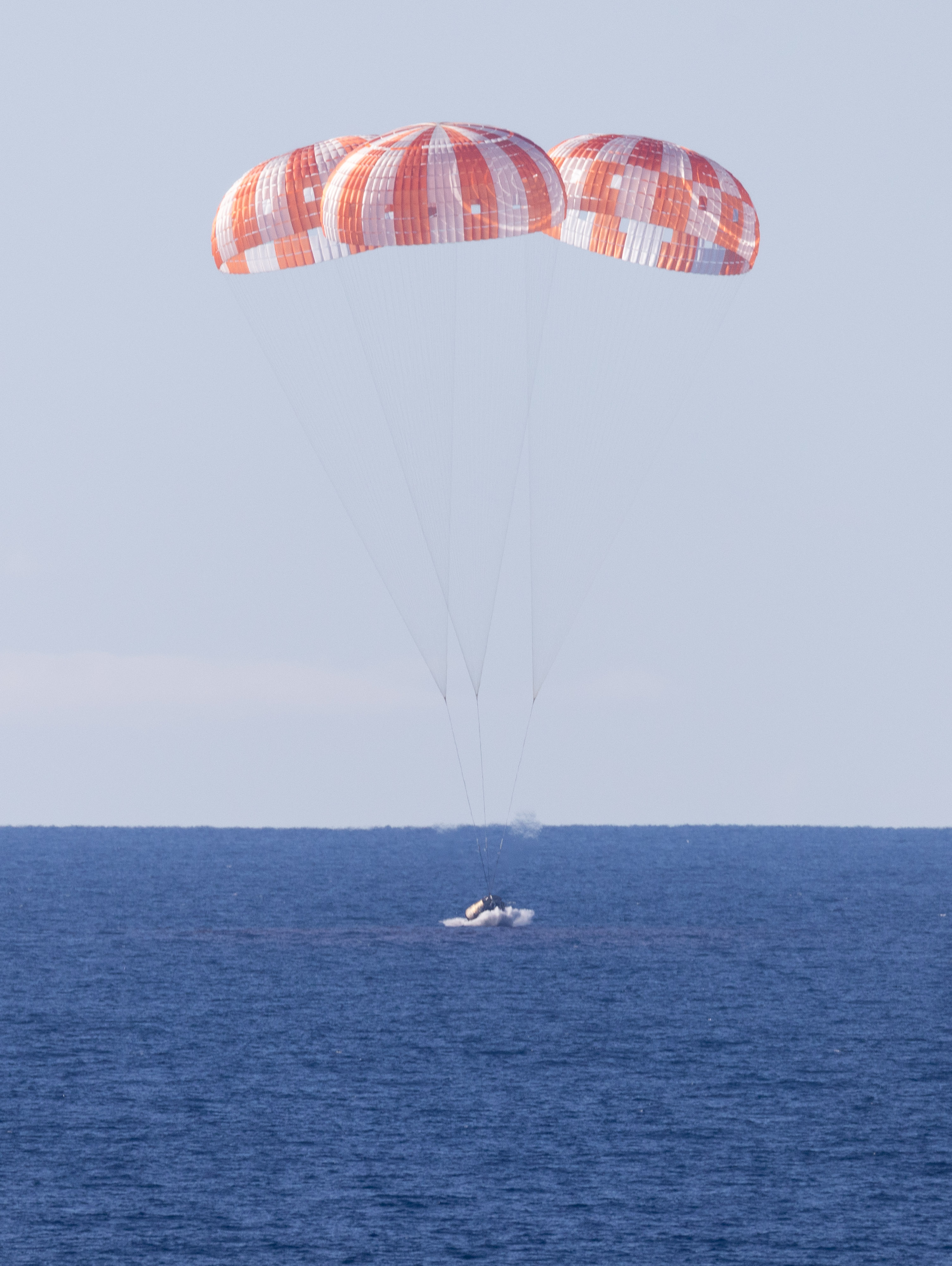
The first astronauts to travel to the Moon in more than half a century are back on Earth after a record-setting mission aboard NASA’s Artemis II test flight.
NASA astronauts Reid Wiseman, Victor Glover, and Christina Koch, and CSA (Canadian Space Agency) astronaut Jeremy Hansen splashed down at 5:07 p.m. PDT Friday off the coast of San Diego, completing a nearly 10-day journey that took them 252,756 miles from home at their farthest distance from Earth.
“Reid, Victor, Christina, and Jeremy, welcome home, and congratulations on a truly historic achievement. NASA is grateful to President Donald Trump and partners in Congress for providing the mandate and resources that made this mission and the future of Artemis possible,” said NASA Administrator Jared Isaacman. “Artemis II demonstrated extraordinary skill, courage, and dedication as the crew pushed Orion, SLS (Space Launch System), and human exploration farther than ever before. As the first astronauts to fly this rocket and spacecraft, the crew accepted significant risk in service of the knowledge gained and the future we are determined to build. NASA also acknowledges the contributions of the entire NASA workforce, along with our international partners, whose expertise and commitment were essential to this mission’s success. With Artemis II complete, focus now turns confidently toward assembling Artemis III and preparing to return to the lunar surface, build the base, and never give up the Moon again.”
After splashdown in the Pacific Ocean, the astronauts were met by a combined NASA and U.S. military team that assisted them out of the spacecraft in open water and transported them via helicopter to the USS John P. Murtha for initial medical checkouts. The crew members are expected to return to NASA’s Johnson Space Center in Houston on Saturday, April 11.
During their mission, Wiseman, Glover, Koch, and Hansen flew 694,481 miles in total. Their lunar flyby took them farther than any humans have ever traveled before, surpassing the previous distance record set by Apollo 13 astronauts in 1970.
The first Artemis crew launched on NASA’s SLS rocket at 6:35 p.m. April 1, from Launch Pad 39B at the agency’s Kennedy Space Center in Florida. With 8.8 million pounds of thrust at liftoff, the American-built rocket propelled the crew inside the Orion spacecraft to space, delivering it to orbit with pinpoint accuracy after a smooth countdown conducted by the agency’s Artemis launch control team.
During the first day in space, the astronauts and teams on the ground checked out the spacecraft — named Integrity by the crew — to confirm all systems were healthy ahead of the transit to the Moon. NASA also deployed four CubeSats from international partners to Earth orbit.
On the second day of the test flight, with all systems Go, Orion’s service module fired its main engine, placing the astronauts on a trajectory that brought them 4,067 miles above the lunar surface at their closest approach.
“The Artemis II crew is home. The entry, descent, and landing systems performed as designed and the final test was completed as intended. This moment belongs to the thousands of people across fourteen countries who built, tested, and trusted this vehicle. Their work protected four human lives traveling at 25,000 miles per hour and brought them safely back to Earth,” said NASA Associate Administrator Amit Kshatriya. “Artemis II proved the vehicle, the teams, the architecture, and the international partnership that will return humanity to the lunar surface. Reid, Victor, Christina, and Jeremy carried the hopes of this world farther than humans have traveled in more than half a century. Fifty‑three years ago, humanity left the Moon. This time, we returned to stay. The future is ours to win.”
With astronauts aboard for the first time, engineers put Orion through a full in‑flight evaluation. The crew tested the spacecraft’s life support systems, confirming Orion can sustain humans in deep space. During several piloting demonstrations, crew members took manual control of the spacecraft, flying Orion to validate its handling and collect data that will guide future rendezvous and docking operations with human-rated landers during Artemis III and beyond.
The crew completed a series of tests to inform how NASA will fly future missions to the Moon, including evaluations of how the spacecraft operates during crew exercise, emergency equipment and procedures, the Orion crew survival system spacesuits, and other critical spacecraft systems.
Wiseman, Glover, Koch, and Hansen also supported scientific investigations to help NASA prepare astronauts to live and work on the Moon as the agency builds a Moon Base and looks toward Mars. These experiments — including the AVATAR investigation, which studies how human tissue responds to microgravity and the deep space radiation environment, and other human research performance studies — are gathering essential health data for long-duration missions.
During their April 6 lunar flyby, the astronauts captured more than 7,000 images of the lunar surface and a solar eclipse, during which the Moon blocked the Sun from Orion’s vantage point. The imagery includes striking views of earthset and earthrise, impact craters, ancient lava flows, our Milky Way galaxy, and surface fractures and color variations across the lunar terrain.
They documented the topography along the terminator — the boundary between lunar day and night — where low-angle sunlight casts long shadows across the surface, creating illumination conditions similar to those in the South Pole region where astronauts are scheduled to land in 2028. The crew also proposed potential names for two lunar craters and reported meteoroid impact flashes on the night side of the Moon.
Artemis II science will pave the way for future missions to the Moon’s surface by helping advance mission operations and training astronauts to use well-informed judgment to identify areas of high interest for science and exploration.
With the crew safely on Earth, NASA and its partners now will turn attention to preparing for next year’s Artemis III mission, when a new Orion crew will test integrated operations with commercially built Moon landers in low Earth orbit.
As part of a Golden Age of innovation and exploration, NASA will send Artemis astronauts on increasingly challenging missions to explore more of the Moon for scientific discovery, economic benefits, establish an enduring human presence on the lunar surface, and lay the groundwork for sending the first astronauts – American astronauts – to Mars.
To learn more about the Artemis program, visit:
-end-
Bethany Stevens / Rachel Kraft
Headquarters, Washington
202-358-1600
bethany.c.stevens@nasa.gov / rachel.h.kraft@nasa.gov
NASA Welcomes Record-Setting Artemis II Moonfarers Back to Earth
The first astronauts to travel to the Moon in more than half a century are back on Earth after a record-setting mission aboard NASA’s Artemis II test flight.
NASA astronauts Reid Wiseman, Victor Glover, and Christina Koch, and CSA (Canadian Space Agency) astronaut Jeremy Hansen splashed down at 5:07 p.m. PDT Friday off the coast of San Diego, completing a nearly 10-day journey that took them 252,756 miles from home at their farthest distance from Earth.
“Reid, Victor, Christina, and Jeremy, welcome home, and congratulations on a truly historic achievement. NASA is grateful to President Donald Trump and partners in Congress for providing the mandate and resources that made this mission and the future of Artemis possible,” said NASA Administrator Jared Isaacman. “Artemis II demonstrated extraordinary skill, courage, and dedication as the crew pushed Orion, SLS (Space Launch System), and human exploration farther than ever before. As the first astronauts to fly this rocket and spacecraft, the crew accepted significant risk in service of the knowledge gained and the future we are determined to build. NASA also acknowledges the contributions of the entire NASA workforce, along with our international partners, whose expertise and commitment were essential to this mission’s success. With Artemis II complete, focus now turns confidently toward assembling Artemis III and preparing to return to the lunar surface, build the base, and never give up the Moon again.”
After splashdown in the Pacific Ocean, the astronauts were met by a combined NASA and U.S. military team that assisted them out of the spacecraft in open water and transported them via helicopter to the USS John P. Murtha for initial medical checkouts. The crew members are expected to return to NASA’s Johnson Space Center in Houston on Saturday, April 11.
During their mission, Wiseman, Glover, Koch, and Hansen flew 694,481 miles in total. Their lunar flyby took them farther than any humans have ever traveled before, surpassing the previous distance record set by Apollo 13 astronauts in 1970.
The first Artemis crew launched on NASA’s SLS rocket at 6:35 p.m. April 1, from Launch Pad 39B at the agency’s Kennedy Space Center in Florida. With 8.8 million pounds of thrust at liftoff, the American-built rocket propelled the crew inside the Orion spacecraft to space, delivering it to orbit with pinpoint accuracy after a smooth countdown conducted by the agency’s Artemis launch control team.
During the first day in space, the astronauts and teams on the ground checked out the spacecraft — named Integrity by the crew — to confirm all systems were healthy ahead of the transit to the Moon. NASA also deployed four CubeSats from international partners to Earth orbit.
On the second day of the test flight, with all systems Go, Orion’s service module fired its main engine, placing the astronauts on a trajectory that brought them 4,067 miles above the lunar surface at their closest approach.
“The Artemis II crew is home. The entry, descent, and landing systems performed as designed and the final test was completed as intended. This moment belongs to the thousands of people across fourteen countries who built, tested, and trusted this vehicle. Their work protected four human lives traveling at 25,000 miles per hour and brought them safely back to Earth,” said NASA Associate Administrator Amit Kshatriya. “Artemis II proved the vehicle, the teams, the architecture, and the international partnership that will return humanity to the lunar surface. Reid, Victor, Christina, and Jeremy carried the hopes of this world farther than humans have traveled in more than half a century. Fifty‑three years ago, humanity left the Moon. This time, we returned to stay. The future is ours to win.”
With astronauts aboard for the first time, engineers put Orion through a full in‑flight evaluation. The crew tested the spacecraft’s life support systems, confirming Orion can sustain humans in deep space. During several piloting demonstrations, crew members took manual control of the spacecraft, flying Orion to validate its handling and collect data that will guide future rendezvous and docking operations with human-rated landers during Artemis III and beyond.
The crew completed a series of tests to inform how NASA will fly future missions to the Moon, including evaluations of how the spacecraft operates during crew exercise, emergency equipment and procedures, the Orion crew survival system spacesuits, and other critical spacecraft systems.
Wiseman, Glover, Koch, and Hansen also supported scientific investigations to help NASA prepare astronauts to live and work on the Moon as the agency builds a Moon Base and looks toward Mars. These experiments — including the AVATAR investigation, which studies how human tissue responds to microgravity and the deep space radiation environment, and other human research performance studies — are gathering essential health data for long-duration missions.
During their April 6 lunar flyby, the astronauts captured more than 7,000 images of the lunar surface and a solar eclipse, during which the Moon blocked the Sun from Orion’s vantage point. The imagery includes striking views of earthset and earthrise, impact craters, ancient lava flows, our Milky Way galaxy, and surface fractures and color variations across the lunar terrain.
They documented the topography along the terminator — the boundary between lunar day and night — where low-angle sunlight casts long shadows across the surface, creating illumination conditions similar to those in the South Pole region where astronauts are scheduled to land in 2028. The crew also proposed potential names for two lunar craters and reported meteoroid impact flashes on the night side of the Moon.
Artemis II science will pave the way for future missions to the Moon’s surface by helping advance mission operations and training astronauts to use well-informed judgment to identify areas of high interest for science and exploration.
With the crew safely on Earth, NASA and its partners now will turn attention to preparing for next year’s Artemis III mission, when a new Orion crew will test integrated operations with commercially built Moon landers in low Earth orbit.
As part of a Golden Age of innovation and exploration, NASA will send Artemis astronauts on increasingly challenging missions to explore more of the Moon for scientific discovery, economic benefits, establish an enduring human presence on the lunar surface, and lay the groundwork for sending the first astronauts – American astronauts – to Mars.
To learn more about the Artemis program, visit:
-end-
Bethany Stevens / Rachel Kraft
Headquarters, Washington
202-358-1600
bethany.c.stevens@nasa.gov / rachel.h.kraft@nasa.gov
NASA’s Artemis II mission was a historic success
NASA’s Artemis II mission was a historic success
Artemis II: splashdown
Today, at 17:07 local time on 10 April (01:07 BST/02:07 CEST 11 April), NASA’s Orion spacecraft and its crew splashed down safely in the Pacific Ocean, marking the end of the Artemis II mission. ESA’s European Service Module powered this historic mission that took four astronauts around the Moon and back for the first time since Apollo 17 in 1972.
NASA’s Artemis II moon mission splashes down
NASA’s Orion capsule and the four astronauts on board have made it back to Earth after 10 days in space and a record-breaking mission around the moon and back
Student Team Finds One of the Oldest Stars in the Universe that Migrated to the Milky Way
A class of undergraduate students at University of Chicago has used data from the Sloan Digital Sky Survey (SDSS) to discover one of the oldest stars in the universe, a star that formed in a companion galaxy and migrated to the Milky Way.
Tweaking the smell of cat food can encourage fussy felines to eat
Tweaking the smell of cat food can encourage fussy felines to eat
Why Does Jupiter Have More Large Moons than Saturn?
The two largest planets in our Solar System, Jupiter and Saturn, have the largest systems of moons. However, Jupiter has more large moons than Saturn, which has only one. Since both planets are gas giants, the reasons for the differences in these satellite systems have long puzzled astronomers. This motivated a collaborative team of researchers from Japan and China to develop a physically consistent model that can explain this.