
Feed aggregator
Artemis II Crew Returns to Houston
Artemis II Crew Returns to Houston
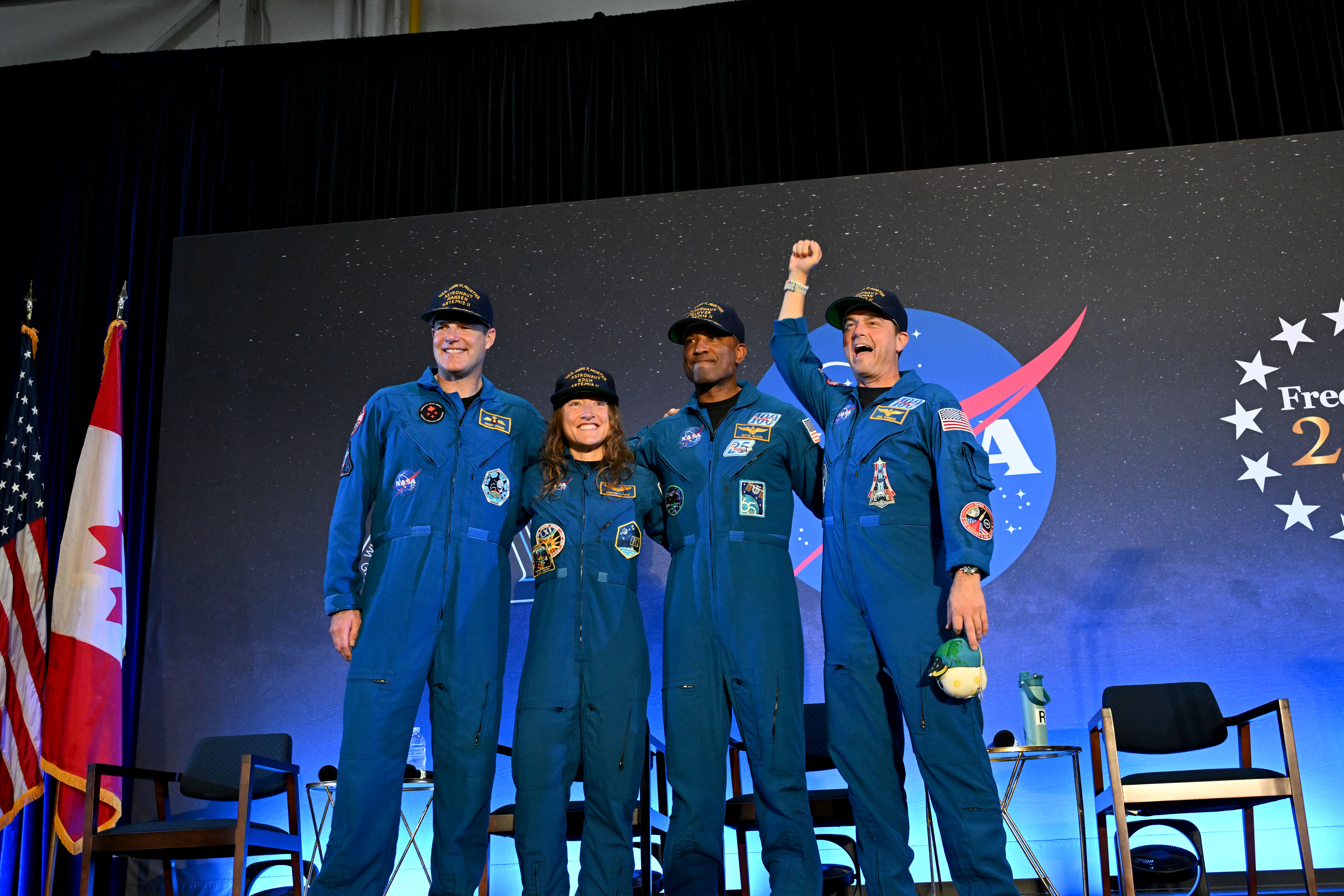
NASA’s Artemis II crew – NASA astronauts Reid Wiseman, Victor Glover, and Christina Koch, and CSA (Canadian Space Agency) astronaut Jeremy Hansen – smile at friends, family, and colleagues. They shared brief remarks with the crowd after landing at Ellington Airport near NASA’s Johnson Space Center in Houston on Saturday, April 11, 2026, after a nearly 10-day journey around the Moon and back to Earth.
View the latest imagery from the Artemis II mission on our Artemis II Multimedia Resource Page.
Image credit: NASA/Helen Arase Vargas
Artemis II Crew Returns to Houston
NASA’s Artemis II crew – NASA astronauts Reid Wiseman, Victor Glover, and Christina Koch, and CSA (Canadian Space Agency) astronaut Jeremy Hansen – smile at friends, family, and colleagues. They shared brief remarks with the crowd after landing at Ellington Airport near NASA’s Johnson Space Center in Houston on Saturday, April 11, 2026, after a nearly 10-day journey around the Moon and back to Earth.
View the latest imagery from the Artemis II mission on our Artemis II Multimedia Resource Page.
Image credit: NASA/Helen Arase Vargas
250-million-year-old fossil proves mammal ancestors laid eggs
Laying eggs may have helped mammal ancestors thrive after Earth’s worst mass extinction
Honoring Alex Goetz, a Landsat Legend
- Landsat Home
- Missions
- News
- Data
- Benefits
- Outreach
- Multimedia
- About
- Search

In the more than five decades of the Landsat program, there have been many visionaries who have changed the course of remote sensing history. One such figure is Alexander Goetz, a physicist and planetary scientist who pioneered imaging spectrometry from space.
Goetz was part of the Landsat Program from the very beginning, working as a principal investigator for Landsats 1 and 2. Years later, he returned to the program as a member of the first formal Landsat Science Team on Landsat 7. This diverse group of researchers, technologists, and calibration and applications specialists helped advance Landsat science goals, refined algorithms, and supported on-the-ground calibration. Crucially, the team advised on the creation of the long-term acquisition plan (LTAP), which ensured consistent global, seasonal coverage of Landsat data. Goetz, for his part, led a study titled “Land and Land-Use Change in the Climate Sensitive High Plains: An Automated Approach with Landsat”.
Goetz, who passed away in 2025 at age 86, was an innovator in the field of spectrometry. According to a 2009 special issue of Remote Sensing of Environment, Goetz was “one of the few remote sensing scientists in the early days of the Landsat program to recognize the Multispectral Scanner (MSS) and later the Thematic Mapper (TM) for what they really were: quantitative spectral measuring instruments, not just ‘cameras in space’ that made pretty pictures.”
True to that vision, in 1974—just two years after the launch of Landsat 1—Goetz developed a portable field spectrometer to acquire ground truth surface reflectance data to calibrate data from the MSS. Building on the success of the field spectrometer experiment, he worked with a team to develop the Shuttle Multispectral Infrared Radiometer (SMIRR), which flew on the Space Shuttle in 1981. SMIRR, which collected data across ten bands, enabled scientists to map mineral composition from space for the first time. Data from SMIRR contributed to the case for adding band 7 to the TM on Landsat 4. By measuring data in the shortwave-infrared (SWIR) part of the electromagnetic spectrum, band 7 allowed geological researchers to better map rock types. Goetz was awarded the prestigious William T. Pecora Award and the NASA Medal for Exceptional Scientific Achievement for his pioneering work on imaging spectrometry.
Today, 27 years after the launch of Landsat 7, we honor the legacy of Alexander Goetz, one of the key figures in Landsat history.
Explore More
Honoring Alex Goetz, a Landsat Legend
2 min read
Dr. Alex Goetz, who passed away in 2025, was a member of the Landsat 7 Science Team and a key…
Apr 15, 2026 ArticleMegaberg Ends Its Long Odyssey at Sea
5 min read
Antarctic Iceberg A-23A’s journey ends in fragmentation in the South Atlantic Ocean, after a 40-year lifespan documented by satellites.
Apr 13, 2026 ArticleSnow in the Shadow of the Andes
2 min read
An early autumn storm left higher elevations in southern Argentina with a fresh and fleeting coat of white.
Apr 9, 2026 Article1
2
3
…
303
Next
Honoring Alex Goetz, a Landsat Legend
- Landsat Home
- Missions
- News
- Data
- Benefits
- Outreach
- Multimedia
- About
- Search
In the more than five decades of the Landsat program, there have been many visionaries who have changed the course of remote sensing history. One such figure is Alexander Goetz, a physicist and planetary scientist who pioneered imaging spectrometry from space.
Goetz was part of the Landsat Program from the very beginning, working as a principal investigator for Landsats 1 and 2. Years later, he returned to the program as a member of the first formal Landsat Science Team on Landsat 7. This diverse group of researchers, technologists, and calibration and applications specialists helped advance Landsat science goals, refined algorithms, and supported on-the-ground calibration. Crucially, the team advised on the creation of the long-term acquisition plan (LTAP), which ensured consistent global, seasonal coverage of Landsat data. Goetz, for his part, led a study titled “Land and Land-Use Change in the Climate Sensitive High Plains: An Automated Approach with Landsat”.
Goetz, who passed away in 2025 at age 86, was an innovator in the field of spectrometry. According to a 2009 special issue of Remote Sensing of Environment, Goetz was “one of the few remote sensing scientists in the early days of the Landsat program to recognize the Multispectral Scanner (MSS) and later the Thematic Mapper (TM) for what they really were: quantitative spectral measuring instruments, not just ‘cameras in space’ that made pretty pictures.”
True to that vision, in 1974—just two years after the launch of Landsat 1—Goetz developed a portable field spectrometer to acquire ground truth surface reflectance data to calibrate data from the MSS. Building on the success of the field spectrometer experiment, he worked with a team to develop the Shuttle Multispectral Infrared Radiometer (SMIRR), which flew on the Space Shuttle in 1981. SMIRR, which collected data across ten bands, enabled scientists to map mineral composition from space for the first time. Data from SMIRR contributed to the case for adding band 7 to the TM on Landsat 4. By measuring data in the shortwave-infrared (SWIR) part of the electromagnetic spectrum, band 7 allowed geological researchers to better map rock types. Goetz was awarded the prestigious William T. Pecora Award and the NASA Medal for Exceptional Scientific Achievement for his pioneering work on imaging spectrometry.
Today, 27 years after the launch of Landsat 7, we honor the legacy of Alexander Goetz, one of the key figures in Landsat history.
Explore More
Honoring Alex Goetz, a Landsat Legend
2 min read
Dr. Alex Goetz, who passed away in 2025, was a member of the Landsat 7 Science Team and a key…
Apr 15, 2026 ArticleMegaberg Ends Its Long Odyssey at Sea
5 min read
Antarctic Iceberg A-23A’s journey ends in fragmentation in the South Atlantic Ocean, after a 40-year lifespan documented by satellites.
Apr 13, 2026 ArticleSnow in the Shadow of the Andes
2 min read
An early autumn storm left higher elevations in southern Argentina with a fresh and fleeting coat of white.
Apr 9, 2026 Article1
2
3
…
303
Next
Catching the 2026 April Lyrid Meteor Shower
April flowers mean one thing to springtime sky-watchers: it’s time for the Lyrid meteor shower. The Lyrids are always a good bet, and always make the top ten list for annual meteor showers. And to top it off, 2026 is a favorable year for the Lyrids, with the waxing crescent Moon mostly out of the way.
Antarctica’s vanishing sea ice transforms marine life
Shrinking ice is arguably one of the most visible indicators of climate change – particularly in the Arctic. However, a European Space Agency-funded study used information from satellites to show that Antarctica is now experiencing similar dramatic changes, with profound consequences for key plankton species that underpin the region’s marine food web.
Metrics
Click here to view the FY26 Services Catalog
The catalogs provide service description, chargeback rate, unit of measure, and service level indicators for each NSSC service.
Service Level Agreement (SLA)Click here to view the Service Level Agreement
The SLA provides information about roles, responsibilities, rates, and service level indicators for all NASA Centers. The SLA is negotiated on an annual basis in line with the fiscal year. A single SLA is shared by all NASA Centers and signed by the Associate Administrator, Chief Financial Officer, Chief Information Officer, and the Office of Inspector General. The SLA provides for the delivery of specific services from the NSSC to NASA Centers and Headquarters Operations in the areas of:
- Financial Management
- Procurement
- Human Resources
- Information Technology
- Agency Business Services
*** On-Line Course Management and Training Purchases have been realigned to the OLC &Training Purchases section of the bill in accordance with the realignment of training funds. Center Special Projects have been consolidated into one Special Projects bill with the funding Center identified for each project.***
FY 2026 – Utilization Reports
October 2025
November 2025
December 2025
January 2026
February 2026
FY 2025 – Utilization Reports
September 2025
August 2025
July 2025
June 2025
May 2025
April 2025
March 2025
February 2025
January 2025
December 2024
November 2024
October 2024
FY 2024 – Utilization Reports
September 2024
August 2024
July 2024
June 2024
May 2024
April 2024
March 2024
February 2024
January 2024
December 2023
November 2023
October 2023
Metrics
Click here to view the FY26 Services Catalog
The catalogs provide service description, chargeback rate, unit of measure, and service level indicators for each NSSC service.
Service Level Agreement (SLA)Click here to view the Service Level Agreement
The SLA provides information about roles, responsibilities, rates, and service level indicators for all NASA Centers. The SLA is negotiated on an annual basis in line with the fiscal year. A single SLA is shared by all NASA Centers and signed by the Associate Administrator, Chief Financial Officer, Chief Information Officer, and the Office of Inspector General. The SLA provides for the delivery of specific services from the NSSC to NASA Centers and Headquarters Operations in the areas of:
- Financial Management
- Procurement
- Human Resources
- Information Technology
- Agency Business Services
*** On-Line Course Management and Training Purchases have been realigned to the OLC &Training Purchases section of the bill in accordance with the realignment of training funds. Center Special Projects have been consolidated into one Special Projects bill with the funding Center identified for each project.***
FY 2026 – Utilization Reports
October 2025
November 2025
December 2025
January 2026
February 2026
FY 2025 – Utilization Reports
September 2025
August 2025
July 2025
June 2025
May 2025
April 2025
March 2025
February 2025
January 2025
December 2024
November 2024
October 2024
FY 2024 – Utilization Reports
September 2024
August 2024
July 2024
June 2024
May 2024
April 2024
March 2024
February 2024
January 2024
December 2023
November 2023
October 2023
Stardust in the Clouds of Venus.
Venus has been hiding a secret for fifty years. Just below its main cloud deck sits a mysterious layer of haze that spacecraft first detected in the 1970s and nobody could explain where it came from. Now a research team in Japan has finally cracked it, and the answer comes from the last place most people would think to look!
A face-swapping illusion can unlock childhood memories
By making people feel as if they inhabit a younger version of their own face, researchers can bring childhood memories into sharper focus
30 years of Pokémon—how the Japanese franchise mirrors real-world science
As Pokémon turns 30, we take a look at how the beloved Japanese kids’ franchise was inspired by—and has shaped—real-world science
Magnetism Frozen in Time.
Every star you've ever looked at is hiding a magnetic secret and it may have been hiding it since birth. A new theoretical study has connected, for the first time, the magnetic fields detected deep inside dying red giants with the magnetism found at the surfaces of their long dead remnants. These fields may be ancient fossils, born early in a star's life and surviving billions of years of violent transformation completely intact.
The Sharpest Eyes on the Sun.
The Sun is the most studied star in the universe, yet some of its most violent behaviour remains stubbornly out of reach. Solar flares, explosive eruptions that can disrupt satellites, knock out power grids and bathe astronauts in radiation release enormous bursts of X-rays that carry vital clues about what drives them. Now, a team of Japanese engineers has built the sharpest X-ray telescope ever to fly on a solar mission, and the technology it has pioneered could soon fit inside a satellite the size of a shoebox.
A New Eye Opens at the Top of the World.
Thirty four years ago, a group of Cornell scientists looked at a remote Chilean mountaintop and imagined what might be built there one day. That day has arrived. The Fred Young Submillimeter Telescope has just opened its eyes on the universe from one of the most extreme observatory sites ever chosen, and the science it promises to deliver from the first moments after the Big Bang to the hidden nurseries of newborn stars.
Ash creeps across Mars
Noticeable change on Mars often takes millions of years – but the European Space Agency’s Mars Express has captured a blanket of dark ash creeping across the planet in just decades.
ESA begins next phase of 'fibre in the sky' optical communications project with Canada
Actionable data from space could be delivered in seconds in the future, thanks to progress towards the European Space Agency’s (ESA) faster and more secure laser communications network, HydRON. At the 41st Space Symposium in Colorado Springs, Canadian satellite communications company Kepler was awarded a contract to lead the next phase in the project’s evolution.
Contours of the James Bay Lowlands
- Earth
- Earth Observatory
- Image of the Day
- EO Explorer
- Topics
- More Content
- About