
Feed aggregator
Are We About to Permanently Scar the Night Sky With One Million AI Satellite and 50,000 Space Mirrors?
If you thought the current crop of satellite megaconstellations was bad, you’re going to be horribly disappointed by new proposals from both SpaceX and a company called Reflect Orbital. Their combined plans would fundamentally alter the night sky as we know it, and the global astronomical community is sounding the alarm - most notably letters from the Royal Astronomical Society (RAS), the European Southern Observatory (ESO), and the International Astronomical Union (IAU) strongly opposing the plan, which currently sits with America’s Federal Communications Commission (FCC) for approval.
Astronauts are ready to return to the moon on Artemis II mission
Astronauts are ready to return to the moon on Artemis II mission
How to get pesticides and ‘forever chemicals’ off fruits and vegetables
Fresh fruits and vegetables can often come with toxic residues from pesticides, some of which contain so-called forever chemicals. Here’s how to limit your exposure
The best kind of olive oil for brain health
The best kind of olive oil for brain health
What kind of olive oil is best for the brain?
What kind of olive oil is best for the brain?
Seven missions launched to test optimised data transfer from space
Eight CubeSats and one payload supported by the European Space Agency (ESA) reached orbit, where they will demonstrate various applications aimed at improving how data is sent around and processed. Thanks to these demonstrations, practical and – sometimes – even life-saving data enabled from space will move more efficiently and reach the right actors on time in the future.
European eyes on Artemis
When the four astronauts of Artemis II lift off to travel towards the Moon for the first time in over 50 years, Europe will be travelling with them – not only through the European Service Module that powers their spacecraft, but also through teams of engineers and medical specialists monitoring every move from Earth.
From ESA centres in the Netherlands and Germany to NASA's Mission Control Center in Houston, European experts will follow the mission around the clock, analysing data, anticipating risks and ensuring that both the crew and their spacecraft remain safe throughout the journey.
Eight more satellites added to IRIDE space programme
Eight satellites have been added to Italy’s IRIDE Earth observation programme, following launch on board a Falcon-9 rocket. The successful launch brings the total number of satellites in orbit for the Italian programme to 24.
Black Hole Runs Out of Gas, Rapidly Dims its Galaxy
It's not often that astronomers can observe huge changes in a galaxy's brightness over the course of a few years. Most galaxies change in brightness (and other characteristics) over millions or billions of years. So, when images of the 10-billion-light-year distant galaxy J0218-0036 showed that it dimmed down by a twentieth of its previous brightness in just 20 years, observers were surprised. What could cause it to do that? That's not "normal" for AGN.
Uranus Mission Concept CASMIUS to Probe Ice Giant Secrets
The ice giant Uranus is one of the most fascinating objects in the solar system, with its sideways rotation, intricate ring system, and unique family of moons. However, it is also one of the least explored objects in the solar system, owing to its extreme distance from the Sun. With NASA’s Voyager 2 spacecraft remaining as the only spacecraft to visit Uranus, scientists continue to design and envision mission concepts for returning to explore Uranus and its icy secrets.
NASA Narrows Artemis Landing Sites to 9 Key Regions
Less than two days from now, NASA’s Artemis II mission is scheduled to lift off for its historic 10-day journey around the Moon, marking the first time humans have ventured beyond Low Earth Orbit for the first time since Apollo 17 in 1972, and possibly even set new distance records for traveling beyond Earth. However, Artemis II is only scheduled as a flyby mission and will not be landing humans on the lunar surface, with this endeavor being scheduled for later missions.
Fires Tear Through Nebraska Grasslands
- Earth
- Earth Observatory
- Image of the Day
- EO Explorer
- Topics
- More Content
- About
Fires Tear Through Nebraska Grasslands
- Earth
- Earth Observatory
- Image of the Day
- EO Explorer
- Topics
- More Content
- About
Oldest Carbon-rich Stars Open a Window to Early Cosmic Chemistry
Astronomers studying the ultra-faint dwarf galaxy Pictor II have found an extremely chemically peculiar star that contains traces of elements created by the first stars in the Universe. It's called PicII-503, a "second-generation star" that is one of the most chemically primitive stars ever found.
NASA starts countdown clock to historic Artemis II moon mission launch
The space agency is targeting Wednesday, April 1, to launch a crew of four astronauts on a potentially record-breaking journey around the moon and back
Sendoff for Artemis II Crew
Sendoff for Artemis II Crew
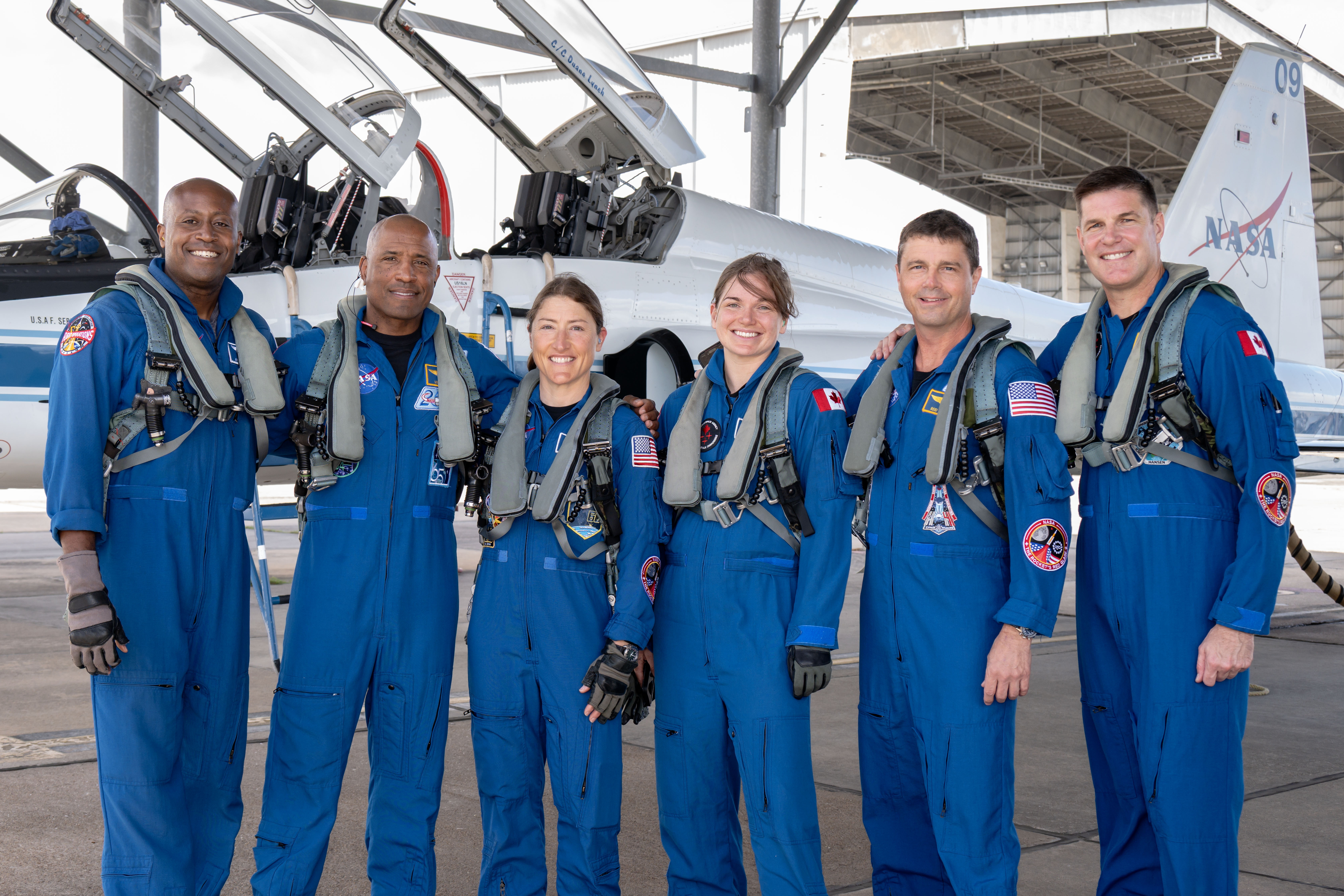
From left to right, NASA astronauts Andre Douglas, Victor Glover, and Christina Koch, CSA (Canadian Space Agency) astronauts Jenni Gibbons, NASA astronaut Reid Wiseman, and CSA astronaut Jeremy Hansen pose for a photo before the Artemis II crew proceed to a media event on March 27, 2026. Douglas and Gibbons are the backup crew members for the mission; they would join the crew if a NASA or CSA astronaut, respectively, is unable to take part in the flight.
Artemis II is NASA’s first crewed mission under the Artemis program and will launch from the agency’s Kennedy Space Center in Florida. It will send Wiseman, Glover, Koch, and Hansen on an approximately 10-day journey around the Moon. Among other objectives, the agency will test the Orion spacecraft’s life support systems for the first time with people and lay the groundwork for future crewed Artemis missions.
Image credit: NASA/Josh Valcarcel