
Feed aggregator
Record-breaking IBM chip uses trick to cram in 100 billion transistors
Record-breaking IBM chip uses trick to cram in 100 billion transistors
Phages could enable us to hijack vaccine immunity to kill cancer cells
Phages could enable us to hijack vaccine immunity to kill cancer cells
Bacteria-killing viruses redirect vaccine immunity to destroy cancer
Weight loss drugs don't work for everyone—here’s why
Some people who take GLP-1 drugs such as semaglutide and tirzepatide see little to no changes to their weight. The reason why may be genetics
Lost books by ancient philosophers recovered from 'unreadable' scrolls
Lost books by ancient philosophers recovered from 'unreadable' scrolls
A first: EarthCARE cloud data sharpen weather forecasts
The European Space Agency’s EarthCARE satellite was developed to make a unique set of simultaneous measurements that shed new light on the role that clouds and aerosols play in regulating Earth’s climate.
Now, in a remarkable example of a research mission delivering direct practical benefits, global observations from the satellite’s cloud profiling radar are being used operationally by the European Centre for Medium-Range Weather Forecasts to improve daily weather forecasts – this landmark achievement marks the first time that cloud radar data from space have been assimilated into a global weather forecasting system.
A Star Dying by the Wrong Rules
Half the stars in the universe live in pairs and when one of them dies it can feed hungrily off the other in a slow, violent dance. Now a Korean team has caught a couple of stars breaking the rules, locked in an orbit so impossibly fast that our best theories of how stars grow old cannot account for it. So what is this dying star trying to tell us?
The Galaxy Living Too Fast
Twelve million light years away, a galaxy is living fast and burning bright, forging new stars ten times quicker than our own Milky Way in a frenzy that cannot possibly last. Now the James Webb Space Telescope has cut clean through its veil of dust to count an astonishing 16.5 million of its stars, one by one. So what is driving the Cigar Galaxy to burn so furiously?
A Turquoise Tint for the Black Sea
- Earth
- Earth Observatory
- Image of the Day
- EO Explorer
- Topics
- More Content
- About
A Turquoise Tint for the Black Sea
- Earth
- Earth Observatory
- Image of the Day
- EO Explorer
- Topics
- More Content
- About
NASA’s TESS Mission Reveals the “Puffiest” Planets Ever Found
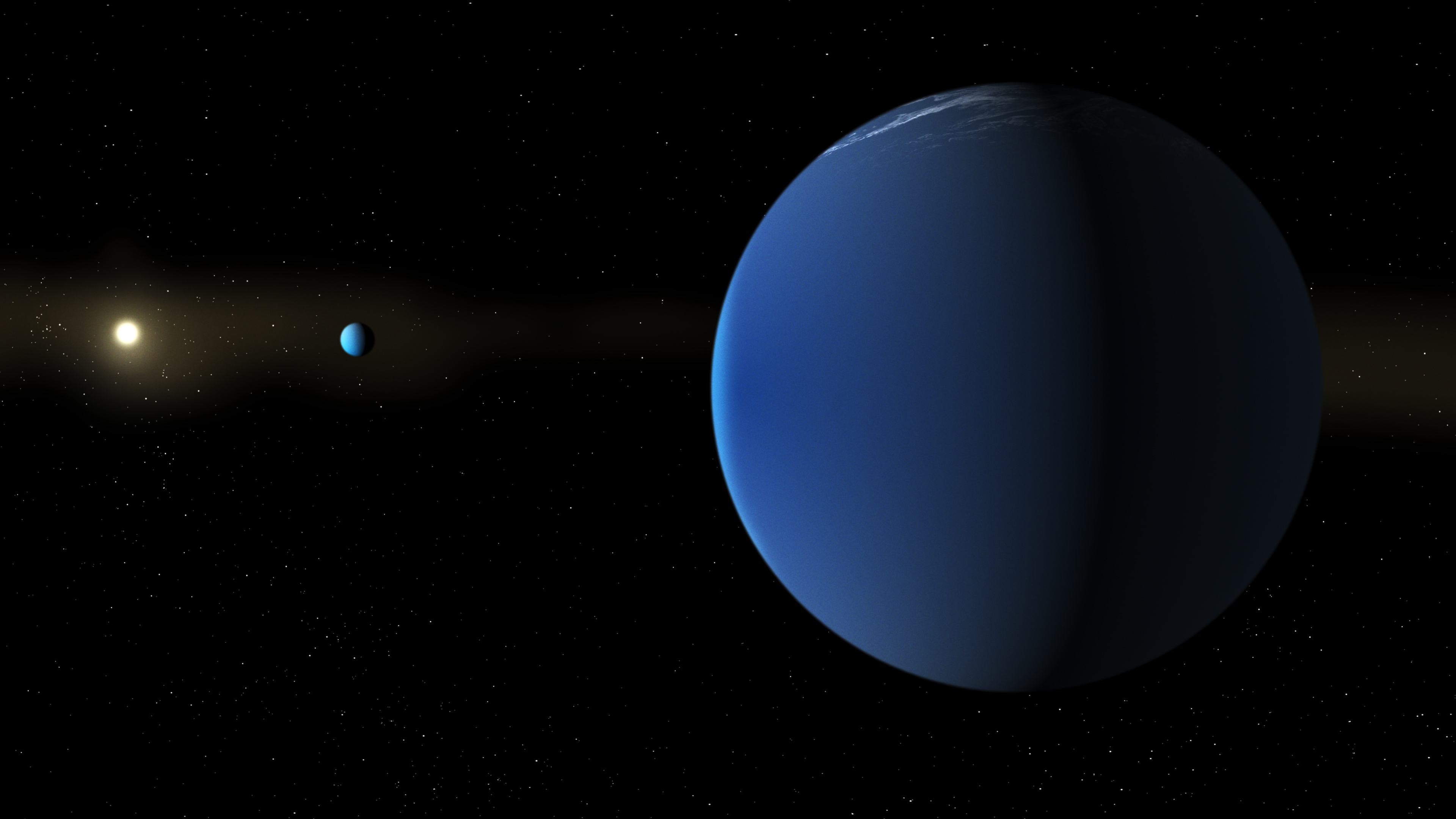
Data from NASA’s TESS (Transiting Exoplanet Survey Satellite) mission has revealed two new “super-puff” planets, giant worlds so light that their density is comparable to cotton candy. Scientists calculate that these Jupiter-sized planets—named TOI-791 b and TOI-791 c—are the “puffiest” worlds ever found.
The planets orbit a Sun-like star named TOI-791 that is approximately 1,113 light years away from Earth. The TESS mission first detected the planets by watching for repeated dips in TOI-791’s brightness, a telltale sign that a planet is transiting, or passing in front of, a star. Further study revealed two large planets with unusual features.
TOI-791 b is nearly the same size as Jupiter but contains just 3.0 percent of Jupiter’s mass. TOI-791 c is even larger than Jupiter but contains just 5.9 percent of Jupiter’s mass.
“The main reason these planets are interesting to study is that we didn’t expect to see them at all,” said Jon Jenkins, the science lead for the Science Processing Operations Center at NASA’s Ames Research Center in California’s Silicon Valley, which provided the science-ready data from TESS analyzed in this study. “They represent a puzzle for us to solve about how giant planets like Jupiter and the super-puffs form.”
This graphic depicts the two giant planets orbiting the Sun-like star TOI-791 as compared to some of the planets in our solar system. These planets are roughly the size of Jupiter but a very tiny fraction of its mass. NASA’s TESS mission detected the shadows of these planets as they passed in front of their star. There is no direct imaging. Therefore, the appearance of the TOI-79 planets in this illustration are an artist’s interpretation. NASA / Daniel Rutter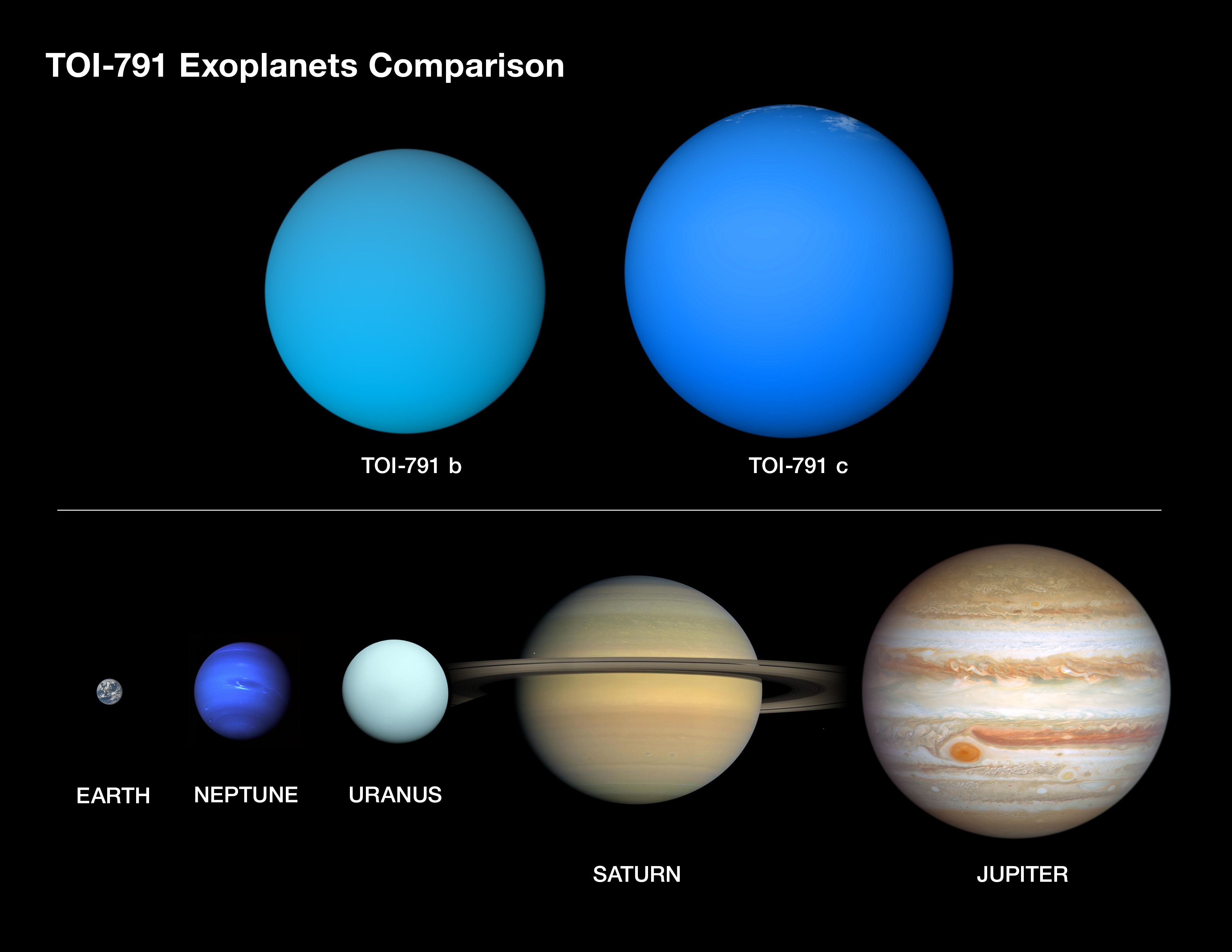
The newly found super-puffs also have unusually long orbits, with TOI‑791 b taking 139 days and TOI‑791 c taking 232 days to circle the host star. Such long-orbit planets are rare to find, needing long durations of telescope observation to capture and confirm their attributes. From its vantage point in high Earth orbit, TESS was able to gather 1,122 days of data on this planetary system over the course of seven years, giving the research team a wealth of data about the planetary system.
Further analysis found that TOI-791 b and TOI-791 c are locked in an orbital pattern that allows them to tug on each other gravitationally. As they orbit their host star, the planets alternate pulling on each other, affecting the timing of their transits across the host star. Scientists used that variation in orbital timing to calculate the planets’ masses, cementing their status as low density super-puffs.
“Only a handful of these super-puffy planets are known, and it is even rarer to find two in the same system,” said lead author George Dransfield of Oxford University’s Department of Physics in Oxford, England. “Their extremely low densities make them fascinating targets for understanding how planetary systems form and evolve.”
With further study, the super-puffs may have more to tell us about planetary evolution.
“Large planet formation is believed to drive the evolution of a planetary system, so further study of these Jupiter-size, but far less than Jupiter-mass, planets is of high value,” said Steve Howell, a NASA Ames research scientist who was involved in this study.
Scientists hope to learn more about the chemical makeup of the planets’ atmospheres, how their spin affects their shape, and how the tilt of their host star compares to their orbits. Deeper investigation could provide new insight into how TOI-791 b and TOI-791 c migrated through the planetary system during their development, whether their orbits were shaped by interactions with other planets, and how low-density super-puff planets form.
The study, published today in the Monthly Notices of the Royal Astronomical Society, was led by the University of Oxford, in collaboration with Université Côte d’Azur/Observatoire de la Côte d’Azur and the University of Birmingham.
NASA’s TESS Mission Reveals the “Puffiest” Planets Ever Found
Data from NASA’s TESS (Transiting Exoplanet Survey Satellite) mission has revealed two new “super-puff” planets, giant worlds so light that their density is comparable to cotton candy. Scientists calculate that these Jupiter-sized planets—named TOI-791 b and TOI-791 c—are the “puffiest” worlds ever found.
The planets orbit a Sun-like star named TOI-791 that is approximately 1,113 light years away from Earth. The TESS mission first detected the planets by watching for repeated dips in TOI-791’s brightness, a telltale sign that a planet is transiting, or passing in front of, a star. Further study revealed two large planets with unusual features.
TOI-791 b is nearly the same size as Jupiter but contains just 3.0 percent of Jupiter’s mass. TOI-791 c is even larger than Jupiter but contains just 5.9 percent of Jupiter’s mass.
“The main reason these planets are interesting to study is that we didn’t expect to see them at all,” said Jon Jenkins, the science lead for the Science Processing Operations Center at NASA’s Ames Research Center in California’s Silicon Valley, which provided the science-ready data from TESS analyzed in this study. “They represent a puzzle for us to solve about how giant planets like Jupiter and the super-puffs form.”
This graphic depicts the two giant planets orbiting the Sun-like star TOI-791 as compared to some of the planets in our solar system. These planets are roughly the size of Jupiter but a very tiny fraction of its mass. NASA’s TESS mission detected the shadows of these planets as they passed in front of their star. There is no direct imaging. Therefore, the appearance of the TOI-79 planets in this illustration are an artist’s interpretation. NASA / Daniel RutterThe newly found super-puffs also have unusually long orbits, with TOI‑791 b taking 139 days and TOI‑791 c taking 232 days to circle the host star. Such long-orbit planets are rare to find, needing long durations of telescope observation to capture and confirm their attributes. From its vantage point in high Earth orbit, TESS was able to gather 1,122 days of data on this planetary system over the course of seven years, giving the research team a wealth of data about the planetary system.
Further analysis found that TOI-791 b and TOI-791 c are locked in an orbital pattern that allows them to tug on each other gravitationally. As they orbit their host star, the planets alternate pulling on each other, affecting the timing of their transits across the host star. Scientists used that variation in orbital timing to calculate the planets’ masses, cementing their status as low density super-puffs.
“Only a handful of these super-puffy planets are known, and it is even rarer to find two in the same system,” said lead author George Dransfield of Oxford University’s Department of Physics in Oxford, England. “Their extremely low densities make them fascinating targets for understanding how planetary systems form and evolve.”
With further study, the super-puffs may have more to tell us about planetary evolution.
“Large planet formation is believed to drive the evolution of a planetary system, so further study of these Jupiter-size, but far less than Jupiter-mass, planets is of high value,” said Steve Howell, a NASA Ames research scientist who was involved in this study.
Scientists hope to learn more about the chemical makeup of the planets’ atmospheres, how their spin affects their shape, and how the tilt of their host star compares to their orbits. Deeper investigation could provide new insight into how TOI-791 b and TOI-791 c migrated through the planetary system during their development, whether their orbits were shaped by interactions with other planets, and how low-density super-puff planets form.
The study, published today in the Monthly Notices of the Royal Astronomical Society, was led by the University of Oxford, in collaboration with Université Côte d’Azur/Observatoire de la Côte d’Azur and the University of Birmingham.
Astronomers Find Stellar Evidence of an Engulfed Planet
A team of 14 researchers from the United States and Chile have found evidence of a subgiant star eating one of its planets. The star, called TOI-5882, was already known to astronomers because of its massive companion, a brown dwarf called TOI-5882 b. The companion may well have helped kick a planet onto a spiraling journey into the star.
That "Pink Planet" Astronomers Found Turns Out to be a Salty Customer!
Found in 2013, Pink Planet was too faint to study with ground-based telescopes. In new study, scientists used JWST and advanced processing methods to obtain its spectrum for the first time. Observations provided some of the first direct evidence for salt clouds in a cold object atmosphere. Pink Planet could be a giant planet or brown dwarf, so astronomers refer to it as a ‘planetary-mass companion’.