

Feed aggregator
Hantavirus can persist in semen for years, but that doesn’t mean it remains contagious
Researchers know very little about how long the Andes version of the hantavirus can remain in human hosts
A real Mr. Snuffleupagus? Meet the ocean’s strangest new fish species
A strange, tiny fish that resembles the famous Sesame Street character camouflages amid red algae thanks to its flamboyant reddish “hairs”
NASA Captures Volatile Changes in Earth's Artificial Light
A study of NASA's Black Marble data reveals a pattern of regional volatility in nighttime illumination across the planet.
This startup wants to make drugs in orbit. If it succeeds, it could transform the space economy
Varda’s plan to develop medicines in microgravity has its advantages, but it requires a big up-front cost
How to arm yourself against hantavirus misinformation
Hantavirus misinformation is spreading fast. COVID trauma and social media algorithms may be to blame
A Galaxy Cluster's Wild Youth
The galaxy cluster Abell 2029 is sometimes described as “the most relaxed cluster in the Universe.” This moniker does not arise from some sort of mellow vibe, but rather because of how calm and undisturbed the superheated gas that pervades the cluster appears to be. But new Chandra X-ray observations of the massive cluster highlight a major merger 4 billion years ago that still shape it today.
Can plants have consciousness? The film Silent Friend reimagines the science
The filmmaker behind the newly released movie Silent Friend shares the scientific and historical inspiration for its story of botanical consciousness
Is Earth’s Constant Companion a Stray Asteroid or a Chunk of the Moon?
Earth has a group of cosmic stalkers. Known as “co-orbitals”, these small bits of rock have a 1:1 mean motion resonance with Earth. Basically, they take the exact same amount of time to orbit the Sun as we do. Astronomers have long believed these objects wandered in from the main asteroid belt between Mars and Jupiter, but recent spectral analysis suggests they better match the space-weathered lunar silicates that make up the Moon’s surface. As such, there has been an ongoing debate about whether these cosmic stalkers are actually visitors from the belt or blasted pieces of the Moon. A new study, published in Icarus, from researchers Elisa Alessi and Robert Jedicke provides strong hints that the belt is the more likely source - but pretty soon we’ll get a definitive answer from a spacecraft.
First test of CO2 removal with green sand finds no harm to marine life
First test of CO2 removal with green sand finds no harm to marine life
Curiosity Shakes Loose a Pesky Rock
SpaceX is about to launch tallest and most powerful rocket in history
SpaceX is about to launch tallest and most powerful rocket in history
Curiosity Shakes Loose a Pesky Rock
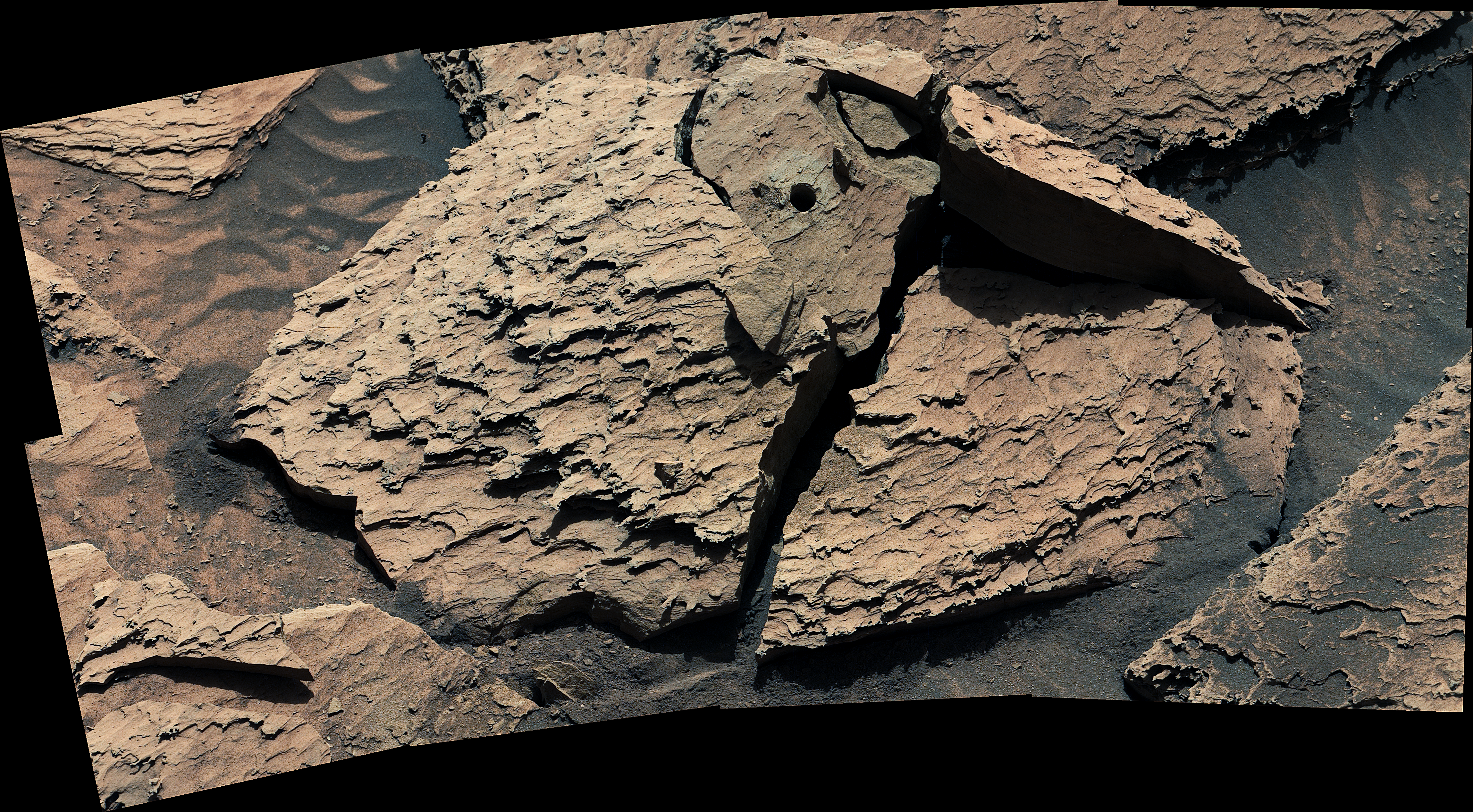
After NASA’s Curiosity Mars rover drilled a sample from this rock on April 25, 2026, it withdrew its robotic arm and pulled the entire rock off the surface with it. Engineers spent several days repositioning the arm and vibrating the drill to try and get the rock loose. When it finally detached on May 1, the rock broke into pieces.
This close-up image of the rock was produced by Curiosity’s Mast Camera, or Mastcam, on May 6. Nicknamed “Atacama,” the rock is estimated to be 1.5 feet in diameter at its base and 6 inches thick. It would weigh roughly 28.6 pounds on Earth (and about a third of that on Mars). The circular hole produced by Curiosity’s drill is visible in the rock.
See Atacama stuck on Curiosity’s drill.
Credit: NASA/JPL-Caltech/MSSS
Curiosity Shakes Loose a Pesky Rock
After NASA’s Curiosity Mars rover drilled a sample from this rock on April 25, 2026, it withdrew its robotic arm and pulled the entire rock off the surface with it. Engineers spent several days repositioning the arm and vibrating the drill to try and get the rock loose. When it finally detached on May 1, the rock broke into pieces.
This close-up image of the rock was produced by Curiosity’s Mast Camera, or Mastcam, on May 6. Nicknamed “Atacama,” the rock is estimated to be 1.5 feet in diameter at its base and 6 inches thick. It would weigh roughly 28.6 pounds on Earth (and about a third of that on Mars). The circular hole produced by Curiosity’s drill is visible in the rock.
See Atacama stuck on Curiosity’s drill.
Credit: NASA/JPL-Caltech/MSSS
Cleaning up air pollution could weaken vital AMOC ocean current
Cleaning up air pollution could weaken vital AMOC ocean current
Asking AI to explain your medical results? What doctors want you to know
As more people turn to chatbots for medical guidance, the technology is revealing both its promise and its risks
Preparing Smile for space
Before Smile can begin studying how Earth responds to the streams of particles and bursts of radiation from the Sun, the spacecraft had to complete an extraordinary journey here on Earth.
Follow the mission through its final launch preparations at Europe’s Spaceport in French Guiana, from fuelling and encapsulation inside its protective fairing, to meeting the rest of the Vega-C rocket that will take it to space.
Smile is flying to space on Vega-C flight VV29. At 35 m tall, Vega-C weighs 210 tonnes on the launch pad and the rocket will take Smile to orbit with three solid-propellant-powered stages before the fourth liquid-propellant stage takes over for a precise drop-off around Earth.
Smile (the Solar wind Magnetosphere Ionosphere Link Explorer) is a joint European-Chinese mission to study the interaction between the solar wind and Earth’s magnetic environment from a unique highly elliptical orbit. During the next three years, it will go high above the North Pole every two days to collect X-ray and ultraviolet images of Earth’s magnetic shield and the northern lights.
Week in images: 11-15 May 2026
Week in images: 11-15 May 2026
Discover our week through the lens