
Feed aggregator
ESA Council appoints two new directors
The European Space Agency Council has approved the appointment of two new directors: Christine Klein as Director of Controlling, Finance and Operational Procurement, and Jean-Luc Trullemans as Director of Strategy, Legal and External Affairs.
ESA Impact: a look at ESA’s spring milestones
ESA Impact: a look at ESA’s spring milestones
Dozens of dust devils hidden in plain sight
The European Space Agency’s Mars Express has captured part of Mars’s Mamers Valles: a fascinating valley system speckled with brief, tornado-like whirlwinds known as dust devils.
Low Water at San Carlos Reservoir
- Earth
- Earth Observatory
- Image of the Day
- EO Explorer
- Topics
- More Content
- About
Low Water at San Carlos Reservoir
- Earth
- Earth Observatory
- Image of the Day
- EO Explorer
- Topics
- More Content
- About
Lava planet has hydrogen-rich, active atmosphere
It’s 2158, and you’re chugging away on your PhD in Planetary Volcanology from the University of Utopia Planitia on Mars. Graduate students still get paid a sub-living wage, so you’ve been stuck eating freeze-dried ramen for the past three years. You’ve completed studying Jupiter’s moon, Io, but now you have to leave the solar system for a good exoplanet analog. While Io’s volcanism is caused by tidal heating, you need an exoplanet whose volcanism is caused by extreme heat from its host star. You recently secured funding from the Exoplanet Research Institute for a faster-than-light (FTL) ship, but the exoplanet is required to be less than 50 light-years away.
Proposed White House regulations could kill 5,000 clinical trials, analysis finds
The Trump administration is mulling new rules that would give political appointees final say on research grants
NASA’s Webb Catches Exoplanet Getting Roasted
- Webb
- News
- Overview
- Science
- Observatory
- Multimedia
- Team
- More
Artwork: NASA, ESA, CSA, Joseph Olmsted (STScI)
4 min read
NASA’s Webb Catches Exoplanet Getting RoastedOne well-done gas giant, coming right up! That’s the latest from researchers analyzing NASA’s James Webb Space Telescope’s observations of HD 80606 b, an exoplanet four times the mass of Jupiter with an extremely elliptical orbit that sweeps close by its Sun-like star. The research team is presenting their study and preliminary findings Tuesday at the 248th meeting of the American Astronomical Society in Pasadena, California.
“Hot Jupiters are already considered some of the most extreme exoplanets we know of, but even among that population, HD 80606 b is one of the most extreme,” said Tiffany Kataria, the study’s principal investigator at NASA’s Jet Propulsion Laboratory in Southern California. “We typically think of hot Jupiters as hot gas giants sitting right next to their stars, but this planet’s highly eccentric orbit creates a completely different beast.”
As the planet plunges close to its star, Webb shows its temperature skyrockets by 1,100 degrees Fahrenheit. Previous studies have shown that radical temperature swings can cause an exoplanet’s chemistry and clouds to change in real time. According to the research team, the dynamic conditions of HD 80606 b make the planet an ideal target to observe these changes with Webb’s powerful instruments.
Image: Artist’s concept exoplanet HD 80606 b This artist’s concept shows exoplanet HD 80606 b being “roasted” as its orbit approaches periastron, the point at which it is closest to its host star, which is similar to our Sun. Artwork: NASA, ESA, CSA, Joseph Olmsted (STScI)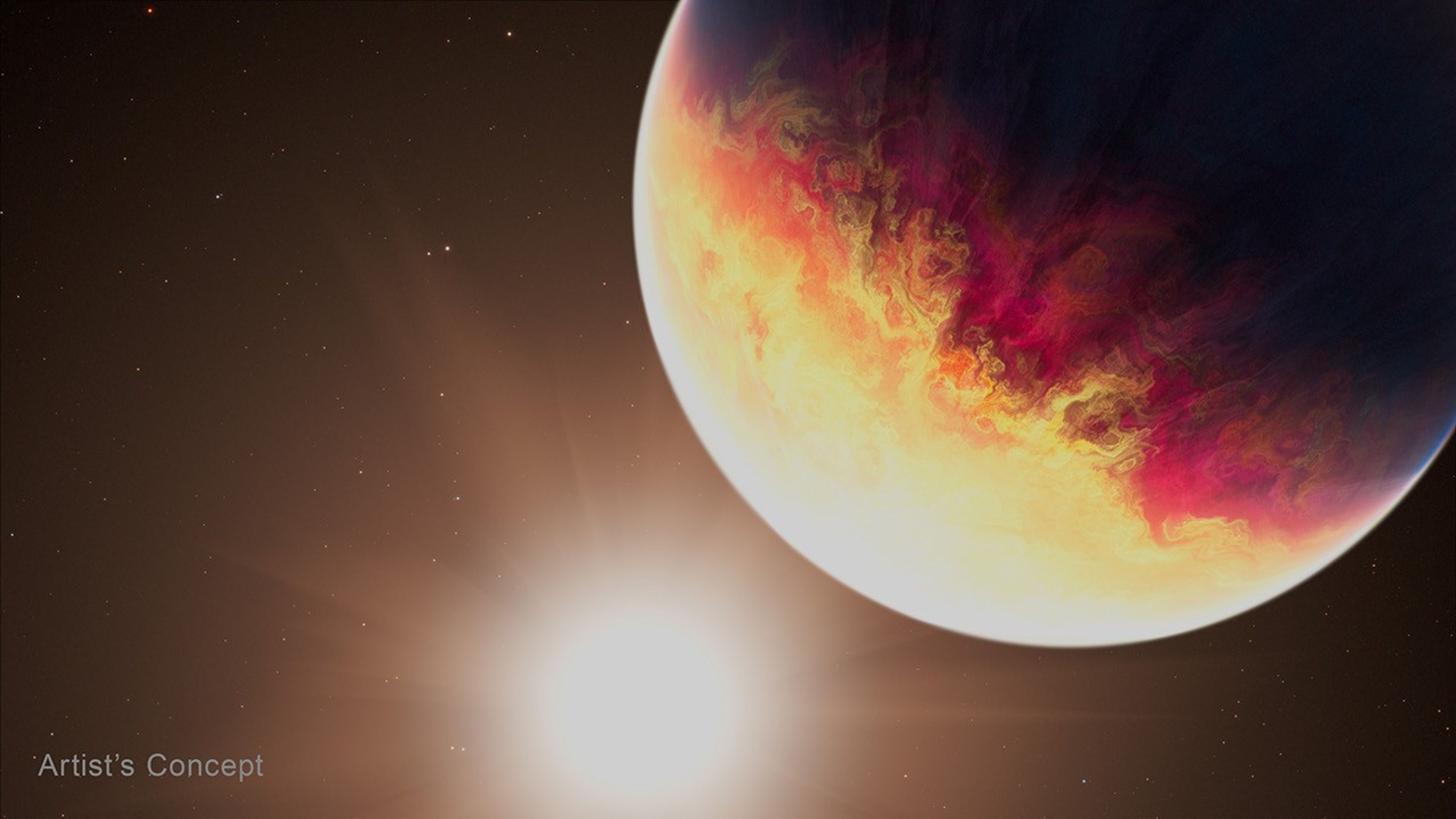
“Observing a planet like HD 80606 b is actually very efficient because its unusual orbit, with the corresponding swings in temperature and chemical composition, allow us to gather data under varying conditions in just hours and apply those findings to other hot Jupiters or more conventional exoplanets,” said Laura C. Mayorga, co-investigator on the study and an exoplanet astronomer at the Johns Hopkins Applied Physics Laboratory in Laurel, Maryland.
Measurements of temperature and chemical composition were done with spectroscopy, a technique scientists use to break light into its component colors to reveal information about the composition, temperature, motion, and physical properties of objects in space. The team used Webb’s MIRI (Mid-Infrared Instrument) for an extended observation of HD 80606 b before, during, and after its periastron, or closest pass by its star. During periastron, the planet also passed behind the star from Webb’s perspective in what’s known as a secondary eclipse. The observation was years in the planning, as scheduling the time to catch the planet at this point was complex given its extremely elliptical 111-day orbit, and Webb’s own restrictions on where it can look during specific times of the year, based on Earth’s position in orbit around the Sun.
Researchers say they have only begun to peel back the layers of an incredibly rich dataset, but they can clearly see a dramatic shift in the exoplanet’s temperature. “Webb has shown that the planet’s increase in temperature was even more extreme than we anticipated based on Spitzer data,” said Kataria.
In fact, the planet had already been dubbed the “roasted exoplanet” and even got its own poster in NASA’s popular series. NASA’s now-retired Spitzer Space Telescope laid the groundwork of infrared observations of HD 80606 b, showing that more detailed spectroscopic data from Webb would be especially compelling.
“Spitzer did amazing work on this exoplanet, and now Webb is building on that legacy by enabling us to drill down to distinguish specific chemical signatures like methane and carbon dioxide, which is just amazing progress,” said Ryan Challener, co-author and research associate at the Cornell Center for Astrophysics and Planetary Science. “There’s so much to learn from this one dataset here — we really are just getting started deciphering what Webb has to tell us.”
The James Webb Space Telescope is the world’s premier space science observatory. Webb is solving mysteries in our solar system, looking beyond to distant worlds around other stars, and probing the mysterious structures and origins of our universe and our place in it. Webb is an international program led by NASA with its partners, ESA (European Space Agency) and CSA (Canadian Space Agency).
For more information on Webb, visit:
Downloads & Related InformationThe following sections contain links to download this article’s images and videos in all available resolutions followed by related information links, media contacts, and if available, research paper and Spanish translation links.
Related Images & Videos HD 80606 b (Artist’s Concept)This artist’s concept shows exoplanet HD 80606 b being “roasted” as its orbit approaches periastron, the point at which it is closest to its host star, which is similar to our Sun.
Related Links
Este Artículo en Español – “Telescopio Webb de la NASA Detecta un Exoplaneto Asandose”
Read: Webb’s Impact on Exoplanet Research
Watch: How to Study Exoplanets: Webb and Challenges
Explore: Eyes on Exoplanets
Print: The Roasted Exoplanet Poster
More Webb: News | Images | Science | Home Page
Laura Betz
NASA’s Goddard Space Flight Center
Greenbelt, Maryland
laura.e.betz@nasa.gov
Leah Ramsay
Space Telescope Science Institute
Baltimore, Maryland
Hannah Braun
Space Telescope Science Institute
Baltimore, Maryland
- Este Artículo en Español – “Telescopio Webb de la NASA Detecta un Exoplaneto Asandose”
- HD 80606 b in NASA Exoplanet Catalog
- Roasted Exoplanet poster
- “Hot Jupiter” exoplanets
Keep Exploring Discover More Topics From Webb James Webb Space Telescope
Webb is the premier observatory of the next decade, serving thousands of astronomers worldwide. It studies every phase in the…
Science Overview
Exoplanets
Webb Image Galleries
NASA’s Webb Catches Exoplanet Getting Roasted
- Webb
- News
- Overview
- Science
- Observatory
- Multimedia
- Team
- More
Artwork: NASA, ESA, CSA, Joseph Olmsted (STScI)
4 min read
NASA’s Webb Catches Exoplanet Getting RoastedOne well-done gas giant, coming right up! That’s the latest from researchers analyzing NASA’s James Webb Space Telescope’s observations of HD 80606 b, an exoplanet four times the mass of Jupiter with an extremely elliptical orbit that sweeps close by its Sun-like star. The research team is presenting their study and preliminary findings Tuesday at the 248th meeting of the American Astronomical Society in Pasadena, California.
“Hot Jupiters are already considered some of the most extreme exoplanets we know of, but even among that population, HD 80606 b is one of the most extreme,” said Tiffany Kataria, the study’s principal investigator at NASA’s Jet Propulsion Laboratory in Southern California. “We typically think of hot Jupiters as hot gas giants sitting right next to their stars, but this planet’s highly eccentric orbit creates a completely different beast.”
As the planet plunges close to its star, Webb shows its temperature skyrockets by 1,100 degrees Fahrenheit. Previous studies have shown that radical temperature swings can cause an exoplanet’s chemistry and clouds to change in real time. According to the research team, the dynamic conditions of HD 80606 b make the planet an ideal target to observe these changes with Webb’s powerful instruments.
Image: Artist’s concept exoplanet HD 80606 b This artist’s concept shows exoplanet HD 80606 b being “roasted” as its orbit approaches periastron, the point at which it is closest to its host star, which is similar to our Sun. Artwork: NASA, ESA, CSA, Joseph Olmsted (STScI)“Observing a planet like HD 80606 b is actually very efficient because its unusual orbit, with the corresponding swings in temperature and chemical composition, allow us to gather data under varying conditions in just hours and apply those findings to other hot Jupiters or more conventional exoplanets,” said Laura C. Mayorga, co-investigator on the study and an exoplanet astronomer at the Johns Hopkins Applied Physics Laboratory in Laurel, Maryland.
Measurements of temperature and chemical composition were done with spectroscopy, a technique scientists use to break light into its component colors to reveal information about the composition, temperature, motion, and physical properties of objects in space. The team used Webb’s MIRI (Mid-Infrared Instrument) for an extended observation of HD 80606 b before, during, and after its periastron, or closest pass by its star. During periastron, the planet also passed behind the star from Webb’s perspective in what’s known as a secondary eclipse. The observation was years in the planning, as scheduling the time to catch the planet at this point was complex given its extremely elliptical 111-day orbit, and Webb’s own restrictions on where it can look during specific times of the year, based on Earth’s position in orbit around the Sun.
Researchers say they have only begun to peel back the layers of an incredibly rich dataset, but they can clearly see a dramatic shift in the exoplanet’s temperature. “Webb has shown that the planet’s increase in temperature was even more extreme than we anticipated based on Spitzer data,” said Kataria.
In fact, the planet had already been dubbed the “roasted exoplanet” and even got its own poster in NASA’s popular series. NASA’s now-retired Spitzer Space Telescope laid the groundwork of infrared observations of HD 80606 b, showing that more detailed spectroscopic data from Webb would be especially compelling.
“Spitzer did amazing work on this exoplanet, and now Webb is building on that legacy by enabling us to drill down to distinguish specific chemical signatures like methane and carbon dioxide, which is just amazing progress,” said Ryan Challener, co-author and research associate at the Cornell Center for Astrophysics and Planetary Science. “There’s so much to learn from this one dataset here — we really are just getting started deciphering what Webb has to tell us.”
The James Webb Space Telescope is the world’s premier space science observatory. Webb is solving mysteries in our solar system, looking beyond to distant worlds around other stars, and probing the mysterious structures and origins of our universe and our place in it. Webb is an international program led by NASA with its partners, ESA (European Space Agency) and CSA (Canadian Space Agency).
For more information on Webb, visit:
Downloads & Related InformationThe following sections contain links to download this article’s images and videos in all available resolutions followed by related information links, media contacts, and if available, research paper and Spanish translation links.
Related Images & Videos HD 80606 b (Artist’s Concept)This artist’s concept shows exoplanet HD 80606 b being “roasted” as its orbit approaches periastron, the point at which it is closest to its host star, which is similar to our Sun.
Related Links
Este Artículo en Español – “Telescopio Webb de la NASA Detecta un Exoplaneto Asandose”
Read: Webb’s Impact on Exoplanet Research
Watch: How to Study Exoplanets: Webb and Challenges
Explore: Eyes on Exoplanets
Print: The Roasted Exoplanet Poster
More Webb: News | Images | Science | Home Page
Laura Betz
NASA’s Goddard Space Flight Center
Greenbelt, Maryland
laura.e.betz@nasa.gov
Leah Ramsay
Space Telescope Science Institute
Baltimore, Maryland
Hannah Braun
Space Telescope Science Institute
Baltimore, Maryland
- Este Artículo en Español – “Telescopio Webb de la NASA Detecta un Exoplaneto Asandose”
- HD 80606 b in NASA Exoplanet Catalog
- Roasted Exoplanet poster
- “Hot Jupiter” exoplanets
Keep Exploring Discover More Topics From Webb James Webb Space Telescope
Webb is the premier observatory of the next decade, serving thousands of astronomers worldwide. It studies every phase in the…
Science Overview
Exoplanets
Webb Image Galleries
Astronaut Jessica Meir Assists With Hardware Updates for NASA’s Cold Atom Lab
NASA Photojournal Navigation Downloads Astronaut Jessica Meir Assists With Hardware Updates for NASA’s Cold Atom Lab
JPEG (4.91 MB)
Description
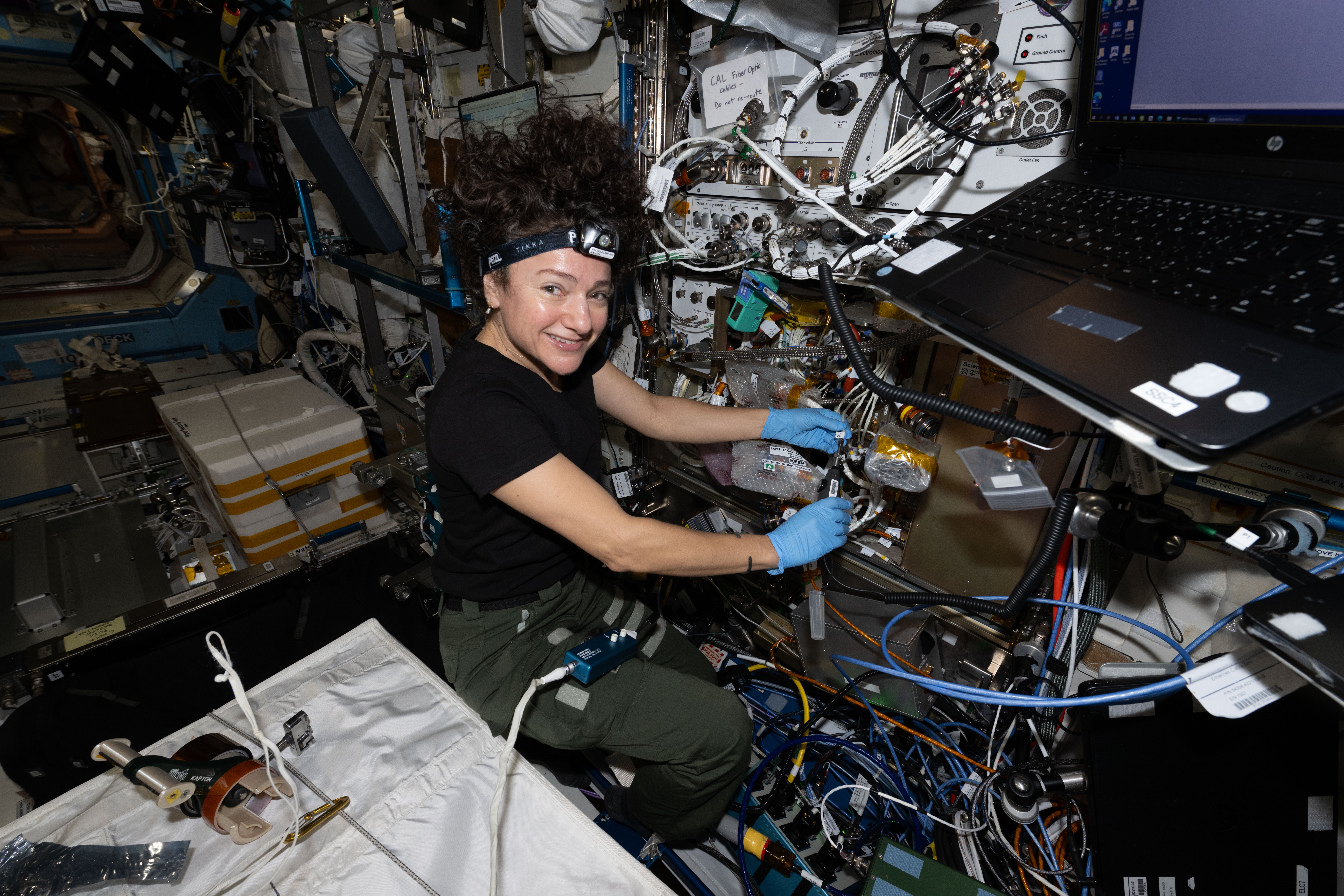
NASA astronaut Jessica Meir inspects optical fibers while installing hardware updates to the agency’s Cold Atom Lab, or CAL, aboard the International Space Station on May 8, 2026.
About the size of a minifridge and operated from Earth, CAL chills atoms to temperatures below minus 459 degrees Fahrenheit (minus 273.15 degrees Celsius), so close to absolute zero that they form a large quantum object called a Bose-Einstein condensate (BEC) — a fifth state of matter distinct from solids, liquids, gases, and plasma. In a BEC, scientists can observe the quantum properties of atoms at a scale visible to the naked eye. For instance, atoms and particles sometimes behave like solid objects and sometimes behave like waves, a quantum property called “wave-particle duality.”
Managed by Caltech in Pasadena, NASA’s Jet Propulsion Laboratory designed, built, and operates Cold Atom Lab, which is sponsored by the Biological and Physical Sciences (BPS) division of NASA’s Science Mission Directorate at the agency’s headquarters in Washington. The BPS division pioneers scientific discovery and enables exploration by using space environments to conduct investigations that are not possible on Earth. Studying biological and physical phenomena under extreme conditions allows researchers to advance the fundamental scientific knowledge required to go farther and stay longer in space, while also benefiting life on Earth.
To learn more about Cold Atom Lab, visit:
https://coldatomlab.jpl.nasa.gov/
Keep Exploring Discover More Topics From Photojournal
Photojournal
Search Photojournal
Photojournal’s Latest Content
Feedback
Astronaut Jessica Meir Assists With Hardware Updates for NASA’s Cold Atom Lab
NASA Photojournal Navigation Downloads Astronaut Jessica Meir Assists With Hardware Updates for NASA’s Cold Atom Lab
JPEG (4.91 MB)
Description
NASA astronaut Jessica Meir inspects optical fibers while installing hardware updates to the agency’s Cold Atom Lab, or CAL, aboard the International Space Station on May 8, 2026.
About the size of a minifridge and operated from Earth, CAL chills atoms to temperatures below minus 459 degrees Fahrenheit (minus 273.15 degrees Celsius), so close to absolute zero that they form a large quantum object called a Bose-Einstein condensate (BEC) — a fifth state of matter distinct from solids, liquids, gases, and plasma. In a BEC, scientists can observe the quantum properties of atoms at a scale visible to the naked eye. For instance, atoms and particles sometimes behave like solid objects and sometimes behave like waves, a quantum property called “wave-particle duality.”
Managed by Caltech in Pasadena, NASA’s Jet Propulsion Laboratory designed, built, and operates Cold Atom Lab, which is sponsored by the Biological and Physical Sciences (BPS) division of NASA’s Science Mission Directorate at the agency’s headquarters in Washington. The BPS division pioneers scientific discovery and enables exploration by using space environments to conduct investigations that are not possible on Earth. Studying biological and physical phenomena under extreme conditions allows researchers to advance the fundamental scientific knowledge required to go farther and stay longer in space, while also benefiting life on Earth.
To learn more about Cold Atom Lab, visit:
https://coldatomlab.jpl.nasa.gov/
Keep Exploring Discover More Topics From Photojournal
Photojournal
Search Photojournal
Photojournal’s Latest Content
Feedback
What Would Happen if the Sun Stopped? Part 2: Kelvin and Helmholtz at the Ready
How can the Sun keep shining with its furnace switched off? Two nineteenth-century aristocrats, Helmholtz and Lord Kelvin, worked out the answer mostly by accident. It comes down to stored heat, gravitational shrinking, and the strange self-regulating thermostat of hydrostatic equilibrium.
Ozempic maker Novo Nordisk breach exposed patients’ clinical trial data
Novo Nordisk said this security incident affected patient data, including health information and birth year
Math predicts humans could go extinct in about 17,000 years
Some mathematicians have predicted when humanity’s downfall might occur—though the circumstances are unspecified
#797: Summer in Space
Mars is cold & dry today, but the evidence is growing that it used to be warmer & wetter. with seas & oceans that covered large parts of its surface. With the additional findings of the chemicals for life, the search for life on Mars is getting pretty interesting! New results from Perseverance and Curiosity describe a past Mars with complex chemistry and water. But did it have life?
Show Notes- Summer astronomy and spaceflight highlights
- Nancy Grace Roman Space Telescope launch outlook
- Roman’s role in mapping the cosmos and exoplanet studies
- Chang’e 7 mission to the Moon’s south pole
- Future lunar exploration and resource utilization plans
- Hayabusa2 flyby of asteroid Torafune
- Upcoming asteroid missions, including Tianwen-2
- Quasi-moons and their possible lunar origin
- August 2026 total solar eclipse in Europe and the Arctic
- Perseid meteor shower under dark, moonless skies
- Crescent Moon passing through the Pleiades
- Partial lunar eclipse in late August
- Starship, Blue Origin, and major launch updates
- Artemis timeline and lunar lander development
- Retirement of the Atlas V rocket
- Challenges and delays facing upcoming space missions
- What to watch in the sky during the Astronomy Cast summer break
Fraser Cain:
Astronomy Cast, Episode 797 Summer in Space 2026. Welcome to Astronomy Cast, our weekly, facts-based journey through the Cosmos, where we help you understand not only what we know, but how we know what we know. I'm Fraser Cain, I'm the publisher of Universe Today.
With me, as always, is Dr. Pamela Gay, Senior Scientist for the Planetary Science Institute and the Director of Cosmoghost. Hey Pamela, how are you doing?
Dr. Pamela Gay:
I am itchy, poison ivy is ivying here. I need a goat, I can't find a goat. Do they have rental goats where you are?
There are places in the U.S. you can rent goats.
Fraser Cain:
I have seen videos, I have definitely admired goat rental from afar, but I am not aware of any place that one could rent a goat here in my area. Although I would if I could, because there's all kinds of shrubbery that I would love to sort of dial back. They apparently will just tear through the Himalayan blackberries, which are awful here on Vancouver Island.
They're tasty, but they are awful. Yeah, yeah. I always mention this, how grateful I am that we don't have venomous snakes or venomous plants.
I feel I'm bulletproof. I walk into the forest, I might get a tick if I'm out for days and days and days. And obviously there's the occasional mosquito, they're named.
But apart from that, we have... And then a bear, obviously we watched bears crossing our property last night.
Dr. Pamela Gay:
Oh, that's cool.
Fraser Cain:
Yeah, there's that. Yeah, we have a bunch of just bears that will move through our property and they'll just follow the same path every day for a couple of weeks while they're eating the dandelions right now. And then they'll move higher, higher elevations than we don't see them for the rest of the summer.
But this time around, you know, May, June, we see a lot of bears. Mamas with babies. Yeah, it's spicy.
Dr. Pamela Gay:
I had a snake that decided it was going to be super bitey, but like it was smaller around than my thumb. So I just made fun of it.
Fraser Cain:
Was it a garter snake?
Dr. Pamela Gay:
It was a garter snake. It was very determined to bite me.
Fraser Cain:
All right. We're about to take a much needed two month hiatus, but just because we're not here doesn't mean that space stops existing and doing things. Today, let's give a preview of the big events due to happen in space this summer.
So you can prepare yourself and make sure you don't miss a thing. OK, so, you know, you you and I both did some research in preparation for this episode, and I feel pretty confident that we are not leaving our audience that bereft for the next two months. There's actually not a ton of really big events that are going to happen, except for like one that's great.
But there's a bunch of smaller events and then one that will probably be delayed and will probably fall back into our schedule anyway, or we'll be able to report on it moments after. So I'm I'm spoilerizing what's about to happen. So let's sort of break this into two areas.
Dr. Pamela Gay:
I need to know what you consider the one really great event. Oh, the eclipse. OK, big solar eclipse.
It could have been the launch of Nancy Grace Roman.
Fraser Cain:
That's the one that I think is going to happen right at the end. We'll probably get delayed. And so, yeah, I think, you know, we're safe to run the rest.
We've got some conjunctions. We've got some lunar events. We've got some sort of milestones for various spacecraft, astrophotography opportunities.
Yeah. And then some classics that come around every every time of year. But we don't have like maybe there'll be some more tests of SpaceX.
But Blorgen is kind of out of the running for several months.
Dr. Pamela Gay:
Yeah, but there could be another Starship explosion.
Fraser Cain:
Yeah, there may be or more launch. Who knows? But even that they're sort of in a in a sort of time after the last test where they got to get a bunch of stuff dialed in.
There are no big plans to send crew. Not a lot of big changes to missions. No space launch systems are going to be launched.
I feel we could not have timed this better for what is in the launch docket right now and in the celestial space motion docket.
Dr. Pamela Gay:
Yes.
Fraser Cain:
But let's just pick something that you think is going to be interesting that people should keep their eyes peeled for this summer.
Dr. Pamela Gay:
So Hayabusa 2 flies past the asteroid. I'm going to say this so wrong. So wrong.
I'm sorry. Torafun.
Fraser Cain:
I'm going to say Torafune if it's Japanese.
Dr. Pamela Gay:
It is Japanese.
Fraser Cain:
Yeah, I'm going to guess Torafune. But I have not learned Japanese yet.
Dr. Pamela Gay:
It's true.
Fraser Cain:
But now I've been there twice. I've been to Japan twice, planning to go again at the end of the year. So at some point, I'm going to have to take the leap and actually start learning some Japanese.
Dr. Pamela Gay:
So this is the mission that went to Ryugu and collected a sample and flung the sample back at Earth. And we have the sample and the mission kept going. And so this is another near-Earth asteroid.
And I am excited to find out if it's another rubble pile like Ryugu or another cashew like Itakawa.
Fraser Cain:
Yeah.
Dr. Pamela Gay:
I'm hoping for another cashew.
Fraser Cain:
And each one of these asteroid close encounters are precious and individual. Yeah, they're super important. And there's like there's nothing that is as good as getting a picture up close from these asteroids.
Like you compare the blurry images that are taken, the single pixels that are seen from Earth-based telescopes. And you compare that to just the luxurious detail that we saw from OSIRIS-REx or Hayabusa to it's there's no comparison.
Dr. Pamela Gay:
It's just awesome.
Fraser Cain:
Yeah. And each one gives us entirely new information. You know, there's not like you see one asteroid, you've seen them all.
You literally could see every single asteroid. And only then will you have seen them all. Yeah.
Dr. Pamela Gay:
Vesta and Ceres are huge and radically different. The little ones are all. And it's not the only encounter we're probably going to have in July.
The other one. So Hayabusa 2 is a JAXA mission. And then we have, you're going to say this correctly for me in a moment, Tianwen-2 gets to the quasi-moon.
Kama-oalewa? It's Hawaiian.
Fraser Cain:
Kamo-oalewa, I'm guessing. And that is a Hawaiian term, a language neither of us are learning.
Dr. Pamela Gay:
So this is a Chinese mission. The exact date of the arrival is unknown. But again, little tiny spud.
This is another asteroid, except this one got captured ever so transitorially. I'm perhaps making up words into Earth's orbit. And so we're going to have in July close-up images of two new worlds.
Fraser Cain:
Yeah, yeah. And I mean, these quasi-moons are really interesting because, you know, one of the possibilities is that these are coming, that these are from the Moon, that to get an object that is in a very similar orbit to the Earth, it had to have a source. And the one source is that it could have just been three-body interactions with various asteroids that kick something into this place where it's now a quasi-moon.
You know, it falls into our gravitational well, hangs out with us for a little while, then falls back out again and goes about its merry business and then hangs out again. And typically they'll stick around for a few orbits. But the case seems to be building that a lot of these quasi-moons have a chemical fingerprint that is very similar to the Moon.
And then you can sort of think, okay, so maybe these things are chunks of the Moon that were gouged out by fairly large impacts at some point in the recent past.
Dr. Pamela Gay:
Or leftover bits from the Theia-Earth collision.
Fraser Cain:
Right. Which would be incredible. Yeah.
Right.
Dr. Pamela Gay:
And then there's also the, we don't know what other chunks may be out there from, like, did Theia have a Moon before it hit into us? That is like science fiction territory here, folks. I just entered science fiction.
Most likely this is a leftover chunk from the collision or something gouged out of the where there are craters kilometers deep.
Fraser Cain:
Right. Yep. So very useful.
And of course, Tim Wynn is then going to be heading off to its future sample return mission. So, you know, there's a lot. And then it's going to end up going into orbit around another comet.
So there's, it's got like a bunch of work. It has a future. Yeah, yeah, totally.
And so, and I love this kind of opportunistic, there happens to be something that's on the, on the trajectory of the spacecraft. Let's just, let's just take a close look. And so we're going to get an image of this little, as you say.
Dr. Pamela Gay:
And, and it's something completely novel.
Fraser Cain:
Yeah, totally. Again, every asteroid is its own unique butterfly. What else you got?
Dr. Pamela Gay:
Um, so, so those are the two big missions that have me super hyped. Then in August, we're looking at potentially the Chang'e 7 launch. This is another lunar mission.
This one's going to the South Pole region. Again, it is specifically tasked with looking for water. And, and so we're, we're starting to see better and better chemistry, uh, missions being launched by China, both going and sampling Mars and bringing it back, going and exploring for water on the moon.
China is really killing it with its slow and steady approach. And then there is hope that on the last day of August, we will see the Nancy Grace Roman Space Telescope launched into orbit, which will give us another infrared observatory. It's a survey telescope.
It, it has all sorts of really cool capacity to see planets, um, and a whole bunch of other stuff. It's just the planet stuff that a lot of us are excited about. So yeah.
Fraser Cain:
Yeah. Yeah. I mean, Nancy Grace Roman is your next big telescope to be obsessed with.
Uh, the history of this, of course, is that it was a spare mirror provided by the natural reconnaissance office to NASA. And then NASA, and they said, you know, we, we've got these Hubble class mirrors that we don't need anymore. Would you like them?
We're just going to throw them in the garbage, uh, because we've got much better mirrors for spying on, on earth. Uh, would you like to do something with it? And, and NASA thought about it and decided that they would make something that they would change, put on different secondary optics than Hubble and make a wide field version of Hubble, but was also in the infrared.
And, and this thing is going to be phenomenal. So much faster, brand new instrumentation. It is going to map out the cosmos at, at a speed and a scale, the likes of which really we only have kind of on earth.
We have Vera Rubin.
Dr. Pamela Gay:
Sphere X is doing its own thing, but it doesn't have the resolution or the depth.
Fraser Cain:
It's compared to the size of, of Nancy Grace Roman. And what I love about this telescope is that it is on budget and it is ahead of schedule. Originally it wasn't thought that it was going to launch until 2027.
Well, here we are in 2026 right now. And the, and it like the launch date just keeps coming forward.
Dr. Pamela Gay:
Yeah.
Fraser Cain:
And, and so it's incredible that we're going to see this thing launch. Ideally, uh, August 31st is the day they're targeting, but you know, one does not simply book a return trip to a rocket launch. Therefore I think we can safely assume that this thing is going to delay at least once or twice.
And so hopefully it will fall back into our regular schedule. And, and when it does, uh, then we're allowed to talk about it, right, Pamela? Oh, I guess after it does some science, we'll get some, wait till first light.
Dr. Pamela Gay:
Yeah. And there's going to be a double header of learning about Nancy Grace Roman, who was the first chief scientist of NASA and the person who really sphere headed the, uh, uh, completion of the Hubble space telescope. Um, and, uh, we'll talk about the mission and the human and it's all super exciting.
Fraser Cain:
Yeah. Yeah. So those are the, those are the confirmed scheduled things.
Uh, there's a few minor things, there's, you know, there's going to be a background constant cadence of, of probably Starlink launches coming out of SpaceX. There's going to be other minor missions. Um, rocket lab is, is planning a mission.
So not neutron. No, no. Um, and then, and you sort of brush past it, but yeah, I think the, the, the Chinese Chang'e seven mission is going to be a big one that, you know, that is them, uh, you know, this one's going to have a hopper, an orbiter, a relay satellite, a lander, uh, and a sample return mission.
It's going to go to the South Pole of the Moon. This is the place where all of the water ice is likely contained. And so this is a really exciting target.
And then this is going to lay the ground for the next one, Chang'e eight, which is coming 27, anyway, a couple of years. And that's going to be doing its issue resource utilization on the surface of the moon. We're going to try to 3d print things on the moon.
Um, and then this is leading up to 2030 when hopefully Chinese astronauts will set foot on the moon for the first time. Let's talk about some of the interesting natural events are going to be happening during this summer.
Dr. Pamela Gay:
So, so your heart belongs to this solar eclipse that is 62 days, 21 hours and 11 minutes away, according to time and date.
Fraser Cain:
I love the time that we're recording this. Okay.
Dr. Pamela Gay:
Time and date has a really cool countdown clock. If you're into countdown clocks, it amuses me. Um, this particular solar eclipse is one that is like in the extreme Northern polar regions and then dips down into Europe.
It's not great for human beings.
Fraser Cain:
I would describe it as terrible. If you look at literally, if you look at the path, like, like think about the one that, that we just had, right. Was it the 2022 one?
2024. The 2024 one. Yeah.
It went, it went Mexico. Just straight across America. Uh, the United States and into Canada.
The 2018 one went all the way across the United States. Yeah. Everybody who wanted could make their way to some place and not be completely on top of each other.
But you look at the trajectory that this one is taking. This map is just so terrible. Is making a little cut on Iceland.
So like, great. Like Iceland can handle that kind of traffic. Greenland.
Greenland. Yeah. So who's going to go to Greenland to, to watch an eclipse.
And then it makes this tiny little pass through a little chunk, like right through the isthmus of Spain. And so all of Europe is going to descend upon this tiny little spot in the corner of, of Spain. And so unless you live there, unless you've got your, your accommodation locked down, this is going to be a nightmare getting in, getting out.
Traffic is going to be like, you remember how awful the traffic was for the various North American eclipses. This is going to be a nightmare on brutal little roads, mountainous roads. This is all like, you've got to be really serious to do this one.
Um, there's some, uh, eclipse cruises. I got, I get invited to do one.
Dr. Pamela Gay:
There's some in the Mediterranean and there's some in the North Atlantic.
Fraser Cain:
Yeah. I got invited to do one and I was like, I'm going to pass. You need to pass those on the main.
Oh, okay. All right. Yeah.
I'll pass them. Pass. Two pairs.
Yeah. So yeah, this one, if you live in Europe and you live close and you've got a place scheduled and you're okay to hunker down for a while, both before and after the event itself, then go for it. But I think transportation accommodation, this one's going to be rough.
Dr. Pamela Gay:
There's some islands in the Mediterranean that again, you are going to be packed in and unable to move. But saying I watched an eclipse from a Mediterranean island just sounds kind of luxurious. Yeah.
Fraser Cain:
It's just, it's just finding the accommodation. Yeah. It's just going to be tough.
Dr. Pamela Gay:
But then August 27, 28 is a lunar eclipse. And the thing about that solar eclipse on August 12th is this is the same time as the Perseids. So forget about the solar eclipse.
No one cares about the solar eclipse. I mean, some people care about the solar eclipse.
Fraser Cain:
Some people care.
Dr. Pamela Gay:
Solar eclipses are the best, but sure. But this means there is a new moon not illuminating the sky when the Perseids is one of the big three meteor shows every year is going to be doing its thing.
Fraser Cain:
Yes.
Dr. Pamela Gay:
So this is your chance to go out, see Meteor Shower. If you're where I live, watch lightning bugs going nuts and see if the meteors outnumber the satellites. That's always the question nowadays, but there'll be no moon.
Fraser Cain:
Yeah. There'll be no moon. This is so important.
Like if there is a bad moon, I just don't even bother.
Dr. Pamela Gay:
Right. The Delta Aquariids don't bother.
Fraser Cain:
Yeah. Not worth it. But when there's a good moon, then you do it.
And the Perseids for the Northern Hemisphere, we understand Southern Hemisphere, you exist. This is not for you. For the Northern Hemisphere, this is the best one because you've just got nice temperatures outside.
You can go out, set up, lay on your sleep cot, lay on the ground, have your friends around you, fall asleep to the Perseids. And with a new moon, this is an absolute dream version of it. So we couldn't ask for a better Perseids Meteor Shower this year.
So if you are at all interested, if you need an excuse, yeah, if you need a hammock excuse, yeah. August 12th, 13th, so like the night of the 12th into the 13th, plan something, please. Some of my favorite memories are my parents setting us out to watch the Perseids Meteor Shower.
These are the memories that will last a lifetime for you and your kids.
Dr. Pamela Gay:
And if you can afford to take more time off, on August 7, there is an event that is going to have me finding a farmer's field with my tripod if it's super hot and I don't want to go camping. The crescent moon is passing through the Pleiades. This is something I've seen through a telescope before, just a little refractor.
It's gorgeous. And I really hope that I can get some good shots of it with my 600 millimeter lens. And this is just one of those.
There's places on the sky that have more stars than others. There's places that are prettier than others. And when the crescent moon, which is not as bright, passes through star clusters, you get this really cool, you can see the dark side in earth glow.
You can see that thin crescent and then you see all the stars around it and you actually see how bright the sky is. So that's actually one of the things I'm most looking forward to.
Fraser Cain:
But you have to act quickly, right? Because that is happening early, like right after sunset. You get the crescent moon, Pleiades is already going to be very low on the horizon and then it's over.
And so then, you know, the way eclipses work, they go in groups. And so usually you get a solar eclipse and that's followed by a lunar eclipse. So there will be a lunar eclipse, which is going to be August 27, 28.
So that's going to be right at the end of our time away from you.
Dr. Pamela Gay:
And it's only partial.
Fraser Cain:
Well, it's partial, but it's a good partial.
Dr. Pamela Gay:
So it's a good partial.
Fraser Cain:
Yeah, it's a 93% partial, which means that the moon will go completely, you'll see the Pac-Man chomping, taking away from the moon. It'll go completely dark and then it'll turn red briefly before it comes out the other side of it. And so you're going to get a pretty good view of the moon for this one.
I would take it.
Dr. Pamela Gay:
Yeah, I am excited. Yep. Africa, Europe.
I am more excited about that crescent in the Pleiades.
Fraser Cain:
Really, huh? Yeah. Most of the Americas and Eastern Pacific.
So, you know, again, it's fairly well positioned. So think Eastern North America, across the ocean, Europe, parts of Africa. It should be a well positioned eclipse for people to be able to see.
Dr. Pamela Gay:
Yeah. And basically, August is enjoy the moon.
Fraser Cain:
Yeah.
Dr. Pamela Gay:
I'm a little bit sad because originally the Griffin one mission or Griffin mission one was supposed to launch that month and it's now delayed into November. But we are getting to the point where as we look at the moon, we can start to imagine there's going to be a whole lot more clutter on that surface fairly soon.
Fraser Cain:
Yep, yep.
Dr. Pamela Gay:
And enjoy it. Yeah.
Fraser Cain:
So we've covered kind of like the space exploration events, the natural events. I guess we should talk about some of the things that are a bit in flux, and we don't know if they're going to happen or not. So let's talk about what SpaceX is up to.
Dr. Pamela Gay:
So this week, there should be the initial public offering, which they're hoping will garner, what is it, $1.75 trillion.
Fraser Cain:
Or a valuation, they're not going to be able to take home, they're going to take home whatever, a couple hundred billion, merely.
Dr. Pamela Gay:
But I did an 11 page, I don't know how I wrote that many pages, assessment of the consequences of what they're planning to do and breaking down the numbers. Wow. The thing that got me about this is in Q1 of calendar year 2026, SpaceX lost $2 billion across their four divisions.
They are on target to lose roughly $8 billion in 2026, which exceeds the NASA Science Mission Directorate budget, which is only $7.25 billion.
Fraser Cain:
Yeah, do you remember when SpaceX was the Jeep?
Dr. Pamela Gay:
Yeah, yeah. So we're currently looking at a situation where SpaceX is throwing away more money than, throwing away is the wrong word, they're losing more money than NASA has for science. Now, all of what they're planning hinges on Starship working.
Um, they were planning for their next Starship to be the catch. The FAA has said, nope, you guys get to hover over the ocean one more time. Because they had booster issues, their booster kind of exploded.
So we are looking this summer, there should be the launch of Starship 13.
Fraser Cain:
Yeah, we should see another launch.
Dr. Pamela Gay:
And there are currently a lot of concerns because we haven't seen any refueling testing. The NASA announced earlier yesterday that the Artemis 3 test in 2027 will have a Starship that does not have any of the human capacity, it's just going to have a docking port bolted on to it. So Starship is desperately behind schedule for what it owes NASA.
And they haven't proven anything other than satellite deployment. Now they can do a lot of what they want to do on ballistic missions using Starship without actually going orbital.
Fraser Cain:
Or with Starship being disposed of.
Dr. Pamela Gay:
Exactly.
Fraser Cain:
They could launch a heavy lift mission and then crash Starship into the ocean if they wanted to. It would be much more expensive than a fully reusable rocket. But it might be something that gets them back on the path to fulfilling their obligation.
So we're going to see. Yeah, exactly.
Dr. Pamela Gay:
What's wild is they are essentially planning to need as much methane per year as 10% of US exports.
Fraser Cain:
Yeah, I mean, I think, you know, you say it all depends on Starship. I actually think it all depends on whether or not the AI bubble pops.
Dr. Pamela Gay:
Yeah, that's another side. But yeah, the AI bubble is going to pop.
Fraser Cain:
How the bubble will pop is the question.
Dr. Pamela Gay:
Right, exactly.
Fraser Cain:
And when. And so they happen to originally, back when it was XAI, they wisely, turns out, invested in a gigantic compute infrastructure. And that is the bottleneck.
And so all of their competitors are coming to them to pay for computing on their systems because they weren't able to make their own AI model function very well. And so they're actually making money hand over fist on just renting out their servers, like a lot of money, like a billion dollars a month or something. It's crazy.
And then the other thing that would have had implications or we would have been watching was the events of New Glenn and what's happening with Blue Origin. They've got their Blueman Mark 1, which actually did a successful test in the big vacuum chamber at NASA. And so that is going to be the lander.
They're going to do some test launches of that lander later on this year. And that's all still on schedule. Then you've got the Mark 2, which is going to be the one that's going to carry humans.
And they were able to kind of get back into the consideration for being able to send humans to the moon as part of Artemis 4 or whatever comes after that. And then they've done one launch. They've successfully tested the reuse of a booster.
And then they had this disaster at Launchpad LC-36A. And that was bad. The rocket exploded.
The launch platform is heavily toast. The mobile transporter is toast. Looks like the various buildings and tanks and water deluges and all that, that all seems okay.
But they're looking at probably 18 months of rebuild. And so various events we were expecting to come out of Lourdes in the summer, they're not going to have.
Dr. Pamela Gay:
And the Mark 1 lander fits inside the Falcon Heavy fairings. So the issue is that SpaceX doesn't have any way to fuel it. So they're trying to figure out, is there a way to fuel the Mark series vehicles in a SpaceX rocket to at least give us multiple rockets for this lander?
There's a lot to be worked out. And we're going to learn just how fast can they rebuild things when you have enough billionaires involved.
Fraser Cain:
So I would not be surprised if nothing happens this summer. I would literally not be surprised if we come back at the beginning of September and no human... No Starship, no New Glenn, no Mark, anything.
Dr. Pamela Gay:
None of that.
Fraser Cain:
Yeah. One launch from Rocket Lab and of a satellite and that's sort of like the big events. But the Japanese are going to be launching an H3 to the space station.
Yeah.
Dr. Pamela Gay:
We're saying goodbye to the Atlas V rocket.
Fraser Cain:
That's right.
Dr. Pamela Gay:
The last Atlas V not assigned to a Starliner and no one knows when Starliner is going to get launched.
Fraser Cain:
Yeah, that's an end of an era.
Dr. Pamela Gay:
Yeah. Atlas V is an old workhorse. So there will be six on retainer for when they either do use the Starliners or give up on the Starliners, one or the other.
But that's it.
Fraser Cain:
Okay. So, you know, hopefully we've given you some events, but I also feel like I hope you guys don't feel like we're leaving you in a lurch. Things seem very calm, I believe.
And there are two more episodes. And there are two more episodes, for sure. But I feel like when it comes to space, although space is still going to exist and still do stuff, we have asked it very nicely to just slow its roll, take a vacation, just be chill, have a good summer with the rest of us.
All right, Pamela, we will see all of you next week. We're not going anywhere yet.
Dr. Pamela Gay:
Nope. See you all next week and stay cool. It's horrible out there, folks.
And thanks to our patrons. Some of you have figured out you can get me to say truly ridiculous things by having truly ridiculous usernames. To those of you who make me laugh, I salute you.
To those of you whose names I'm about to mispronounce, I'm just really sorry. This week, we would like to thank Alan Gross, Andrew Allen, Antosaur, AstroSets, Bebop Apocalypse, Bob Zatzke, Brian Bede, Burry Gowan, Claudia Mastriani, Dale Alexander, David, David Rostiera, John Mundus, Elliot Walker, Fairchild Just as it Sounds, Frodo Tannenbaum, Gerhard Schweitzer, Greg Davis, Hannah Tankery, James Signorowicz, John-Baptiste Lematne, Jim McGeehan, John Holstein, John Herman, Jonathan Poe, Justin S., Katie and Ulyssa, Kimberly Rieck, Larry Zatz, Lou Zeeland, Mark Sher, Masa Herleu, Matthias Hayden, Michael Wichman, Mike Huzzy, Nick Boyd, Patricia Hope, Paul Lowell, Rajev Akari, Richard Drumm, Robert Cordova, Ryan Amari, Sam Brooks and his mom, Scott Bieber, Semyon Torfason, Steve Rutley, T.C. Starboy, Travis C. Porco, Rutley, and wiped only three times because I like the itch. Thank you all so very much.
Fraser Cain:
All right. Thanks, everyone, and we will see you next week.
Dr. Pamela Gay:
Bye-bye.
Live ShowNASA Webb, Hubble Reveal History of Relic of Milky Way’s Formation
- Webb
- News
- Overview
- Science
- Observatory
- Multimedia
- Team
- More
Image: NASA, ESA, CSA, STScI, Giorgia Zullo (University of Bologna), Francesco Ferraro (University of Bologna); Image Processing: Alyssa Pagan (STScI)
Researchers using two of humanity’s most powerful observatories — NASA’s James Webb and Hubble Space Telescopes — have definitively shown that Terzan 5 is not a globular star cluster as it was once classified, offering new insight into how galaxies like our own form and evolve over time. A globular star cluster typically has only one ancient star population. New data not only confirms the existence of two distinct populations of stars in Terzan 5, but also provides evidence for two more recent rounds of star formation. Although located within the crowded bulge of our Milky Way, our galaxy’s central, spherical region of older stars, Terzan 5 was massive enough to maintain its separate identity while lighter weight systems spread out and mixed to form the bulge billions of years ago. It’s like a lump in an otherwise well-mixed cake batter.
“Webb’s new near-infrared observations, cross-referenced with Hubble’s archival observations, have given us a much clearer picture of the history of Terzan 5,” said Giorgia Zullo, who led the research and is a PhD student at the University of Bologna in Italy.
These results were presented at a press conference Tuesday at the 248th meeting of the American Astronomical Society in Pasadena, and were published in Astronomy & Astrophysics.
Image: Bulge Fossil Fragment Terzan 5 (Webb and Hubble Image) New observations from Webb combined with multiple observations from Hubble prove that Terzan 5 is a self-contained, self-enriching stellar system that contains up to four distinct star populations. It orbits within our Milky Way galaxy’s central bulge. Image: NASA, ESA, CSA, STScI, Giorgia Zullo (University of Bologna), Francesco Ferraro (University of Bologna); Image Processing: Alyssa Pagan (STScI) Four generations of stars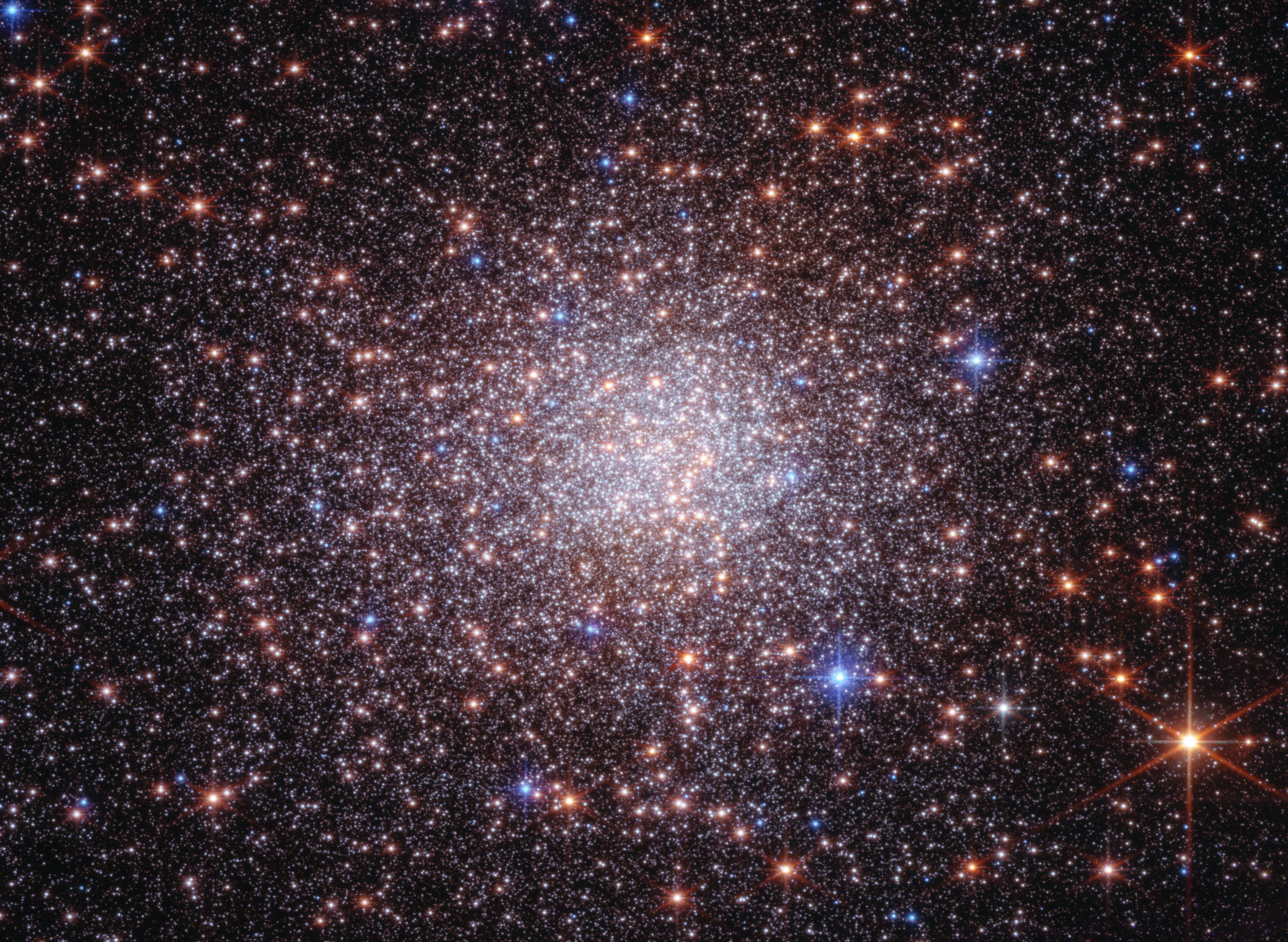
Discovered in 1968 by astronomer Azop Terzan, Terzan 5 resembles a globular cluster in many ways. However, in 2009 this system was discovered to harbor two distinct populations of stars. In 2016 Hubble provided the first estimate of their ages, showing that one formed roughly 12 billion years ago — as the Milky Way itself was assembling — and the other about 5 billion years ago, just before Earth started forming. This pointed to a more complex history than a typical globular cluster.
Studying Terzan 5 is complicated by its location in a region of our galaxy crowded with stars and heavily obscured by dust. This is where Webb stepped in. Its infrared view allowed the research team to peer through the dust and catalog many more stars, and fainter stars, than previous work. By measuring star colors and brightnesses, astronomers can classify them into populations of different ages and chemistries.
Webb was able to measure these key properties for every star within the field of view in the sky — both stars within Terzan 5 and unrelated foreground stars. To isolate the stars of Terzan 5, the team relied on the power and longevity of Hubble. The 12-year separation allowed the team to measure very small movements of individual stars, known as proper motions, to determine which stars belong to Terzan 5 and which are part of the Milky Way bulge.
By combining data from both Webb and Hubble, the researchers found strong evidence for two more stellar populations, one that formed 3.8 billion years ago and another only 2.5 billion years ago. They also were able to determine the ages of the previously known stellar populations with unprecedented precision, finding that they formed 12.5 billion and 4.7 billion years ago.
With the previously known two generations of stars, astronomers could not rule out the possibility that Terzan 5 interacted with another object, like a globular cluster or a giant molecular cloud, becoming enriched with new gas and dust that set off a second round of star formation. With four stellar generations, those explanations are ruled out.
Measurements of the stellar composition of Terzan 5 populations made at the W. M. Keck Observatory and European Southern Observatory’s Very Large Telescope also point toward very distinct populations. “Along with the ages of these populations, the cluster preserves a fossil record of progressive enrichment of heavy elements by supernovae,” said co-author R. Michael Rich, a research astronomer at the University of California, Los Angeles.
Terzan 5 formed multiple generations of stars because it was able to retain the necessary raw materials. There is evidence of powerful supernova explosions in Terzan 5 that forged heavier elements that were swept up by subsequent generations of stars. In lighter weight systems, the force of the explosions themselves could have ejected the resulting elements as well as sweeping out leftover gas and dust. The progenitor of Terzan 5 had enough mass to retain those stars’ ejections, allowing new generations of stars to form over billions of years.
‘Bulge fossil fragment’The results show that Terzan 5 is most likely the remnant of a much more massive stellar system that initially formed 12.5 billion years ago. Terzan 5 is extraordinary because it survived — and never merged or fully “mixed in” with the Milky Way’s bulge. “For some reason, this peculiar clump of stars formed separately from the bulge and was not destroyed as the bulge itself formed,” said Francesco R. Ferraro, a professor at the University of Bologna and principal investigator of the Webb observations. “Terzan 5 is what we now call a bulge fossil fragment because it resembles the primordial clumps that contributed to the formation of the bulge.”
To date, there’s one other known cosmic object like Terzan 5. Liller 1 was the second to be reclassified from a globular star cluster to a bulge fossil fragment. It also contains multiple generations of stars. There may be more objects like it. Between 40 to 50 additional globular clusters that orbit within the bulge will be examined by Ferraro’s team to determine if their stellar populations are all the same, like globular clusters, or have several generations, like bulge fossil fragments.
Video: Zoom to See Terzan 5 Near Our Milky Way Galaxy’s BulgeTo view this video please enable JavaScript, and consider upgrading to a web browser that
supports HTML5 video
Ultimately, this research may improve what we know about how the central bulges of galaxies form over hundreds of millions of years. “Based on observations and in-depth simulations, we think that galaxies in the early universe had huge disks of gas that fragmented into clumps and formed stars. These clumps migrated to the center of the galaxies, and many merged to form their bulges,” said Barbara Lanzoni, a co-author and associate professor at the University of Bologna. For example, Webb has turned up several examples of “clumpy” galaxies that were actively forming when the universe was only a few hundred million years old, like the clumps in the Firefly Sparkle galaxy. “Terzan 5 may provide direct evidence that can help explain how bulges formed in galaxies throughout the universe,” Lanzoni said.
The James Webb Space Telescope is the world’s premier space science observatory. Webb is solving mysteries in our solar system, looking beyond to distant worlds around other stars, and probing the mysterious structures and origins of our universe and our place in it. Webb is an international program led by NASA with its partners, ESA (European Space Agency) and CSA (Canadian Space Agency).
The Hubble Space Telescope has been operating for over three decades and continues to make ground-breaking discoveries that shape our fundamental understanding of the universe. Hubble is a project of international cooperation between NASA and ESA (European Space Agency). NASA’s Goddard Space Flight Center in Greenbelt, Maryland, manages the telescope and mission operations. Lockheed Martin Space, based in Denver, also supports mission operations at Goddard. The Space Telescope Science Institute in Baltimore, which is operated by the Association of Universities for Research in Astronomy, conducts Hubble science operations for NASA.
To learn more about Webb, visit:
To learn more about Hubble, visit:
https://science.nasa.gov/hubble
Downloads & Related InformationThe following sections contain links to download this article’s images and videos in all available resolutions followed by related information links, media contacts, and if available, research paper and Spanish translation links.
Related Images & Videos Bulge Fossil Fragment Terzan 5 (Webb and Hubble Image)New observations from Webb combined with multiple observations from Hubble prove that Terzan 5 is a self-contained, self-enriching stellar system that contains up to four distinct star populations. It orbits within our Milky Way galaxy’s central bulge.
Terzan 5 (Webb and Hubble Compass Image)
This image of bulge fossil fragment Terzan 5 was captured by the James Webb and Hubble space telescopes. Webb’s data are from its NIRCam (Near-Infrared Camera) and Hubble’s from its Advanced Camera for Surveys (ACS). The image shows a scale bar, compass arrows, and co…
Zoom to See Terzan 5 Near Our Milky Way Galaxy’s Bulge
Zoom in to Terzan 5, a star cluster that lies within the crowded central region of our Milky Way galaxy known as the bulge. The scene starts with a ground-based image of our Milky Way bulge and zooms in on and circles Terzan 5, ending with the composite image of the star system f…
Related Links
Read more: Hubble’s star clusters
Explore more: ViewSpace | Forms of light: the Cluster Omega Centauri
Watch: Globular Clusters, Stellar Pockets
Watch: Sorting the Stars in Omega Centauri
Webb: News | Images | Science | Home Page
Hubble: News | Images | Science | Home Page
Laura Betz
NASA’s Goddard Space Flight Center
Greenbelt, Maryland
laura.e.betz@nasa.gov
Christine Pulliam
Space Telescope Science Institute
Baltimore, Maryland
Claire Blome
Space Telescope Science Institute
Baltimore, Maryland
Keep Exploring Related Topics James Webb Space Telescope
Webb is the premier observatory of the next decade, serving thousands of astronomers worldwide. It studies every phase in the…
Stars
Galaxies
Galaxies Stories
Webb & Hubble reveal relic of our galaxy’s formation
Researchers have confirmed a new class of objects within our Milky Way galaxy: survivors called 'bulge fossil fragments.' Terzan 5 is the prototype of these remnants of our galaxy's early formation. Using the NASA/ESA/CSA James Webb Space Telescope and the NASA/ESA Hubble Space Telescopes researchers have shown that Terzan 5 is not a globular star cluster as it was once classified. Instead, it is something much odder and rarer.
NASA Webb, Hubble Reveal History of Relic of Milky Way’s Formation
- Webb
- News
- Overview
- Science
- Observatory
- Multimedia
- Team
- More
Image: NASA, ESA, CSA, STScI, Giorgia Zullo (University of Bologna), Francesco Ferraro (University of Bologna); Image Processing: Alyssa Pagan (STScI)
Researchers using two of humanity’s most powerful observatories — NASA’s James Webb and Hubble Space Telescopes — have definitively shown that Terzan 5 is not a globular star cluster as it was once classified, offering new insight into how galaxies like our own form and evolve over time. A globular star cluster typically has only one ancient star population. New data not only confirms the existence of two distinct populations of stars in Terzan 5, but also provides evidence for two more recent rounds of star formation. Although located within the crowded bulge of our Milky Way, our galaxy’s central, spherical region of older stars, Terzan 5 was massive enough to maintain its separate identity while lighter weight systems spread out and mixed to form the bulge billions of years ago. It’s like a lump in an otherwise well-mixed cake batter.
“Webb’s new near-infrared observations, cross-referenced with Hubble’s archival observations, have given us a much clearer picture of the history of Terzan 5,” said Giorgia Zullo, who led the research and is a PhD student at the University of Bologna in Italy.
These results were presented at a press conference Tuesday at the 248th meeting of the American Astronomical Society in Pasadena, and were published in Astronomy & Astrophysics.
Image: Bulge Fossil Fragment Terzan 5 (Webb and Hubble Image) New observations from Webb combined with multiple observations from Hubble prove that Terzan 5 is a self-contained, self-enriching stellar system that contains up to four distinct star populations. It orbits within our Milky Way galaxy’s central bulge. Image: NASA, ESA, CSA, STScI, Giorgia Zullo (University of Bologna), Francesco Ferraro (University of Bologna); Image Processing: Alyssa Pagan (STScI) Four generations of starsDiscovered in 1968 by astronomer Azop Terzan, Terzan 5 resembles a globular cluster in many ways. However, in 2009 this system was discovered to harbor two distinct populations of stars. In 2016 Hubble provided the first estimate of their ages, showing that one formed roughly 12 billion years ago — as the Milky Way itself was assembling — and the other about 5 billion years ago, just before Earth started forming. This pointed to a more complex history than a typical globular cluster.
Studying Terzan 5 is complicated by its location in a region of our galaxy crowded with stars and heavily obscured by dust. This is where Webb stepped in. Its infrared view allowed the research team to peer through the dust and catalog many more stars, and fainter stars, than previous work. By measuring star colors and brightnesses, astronomers can classify them into populations of different ages and chemistries.
Webb was able to measure these key properties for every star within the field of view in the sky — both stars within Terzan 5 and unrelated foreground stars. To isolate the stars of Terzan 5, the team relied on the power and longevity of Hubble. The 12-year separation allowed the team to measure very small movements of individual stars, known as proper motions, to determine which stars belong to Terzan 5 and which are part of the Milky Way bulge.
By combining data from both Webb and Hubble, the researchers found strong evidence for two more stellar populations, one that formed 3.8 billion years ago and another only 2.5 billion years ago. They also were able to determine the ages of the previously known stellar populations with unprecedented precision, finding that they formed 12.5 billion and 4.7 billion years ago.
With the previously known two generations of stars, astronomers could not rule out the possibility that Terzan 5 interacted with another object, like a globular cluster or a giant molecular cloud, becoming enriched with new gas and dust that set off a second round of star formation. With four stellar generations, those explanations are ruled out.
Measurements of the stellar composition of Terzan 5 populations made at the W. M. Keck Observatory and European Southern Observatory’s Very Large Telescope also point toward very distinct populations. “Along with the ages of these populations, the cluster preserves a fossil record of progressive enrichment of heavy elements by supernovae,” said co-author R. Michael Rich, a research astronomer at the University of California, Los Angeles.
Terzan 5 formed multiple generations of stars because it was able to retain the necessary raw materials. There is evidence of powerful supernova explosions in Terzan 5 that forged heavier elements that were swept up by subsequent generations of stars. In lighter weight systems, the force of the explosions themselves could have ejected the resulting elements as well as sweeping out leftover gas and dust. The progenitor of Terzan 5 had enough mass to retain those stars’ ejections, allowing new generations of stars to form over billions of years.
‘Bulge fossil fragment’The results show that Terzan 5 is most likely the remnant of a much more massive stellar system that initially formed 12.5 billion years ago. Terzan 5 is extraordinary because it survived — and never merged or fully “mixed in” with the Milky Way’s bulge. “For some reason, this peculiar clump of stars formed separately from the bulge and was not destroyed as the bulge itself formed,” said Francesco R. Ferraro, a professor at the University of Bologna and principal investigator of the Webb observations. “Terzan 5 is what we now call a bulge fossil fragment because it resembles the primordial clumps that contributed to the formation of the bulge.”
To date, there’s one other known cosmic object like Terzan 5. Liller 1 was the second to be reclassified from a globular star cluster to a bulge fossil fragment. It also contains multiple generations of stars. There may be more objects like it. Between 40 to 50 additional globular clusters that orbit within the bulge will be examined by Ferraro’s team to determine if their stellar populations are all the same, like globular clusters, or have several generations, like bulge fossil fragments.
Video: Zoom to See Terzan 5 Near Our Milky Way Galaxy’s BulgeTo view this video please enable JavaScript, and consider upgrading to a web browser that
supports HTML5 video
Ultimately, this research may improve what we know about how the central bulges of galaxies form over hundreds of millions of years. “Based on observations and in-depth simulations, we think that galaxies in the early universe had huge disks of gas that fragmented into clumps and formed stars. These clumps migrated to the center of the galaxies, and many merged to form their bulges,” said Barbara Lanzoni, a co-author and associate professor at the University of Bologna. For example, Webb has turned up several examples of “clumpy” galaxies that were actively forming when the universe was only a few hundred million years old, like the clumps in the Firefly Sparkle galaxy. “Terzan 5 may provide direct evidence that can help explain how bulges formed in galaxies throughout the universe,” Lanzoni said.
The James Webb Space Telescope is the world’s premier space science observatory. Webb is solving mysteries in our solar system, looking beyond to distant worlds around other stars, and probing the mysterious structures and origins of our universe and our place in it. Webb is an international program led by NASA with its partners, ESA (European Space Agency) and CSA (Canadian Space Agency).
The Hubble Space Telescope has been operating for over three decades and continues to make ground-breaking discoveries that shape our fundamental understanding of the universe. Hubble is a project of international cooperation between NASA and ESA (European Space Agency). NASA’s Goddard Space Flight Center in Greenbelt, Maryland, manages the telescope and mission operations. Lockheed Martin Space, based in Denver, also supports mission operations at Goddard. The Space Telescope Science Institute in Baltimore, which is operated by the Association of Universities for Research in Astronomy, conducts Hubble science operations for NASA.
To learn more about Webb, visit:
To learn more about Hubble, visit:
https://science.nasa.gov/hubble
Downloads & Related InformationThe following sections contain links to download this article’s images and videos in all available resolutions followed by related information links, media contacts, and if available, research paper and Spanish translation links.
Related Images & Videos Bulge Fossil Fragment Terzan 5 (Webb and Hubble Image)New observations from Webb combined with multiple observations from Hubble prove that Terzan 5 is a self-contained, self-enriching stellar system that contains up to four distinct star populations. It orbits within our Milky Way galaxy’s central bulge.
Terzan 5 (Webb and Hubble Compass Image)
This image of bulge fossil fragment Terzan 5 was captured by the James Webb and Hubble space telescopes. Webb’s data are from its NIRCam (Near-Infrared Camera) and Hubble’s from its Advanced Camera for Surveys (ACS). The image shows a scale bar, compass arrows, and co…
Zoom to See Terzan 5 Near Our Milky Way Galaxy’s Bulge
Zoom in to Terzan 5, a star cluster that lies within the crowded central region of our Milky Way galaxy known as the bulge. The scene starts with a ground-based image of our Milky Way bulge and zooms in on and circles Terzan 5, ending with the composite image of the star system f…
Related Links
Read more: Hubble’s star clusters
Explore more: ViewSpace | Forms of light: the Cluster Omega Centauri
Watch: Globular Clusters, Stellar Pockets
Watch: Sorting the Stars in Omega Centauri
Webb: News | Images | Science | Home Page
Hubble: News | Images | Science | Home Page
Laura Betz
NASA’s Goddard Space Flight Center
Greenbelt, Maryland
laura.e.betz@nasa.gov
Christine Pulliam
Space Telescope Science Institute
Baltimore, Maryland
Claire Blome
Space Telescope Science Institute
Baltimore, Maryland
Keep Exploring Related Topics James Webb Space Telescope
Webb is the premier observatory of the next decade, serving thousands of astronomers worldwide. It studies every phase in the…
Stars
Galaxies
Galaxies Stories
NASA’s Quantum Lab Aboard Space Station Gets Chilly Upgrade
Astronauts aboard the International Space Station have switched on NASA’s newly upgraded Cold Atom Lab, a one-of-a-kind facility designed to improve how scientists explore the fundamental workings of matter and develop new quantum technologies. By leveraging the unique environment of microgravity in space, the lab can accomplish cutting-edge science impossible to do anywhere else.
Quantum science is the study of matter at the smallest scales, like atoms, electrons, and single particles of light. While it’s easy to imagine atoms as billiard balls bouncing off one another, they also exhibit wave-like behavior, can exist simultaneously in two places at once, and may even pass through one another.
About the size of a minifridge and operated from Earth, the Cold Atom Lab chills atoms to temperatures below minus 459 degrees Fahrenheit (minus 237 degrees Celsius). At this extreme cold, just above absolute zero, atoms form a large quantum object called a Bose‑Einstein condensate, or BEC, a collection of matter waves that is a fifth state of matter beyond solids, liquids, gases, and plasma. This object follows the rules of quantum mechanics despite being much larger than subatomic particles, and the microgravity of low Earth orbit helps make the waves even larger.
“At the coldest temperatures, matter behaves drastically different from anything we have experienced,” said Jason Williams, project scientist for Cold Atom Lab at NASA’s Jet Propulsion Laboratory in Southern California, which built the facility. “The wavelike nature of matter dominates, and ultracold matter can behave in ways that are not only unexpected, but that also enable extremely precise measurements of time, gravity, and motion. The lab has lots of tools — especially with this latest upgrade — to let us probe the nature of the universe.”
The project supports five international teams studying fundamental physics. It also tests the space-readiness of quantum tools that could support future Earth science and space exploration missions.
How it worksThe heart of the Cold Atom Lab is a complex set of instruments called its science module. An upgraded module launched on April 11 as part of a Commercial Resupply Services mission to the space station, enabling new kinds of experiments.
For each experiment, a strip of rubidium or potassium metal is heated to as high as 750 F (400 C) — hot enough to form a gas within the facility’s vacuum chamber. Lasers tuned to specific frequencies are then fired at the gas, draining the energy from these atoms, and cooling them by slowing them down. Once this gas has completed the laser-cooling stage, a magnetic trap captures and holds the gas in place. Through a series of complex techniques, the laboratory reduces an atom cloud’s energy further, bringing it close to a standstill and maximizing its time in microgravity.
While facilities for studying ultracold gases exist on Earth, the Cold Atom Lab can study quantum gases in microgravity for longer periods of time and at even lower temperatures. Conducting these experiments in low gravity allows scientists to study larger quantum waves that also interact for longer times with gravity. To harness these benefits, the Cold Atom Lab essentially shrinks an atom physics lab, typically the size of an entire room filled with lasers and tabletop mirrors, to fit within an experiment rack aboard the space station.
“As the first project to create Bose-Einstein condensates in orbit, we’re demonstrating that we can make quantum technology work reliably in space,” said Ethan Elliott, deputy project scientist for Cold Atom Lab at JPL. “In the previous century, there was a quantum revolution that led to lasers, cellphones, and MRIs for medical imaging. We’re performing quantum 2.0 — direct manipulation of large quantum states — and we hope for similar gains in quantum tech by advancing this science in orbit.”
The latest upgrade is the fourth since the Cold Atom Lab arrived at the space station in 2018. Key improvements include a newly designed magnetic trap that changes the shape of the quantum gas clouds, allowing scientists to test different properties related to their atoms. The upgrade also features redesigned metal strips that act as sources for those gas clouds.
“It’s the closest thing we have to controlling the boundary of the quantum world,” said Kamal Oudrhiri, project manager of Cold Atom Lab at JPL, referring to those low temperatures. “This new upgrade pushes that boundary even further.”
The upgrade, Oudrhiri added, “demonstrates NASA’s ability to maintain U.S. leadership in space-based quantum technologies while maturing future quantum instruments, such as matter-wave interferometers for fundamental physics missions, positioning, navigation, timing, and gravity sensing of Earth, the Moon, and beyond.”
More about Cold Atom LabManaged by Caltech in Pasadena, JPL designed, built, and operates the Cold Atom Lab, which is sponsored by the Biological and Physical Sciences division of NASA’s Science Mission Directorate at the agency’s headquarters in Washington. The division pioneers scientific discovery and enables exploration by using space environments to conduct investigations that are not possible on Earth. Studying biological and physical phenomena under extreme conditions allows researchers to advance the fundamental scientific knowledge required to go farther and stay longer in space, while also benefiting life on Earth.
To learn more about Cold Atom Lab, visit:
https://nasa.gov/cold-atom-laboratory/
Media ContactAndrew Good
Jet Propulsion Laboratory, Pasadena, Calif.
818-393-2433
andrew.c.good@jpl.nasa.gov
2026-039
Explore More 4 min read El Niño Is UnderwaySatellite observations of sea surface height indicated that the 2026 event continued to strengthen in…
Article 7 minutes ago 2 min read Astronaut Jessica Meir Assists With Hardware Updates for NASA’s Cold Atom LabDescription NASA astronaut Jessica Meir inspects optical fibers while installing hardware updates to the agency’s…
Article 1 day ago 3 min read Explore JPL to Take Place Oct. 10, 11 Article 2 days ago Keep Exploring Discover More Topics From NASA Cold Atom LaboratoryAbout the mission The Cold Atom Laboratory launched to the International Space Station in May 2018 and was installed a…
Jet Propulsion Laboratory
International Space Station
Physical Sciences Program