
Feed aggregator
Mars astronauts may do laundry by blasting clothes with a plasma beam
Mars astronauts may do laundry by blasting clothes with a plasma beam
Why your brain needs plenty of “Aha!” moments
Why your brain needs plenty of “Aha!” moments
A Brief-ish History of SETI. Part VII: Brief Windows and Transcendence
Could the "Great Silence" be the result of extraterrestrial civilizations dying out before they can make contact, or will they evolve to the point where communication with them is no longer possible?
Alien life may be missed by current space missions, but AI might help
It’s 2035 and NASA’s Dragonfly quadcopter has been “hopping” around the surface of Saturn’s largest moon Titan for just over a year taking images, scanning pebbles, drilling holes, and analyzing surface material for potential signs of life. You’re at NASA JPL and just moved to Blue Team (12am-8am) from Red Team (4pm-12am), so you’re hyped up on coffee, Red Bull, and will power. It’s 3:30am, you’ve been analyzing data since you clocked in, and you keep discarding what you’ve been told looks like positive signs of life but is more commonly known as false positives. In the meantime, some microbes on Titan that got scanned by Dragonfly keep posing in front of its main camera with signs saying, “We’re here!”
Tiny alien-like blue octopus discovered lurking off the Galapagos Islands
This teensy creature was discovered along a deep-sea mountain
Ocean census reveals more than 1,100 new species
Over the course of 13 expeditions and other efforts between mid-2025 and mid-2026, scientists found hundreds of previously undiscovered creatures living under the waves
The universe could have 18 possible shapes
Our universe appears flat—but this observation still leaves plenty of options for its true shape. In fact, our cosmos could resemble a donut
Mars Fungi Could Make Red Planet Regolith Fertile for Crops
You’re on the fourth human mission to Mars, and you’ve been tasked with establishing the first self-sustaining food crop on a Martian settlement. You’re nervous because you’re using a new type of fungi called beneficial fungi, which you’re told will help enhance Martian regolith, enabling it to be used for growing crops. You were privately told that doing this will not only get a high school named after you, but you will successfully feed future settlers without the need to bring food from Earth. But you really only care about having your name on a high school.
SpaceX's Next-Gen Starship Passes Its First Flight Test Despite Snags
SpaceX's next-generation Starship V3 rocket got off to a glorious start for its first test flight, and although not all of its engines fired fully according to plan, SpaceX CEO Elon Musk said the mission "scored a goal for humanity."
Is Dust the Best Thing in the Universe? Part 4: We Owe Dust Our Lives
No dust, no way to cool a collapsing gas cloud. No way to cool it, no stars. No dust, no first rung on the ladder from grain to pebble to planet. The substance I spent two articles complaining about turns out to be the substance that makes me possible.
SpaceX launches Starship V3—the world's most powerful and tallest rocket ever
Friday's test flight marks a major milestone for SpaceX as the company gears up to go public and to participate in NASA's Artemis III mission in 2027
Call for Creatives: NASA Seeks Help Illuminating Mission Storytelling
As NASA pushes the boundaries of exploration and innovation for the benefit of humanity, the agency is looking for partners to share mission stories covering Artemis Moon missions, nuclear propulsion, aeronautics, and more.
NASA published an Announcement for Proposals on May 21 asking filmmakers, documentarians, songwriters, storytellers, poets, and others to submit proposals to partner with the agency by Tuesday, June 30.
In this initial round, NASA is seeking up to 10 partners for unfunded Space Act Agreements to share the stories behind, and insights into, multiple NASA missions, including, but not limited to, the following:
- Artemis program, including the recently added Artemis III mission in 2027, and Artemis IV lunar landing in 2028, as well as plans for the agency to develop a Moon Base. Learn more about Artemis on the agency’s website.
- NASA’s advancement of nuclear propulsion, including the Space Reactor-1 Freedom mission to Mars in 2028 carrying the Skyfall payload.
- NASA’s cutting-edge aviation work through flight tests and other efforts.
While this opportunity is focused on U.S. creators, the agency will consider proposals with a minority of international participants. Proposals should detail which area of focus is desired, funding and distribution arrangements, and any specifics needs from NASA to move forward (access to facilities, personnel, etc.).
Full requirements and other details are available online:
https://go.nasa.gov/CreatorProposals
-end-
Camille Gallo / Cheryl Warner
Headquarters, Washington
202-358-1600
camille.m.gallo@nasa.gov / cheryl.m.warner@nasa.gov
Call for Creatives: NASA Seeks Help Illuminating Mission Storytelling
As NASA pushes the boundaries of exploration and innovation for the benefit of humanity, the agency is looking for partners to share mission stories covering Artemis Moon missions, nuclear propulsion, aeronautics, and more.
NASA published an Announcement for Proposals on May 21 asking filmmakers, documentarians, songwriters, storytellers, poets, and others to submit proposals to partner with the agency by Tuesday, June 30.
In this initial round, NASA is seeking up to 10 partners for unfunded Space Act Agreements to share the stories behind, and insights into, multiple NASA missions, including, but not limited to, the following:
- Artemis program, including the recently added Artemis III mission in 2027, and Artemis IV lunar landing in 2028, as well as plans for the agency to develop a Moon Base. Learn more about Artemis on the agency’s website.
- NASA’s advancement of nuclear propulsion, including the Space Reactor-1 Freedom mission to Mars in 2028 carrying the Skyfall payload.
- NASA’s cutting-edge aviation work through flight tests and other efforts.
While this opportunity is focused on U.S. creators, the agency will consider proposals with a minority of international participants. Proposals should detail which area of focus is desired, funding and distribution arrangements, and any specifics needs from NASA to move forward (access to facilities, personnel, etc.).
Full requirements and other details are available online:
https://go.nasa.gov/CreatorProposals
-end-
Camille Gallo / Cheryl Warner
Headquarters, Washington
202-358-1600
camille.m.gallo@nasa.gov / cheryl.m.warner@nasa.gov
NASA’S Juno Makes Closest Ever Approach To Jupiter’s Moon Of Thebe
NASA’S Juno spacecraft images Jupiter’s tiny moon of Thebe in a recent close approach.
NASA Sets Coverage for Roscosmos Spacewalk Outside Space Station
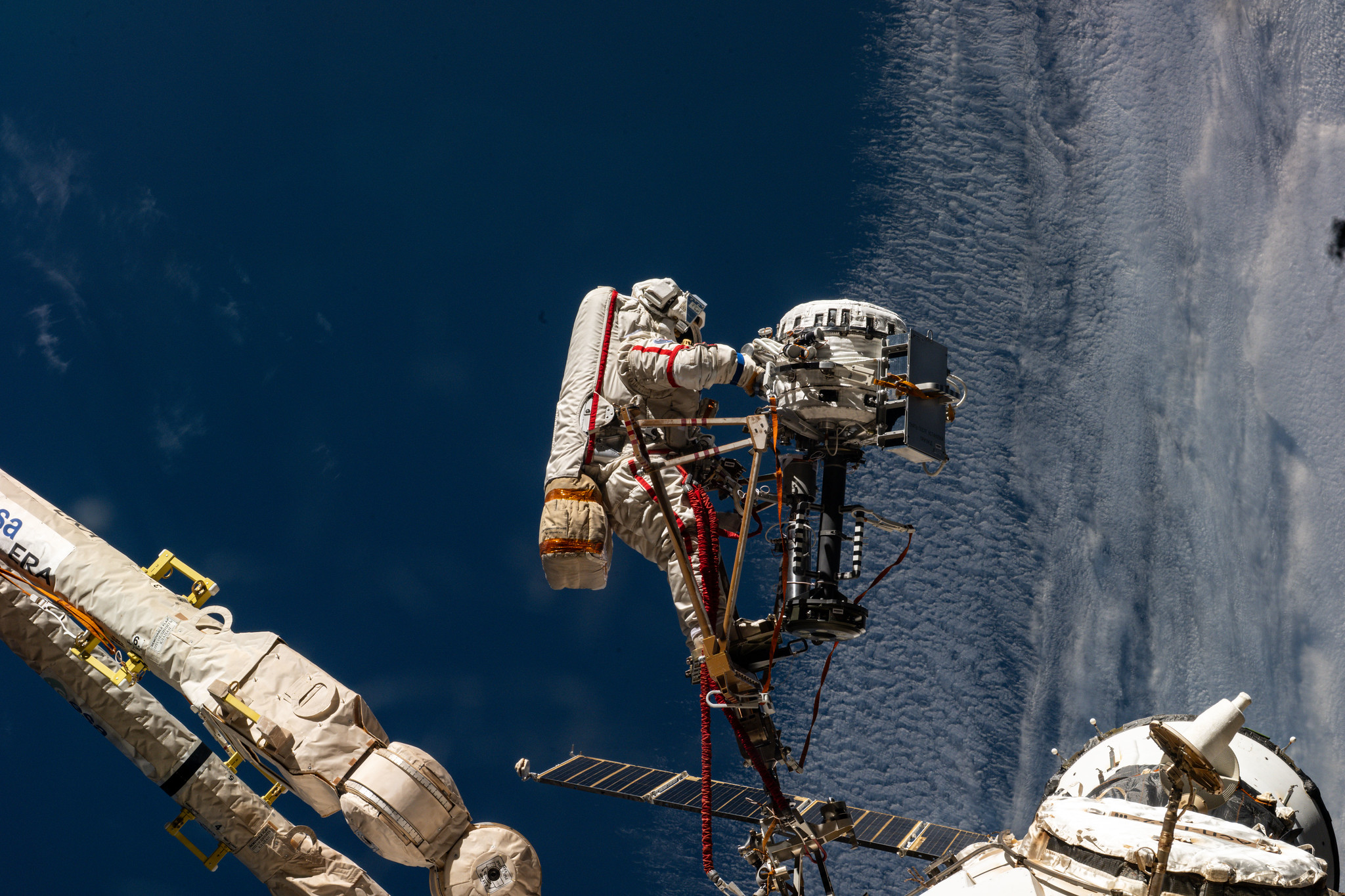
NASA will provide live coverage on Wednesday, May 27, as two Roscosmos cosmonauts conduct a spacewalk outside the International Space Station. The spacewalk is scheduled to begin at approximately 10:15 a.m. EDT and last roughly five hours.
Watch NASA’s live coverage beginning at 9:45 a.m. on NASA+, Amazon Prime, and the agency’s YouTube channel. Learn how to watch NASA content through a variety of online platforms, including social media.
International Space Station Expedition 74 commander Sergey Kud-Sverchkov and flight engineer Sergei Mikaev will install a solar radiation experiment on the Zvezda service module and remove other science hardware from the Poisk and Nauka modules of the orbiting complex’s Roscosmos segment. If time allows, the duo also will photograph one of the Progress 94 cargo spacecraft’s Kurs rendezvous antennas, which failed to deploy in March following its launch to the space station.
This Roscosmos spacewalk will be the second for Kud-Sverchkov and the first for Mikaev. Kud-Sverchkov will wear a spacesuit with red stripes, and Mikaev will wear a spacesuit with blue stripes. It will be the 279th spacewalk in support of space station assembly, maintenance, and upgrades.
To learn more about International Space Station research, operations, and its crews, visit:
-end-
Josh Finch / Jimi Russell
Headquarters, Washington
202-358-1100
joshua.a.finch@nasa.gov / james.j.russell@nasa.gov
Sandra Jones
Johnson Space Center, Houston
281-483-5111
sandra.p.jones@nasa.gov
NASA Sets Coverage for Roscosmos Spacewalk Outside Space Station
NASA will provide live coverage on Wednesday, May 27, as two Roscosmos cosmonauts conduct a spacewalk outside the International Space Station. The spacewalk is scheduled to begin at approximately 10:15 a.m. EDT and last roughly five hours.
Watch NASA’s live coverage beginning at 9:45 a.m. on NASA+, Amazon Prime, and the agency’s YouTube channel. Learn how to watch NASA content through a variety of online platforms, including social media.
International Space Station Expedition 74 commander Sergey Kud-Sverchkov and flight engineer Sergei Mikaev will install a solar radiation experiment on the Zvezda service module and remove other science hardware from the Poisk and Nauka modules of the orbiting complex’s Roscosmos segment. If time allows, the duo also will photograph one of the Progress 94 cargo spacecraft’s Kurs rendezvous antennas, which failed to deploy in March following its launch to the space station.
This Roscosmos spacewalk will be the second for Kud-Sverchkov and the first for Mikaev. Kud-Sverchkov will wear a spacesuit with red stripes, and Mikaev will wear a spacesuit with blue stripes. It will be the 279th spacewalk in support of space station assembly, maintenance, and upgrades.
To learn more about International Space Station research, operations, and its crews, visit:
-end-
Josh Finch / Jimi Russell
Headquarters, Washington
202-358-1100
joshua.a.finch@nasa.gov / james.j.russell@nasa.gov
Sandra Jones
Johnson Space Center, Houston
281-483-5111
sandra.p.jones@nasa.gov