
Feed aggregator
Australia is battling its largest diphtheria outbreak in living memory
Span wants to turn homes into mini data centers
Smart-panel start-up Span wants to turn spare household electricity into AI computing power. How far it can scale and what effect that would have on the residential grid remain unsettled
Hubble Captures Galaxy Cluster
- Hubble Home
- Overview
- Impact & Benefits
- Science
- Observatory
- Team
- Multimedia
- News
- More
2 min read
Hubble Captures Galaxy Cluster NASA’s Hubble Space Telescope captured this scene of galaxy cluster MACS J1141.6-1905 in visible and infrared light. NASA, ESA, H. Ebeling (University of Hawaii); Image Processing: G. Kober (NASA/Catholic University of America)Look closely at this image from NASA’s Hubble Space Telescope and you’ll see galaxies of various shapes and sizes clustered together toward the center-left of the image. A few foreground stars shine brightly and are easily distinguished by the spikes that appear to extend outward from each star. These spikes, called diffraction spikes, are the result of how point sources of light (such as stars) bend, or diffract, around the supports for Hubble’s secondary mirror.
Hubble captured this scene of MACS J1141.6-1905 in visible and infrared light. The image includes data from two Hubble observing programs that looked at massive galaxy clusters that shine very brightly in X-rays. Both programs were looking for distant galaxies gravitationally lensed by the cluster. They also wanted to better understand the physical nature of interactions at each cluster’s core. An extra bonus was the addition of Hubble’s visible and infrared observations of these very bright X-ray clusters to its archive.
Hubble’s archive of 1.7 million observations, and counting, is a valuable tool for current and future astronomers. They can mine Hubble’s 36 years of observations and examine the data with new tools, enabling researchers to make new discoveries.
MACS J1141.6-1905 is around four billion light-years away in the constellation Crater (the Cup).
Facebook logo @NASAHubble @NASAHubble Instagram logo @NASAHubbleMedia Contact:
Claire Andreoli
NASA’s Goddard Space Flight Center, Greenbelt, MD
claire.andreoli@nasa.gov
Since its 1990 launch, the Hubble Space Telescope has changed our fundamental understanding of the universe.
Hubble Spectroscopy
Hubble’s Partners in Science
AI and Hubble Science
Hubble Captures Galaxy Cluster
- Hubble Home
- Overview
- Impact & Benefits
- Science
- Observatory
- Team
- Multimedia
- News
- More
2 min read
Hubble Captures Galaxy Cluster NASA’s Hubble Space Telescope captured this scene of galaxy cluster MACS J1141.6-1905 in visible and infrared light. NASA, ESA, H. Ebeling (University of Hawaii); Image Processing: G. Kober (NASA/Catholic University of America)Look closely at this image from NASA’s Hubble Space Telescope and you’ll see galaxies of various shapes and sizes clustered together toward the center-left of the image. A few foreground stars shine brightly and are easily distinguished by the spikes that appear to extend outward from each star. These spikes, called diffraction spikes, are the result of how point sources of light (such as stars) bend, or diffract, around the supports for Hubble’s secondary mirror.
Hubble captured this scene of MACS J1141.6-1905 in visible and infrared light. The image includes data from two Hubble observing programs that looked at massive galaxy clusters that shine very brightly in X-rays. Both programs were looking for distant galaxies gravitationally lensed by the cluster. They also wanted to better understand the physical nature of interactions at each cluster’s core. An extra bonus was the addition of Hubble’s visible and infrared observations of these very bright X-ray clusters to its archive.
Hubble’s archive of 1.7 million observations, and counting, is a valuable tool for current and future astronomers. They can mine Hubble’s 36 years of observations and examine the data with new tools, enabling researchers to make new discoveries.
MACS J1141.6-1905 is around four billion light-years away in the constellation Crater (the Cup).
Facebook logo @NASAHubble @NASAHubble Instagram logo @NASAHubbleMedia Contact:
Claire Andreoli
NASA’s Goddard Space Flight Center, Greenbelt, MD
claire.andreoli@nasa.gov
Since its 1990 launch, the Hubble Space Telescope has changed our fundamental understanding of the universe.
Hubble Spectroscopy
Hubble’s Partners in Science
AI and Hubble Science
What will happen if the Milky Way and Andromeda galaxies collide?
Our galaxy and its nearest large companion, Andromeda, may be headed for a collision on a cosmic scale. What happens then?
What is E15 fuel? Why higher-ethanol gasoline could raise summer smog levels
In an effort to reduce prices at the pump, an EPA wavier allows the sale of fuel with 15 percent ethanol content
Bixonimania’—the fake illness that AI fell for
How an experiment involving a made-up skin condition exposes the risks of increasingly popular AI medical advice
This Week's Sky at a Glance, May 22 – 31
Venus and Jupiter — the Evening Star and the False Evening Star — draw closer together in the western twilight and point down to Mercury. The waxing Moon shows off its rich telescopic detail.
The post This Week's Sky at a Glance, May 22 – 31 appeared first on Sky & Telescope.
How ageing on Earth mimics the effects of space travel
How ageing on Earth mimics the effects of space travel
Earth from Space: Algerian arid landscape
Nereid Could be Neptune’s Only Original Moon
New research suggests that Triton — or a Triton-like object — might have disrupted Neptune's original moon system. Nereid might be the sole survivor.
The post Nereid Could be Neptune’s Only Original Moon appeared first on Sky & Telescope.
Tornado Draws a Jagged Line in Mississippi
- Earth
- Earth Observatory
- Image of the Day
- EO Explorer
- Topics
- More Content
- About
Tornado Draws a Jagged Line in Mississippi
- Earth
- Earth Observatory
- Image of the Day
- EO Explorer
- Topics
- More Content
- About
Both Hemispheres of 3I/ATLAS Observed Simultaneously by JUICE and Europa Clipper
The Southwest Research Institute-led Ultraviolet Spectrograph (UVS) instruments aboard ESA’s Jupiter Icy Moons Explorer (Juice) spacecraft and NASA’s Europa Clipper made unique observations of interstellar comet 3I/ATLAS in late 2025. SwRI leads the UVS instruments on both spacecraft, simultaneously imaging both hemispheres of the comet and detecting the comet’s ultraviolet emissions.
Crypto Investor Works on a Plan to Ride SpaceX's Starship Around Mars
Chinese-born cryptocurrency investor Chun Wang has become the latest deep-pocketed space enthusiast to set his sights on a trip around Mars. But first, he wants to take a ride around the moon on SpaceX's Starship. And SpaceX is willing to work with him.
SpaceX scrubs launch of Starship V3—the tallest and most powerful rocket ever built
This launch, when it comes, will mark the 12th flight test of Starship and the first demonstration of its V3 design. A new attempt could come as soon as Friday
NASA to Showcase Mission to Boost Swift Spacecraft’s Orbit
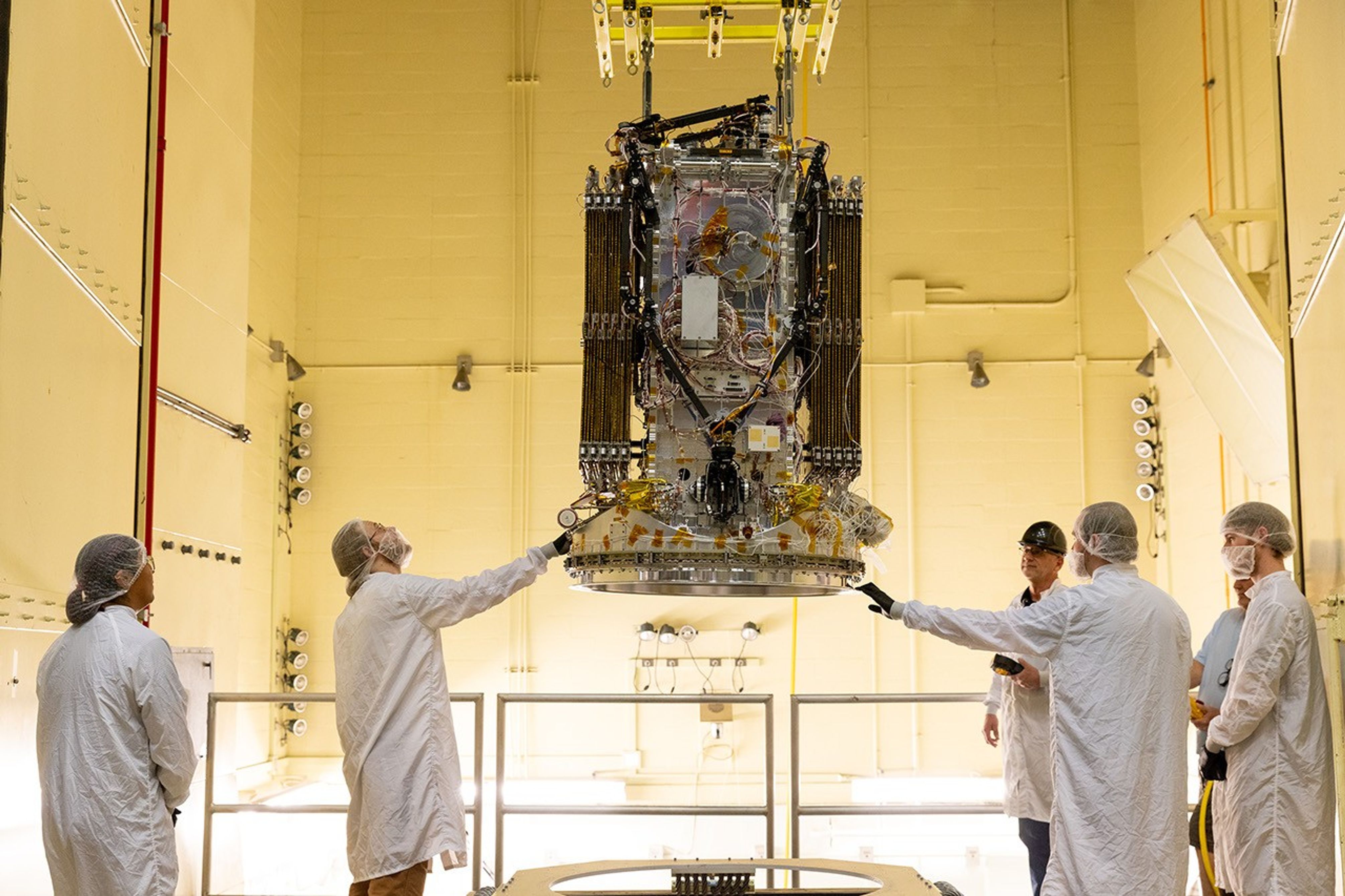
Media are invited to NASA’s Wallops Flight Facility in Virginia on Wednesday, June 17, to view Northrop Grumman’s Pegasus XL rocket, carrying a Katalyst robotic spacecraft that will attempt to boost the orbit of NASA’s Neil Gehrels Swift Observatory.
Katalyst’s robotic servicing spacecraft, called LINK, will launch on Pegasus in June to rendezvous with Swift and raise its altitude, extending its science mission lifespan.
Both United States and international media may apply for onsite credentials to view the Pegasus and the L-1011 Stargazer aircraft that will deploy the rocket at launch. In addition to interview opportunities on site, media also will receive images and video of LINK, as the spacecraft already will be encapsulated in the rocket.
NASA and Katalyst also will host an audio-only media teleconference on June 17 to preview the mission to boost Swift’s orbit. Audio of the media teleconference will stream live on NASA’s YouTube channel. Information about timing and teleconference participants will be shared closer to the event.
The application deadline for U.S. citizens to attend in person is 4 p.m. EDT, Wednesday, June 10. International media without U.S. citizenship must apply by 3 p.m. EDT, Wednesday, May 27. NASA’s media accreditation policy is available online.
Media requesting to participate in person or join the media call must send their accreditation requests to Amy Barra at: amy.l.barra@nasa.gov, with the following information:
- Legal first and last name (must match government identification)
- Phone number
- Job title and organization
- Citizenship
The Swift mission, which launched in 2004, leads NASA’s fleet of space telescopes in studying changes in the high-energy universe. It studies gamma-ray bursts — the most powerful explosions in the universe — and other cosmic objects and events. When a rapid, sudden event takes place in the cosmos, Swift serves as a “dispatcher,” providing critical information that allows other “first responder” missions to follow up to learn more about how the universe works.
Learn more about the mission to boost Swift’s orbit at:
https://science.nasa.gov/mission/swift/swift-boost-mission
-end-
Karen Fox / Alise Fisher
Headquarters, Washington
202-385-1287 / 202-358-2546
karen.c.fox@nasa.gov / alise.m.fisher@nasa.gov
Amy Barra
Wallops Flight Facility, Wallops Island, Virginia
757-824-1579
amy.l.barra@nasa.gov
NASA to Showcase Mission to Boost Swift Spacecraft’s Orbit
Media are invited to NASA’s Wallops Flight Facility in Virginia on Wednesday, June 17, to view Northrop Grumman’s Pegasus XL rocket, carrying a Katalyst robotic spacecraft that will attempt to boost the orbit of NASA’s Neil Gehrels Swift Observatory.
Katalyst’s robotic servicing spacecraft, called LINK, will launch on Pegasus in June to rendezvous with Swift and raise its altitude, extending its science mission lifespan.
Both United States and international media may apply for onsite credentials to view the Pegasus and the L-1011 Stargazer aircraft that will deploy the rocket at launch. In addition to interview opportunities on site, media also will receive images and video of LINK, as the spacecraft already will be encapsulated in the rocket.
NASA and Katalyst also will host an audio-only media teleconference on June 17 to preview the mission to boost Swift’s orbit. Audio of the media teleconference will stream live on NASA’s YouTube channel. Information about timing and teleconference participants will be shared closer to the event.
The application deadline for U.S. citizens to attend in person is 4 p.m. EDT, Wednesday, June 10. International media without U.S. citizenship must apply by 3 p.m. EDT, Wednesday, May 27. NASA’s media accreditation policy is available online.
Media requesting to participate in person or join the media call must send their accreditation requests to Amy Barra at: amy.l.barra@nasa.gov, with the following information:
- Legal first and last name (must match government identification)
- Phone number
- Job title and organization
- Citizenship
The Swift mission, which launched in 2004, leads NASA’s fleet of space telescopes in studying changes in the high-energy universe. It studies gamma-ray bursts — the most powerful explosions in the universe — and other cosmic objects and events. When a rapid, sudden event takes place in the cosmos, Swift serves as a “dispatcher,” providing critical information that allows other “first responder” missions to follow up to learn more about how the universe works.
Learn more about the mission to boost Swift’s orbit at:
https://science.nasa.gov/mission/swift/swift-boost-mission
-end-
Karen Fox / Alise Fisher
Headquarters, Washington
202-385-1287 / 202-358-2546
karen.c.fox@nasa.gov / alise.m.fisher@nasa.gov
Amy Barra
Wallops Flight Facility, Wallops Island, Virginia
757-824-1579
amy.l.barra@nasa.gov