

Feed aggregator
Psyche’s High-Resolution View of Mars’ South Pole
NASA/JPL-Caltech/ASU Photojournal Navigation Downloads Psyche’s High-Resolution View of Mars’ South Pole
PNG (1.09 MB)
Description
This is the highest-resolution view of the water ice-rich south polar cap of Mars captured by NASA’s Psyche mission after it made its close approach with the planet for a gravity assist. The image scale is around 0.7 miles per pixel (1.14 kilometers per pixel). The cap itself extends across more than 430 miles (700 kilometers). The image was acquired with Imager A on May 15, 2026, at about 1:53 p.m. PDT.
With Mars in the rearview mirror, the spacecraft will soon resume use of its solar-electric propulsion system to make a beeline to the main asteroid belt, between the orbits of Mars and Jupiter. When it arrives in August 2029, it will insert itself into orbit around the asteroid Psyche, which is thought to be the partial core of a planetesimal, a building block of an early planet.
For more information about NASA’s Psyche mission, visit:
https://science.nasa.gov/mission/psyche/
Keep Exploring Discover More Topics From Photojournal
Photojournal
Search Photojournal
Photojournal’s Latest Content
Feedback
Psyche’s High-Resolution View of Mars’ South Pole
NASA/JPL-Caltech/ASU Photojournal Navigation Downloads Psyche’s High-Resolution View of Mars’ South Pole
PNG (1.09 MB)
Description
This is the highest-resolution view of the water ice-rich south polar cap of Mars captured by NASA’s Psyche mission after it made its close approach with the planet for a gravity assist. The image scale is around 0.7 miles per pixel (1.14 kilometers per pixel). The cap itself extends across more than 430 miles (700 kilometers). The image was acquired with Imager A on May 15, 2026, at about 1:53 p.m. PDT.
With Mars in the rearview mirror, the spacecraft will soon resume use of its solar-electric propulsion system to make a beeline to the main asteroid belt, between the orbits of Mars and Jupiter. When it arrives in August 2029, it will insert itself into orbit around the asteroid Psyche, which is thought to be the partial core of a planetesimal, a building block of an early planet.
For more information about NASA’s Psyche mission, visit:
https://science.nasa.gov/mission/psyche/
Keep Exploring Discover More Topics From Photojournal
Photojournal
Search Photojournal
Photojournal’s Latest Content
Feedback
NASA’s Psyche Mission Sees Mars’ South Pole After Flyby
NASA/JPL-Caltech/ASU Photojournal Navigation Downloads NASA’s Psyche Mission Sees Mars’ South Pole After Flyby
PNG (423.28 KB)
Description
This is Psyche’s first view of a nearly “full Mars” seen shortly after the spacecraft’s closest approach to the planet on May 15, 2026. The view extends from the south polar cap northwards to the Valles Marineris canyon system and beyond.
With Mars in the rearview mirror, the spacecraft will soon resume use of its solar-electric propulsion system to make a beeline to the main asteroid belt, between the orbits of Mars and Jupiter. When it arrives in August 2029, it will insert itself into orbit around the asteroid Psyche, which is thought to be the partial core of a planetesimal, a building block of an early planet.
For more information about NASA’s Psyche mission, visit:
https://science.nasa.gov/mission/psyche/
Keep Exploring Discover More Topics From Photojournal
Photojournal
Search Photojournal
Photojournal’s Latest Content
Feedback
NASA’s Psyche Mission Sees Mars’ South Pole After Flyby
NASA/JPL-Caltech/ASU Photojournal Navigation Downloads NASA’s Psyche Mission Sees Mars’ South Pole After Flyby
PNG (423.28 KB)
Description
This is Psyche’s first view of a nearly “full Mars” seen shortly after the spacecraft’s closest approach to the planet on May 15, 2026. The view extends from the south polar cap northwards to the Valles Marineris canyon system and beyond.
With Mars in the rearview mirror, the spacecraft will soon resume use of its solar-electric propulsion system to make a beeline to the main asteroid belt, between the orbits of Mars and Jupiter. When it arrives in August 2029, it will insert itself into orbit around the asteroid Psyche, which is thought to be the partial core of a planetesimal, a building block of an early planet.
For more information about NASA’s Psyche mission, visit:
https://science.nasa.gov/mission/psyche/
Keep Exploring Discover More Topics From Photojournal
Photojournal
Search Photojournal
Photojournal’s Latest Content
Feedback
NASA’s Psyche Mission Images the Crescent of Mars
NASA/JPL-Caltech/ASU Photojournal Navigation Downloads NASA’s Psyche Mission Images the Crescent of Mars
PNG (251.49 KB)
Description
This view of a crescent Mars was captured on May 15, 2026, at about 5:03 a.m. PDT by NASA’s Psyche mission as it approached the planet for a gravity assist. Captured by the spacecraft’s multispectral imager instrument, this was the last view of the whole planet before it began to overfill the field of view of the camera.
Because Psyche approached Mars from a high phase angle, the planet appeared as a thin crescent in the days running up to the close approach, lit by sunlight reflecting off its surface. In observations from the spacecraft’s multispectral imagers, the crescent appeared brighter and extended farther around the planet’s disk than anticipated because of the strong scattering of sunlight through the planet’s dusty atmosphere.
The image was acquired with Imager A. It has been processed into a natural-color view (approximating what the human eye would see) using red, green, and blue data from imager filters.
For more information about NASA’s Psyche mission, visit:
https://science.nasa.gov/mission/psyche/
Keep Exploring Discover More Topics From Photojournal
Photojournal
Search Photojournal
Photojournal’s Latest Content
Feedback
NASA’s Psyche Mission Images the Crescent of Mars
NASA/JPL-Caltech/ASU Photojournal Navigation Downloads NASA’s Psyche Mission Images the Crescent of Mars
PNG (251.49 KB)
Description
This view of a crescent Mars was captured on May 15, 2026, at about 5:03 a.m. PDT by NASA’s Psyche mission as it approached the planet for a gravity assist. Captured by the spacecraft’s multispectral imager instrument, this was the last view of the whole planet before it began to overfill the field of view of the camera.
Because Psyche approached Mars from a high phase angle, the planet appeared as a thin crescent in the days running up to the close approach, lit by sunlight reflecting off its surface. In observations from the spacecraft’s multispectral imagers, the crescent appeared brighter and extended farther around the planet’s disk than anticipated because of the strong scattering of sunlight through the planet’s dusty atmosphere.
The image was acquired with Imager A. It has been processed into a natural-color view (approximating what the human eye would see) using red, green, and blue data from imager filters.
For more information about NASA’s Psyche mission, visit:
https://science.nasa.gov/mission/psyche/
Keep Exploring Discover More Topics From Photojournal
Photojournal
Search Photojournal
Photojournal’s Latest Content
Feedback
NASA’s Psyche Mission Aces Mars Flyby, Targets Metal-Rich Asteroid
5 min read
Preparations for Next Moonwalk Simulations Underway (and Underwater) This view of a crescent Mars was captured on May 15, 2026, at about 5:03 a.m. PDT by NASA’s Psyche mission as it approached the planet for a gravity assist. The image has been processed into a natural-color view using red, green, and blue data from the multispectral imager instrument.NASA/JPL-Caltech/ASU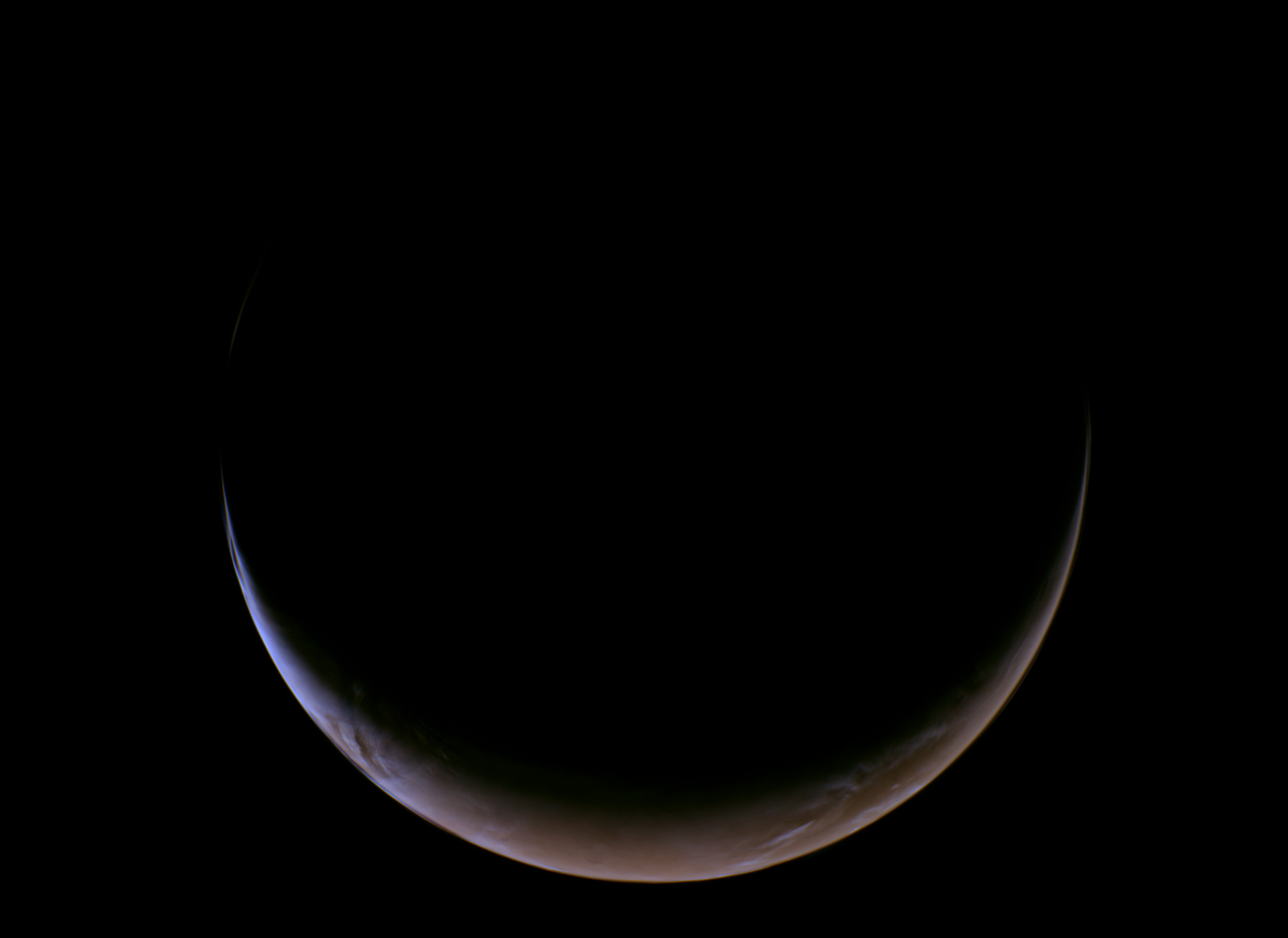
NASA’s Psyche spacecraft completed its close approach of Mars on May 15, coming within 2,864 miles (4,609 kilometers) of the planet’s surface. This flyby used a gravity assist from Mars to provide a critical boost in speed and to adjust the spacecraft’s orbital plane without using any onboard propellant, sending it on its way toward the metal-rich asteroid Psyche.
The spacecraft is now headed directly toward the asteroid, located in the main asteroid belt between Mars and Jupiter. After the Mars flyby, the flight team analyzed radio signals between the spacecraft and NASA’s Deep Space Network (DSN), the agency’s global system for communicating with interplanetary spacecraft, to confirm that Psyche was on the correct trajectory.
“Although we were confident in our calculations and flight plan, monitoring the DSN’s Doppler signal in real time during the flyby was still exciting,” said Don Han, Psyche’s navigation lead at NASA’s Jet Propulsion Laboratory in Southern California. “We’ve confirmed that Mars gave the spacecraft a 1,000 mile‑per‑hour boost and shifted its orbital plane by about 1 degree relative to the Sun. We are now on course for arrival at the asteroid Psyche in summer 2029.”
This is the first view of a nearly “full Mars” as seen by NASA’s Psyche spacecraft shortly after its closest approach to the planet on May 15, 2026. The view extends from the south polar cap northwards to the Valles Marineris canyon system and beyond.NASA/JPL-Caltech/ASU This is the highest-resolution view of the water ice-rich south polar cap of Mars captured by NASA’s Psyche mission after it made its close approach with the planet for a gravity assist. The cap is more than 430 miles (700 kilometers) across.NASA/JPL-Caltech/ASU Unique Martian viewIn the days running up to and during close approach, all of Psyche’s instruments were powered up for calibration efforts, including its imagers, magnetometers, and gamma-ray and neutron spectrometer. The planetary encounter provided the mission a valuable practice run for when it reaches the asteroid Psyche; as a bonus, it captured Mars images from a rare perspective.
Because Psyche approached Mars from a high phase angle, the planet appeared as a thin crescent in the days running up to the close approach, lit by sunlight reflecting off its surface. In observations from the spacecraft’s multispectral imager, the crescent appeared brighter and extended farther around the planet’s disk than anticipated because of the strong scattering of sunlight through the planet’s dusty atmosphere. As Psyche passed from Mars’ nighttime skies to daytime, it took a rapid series of pictures of the surface around the time of closest approach.
“We’ve captured thousands of images of the approach to Mars and of the planet’s surface and atmosphere at close approach. This dataset provides unique and important opportunities for us to calibrate and characterize the performance of the cameras, as well as test the early versions of our image processing tools being developed for use at the asteroid Psyche,” said Jim Bell, the Psyche imager instrument lead at Arizona State University (ASU) in Tempe. “As the spacecraft continues its journey after the flyby, we’ll continue calibration imaging of Mars for the rest of the month as it recedes into the distance.”
Bell also leads the Mastcam-Z imaging investigation on NASA’s Perseverance Mars rover mission team, which was among several missions that provided complementary surface and atmospheric imaging as well as navigation data during the flyby to help with calibration efforts. Other missions involved include NASA’s Mars Reconnaissance Orbiter, 2001 Mars Odyssey orbiter, and Curiosity rover, along with ESA’s (European Space Agency’s) Mars Express and ExoMars Trace Gas Orbiter.
In addition to the imager, early calibration measurements made by Psyche’s magnetometers may have detected Mars’ bow shock as the spacecraft passed the planet. The gamma-ray and neutron spectrometer team was also quickly gathering data to calibrate the instrument by comparing their measurements with the large pool of existing Mars data.
This view of the Martian surface shows streaks that have formed due to wind blowing over impact craters in the Syrtis Major region. The wind streaks extend to about 30 miles (50 kilometers) long, and the large craters near center-bottom of the scene average around 30 miles in diameter.NASA/JPL-Caltech/ASU Captured by Psyche’s multispectral imager instrument, this is an enhanced-color view of the large double-ring crater Huygens (upper right; about 290 miles, or 470 kilometers, in diameter) and the surrounding heavily cratered southern highlands.NASA/JPL-Caltech/ASU Onward to asteroid PsycheWith Mars in the rearview mirror, the spacecraft will soon resume using its solar-electric propulsion system to make a beeline to the main asteroid belt. When it arrives in August 2029, it will insert itself into orbit around the asteroid Psyche, which is thought to be the partial core of a planetesimal, a building block of an early planet. Through a series of circular orbits that go lower and then higher in altitude around Psyche, which is about 173 miles (280 kilometers) across at its widest point, the spacecraft will map the asteroid and gather science data.
If the asteroid proves to be the metallic core of an ancient planetesimal, it could offer a one-of-a-kind window into the interior of rocky planets like Earth.
“We’ve been anticipating the Mars flyby for years, but now it’s complete. We can thank the Red Planet for giving our spacecraft a critical gravitational slingshot farther into the solar system,” said Lindy Elkins-Tanton, principal investigator for Psyche at the University of California, Berkeley. “Onward to the asteroid Psyche!”
More about PsycheThe Psyche mission is led by ASU. A division of Caltech in Pasadena, JPL is responsible for the mission’s overall management, system engineering, integration and test, and mission operations. Intuitive Machines in Palo Alto, California, provided the high-power solar electric propulsion spacecraft chassis. The operations of the imager instrument are led by ASU, collaborating with Malin Space Science Systems in San Diego on the design, fabrication, and testing of the cameras.
Psyche is the 14th mission selected as part of NASA’s Discovery Program, managed by the agency’s Marshall Space Flight Center in Huntsville, Alabama. NASA’s Launch Services Program, based at NASA’s Kennedy Space Center in Florida, managed the launch service.
For more information about NASA’s Psyche mission, visit:
https://science.nasa.gov/mission/psyche/
News Media Contacts
Ian J. O’Neill
Jet Propulsion Laboratory, Pasadena, Calif.
818-354-2649
ian.j.oneill@jpl.nasa.gov
Karen Fox / Molly Wasser
NASA Headquarters, Washington
240-285-5155 / 240-419-1732
karen.c.fox@nasa.gov / molly.l.wasser@nasa.gov
2026-033
Share Details Last Updated May 19, 2026 Related Terms Explore More 1 min read NASA’s Psyche Mission Images Mars’ Huygens CraterDescription Captured by the multispectral imager instrument on NASA’s Psyche mission, this is an enhanced-color…
Article 6 hours ago 1 min read NASA’s Psyche Mission Spies Mars’ Wind-Blown Craters During Close ApproachDescription This view of the Martian surface, captured by NASA’s Psyche spacecraft on May 15,…
Article 6 hours ago 1 min read Psyche’s High-Resolution View of Mars’ South PoleDescription This is the highest-resolution view of the water ice-rich south polar cap of Mars…
Article 6 hours ago Keep Exploring Discover Related Topics Psyche SpacecraftPsyche is a NASA mission to study a metal rich asteroid with the same name located in the main asteroid…
Asteroids, Comets & MeteorsOverview Asteroids, comets, and meteoroids are chunks of rock, ice, and metal left over from the formation of our solar…
Mars ExplorationMars is the only planet we know of inhabited entirely by robots. Learn more about the Mars Missions.
Planetary ScienceNASA’s planetary science program explores the objects in our solar system to better understand its history and the distribution of…
Moon-Venus Conjunction
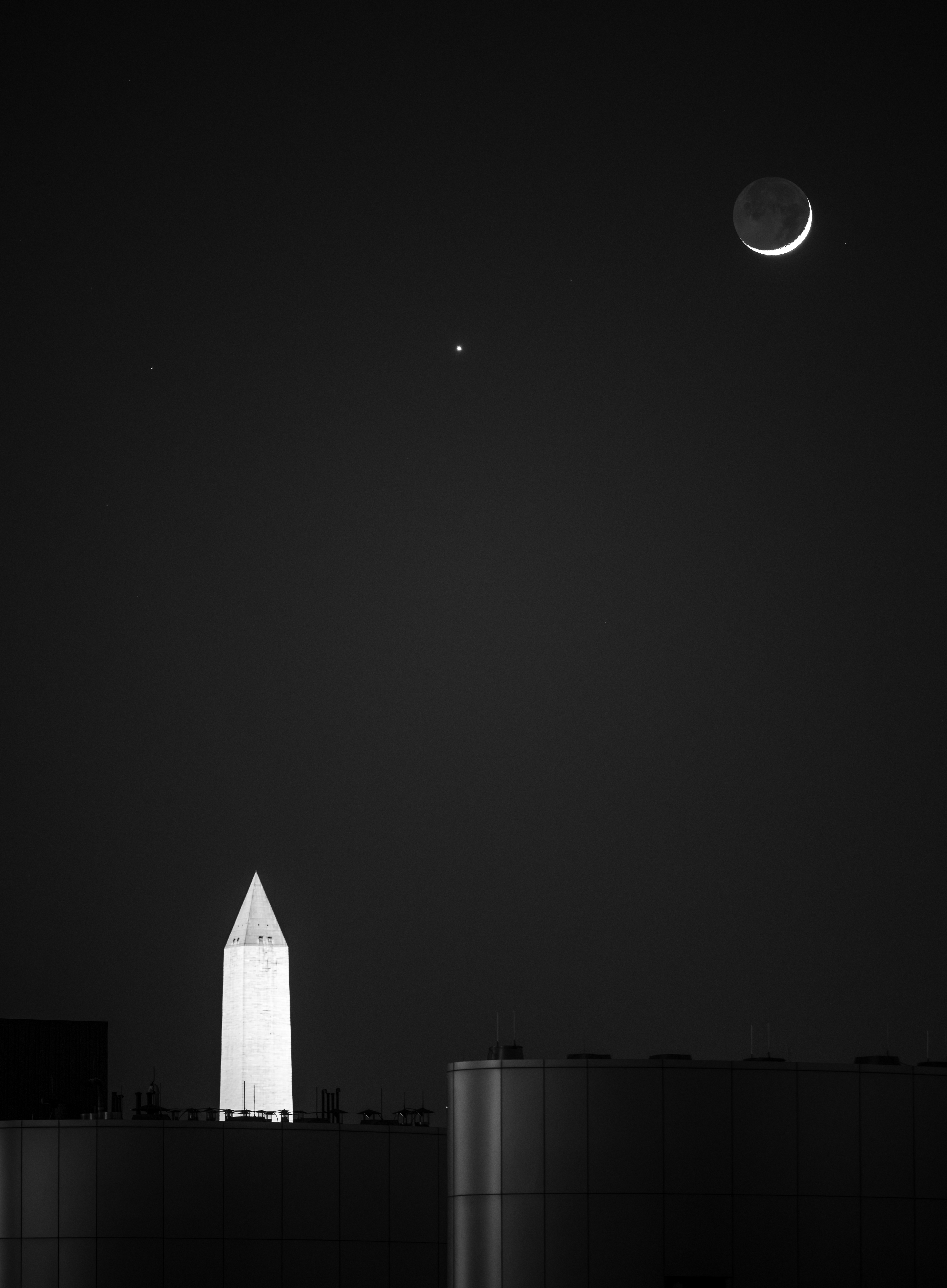
The Moon and Venus, center, are seen in conjunction above the Washington Monument, Monday, May 18, 2026, as viewed from the Mary W. Jackson NASA Headquarters Building in Washington.
The Moon and Venus look close together because they line up from our point of view on Earth. In reality, they are separated by millions of miles in space.
See more photos of the conjunction.
Image credit: NASA/Bill Ingalls