
Feed aggregator
Ancient bacterium’s genome could rewrite the history of syphilis
Treponema pallidum, a microorganism that can cause a deadly sexually transmitted disease in humans, may have a far more ancient lineage than scientists once thought
Parents might age faster or slower based on how many kids they have
A new study found that women in Finland who had a lot of kids—or none—aged faster than those with one or a few kids. But the findings don’t necessarily translate to today’s parents
Probing the Mysteries of the Solar Corona with ESA’s Proba-3
Some really unique science can be done during a total solar eclipse. Totality is the one time we can see the elusive corona of the Sun, the pearly white segment of our host star’s lower atmosphere where space weather activity originates. The trouble is, totality is fleeting. What researchers really need are eclipses on demand. ESA’s innovative Proba-3 mission does just that, by making use of a free-flying occulting disk. Launched in late 2024, we’re now seeing some unique science and images from the space observatory.
Our oral microbiome could hold the key to preventing obesity
Our oral microbiome could hold the key to preventing obesity
Ancient giant kangaroos could have hopped despite their huge size
Ancient giant kangaroos could have hopped despite their huge size
NASA AI Model That Found 370 Exoplanets Now Digs Into TESS Data
4 min read
NASA AI Model That Found 370 Exoplanets Now Digs Into TESS Data This artist’s impression shows the star TRAPPIST-1 with two planets transiting across it. ExoMiner++, a recently updated open-source software package developed by NASA, uses artificial intelligence to help find new transiting exoplanets in data collected by NASA’s missions. NASA, ESA, and G. Bacon (STScI)
Scientists have discovered over 6,000 planets that orbit stars other than our Sun, known as exoplanets. More than half of these planets were discovered thanks to data from NASA’s retired Kepler mission and NASA’s current TESS (Transiting Exoplanet Survey Satellite) mission. However, the enormous treasure trove of data from these missions still contains many yet-to-be-discovered planets. All of the data from both missions is publicly available in NASA archives, and many teams around the world have used that data to find new planets using a number of techniques.
In 2021, a team from NASA’s Ames Research Center in California’s Silicon Valley created ExoMiner, a piece of open-source software that used artificial intelligence (AI) to validate 370 new exoplanets from Kepler data. Now, the team has created a new version of the model trained on both Kepler and TESS data, called ExoMiner++.
Artist’s impression of NASA’s Transiting Exoplanet Survey Satellite (TESS), which launched in 2018 and has discovered nearly 700 exoplanets so far. NASA’s ExoMiner++ software is working toward identifying more planets in TESS data using artificial intelligence. NASA’s Goddard Space Flight Center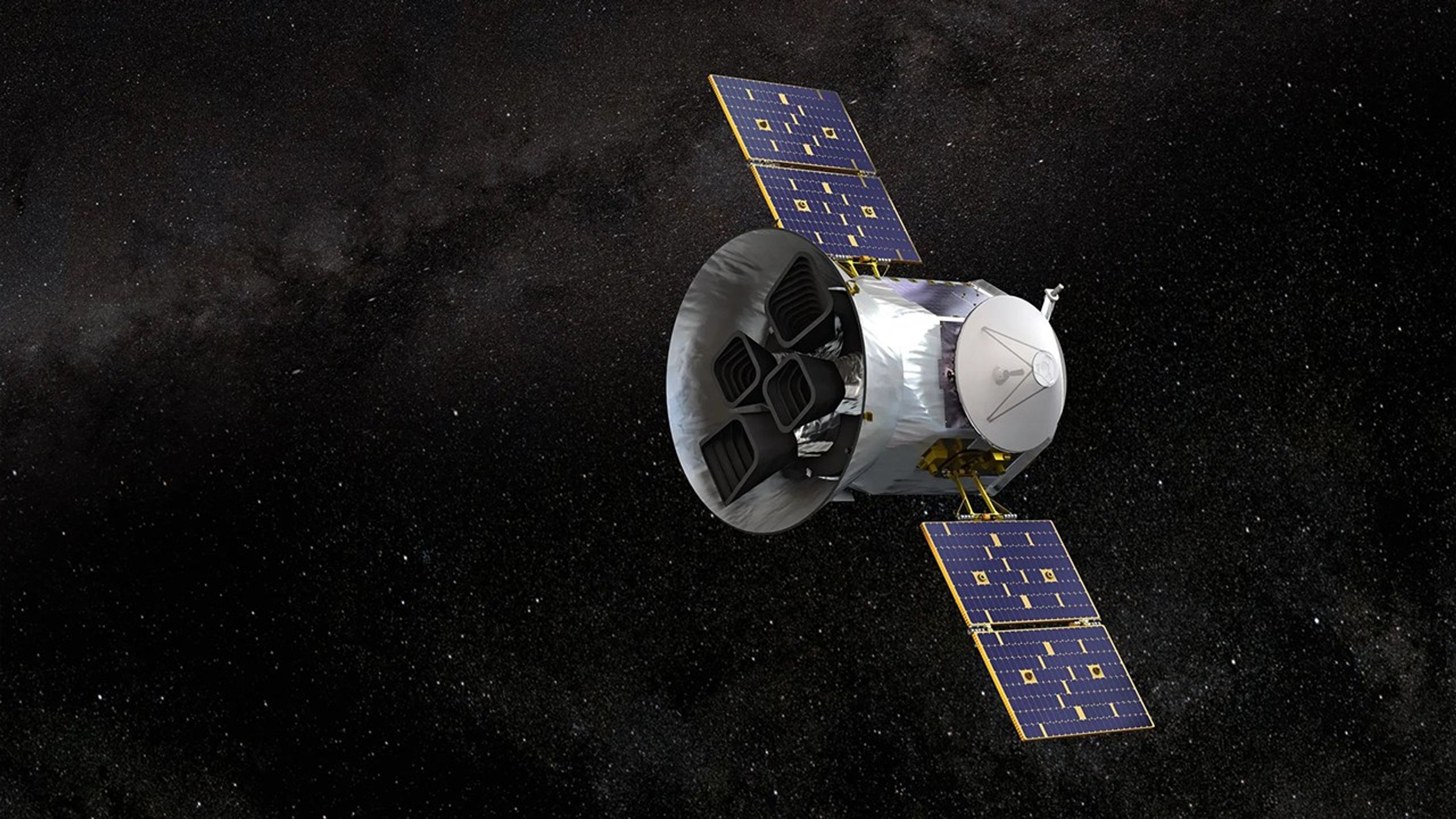
The new algorithm, which is discussed in a recent paper published in the Astronomical Journal, identified 7,000 targets as exoplanet candidates from TESS on an initial run. An exoplanet candidate is a signal that is likely to be a planet but requires follow-up observations from additional telescopes to confirm.
ExoMiner++ can be freely downloaded from GitHub, allowing any researcher to use the tool to hunt for planets in TESS’s growing public data archive.
“Open-source software like ExoMiner accelerates scientific discovery,” said Kevin Murphy, NASA’s chief science data officer at NASA Headquarters in Washington. “When researchers freely share the tools they’ve developed, it lets others replicate the results and dig deeper into the data, which is why open data and code are important pillars of gold-standard science.”
ExoMiner++ sifts through observations of possible transits to predict which ones are caused by exoplanets and which ones are caused by other astronomical events, such as eclipsing binary stars. “When you have hundreds of thousands of signals, like in this case, it’s the ideal place to deploy these deep learning technologies,” said Miguel Martinho, a KBR employee at NASA Ames who serves as the co-investigator for ExoMiner++.
To view this video please enable JavaScript, and consider upgrading to a web browser that
supports HTML5 video
Kepler and TESS operate differently — TESS is surveying nearly the whole sky, mainly looking for planets transiting nearby stars, while Kepler looked at a small patch of sky more deeply than TESS. Despite these different observing strategies, the two missions produce compatible datasets, allowing ExoMiner++ to train on data from both telescopes and deliver strong results. “With not many resources, we can make a lot of returns,” said Hamed Valizadegan, the project lead for ExoMiner and a KBR employee at NASA Ames.
The next version of ExoMiner++ will improve the usefulness of the model and inform future exoplanet detection efforts. While ExoMiner++ can currently flag planet candidates when given a list of possible transit signals, the team is also working on giving the model the ability to identify the signals themselves from the raw data.
Open-source science and open-source software are why the exoplanet field is advancing as quickly as it is.Jon Jenkins
Exoplanet Scientist, NASA Ames Research Center
In addition to the ongoing stream of data from TESS, future exoplanet-hunting missions will give ExoMiner users plenty more data to work with. NASA’s upcoming Nancy Grace Roman Space Telescope will capture tens of thousands of exoplanet transits — and, like TESS data, Roman data will be freely available in line with NASA’s commitment to Gold Standard Science and sharing data with the public. The advances made with the ExoMiner models could help hunt for exoplanets in Roman data, too.
“The open science initiative out of NASA is going to lead to not just better science, but also better software,” said Jon Jenkins, an exoplanet scientist at NASA Ames. “Open-source science and open-source software are why the exoplanet field is advancing as quickly as it is.”
NASA’s Office of the Chief Science Data Officer leads the open science efforts for the agency. Public sharing of scientific data, tools, research, and software maximizes the impact of NASA’s science missions. To learn more about NASA’s commitment to transparency and reproducibility of scientific research, visit science.nasa.gov/open-science. To get more stories about the impact of NASA’s science data delivered directly to your inbox, sign up for the NASA Open Science newsletter.
By Lauren Leese
Web Content Strategist for the Office of the Chief Science Data Officer
Article
2 weeks ago
5 min read NASA’s Hubble Sees Asteroids Colliding at Nearby Star for First Time
Article
1 month ago
6 min read NASA’s Webb Observes Exoplanet Whose Composition Defies Explanation
Article
1 month ago
Keep Exploring Discover Related Topics
Missions
Humans in Space
Climate Change
Solar System
NASA AI Model That Found 370 Exoplanets Now Digs Into TESS Data
4 min read
NASA AI Model That Found 370 Exoplanets Now Digs Into TESS Data This artist’s impression shows the star TRAPPIST-1 with two planets transiting across it. ExoMiner++, a recently updated open-source software package developed by NASA, uses artificial intelligence to help find new transiting exoplanets in data collected by NASA’s missions. NASA, ESA, and G. Bacon (STScI)Scientists have discovered over 6,000 planets that orbit stars other than our Sun, known as exoplanets. More than half of these planets were discovered thanks to data from NASA’s retired Kepler mission and NASA’s current TESS (Transiting Exoplanet Survey Satellite) mission. However, the enormous treasure trove of data from these missions still contains many yet-to-be-discovered planets. All of the data from both missions is publicly available in NASA archives, and many teams around the world have used that data to find new planets using a number of techniques.
In 2021, a team from NASA’s Ames Research Center in California’s Silicon Valley created ExoMiner, a piece of open-source software that used artificial intelligence (AI) to validate 370 new exoplanets from Kepler data. Now, the team has created a new version of the model trained on both Kepler and TESS data, called ExoMiner++.
Artist’s impression of NASA’s Transiting Exoplanet Survey Satellite (TESS), which launched in 2018 and has discovered nearly 700 exoplanets so far. NASA’s ExoMiner++ software is working toward identifying more planets in TESS data using artificial intelligence. NASA’s Goddard Space Flight CenterThe new algorithm, which is discussed in a recent paper published in the Astronomical Journal, identified 7,000 targets as exoplanet candidates from TESS on an initial run. An exoplanet candidate is a signal that is likely to be a planet but requires follow-up observations from additional telescopes to confirm.
ExoMiner++ can be freely downloaded from GitHub, allowing any researcher to use the tool to hunt for planets in TESS’s growing public data archive.
“Open-source software like ExoMiner accelerates scientific discovery,” said Kevin Murphy, NASA’s chief science data officer at NASA Headquarters in Washington. “When researchers freely share the tools they’ve developed, it lets others replicate the results and dig deeper into the data, which is why open data and code are important pillars of gold-standard science.”
ExoMiner++ sifts through observations of possible transits to predict which ones are caused by exoplanets and which ones are caused by other astronomical events, such as eclipsing binary stars. “When you have hundreds of thousands of signals, like in this case, it’s the ideal place to deploy these deep learning technologies,” said Miguel Martinho, a KBR employee at NASA Ames who serves as the co-investigator for ExoMiner++.
To view this video please enable JavaScript, and consider upgrading to a web browser that
supports HTML5 video
Kepler and TESS operate differently — TESS is surveying nearly the whole sky, mainly looking for planets transiting nearby stars, while Kepler looked at a small patch of sky more deeply than TESS. Despite these different observing strategies, the two missions produce compatible datasets, allowing ExoMiner++ to train on data from both telescopes and deliver strong results. “With not many resources, we can make a lot of returns,” said Hamed Valizadegan, the project lead for ExoMiner and a KBR employee at NASA Ames.
The next version of ExoMiner++ will improve the usefulness of the model and inform future exoplanet detection efforts. While ExoMiner++ can currently flag planet candidates when given a list of possible transit signals, the team is also working on giving the model the ability to identify the signals themselves from the raw data.
Open-source science and open-source software are why the exoplanet field is advancing as quickly as it is.Jon Jenkins
Exoplanet Scientist, NASA Ames Research Center
In addition to the ongoing stream of data from TESS, future exoplanet-hunting missions will give ExoMiner users plenty more data to work with. NASA’s upcoming Nancy Grace Roman Space Telescope will capture tens of thousands of exoplanet transits — and, like TESS data, Roman data will be freely available in line with NASA’s commitment to Gold Standard Science and sharing data with the public. The advances made with the ExoMiner models could help hunt for exoplanets in Roman data, too.
“The open science initiative out of NASA is going to lead to not just better science, but also better software,” said Jon Jenkins, an exoplanet scientist at NASA Ames. “Open-source science and open-source software are why the exoplanet field is advancing as quickly as it is.”
NASA’s Office of the Chief Science Data Officer leads the open science efforts for the agency. Public sharing of scientific data, tools, research, and software maximizes the impact of NASA’s science missions. To learn more about NASA’s commitment to transparency and reproducibility of scientific research, visit science.nasa.gov/open-science. To get more stories about the impact of NASA’s science data delivered directly to your inbox, sign up for the NASA Open Science newsletter.
By Lauren Leese
Web Content Strategist for the Office of the Chief Science Data Officer
Article
2 weeks ago
5 min read NASA’s Hubble Sees Asteroids Colliding at Nearby Star for First Time
Article
1 month ago
6 min read NASA’s Webb Observes Exoplanet Whose Composition Defies Explanation
Article
1 month ago
Keep Exploring Discover Related Topics
Missions
Humans in Space
Climate Change
Solar System
Watch Stellar Explosions Near and Far (Videos)
New videos from the Solar Orbiter and the Chandra X-ray Observatory capture magnetic avalanches on the Sun and the exploding remnants of a star 17,000 light-years away.
The post Watch Stellar Explosions Near and Far (Videos) appeared first on Sky & Telescope.
Does limiting social media help teens? We'll finally get some evidence
Does limiting social media help teens? We'll finally get some evidence
Mutations from Space Might Solve an Antibiotic Crisis
If humans are ever going to expand into space itself, it will have to be for a reason. Optimists think that reason is simply due to our love of exploration itself. But in history, it is more often a profit motive that has led humans to seek out new lands. So, it stands to reason that, in order for us to truly begin space colonization, we will have to have a business-related reason to do so. A new paper from the lab of Srivatsan Raman at the University of Wisconsin-Madison and recently published in PLOS Biology, describes one potential such business case - genetically modifying bacteriophages to attack antibiotic resistant bacteria.
Scientists just calculated how many microplastics are in our atmosphere. The number is absolutely shocking
A new estimate suggests land sources eject 600 quadrillion pieces of microplastic into the atmosphere every year
Arctic Weather Satellite paves way for constellation
Already recognised for its excellence and even adopted for operational weather forecasting, the European Space Agency’s Arctic Weather Satellite has now fulfilled its most important role. This small prototype mission has succeeded in paving the way for a new constellation of similar satellites, known as EPS-Sterna.
Strips of dried placenta help wounds heal with less scarring
Strips of dried placenta help wounds heal with less scarring
A celebrity cluster in the spotlight
#779: Milankovitch Cycles
Humans live short lives, and from our perspective the seasons are something that come and go with perfect regularity. But astronomers know the terrible truth! And that there are cycles that slowly shift over tens of thousands of years, shifting the cycles and the Earth’s climate. Today we’ll talk about the Milankovich Cycles! The Earth’s orbit, tilt, and other physical attributes aren’t quite as constant as you might think! Come learn how long-term changes do and don’t affect our climate.
Show Notes- Milankovitch Cycles Explained
- Historical Context
- Earth’s Orbital Mechanics
- Axial Tilt and Precession
- Climate and Glaciation
- Earth in a Larger Cosmic Context
- Science in Progress
Fraser Cain:
Welcome to AstronomyCast, our weekly facts-based journey through the Cosmos, where we help you understand not only what we know, but how we know what we know. I’m Fraser Cain. I’m the publisher of Universe Today.
With me is Dr. Pamela Gay, a senior scientist for the Planetary Science Institute and the director of CosmoQuest. Hey Pamela, how you doing?
Dr. Pamela Gay:
I am doing well. Next week we will not be recording live because I’m actually going on a vacation.
Fraser Cain:
Right on. So I have been going through old media that I recall loving, but hadn’t watched recently. And so I think I might’ve mentioned to people that I re-watched the original Lord of the Rings trilogy, the ones with the extended editions in the box set with the four discs per, man, they’re so great.
Like obviously the movies were great, but just that we’ve entered this world where nobody wants to see behind the scenes to hear the commentary, to see the additional deleted scenes.
Dr. Pamela Gay:
I don’t understand that.
Fraser Cain:
Yeah. Like, like as a media creator, I want to see how the sausage gets made. And so being able to see all of these little featurettes that they publish in addition to that is so wonderful.
And I’m guessing that Netflix tried this and just found that, that people were watching them and they’re like, who cares? Right? Like we don’t even need any of this stuff anymore.
Let’s just get the movie and get in, get out.
Dr. Pamela Gay:
So Disney Plus does do them for their Star Wars shows. So each of the Star Wars shows has a behind the scenes special. And those are actually really cool.
They make me want to go try there. They have this giant room that they record in that allows them to like, yeah, it’s amazing.
Fraser Cain:
Yeah. So keep doing that. And then I watched the Matrix series and they held up, especially the first one, like the first one.
There’s a few bits in the beginning where I was like, oh, cringe. Right. But then the rest of the movie I thought was absolutely terrific.
I enjoyed the next two movies. I know a lot of people, although I really disliked the ending of the third movie. So, um, and then I rewatched Moon, which is with Sam Rockwell and where he’s a, he’s an astronaut on the moon running a mining operation.
And it’s, it’s such a great movie. Oh, it’s so good. So, uh, and that was a long time since I’ve watched that movie.
And so I’d forgotten most of the details. And so I’m really enjoying realizing that there are movies that I have enjoyed in the past. And now my, my, I don’t remember the details from scene to scene.
And so it’s kind of like I’m rewatching it fresh. And yet I know that this is going to be a guaranteed great movie. So, uh, if you haven’t already go back, find movies that it’s been so long that you probably don’t remember the details, but you know, you’re going to love them.
Television shows.
Dr. Pamela Gay:
Blade Runner.
Fraser Cain:
Yeah.
Dr. Pamela Gay:
So good. Yeah.
Fraser Cain:
I watched, I watched Blade Runner with my wife probably about six years ago with that sort of same idea. And then we watched the 2049, but now I don’t even remember how 2049 went, so it’s time to watch it again. So there you go.
That’s my recommendation. Go back, find some old media that you’re kind of nostalgic about, but you’re holding off because like, I’ve seen that movie. Have you?
Do you remember it? Are those neurons? Are those neurons still present?
Dr. Pamela Gay:
See it in the modern political context.
Fraser Cain:
Hmm. There you go. Humans live short lives and from our perspective, the seasons are something that come and go with perfect regularity.
But astronomers know the terrible truth and that there are cycles that slowly shift over tens of thousands of years, shifting the cycles and the Earth’s climate. Today we’ll talk about the Milankovitch cycles. So I think we’re going to need another disclaimer.
And that is that all of the cycles that we’re going to talk about and their influence on the Earth’s climate happen very slowly and they have absolutely no connection to the climate change that scientists are currently measuring. It’s also true. Right.
And so they are, you know, that we are sort of forcing climate change because of the greenhouse gases that are being emitted by our modern civilization in a way that is very easy to calculate. You can literally do this on the back of an envelope, calculate, you know, take the volume of the mass, the volume of the Earth’s atmosphere, measure the amount of carbon dioxide that’s in it. You can calculate the average global temperature that will be expected at various concentrations and there will be sort of specific differences depending on whether it’s the Arctic.
That’s where the complexity comes in, all the simulation and so on, but you can just do this math. So I know like some of you are going to say, I’m never going to listen to astronomy cast again. That’s fine.
You know, like you’re going to, you got to do what you got to do. I know that some of you are going to be sort of angry that we’re not sort of, or that you’re hoping that we are going to somehow turn this into an explanation for climate change and we are not. No.
We’re just that these unfold on cycles that are much longer. So, so with that, and I don’t want to like dance around the reality of the astronomy and the geology and the, and the ball of that, things can be true at once.
Dr. Pamela Gay:
There can be ongoing orbital kinematic cycles and there can be anthropogenic climate change. Both can be true.
Fraser Cain:
Yes. And so, you know, can the Milankovitch cycles be, uh, there was the, the explanation for climate change? No, people checked.
Yeah. So there you go. And like, we don’t need to go into that.
Like there’s a whole other world where there’s all kinds of papers where people are checking and it has no effect. So let’s get on then to the Milankovitch cycles with this sort of like, Hey, it’s 1971 and we’ve never sort of experienced the modern political diatribe, uh, against, uh, the results of, of climate science work. And people just want to learn about the kinematics and, uh, orbital, uh, interesting things that happen with planets going around stars.
So let’s talk about the cycles.
Dr. Pamela Gay:
So you know, first you have to go all the way back to the 1920s, which is really cool to me. But do you have to go back to like the, before the BCE, like you have to go back to the Greeks? I mean, you could.
I want to. We’ve actually known about precession for a long time because folks like Ptolemy that were looking back through historic calendars of stellar positions were able to track the changing North pole. It was more complicated than that.
I just oversimplified a whole lot of stuff there.
Fraser Cain:
I’m going to rabbit hole for one second, which is that the ancient Greeks suspected that the earth orbits around the sun and that the proof that they, that they would use to confirm that was that they were looking for a stellar parallax. And we know now that that parallax is there, but you know, essentially the shifting of the view of the stars based on the position of the earth, whether it’s on one side of the sun or the other, right? That’s how you tell that the earth is going around the sun.
You know, it’s this background that is sort of shifting back and forth every year. And they knew that that’s what you would expect to see. And they tried to find it, but all they had were these little sighting tubes that they use that they would align with a star at the right time and the right place.
And they couldn’t measure to the level of precision that was required to be able to confirm the stellar parallax. And so they went down the, no, no, no. The earth is the center of the universe.
Yeah. Amazing. The Greeks were amazing what they could, what they were able to do anyway.
So yeah, they had their suspicions. They were already starting to detect the motion of, of the stars in the sky year after year.
Dr. Pamela Gay:
They just underestimated the, the size of the universe. And when you underestimate the size of the universe, you expect the parallax is to be much, much bigger than it actually is. But they did see other motions in the sky over time.
And that’s just super cool. There’s neat stories related to the salinity of the oceans that you can go find. There’s all sorts of cool stuff.
Now it was in the 1920s that folks tried to like mathematically take this on as geophysics began to be an actual field. So the 1920s is when astrophysics was born, when geophysics was born, when we started taking all of these things that we observed and having enough understanding of math to be able to say, well, this is why we see these things we see. And they had started to realize at this point that there had been geological cycles with glacial periods.
Europe has lots and lots of evidence for glaciers. North America has evidence for glaciers. And so a Serbian scientist, Milutin Milankovic, in the 1920s worked through James Kroll’s earlier work, trying to do all the maths by hand to figure out, all right, what are the different motions we need to consider?
And so you have things like our Earth’s orbit is mostly circular, but not perfectly circular. So at the beginning of January is when the Earth is closest to the sun. It’s a fairly small effect, but it adds up.
And over the course of millennia, Jupiter and Saturn’s influence causes the orbit to get slightly more elliptical and slightly rounder and slightly more elliptical and slightly rounder. We’re actually heading towards a rounder phase right now. But the degree of change this causes is several days per season of asymmetry between the seasons.
So here in the northern hemisphere, because you move faster in your orbit when you’re closer to the sun, we have a slightly shorter winter, we are getting slightly more sunlight. So the summer to winter dichotomy in the north is less than it is in the south. And we literally get less winter in the north.
So that is excellent. Someday, the orbit will be much closer to round and it will essentially be equal seasons for everybody. But we’re not there right now.
We’re headed that direction.
Fraser Cain:
And how long does that cycle take?
Dr. Pamela Gay:
So this is one of those cycles that isn’t as periodic as others because you’re dealing with Jupiter’s orbit and you’re dealing with Saturn’s orbit. So when you’re looking up the extremes, the extremes occur on millions of years. So like the highest eccentricity ever was 250 million years ago.
Fraser Cain:
And that’s like the Earth’s orbit was the most elliptical that it could be.
Dr. Pamela Gay:
Yeah. Yeah. And so in general, there’s a 400,000 year coupling and it’s paired up with the 100,000 year cycles that we see from other factors.
Right.
Fraser Cain:
So about every 100,000 years, you get a sort of a full cycle through the Earth moving from what is a more circular orbit to a more elliptical orbit. And we, as you mentioned, we experience these seasons. The north experiences shorter winters, longer summers.
The south experiences longer winters, shorter summers. And partly that’s due to the eccentricity. Essentially, Earth is at its closest point to the sun when the northern hemisphere is having, is dead in the heart of its winter.
It’s so close to solstice. Yeah. Yeah.
Dr. Pamela Gay:
It’s wild.
Fraser Cain:
Yeah. It’s incredible. And so I know winter may feel like it sucks for the northern hemisphere, but it could be worse consider the people in the southern hemisphere.
And one of the things that we see is that the Arctic can have extremely cold temperatures, but Antarctica has ludicrously cold temperatures. So yeah. So weirdly, the southern hemisphere experiences these more severe winters than we experience in the north.
Dr. Pamela Gay:
And there’s other weird stuff on top of this, like the fact that there’s so much land in the north. Yes. That has all sorts of weird effects because oceans are thermal sinks and land is capable of varying much faster.
So we know there’s other complicating factors on top of this, and that’s what makes it awesome.
Fraser Cain:
And so this shift is driven by the interactions of the gravity from Jupiter and Saturn on the Earth’s orbit, tugging it bit by bit by bit, orbit after orbit after orbit, slowly circularizing its orbit, and then slowly making its orbit more eccentric again. So that is the first cycle.
Dr. Pamela Gay:
Yes.
Fraser Cain:
Let’s move on to book two of the Milankovitch cycles.
Dr. Pamela Gay:
So that is describing the overall shape of our orbit. Now, once you have the shape of the orbit to contend with, you have the Earth’s position within that orbit, by which I mean the way we’re tilted. So we’re quite lucky right now that for us here in the northern hemisphere, I mean, we have winter solstice so close to perihelion.
It didn’t have to be that way. And the tilt that we have right now isn’t hugely problematic. It’s 23.4 degrees. And that tilt will vary over time from 22.1 to 24.5. So we have this tilt that’s varying, and we have the whole thing is rotating. So the amount that we’re tilted can get more extreme, which makes the seasons more extreme.
Fraser Cain:
Right.
Dr. Pamela Gay:
And where we’re pointed relative to the stars will change. And the tilt is changing on a 41,000-year cycle.
Fraser Cain:
Okay. All right. So I’ve sort of imagined this imaginary line that’s passing through the poles of the Earth, and the Earth is spinning around this imaginary line.
Yeah. And if you sort of look at the angle of what that line is, it’s sort of slowly drifting down and then slowly drifting up, slowly drifting back and forth over this 41,000 years. And so during that 41,000-year period, you’ll have the point of the maximum thing, and then it will go through the minimum and then return to the maximum.
And that’s sort of your cycle, your 41,000 years. And so we’re at 20… You said 23.4. Yeah. So we’re kind of smack in the middle of the potential axial tilt. Yeah, it’s perfectly reasonable. A more extreme axial tilt or a less extreme axial tilt.
And I guess if we had zero axial tilt, then there would be no seasons. Everything would be the same every day forever.
Dr. Pamela Gay:
And then on top of this, that entire tilt is rotating. It’s precession like the precession of a top, and that is happening on a 25.7,000-year cycle. So every 25,700 years, that is rotating.
And so that change changes when the seasons are occurring throughout the year.
Fraser Cain:
Right. And I think we all learned, hopefully, in elementary school or whatever, how the seasons work. I’m sure a pop quiz, when you ask somebody how the seasons work, but essentially…
Dr. Pamela Gay:
A lot of people have no idea. It’s really kind of amazing.
Fraser Cain:
Yeah, yeah, yeah. But the gist is, again, imagine the Earth. It’s this ball that’s spinning.
It’s tilted at an angle of 23.5 degrees. During the summertime, the Northern Hemisphere is tilted towards the sun. Therefore, it’s experiencing more sunlight, and the Southern Hemisphere is experiencing less sunlight.
And then when the situation is reversed, then it’s the Southern Hemisphere that’s experiencing more sunlight, and it’s the Northern Hemisphere that’s receiving less. But in addition to that kind of angle changing, you also get this wobbling of the top. And as you said, the seasons reverse over the course of about 26,000 years.
I’ll bet you we did the same thing. Think back to young Pamela in high school or elementary school, learning this baffling fact and doing the math to figure out how quickly the days change. Did you do that?
No. I did. Oh, man.
I was like, wait a minute. That means that since the Roman time, the seasons have shifted by some number of days. And I calculated, I forget what, a handful of days, like a couple of weeks have shifted.
That summer has arrived, I don’t know, earlier or later, I forget which way it goes, by a measurable number of days than what they used to experience.
Dr. Pamela Gay:
These are things that have to get taken into account in archaeology. And so when you’re trying to consider historical reports of the seasons that things occurred from enough thousands of years ago, slight changes that when you’re dating things based on what flowers are in bloom, that’s the kind of stuff that kind of matters. And it’s just wild to think about all the different changes that are going on.
And it all comes down to just a little bit of torque here, a little bit of torque there. It’s all about uneven forces over time.
Fraser Cain:
And so what’s driving the wobble?
Dr. Pamela Gay:
So it all comes down to the Earth isn’t a perfect sphere and the sun and the moon’s gravitational force just do a little bit more yanking where there’s a little bit more stuff to yank on and that adds up to create this torque that generates the precession that we see.
Fraser Cain:
Okay, well, we’re going to continue on to chapter three of the Milankovitch cycle. All right, let’s move on to book three. That was my favorite book in the trilogy of the Milankovitch cycle.
No, I have no opinion.
Dr. Pamela Gay:
So on top of this, you have the Earth’s ellipticity means that there’s an axis of the orbit that is longer and an axis of the orbit that is shorter. And where those axes are, are rotating over time. And so you have how much the Earth’s orbit is round changes over time.
You have the tilt changes over time. You have where the tilt is pointed changing over time. And you have where the orbit is pointed changing over time.
And yeah, it all adds up to change. You have to keep track of both. Where is the nearest point of the sun?
Where’s the furthest point of the sun relative to the stars? And also, where is the north and south pole pointed relative to the stars? So that you can figure out how do the solstices and perihelion and apohelion all line up or fail to line up.
Fraser Cain:
And so what impact did this have historically on the climate of the Earth?
Dr. Pamela Gay:
Well, so it was expected that there’d be a order of tens of thousands of years cycle in the glacial period. For reasons we have not figured out yet, there is a hundred thousand cycle in the glaciation period. And again, we’re still trying to figure out what are the additional effects that were missed the first time around?
Like one of the effects that was missed the first time around is the tilt of the orbit relative to the moment of inertia of the solar system has changed over time.
Fraser Cain:
Right. So sorry. Yeah.
So like the Earth is tilted off of the sun’s orbit. Yeah, the Earth’s orbit is tilted.
Dr. Pamela Gay:
Off of Jupiter’s defined plane that is kind of the primary plane of the solar system. Yeah.
Fraser Cain:
And so if you imagine you sort of hold your hand out and you kind of imagine like here’s the orbit of the sun. Here’s the equator of the sun. And then Earth is like slightly tilted off that.
We call that the plane of the ecliptic is where the Earth’s orbit is that that tilt is kind of going up and down as well. And that’s fairly new. Like this would be a fourth chapter that Milankovitch wrote after.
Dr. Pamela Gay:
But he didn’t write it.
Fraser Cain:
But he didn’t write it. No, no. But like if he did, you know, he wanted to make more money because the trilogy had done so well.
He would have written part four, the orbital inclination. But you know, he never got around to that chapter. So, um, but, but like, isn’t it really about that?
Sometimes these forces, these, these positions average each other out that they do that you’ve got. We’re a little bit close. You know, we’re, we’re on average closer to the sun.
Things are kind of warmer, but then we’re on average like a little more tilted away. The northern hemisphere is more extreme, but then, but then it’s pushing in another way and things get bad when they all line up in the worst possible ways. So you get the coldest, the most extreme, all of these things start to compound on each other.
And then you can find those in the geologic record of like, oh yeah, we had a really bad glacier. Well, no, no kidding. We had, you know, we, we, that all those variations are happening cycle after cycle after cycle.
And each one is having this independent experience, you know, cause to the earth. And sometimes they all balance out and there’s no change. And other times each one is hits the extreme and then you get a severe glaciation or a very long warm period.
Right.
Dr. Pamela Gay:
And, and the other issue that we have to deal with is there’s probably stuff that we just haven’t found in the geologic record because for the most part, each new glacial period likes to just scrape away the evidence of the past glaciation period. We periodically get things like asteroid impacts that kill the dinosaurs. We get massive changes to the life forms on the planet that lead to massive anoxic events and stuff like that.
And so each of the things that is tied to massive die offs does its own part to the environment of our world. So yes, human beings are changing our planet. We are not the first life form to do this.
We are just the most recent to do this. And, and so the geologic record is super complicated to couple with, with what caused what, because sometimes it’s the volcanoes got angry and Siberia, all of it erupted because it could. The Siberian traps is the most terrifying thing in the geologic record as near as I can tell.
Just, just saying.
Fraser Cain:
Right.
Dr. Pamela Gay:
Yeah. If you, if you want to stay awake at night, go read about that.
Fraser Cain:
Look at the Deccan traps.
Dr. Pamela Gay:
Yeah. That’s another one that’s terrifying. So trying to understand, is it, what, what have we missed?
What secondary effects are we missing? What additional things do we need to take into consideration? We’re still learning all of this and that’s what’s so amazing and why we keep doing science is because there is so much stuff left to learn and hopefully to find in, in some rock outcrop we haven’t explored yet.
And this is the thing that the folks who work in fossils are constantly discovering is there’s going to be a new cave. There’s going to be a new rock outcrop. There’s going to be a new, something erodes and uncovers something amazing.
And we’ll find the answers over time.
Fraser Cain:
So one interesting cycle that is sort of disconnected is that the, the solar system is moving around the galaxy, around the Milky Way. Yeah. And that it has, like the, like the earth is going sort of up and down in its orbit compared to the sun, the solar system bobs up and down in the Milky Way as it orbits around.
And that it’s thought that maybe that there, that the solar system is protected by the mutual magnetic fields in the interstellar medium. And so there are times when maybe the, as the solar system rises up above the galactic plane, it can experience more cosmic radiation and maybe that could have led to times of greater die-offs on the, on the planet. So, so, you know, although there’s, there’s no sun that we are orbiting in the Milky Way that is, you know, giving us illumination that we need that defines the global temperature.
There can be, you know, particles that are colliding with the planet, whether, depending on our position above and below the galactic plane, which is a totally different cycle. And, you know, not necessarily super confirmed to be a thing, but it’s kind of interesting to think about these even larger cycles. It’s all cycles within cycles.
Dr. Pamela Gay:
And that one is thought to also be tied to the, the sudden, a whole bunch more comets get sent on their way into the inner solar system. They also get sent out of the solar system. They get sent in both directions.
Fraser Cain:
Yeah. Yeah. Or, or like I said, or less protection from cosmic rays by the some magnetic fields of all of the stars.
So yeah, it’s a, it’s a very interesting sort of idea to think about. Cool. Well, there you go.
The Milankovitch cycle.
Dr. Pamela Gay:
And now you know.
Fraser Cain:
And now you know. Thanks Pamela.
Dr. Pamela Gay:
Thank you, Fraser. And thank you so much to everyone out on Patreon that supports us and allows us to keep putting these episodes together. This week.
I’d like to thank the following $10 a month and up patrons. Abraham Cottrell, Alex Cohen, Andrew Allen, Andy Moore, Arno DeGroot, Bore Andro-Levsvall, Benjamin Carrier, Bill Smith, Boogie Nut, Brian Breed, Brian Kilby, Buzz Parsec, Claudia Mastriani, Cooper, Daniel Schechter, David Gates, Diane Philippon, Don Mundus, Ed, Eric Lee, Father Prax, Frederick Salvo, G. Caleb Sexton, Gerhard Schweitzer, Gold, Greg Vylde, Hannah Tackery, Jacob Houle, Jarvis Earl, Jeanette Wink, Jim McGeehan, Joanne Mulvey, John Muthis.
Thank you so very much.
Fraser Cain:
Thanks, Pamela. We’ll see you next week.
Dr. Pamela Gay:
Thank you, Fraser. Move on.
Fraser Cain:
I guess we won’t.
Dr. Pamela Gay:
No, next week we won’t. Next week. I’m I’m going on vacation with friends.
Fraser Cain:
We’ll see you in two weeks.
Dr. Pamela Gay:
Okay, bye-bye.
Live Shows