
Feed aggregator
Clouds Swimming over Lago Argentino
- Earth
- Earth Observatory
- Image of the Day
- EO Explorer
- Topics
- More Content
- About
Coverage, Briefing Set for NASA’s Artemis II Moon Rocket Roll to Pad
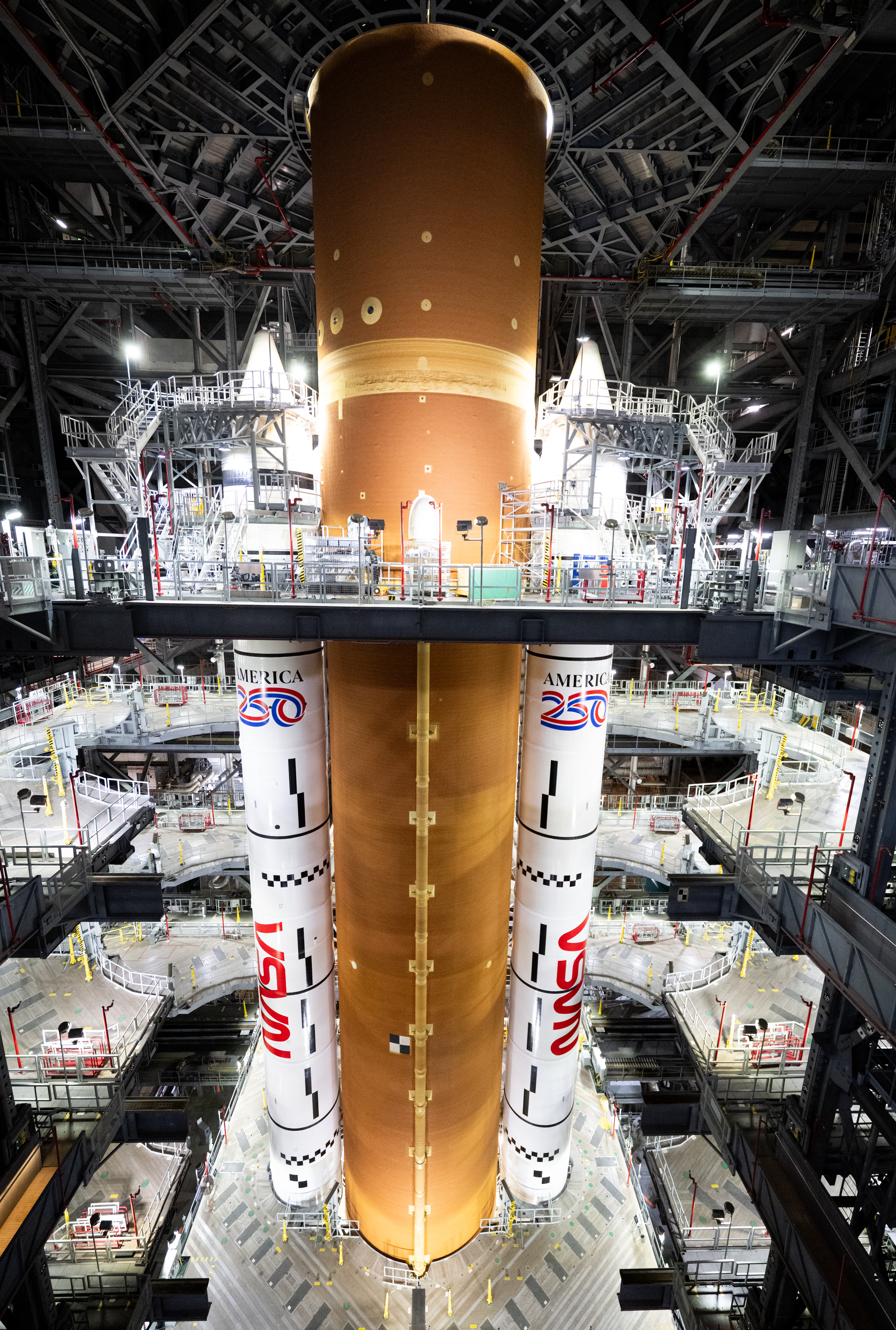
NASA’s integrated SLS (Space Launch System) rocket and Orion spacecraft for the Artemis II mission is inching closer to launch – literally.
The agency is targeting no earlier than 7 a.m. EST, Saturday, Jan. 17, to begin the multi-hour trek from the Vehicle Assembly Building to Launch Pad 39B at NASA’s Kennedy Space Center in Florida.
A pre rollout mission news conference, live feed of rollout, and a media gaggle will stream on NASA’s YouTube channel. Individual streams for each of these events will be available from that page. Learn how to stream NASA content through a variety of online platforms, including social media.
The time of rollout is subject to change if additional time is needed for technical preparations or weather.
All times are Eastern. Events are as follows:
Friday, Jan. 16:
12 p.m.: Artemis II Rollout, Mission Overview News Conference
- John Honeycutt, Artemis II mission management team chair
- Charlie Blackwell-Thompson, Artemis launch director, Exploration Ground Systems
- Jeff Radigan, Artemis II lead flight director, Flight Operations Directorate
- Lili Villarreal, landing and recovery director, Exploration Ground Systems
- Jacob Bleacher, chief exploration scientist, Exploration Systems Development Mission Directorate
Saturday, Jan. 17:
7 a.m.: Rollout, Artemis II Live Views from Kennedy Space Center feed begins
9 a.m.: Artemis II Crew Rollout Media Event
- NASA Administrator Jared Isaacman and the Artemis II crew, including NASA astronauts Reid Wiseman, Victor Glover, and Christina Koch, and CSA (Canadian Space Agency) astronaut Jeremy Hansen, will answer questions about their preparations and the mission for media in-person at the countdown clock.
NASA’s crawler-transporter 2 will carry the 11-million-pound stack at about one mile per hour along the four-mile route from the Vehicle Assembly Building to Launch Pad 39B, on a journey that will take up to 12 hours.
To participate in the news conference by telephone, media must RSVP no later than two hours before the start to: ksc-newsroom@mail.nasa.gov.
These events will be open in-person only to media previously credentialed for launch. The deadline has passed for in-person accreditation for Artemis II events at Kennedy.
Rollout to the pad marks another milestone leading up to the Artemis II mission. In the coming weeks, NASA will complete final preparations of the rocket and, if needed, rollback SLS and Orion to the Vehicle Assembly Building for additional work. While the Artemis II launch window opens as early as Friday, Feb. 6, the mission management team will assess flight readiness after the wet dress rehearsal across the spacecraft, launch infrastructure, and the crew and operations teams before selecting a launch date.
Follow NASA’s Artemis blog for mission updates.
Through Artemis, NASA will send astronauts to explore the Moon for scientific discovery, economic benefits, and to build the foundation for the first crewed missions to Mars.
Learn more about Artemis at:
-end-
Rachel Kraft / Lauren Low
Headquarters, Washington
202-358-1600
rachel.h.kraft@nasa.gov / lauren.e.low@nasa.gov
Tiffany Fairley
Kennedy Space Center, Fla.
321-867-2468
tiffany.l.fairley@nasa.gov
Coverage, Briefing Set for NASA’s Artemis II Moon Rocket Roll to Pad
NASA’s integrated SLS (Space Launch System) rocket and Orion spacecraft for the Artemis II mission is inching closer to launch – literally.
The agency is targeting no earlier than 7 a.m. EST, Saturday, Jan. 17, to begin the multi-hour trek from the Vehicle Assembly Building to Launch Pad 39B at NASA’s Kennedy Space Center in Florida.
A pre rollout mission news conference, live feed of rollout, and a media gaggle will stream on NASA’s YouTube channel. Individual streams for each of these events will be available from that page. Learn how to stream NASA content through a variety of online platforms, including social media.
The time of rollout is subject to change if additional time is needed for technical preparations or weather.
All times are Eastern. Events are as follows:
Friday, Jan. 16:
12 p.m.: Artemis II Rollout, Mission Overview News Conference
- John Honeycutt, Artemis II mission management team chair
- Charlie Blackwell-Thompson, Artemis launch director, Exploration Ground Systems
- Jeff Radigan, Artemis II lead flight director, Flight Operations Directorate
- Lili Villarreal, landing and recovery director, Exploration Ground Systems
- Jacob Bleacher, chief exploration scientist, Exploration Systems Development Mission Directorate
Saturday, Jan. 17:
7 a.m.: Rollout, Artemis II Live Views from Kennedy Space Center feed begins
9 a.m.: Artemis II Crew Rollout Media Event
- NASA Administrator Jared Isaacman and the Artemis II crew, including NASA astronauts Reid Wiseman, Victor Glover, and Christina Koch, and CSA (Canadian Space Agency) astronaut Jeremy Hansen, will answer questions about their preparations and the mission for media in-person at the countdown clock.
NASA’s crawler-transporter 2 will carry the 11-million-pound stack at about one mile per hour along the four-mile route from the Vehicle Assembly Building to Launch Pad 39B, on a journey that will take up to 12 hours.
To participate in the news conference by telephone, media must RSVP no later than two hours before the start to: ksc-newsroom@mail.nasa.gov.
These events will be open in-person only to media previously credentialed for launch. The deadline has passed for in-person accreditation for Artemis II events at Kennedy.
Rollout to the pad marks another milestone leading up to the Artemis II mission. In the coming weeks, NASA will complete final preparations of the rocket and, if needed, rollback SLS and Orion to the Vehicle Assembly Building for additional work. While the Artemis II launch window opens as early as Friday, Feb. 6, the mission management team will assess flight readiness after the wet dress rehearsal across the spacecraft, launch infrastructure, and the crew and operations teams before selecting a launch date.
Follow NASA’s Artemis blog for mission updates.
Through Artemis, NASA will send astronauts to explore the Moon for scientific discovery, economic benefits, and to build the foundation for the first crewed missions to Mars.
Learn more about Artemis at:
-end-
Rachel Kraft / Lauren Low
Headquarters, Washington
202-358-1600
rachel.h.kraft@nasa.gov / lauren.e.low@nasa.gov
Tiffany Fairley
Kennedy Space Center, Fla.
321-867-2468
tiffany.l.fairley@nasa.gov
Astronauts Evacuate the ISS after Medical Incident
The four members of Crew-11 are on their way back to Earth after one of them became unwell with an unknown condition
Eroding the Clean Air Act Will Make America Sicker, Dirtier and Poorer
The Clean Air Act has saved millions of lives, but the EPA will stop calculating those benefits for at least some proposed regulations
Two New Exoplanets And The Need For New Habitable Zone Definitions
How solid is our understanding of exoplanet habitability? Are the ideas of an Optimistic Habitable Zone and a Conservative Habitable Zone sufficient to advance our understanding? New research introduces an expanded exoplanet 'temperate zone,' highlighting planets that are amenable to atmospheric study by the JWST.
Horses Can Smell Your Fear, Bizarre Sweat Study Finds
Horses that were presented with cotton pads soaked in a scared human’s sweat showed more signs of fear themselves
New York–Newark–Jersey City Metropolitan Area

The New York–Newark–Jersey City Metropolitan Statistical Area, which spans 23 counties across New York, New Jersey, and Connecticut and has a population of about 19.9 million, is pictured at approximately 3:29 a.m. local time Dec. 20, 2025, from the International Space Station as it orbited 262 miles above the Atlantic coast.
Crew members aboard the orbital lab have produced hundreds of thousands of images of the land, oceans, and atmosphere of Earth, and even of the Moon through Crew Earth Observations. Their photographs of Earth record how the planet changes over time due to human activity and natural events. This allows scientists to monitor disasters and direct response on the ground and study a number of phenomena, from the movement of glaciers to urban wildlife.
Image credit: NASA
New York–Newark–Jersey City Metropolitan Area
The New York–Newark–Jersey City Metropolitan Statistical Area, which spans 23 counties across New York, New Jersey, and Connecticut and has a population of about 19.9 million, is pictured at approximately 3:29 a.m. local time Dec. 20, 2025, from the International Space Station as it orbited 262 miles above the Atlantic coast.
Crew members aboard the orbital lab have produced hundreds of thousands of images of the land, oceans, and atmosphere of Earth, and even of the Moon through Crew Earth Observations. Their photographs of Earth record how the planet changes over time due to human activity and natural events. This allows scientists to monitor disasters and direct response on the ground and study a number of phenomena, from the movement of glaciers to urban wildlife.
Image credit: NASA
New York–Newark–Jersey City Metropolitan Area
Trump Administration Reinstates Mental Health and Addiction Grants—Report
Experts have said that if previously reported cuts to federal grants had come to pass, they would have exacerbated the U.S.’s addiction crisis