
Feed aggregator
Man destined for Alzheimer's may have been saved by accidental therapy
Man destined for Alzheimer's may have been saved by accidental therapy
Man destined to get Alzheimer’s saved by accidental heat therapy
Man destined to get Alzheimer’s saved by accidental heat therapy
Quantum computers simulated their biggest molecule yet – with help
Quantum computers simulated their biggest molecule yet – with help
#792: Star Wars Science
May the fourth be with you! Isn’t that what people say on the international holiday known as Star Wars Day? Today we’re gonna talk about the science in everyone’s favorite sci-fi fantasy stories. Which of it is real, and which is essentially magic? Let’s find out! Let's look at the science of a galaxy long ago and far away. (Did you just hear the theme music in your head? We heard it start in our head!)
Show Notes- Science and physics of the Star Wars universe
- Pamela dressed as Princess Leia
- Future science episodes:
- Star Trek
- Stargate SG-1
- Fraser and Pamela’s first Star Wars memories
- Favorite sci-fi shows:
- Andor
- The Expanse
- Babylon 5
- Debate: Is Star Wars fantasy or science fiction?
- Discussion of the Star Wars galaxy and black holes
- Kessel Run and the “parsec” debate
- Hyperspace travel and hyperlanes
- Real-world concepts:
- Ion engines
- Interplanetary Superhighway
- Alcubierre drive
- Unrealistic asteroid belts in sci-fi
- Gravity inaccuracies in science fiction
- Lightsabers as plasma weapons
- Tokamak and fusion reactor comparisons
- The Force linked to gravity and quantum-like effects
- Planet-destroying weapons and Starkiller Base physics
- Technology differences between Star Wars and Star Trek
Fraser Cain:
AstronomyCast, Episode 792, The Science of Star Wars. Welcome to AstronomyCast, our weekly facts-based journey through the Cosmos, where we help you understand not only what we know, but how we know what we know. I'm Fraser Cain, I'm the Publisher of Universe Today.
With me as always is Dr. Pamela Gay, a Senior Scientist for the Planetary Science Institute and the Director of CosmoQuest. Hey Pamela, how are you doing?
Dr. Pamela Gay:
I am well, and my allegiance is to the Republic, to democracy.
Fraser Cain:
Yeah, so hopefully if people are seeing the video of the episode that we are recording, you have Princess Leia hair.
Dr. Pamela Gay:
I do, I do, and the video is currently working. We did have a glitch in our pre-show that folks watching on YouTube got to see. I am wearing my rainbow rubble t-shirt, the Princess Leia braids criss-crossing, which is I think about the only hairstyle she has you can actually do with your hair.
Everything else requires more hair than human beings have.
Fraser Cain:
So I didn't know we were doing this, so I, you know, didn't have a costume. But, and if I had, I would have pushed back and said, I will do this, but only if we will also do a Science of Star Trek and a Science of Stargate. I'm good for that.
All right. Okay. So we'll make this a trilogy.
Dr. Pamela Gay:
I will rewrite the season and yes, we shall make it so.
Fraser Cain:
Nice. Make it so. Number one.
All right. May the 4th be with you. Isn't that what people say on the international holiday known as Star Wars Day?
Today, we're going to talk about the science at everyone's favorite sci-fi fantasy stories, which of it is real and which is essentially magic. Let's find out. All right.
So Pamela, when did you experience Star Wars first?
Dr. Pamela Gay:
I in theory saw it in the theater when it first came out. However, I was of so early an age that I have no memories of this. But I am pretty sure that I got to watch Star Wars for the first time for realsies in a meaningful way at our local library during one of the summer library programs.
And Empire Strikes Back, waiting in line to see Empire Strikes Back, I have distinct memories of sitting on the cement, leaning against the wall at the shopping mall, drawing and coloring books. And I had a massive bag filled with toys to keep me occupied the entire day.
Fraser Cain:
So you would have been like six?
Dr. Pamela Gay:
Something like that. Yeah.
Fraser Cain:
Yeah. I was seven. Six.
I was six in 1977. I think I watched it in 78. But I actually think I read the comic book first.
But it was weird. Like back in the day, back in the olden times, in the before 40 times, movies would be playing for six months. Right.
Right. And so you could just go and watch the movie and then go back and watch it. Like that does not happen anymore.
Like it's switched to video, you know, the DVDs come out and even that doesn't even happen anymore. This goes straight to streaming. So, um, but yeah, and it affected me.
Like I'm sure it did you, like here you are wearing your Princess Leia hair. So it must have affected you. It was, it just blew my, my young mind that, that you could have a movie that had spaceships and glowing swords and aliens.
And it was amazing. Uh, haven't watched it since my kids were born.
Dr. Pamela Gay:
Really?
Fraser Cain:
Yeah. Like I tried to, well, they were like six, five and I was like, okay, time to watch Star Wars. And they're like, meh, let's watch Avatar the Last Airbender again.
Like, all right. Yeah. I can't, can't argue with that.
Dr. Pamela Gay:
So I have to admit that watching it as an adult, I do find Luke to be insufferably emo.
Fraser Cain:
Yeah. So I've got the, I've got the blu rays, uh, I found them at a thrift shop and so I'm going to, I'm going to watch them, but I, I didn't watch it, but I, you know, I've gone on record saying that Andor is easily my favorite, definitely my favorite Star Wars thing ever. Probably in my top three favorite science fiction things ever.
Dr. Pamela Gay:
Yeah.
Fraser Cain:
So it, and I'm like rewatching Stargate right now.
Dr. Pamela Gay:
But it's not comfort food, just to warn you. There's like... Andor?
Yeah, like I can rewatch Buffy a gazillion times as comfort food, even though it's not a happy, bright show, but, and I can watch Babylon five. It's comfort food. Andor takes your heart.
So it says, see this, see this?
Fraser Cain:
Squish. Yeah. Yeah. I love it.
Give me more of that. It's not comfort food. Yeah.
Yeah. Yeah. So I'm seeing the Expanse.
Dr. Pamela Gay:
Yeah.
Fraser Cain:
Andor. Oh man. I've been...
Dr. Pamela Gay:
Babylon five and the new version of Battlestar Galactica.
Fraser Cain:
So the new Battlestar Galactica is dead to me.
Dr. Pamela Gay:
The last episode killed the entire series? Dead to me.
Fraser Cain:
Yep.
Dr. Pamela Gay:
Okay. That's fair.
Fraser Cain:
It is, it is, it is utterly failed.
Dr. Pamela Gay:
The first two seasons of it. Yeah. Yeah.
The first two seasons are amazing.
Fraser Cain:
The first season is probably the finest season of science fiction ever made.
Dr. Pamela Gay:
Yeah.
Fraser Cain:
The rest are, the rest, I mean, when Starbuck returns...
Dr. Pamela Gay:
Once they could found the planet that they started colonizing, it was over. Yeah.
Fraser Cain:
No. Yeah. Anyway, but that's not what we're talking about.
We're talking about Star Wars. But I hope everybody is sort of thinking about, everyone who loves Star Wars anyway, is thinking about when they first encountered the medium, the juggernaut that is Star Wars. But I was listening to a Brandon Sanderson podcast recently.
Okay. And he said, Star Wars isn't science fiction. It's fantasy.
Dr. Pamela Gay:
It is, it is both, I would argue.
Fraser Cain:
Yeah. I, I, I sort of buy it that it is fantasy. And weirdly the Lord of the Rings is science fiction.
But but let's talk about sort of the science that is in Star Wars. Where do you want to start?
Dr. Pamela Gay:
So I want to start with considering the question, is it a galaxy far, far away? Is it a dwarf galaxy far, far away? Is it a star forming region far, far away?
Because there, there is this sense that you get across all the different episodes over the years that it is tightly compact, that, that this is someplace where it's easy to get from point A to point B. And there is a scene after Luke has had his hand reattached, where they're all looking out the window at what looks like the Sombrero galaxy, as though they're really darn close to it.
Fraser Cain:
Hmm. And was it actually the Sombrero?
Dr. Pamela Gay:
It was not actually the Sombrero, but it was definitely artwork very close to the Sombrero galaxy.
Fraser Cain:
So they were they were outside of a galaxy.
Dr. Pamela Gay:
Yeah.
Fraser Cain:
Yeah. That's weird. So you're thinking, so you're thinking dwarf, that's, that's funny, that that that has never even occurred to you.
But now it is having back. And so you're thinking that they're in a dwarf galaxy that is orbiting, it's, it's something like large Magellanic cloud, right, right there in a dwarf galaxy that is orbiting around some recent, recently merged or impacted, maybe jellyfish galaxy, like the Sombrero. That's interesting.
Okay. Oh, good eye.
Dr. Pamela Gay:
And this opens up a lot of their stuff to make more sense, because how do you get it so that it is so easy to get from one world to another and I know about hyperspace lanes and all that sort of nonsense. But the Kessler system is theoretically in the center of their galaxy. And you have to go through thick clouds to get to it.
And if it is a massively star forming dwarf galaxy, something like, I guess, more like the small Magellanic cloud, right, right. You can imagine having that exist without having a supermassive black hole right there, making it impossible to get to and ruining the possibility of life.
Fraser Cain:
Right. And I mean, the retcon about the whole Kessler run in blah, blah, blah, blah, parsecs. And later on, people have said, well, they've, the way you explain it is that there's a black hole.
Well, why not have there be an intermediate mass black hole at the heart of this dwarf galaxy? And you can have your stars close together. You can have a lot of sort of big, obnoxious stars, a lot of kinds of places that will have been seeded with heavier elements.
You could have more metals, more, uh, more interesting star forming regions. Yeah. That's interesting.
Dr. Pamela Gay:
There's other ways within the canon that make more sense to fix that. So, so one of the things that comes out in, in the, uh, high Republic era is that the standard, uh, hyper lanes that are used to get between different jump points. It's the reason that Tatooine has so much traffic is because it has a lot of jump lanes that go there.
And if you consider most ships fly along these jump lanes, but some have the capacity to generate their own jump points, or I guess hyper lane paths is the better way to phrase it. Then suddenly you have it where the Millennium Falcon, instead of following a standard hyperspace lane is generating its own hyperspace lane, making its own calculations and reducing the castle run from 18 parsecs to 12.
Fraser Cain:
No, no, no, no, no, no. I will not let you follow that retcon.
Dr. Pamela Gay:
Okay.
Fraser Cain:
No, it was George Lucas messing up an astronomical term. He thought parsec was a measure of, of time. It's a, it's a measure of distance.
He screwed it up and, and nope, nope, nope. But fine, fine. You know, if you want to retcon, because the problem is how do you retcon the mistake to explain the, the, the galaxy?
No, no, fine. Like, I'm just going to roll over. I don't care.
Whatever. Um, okay. So, so that's, that's great.
You know, it had never really occurred to me to try and place the galaxy. And I love the clues that you're, that you're working with because like, obviously, again, just some artists had said, Oh, it'd be really cool to have a really cool galaxy. Kind of like how it would be cool to have a really cool nebulas outside the window, have them looking at it.
Well, to look at a galaxy that big with your eyeballs has to put you in a certain position. I think that, yeah, I think that's interesting. So I wasn't familiar with this idea of the, of the transportation system that, that you had to follow these, these hyper lanes.
So did they ever explain this?
Dr. Pamela Gay:
Yeah. So apparently, uh, various life forms, the space whales, I know they have a fancier name. Um, as well as some Jedi have the ability to fold space, essentially doing Tesseracts for stealing ideas from other authors now.
Fraser Cain:
Talk about stealing from Dune. Yeah.
Dr. Pamela Gay:
Yeah. And, and in the process they create paths through space.
Fraser Cain:
Got it.
Dr. Pamela Gay:
Okay. And then technology also enabled this to happen. So there is an issue where a lot of force users are actually extremely uncomfortable in hyperspace because they're sensitive to what has happened in the past.
You don't see this in the, uh, Star Wars trilogy trilogy as much, uh, because Jedi in the modern era are less capable of than ones in the past era. Um, yeah, that gets into genetics issues that is a different issue.
Fraser Cain:
Right. And so they're sort of following this idea of there being highways, space highways that you have. So, okay.
So let's talk about the science of that then. Are there space highways?
Dr. Pamela Gay:
Not so much. What there are is lower gravity pathways between, uh, or I guess gravitationally favorable pathways between points. So you can imagine with each massive object curving space in certain ways, the shortest path between two points isn't going to be a straight line.
It's going to be something that is this weird curved path that maximizes how you take it advantage of these gravitational wells.
Fraser Cain:
Yeah. And this was called the interplanetary superhighway and this was something that came out like maybe we learned about it like maybe 20 years ago and people had done the math where you could essentially drift from a Lagrange point to Lagrange point. And this would explain some of the migration of various objects in the solar system that there are these, these propellant free pathways that you can take and they can take tens of thousands of years for you to get from say Earth vicinity, Mars vicinity or vice versa.
But for, you know, long, long term movement within the solar system, this can explain some of the weird migrations that we see.
Dr. Pamela Gay:
It also starts to get you towards some of the semi-stable things that we have, but that's a different episode.
Fraser Cain:
Right. Yeah. Yeah.
Okay. So, so that is transportation. And then, and then how the, you've got the, the ion engines which carry you inside the, you know, at sub light speed, which that feels, you know, that's very scientific.
Dr. Pamela Gay:
It's both very now and very problematic simultaneously because you have to wonder just what ions are they flinging that allow them to accelerate that fast? One of the major problems with ion drives is you're flinging like literal atoms. And even if you upgrade to molecules, you can only fling them so fast.
And they're called ion drives. So, the idea is they are either loading up with a whole lot of mass that they are flinging at rates no magnetic field we have is capable of, like not the rate of the particles, but the throughput of the particles. It has a higher flux density than our current ion drives.
Yeah. And, and then you're just like, wow, they're carrying a lot of really high energy particles.
Fraser Cain:
So that, see, that does not bother me at all. Like someone saying this propulsion system that we know works and has been used on spacecraft and is actually, it was very, very responsive, lasts for long periods of time, sits at fuel, highly efficient.
Dr. Pamela Gay:
It makes me feel uncomfortable about the stability, not the lack of its existence.
Fraser Cain:
You can then just say, future societies will scale this technology up so that you can actually have them be on TIE fighters and they can be flying around doing dogfights like that. That is the one of the least things for me, when you then say, well, you know, could you space with these, with these giant ships and wink in and out of existence and travel it at faster than light speeds? Then we're shifting into Alcubierre drives and warp technology, which requires entirely new physics.
Dr. Pamela Gay:
Yeah. We don't have that physics. The ion drives like this could exist.
I fear for the people using them. Sure.
Fraser Cain:
Yeah. But I mean, like all of it, I mean.
Dr. Pamela Gay:
It is not a safe universe.
Fraser Cain:
Yeah. Yeah. I mean, you know, you got swords that people can walk around with that create, that can melt metal.
Dr. Pamela Gay:
I mean, come on. Yeah.
Fraser Cain:
All right. Okay. So we've talked about the, the spaceships.
What do you want to, what else do you want to talk about?
Dr. Pamela Gay:
Asteroids.
Fraser Cain:
Okay.
Dr. Pamela Gay:
So, so I have two rants. One, I'm sure you've all heard before, and this is the density of the asteroids in asteroid belts in the star Wars universe is much greater.
Fraser Cain:
And every universe. No, no, no. They're all the same.
Dr. Pamela Gay:
No, no, no.
Fraser Cain:
That's true. Star Wars, Stargate, Battlestar Galactica. It's all the same.
They all make the same mistake.
Dr. Pamela Gay:
They, they aren't that dense folks. If they were, the objects would gravitationally pull themselves back together and form large objects. That's just what gravity does.
Fraser Cain:
Yeah. In like the asteroid belt, the objects are hundreds of thousands of kilometers apart from each other.
Dr. Pamela Gay:
Yeah.
Fraser Cain:
When you're in the Kuiper belt, they are millions. When you're in the earth cloud, they are tens of millions of kilometers apart from each other.
Dr. Pamela Gay:
Space is very empty where space is not very empty. Things are attracted to each other and either orbiting each other or on collision courses with one another or both, both as an option.
Fraser Cain:
And so there is no such thing as an asteroid field.
Dr. Pamela Gay:
Only right after something has been destroyed. So like maybe right after Alderaan gets blasted apart, um, that would form a fairly dense field, but for hours.
Fraser Cain:
Yeah. Yeah. Okay.
So, so a hundred percent agree with you. Um, what else do you think is, uh, what else would you like to talk about the weapons?
Dr. Pamela Gay:
No, no, no. I have a second rant.
Fraser Cain:
Oh, you have a second. You have a second rant.
Dr. Pamela Gay:
Asteroids. So in, I believe it is Empire Strikes Back, they are flying the Millennium Falcon through the asteroid belt and they take damage. They go to land in a cave.
I have no problems with the concept of a cave. It's what happens next. So they have landed on a fairly small object in the grand scheme of things.
It's significantly smaller than our moon and they land and I'm fine with the gravity after they land while they're on the Millennium Falcon because we've already come to understand it has artificial gravity of some sort, but they step outside and as they're walking around in what turns out to be the mouth of a big old scary object, um, they're not experiencing low gravity.
Fraser Cain:
Right. They're experiencing normal Earth gravity.
Dr. Pamela Gay:
Yeah. They should be bouncing around way more than, uh, folks on the moon did back in the sixties. They, they should be like accidentally flinging themselves into the ceiling and there is somehow a fairly thick atmosphere, uh, that is allowing flying things to fly and, and that amount of gravity would require that asteroid to be made of, of neutron star, not quite, but definitely it starts to make you question, uh, why are they landing here rather than mining this?
Cause if it's made of that kind of material, clearly this is useful for other purposes.
Fraser Cain:
Yeah. So to be fair, everyone also makes that mistake. You have either Earth gravity or weightlessness.
That is, that is all that is ever portrayed in science fiction. I have never, ever once seen a lower gravity portrayed in any way.
Dr. Pamela Gay:
Eureka. There was one episode of Eureka where hats off to Kevin Grazier cause he was their science advisor and they land on Titan and get out to walk around and I'm like, Titan has low gravity. What's going on here, Kevin?
This is my internal dialogue. And then the scientists on the TV or show like this can't be Titan, the gravity's wrong. I'm like, yes, they got it. They figured something out. Well, but they didn't display it. Yeah.
One episode of Eureka.
Fraser Cain:
Acknowledging it. Yes. But, but like when I think about, uh, for all mankind, they're on the moon, they're on, uh, they're on Mars, they're pouring liquids, they're walking around, they're climbing ladders.
Like it would all just be different. And someone is, someone is mentioning in the chat here about the expanse. Nope.
The expanse doesn't do it either. They don't get it quite right. They try.
The expanse, when you're on the asteroid station, they show birds flying in a way that they would in low gravity. And I was like, oh my God, somebody actually did it. But, but the way they pour liquid, the way liquids would slosh, the way people would walk around, they would, the way they would get out of their chairs, just walking around on a station when you are one 100th gravity would be totally different or even one 10th gravity, one 20th gravity.
It just is a totally different experience than what it would be for you to be on earth. And it's just like, obviously because it's too complicated, it's way too easy. Why bother?
Because only nerds like me are going to notice.
Dr. Pamela Gay:
I do appreciate that an expanse, they tie up hair in a way that you don't notice.
Fraser Cain:
Yeah. Yeah. For the zero gravity.
Dr. Pamela Gay:
Okay.
Fraser Cain:
Well, let's move back to Star Wars. Now, I think we just added a fourth thing for the expanse. But let's, let's go into some other aspects of the Star Wars universe.
Where else do you want to go?
Dr. Pamela Gay:
So I think we have to address the elephant in the room. Is it the Death Star? That's bigger than an elephant.
I was thinking more the lightsabers.
Fraser Cain:
Okay, sure. We'll talk about lightsabers.
Dr. Pamela Gay:
So lightsabers, originally called laser swords in the script, are clearly plasma swords. And people do confuse lasers and plasma. I don't fully understand it is a thing.
But what's really cool is if you do assume that they're plasma swords, the colors that they're at are such that you can say that it's either contaminants or they're different temperatures such that Jedi with blue kyber crystals have much hotter laser plasma swords than the red Sith. So I just appreciate that. Although I'm more on the it's probably contaminants side.
Fraser Cain:
Right. Yeah.
Dr. Pamela Gay:
Because that is more in keeping with the kyber crystals as a way of handling the plasma. Now, what is really fun to think about is tokamaks use tokamak nuclear fusion uses their fission.
Fraser Cain:
Tokamaks are fusion.
Dr. Pamela Gay:
They are fusion. Okay. I'm having a moment.
Clearly.
Fraser Cain:
Yeah. So it's a magnetic containment.
Dr. Pamela Gay:
They're not hydrogen helium. They're heavy elements.
Fraser Cain:
No. They're hydrogen helium. Yeah.
Yeah. The hydrogen. So tokamak is a type of fusion reaction.
So you can either have the laser ignition, which is what was done. Finally, they reached energy parity in the, in the U S at the national ignition facility. The other option is your, is your magnetic containment, which is a tokamak reactor.
And that's what's being done for the, for the IDER experiment, which is being built in Europe right now. And you essentially take fusion, you take hydrogen, contain it, heat it up to ludicrous temperatures so that like, because in the sun you get enormous pressure at reasonable temperatures. And by reasonable, I say 4 million or whatever it is, 15 million degrees, right?
And then you have the entire pressure of the sun and that gets you fusion, but you can't produce the, the pressure in a, in a hydrogen in, in a tokamak reactor. So instead you go for the temperature. And so they go to whatever, a hundred million Celsius, and that gets you the recipe again, but you have to use this magnetic containment that keeps the thing together.
Dr. Pamela Gay:
You have a donut shaped magnetic contained plasma, which is apparently where I stopped reading because I got so excited because it's a toroid. And so this beautifully contained plasma doesn't have essentially stray filaments of plasma because it's, it's confined in a shape that the magnetic fields cause things to just curve back around. Now in order to get a stable lightsaber, it would have to actually be a hollow, long skinny toroid that, that allows this no hair magnetic field solution.
And so you can imagine, uh, the best way to do this is to have a dipole that flies out as you turn on your lightsaber. What if you had a monopole, would that work?
Fraser Cain:
Magnetic monopole? Yeah.
Dr. Pamela Gay:
Magnetic monopoles are, are one of those theoretical things that doesn't seem to actually exist. So I haven't gone down that rabbit hole.
Fraser Cain:
Right. Yeah. But, but I think again, it doesn't really bother me that much.
Dr. Pamela Gay:
No, but it's fun to think that the same science that works in, in tokamak reactors also could explain lightsabers, which means we might be able to create these as a really good cutting tool and a way to slaughter your neighbors.
Fraser Cain:
It would be, yeah, it would be really amazing that if, if like you saw the lightsaber and then in just the right orientation, you could see that the lightsaber was actually a, was, had a, had a line in the middle that it was following a kind of toroidal shape. That would be like a very long skinny toroidal shape. And so it would look like a, like a sword, but if you, and because even when you look at the lightsabers, the ends of them are, are rounded, like the end of the, the very end of it is rounded.
And if so, so it'd be very interesting if they had a, they had a lightsaber and they, they were fighting with it and it actually turns out you've looked at it just right. It's actually like a balloon animal turn, you know, like a long balloon animal pinched off at both ends with a, with a sort of gap in between. That would be really, that would be great.
I would love that.
Dr. Pamela Gay:
And electromagnetic fields like this hum and yeah, you can imagine the magnetic field reconnections occurring when lightsabers collide with one another. And, and so the, the one place where it falls down is where you have two lightsabers getting held in contact with one another. Those magnetic fields would probably merge and just create some sort of really nasty moving plasma.
There's, there's no word for what would occur. Yeah. Um, so, so I was going fine until I started thinking about collisions and yes, like plasma colliding with plasma isn't going to be a rigid magnetic field versus magnetic field.
Magnetic fields are, are in their fields. They flow like water.
Fraser Cain:
But they can add, they can, they can subtract from each other. Yeah. It would be a mess, wouldn't it?
You'd be like pouring out contained magnetic plasma, pouring out plasma on each other. The second your swords hit, that would be a bad day.
Dr. Pamela Gay:
Well, you'd have the sum of the two fields.
Fraser Cain:
Yeah.
Dr. Pamela Gay:
So the sum of the two fields, you're now like, that's math I don't want to do, but it could be fun. It could be fun.
Fraser Cain:
Yeah. But you, you could get the sum of the fields. You could also get those fields canceling each other out.
You could get the, right. You could get, and so what you would end up with is a, a spray of plasma on, on each fighter. That would be very bad.
All right. Uh, we're, we're running out of time. So we've got to, we've got to speed run through the, through some of the other aspects of, of Star Trek because there's way too much.
Okay. Can we just say the force, there's nothing.
Dr. Pamela Gay:
So, so the force is interesting because the force is instantaneous. Uh, so it clearly, it clearly doesn't travel at the speed of light because OB one is able to sense the destruction of, uh, Alderaan at a distance while they're traveling at faster than the speed of light. So the force is somehow instantaneous.
It has a massive effects on gravity. So, uh, you can also realize that, uh, Amidala, uh, Queen Amidala, uh, she's a force user. If you look at, uh, where she frees herself and the second movie, um, where they're fighting and in the, the big gladiatorial battle and all the robots come in at the end, I guess that's, yeah, that's the second movie.
Fraser Cain:
I don't, it has almost been washed from my mind.
Dr. Pamela Gay:
It's okay. It's the one where, uh, OB one ends up riding a lizard because he is far better at riding animals than he is at flying spaceships. Um, and, and, uh, if you look at the height that she's jumping from and the rate at which she falls in the movie, you can actually calculate that, that the rate that gravity is affecting her is not the same rate that it's affecting other things in the field.
So she must be a force user, which had been predicted in other things. Um, but, but the over and over and over across all the different series, uh, there's, there's a, uh, in the Clone Wars comic series, there's, uh, an episode where OB one theoretically dies so that they can have him go under, go undercover in, um, with some stuff. And, and Ahsoka is like, he should have been able to survive that fall because force users manipulate gravity left and right.
It's just what they do. So gravity and the force are deeply tied together.
Fraser Cain:
Right. And so whatever it is, it's instantaneous. So it's kind of like an entanglement.
Yes. And it has something to do with gravity. Yes.
Right. But it also has something to do with minds, which again.
Dr. Pamela Gay:
It's working at a quantum mechanics level for some things.
Fraser Cain:
Yeah.
Dr. Pamela Gay:
So, and then it's capable of warping space and time. If it was force users who created the hyperspace tunnels.
Fraser Cain:
Right. Okay. All right.
What is, was there, were there any other aspects that you wanted to talk about, about the science of Star Wars before we, before we wrap up this episode?
Dr. Pamela Gay:
I mean, I'm, I'm, I'm willing to say that I will die on the hill that that galaxy long ago and far away was, was not a massive galaxy. And that all the maps we see across everything from their Goonies like child series that came out recently to the maps in the third trilogy, uh, all seem to indicate we're looking at a dwarf galaxy.
Fraser Cain:
Right. Right. So the last thing that I think is, is kind of interesting, you know, I mean, I brought this up earlier, which was the death star.
And that is just that if you want to destroy a planet with a laser, then you have to overcome the gravitational binding energy of the planet. That is, that's the math that you need to do. So if you're looking to do a calculation of how much energy would be required, you just need to calculate the, the gravitational binding energy of, of earth, for example.
And then that you get that calculation, which is essentially how much energy would take to lift a chunk of earth, like say a kilogram of earth off the planet and out onto an escape trajectory and then grab another kilogram. And of course, earth has become less massive while you lift these kilograms off, add up all that energy. You know, it's like, it's a calculus thing.
Dr. Pamela Gay:
Yeah.
Fraser Cain:
Once you're down to zero, that is the total amount of energy that must be delivered by some weapon. And if you can do that, then you can destroy a planet. Um, and then in the sequels, they have the star killer base where they're clearly right.
And they're firing a laser across light years of distance and then destroying targets, which of course doesn't work because it's an energy weapon needs to travel at the speed of light. You would need to wait, uh, years for the, for the destruction of this weapon to come through. So, so that I have, I have a problem with, uh, the, the rest of the things, the weapons is fine.
Lasers sounds good. Uh, was it proton torpedoes? Fine.
That's Star Trek. No, that's photon torpedoes.
Dr. Pamela Gay:
Oh, you're right. You're right.
Fraser Cain:
Yeah. In Star Wars, they're proton torpedoes.
Dr. Pamela Gay:
Okay.
Fraser Cain:
You're right. And then they have, which I, which I think is great is they have, um, ion, ion blasters, but they can disrupt the electronics of the spacecraft that they hit destroy, drop the shields.
Dr. Pamela Gay:
So one of the things that remains deeply amusing to me that is sideways from the science we normally do, and that's the lack of passwords that R2D2 has to know. Right. Uh, so, so clearly.
Bad security.
Fraser Cain:
Yeah.
Dr. Pamela Gay:
Yeah. Yeah. Either R2D2 is, is running that new, uh, mythos software, uh, that came out or is just hacker extraordinary because there clearly are passwords in the Star Wars universe.
Just not that bother R2D2.
Fraser Cain:
Yeah. Yeah. I, I love the lack of computers in the Star Wars universe.
I think that's, that's terrific. It's totally unrealistic, but I love it. And, uh, yeah, I do.
I think that, that having it go, it could, because it's sort of like, it's too easy. Like once the computers are super fancy and the, you know, we think about the level of AI that we have today, just imagine if you're on some spaceship and you you're needing questions to be answered, that's what it's like in Star Trek, which we'll talk, we'll talk about in an upcoming episode. All right.
Dr. Pamela Gay:
One last thought, the, the Star Wars universe has the moral equivalent of switch for handheld devices while Star Trek has the moral equivalent of iPads. So you can see where different places were inspired. Right.
Fraser Cain:
Yeah, totally. All right. That was, that was fun.
Uh, may the, may the fourth be with you. And unto you.
Dr. Pamela Gay:
All right. We would now like to thank a new round of humans because it is a new month. Uh, so if you joined in the month of April, this will be the first month.
You have a chance of hearing your name. There are a lot of you. So we're going to divide this up into a different group each week.
And as always, I'm really sorry for my lack of ability to pronounce things. That's part of the charm.
Fraser Cain:
And it really is.
Dr. Pamela Gay:
Our show wouldn't be here without the amazing support of so many of you at patreon.com slash astronomy cast this week. We'd like to thank by name. And I'm sorry for my pronunciation.
Phonics is not my friend. This week. We'd like to thank Astro Bob, Bob Carroll, Brett Mormon, Brian Cook, Bruce Amazine, Cooper, Dale Alexander, Daniel loosely, David Rossiata, Don Mundus, Dr. Jeff Collins, Elliot Walker. Fairchild. Just as it sounds. Father Prax. Felix book. Good. Gordon Dewis. Gregory Singleton. How McKinney. James. Jeanette wink. Jim McGeehan. Joanne Mulvey. Kate Sindretto. Kate and Ulysses. Keith Murray. Kenneth Ryan. Kinsaya Panko. Mark. Mark. Steven Rasnack. Mark Thompson. Matthew Crampton. Matthew Horstman. Matthias Hayden. MHW 1961. Super symmetrical. Michael Prashada. Michael Regan. Papa hot dog. Paul Garmin.Peter Raj. Jeff are Kari. Ruben McCarthy. Sage Sinfen. Scone. Scott Bieber. Shabhana. Steve Rutley. Taz Tali. Van Ruckman. Will Field and zero chill. Thank you all so very much.
Fraser Cain:
All right. Thanks everyone. And we'll see you next week.
Dr. Pamela Gay:
Bye bye.
Live ShowMoon’s Formation In Many Ways Still Remains A Mystery
Our Moon is still guarding its secrets decades after the last of the Apollo missions lifted off the lunar surface. Lunar scientists still puzzle over just when and how a giant Earth impactor formed our Moon, completely altering our early Earth in the process.
NASA Welcomes Ireland as Newest Artemis Accords Signatory
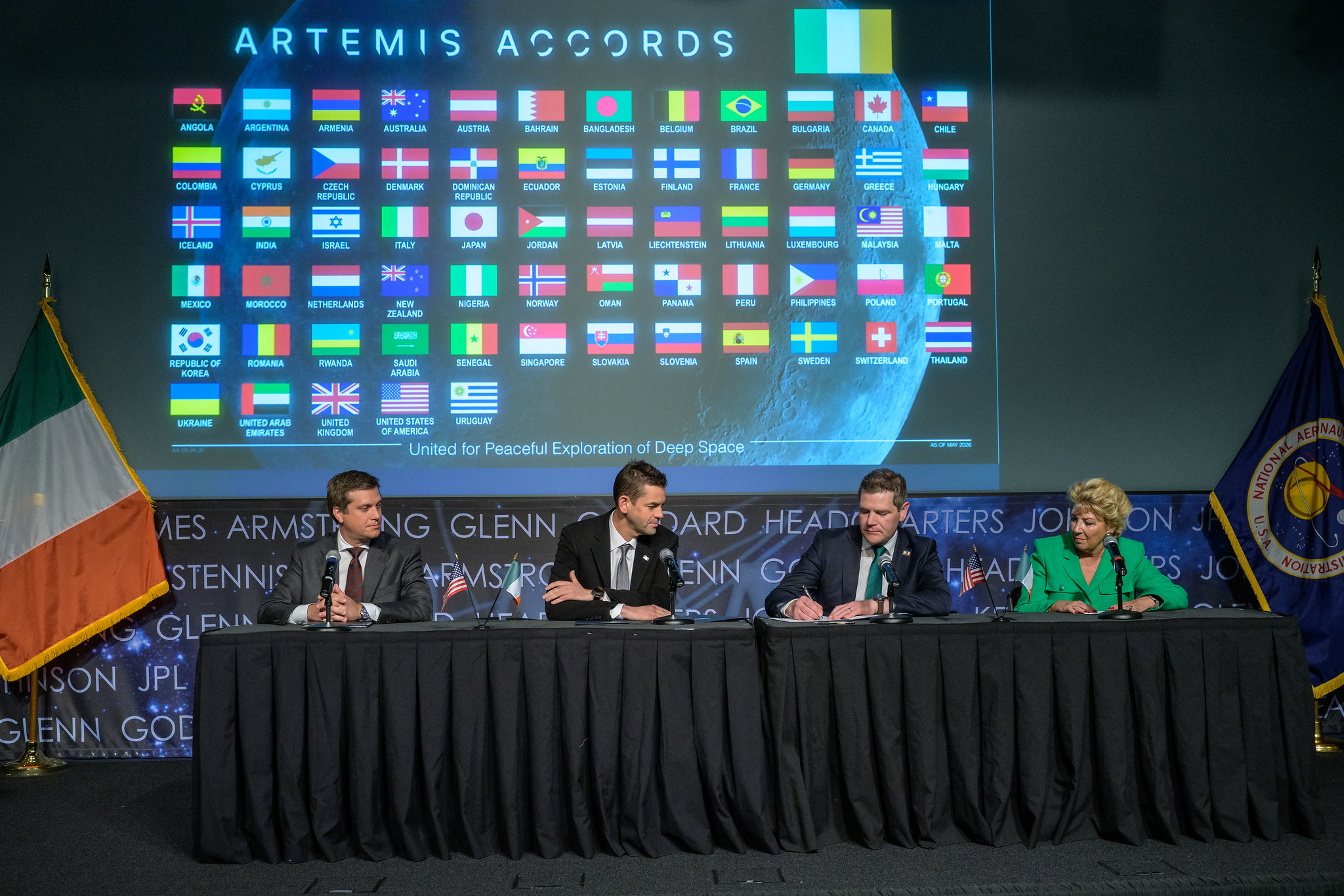
Ireland signed the Artemis Accords Monday during a signing ceremony hosted by NASA, becoming the latest nation to commit to the responsible exploration of space for all humanity.
Ireland, a longstanding member of ESA (European Space Agency) and a valued international partner for NASA, now joins all 23 ESA member states as a signatory of the Artemis Accords.
“It is my privilege to welcome Ireland as the 66th and newest signatory to the Artemis Accords,” said NASA Administrator Jared Isaacman during remarks. “The Emerald Isle is now part of a growing community of like-minded nations committed to the peaceful, transparent, and responsible exploration of space. Ireland joins at a pivotal moment. Artemis II was the opening act in humanity’s return to the Moon. What comes next is a sustained campaign of missions that will take us back to the lunar surface, not just for flags and footprints, but to build a base and stay.”
Underscoring the longstanding cultural ties and shared heritage between the United States and Ireland, the signing was celebrated during a ceremony at NASA Headquarters in Washington attended by U.S. Congressional staffers and interagency representatives.
Ireland’s Minister for Enterprise, Tourism and Employment Peter Burke, T.D., signed on behalf of the country.
“From an island shaped by the sea, whose people have always looked beyond the horizon and journeyed across the world, forging connections far beyond our shores, Ireland is proud to bring that same spirit to a new frontier and to join a global community committed to the peaceful exploration of space,” said Burke.
Ambassador of Ireland to the United States of America Geraldine Byrne Nason and Chief of Staff in the Office of the Under Secretary for Economic Affairs William Cappelletti, U.S. Department of State, participated in the event. U.S. Ambassador to Ireland Edward Walsh also attended.
In 2020, during the first Trump Administration, the United States, led by NASA and the U.S. Department of State, joined with seven other founding nations to establish the Artemis Accords, responding to the growing interest in lunar activities by both governments and private companies.
The Artemis Accords introduced the first set of practical principles aimed at enhancing the safety and coordination between like-minded nations as they explore the Moon, Mars, and beyond.
Signing the Artemis Accords means committing to explore peaceably and transparently, to render aid to those in need, to enable access to scientific data that all of humanity can learn from, to ensure activities do not interfere with those of others, and to preserve historically significant sites and artifacts by developing best practices for space exploration for the benefit of all.
More countries are expected to sign the Artemis Accords in the months and years ahead, as NASA continues its work to establish a safe, peaceful, and prosperous future in space.
Learn more about the Artemis Accords at:
https://www.nasa.gov/artemis-accords
Share Details Last Updated May 04, 2026 LocationNASA Headquarters Related TermsNASA Welcomes Ireland as Newest Artemis Accords Signatory
Ireland signed the Artemis Accords Monday during a signing ceremony hosted by NASA, becoming the latest nation to commit to the responsible exploration of space for all humanity.
Ireland, a longstanding member of ESA (European Space Agency) and a valued international partner for NASA, now joins all 23 ESA member states as a signatory of the Artemis Accords.
“It is my privilege to welcome Ireland as the 66th and newest signatory to the Artemis Accords,” said NASA Administrator Jared Isaacman during remarks. “The Emerald Isle is now part of a growing community of like-minded nations committed to the peaceful, transparent, and responsible exploration of space. Ireland joins at a pivotal moment. Artemis II was the opening act in humanity’s return to the Moon. What comes next is a sustained campaign of missions that will take us back to the lunar surface, not just for flags and footprints, but to build a base and stay.”
Underscoring the longstanding cultural ties and shared heritage between the United States and Ireland, the signing was celebrated during a ceremony at NASA Headquarters in Washington attended by U.S. Congressional staffers and interagency representatives.
Ireland’s Minister for Enterprise, Tourism and Employment Peter Burke, T.D., signed on behalf of the country.
“From an island shaped by the sea, whose people have always looked beyond the horizon and journeyed across the world, forging connections far beyond our shores, Ireland is proud to bring that same spirit to a new frontier and to join a global community committed to the peaceful exploration of space,” said Burke.
Ambassador of Ireland to the United States of America Geraldine Byrne Nason and Chief of Staff in the Office of the Under Secretary for Economic Affairs William Cappelletti, U.S. Department of State, participated in the event. U.S. Ambassador to Ireland Edward Walsh also attended.
In 2020, during the first Trump Administration, the United States, led by NASA and the U.S. Department of State, joined with seven other founding nations to establish the Artemis Accords, responding to the growing interest in lunar activities by both governments and private companies.
The Artemis Accords introduced the first set of practical principles aimed at enhancing the safety and coordination between like-minded nations as they explore the Moon, Mars, and beyond.
Signing the Artemis Accords means committing to explore peaceably and transparently, to render aid to those in need, to enable access to scientific data that all of humanity can learn from, to ensure activities do not interfere with those of others, and to preserve historically significant sites and artifacts by developing best practices for space exploration for the benefit of all.
More countries are expected to sign the Artemis Accords in the months and years ahead, as NASA continues its work to establish a safe, peaceful, and prosperous future in space.
Learn more about the Artemis Accords at:
https://www.nasa.gov/artemis-accords
Share Details Last Updated May 04, 2026 LocationNASA Headquarters Related TermsNASA Fosters Development of Lunar Resource-Seeking Technologies
To support long-duration missions to the Moon and Mars, NASA and industry are developing technologies that can extract resources such as hydrogen and helium-3 from lunar soil, known as regolith. This capability, known as in-situ resource utilization (ISRU), allows explorers to use what is already available on other planetary bodies, from water ice to minerals. These resources could eventually support propulsion, energy production, life support systems, and other needs for astronauts living and working in deep space.
To advance ISRU technologies, NASA has awarded a firm‑fixed‑price contract of $6.9 million over the next year and a half to Interlune of Seattle, a company focused on developing natural resources beyond Earth.
Funded through a Phase III NASA Small Business Innovation Research (SBIR) award, a contracting mechanism focused on transitioning technology into NASA missions or the private sector, the company will pursue validation of critical resource‑prospecting tools to make future lunar missions more self‑sufficient, reducing the need to transport supplies from Earth.
This effort builds on prior work with NASA’s Flight Opportunities program, in which Interlune built and tested payload prototypes on parabolic flights that replicated lunar gravity.
Under the SBIR Phase III contract, Interlune will design, build, and test engineering development units and flight hardware. The payload is designed to collect lunar regolith samples, sort particles by size, extract solar wind volatile gases, and measure their quantities. The company’s design includes a mass spectrometer inspired by NASA’s Mass Spectrometer Observing Lunar Operations (MSOLO) technology to measure the concentration of gases released from lunar soil.
Developed at NASA’s Kennedy Space Center in Florida, MSOLO is a compact, rugged mass spectrometer designed to analyze gases and the chemical makeup of landing sites on the Moon. The MSOLO technology, developed by NASA’s Game Changing Development program, demonstrated its hardware in lunar conditions during the Intuitive Machines 2 mission to the lunar South Pole in 2025.
“A major goal of NASA is to mature transformative technologies so they can be confidently adopted by industry,” said Michael Johansen, Deputy Program Manager for NASA’s Game Changing Development Program. “The evolution of MSOLO into a robust, flight-ready instrument is a perfect example of that success. We are thrilled to see this proven technology leveraged by an industry effort, marking a significant step forward in commercial resource prospecting.”
NASA’s MSOLO technology is available for commercial use and adaptable for ground tests and variable flight configurations. The instrument’s internal architecture includes a hybrid computer for onboard processing and a calibration gas system that allows the device to check and adjust its readings directly on the lunar surface. This data can benefit both commercial developers and NASA’s Artemis program. Its software has already been adapted to interface with four different CLPS (Commercial Lunar Payload Services) lander designs, reflecting its flexibility and increasing applicability to commercial lunar missions.
Investments by the agency in lunar surface technology from commercial partners represents an important step toward establishing a sustainable presence on the lunar surface. By advancing resource‑prospecting instruments and maturing technologies that enable the use of lunar materials, these efforts will help reduce the cost and complexity of future exploration missions.
NASA’s Small Business Innovation Research (SBIR) and Small Business Technology Transfer (STTR) program is managed by the agency’s Space Technology Mission Directorate. Through this program, entrepreneurs, startups, and small businesses with fewer than 500 employees can receive funding and non-monetary support to build, mature, and commercialize their technologies, advancing NASA missions and helping solve important challenges facing our nation.
This year, NASA’s SBIR/STTR program is adopting a Broad Agency Announcement framework to increase opportunities for small businesses while enhancing agility for the agency. The 2026-2027 BAA appendices, outlining topics and subtopics for desired technology proposals, closes May 21. Interested businesses and institutions are encouraged to visit the information hub for helpful details on applying.
To learn more about working with NASA Technology, visit
https://www.nasa.gov/stmd-solicitations-and-opportunities/
Explore More 4 min read Liquid Lifeline: NASA Tech Could Create IV Fluid In Space Article 2 weeks ago 4 min read NASA Space Tech’s Favorite Place to Travel in 2025: The Moon! Article 1 year ago 3 min read The Robotics of Sampling RegolithThe Perseverance rover recently collected its first two samples of Martian regolith!
Article 3 years ago Share Details Last Updated May 04, 2026 EditorLoura HallLocationNASA Headquarters Related TermsNASA Fosters Development of Lunar Resource-Seeking Technologies
To support long-duration missions to the Moon and Mars, NASA and industry are developing technologies that can extract resources such as hydrogen and helium-3 from lunar soil, known as regolith. This capability, known as in-situ resource utilization (ISRU), allows explorers to use what is already available on other planetary bodies, from water ice to minerals. These resources could eventually support propulsion, energy production, life support systems, and other needs for astronauts living and working in deep space.
To advance ISRU technologies, NASA has awarded a firm‑fixed‑price contract of $6.9 million over the next year and a half to Interlune of Seattle, a company focused on developing natural resources beyond Earth.
Funded through a Phase III NASA Small Business Innovation Research (SBIR) award, a contracting mechanism focused on transitioning technology into NASA missions or the private sector, the company will pursue validation of critical resource‑prospecting tools to make future lunar missions more self‑sufficient, reducing the need to transport supplies from Earth.
This effort builds on prior work with NASA’s Flight Opportunities program, in which Interlune built and tested payload prototypes on parabolic flights that replicated lunar gravity.
Under the SBIR Phase III contract, Interlune will design, build, and test engineering development units and flight hardware. The payload is designed to collect lunar regolith samples, sort particles by size, extract solar wind volatile gases, and measure their quantities. The company’s design includes a mass spectrometer inspired by NASA’s Mass Spectrometer Observing Lunar Operations (MSOLO) technology to measure the concentration of gases released from lunar soil.
Developed at NASA’s Kennedy Space Center in Florida, MSOLO is a compact, rugged mass spectrometer designed to analyze gases and the chemical makeup of landing sites on the Moon. The MSOLO technology, developed by NASA’s Game Changing Development program, demonstrated its hardware in lunar conditions during the Intuitive Machines 2 mission to the lunar South Pole in 2025.
“A major goal of NASA is to mature transformative technologies so they can be confidently adopted by industry,” said Michael Johansen, Deputy Program Manager for NASA’s Game Changing Development Program. “The evolution of MSOLO into a robust, flight-ready instrument is a perfect example of that success. We are thrilled to see this proven technology leveraged by an industry effort, marking a significant step forward in commercial resource prospecting.”
NASA’s MSOLO technology is available for commercial use and adaptable for ground tests and variable flight configurations. The instrument’s internal architecture includes a hybrid computer for onboard processing and a calibration gas system that allows the device to check and adjust its readings directly on the lunar surface. This data can benefit both commercial developers and NASA’s Artemis program. Its software has already been adapted to interface with four different CLPS (Commercial Lunar Payload Services) lander designs, reflecting its flexibility and increasing applicability to commercial lunar missions.
Investments by the agency in lunar surface technology from commercial partners represents an important step toward establishing a sustainable presence on the lunar surface. By advancing resource‑prospecting instruments and maturing technologies that enable the use of lunar materials, these efforts will help reduce the cost and complexity of future exploration missions.
NASA’s Small Business Innovation Research (SBIR) and Small Business Technology Transfer (STTR) program is managed by the agency’s Space Technology Mission Directorate. Through this program, entrepreneurs, startups, and small businesses with fewer than 500 employees can receive funding and non-monetary support to build, mature, and commercialize their technologies, advancing NASA missions and helping solve important challenges facing our nation.
This year, NASA’s SBIR/STTR program is adopting a Broad Agency Announcement framework to increase opportunities for small businesses while enhancing agility for the agency. The 2026-2027 BAA appendices, outlining topics and subtopics for desired technology proposals, closes May 21. Interested businesses and institutions are encouraged to visit the information hub for helpful details on applying.
To learn more about working with NASA Technology, visit
https://www.nasa.gov/stmd-solicitations-and-opportunities/
Explore More 4 min read Liquid Lifeline: NASA Tech Could Create IV Fluid In Space Article 2 weeks ago 4 min read NASA Space Tech’s Favorite Place to Travel in 2025: The Moon! Article 1 year ago 3 min read The Robotics of Sampling RegolithThe Perseverance rover recently collected its first two samples of Martian regolith!
Article 3 years ago Share Details Last Updated May 04, 2026 EditorLoura HallLocationNASA Headquarters Related TermsNASA just dropped more than 12,000 Artemis II photos—here’s how to see them
Want to go to the moon? Travel vicariously through the more than 12,000 photos NASA just posted from the Artemis II mission
#792: Star Wars Science
May the fourth be with you! Isn’t that what people say on the international holiday known as Star Wars Day? Today we’re gonna talk about the science in everyone’s favorite sci-fi fantasy stories. Which of it is real, and which is essentially magic? Let’s find out! Let's look at the science of a galaxy long ago and far away. (Did you just hear the theme music in your head? We heard it start in our head!)
How a Greenland shark’s heart can beat for centuries
Greenland sharks have hearts that can function normally for more than a century
NASA Welcomes Malta as Newest Artemis Accords Signatory
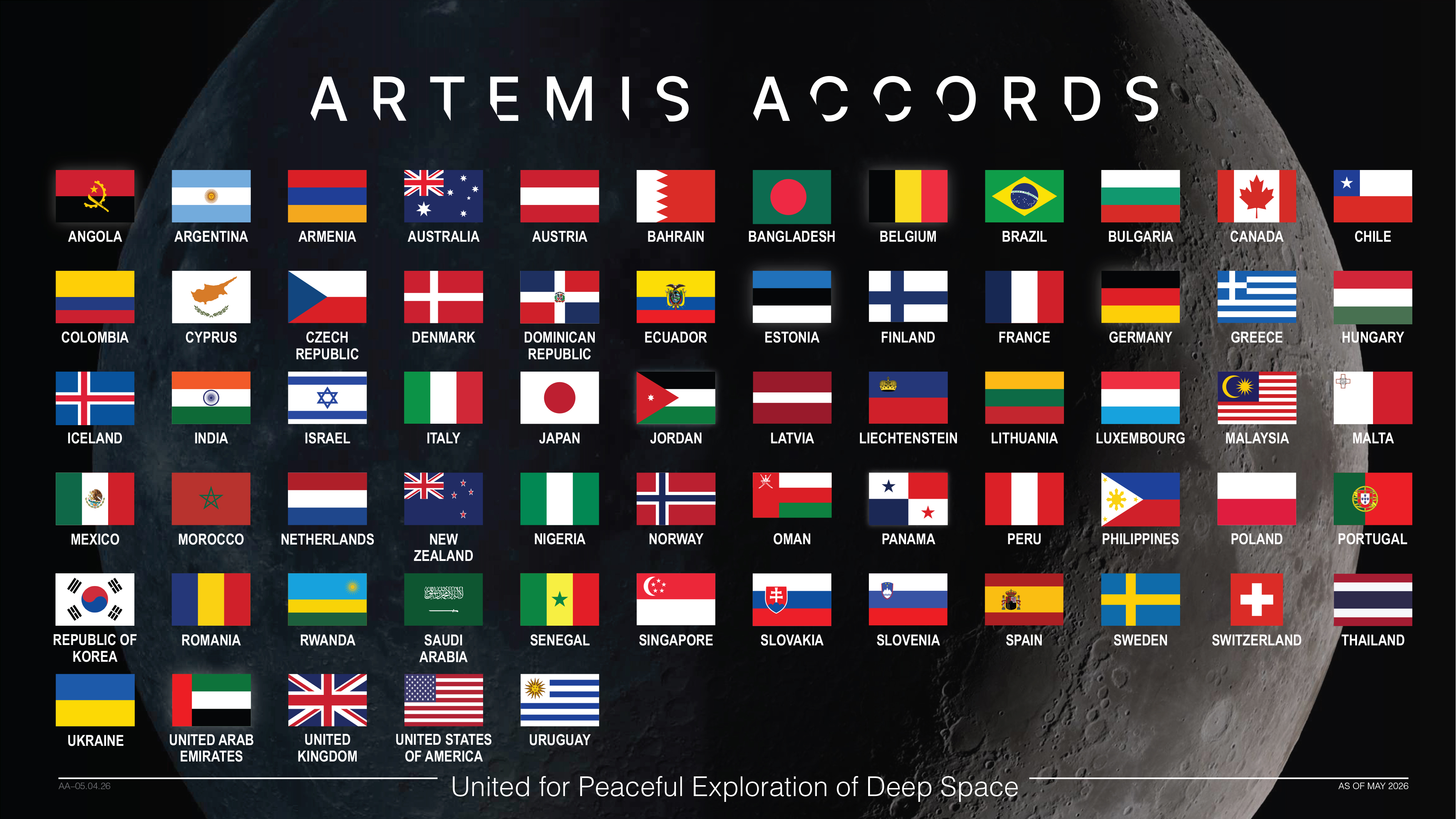
The Republic of Malta became the 65th signatory to the Artemis Accords on Monday during a ceremony in the town of Kalkara with NASA and U.S. Department of State officials present.
“Today, it’s my pleasure to welcome the Republic of Malta to the Artemis Accords community,” NASA Administrator Jared Isaacman said in recorded remarks. “By joining this growing coalition, Malta affirms shared commitments to peaceful, transparent, and responsible space exploration. These commitments safeguard against chaos and confusion, and they chart a responsible path forward for every nation that dares to accomplish the near-impossible in space.”
Malta’s Minister for Education, Youth, Sports, Research and Innovation Clifton Grima signed the Artemis Accords on behalf of the country.
“Malta is taking a deliberate step to position itself within a high-value, innovation-driven global sector,” said Grima. “This initiative strengthens our governance framework, enhances Malta’s international credibility and creates new opportunities to attract investment, build expertise and generate quality employment within the space economy.”
U.S. Ambassador to Malta Somers W. Farkas and NASA Europe Representative Gregory Mann witnessed the signing together with Deputy Prime Minister and Minister for Foreign Affairs and Tourism Ian Borg.
The United States and Malta have a long history of shared values and common interests, dating back to the American Revolution. NASA looks forward to future engagement on the Artemis Accords and recently outlined new opportunities for signatory countries to deepen their participation in NASA’s Artemis program.
In 2020, during the first Trump Administration, the United States, led by NASA and the U.S. Department of State, joined with seven other founding nations to establish the Artemis Accords, responding to the growing interest in lunar activities by both governments and private companies.
The Artemis Accords introduced the first set of practical principles aimed at enhancing the safety and coordination between like-minded nations as they explore the Moon, Mars, and beyond.
Signing the Artemis Accords means committing to explore peaceably and transparently, to render aid to those in need, to enable access to scientific data that all of humanity can learn from, to ensure activities do not interfere with those of others, and to preserve historically significant sites and artifacts by developing best practices for space exploration for the benefit of all.
More countries are expected to sign the Artemis Accords in the months and years ahead, as NASA continues its work to establish a safe, peaceful, and prosperous future in space.
Learn more about the Artemis Accords at:
https://www.nasa.gov/artemis-accords
Share Details Last Updated May 04, 2026 LocationNASA Headquarters Related TermsNASA Welcomes Malta as Newest Artemis Accords Signatory
The Republic of Malta became the 65th signatory to the Artemis Accords on Monday during a ceremony in the town of Kalkara with NASA and U.S. Department of State officials present.
“Today, it’s my pleasure to welcome the Republic of Malta to the Artemis Accords community,” NASA Administrator Jared Isaacman said in recorded remarks. “By joining this growing coalition, Malta affirms shared commitments to peaceful, transparent, and responsible space exploration. These commitments safeguard against chaos and confusion, and they chart a responsible path forward for every nation that dares to accomplish the near-impossible in space.”
Malta’s Minister for Education, Youth, Sports, Research and Innovation Clifton Grima signed the Artemis Accords on behalf of the country.
“Malta is taking a deliberate step to position itself within a high-value, innovation-driven global sector,” said Grima. “This initiative strengthens our governance framework, enhances Malta’s international credibility and creates new opportunities to attract investment, build expertise and generate quality employment within the space economy.”
U.S. Ambassador to Malta Somers W. Farkas and NASA Europe Representative Gregory Mann witnessed the signing together with Deputy Prime Minister and Minister for Foreign Affairs and Tourism Ian Borg.
The United States and Malta have a long history of shared values and common interests, dating back to the American Revolution. NASA looks forward to future engagement on the Artemis Accords and recently outlined new opportunities for signatory countries to deepen their participation in NASA’s Artemis program.
In 2020, during the first Trump Administration, the United States, led by NASA and the U.S. Department of State, joined with seven other founding nations to establish the Artemis Accords, responding to the growing interest in lunar activities by both governments and private companies.
The Artemis Accords introduced the first set of practical principles aimed at enhancing the safety and coordination between like-minded nations as they explore the Moon, Mars, and beyond.
Signing the Artemis Accords means committing to explore peaceably and transparently, to render aid to those in need, to enable access to scientific data that all of humanity can learn from, to ensure activities do not interfere with those of others, and to preserve historically significant sites and artifacts by developing best practices for space exploration for the benefit of all.
More countries are expected to sign the Artemis Accords in the months and years ahead, as NASA continues its work to establish a safe, peaceful, and prosperous future in space.
Learn more about the Artemis Accords at:
https://www.nasa.gov/artemis-accords
Share Details Last Updated May 04, 2026 LocationNASA Headquarters Related TermsSupreme Court reinstates access to abortion drug mifepristone by mail
On Monday the Supreme Court paused a ruling by a federal appeals court that prevented health care providers from prescribing mifepristone by telemedicine, setting the stage for further action from the nation’s highest court
School cell phone bans may boost student well-being—but not test scores, new study suggests
Banning cell phones in schools has been touted as a silver bullet for poor test scores and low student well-being and attendance, but new research suggests the results are more mixed