
Feed aggregator
The Simpsons reference that refutes one of history’s greatest mathematicians
In one famous episode of The Simpsons, Homer finds a counterexample to Fermat’s last theorem
Nighttime Imaging Grows Landsat’s Science Value
- Landsat Home
- Missions
- News
- Data
- Benefits
- Outreach
- Multimedia
- About
- Search
By Earth Resources Observation and Science (EROS) Center
For more than 50 years, Landsat has imaged Earth’s land and near-shore surfaces as the satellites descend in midmorning orbit, when daily sunlight is optimal. That’s just what they’ve always done.
Currently, Landsat 8 and Landsat 9 circle the globe while also making better use of their ascending paths, peering into the darkness for special requests.
The visible spectral bands of Landsat—the same blue, green and red wavelength colors our eyes can see—are typically not that useful when collected on the ascending orbit node (also known as “nighttime imagery”). The exception is twilight or darkness at Earth’s poles, which can provide a surprisingly clear observation in the thermal infrared spectral bands where snow, ice and water temperatures can be retrieved when the sun is at or below the horizon.
Through the dark, shortwave infrared (SWIR) bands within Landsat’s Operational Land Imager (OLI) instrument can detect intense heat sources such as volcanoes or active fires, while the Thermal Infrared Sensor (TIRS) measures surface temperatures that range from geothermal geysers to solid ice.
There is a growing interest in seeing what Landsat can capture as it ascends over the dark side of Earth, according to Dr. Christopher Crawford, the Landsat Project Scientist at the U.S. Geological Survey (USGS) Earth Resources Observation and Science (EROS) Center. Crawford leads and oversees Landsat’s long-term Earth data acquisition strategy for the USGS.
“I’ve seen a noticeable uptick in the number of nighttime imaging special requests. That’s a very active and innovative measurement science area for Landsat right now,” Crawford said.
“We have active volcanoes, we’ve got an ice environment that’s changing, and wildfire occurrences are increasingly growing into hazards that threaten human safety, infrastructure and wildlife, among other issues. Nighttime imaging is an all-purpose solution, kind of like Jiffy Baking Mix.”
R. Greg Vaughan of the USGS Astrogeology Science Center does field work at Yellowstone National Park. USGS photo Sources/Usage: Public Domain Keeping an Eye on Volcanoes and Yellowstone
A particular request for nighttime imagery that turned into a “systematic observation,” Crawford said, is Yellowstone National Park. The volcanic area’s 10,000 thermal features, such as geysers or hot springs or steam vents, can get hotter or colder, and they can appear or disappear.
Crawford is fascinated by volcanoes in general and recognizes the value of imaging them day and night. After Landsat 9 launched in 2021, when two satellites with the same high-quality sensors would together yield an image of each area of land every eight days, it seemed like a good time to start a consistent annual campaign to capture active volcanoes at night, he said.
To view this video please enable JavaScript, and consider upgrading to a web browser that
supports HTML5 video
R. Greg Vaughan of the USGS Astrogeology Science Center, who researches active volcanoes, gave him a list. Vaughan has used Landsat data and other remote sensing methods to monitor changing thermal features in his role as the remote sensing lead for the Yellowstone Volcano Observatory.
Vaughan also taught Crawford something about imaging Yellowstone’s thermal features at night—that the best season for locating them is during winter. That’s when the contrast between the heated features and the colder surrounding area is greatest.
“The thing that I’ve probably taken away the most is that you have to acquire data to then understand what data to continue to acquire,” Crawford said.
Vaughan spotted an exciting surprise when reviewing Landsat 8 nighttime TIRS data of Yellowstone acquired in April 2017. Comparing warm areas in the imagery to previously mapped thermal features, he found a “big blob of bright, warm pixels” that didn’t match anything on the map.
After ruling out the possibility that it could be a thawing lake next to frozen land, he looked at the secluded area with daytime aerial imagery. The telltale signs of a new and growing thermal feature were there: bright hydrothermal-altered soil and dead and dying trees.
A Landsat 8 nighttime thermal infrared image from April 2017 shows the Tern Lake area in Yellowstone National Park. In Yellowstone, temperatures are extremely cold at night in the winter, and most lakes are frozen (dark pixels). West Tern Lake seems to be thawing here; it might receive some thermal water inflow from nearby hot springs. The patch of bright (warm) pixels between West Tern Lake and the Tern Lake Thermal Area emerged over a period of roughly 20 years. Lakes are outlined in blue; known thermal areas are outlined in red; and the red triangles are individual thermal features that have been mapped. Image credit: R. Greg Vaughn, USGS
Vaughan discussed his find and his use of Landsat data in a recent Eyes on Earth podcast episode produced by USGS EROS.
“This is why I love Landsat 8 and 9 so much. These instruments acquire data regularly, not just during the day, but they can also be tasked to acquire data at night on a regular basis. And this is really critical for my work,” Vaughan said.
Vaughan has been named a member of the current Landsat Science Team, a group of scientific and technical subject matter experts who provide analysis and advice to the Landsat Program. His research in that capacity will focus on active volcanoes.
An aerial view of the area in the Landsat 8 nighttime image shows the new thermal area (center left) that R. Greg Vaughan spotted in the Landsat image. The existing Tern Lake Thermal Area is the bright white patch of ground in the upper middle part of the image. West Tern Lake is the dark area in the lower right, and Tern Lake is above that. Photo credit: Michael Poland, USGS Fires, Flares and Urban Areas Among Requests
The fire community in the western United States also finds value in Landsat nighttime imagery, Crawford said—including the energy industry and its infrastructure.
The Department of Energy’s Pacific Northwest National Laboratory submits annual special requests for proactive nighttime imaging of seasonal wildfires to support on-the-ground decision making.
“We’ve done it three seasons in a row, and the results are pretty remarkable in terms of what we’re able to see,” especially with the SWIR bands, Crawford said. Those results compare well to airborne infrared sensing taken from low-altitude flights over the same wildfires.
Landsat can also detect gas flares that are useful to oil and gas industry functions. “There are regular special requests submitted to monitor global sites that produce Liquefied Natural Gas, or LNG,” Crawford said.
In addition, he sees requests for nighttime images over particular cities to map urban temperature, which may be higher than cooler surrounding areas.
One recent request went beyond the already routine monitoring of active volcanoes in Iceland to encompass the entire country and coastline in a large seasonal campaign to survey overall volcanic activity.
Crawford weighs this type of request carefully, posing these questions: “Does this advance the science mission? Is it serving the user community?”
For Iceland, that was a yes.
“I look for areas where Landsat imaging data may be underutilized, as well as areas for strategic science mission advancement and societal benefits, and in many ways, these growth areas can be enabled through the data acquisition process,” Crawford said.
Landsat 8’s thermal infrared, shortwave infrared and near infrared spectral bands expose the Caldor Fire’s advancing edge south of Lake Tahoe in California in a nighttime image from August 29, 2021. A LEAP Forward
A significant advancement in learning about Landsat’s nighttime capabilities came with the effort to monitor polar regions year-round, with leadership from former Landsat Science Team member Dr. Ted Scambos from the University of Colorado Boulder.
The Landsat Extended Acquisition of the Poles (LEAP) campaign now routinely collects imagery over the polar regions, where few wintertime images had existed in Landsat’s data record before. The visible-to-shortwave infrared and thermal infrared spectral bands allow scientists to track changes in polar ice sheets, measure polar surface temperatures and examine the interaction of ocean water and ice shelves.
The sun’s low angle is not much of a hindrance to imaging data quality, Crawford said in an Eyes on Earth episode about the LEAP campaign. “Snow and ice are still really bright mediums on the surface, and so even if the illumination is low, you can still see a lot of detail because of the high reflectivity.”
Fortunately, nighttime imaging does not burden Landsat 8 and Landsat 9. “The instruments are always on, so it’s just a matter of whether we’re recording the data,” Crawford said.
This twilight thermal infrared image of Petermann Glacier, Greenland, was captured by Landsat 9 on January 5, 2024. This winter image displays data acquired when the sun was below the horizon. Darker areas are relatively colder than bright areas.
The imagery’s darkness helps keep data volumes much lower than the daytime and allows sufficient time for the satellites to pass off the data to ground stations around the globe whose function is to downlink the recorded data.
“We’re starting to leverage Landsat 8 and Landsat 9 observatory capabilities to maximum scientific and societal benefit returns,” Crawford said.
“We’re populating the Landsat archive with long-term image data records that are helpful for not only quantifying changes on the Earth’s surface right now, but in the past and in the future.”
Requesting and Accessing ImageryTo learn more about Landsat data acquisitions and to submit a special request for future nighttime imagery, visit the Landsat Acquisitions webpage.
All imagery collected by special requests is made available to the public through the USGS EarthExplorer website. Select the “Landsat Collection 2 Level-1” dataset, and then select “Night” under Additional Criteria.
Explore More
Nighttime Imaging Grows Landsat’s Science Value
7 min read
By Earth Resources Observation and Science (EROS) Center For more than 50 years, Landsat has imaged Earth’s land and near-shore surfaces as…
Apr 28, 2026 ArticleFiery Fall Color in Southern Chile
3 min read
The beech forests of southern Patagonia put on vibrant autumn displays.
Apr 28, 2026 ArticleAn Agricultural Mosaic in Taiwan
4 min read
Diversity reigns across the farmland of Yunlin County in southwestern Taiwan—a region that produces an array of crops on small…
Apr 24, 2026 Article1
2
3
…
305
Next
Nighttime Imaging Grows Landsat’s Science Value
- Landsat Home
- Missions
- News
- Data
- Benefits
- Outreach
- Multimedia
- About
- Search
By Earth Resources Observation and Science (EROS) Center
For more than 50 years, Landsat has imaged Earth’s land and near-shore surfaces as the satellites descend in midmorning orbit, when daily sunlight is optimal. That’s just what they’ve always done.
Currently, Landsat 8 and Landsat 9 circle the globe while also making better use of their ascending paths, peering into the darkness for special requests.
The visible spectral bands of Landsat—the same blue, green and red wavelength colors our eyes can see—are typically not that useful when collected on the ascending orbit node (also known as “nighttime imagery”). The exception is twilight or darkness at Earth’s poles, which can provide a surprisingly clear observation in the thermal infrared spectral bands where snow, ice and water temperatures can be retrieved when the sun is at or below the horizon.
Through the dark, shortwave infrared (SWIR) bands within Landsat’s Operational Land Imager (OLI) instrument can detect intense heat sources such as volcanoes or active fires, while the Thermal Infrared Sensor (TIRS) measures surface temperatures that range from geothermal geysers to solid ice.
There is a growing interest in seeing what Landsat can capture as it ascends over the dark side of Earth, according to Dr. Christopher Crawford, the Landsat Project Scientist at the U.S. Geological Survey (USGS) Earth Resources Observation and Science (EROS) Center. Crawford leads and oversees Landsat’s long-term Earth data acquisition strategy for the USGS.
“I’ve seen a noticeable uptick in the number of nighttime imaging special requests. That’s a very active and innovative measurement science area for Landsat right now,” Crawford said.
“We have active volcanoes, we’ve got an ice environment that’s changing, and wildfire occurrences are increasingly growing into hazards that threaten human safety, infrastructure and wildlife, among other issues. Nighttime imaging is an all-purpose solution, kind of like Jiffy Baking Mix.”
R. Greg Vaughan of the USGS Astrogeology Science Center does field work at Yellowstone National Park. USGS photo Sources/Usage: Public Domain Keeping an Eye on Volcanoes and YellowstoneA particular request for nighttime imagery that turned into a “systematic observation,” Crawford said, is Yellowstone National Park. The volcanic area’s 10,000 thermal features, such as geysers or hot springs or steam vents, can get hotter or colder, and they can appear or disappear.
Crawford is fascinated by volcanoes in general and recognizes the value of imaging them day and night. After Landsat 9 launched in 2021, when two satellites with the same high-quality sensors would together yield an image of each area of land every eight days, it seemed like a good time to start a consistent annual campaign to capture active volcanoes at night, he said.
To view this video please enable JavaScript, and consider upgrading to a web browser that
supports HTML5 video
R. Greg Vaughan of the USGS Astrogeology Science Center, who researches active volcanoes, gave him a list. Vaughan has used Landsat data and other remote sensing methods to monitor changing thermal features in his role as the remote sensing lead for the Yellowstone Volcano Observatory.
Vaughan also taught Crawford something about imaging Yellowstone’s thermal features at night—that the best season for locating them is during winter. That’s when the contrast between the heated features and the colder surrounding area is greatest.
“The thing that I’ve probably taken away the most is that you have to acquire data to then understand what data to continue to acquire,” Crawford said.
Vaughan spotted an exciting surprise when reviewing Landsat 8 nighttime TIRS data of Yellowstone acquired in April 2017. Comparing warm areas in the imagery to previously mapped thermal features, he found a “big blob of bright, warm pixels” that didn’t match anything on the map.
After ruling out the possibility that it could be a thawing lake next to frozen land, he looked at the secluded area with daytime aerial imagery. The telltale signs of a new and growing thermal feature were there: bright hydrothermal-altered soil and dead and dying trees.
A Landsat 8 nighttime thermal infrared image from April 2017 shows the Tern Lake area in Yellowstone National Park. In Yellowstone, temperatures are extremely cold at night in the winter, and most lakes are frozen (dark pixels). West Tern Lake seems to be thawing here; it might receive some thermal water inflow from nearby hot springs. The patch of bright (warm) pixels between West Tern Lake and the Tern Lake Thermal Area emerged over a period of roughly 20 years. Lakes are outlined in blue; known thermal areas are outlined in red; and the red triangles are individual thermal features that have been mapped. Image credit: R. Greg Vaughn, USGSVaughan discussed his find and his use of Landsat data in a recent Eyes on Earth podcast episode produced by USGS EROS.
“This is why I love Landsat 8 and 9 so much. These instruments acquire data regularly, not just during the day, but they can also be tasked to acquire data at night on a regular basis. And this is really critical for my work,” Vaughan said.
Vaughan has been named a member of the current Landsat Science Team, a group of scientific and technical subject matter experts who provide analysis and advice to the Landsat Program. His research in that capacity will focus on active volcanoes.
An aerial view of the area in the Landsat 8 nighttime image shows the new thermal area (center left) that R. Greg Vaughan spotted in the Landsat image. The existing Tern Lake Thermal Area is the bright white patch of ground in the upper middle part of the image. West Tern Lake is the dark area in the lower right, and Tern Lake is above that. Photo credit: Michael Poland, USGS Fires, Flares and Urban Areas Among RequestsThe fire community in the western United States also finds value in Landsat nighttime imagery, Crawford said—including the energy industry and its infrastructure.
The Department of Energy’s Pacific Northwest National Laboratory submits annual special requests for proactive nighttime imaging of seasonal wildfires to support on-the-ground decision making.
“We’ve done it three seasons in a row, and the results are pretty remarkable in terms of what we’re able to see,” especially with the SWIR bands, Crawford said. Those results compare well to airborne infrared sensing taken from low-altitude flights over the same wildfires.
Landsat can also detect gas flares that are useful to oil and gas industry functions. “There are regular special requests submitted to monitor global sites that produce Liquefied Natural Gas, or LNG,” Crawford said.
In addition, he sees requests for nighttime images over particular cities to map urban temperature, which may be higher than cooler surrounding areas.
One recent request went beyond the already routine monitoring of active volcanoes in Iceland to encompass the entire country and coastline in a large seasonal campaign to survey overall volcanic activity.
Crawford weighs this type of request carefully, posing these questions: “Does this advance the science mission? Is it serving the user community?”
For Iceland, that was a yes.
“I look for areas where Landsat imaging data may be underutilized, as well as areas for strategic science mission advancement and societal benefits, and in many ways, these growth areas can be enabled through the data acquisition process,” Crawford said.
Landsat 8’s thermal infrared, shortwave infrared and near infrared spectral bands expose the Caldor Fire’s advancing edge south of Lake Tahoe in California in a nighttime image from August 29, 2021. A LEAP ForwardA significant advancement in learning about Landsat’s nighttime capabilities came with the effort to monitor polar regions year-round, with leadership from former Landsat Science Team member Dr. Ted Scambos from the University of Colorado Boulder.
The Landsat Extended Acquisition of the Poles (LEAP) campaign now routinely collects imagery over the polar regions, where few wintertime images had existed in Landsat’s data record before. The visible-to-shortwave infrared and thermal infrared spectral bands allow scientists to track changes in polar ice sheets, measure polar surface temperatures and examine the interaction of ocean water and ice shelves.
The sun’s low angle is not much of a hindrance to imaging data quality, Crawford said in an Eyes on Earth episode about the LEAP campaign. “Snow and ice are still really bright mediums on the surface, and so even if the illumination is low, you can still see a lot of detail because of the high reflectivity.”
Fortunately, nighttime imaging does not burden Landsat 8 and Landsat 9. “The instruments are always on, so it’s just a matter of whether we’re recording the data,” Crawford said.
This twilight thermal infrared image of Petermann Glacier, Greenland, was captured by Landsat 9 on January 5, 2024. This winter image displays data acquired when the sun was below the horizon. Darker areas are relatively colder than bright areas.The imagery’s darkness helps keep data volumes much lower than the daytime and allows sufficient time for the satellites to pass off the data to ground stations around the globe whose function is to downlink the recorded data.
“We’re starting to leverage Landsat 8 and Landsat 9 observatory capabilities to maximum scientific and societal benefit returns,” Crawford said.
“We’re populating the Landsat archive with long-term image data records that are helpful for not only quantifying changes on the Earth’s surface right now, but in the past and in the future.”
Requesting and Accessing ImageryTo learn more about Landsat data acquisitions and to submit a special request for future nighttime imagery, visit the Landsat Acquisitions webpage.
All imagery collected by special requests is made available to the public through the USGS EarthExplorer website. Select the “Landsat Collection 2 Level-1” dataset, and then select “Night” under Additional Criteria.
Explore More
Nighttime Imaging Grows Landsat’s Science Value
7 min read
By Earth Resources Observation and Science (EROS) Center For more than 50 years, Landsat has imaged Earth’s land and near-shore surfaces as…
Apr 28, 2026 ArticleFiery Fall Color in Southern Chile
3 min read
The beech forests of southern Patagonia put on vibrant autumn displays.
Apr 28, 2026 ArticleAn Agricultural Mosaic in Taiwan
4 min read
Diversity reigns across the farmland of Yunlin County in southwestern Taiwan—a region that produces an array of crops on small…
Apr 24, 2026 Article1
2
3
…
305
Next
Curiosity Captures a 360-Degree View at ‘Nevado Sajama’
NASA/JPL-Caltech/MSSS Photojournal Navigation Downloads PIA26696 Figure A
PNG (1.79 GB)
PIA26696 Figure B
PNG (276.01 MB)
Description
NASA’s Curiosity Mars rover captured this 360-degree view of a region filled with low ridges called boxwork formations between Nov. 9 and Dec. 7, 2025 (the 4,714th to 4,741st Martian days, or sols, of the mission). At 1.5 billion pixels, this is one of the largest panoramas Curiosity has ever taken (the rover’s largest panorama of all time is 1.8 billion pixels). This newer panorama is made up of 1,031 individual images captured by Curiosity’s Mastcam using its right camera, which has a 100-millimeter focal length lens. The images were later sent to Earth and stitched together into the full panorama.
The images were taken at a ridgetop site nicknamed “Nevado Sajama,” where Curiosity collected a rock sample using a drill on the end of its robotic arm. Since May 2025, Curiosity has been exploring a region full of geologic formations called boxwork, which crisscross the surface for miles and look like giant spiderwebs when viewed from space. The new panorama shows them as they really are: low ridges standing roughly 3 to 6 feet (1 to 2 meters) tall and about 30 feet (9 meters) across with sandy hollows in between.
Figure A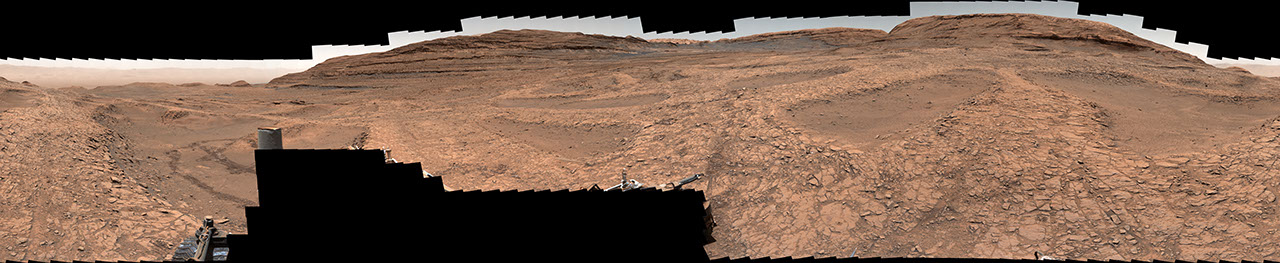
Figure A is a high-resolution version of this panorama (1.8 gigabytes).
Figure B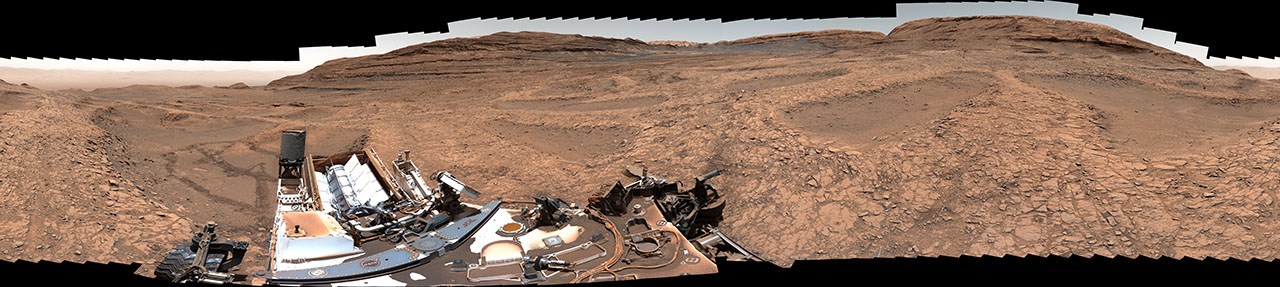
Figure B is a lower-resolution version of the panorama (276 megabytes) captured by Mastcam’s left camera, which has a 34-millimeter focal length lens. This version includes the rover’s deck, which is often left out of such imagery in order to reduce the amount of data relayed back to Earth.
Curiosity was built by NASA’s Jet Propulsion Laboratory, which is managed by Caltech in Pasadena, California. JPL leads the mission on behalf of NASA’s Science Mission Directorate in Washington as part of NASA’s Mars Exploration Program portfolio. Malin Space Science Systems in San Diego built and operates Mastcam.
To learn more about Curiosity, visit:
science.nasa.gov/mission/msl-curiosity
Keep Exploring Discover More Topics From Photojournal
Photojournal
Search Photojournal
Photojournal’s Latest Content
Feedback
Curiosity Captures a 360-Degree View at ‘Nevado Sajama’
NASA/JPL-Caltech/MSSS Photojournal Navigation Downloads PIA26696 Figure A
PNG (1.79 GB)
PIA26696 Figure B
PNG (276.01 MB)
Description
NASA’s Curiosity Mars rover captured this 360-degree view of a region filled with low ridges called boxwork formations between Nov. 9 and Dec. 7, 2025 (the 4,714th to 4,741st Martian days, or sols, of the mission). At 1.5 billion pixels, this is one of the largest panoramas Curiosity has ever taken (the rover’s largest panorama of all time is 1.8 billion pixels). This newer panorama is made up of 1,031 individual images captured by Curiosity’s Mastcam using its right camera, which has a 100-millimeter focal length lens. The images were later sent to Earth and stitched together into the full panorama.
The images were taken at a ridgetop site nicknamed “Nevado Sajama,” where Curiosity collected a rock sample using a drill on the end of its robotic arm. Since May 2025, Curiosity has been exploring a region full of geologic formations called boxwork, which crisscross the surface for miles and look like giant spiderwebs when viewed from space. The new panorama shows them as they really are: low ridges standing roughly 3 to 6 feet (1 to 2 meters) tall and about 30 feet (9 meters) across with sandy hollows in between.
Figure AFigure A is a high-resolution version of this panorama (1.8 gigabytes).
Figure BFigure B is a lower-resolution version of the panorama (276 megabytes) captured by Mastcam’s left camera, which has a 34-millimeter focal length lens. This version includes the rover’s deck, which is often left out of such imagery in order to reduce the amount of data relayed back to Earth.
Curiosity was built by NASA’s Jet Propulsion Laboratory, which is managed by Caltech in Pasadena, California. JPL leads the mission on behalf of NASA’s Science Mission Directorate in Washington as part of NASA’s Mars Exploration Program portfolio. Malin Space Science Systems in San Diego built and operates Mastcam.
To learn more about Curiosity, visit:
science.nasa.gov/mission/msl-curiosity
Keep Exploring Discover More Topics From Photojournal
Photojournal
Search Photojournal
Photojournal’s Latest Content
Feedback
Fusion energy company Commonwealth applies to join a U.S. power grid—a first
The fusion energy start-up Commonwealth Fusion Systems aims to bring its first power plant online by the early 2030s, but daunting technical hurdles remain
NASA Fires Up Powerful Lithium-Fed Thruster for Trips to Mars
A technology that could propel crewed missions to Mars and robotic spacecraft throughout the solar system was recently put to the test at NASA’s Jet Propulsion Laboratory in Southern California. On Feb. 24, for the first time in years and at power levels exceeding any previous test in the United States, a team fired up an electromagnetic thruster that runs on lithium metal vapor.
This prototype achieved power levels beyond the highest-power electric thrusters on any of the agency’s current spacecraft. Valuable data from the first firing of this thruster will help inform an upcoming series of tests.
“At NASA, we work on many things at once, and we haven’t lost sight of Mars. The successful performance of our thruster in this test demonstrates real progress toward sending an American astronaut to set foot on the Red Planet,” said NASA Administrator Jared Isaacman. “This marks the first time in the United States that an electric propulsion system has operated at power levels this high, reaching up to 120 kilowatts. We will continue to make strategic investments that will propel that next giant leap.”
JPL senior research scientist James Polk peers into the condensable metal propellant (CoMeT) vacuum facility at JPL’s Electric Propulsion Lab, where a high-power electric thruster prototype his team developed was being put to the test in February 2026.NASA/JPL-Caltech
During five ignitions, the tungsten electrode at the thruster’s center glowed bright white, reaching over 5,000 degrees Fahrenheit (2,800 degrees Celsius). The work was conducted in JPL’s Electric Propulsion Lab, home to the condensable metal propellant vacuum facility, a unique national asset for safely testing electric thrusters that use metal vapor propellants at up to megawatt-class power levels.
Powering upElectric propulsion uses up to 90% less propellant than traditional, high-thrust chemical rockets. Current electric propulsion thrusters, like those powering NASA’s Psyche mission, use solar power to accelerate propellants, producing a low, continuous thrust that reaches high speeds over time. NASA JPL is testing a lithium-fed magnetoplasmadynamic (MPD) thruster, a technology that has been researched since the 1960s but never flown operationally. The MPD engine differs from existing thrusters by using high currents interacting with a magnetic field to electromagnetically accelerate lithium plasma.
The prototype thruster is enclosed in JPL’s condensable metal propellant (CoMeT) vacuum facility, a unique national asset designed to safely test thrusters using metal-vapor propellants as part of potential megawatt-class electric propulsion systems.NASA/JPL-Caltech
During the test, the team achieved power levels of up to 120 kilowatts. That’s over 25 times the power of the thrusters on Psyche, which is currently operating the highest-power electric thrusters of any NASA spacecraft. In the vacuum of space, the gentle but steady force Psyche’s thrusters provide over time accelerates the spacecraft to 124,000 mph.
“Designing and building these thrusters over the last couple of years has been a long lead-up to this first test,” said James Polk, senior research scientist at JPL. “It’s a huge moment for us because we not only showed the thruster works, but we also hit the power levels we were targeting. And we know we have a good testbed to begin addressing the challenges to scaling up.”
Going electricTo view the test, Polk peered through a small portal into the 26-foot-long (8-meter-long) water-cooled vacuum chamber. Inside, the thruster flared to life, its nozzle-shaped outer electrode glowing incandescent as it emitted a vibrant red plume. Polk has researched lithium-fed MPD thrusters for decades, having worked on NASA’s Dawn mission and the agency’s Deep Space 1, the first demonstration of electric propulsion beyond Earth orbit.
The team aims to reach power levels between 500 kilowatts and 1 megawatt per thruster in coming years. Because the hardware operates at such high temperatures, proving the components can withstand the heat over many hours of testing will be a key challenge. A human mission to Mars might need 2 to 4 megawatts of power, requiring multiple MPD thrusters, which would have to operate for more than 23,000 hours.
Lithium-fed MPD thrusters have the potential to operate at high power levels, use propellant efficiently, and provide significantly greater thrust than currently flying electric thrusters. Fully developed and paired with a nuclear power source, they could reduce launch mass and support payloads required for human Mars missions.
The MPD thruster work, in development for the past 2½ years, is led by JPL in collaboration with Princeton University in New Jersey and NASA’s Glenn Research Center in Cleveland. It is funded by NASA’s Space Nuclear Propulsion project, which in 2020 began supporting a megawatt-class nuclear electric propulsion program for human Mars missions by focusing on five critical technology elements, of which the electric propulsion subsystem is one. The project, based at the agency’s Marshall Space Flight Center in Huntsville, Alabama, is part of the NASA’s Space Technology Mission Directorate.
To learn about NASA’s nuclear efforts, visit:
https://www.nasa.gov/ignition/
Media Contact
Melissa Pamer
Jet Propulsion Laboratory, Pasadena, Calif.
626-314-4928
melissa.pamer@jpl.nasa.gov
2026-026
Explore More 4 min read NASA Connects Little Red Dots with Chandra, WebbA newly discovered object may be a key to unlocking the true nature of a…
Article 16 hours ago 4 min read NASA Laser Terminal Enhances Views During Artemis II Mission Article 20 hours ago 5 min read NASA’s Perseverance, Curiosity Panoramas Capture Two Sides of Mars Article 2 days ago Keep Exploring Discover More Topics From NASAJet Propulsion Laboratory
Marshall Space Flight Center
Glenn Research Center
Technology Demonstration Missions (TDM)
NASA Fires Up Powerful Lithium-Fed Thruster for Trips to Mars
A technology that could propel crewed missions to Mars and robotic spacecraft throughout the solar system was recently put to the test at NASA’s Jet Propulsion Laboratory in Southern California. On Feb. 24, for the first time in years and at power levels exceeding any previous test in the United States, a team fired up an electromagnetic thruster that runs on lithium metal vapor.
This prototype achieved power levels beyond the highest-power electric thrusters on any of the agency’s current spacecraft. Valuable data from the first firing of this thruster will help inform an upcoming series of tests.
“At NASA, we work on many things at once, and we haven’t lost sight of Mars. The successful performance of our thruster in this test demonstrates real progress toward sending an American astronaut to set foot on the Red Planet,” said NASA Administrator Jared Isaacman. “This marks the first time in the United States that an electric propulsion system has operated at power levels this high, reaching up to 120 kilowatts. We will continue to make strategic investments that will propel that next giant leap.”
JPL senior research scientist James Polk peers into the condensable metal propellant (CoMeT) vacuum facility at JPL’s Electric Propulsion Lab, where a high-power electric thruster prototype his team developed was being put to the test in February 2026.NASA/JPL-CaltechDuring five ignitions, the tungsten electrode at the thruster’s center glowed bright white, reaching over 5,000 degrees Fahrenheit (2,800 degrees Celsius). The work was conducted in JPL’s Electric Propulsion Lab, home to the condensable metal propellant vacuum facility, a unique national asset for safely testing electric thrusters that use metal vapor propellants at up to megawatt-class power levels.
Powering upElectric propulsion uses up to 90% less propellant than traditional, high-thrust chemical rockets. Current electric propulsion thrusters, like those powering NASA’s Psyche mission, use solar power to accelerate propellants, producing a low, continuous thrust that reaches high speeds over time. NASA JPL is testing a lithium-fed magnetoplasmadynamic (MPD) thruster, a technology that has been researched since the 1960s but never flown operationally. The MPD engine differs from existing thrusters by using high currents interacting with a magnetic field to electromagnetically accelerate lithium plasma.
The prototype thruster is enclosed in JPL’s condensable metal propellant (CoMeT) vacuum facility, a unique national asset designed to safely test thrusters using metal-vapor propellants as part of potential megawatt-class electric propulsion systems.NASA/JPL-CaltechDuring the test, the team achieved power levels of up to 120 kilowatts. That’s over 25 times the power of the thrusters on Psyche, which is currently operating the highest-power electric thrusters of any NASA spacecraft. In the vacuum of space, the gentle but steady force Psyche’s thrusters provide over time accelerates the spacecraft to 124,000 mph.
“Designing and building these thrusters over the last couple of years has been a long lead-up to this first test,” said James Polk, senior research scientist at JPL. “It’s a huge moment for us because we not only showed the thruster works, but we also hit the power levels we were targeting. And we know we have a good testbed to begin addressing the challenges to scaling up.”
Going electricTo view the test, Polk peered through a small portal into the 26-foot-long (8-meter-long) water-cooled vacuum chamber. Inside, the thruster flared to life, its nozzle-shaped outer electrode glowing incandescent as it emitted a vibrant red plume. Polk has researched lithium-fed MPD thrusters for decades, having worked on NASA’s Dawn mission and the agency’s Deep Space 1, the first demonstration of electric propulsion beyond Earth orbit.
The team aims to reach power levels between 500 kilowatts and 1 megawatt per thruster in coming years. Because the hardware operates at such high temperatures, proving the components can withstand the heat over many hours of testing will be a key challenge. A human mission to Mars might need 2 to 4 megawatts of power, requiring multiple MPD thrusters, which would have to operate for more than 23,000 hours.
Lithium-fed MPD thrusters have the potential to operate at high power levels, use propellant efficiently, and provide significantly greater thrust than currently flying electric thrusters. Fully developed and paired with a nuclear power source, they could reduce launch mass and support payloads required for human Mars missions.
The MPD thruster work, in development for the past 2½ years, is led by JPL in collaboration with Princeton University in New Jersey and NASA’s Glenn Research Center in Cleveland. It is funded by NASA’s Space Nuclear Propulsion project, which in 2020 began supporting a megawatt-class nuclear electric propulsion program for human Mars missions by focusing on five critical technology elements, of which the electric propulsion subsystem is one. The project, based at the agency’s Marshall Space Flight Center in Huntsville, Alabama, is part of the NASA’s Space Technology Mission Directorate.
To learn about NASA’s nuclear efforts, visit:
https://www.nasa.gov/ignition/
Media Contact
Melissa Pamer
Jet Propulsion Laboratory, Pasadena, Calif.
626-314-4928
melissa.pamer@jpl.nasa.gov
2026-026
Explore More 4 min read NASA Connects Little Red Dots with Chandra, WebbA newly discovered object may be a key to unlocking the true nature of a…
Article 8 hours ago 4 min read NASA Laser Terminal Enhances Views During Artemis II Mission Article 12 hours ago 5 min read NASA’s Perseverance, Curiosity Panoramas Capture Two Sides of Mars Article 1 day ago Keep Exploring Discover More Topics From NASAJet Propulsion Laboratory
Marshall Space Flight Center
Glenn Research Center
Technology Demonstration Missions (TDM)
Astronomers Find the Edge of the Milky Way’s Star-Forming Disc
Where exactly is the edge of the Milky Way? That question is harder to answer than one might expect. Since we’re inside of the galaxy itself, it’s obviously hard to judge the “edge” to begin with. But it gets even more complicated when defining what the edge even is - the galaxy simply gets less dense the farther away from the center it goes. A new paper by researchers originally at the University of Malta thinks they have an answer though. The “edge” can be defined as the star-forming region, and in their paper, published in Astronomy & Astrophysics, they very clearly show that “edge” to be between 11.28 and 12.15 kiloparsecs (or about 40,000 light years) from the center.
NASA Laser Terminal Enhances Views During Artemis II Mission
Millions of people watched the historic launch of Artemis II and were captivated by the mission’s 10-day journey around the Moon as NASA astronauts Reid Wiseman, Victor Glover, and Christina Koch, and CSA (Canadian Space Agency) astronaut Jeremy Hansen ventured farther into space than any human before. Part of the public’s ability to experience the mission in high-definition was due to laser communications.
To view this video please enable JavaScript, and consider upgrading to a web browser that supports HTML5 video
An animation depicting the Orion capsule using infrared light. Although infrared light is shown here, it is actually invisible to the human eye.NASA/Dave RyanLaser, or optical, communications systems use invisible infrared light to transmit more data in a single downlink than traditional radio frequency systems. During Artemis II, NASA tested an optical communications system to demonstrate the benefits laser communications can bring to future human spaceflight missions to the Moon.
The optical terminal, a payload attached to the Orion spacecraft’s exterior, marked the first time laser communications supported a crewed mission at lunar distance. The terminal collected and transmitted high-definition video, flight procedures, photos, engineering and science data, and voice communications to Earth over laser signals when the spacecraft had line of sight with ground terminals.
The Orion capsule showing the Orion Artemis II Optical Communications System (O2O). O2O was developed by the Massachusetts Institute of Technology Lincoln Laboratory in Lexington, Massachusetts. NASA
“Access to high-resolution imagery and other scientific data during dynamic science mission phases is a game changer,” said Dr. Kelsey Young, Artemis II lunar science lead. “It means faster insights, better science decision-making to support the crew as they’re completing science exploration, and a mission with a more integrated science presence. It felt like we were right there with the crew, and it maximized the lunar science impact of the mission as it allowed for a more productive crew science conference the morning after the flyby.”
Access to high-resolution imagery and other scientific data during dynamic science mission phases is a game changer."Dr. Kelsey young
Artemis II Lunar Science Lead
During the about 10-day journey, the laser communications system exchanged 484 gigabytes of data between Orion and Earth, roughly equivalent to 100 high-definition movies compared to the capacity of standard radio frequency systems. The crisp, clear photos of Earthset, Earthrise, and many of the other mission images were downlinked over the Orion Artemis II optical communication system’s laser links. The terminal also was able to transmit data to the Orion capsule, delivering information to the crew.
The solar eclipse captured from a camera mounted on one of the Orion spacecraft’s solar array wings during the Artemis II crew’s flyby of the Moon’s far side.NASA

Artemis II’s primary communications support came from the Near Space Network and Deep Space Network, NASA’s traditional radio frequency systems. At lunar distances, with the current processing structure, these systems were limited to single-digit data rates in the megabits per second range. When the optical system was in use, the Orion crew module established multiple 260 megabits per second downlinks, surpassing many of its demonstration goals.
On Earth, NASA ground station telescopes at the NASA’s Jet Propulsion Laboratory in Southern California and White Sands Complex in New Mexico were selected for their high-altitude, dry environments to ensure a strong link between Earth and the optical terminal aboard Orion. These stations collected the bulk of Orion’s optical signals, hitting a record of 26 gigabytes of data received, downloaded, and transmitted to mission control in under an hour – enabling faster data transfer than most home internet capabilities.
This video from the NASA broadcast shows the Orion feed switching from the radio frequency link over to the optical link and the change in clarity.In addition to NASA’s two main ground stations, Orion also downlinked data to a newly developed site at the Australian National University Quantum Optical Ground Station at Mount Stromlo in Canberra, Australia. After several years of technical support, subject matter experts from NASA’s Glenn Research Center in Cleveland and the agency’s Goddard Space Flight Center in Greenbelt, Maryland, worked with the university to build and demonstrate a lunar-capable optical telescope leveraging affordable parts developed by commercial industry.
Quantum Optical Ground Station (QOGS) at the Mount Stromlo Observatory in Canberra, Australia.ANU/Nic Vevers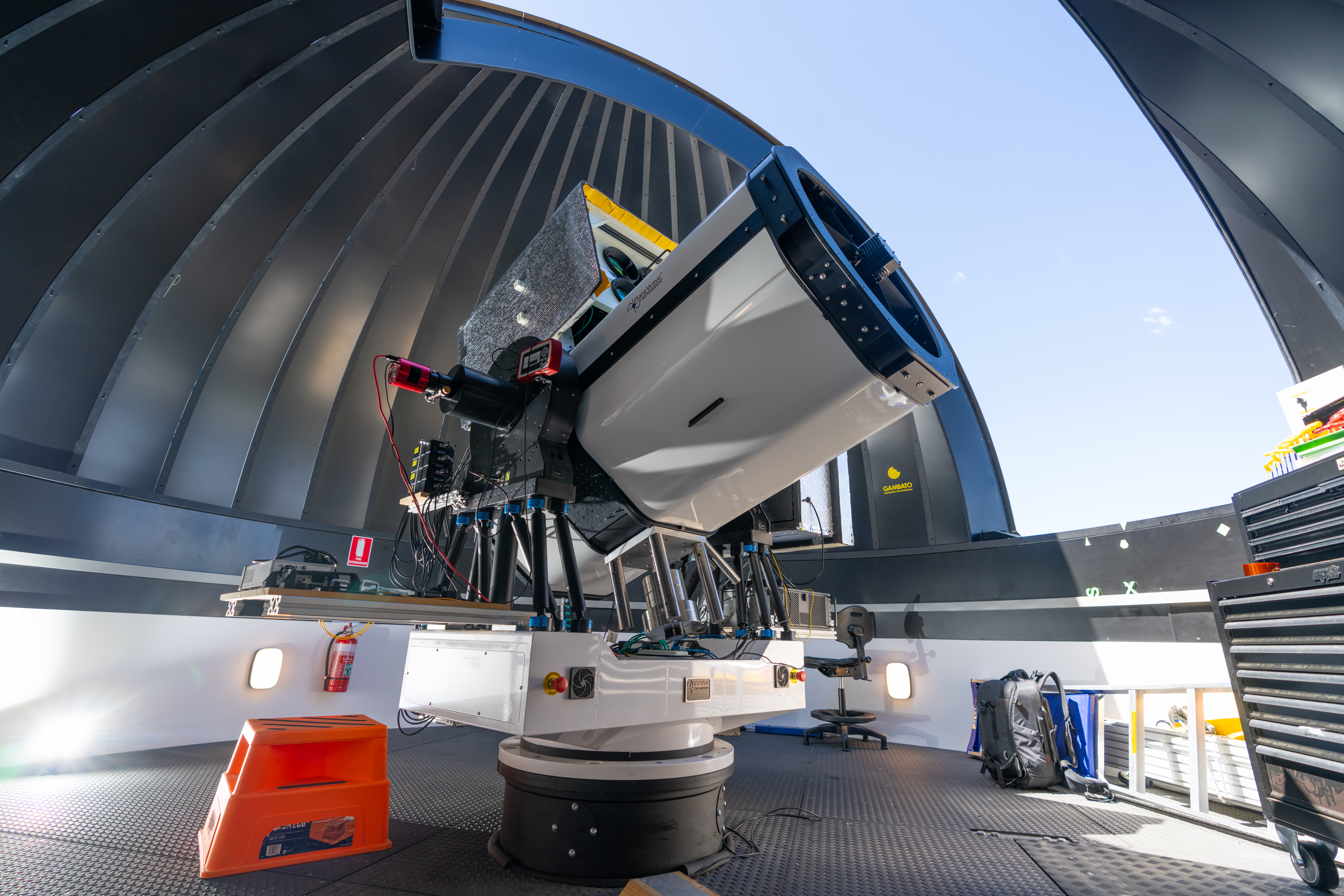
Throughout the mission, the Australian site achieved dual-stream video with Orion for more than 15.5 hours, contributing to NASA’s “Live Views from Orion” feed, which enabled millions of viewers to follow Artemis II milestones. The ground station successfully downlinked the terminal’s highest possible data rate of 260 megabits per seconds, proving that commercial, off-the-shelf parts can be leveraged to decrease the cost, time, and difficulty required to assemble optical ground stations.
Space communications isn’t just about moving bytes, it’s about delivering the images, the video, and the voices of the crew that bring a mission to life.Greg Heckler
SCaN Deputy Program Manager for Capability Development
“Space communications isn’t just about moving bytes, it’s about delivering the images, the video, and the voices of the crew that bring a mission to life,” said Greg Heckler, SCaN’s deputy program manager for capability development. “With the optical payload, we were able to watch astronauts embark on their journey in near real-time. Those moments gave us a breathtaking new view of Earth and revealed the crew isn’t just a team, but a family.”
As NASA pushes the boundaries of human exploration, the successful use of laser communications demonstrated faster data transfer, offering a glimpse into options for future agency missions.
Under Artemis, NASA will send astronauts on increasingly difficult missions to explore more of the Moon for scientific discovery and economic benefits, building the foundation for the first crewed missions to Mars.
Learn more about the Artemis II mission:
https://www.nasa.gov/artemis-ii
Share Details Last Updated Apr 28, 2026 EditorLauren LowLocationGoddard Space Flight Center Related Terms Explore More 3 min read I Am Artemis: Erik Richards Article 1 month ago 5 min read Networks Keeping NASA’s Artemis II Mission Connected Article 3 months ago 3 min read I Am Artemis: Peter Rossoni Article 5 days agoNASA Laser Terminal Enhances Views During Artemis II Mission
Millions of people watched the historic launch of Artemis II and were captivated by the mission’s 10-day journey around the Moon as NASA astronauts Reid Wiseman, Victor Glover, and Christina Koch, and CSA (Canadian Space Agency) astronaut Jeremy Hansen ventured farther into space than any human before. Part of the public’s ability to experience the mission in high-definition was due to laser communications.
To view this video please enable JavaScript, and consider upgrading to a web browser that supports HTML5 video
An animation depicting the Orion capsule using infrared light. Although infrared light is shown here, it is actually invisible to the human eye.NASA/Dave RyanLaser, or optical, communications systems use invisible infrared light to transmit more data in a single downlink than traditional radio frequency systems. During Artemis II, NASA tested an optical communications system to demonstrate the benefits laser communications can bring to future human spaceflight missions to the Moon.
The optical terminal, a payload attached to the Orion spacecraft’s exterior, marked the first time laser communications supported a crewed mission at lunar distance. The terminal collected and transmitted high-definition video, flight procedures, photos, engineering and science data, and voice communications to Earth over laser signals when the spacecraft had line of sight with ground terminals.
The Orion capsule showing the Orion Artemis II Optical Communications System (O2O). O2O was developed by the Massachusetts Institute of Technology Lincoln Laboratory in Lexington, Massachusetts. NASA“Access to high-resolution imagery and other scientific data during dynamic science mission phases is a game changer,” said Dr. Kelsey Young, Artemis II lunar science lead. “It means faster insights, better science decision-making to support the crew as they’re completing science exploration, and a mission with a more integrated science presence. It felt like we were right there with the crew, and it maximized the lunar science impact of the mission as it allowed for a more productive crew science conference the morning after the flyby.”
Access to high-resolution imagery and other scientific data during dynamic science mission phases is a game changer."Dr. Kelsey young
Artemis II Lunar Science Lead
During the about 10-day journey, the laser communications system exchanged 484 gigabytes of data between Orion and Earth, roughly equivalent to 100 high-definition movies compared to the capacity of standard radio frequency systems. The crisp, clear photos of Earthset, Earthrise, and many of the other mission images were downlinked over the Orion Artemis II optical communication system’s laser links. The terminal also was able to transmit data to the Orion capsule, delivering information to the crew.
The solar eclipse captured from a camera mounted on one of the Orion spacecraft’s solar array wings during the Artemis II crew’s flyby of the Moon’s far side.NASAArtemis II’s primary communications support came from the Near Space Network and Deep Space Network, NASA’s traditional radio frequency systems. At lunar distances, with the current processing structure, these systems were limited to single-digit data rates in the megabits per second range. When the optical system was in use, the Orion crew module established multiple 260 megabits per second downlinks, surpassing many of its demonstration goals.
On Earth, NASA ground station telescopes at the NASA’s Jet Propulsion Laboratory in Southern California and White Sands Complex in New Mexico were selected for their high-altitude, dry environments to ensure a strong link between Earth and the optical terminal aboard Orion. These stations collected the bulk of Orion’s optical signals, hitting a record of 26 gigabytes of data received, downloaded, and transmitted to mission control in under an hour – enabling faster data transfer than most home internet capabilities.
This video from the NASA broadcast shows the Orion feed switching from the radio frequency link over to the optical link and the change in clarity.In addition to NASA’s two main ground stations, Orion also downlinked data to a newly developed site at the Australian National University Quantum Optical Ground Station at Mount Stromlo in Canberra, Australia. After several years of technical support, subject matter experts from NASA’s Glenn Research Center in Cleveland and the agency’s Goddard Space Flight Center in Greenbelt, Maryland, worked with the university to build and demonstrate a lunar-capable optical telescope leveraging affordable parts developed by commercial industry.
Quantum Optical Ground Station (QOGS) at the Mount Stromlo Observatory in Canberra, Australia.ANU/Nic VeversThroughout the mission, the Australian site achieved dual-stream video with Orion for more than 15.5 hours, contributing to NASA’s “Live Views from Orion” feed, which enabled millions of viewers to follow Artemis II milestones. The ground station successfully downlinked the terminal’s highest possible data rate of 260 megabits per seconds, proving that commercial, off-the-shelf parts can be leveraged to decrease the cost, time, and difficulty required to assemble optical ground stations.
Space communications isn’t just about moving bytes, it’s about delivering the images, the video, and the voices of the crew that bring a mission to life.Greg Heckler
SCaN Deputy Program Manager for Capability Development
“Space communications isn’t just about moving bytes, it’s about delivering the images, the video, and the voices of the crew that bring a mission to life,” said Greg Heckler, SCaN’s deputy program manager for capability development. “With the optical payload, we were able to watch astronauts embark on their journey in near real-time. Those moments gave us a breathtaking new view of Earth and revealed the crew isn’t just a team, but a family.”
As NASA pushes the boundaries of human exploration, the successful use of laser communications demonstrated faster data transfer, offering a glimpse into options for future agency missions.
Under Artemis, NASA will send astronauts on increasingly difficult missions to explore more of the Moon for scientific discovery and economic benefits, building the foundation for the first crewed missions to Mars.
Learn more about the Artemis II mission:
https://www.nasa.gov/artemis-ii
Share Details Last Updated Apr 28, 2026 EditorLauren LowLocationGoddard Space Flight Center Related Terms Explore More 3 min read I Am Artemis: Erik Richards Article 1 month ago 5 min read Networks Keeping NASA’s Artemis II Mission Connected Article 3 months ago 3 min read I Am Artemis: Peter Rossoni Article 4 days agoGamblers are betting millions of dollars on measles outbreaks
Gamblers are betting millions of dollars on measles outbreaks
People are betting on measles outbreaks – and that might be useful
People are betting on measles outbreaks – and that might be useful
Is consciousness more fundamental to reality than quantum physics?
Is consciousness more fundamental to reality than quantum physics?
DECam's New Image of the Sombrero Galaxy: A Portrait of Ancient Mergers
The 570 megapixel Dark Energy Camera captured this image of the iconic Sombrero Galaxy. The galaxy has characteristics of both elliptical galaxies and spiral galaxies, and is likely the result of multiple mergers and cannibalizations of dwarf galaxies. A faint stellar stream, only fully traced a few years ago, is revealed by DECam's resolving power.
Six Years of Curiosity’s Wheels on the Move
NASA/JPL-Caltech Photojournal Navigation Downloads PIA26721 Animation
MP4 (47.13 MB)
Description
NASA’s Curiosity Mars rover used its right navigation camera — one of two on the rover’s mast, or head — to capture the images in this timelapse, which spans six years of driving. The images were snapped between Jan. 2, 2020, and March 8, 2026 (the 2,633rd and 4,830th Martian day, or sol, of the mission, respectively). The images were taken when the mast was looking behind the rover to help the science team choose rocks to study.
Curiosity’s team is using this timelapse to watch for sand grains shifting on the rover’s deck. Distinguishing between sand jostled by each drive and wind gusts can provide new information about seasonal changes in the atmosphere.
Curiosity was built by NASA’s Jet Propulsion Laboratory, which is managed by Caltech in Pasadena, California. JPL leads the mission on behalf of NASA’s Science Mission Directorate in Washington as part of NASA’s Mars Exploration Program portfolio.
To learn more about Curiosity, visit:
science.nasa.gov/mission/msl-curiosity
Keep Exploring Discover More Topics From Photojournal
Photojournal
Search Photojournal
Photojournal’s Latest Content
Feedback
Six Years of Curiosity’s Wheels on the Move
NASA/JPL-Caltech Photojournal Navigation Downloads PIA26721 Animation
MP4 (47.13 MB)
Description
NASA’s Curiosity Mars rover used its right navigation camera — one of two on the rover’s mast, or head — to capture the images in this timelapse, which spans six years of driving. The images were snapped between Jan. 2, 2020, and March 8, 2026 (the 2,633rd and 4,830th Martian day, or sol, of the mission, respectively). The images were taken when the mast was looking behind the rover to help the science team choose rocks to study.
Curiosity’s team is using this timelapse to watch for sand grains shifting on the rover’s deck. Distinguishing between sand jostled by each drive and wind gusts can provide new information about seasonal changes in the atmosphere.
Curiosity was built by NASA’s Jet Propulsion Laboratory, which is managed by Caltech in Pasadena, California. JPL leads the mission on behalf of NASA’s Science Mission Directorate in Washington as part of NASA’s Mars Exploration Program portfolio.
To learn more about Curiosity, visit:
science.nasa.gov/mission/msl-curiosity
Keep Exploring Discover More Topics From Photojournal
Photojournal
Search Photojournal
Photojournal’s Latest Content
Feedback