
Feed aggregator
Scientists catalog the ‘fractal dimensions’ of more than 130,000 islands
The “coastline paradox” helped to define fractals, but coastlines themselves turn out to be less fractal than thought
Himalayan wolf-dog hybrids emerge as a threat to wolves and people
Himalayan wolf-dog hybrids emerge as a threat to wolves and people
NASA Science, Cargo Launch on 34th SpaceX Resupply Mission to Station
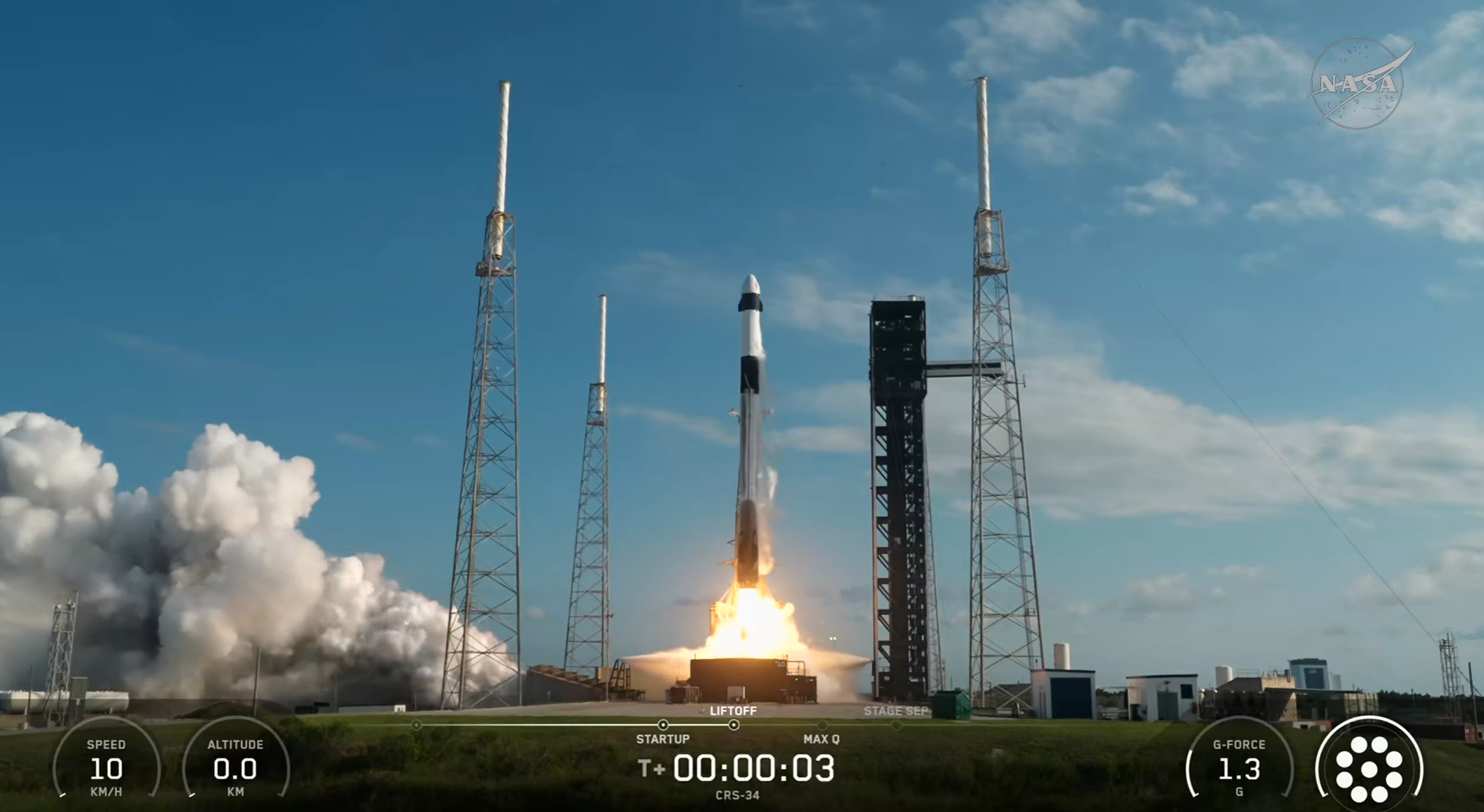
The 34th SpaceX commercial resupply mission under contract with NASA is headed to the International Space Station with new scientific experiments after lifting off at 6:05 p.m. EDT Friday on a Falcon 9 rocket from Space Launch Complex 40 at Cape Canaveral Space Force Station in Florida.
The SpaceX spacecraft, loaded with nearly 6,500 pounds of cargo for the space station’s Expedition 74 crew, is scheduled to autonomously dock at about 7 a.m. Sunday, May 17, to the forward port of the station’s Harmony module.
Watch NASA’s live rendezvous and docking coverage beginning at 5:30 a.m. on NASA+, Amazon Prime, and the agency’s YouTube channel. Learn how to watch NASA content through a variety of online platforms, including social media.
In addition to cargo for the crew aboard the space station, Dragon will deliver several new experiments, including a project to determine how well Earth-based simulators mimic microgravity conditions, a bone scaffold made from wood that could produce new treatments for fragile bone conditions like osteoporosis, and equipment to help researchers evaluate how red blood cells and the spleen change in space. The Dragon spacecraft also will carry a new instrument to study charged particles around Earth that can impact power grids and satellites, an investigation that could provide a fundamental understanding of how planets form, and an instrument designed to take highly accurate measurements of sunlight reflected by Earth and the Moon.
These experiments are just a sample of the hundreds of investigations conducted aboard the orbiting laboratory in the areas of biology and biotechnology, physical sciences, and Earth and space science. For more than 25 years, people have lived and worked continuously aboard the International Space Station, advancing scientific knowledge and making research breakthroughs that aren’t possible on Earth. The space station helps NASA understand and overcome the challenges of human spaceflight, expand commercial opportunities in low Earth orbit, and build on the foundation for long-duration missions to the Moon, as part of the Artemis program, and to Mars.
The Dragon spacecraft is scheduled to remain at the station until mid-June, when it will depart and return to Earth with time-sensitive research and cargo, ahead of splashing down off the coast of California.
Learn more about International Space Station research, operations, and its crews at:
-end-
Jimi Russell
Headquarters, Washington
202-358-1100
james.j.russell@nasa.gov
Danielle Sempsrott / Leejay Lockhart
Kennedy Space Center, Fla.
321-867-2468
danielle.c.sempsrott@nasa.gov / leejay.lockhart@nasa.gov
Sandra Jones / Joseph Zakrzewski
Johnson Space Center, Houston
281-483-5111
sandra.p.jones@nasa.gov / joseph.a.zakrzewski@nasa.gov
NASA Science, Cargo Launch on 34th SpaceX Resupply Mission to Station
The 34th SpaceX commercial resupply mission under contract with NASA is headed to the International Space Station with new scientific experiments after lifting off at 6:05 p.m. EDT Friday on a Falcon 9 rocket from Space Launch Complex 40 at Cape Canaveral Space Force Station in Florida.
The SpaceX spacecraft, loaded with nearly 6,500 pounds of cargo for the space station’s Expedition 74 crew, is scheduled to autonomously dock at about 7 a.m. Sunday, May 17, to the forward port of the station’s Harmony module.
Watch NASA’s live rendezvous and docking coverage beginning at 5:30 a.m. on NASA+, Amazon Prime, and the agency’s YouTube channel. Learn how to watch NASA content through a variety of online platforms, including social media.
In addition to cargo for the crew aboard the space station, Dragon will deliver several new experiments, including a project to determine how well Earth-based simulators mimic microgravity conditions, a bone scaffold made from wood that could produce new treatments for fragile bone conditions like osteoporosis, and equipment to help researchers evaluate how red blood cells and the spleen change in space. The Dragon spacecraft also will carry a new instrument to study charged particles around Earth that can impact power grids and satellites, an investigation that could provide a fundamental understanding of how planets form, and an instrument designed to take highly accurate measurements of sunlight reflected by Earth and the Moon.
These experiments are just a sample of the hundreds of investigations conducted aboard the orbiting laboratory in the areas of biology and biotechnology, physical sciences, and Earth and space science. For more than 25 years, people have lived and worked continuously aboard the International Space Station, advancing scientific knowledge and making research breakthroughs that aren’t possible on Earth. The space station helps NASA understand and overcome the challenges of human spaceflight, expand commercial opportunities in low Earth orbit, and build on the foundation for long-duration missions to the Moon, as part of the Artemis program, and to Mars.
The Dragon spacecraft is scheduled to remain at the station until mid-June, when it will depart and return to Earth with time-sensitive research and cargo, ahead of splashing down off the coast of California.
Learn more about International Space Station research, operations, and its crews at:
-end-
Jimi Russell
Headquarters, Washington
202-358-1100
james.j.russell@nasa.gov
Danielle Sempsrott / Leejay Lockhart
Kennedy Space Center, Fla.
321-867-2468
danielle.c.sempsrott@nasa.gov / leejay.lockhart@nasa.gov
Sandra Jones / Joseph Zakrzewski
Johnson Space Center, Houston
281-483-5111
sandra.p.jones@nasa.gov / joseph.a.zakrzewski@nasa.gov
A New Theory of Dark Matter Could Solve Three Cosmic Mysteries
A study led by UC Riverside physicist Hai-Bo Yu suggests that a new type of dark matter could explain three astrophysical puzzles across vastly different environments.
Bizarre Venus Surface Formations Puzzle Planetary Scientists
Enigmatic crownlike surface formations on Venus hold keys to understanding our twin planet’s deep interior. Or so says a new paper presented at the recent European Geosciences Union 2026 general assembly in Vienna.
Hantavirus can persist in semen for years, but that doesn’t mean it remains contagious
Researchers know very little about how long the Andes version of the hantavirus can remain in human hosts
A real Mr. Snuffleupagus? Meet the ocean’s strangest new fish species
A strange, tiny fish that resembles the famous Sesame Street character camouflages amid red algae thanks to its flamboyant reddish “hairs”
NASA Captures Volatile Changes in Earth's Artificial Light
A study of NASA's Black Marble data reveals a pattern of regional volatility in nighttime illumination across the planet.
This startup wants to make drugs in orbit. If it succeeds, it could transform the space economy
Varda’s plan to develop medicines in microgravity has its advantages, but it requires a big up-front cost
How to arm yourself against hantavirus misinformation
Hantavirus misinformation is spreading fast. COVID trauma and social media algorithms may be to blame
A Galaxy Cluster's Wild Youth
The galaxy cluster Abell 2029 is sometimes described as “the most relaxed cluster in the Universe.” This moniker does not arise from some sort of mellow vibe, but rather because of how calm and undisturbed the superheated gas that pervades the cluster appears to be. But new Chandra X-ray observations of the massive cluster highlight a major merger 4 billion years ago that still shape it today.
Can plants have consciousness? The film Silent Friend reimagines the science
The filmmaker behind the newly released movie Silent Friend shares the scientific and historical inspiration for its story of botanical consciousness
Is Earth’s Constant Companion a Stray Asteroid or a Chunk of the Moon?
Earth has a group of cosmic stalkers. Known as “co-orbitals”, these small bits of rock have a 1:1 mean motion resonance with Earth. Basically, they take the exact same amount of time to orbit the Sun as we do. Astronomers have long believed these objects wandered in from the main asteroid belt between Mars and Jupiter, but recent spectral analysis suggests they better match the space-weathered lunar silicates that make up the Moon’s surface. As such, there has been an ongoing debate about whether these cosmic stalkers are actually visitors from the belt or blasted pieces of the Moon. A new study, published in Icarus, from researchers Elisa Alessi and Robert Jedicke provides strong hints that the belt is the more likely source - but pretty soon we’ll get a definitive answer from a spacecraft.