
Feed aggregator
NASA’s Juno Measures Thickness of Europa’s Ice Shell
5 min read
Preparations for Next Moonwalk Simulations Underway (and Underwater) Jupiter’s moon Europa was captured by the JunoCam instrument aboard NASA’s Juno spacecraft during the mission’s close flyby on Sept. 29, 2022. The images show the fractures, ridges, and bands that crisscross the moon’s surface.Image data: NASA/JPL-Caltech/SwRI/MSSS Image processing: Björn Jónsson (CC BY 3.0)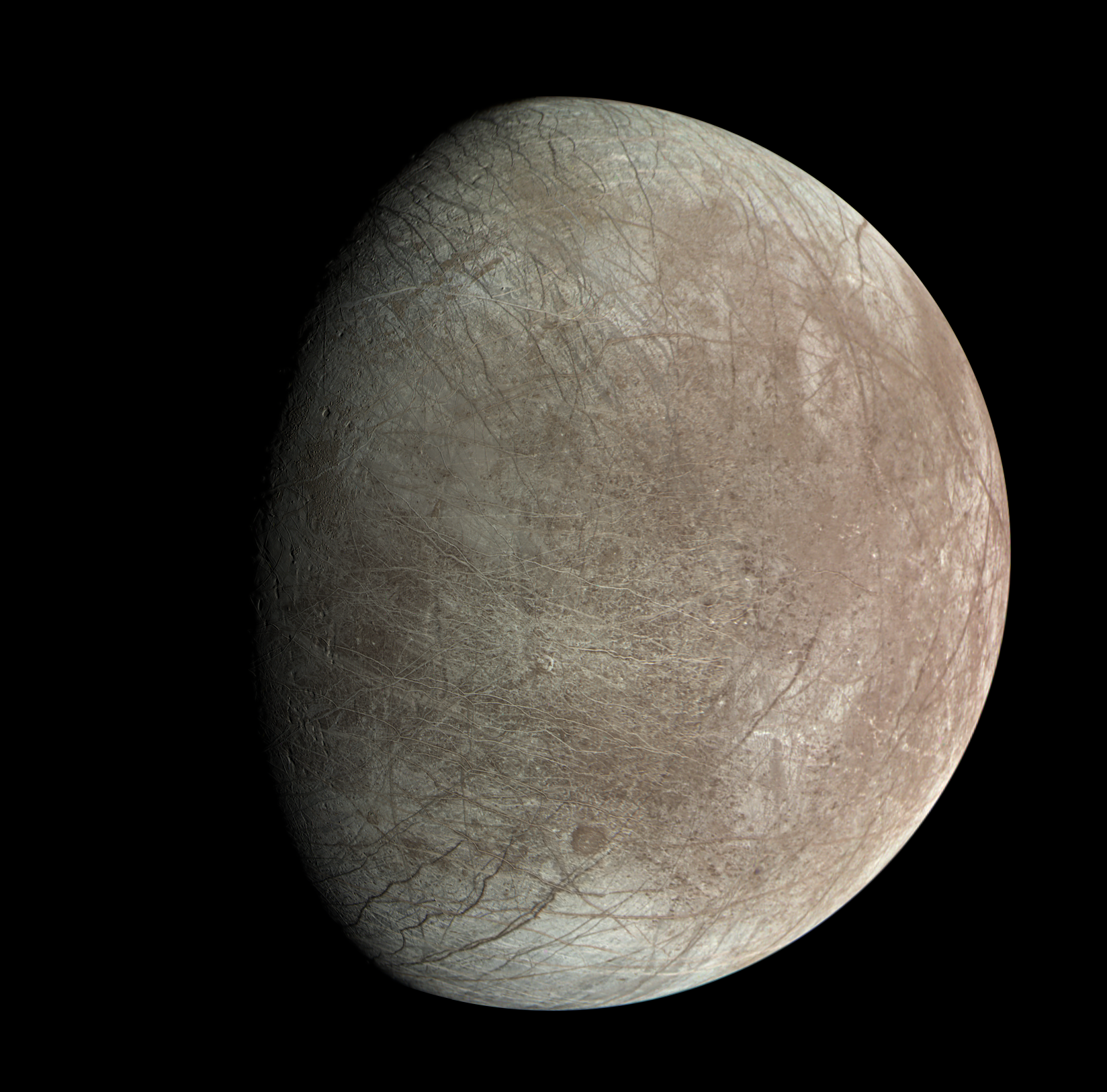
Results from the solar-powered spacecraft provide a new measurement of the thickness of the ice shell encasing the Jovian moon’s ocean.
Data from NASA’s Juno mission has provided new insights into the thickness and subsurface structure of the icy shell encasing Jupiter’s moon Europa. Using the spacecraft’s Microwave Radiometer (MWR), mission scientists determined that the shell averages about 18 miles (29 kilometers) thick in the region observed during Juno’s 2022 flyby of Europa. The Juno measurement is the first to discriminate between thin and thick shell models that have suggested the ice shell is anywhere from less than half a mile to tens of miles thick.
Slightly smaller than Earth’s moon, Europa is one of the solar system’s highest-priority science targets for investigating habitability. Evidence suggests that the ingredients for life may exist in the saltwater ocean that lies beneath its ice shell. Uncovering a variety of characteristics of the ice shell, including its thickness, provides crucial pieces of the puzzle for understanding the moon’s internal workings and the potential for the existence of a habitable environment.
The new estimate on the ice thickness in the near-surface icy crust was published on Dec. 17 in the journal Nature Astronomy.
This artist’s concept depicts a cutaway view showing Europa’s ice shell. Data used to generate a new result on the ice thickness and structure was collected by the microwave radiometer instrument on NASA’s Juno during a close flyby of the Jovian moon on Sept. 29, 2022.NASA/JPL-Caltech/SwRI/Koji Kuramura/ Gerald Eichstädt (CC BY) Catching waves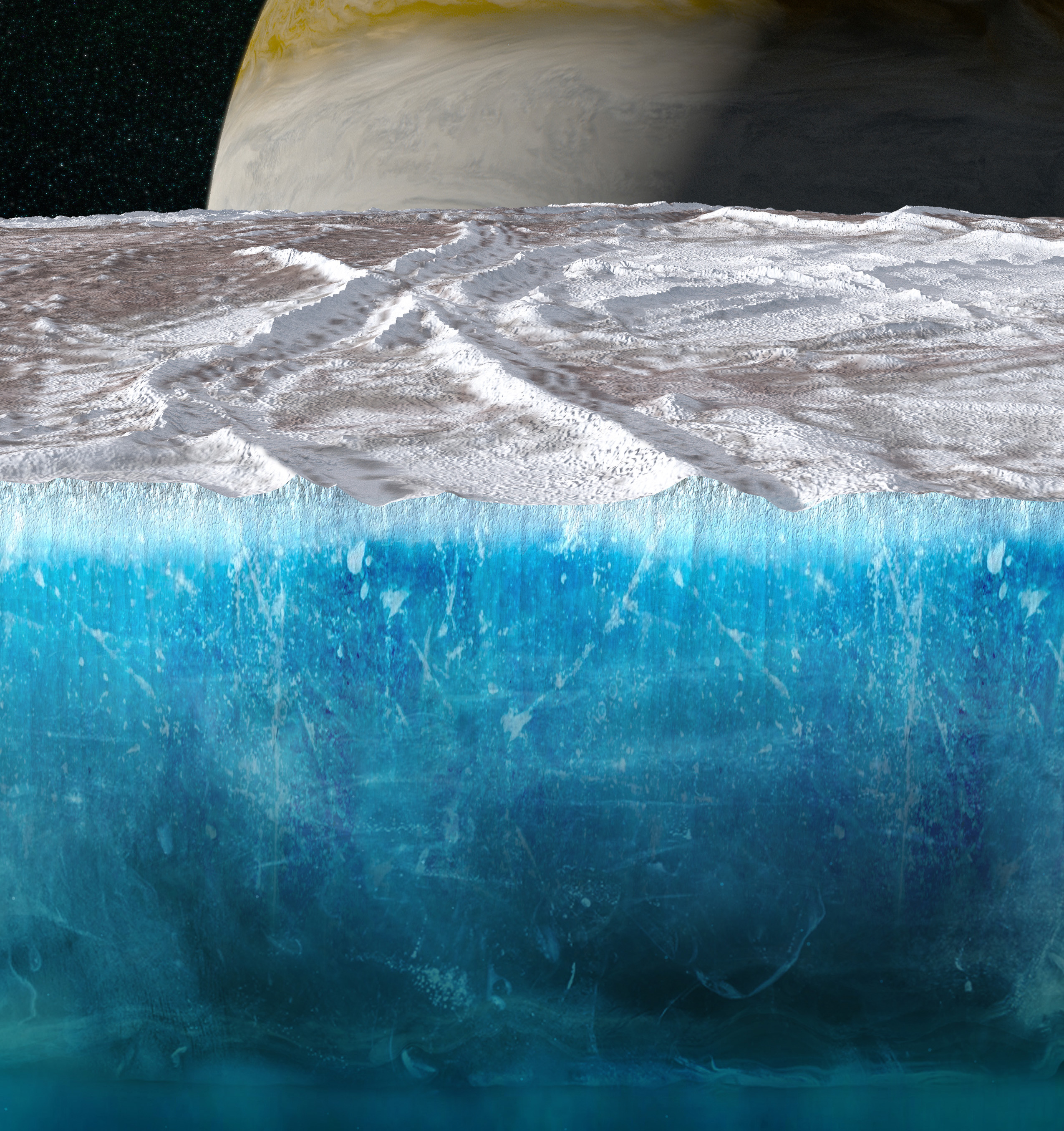
Although the MWR instrument was designed to investigate Jupiter’s atmosphere below the cloud tops, the novel instrument has proven valuable for studying the gas giant’s icy and volcanic moons as well.
On Sept. 29, 2022, Juno came within about 220 miles (360 kilometers) of Europa’s frozen surface. During the flyby, MWR collected data on about half the moon’s surface, peering beneath the ice to measure its temperatures at various depths.
“The 18-mile estimate relates to the cold, rigid, conductive outer-layer of a pure water ice shell,” said Steve Levin, Juno project scientist and co-investigator from NASA’s Jet Propulsion Laboratory in Southern California, which manages the mission. “If an inner, slightly warmer convective layer also exists, which is possible, the total ice shell thickness would be even greater. If the ice shell contains a modest amount of dissolved salt, as suggested by some models, then our estimate of the shell thickness would be reduced by about 3 miles.”
The thick shell, as suggested by the MWR data, implies a longer route that oxygen and nutrients would have to travel to connect Europa’s surface with its subsurface ocean. Understanding this process may be relevant to future studies of Europa’s habitability.
Cracks, poresThe MWR data also provides new insights into the makeup of the ice just below Europa’s surface. The instrument revealed the presence of “scatterers” — irregularities in the near-surface ice such as cracks, pores, and voids that scatter the instrument’s microwaves reflecting off the ice (similar to how visible light is scattered in ice cubes). These scatterers are estimated to be no bigger than a few inches in diameter and appear to extend to depths of hundreds of feet below Europa’s surface.
The small size and shallow depth of these features, as modeled in this study, suggest they are unlikely to be a significant pathway for oxygen and nutrients to travel from Europa’s surface to its salty ocean.
“How thick the ice shell is and the existence of cracks or pores within the ice shell are part of the complex puzzle for understanding Europa’s potential habitability,” said Scott Bolton, principal investigator of Juno from the Southwest Research Institute in San Antonio. “They provide critical context for NASA’s Europa Clipper and the ESA (European Space Agency) Juice (JUpiter ICy moons Explorer) spacecraft — both of which are on their way to the Jovian system.” Europa Clipper will arrive there in 2030, while Juice will arrive the year after.
Juno will carry out its 81st flyby of Jupiter on Feb. 25.
More about JunoA division of Caltech in Pasadena, California, JPL manages the Juno mission for the principal investigator, Scott Bolton, of the Southwest Research Institute in San Antonio. Juno is part of NASA’s New Frontiers Program, managed at NASA’s Marshall Space Flight Center in Huntsville, Alabama, for the agency’s Science Mission Directorate in Washington.
To learn more about Juno, go to:
https://science.nasa.gov/mission/juno
News Media Contacts
DC Agle
Jet Propulsion Laboratory
818-393-9011
agle@jpl.nasa.gov
Karen Fox / Molly Wasser
NASA Headquarters, Washington
240-285-5155 / 240-419-1732
karen.c.fox@nasa.gov / molly.l.wasser@nasa.gov
Deb Schmid
Southwest Research Institute, San Antonio
210-522-2254
dschmid@swri.org
2026-004
Share Details Last Updated Jan 27, 2026 Related Terms Explore More 6 min read NASA’s Pandora Satellite, CubeSats to Explore Exoplanets, BeyondEditor’s Note, Jan. 13, 2026: Mission controllers received full acquisition of signal from the Pandora…
Article 3 weeks ago 6 min read NASA’s SPHEREx Observatory Completes First Cosmic Map Like No Other Article 1 month ago 6 min read NASA’s Perseverance Mars Rover Ready to Roll for Miles in Years Ahead Article 1 month ago Keep Exploring Discover Related TopicsJupiter: Exploration
JunoNASA’s Juno spacecraft has explored Jupiter, its moons, and rings since 2016, gathering breakthrough science and breathtaking imagery.
Jupiter Moons
EuropaEyes on the Solar System: Europa
This Rapidly Growing Black Hole Is Challenging Super-Eddington Accretion
Why are SMBH in the early Universe so massive? According to astrophysical models, these extraordinarily large SMBH haven't had time to become so massive. Super-Eddington accretion might explain it, but can it explain a very unusual early SMBH recently discovered?
Amazon is getting drier as deforestation shuts down atmospheric rivers
Amazon is getting drier as deforestation shuts down atmospheric rivers
To halt measles' resurgence we must fight the plague of misinformation
To halt measles' resurgence we must fight the plague of misinformation
NASA Launches Its Most Powerful, Efficient Supercomputer
3 min read
Preparations for Next Moonwalk Simulations Underway (and Underwater) Athena, NASA’s newest supercomputer, is housed at the agency’s Modular Supercomputing Facility at NASA’s Ames Research Center in California’s Silicon Valley.NASA/Brandon Torres-Navarrete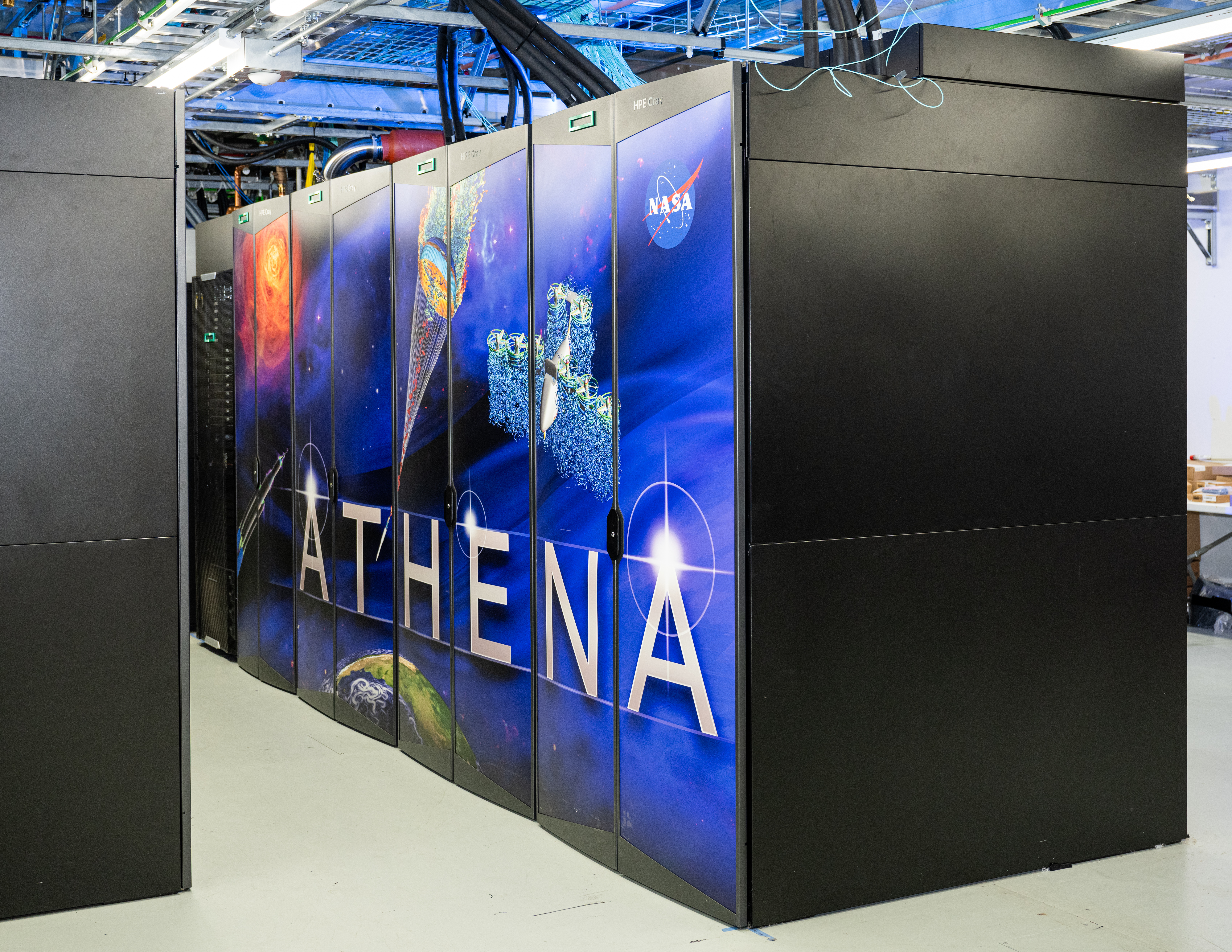
NASA is announcing the availability of its newest supercomputer, Athena, an advanced system designed to support a new generation of missions and research projects. The newest member of the agency’s High-End Computing Capability project expands the resources available to help scientists and engineers tackle some of the most complex challenges in space, aeronautics, and science.
Housed in the agency’s Modular Supercomputing Facility at NASA’s Ames Research Center in California’s Silicon Valley, Athena delivers more computing power than any other NASA system, surpassing the capabilities of its predecessors, Aitken and Pleiades, in power and efficiency. The new system, which was rolled out in January to existing users after a beta testing period, delivers over 20 petaflops of peak performance – a measurement of the number of calculations it can make per second – while reducing the agency’s supercomputing utility costs.
“Exploration has always driven NASA to the edge of what’s computationally possible,” said Kevin Murphy, chief science data officer and lead for the agency’s High-End Computing Capability portfolio at NASA Headquarters in Washington. “Now with Athena, NASA will expand its efforts to provide tailored computing resources that meet the evolving needs of its missions.”
Supercomputers like Athena are critical to missions and research across the agency, providing the computational power necessary to simulate rocket launches, design next-generation aircraft, and train large-scale artificial intelligence foundation models capable of analyzing massive datasets to uncover new scientific insights. The supercomputer is available to NASA researchers and external scientist and researchers supporting NASA programs who can apply for time to use the system.
The name Athena was selected through a contest held in March 2025 among the agency’s High-End Computing Capability workforce, which chose the name of the Greek goddess of wisdom and warfare because she is the half-sister of Artemis.
Managed by NASA’s Office of the Chief Science Data Officer, the High-End Computing Capability portfolio supports a flexible, hybrid computing approach that combines supercomputers with access to other tools, such as commercial cloud platforms. This strategy enables NASA teams to choose the most effective computing environment for their research, whether running complex simulations, developing and deploying AI models, or performing large-scale data analysis.
The project’s capabilities will continue to expand as the agency invests in advanced supercomputing to meet the growing complexity of its missions. As exploration pushes further into the universe, the ability to compute quickly, efficiently, and intelligently will be more important than ever. With Athena, NASA is laying the digital foundation for the next era of discovery.
To learn more about high-end computing at NASA, visit:
Share Details Last Updated Jan 27, 2026 Related Terms Explore More 4 min read NASA Science Flights Venture to Improve Severe Winter Weather Warnings Article 14 hours ago 5 min read NASA’s Chandra Releases Deep Cut From Catalog of Cosmic Recordings Article 5 days ago 4 min read NASA AI Model That Found 370 Exoplanets Now Digs Into TESS DataTrained on data from NASA’s exoplanet-hunting missions, the open-source ExoMiner++ deep learning model uses an…
Article 6 days ago Keep Exploring Discover More Topics From NASA Office of the Chief Science Data OfficerNASA’s groundbreaking science and exploration missions increasingly rely on the efficient use of large-scale data, advanced computing, and high-performance analytics.…
Core Area of Expertise: Supercomputing
Ames Research Center
Computing
NASA Launches Its Most Powerful, Efficient Supercomputer
3 min read
Preparations for Next Moonwalk Simulations Underway (and Underwater) Athena, NASA’s newest supercomputer, is housed at the agency’s Modular Supercomputing Facility at NASA’s Ames Research Center in California’s Silicon Valley.NASA/Brandon Torres-NavarreteNASA is announcing the availability of its newest supercomputer, Athena, an advanced system designed to support a new generation of missions and research projects. The newest member of the agency’s High-End Computing Capability project expands the resources available to help scientists and engineers tackle some of the most complex challenges in space, aeronautics, and science.
Housed in the agency’s Modular Supercomputing Facility at NASA’s Ames Research Center in California’s Silicon Valley, Athena delivers more computing power than any other NASA system, surpassing the capabilities of its predecessors, Aitken and Pleiades, in power and efficiency. The new system, which was rolled out in January to existing users after a beta testing period, delivers over 20 petaflops of peak performance – a measurement of the number of calculations it can make per second – while reducing the agency’s supercomputing utility costs.
“Exploration has always driven NASA to the edge of what’s computationally possible,” said Kevin Murphy, chief science data officer and lead for the agency’s High-End Computing Capability portfolio at NASA Headquarters in Washington. “Now with Athena, NASA will expand its efforts to provide tailored computing resources that meet the evolving needs of its missions.”
Supercomputers like Athena are critical to missions and research across the agency, providing the computational power necessary to simulate rocket launches, design next-generation aircraft, and train large-scale artificial intelligence foundation models capable of analyzing massive datasets to uncover new scientific insights. The supercomputer is available to NASA researchers and external scientist and researchers supporting NASA programs who can apply for time to use the system.
The name Athena was selected through a contest held in March 2025 among the agency’s High-End Computing Capability workforce, which chose the name of the Greek goddess of wisdom and warfare because she is the half-sister of Artemis.
Managed by NASA’s Office of the Chief Science Data Officer, the High-End Computing Capability portfolio supports a flexible, hybrid computing approach that combines supercomputers with access to other tools, such as commercial cloud platforms. This strategy enables NASA teams to choose the most effective computing environment for their research, whether running complex simulations, developing and deploying AI models, or performing large-scale data analysis.
The project’s capabilities will continue to expand as the agency invests in advanced supercomputing to meet the growing complexity of its missions. As exploration pushes further into the universe, the ability to compute quickly, efficiently, and intelligently will be more important than ever. With Athena, NASA is laying the digital foundation for the next era of discovery.
To learn more about high-end computing at NASA, visit:
Share Details Last Updated Jan 27, 2026 Related Terms Explore More 4 min read NASA Science Flights Venture to Improve Severe Winter Weather Warnings Article 10 hours ago 5 min read NASA’s Chandra Releases Deep Cut From Catalog of Cosmic Recordings Article 5 days ago 4 min read NASA AI Model That Found 370 Exoplanets Now Digs Into TESS DataTrained on data from NASA’s exoplanet-hunting missions, the open-source ExoMiner++ deep learning model uses an…
Article 6 days ago Keep Exploring Discover More Topics From NASA Office of the Chief Science Data OfficerNASA’s groundbreaking science and exploration missions increasingly rely on the efficient use of large-scale data, advanced computing, and high-performance analytics.…
Core Area of Expertise: Supercomputing
Ames Research Center
Computing
The Rubin Observatory Will Rapidly Detect More Supernovae
It's been about one millennia since humans directly observed a core-collapse supernova in the Milky Way. That's strange, since there should be 1 or 2 every century. By working with neutrino detectors, the Vera C. Rubin Observatory should be able to detect far more supernovae.
NASA’s James Webb Space Telescope Finds Crystal-Spewing Protostar
NASA’s James Webb Space Telescope Finds Crystal-Spewing Protostar

The NIRCam (Near-Infrared Camera) on NASA’s James Webb Space Telescope captured the actively forming protostar EC 53 (circled at left) in the Serpens Nebula in this image released on Jan. 21, 2026.
Astronomers have long sought evidence to explain why comets at the outskirts of our own solar system contain crystalline silicates, since crystals require intense heat to form and these “dirty snowballs” spend most of their time in the ultracold Kuiper Belt and Oort Cloud. Now, looking outside our solar system, Webb has returned the first conclusive evidence that links how those conditions are possible.
The telescope clearly showed for the first time that the hot, inner part of the disk of gas and dust surrounding a very young, actively forming star is where crystalline silicates are forged. Webb also revealed a strong outflow that is capable of carrying the crystals to the outer edges of this disk. Compared to our own fully formed, mostly dust-cleared solar system, the crystals would be forming approximately between the Sun and Earth.
Read more about this discovery.
Image credit: NASA, ESA, CSA, STScI, Klaus Pontoppidan (NASA-JPL), Joel Green (STScI); Image Processing: Alyssa Pagan (STScI)
NASA’s James Webb Space Telescope Finds Crystal-Spewing Protostar
The NIRCam (Near-Infrared Camera) on NASA’s James Webb Space Telescope captured the actively forming protostar EC 53 (circled at left) in the Serpens Nebula in this image released on Jan. 21, 2026.
Astronomers have long sought evidence to explain why comets at the outskirts of our own solar system contain crystalline silicates, since crystals require intense heat to form and these “dirty snowballs” spend most of their time in the ultracold Kuiper Belt and Oort Cloud. Now, looking outside our solar system, Webb has returned the first conclusive evidence that links how those conditions are possible.
The telescope clearly showed for the first time that the hot, inner part of the disk of gas and dust surrounding a very young, actively forming star is where crystalline silicates are forged. Webb also revealed a strong outflow that is capable of carrying the crystals to the outer edges of this disk. Compared to our own fully formed, mostly dust-cleared solar system, the crystals would be forming approximately between the Sun and Earth.
Read more about this discovery.
Image credit: NASA, ESA, CSA, STScI, Klaus Pontoppidan (NASA-JPL), Joel Green (STScI); Image Processing: Alyssa Pagan (STScI)
Our brains play a surprising role in recovering from a heart attack
Our brains play a surprising role in recovering from a heart attack
Nobel prizewinner Omar Yaghi says his invention will change the world
Nobel prizewinner Omar Yaghi says his invention will change the world
A foraging teenager was mauled by a bear 27,000 years ago, skeleton shows
The remains of a teenage boy who lived around 27,000 years ago suggest he was attacked by a cave bear—some of the first direct evidence of a predator attacking an ancient human
NASA to push ahead with ‘wet’ dress rehearsal for Artemis II moon mission
A crucial test of NASA’s upcoming crewed flight to the moon is set to take place as soon as Saturday, the agency said
NASA, Partners Advance LISA Prototype Hardware
3 min read
NASA, Partners Advance LISA Prototype HardwareEngineers and scientists at NASA’s Goddard Space Flight Center in Greenbelt, Maryland, completed tests this month on a second early version of a key element of the upcoming LISA (Laser Interferometer Space Antenna) mission.
The LISA mission, a collaboration between ESA (the European Space Agency) and NASA, will use infrared lasers to detect gravitational waves, or ripples in the fabric of space-time. The tests involved the frequency reference system, delivered by BAE Systems, that will help control the lasers connecting LISA’s three spacecraft. The lasers must be finely tuned to make precise measurements — to within a trillionth of a meter, called a picometer.
A prototype laser optical module for LISA (Laser Interferometer Space Antenna) rests on a table after testing at NASA’s Goddard Space Flight Center in Greenbelt, Maryland, in May 2025. Xiaozhen Xu, an engineer with Miller Engineering and Research Corp., works in the background. The smaller box to the right is the laser electronics module. Each of the three LISA spacecraft will have a laser system with a frequency reference component and six laser heads.NASA/Sophia Roberts Download high-resolution images from NASA’s Scientific Visualization Studio
The team tested the first version of the system in May 2025.
“The extensive round of checkouts on the frequency reference system last year were very successful,” said Ira Thorpe, the project scientist for LISA at NASA Goddard. “This second unit is identical, so our assessments this time around were less intense and preface a future cross-check of the two, which is the gold-standard for checking the stability of the system overall.”
In addition to the laser system, NASA is contributing the telescopes, devices to manage the buildup of onboard electrical charge, and the framework scientists will need to process the data the mission will generate.
A prototype charge management device for LISA sits on a lab bench at NASA Goddard in May 2025. Each of the three LISA spacecraft will have a charge management device to reduce the buildup of electric charge on the gold-platinum proof masses that fly freely inside the spacecraft. The University of Florida in Gainesville and Fibertek Inc. in McNair, Va., are developing the devices.NASA/Dennis Henry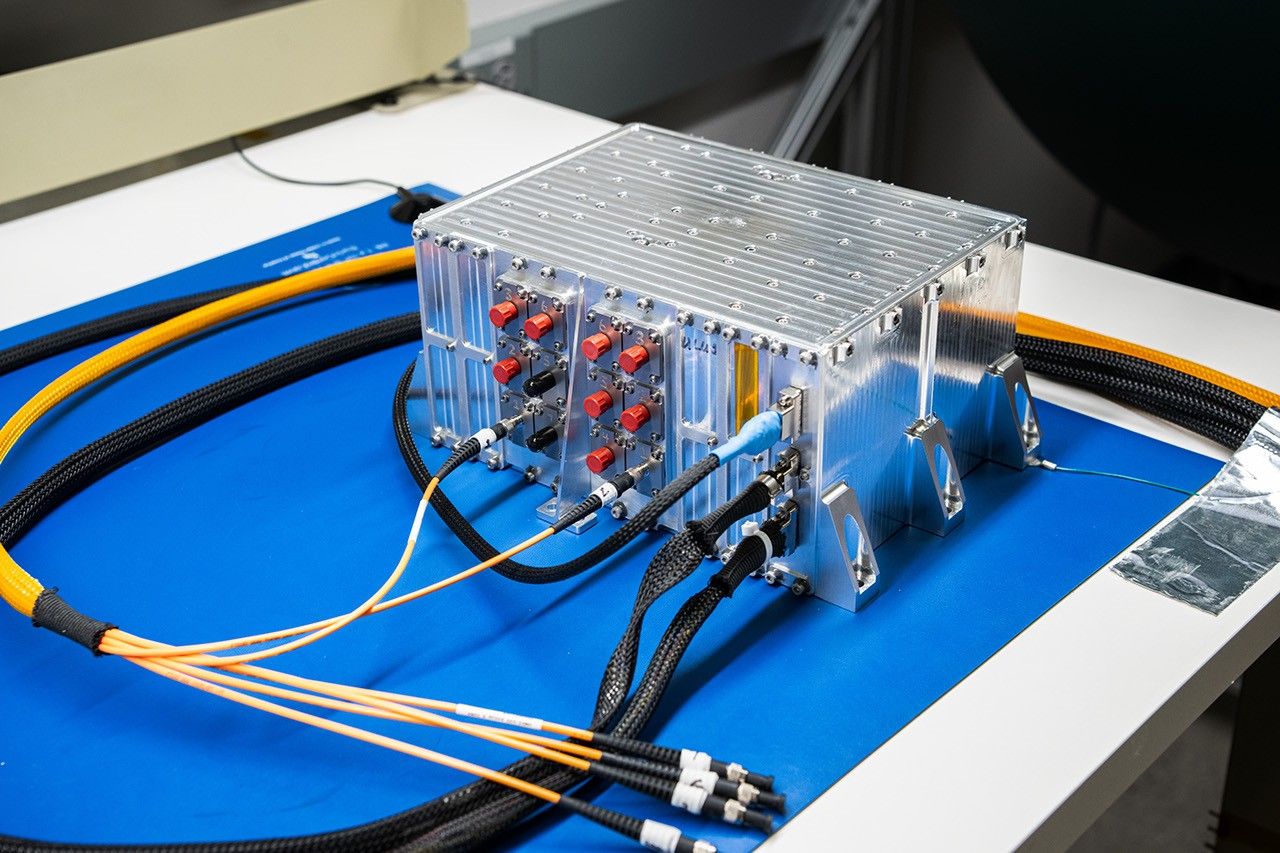
NASA’s contributions are part of the agency’s efforts to innovate on ambitious science missions that will help us better understand how the universe works. LISA will also offer a major advancement in multimessenger astronomy, which is how scientists explore cosmic signals other than light.
The three LISA spacecraft will fly in a vast triangular formation that follows Earth as it orbits the Sun. Each arm of the triangle will stretch 1.6 million miles (2.5 million kilometers).
Each spacecraft will contain two free-floating cubes inside called proof masses. Arriving gravitational waves from throughout the universe will minutely change the lengths of the triangle’s arms. The lasers connecting the cubes will measure changes in their separation to within a distance smaller than a helium atom.
In May 2024, technicians inspected the prototype LISA telescope in a darkened clean room at NASA Goddard. Illuminated by a flashlight, the telescope’s structure glows. The prototype is made from a translucent, amber-colored, glass-ceramic material called Zerodur, which is often used in high-precision applications because it resists changes in shape over a wide temperature range. The mirror, near center and coated in gold, reflects a magnified image of part of the telescope.NASA/Dennis Henry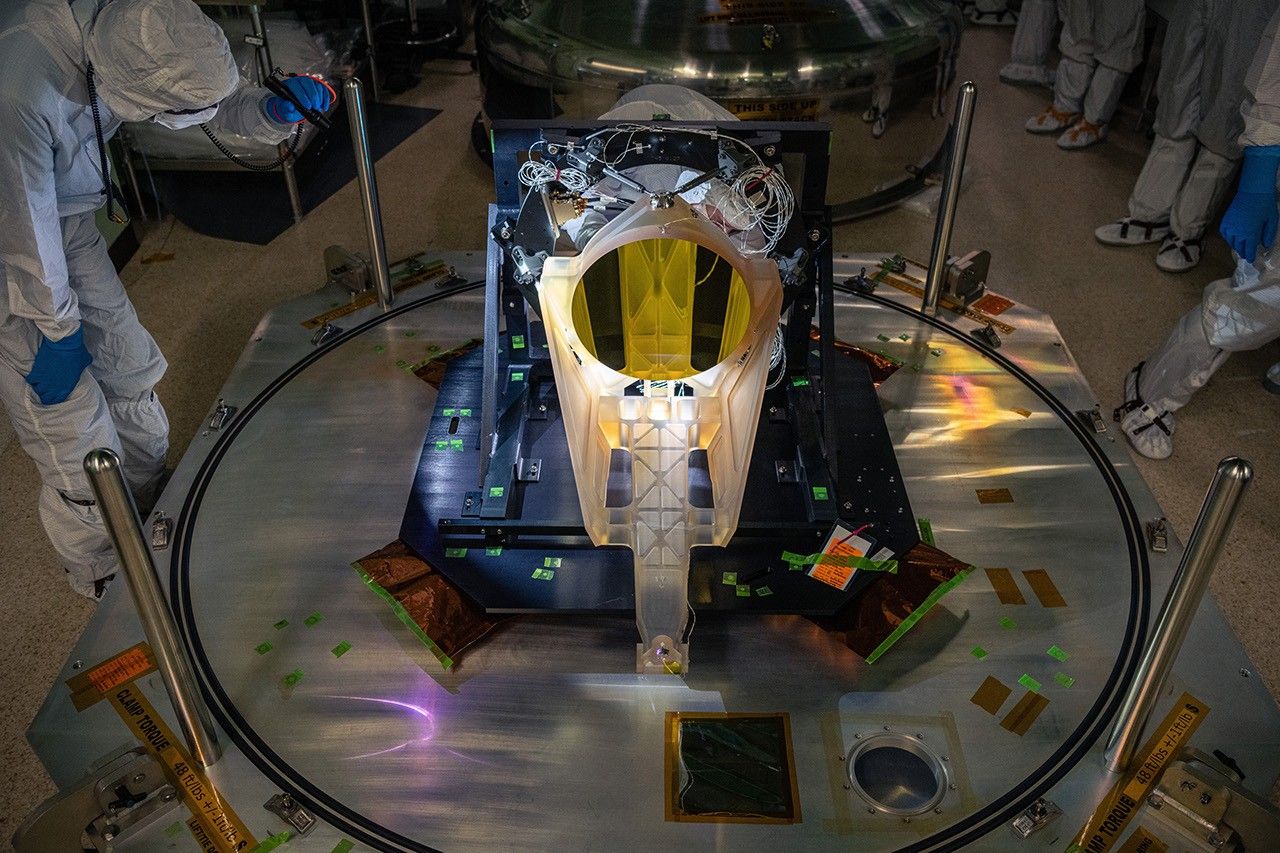
The enormous scale of the triangle will enable LISA to detect gravitational waves that cannot be found with ground-based facilities, such as those generated when massive black holes in the centers of galaxies merge. Scientists can use the data to learn about a source’s distance and physical properties.
The LISA mission is slated to launch in the mid-2030s.
By Jeanette Kazmierczak
NASA’s Goddard Space Flight Center, Greenbelt, Md.
Media Contact:
Claire Andreoli
301-286-1940
NASA’s Goddard Space Flight Center, Greenbelt, Md.
NASA, Partners Advance LISA Prototype Hardware
3 min read
NASA, Partners Advance LISA Prototype HardwareEngineers and scientists at NASA’s Goddard Space Flight Center in Greenbelt, Maryland, completed tests this month on a second early version of a key element of the upcoming LISA (Laser Interferometer Space Antenna) mission.
The LISA mission, a collaboration between ESA (the European Space Agency) and NASA, will use infrared lasers to detect gravitational waves, or ripples in the fabric of space-time. The tests involved the frequency reference system, delivered by BAE Systems, that will help control the lasers connecting LISA’s three spacecraft. The lasers must be finely tuned to make precise measurements — to within a trillionth of a meter, called a picometer.
A prototype laser optical module for LISA (Laser Interferometer Space Antenna) rests on a table after testing at NASA’s Goddard Space Flight Center in Greenbelt, Maryland, in May 2025. Xiaozhen Xu, an engineer with Miller Engineering and Research Corp., works in the background. The smaller box to the right is the laser electronics module. Each of the three LISA spacecraft will have a laser system with a frequency reference component and six laser heads.NASA/Sophia Roberts Download high-resolution images from NASA’s Scientific Visualization StudioThe team tested the first version of the system in May 2025.
“The extensive round of checkouts on the frequency reference system last year were very successful,” said Ira Thorpe, the project scientist for LISA at NASA Goddard. “This second unit is identical, so our assessments this time around were less intense and preface a future cross-check of the two, which is the gold-standard for checking the stability of the system overall.”
In addition to the laser system, NASA is contributing the telescopes, devices to manage the buildup of onboard electrical charge, and the framework scientists will need to process the data the mission will generate.
A prototype charge management device for LISA sits on a lab bench at NASA Goddard in May 2025. Each of the three LISA spacecraft will have a charge management device to reduce the buildup of electric charge on the gold-platinum proof masses that fly freely inside the spacecraft. The University of Florida in Gainesville and Fibertek Inc. in McNair, Va., are developing the devices.NASA/Dennis HenryNASA’s contributions are part of the agency’s efforts to innovate on ambitious science missions that will help us better understand how the universe works. LISA will also offer a major advancement in multimessenger astronomy, which is how scientists explore cosmic signals other than light.
The three LISA spacecraft will fly in a vast triangular formation that follows Earth as it orbits the Sun. Each arm of the triangle will stretch 1.6 million miles (2.5 million kilometers).
Each spacecraft will contain two free-floating cubes inside called proof masses. Arriving gravitational waves from throughout the universe will minutely change the lengths of the triangle’s arms. The lasers connecting the cubes will measure changes in their separation to within a distance smaller than a helium atom.
In May 2024, technicians inspected the prototype LISA telescope in a darkened clean room at NASA Goddard. Illuminated by a flashlight, the telescope’s structure glows. The prototype is made from a translucent, amber-colored, glass-ceramic material called Zerodur, which is often used in high-precision applications because it resists changes in shape over a wide temperature range. The mirror, near center and coated in gold, reflects a magnified image of part of the telescope.NASA/Dennis HenryThe enormous scale of the triangle will enable LISA to detect gravitational waves that cannot be found with ground-based facilities, such as those generated when massive black holes in the centers of galaxies merge. Scientists can use the data to learn about a source’s distance and physical properties.
The LISA mission is slated to launch in the mid-2030s.
By Jeanette Kazmierczak
NASA’s Goddard Space Flight Center, Greenbelt, Md.
Media Contact:
Claire Andreoli
301-286-1940
NASA’s Goddard Space Flight Center, Greenbelt, Md.