

Feed aggregator
Extreme weather in 2025 drove record wildfire emissions in Europe
Chanda Prescod-Weinstein connects physics, poetry and pop culture
A physicist explores how poetry, pop culture and imagination help us understand spacetime and our place in the universe
Canada Proposes POET Mission to Hunt Earth-Sized Planets
Exoplanet science and the search for life beyond Earth continue to advance at break-neck speeds, with the number of confirmed exoplanets by NASA rapidly approaching 6,300, with 223 of those exoplanets being designated as terrestrial (rocky) exoplanets. With the promise of discovering an increasing number of Earth-sized exoplanets increasing every day, new telescopes from across the world have the opportunity to contribute to this incredible field.
Fires Rage in Georgia
- Earth
- Earth Observatory
- Image of the Day
- EO Explorer
- Topics
- More Content
- About
Fires Rage in Georgia
- Earth
- Earth Observatory
- Image of the Day
- EO Explorer
- Topics
- More Content
- About
Designing In Situ Power Stations for Future Mars Missions
You’re in the lab analyzing Martian regolith samples within your cozy Mars habitat serving on fifth human mission to Mars. The power within the habitat has been flowing flawlessly thanks to the MARS-MES (Mars Atmospheric Resource & Multimodal Energy System), including the general habitat lighting, science lab, sleeping quarters, exercise equipment, the virtual reality headsets the crew use for rest & relaxation, oxygen and fuel generation, and water. All this from converting the Martian atmosphere into workable electricity.
The Sun's Impossible Floating Mountains
Scientists at the Max Planck Institute for Solar System Research have produced the most detailed simulations ever of solar prominences. These vast clouds of cooler plasma suspended in the Sun's scorching outer atmosphere have often perplexed solar astronomers. Their research reveals that two separate processes work together to keep these structures alive, and could one day help us predict the violent eruptions that drive dangerous space weather here on Earth.
Cancer is increasing in young people and we still don't know why
Cancer is increasing in young people and we still don't know why
Our Galaxy Has a Hot Side and Now We Know Why
Our Galaxy's halo of hot gas is measurably warmer on one side than the other and a team of scientists have found the culprit. The gravitational pull of the Large Magellanic Cloud is drawing the Milky Way slowly southward, compressing the gas in its path and heating it up, much like a piston in an engine. The discovery solves a puzzle that has intrigued astronomers since the temperature difference was first detected in 2024.
NASA Connects Little Red Dots with Chandra, Webb

A newly discovered object may be a key to unlocking the true nature of a mysterious class of sources that astronomers have found in the early universe in recent years.
A “X-ray dot” found by NASA’s Chandra X-ray Observatory could explain what the hundreds or potentially thousands of these objects are. A paper describing the results published in The Astrophysical Journal Letters.
Shortly after NASA’s James Webb Space Telescope started its science observations, reports of a new class of mysterious objects emerged. Astronomers found small, red objects about 12 billion light-years from Earth or farther, which became known as “little red dots” (LRDs).
Many scientists think LRDs are supermassive black holes embedded in clouds of dense gas, which mask some of the typical signatures in different kinds of light – including X-rays – that astronomers usually use to identify them. This would make them different from typical growing supermassive black holes, which are not embedded in dense gas, allowing bright ultraviolet light and X-rays from material orbiting the black holes to escape.
Because of this and their potential similarities to stellar atmospheres, astronomers have called this the “black hole star” scenario for LRDs.
This new “X-ray dot” (officially known as 3DHST-AEGIS-12014), which is located about 11.8 billion light-years from Earth, may provide a crucial bridge between black hole stars and typical growing supermassive black holes. It exhibits most of the features of an LRD, including being small, red, and located at a vast distance, but it glows in X-ray light, unlike other LRDs.
“Astronomers have been trying to figure out what little red dots are for several years,” said lead author Raphael Hviding of the Max Planck Institute for Astronomy in Germany. “This single X-ray object may be – to use a phrase – what lets us connect all of the dots.”
Artist’s Illustration of a Close-Up View of X-ray Dot, 3DHST-AEGIS-12014. NASA/CXC/SAO/M. Weiss; adapted by K. Arcand & J. Major
The team found this one special object after comparing new data from Webb with a deep survey previously performed by Chandra.
“If little red dots are rapidly growing supermassive black holes, why do they not give off X-rays like other such black holes?” said co-author Anna de Graaff of the Center for Astrophysics | Harvard & Smithsonian, in Cambridge, Massachusetts. “Finding a little red dot that looks different from the others gives us important new insight into what could power them.”
The researchers suggest that the X-ray dot represents a transition phase from an LRD to a typical growing supermassive black hole. As the black hole star consumes its surrounding gas, patchy holes in the clouds of gas appear. This allows X-rays from material falling onto the black hole to poke through, which are observed by Chandra. Eventually all the gas is consumed, and the black hole star ceases to exist.
There are also hints in the Chandra data of the X-ray dot that there are variations in X-ray brightness, which supports the idea that the black hole is partly obscured. As the cloud of gas rotates, patches of denser and less dense gas can move across the black hole, causing changes in X-ray brightness.
“If we confirm the X-ray dot as a little red dot in transition, not only would it be the first of its kind, but we may be seeing into the heart of a little red dot for the first time,” said co-author Hanpu Liu of Princeton University in New Jersey. “We would also have the strongest piece of evidence yet that the growth of supermassive black holes is at the center of some, if not all, of the little red dot population.”
An alternate idea for the X-ray dot is that it is a more common type of growing supermassive black hole but is veiled in an exotic type of dust that astronomers have not seen before. Future observations are planned that should be able to shed light on the truth.
“The X-ray dot had been sitting in our Chandra survey data for over ten years, but we had no idea how remarkable it was before Webb came along to observe the field,” said co-author Andy Goulding of Princeton. “This is a powerful example of collaboration between two great observatories.”
NASA’s Marshall Space Flight Center manages the Chandra program. The Smithsonian Astrophysical Observatory’s Chandra X-ray Center controls science operations from Cambridge, Massachusetts, and flight operations from Burlington, Massachusetts.
Read more from NASA’s Chandra X-ray Observatory
Learn more about the Chandra X-ray Observatory and its mission here:
https://science.nasa.gov/chandra
News Media ContactMegan Watzke
Chandra X-ray Center
Cambridge, Mass.
617-496-7998
mwatzke@cfa.harvard.edu
Joel Wallace
Marshall Space Flight Center, Huntsville, Alabama
256-544-0034
joel.w.wallace@nasa.gov
NASA Connects Little Red Dots with Chandra, Webb
A newly discovered object may be a key to unlocking the true nature of a mysterious class of sources that astronomers have found in the early universe in recent years.
A “X-ray dot” found by NASA’s Chandra X-ray Observatory could explain what the hundreds or potentially thousands of these objects are. A paper describing the results published in The Astrophysical Journal Letters.
Shortly after NASA’s James Webb Space Telescope started its science observations, reports of a new class of mysterious objects emerged. Astronomers found small, red objects about 12 billion light-years from Earth or farther, which became known as “little red dots” (LRDs).
Many scientists think LRDs are supermassive black holes embedded in clouds of dense gas, which mask some of the typical signatures in different kinds of light – including X-rays – that astronomers usually use to identify them. This would make them different from typical growing supermassive black holes, which are not embedded in dense gas, allowing bright ultraviolet light and X-rays from material orbiting the black holes to escape.
Because of this and their potential similarities to stellar atmospheres, astronomers have called this the “black hole star” scenario for LRDs.
This new “X-ray dot” (officially known as 3DHST-AEGIS-12014), which is located about 11.8 billion light-years from Earth, may provide a crucial bridge between black hole stars and typical growing supermassive black holes. It exhibits most of the features of an LRD, including being small, red, and located at a vast distance, but it glows in X-ray light, unlike other LRDs.
“Astronomers have been trying to figure out what little red dots are for several years,” said lead author Raphael Hviding of the Max Planck Institute for Astronomy in Germany. “This single X-ray object may be – to use a phrase – what lets us connect all of the dots.”
Artist’s Illustration of a Close-Up View of X-ray Dot, 3DHST-AEGIS-12014. NASA/CXC/SAO/M. Weiss; adapted by K. Arcand & J. MajorThe team found this one special object after comparing new data from Webb with a deep survey previously performed by Chandra.
“If little red dots are rapidly growing supermassive black holes, why do they not give off X-rays like other such black holes?” said co-author Anna de Graaff of the Center for Astrophysics | Harvard & Smithsonian, in Cambridge, Massachusetts. “Finding a little red dot that looks different from the others gives us important new insight into what could power them.”
The researchers suggest that the X-ray dot represents a transition phase from an LRD to a typical growing supermassive black hole. As the black hole star consumes its surrounding gas, patchy holes in the clouds of gas appear. This allows X-rays from material falling onto the black hole to poke through, which are observed by Chandra. Eventually all the gas is consumed, and the black hole star ceases to exist.
There are also hints in the Chandra data of the X-ray dot that there are variations in X-ray brightness, which supports the idea that the black hole is partly obscured. As the cloud of gas rotates, patches of denser and less dense gas can move across the black hole, causing changes in X-ray brightness.
“If we confirm the X-ray dot as a little red dot in transition, not only would it be the first of its kind, but we may be seeing into the heart of a little red dot for the first time,” said co-author Hanpu Liu of Princeton University in New Jersey. “We would also have the strongest piece of evidence yet that the growth of supermassive black holes is at the center of some, if not all, of the little red dot population.”
An alternate idea for the X-ray dot is that it is a more common type of growing supermassive black hole but is veiled in an exotic type of dust that astronomers have not seen before. Future observations are planned that should be able to shed light on the truth.
“The X-ray dot had been sitting in our Chandra survey data for over ten years, but we had no idea how remarkable it was before Webb came along to observe the field,” said co-author Andy Goulding of Princeton. “This is a powerful example of collaboration between two great observatories.”
NASA’s Marshall Space Flight Center manages the Chandra program. The Smithsonian Astrophysical Observatory’s Chandra X-ray Center controls science operations from Cambridge, Massachusetts, and flight operations from Burlington, Massachusetts.
Read more from NASA’s Chandra X-ray Observatory
Learn more about the Chandra X-ray Observatory and its mission here:
https://science.nasa.gov/chandra
News Media ContactMegan Watzke
Chandra X-ray Center
Cambridge, Mass.
617-496-7998
mwatzke@cfa.harvard.edu
Joel Wallace
Marshall Space Flight Center, Huntsville, Alabama
256-544-0034
joel.w.wallace@nasa.gov
City birds appear more afraid of women than men, and scientists have no idea why
“I fully believe our results, that urban birds react differently based on the sex of the person approaching them,” said a co-author of a study that made this finding, “but I can’t explain them right now”
NASA chief Jared Isaacman hints at campaign to make Pluto a planet again
The NASA administrator’s latest remarks in support of reexamining Pluto’s status come 20 years after the orb was downgraded to a dwarf planet by the International Astronomical Union
There’s No Place Like NASA’s New X-59 Hangar Home
4 min read
Preparations for Next Moonwalk Simulations Underway (and Underwater) NASA’s X-59 quiet supersonic airplane sits parked in front of its new hangar home at the agency’s Armstrong Flight Research Center in California. The facility originally was constructed in 1968 and for nearly 60 years has hosted a number of research aircraft and programs.NASA/Christopher LC Clark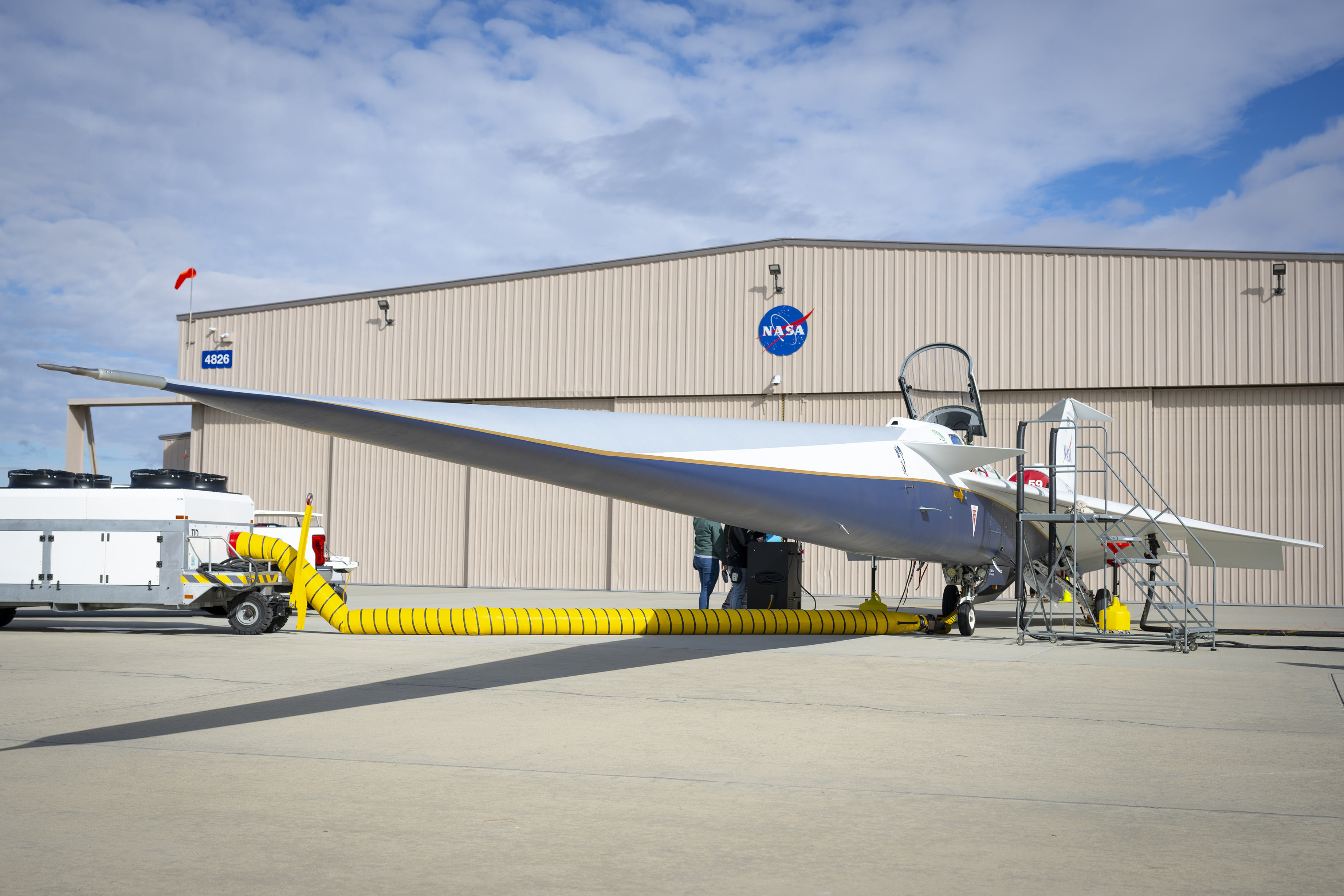
There’s no sign reading “home sweet home” in the hangar where the X‑59 now sits, but the sentiment is unmistakable among those tending to the quiet supersonic aircraft.
Located at NASA’s Armstrong Flight Research Center in Edwards, California, the X-59 hangar was built in 1968 but looks like new thanks to a full renovation and modernization. While the X-59 was being assembled in Palmdale, California, workers at NASA Armstrong gutted the hangar, adding new electrical wiring, a fire suppression system, office space, air conditioning, and other safety features.
“The whole team is incredibly proud of what we’ve accomplished in preparing this new home for the X-59,” said Bryan Watters, the NASA project manager at Armstrong who led the renovation effort. “The fact we could take a 1960s hangar and modernize it for use by a 2020’s X-plane is very special.”
The X-59 is the centerpiece of NASA’s Quesst mission to enable a new era of commercial supersonic air travel over land by reducing the sound of typically loud sonic booms to a much quieter sonic thump.
Home huntingWhen NASA test pilot Nils Larson successfully took the X-59 into the air for the first time on Oct. 28, 2025, he flew from the Lockheed Martin Skunk Works assembly site in Palmdale to nearby NASA Armstrong, from where test flights have continued to make progress.
From the beginning of the program, knowing the X-59 would eventually need a new residence at NASA Armstrong, Quesst managers were on the hunt for somewhere to house the quiet supersonic demonstrator.
Like anyone looking for the ideal place to call home, the team made sure there would be enough space for the airplane and all its support equipment. But with the experimental jet measuring at just under 100 feet long and 30 feet wide, there were few options.
“We had to find a hangar that was long enough so that part of the X-59 wouldn’t hang outside, exposed to the elements,” Watters said.
Building 4826, as the hangar is officially designated, turned out to be the choice spot. “It was basically stripped down and gutted so that essentially it was just structural steel with siding. From that state it was rebuilt,” Watters said.
The feature they are perhaps most proud of is the hangar’s new floor. Covering more than 32,000 square feet, it is coated with epoxy that prevents any spills from seeping into the concrete.
From the hangar’s office windows, the view of the hangar floor can include the F-15 research jets that will be used as chase planes to support X-59 flights in the coming months. The renovation faced challenges along the way, chief among them being supply chain issues stemming from the COVID-19 pandemic. But there were some incredible, unforgettable moments too.
Circa 1990 Nov. 2025 On loan to NASA from the Air Force, an F-15 Eagle fighter jet was the focus of the Short Takeoff and Landing/Maneuver Technology Demonstrator research program, which concluded in 1991. The aircraft is seen here inside Building 4826, a hangar at NASA’s Armstrong Flight Research Center that was renovated and began use in 2025 as home for the X-59 quiet supersonic technology demonstrator.NASA NASA’s X-59 quiet supersonic technology demonstrator aircraft is seen parked inside its new hangar home at the agency’s Armstrong Flight Research Center in California.NASA/Christopher LC Clark Circa 1990Nov. 2025 On loan to NASA from the Air Force, an F-15 Eagle fighter jet was the focus of the Short Takeoff and Landing/Maneuver Technology Demonstrator research program, which concluded in 1991. The aircraft is seen here inside Building 4826, a hangar at NASA’s Armstrong Flight Research Center that was renovated and began use in 2025 as home for the X-59 quiet supersonic technology demonstrator.NASA NASA’s X-59 quiet supersonic technology demonstrator aircraft is seen parked inside its new hangar home at the agency’s Armstrong Flight Research Center in California.NASA/Christopher LC Clark Circa 1990 Nov. 2025past and present
Hangar Updated to Continue Hosting Historic Research CurtainToggle2-Up Image Details This NASA hangar at Armstrong Flight Research Center originally was constructed in 1968 and since then has hosted a number of history-making programs. Compare the two images above to see how the hangar looked during the late 1980s when it hosted an F-15 research aircraft (left), and beginning in 2025 after it had been renovated and modernized to host the X-59 quite supersonic technology demonstrator aircraft. Moved inWith X-59 now flying regularly and comfortably settled into its new digs, the Quesst team is gauging its performance on the way to quiet supersonic flight.
“This is truly a great time for Quesst and the X-59,” said Cathy Bahm, NASA’s project manager for the Low Boom Flight Demonstrator. “It’s also still a little surreal to be able to just walk down from your office and see the airplane in our hangar.”
For more than a year, the hangar refurbishment team worked through every detail of the X-59’s new home to make sure it would be safe and sound. But actually seeing the aircraft occupy that space is an adjustment for them, too.
“We’ve looked at X-59 models on our desk for years and then, you know, there’s the real thing right in front of us, in a hangar that we renovated,” Watters said.
A real thing in the hangar – and streaking across the California desert sky. The X-59’s transition from an idea into a working aircraft is a testament to the teams that help build out every aspect of its infrastructure.
NASA’s X-59 is supported under the agency’s Aeronautics Research Mission Directorate.
About the AuthorJim BankeManaging Editor/Senior WriterJim Banke is a veteran aviation and aerospace communicator with more than 40 years of experience as a writer, producer, consultant, and project manager based at Cape Canaveral, Florida. He is part of NASA Aeronautics' Strategic Communications Team and is Managing Editor for the Aeronautics topic on nasa.gov. In 2007 he was recognized with a Distinguished Public Service Medal, NASA's highest honor for a non-government employee.
Facebook logo @NASA@NASAArmstrong@NASAaero@NASA_es @NASA@NASAArmstrong@NASAaero@NASA_es Instagram logo @NASA@NASAArmstrong@NASAaero@NASA_es Linkedin logo @NASA Explore More 8 min read NASA Celebrates Decade of University Innovation in Aeronautics Article 5 days ago 4 min read NASA Releases Powerful LAVA Software to US Aerospace Industry Article 6 days ago 3 min read NASA’s 777 Aircraft Returns Home with Science Flights on the Horizon Article 7 days ago Keep Exploring Discover More Topics From NASAMissions
Artemis
Aeronautics STEM
Explore NASA’s History
Share Details Last Updated Apr 28, 2026 EditorDede DiniusContactKristen Hatfieldkristen.m.hatfield@nasa.govLocationArmstrong Flight Research Center Related TermsThere’s No Place Like NASA’s New X-59 Hangar Home
4 min read
Preparations for Next Moonwalk Simulations Underway (and Underwater) NASA’s X-59 quiet supersonic airplane sits parked in front of its new hangar home at the agency’s Armstrong Flight Research Center in California. The facility originally was constructed in 1968 and for nearly 60 years has hosted a number of research aircraft and programs.NASA/Christopher LC ClarkThere’s no sign reading “home sweet home” in the hangar where the X‑59 now sits, but the sentiment is unmistakable among those tending to the quiet supersonic aircraft.
Located at NASA’s Armstrong Flight Research Center in Edwards, California, the X-59 hangar was built in 1968 but looks like new thanks to a full renovation and modernization. While the X-59 was being assembled in Palmdale, California, workers at NASA Armstrong gutted the hangar, adding new electrical wiring, a fire suppression system, office space, air conditioning, and other safety features.
“The whole team is incredibly proud of what we’ve accomplished in preparing this new home for the X-59,” said Bryan Watters, the NASA project manager at Armstrong who led the renovation effort. “The fact we could take a 1960s hangar and modernize it for use by a 2020’s X-plane is very special.”
The X-59 is the centerpiece of NASA’s Quesst mission to enable a new era of commercial supersonic air travel over land by reducing the sound of typically loud sonic booms to a much quieter sonic thump.
Home huntingWhen NASA test pilot Nils Larson successfully took the X-59 into the air for the first time on Oct. 28, 2025, he flew from the Lockheed Martin Skunk Works assembly site in Palmdale to nearby NASA Armstrong, from where test flights have continued to make progress.
From the beginning of the program, knowing the X-59 would eventually need a new residence at NASA Armstrong, Quesst managers were on the hunt for somewhere to house the quiet supersonic demonstrator.
Like anyone looking for the ideal place to call home, the team made sure there would be enough space for the airplane and all its support equipment. But with the experimental jet measuring at just under 100 feet long and 30 feet wide, there were few options.
“We had to find a hangar that was long enough so that part of the X-59 wouldn’t hang outside, exposed to the elements,” Watters said.
Building 4826, as the hangar is officially designated, turned out to be the choice spot. “It was basically stripped down and gutted so that essentially it was just structural steel with siding. From that state it was rebuilt,” Watters said.
The feature they are perhaps most proud of is the hangar’s new floor. Covering more than 32,000 square feet, it is coated with epoxy that prevents any spills from seeping into the concrete.
From the hangar’s office windows, the view of the hangar floor can include the F-15 research jets that will be used as chase planes to support X-59 flights in the coming months. The renovation faced challenges along the way, chief among them being supply chain issues stemming from the COVID-19 pandemic. But there were some incredible, unforgettable moments too.
Circa 1990 Nov. 2025 On loan to NASA from the Air Force, an F-15 Eagle fighter jet was the focus of the Short Takeoff and Landing/Maneuver Technology Demonstrator research program, which concluded in 1991. The aircraft is seen here inside Building 4826, a hangar at NASA’s Armstrong Flight Research Center that was renovated and began use in 2025 as home for the X-59 quiet supersonic technology demonstrator.NASA NASA’s X-59 quiet supersonic technology demonstrator aircraft is seen parked inside its new hangar home at the agency’s Armstrong Flight Research Center in California.NASA/Christopher LC Clark Circa 1990Nov. 2025 On loan to NASA from the Air Force, an F-15 Eagle fighter jet was the focus of the Short Takeoff and Landing/Maneuver Technology Demonstrator research program, which concluded in 1991. The aircraft is seen here inside Building 4826, a hangar at NASA’s Armstrong Flight Research Center that was renovated and began use in 2025 as home for the X-59 quiet supersonic technology demonstrator.NASA NASA’s X-59 quiet supersonic technology demonstrator aircraft is seen parked inside its new hangar home at the agency’s Armstrong Flight Research Center in California.NASA/Christopher LC Clark Circa 1990 Nov. 2025past and present
Hangar Updated to Continue Hosting Historic Research CurtainToggle2-Up Image Details This NASA hangar at Armstrong Flight Research Center originally was constructed in 1968 and since then has hosted a number of history-making programs. Compare the two images above to see how the hangar looked during the late 1980s when it hosted an F-15 research aircraft (left), and beginning in 2025 after it had been renovated and modernized to host the X-59 quite supersonic technology demonstrator aircraft. Moved inWith X-59 now flying regularly and comfortably settled into its new digs, the Quesst team is gauging its performance on the way to quiet supersonic flight.
“This is truly a great time for Quesst and the X-59,” said Cathy Bahm, NASA’s project manager for the Low Boom Flight Demonstrator. “It’s also still a little surreal to be able to just walk down from your office and see the airplane in our hangar.”
For more than a year, the hangar refurbishment team worked through every detail of the X-59’s new home to make sure it would be safe and sound. But actually seeing the aircraft occupy that space is an adjustment for them, too.
“We’ve looked at X-59 models on our desk for years and then, you know, there’s the real thing right in front of us, in a hangar that we renovated,” Watters said.
A real thing in the hangar – and streaking across the California desert sky. The X-59’s transition from an idea into a working aircraft is a testament to the teams that help build out every aspect of its infrastructure.
NASA’s X-59 is supported under the agency’s Aeronautics Research Mission Directorate.
About the AuthorJim BankeManaging Editor/Senior WriterJim Banke is a veteran aviation and aerospace communicator with more than 40 years of experience as a writer, producer, consultant, and project manager based at Cape Canaveral, Florida. He is part of NASA Aeronautics' Strategic Communications Team and is Managing Editor for the Aeronautics topic on nasa.gov. In 2007 he was recognized with a Distinguished Public Service Medal, NASA's highest honor for a non-government employee.
Facebook logo @NASA@NASAArmstrong@NASAaero@NASA_es @NASA@NASAArmstrong@NASAaero@NASA_es Instagram logo @NASA@NASAArmstrong@NASAaero@NASA_es Linkedin logo @NASA Explore More 8 min read NASA Celebrates Decade of University Innovation in Aeronautics Article 5 days ago 4 min read NASA Releases Powerful LAVA Software to US Aerospace Industry Article 6 days ago 3 min read NASA’s 777 Aircraft Returns Home with Science Flights on the Horizon Article 6 days ago Keep Exploring Discover More Topics From NASAMissions
Artemis
Aeronautics STEM
Explore NASA’s History
Share Details Last Updated Apr 28, 2026 EditorDede DiniusContactKristen Hatfieldkristen.m.hatfield@nasa.govLocationArmstrong Flight Research Center Related TermsHumanity may be doomed to die in nuclear war—unless we act soon, physicist David Gross says
After winning a Breakthrough Prize, the world’s most lucrative science award, theoretical physicist David Gross is using the moment to warn of nuclear war’s existential threat—and how we can escape it
The Simpsons reference that refutes one of history’s greatest mathematicians
In one famous episode of The Simpsons, Homer finds a counterexample to Fermat’s last theorem
Nighttime Imaging Grows Landsat’s Science Value
- Landsat Home
- Missions
- News
- Data
- Benefits
- Outreach
- Multimedia
- About
- Search
By Earth Resources Observation and Science (EROS) Center
For more than 50 years, Landsat has imaged Earth’s land and near-shore surfaces as the satellites descend in midmorning orbit, when daily sunlight is optimal. That’s just what they’ve always done.
Currently, Landsat 8 and Landsat 9 circle the globe while also making better use of their ascending paths, peering into the darkness for special requests.
The visible spectral bands of Landsat—the same blue, green and red wavelength colors our eyes can see—are typically not that useful when collected on the ascending orbit node (also known as “nighttime imagery”). The exception is twilight or darkness at Earth’s poles, which can provide a surprisingly clear observation in the thermal infrared spectral bands where snow, ice and water temperatures can be retrieved when the sun is at or below the horizon.
Through the dark, shortwave infrared (SWIR) bands within Landsat’s Operational Land Imager (OLI) instrument can detect intense heat sources such as volcanoes or active fires, while the Thermal Infrared Sensor (TIRS) measures surface temperatures that range from geothermal geysers to solid ice.
There is a growing interest in seeing what Landsat can capture as it ascends over the dark side of Earth, according to Dr. Christopher Crawford, the Landsat Project Scientist at the U.S. Geological Survey (USGS) Earth Resources Observation and Science (EROS) Center. Crawford leads and oversees Landsat’s long-term Earth data acquisition strategy for the USGS.
“I’ve seen a noticeable uptick in the number of nighttime imaging special requests. That’s a very active and innovative measurement science area for Landsat right now,” Crawford said.
“We have active volcanoes, we’ve got an ice environment that’s changing, and wildfire occurrences are increasingly growing into hazards that threaten human safety, infrastructure and wildlife, among other issues. Nighttime imaging is an all-purpose solution, kind of like Jiffy Baking Mix.”
R. Greg Vaughan of the USGS Astrogeology Science Center does field work at Yellowstone National Park. USGS photo Sources/Usage: Public Domain Keeping an Eye on Volcanoes and Yellowstone
A particular request for nighttime imagery that turned into a “systematic observation,” Crawford said, is Yellowstone National Park. The volcanic area’s 10,000 thermal features, such as geysers or hot springs or steam vents, can get hotter or colder, and they can appear or disappear.
Crawford is fascinated by volcanoes in general and recognizes the value of imaging them day and night. After Landsat 9 launched in 2021, when two satellites with the same high-quality sensors would together yield an image of each area of land every eight days, it seemed like a good time to start a consistent annual campaign to capture active volcanoes at night, he said.
To view this video please enable JavaScript, and consider upgrading to a web browser that
supports HTML5 video
R. Greg Vaughan of the USGS Astrogeology Science Center, who researches active volcanoes, gave him a list. Vaughan has used Landsat data and other remote sensing methods to monitor changing thermal features in his role as the remote sensing lead for the Yellowstone Volcano Observatory.
Vaughan also taught Crawford something about imaging Yellowstone’s thermal features at night—that the best season for locating them is during winter. That’s when the contrast between the heated features and the colder surrounding area is greatest.
“The thing that I’ve probably taken away the most is that you have to acquire data to then understand what data to continue to acquire,” Crawford said.
Vaughan spotted an exciting surprise when reviewing Landsat 8 nighttime TIRS data of Yellowstone acquired in April 2017. Comparing warm areas in the imagery to previously mapped thermal features, he found a “big blob of bright, warm pixels” that didn’t match anything on the map.
After ruling out the possibility that it could be a thawing lake next to frozen land, he looked at the secluded area with daytime aerial imagery. The telltale signs of a new and growing thermal feature were there: bright hydrothermal-altered soil and dead and dying trees.
A Landsat 8 nighttime thermal infrared image from April 2017 shows the Tern Lake area in Yellowstone National Park. In Yellowstone, temperatures are extremely cold at night in the winter, and most lakes are frozen (dark pixels). West Tern Lake seems to be thawing here; it might receive some thermal water inflow from nearby hot springs. The patch of bright (warm) pixels between West Tern Lake and the Tern Lake Thermal Area emerged over a period of roughly 20 years. Lakes are outlined in blue; known thermal areas are outlined in red; and the red triangles are individual thermal features that have been mapped. Image credit: R. Greg Vaughn, USGS
Vaughan discussed his find and his use of Landsat data in a recent Eyes on Earth podcast episode produced by USGS EROS.
“This is why I love Landsat 8 and 9 so much. These instruments acquire data regularly, not just during the day, but they can also be tasked to acquire data at night on a regular basis. And this is really critical for my work,” Vaughan said.
Vaughan has been named a member of the current Landsat Science Team, a group of scientific and technical subject matter experts who provide analysis and advice to the Landsat Program. His research in that capacity will focus on active volcanoes.
An aerial view of the area in the Landsat 8 nighttime image shows the new thermal area (center left) that R. Greg Vaughan spotted in the Landsat image. The existing Tern Lake Thermal Area is the bright white patch of ground in the upper middle part of the image. West Tern Lake is the dark area in the lower right, and Tern Lake is above that. Photo credit: Michael Poland, USGS Fires, Flares and Urban Areas Among Requests
The fire community in the western United States also finds value in Landsat nighttime imagery, Crawford said—including the energy industry and its infrastructure.
The Department of Energy’s Pacific Northwest National Laboratory submits annual special requests for proactive nighttime imaging of seasonal wildfires to support on-the-ground decision making.
“We’ve done it three seasons in a row, and the results are pretty remarkable in terms of what we’re able to see,” especially with the SWIR bands, Crawford said. Those results compare well to airborne infrared sensing taken from low-altitude flights over the same wildfires.
Landsat can also detect gas flares that are useful to oil and gas industry functions. “There are regular special requests submitted to monitor global sites that produce Liquefied Natural Gas, or LNG,” Crawford said.
In addition, he sees requests for nighttime images over particular cities to map urban temperature, which may be higher than cooler surrounding areas.
One recent request went beyond the already routine monitoring of active volcanoes in Iceland to encompass the entire country and coastline in a large seasonal campaign to survey overall volcanic activity.
Crawford weighs this type of request carefully, posing these questions: “Does this advance the science mission? Is it serving the user community?”
For Iceland, that was a yes.
“I look for areas where Landsat imaging data may be underutilized, as well as areas for strategic science mission advancement and societal benefits, and in many ways, these growth areas can be enabled through the data acquisition process,” Crawford said.
Landsat 8’s thermal infrared, shortwave infrared and near infrared spectral bands expose the Caldor Fire’s advancing edge south of Lake Tahoe in California in a nighttime image from August 29, 2021. A LEAP Forward
A significant advancement in learning about Landsat’s nighttime capabilities came with the effort to monitor polar regions year-round, with leadership from former Landsat Science Team member Dr. Ted Scambos from the University of Colorado Boulder.
The Landsat Extended Acquisition of the Poles (LEAP) campaign now routinely collects imagery over the polar regions, where few wintertime images had existed in Landsat’s data record before. The visible-to-shortwave infrared and thermal infrared spectral bands allow scientists to track changes in polar ice sheets, measure polar surface temperatures and examine the interaction of ocean water and ice shelves.
The sun’s low angle is not much of a hindrance to imaging data quality, Crawford said in an Eyes on Earth episode about the LEAP campaign. “Snow and ice are still really bright mediums on the surface, and so even if the illumination is low, you can still see a lot of detail because of the high reflectivity.”
Fortunately, nighttime imaging does not burden Landsat 8 and Landsat 9. “The instruments are always on, so it’s just a matter of whether we’re recording the data,” Crawford said.
This twilight thermal infrared image of Petermann Glacier, Greenland, was captured by Landsat 9 on January 5, 2024. This winter image displays data acquired when the sun was below the horizon. Darker areas are relatively colder than bright areas.
The imagery’s darkness helps keep data volumes much lower than the daytime and allows sufficient time for the satellites to pass off the data to ground stations around the globe whose function is to downlink the recorded data.
“We’re starting to leverage Landsat 8 and Landsat 9 observatory capabilities to maximum scientific and societal benefit returns,” Crawford said.
“We’re populating the Landsat archive with long-term image data records that are helpful for not only quantifying changes on the Earth’s surface right now, but in the past and in the future.”
Requesting and Accessing ImageryTo learn more about Landsat data acquisitions and to submit a special request for future nighttime imagery, visit the Landsat Acquisitions webpage.
All imagery collected by special requests is made available to the public through the USGS EarthExplorer website. Select the “Landsat Collection 2 Level-1” dataset, and then select “Night” under Additional Criteria.
Explore More
Nighttime Imaging Grows Landsat’s Science Value
7 min read
By Earth Resources Observation and Science (EROS) Center For more than 50 years, Landsat has imaged Earth’s land and near-shore surfaces as…
Apr 28, 2026 ArticleFiery Fall Color in Southern Chile
3 min read
The beech forests of southern Patagonia put on vibrant autumn displays.
Apr 28, 2026 ArticleAn Agricultural Mosaic in Taiwan
4 min read
Diversity reigns across the farmland of Yunlin County in southwestern Taiwan—a region that produces an array of crops on small…
Apr 24, 2026 Article1
2
3
…
305
Next