
Feed aggregator
Snow Buries the U.S. Interior and East
- Earth
- Earth Observatory
- Image of the Day
- EO Explorer
- Topics
- More Content
- About
Snow Buries the U.S. Interior and East
- Earth
- Earth Observatory
- Image of the Day
- EO Explorer
- Topics
- More Content
- About
The "China Sky Eye" Traces Fast Radio Bursts to a Binary Star System
An international team of astronomers has uncovered the first definitive evidence that at least some fast radio bursts (FRBs) originate in binary stellar systems.
Intermittent Black Hole Jets Are Like A 'Cosmic Volcano'
Supermassive black holes grow larger by accreting matter. When they're actively accreting matter they're called active galactic nuclei (AGN). AGN are the most luminous sources of persistent radiation in the Universe, yet they turn on and off as the SMBH passes through quiet and active phases. Astronomers have found one that is just turning on its powerful jets after a long period of dormancy.
Stellar Fireworks at the Heart of the Milky Way
Using the South Pole Telescope, astronomers have detected powerful stellar flares erupting from stars near the supermassive black hole at the centre of the Milky Way. Operating at millimetre wavelengths that can penetrate the dust obscuring our view of the core of the Galaxy, the telescope caught these dramatic magnetic energy releases in one of the most extreme environments in our Galaxy. The discovery opens a new observational window for studying stellar behaviour in regions previously hidden from view and provides insights into how stars survive and behave in the intense gravitational and radiation environment surrounding the Milky Way's central black hole.
The Monk Who Recognised Halley's Comet First
The comet bearing Edmond Halley's name may have been misnamed! New research from Leiden University reveals that an 11th Century English monk recognised the famous comet's periodicity centuries before the British astronomer. Eilmer of Malmesbury witnessed the comet's appearances in both 989 and 1066, linking the two observations and understanding they represented the same celestial visitor returning after decades, a realisation documented by the medieval chronicler William of Malmesbury but overlooked by scholars until now. The discovery challenges whether history's most famous comet should continue bearing Halley's name when a Benedictine monk beat him to the discovery by more than 600 years.
NASA Testing Advances Space Nuclear Propulsion Capabilities
Nuclear propulsion and power technologies could unlock new frontiers in missions to the Moon, Mars, and beyond. NASA has reached an important milestone advancing nuclear propulsion that could benefit future deep space missions by completing a cold-flow test campaign of the first flight reactor engineering development unit since the 1960s.
Crews at NASA’s Marshall Space Flight Center in Huntsville, Alabama, install a flight reactor engineering development unit into Test Stand 400 in preparation for cold-flow testing. The test campaign began in July and ran through September and marked the first testing on a light reactor engineering development unit since the 1960s.NASA/Adam Butt Crews at NASA’s Marshall Space Flight Center in Huntsville, Alabama, install a flight reactor engineering development unit into Test Stand 400 in preparation for cold-flow testing. The test campaign began in July and ran through September and marked the first testing on a flight reactor engineering development unit since the 1960s. NASA/Adam Butt Crews at NASA’s Marshall Space Flight Center in Huntsville, Alabama, install a flight reactor engineering development unit into Test Stand 400 in preparation for cold-flow testing. The test campaign began in July and ran through September and marked the first testing on a flight reactor engineering development unit since the 1960s. NASA/Adam Butt A flight reactor engineering development unit is fully installed at Test Stand 400 in preparation for cold-flow testing. The test campaign began in July and ran through September, marking the first testing on a flight reactor engineering development unit since the 1960s. NASA/Adam Butt“Nuclear propulsion has multiple benefits including speed and endurance that could enable complex deep space missions,” said Greg Stover acting associate administrator of NASA’s Space Technology Mission Directorate at NASA Headquarters in Washington. “By shortening travel times and expanding mission capabilities, this technology will lay the foundation to explore farther into our solar system than ever before. Information from the cold-flow test series is instrumental in understanding the operational characteristics and fluid flow performance of nuclear reactors.”
Teams at the agency’s Marshall Space Flight Center in Huntsville, Alabama, conducted more than 100 tests on the engineering development unit over several months in 2025. The 44-inch by 72-inch unit, built by BWX Technologies of Lynchburg, Virginia, is a full-scale, non-nuclear, flight-like development test article the size of a 100-gallon drum that simulates propellant flow throughout the reactor across a range of operational conditions.
The cold-flow tests at NASA Marshall are the culmination of a multi-year activity for the agency and its industry partners. Key test objectives included simulating operational fluid-dynamic responses, gathering critical information for design of the flight instrumentation and control system, providing crucial validation of analytical tools, and serving as a pathfinder for manufacturing, assembly, and integration of near-term flight-capable nuclear propulsion systems.
Other benefits to space travel include increasing the science payload capacity and higher power for instrumentation and communication.
Test engineers were able to demonstrate that the reactor design is not susceptible to destructive flow-induced oscillations, vibrations or pressure waves that occur when a moving fluid interacts with a structure in a way that makes the system shake.
“We’re doing more than proving a new technology,” said Jason Turpin, manager of the Space Nuclear Propulsion Office at NASA Marshall. “This test series generated some of the most detailed flow responses for a flight-like space reactor design in more than 50 years and is a key steppingstone toward developing a flight-capable system. Each milestone brings us closer to expanding what’s possible for the future of human spaceflight, exploration, and science.”
The Space Nuclear Propulsion Office is part of NASA’s Technology Demonstration Missions Program within the agency’s Space Technology Mission Directorate.
Learn more about NASA’s technology advancements:
https://www.nasa.gov/space-technology-mission-directorate/
News Media ContactJoel Wallace
Marshall Space Flight Center, Huntsville, Alabama
256-544-0034
joel.w.wallace@nasa.gov
NASA Testing Advances Space Nuclear Propulsion Capabilities
Nuclear propulsion and power technologies could unlock new frontiers in missions to the Moon, Mars, and beyond. NASA has reached an important milestone advancing nuclear propulsion that could benefit future deep space missions by completing a cold-flow test campaign of the first flight reactor engineering development unit since the 1960s.
Crews at NASA’s Marshall Space Flight Center in Huntsville, Alabama, install a flight reactor engineering development unit into Test Stand 400 in preparation for cold-flow testing. The test campaign began in July and ran through September and marked the first testing on a light reactor engineering development unit since the 1960s.NASA/Adam Butt Crews at NASA’s Marshall Space Flight Center in Huntsville, Alabama, install a flight reactor engineering development unit into Test Stand 400 in preparation for cold-flow testing. The test campaign began in July and ran through September and marked the first testing on a flight reactor engineering development unit since the 1960s. NASA/Adam Butt Crews at NASA’s Marshall Space Flight Center in Huntsville, Alabama, install a flight reactor engineering development unit into Test Stand 400 in preparation for cold-flow testing. The test campaign began in July and ran through September and marked the first testing on a flight reactor engineering development unit since the 1960s. NASA/Adam Butt A flight reactor engineering development unit is fully installed at Test Stand 400 in preparation for cold-flow testing. The test campaign began in July and ran through September, marking the first testing on a flight reactor engineering development unit since the 1960s. NASA/Adam Butt“Nuclear propulsion has multiple benefits including speed and endurance that could enable complex deep space missions,” said Greg Stover acting associate administrator of NASA’s Space Technology Mission Directorate at NASA Headquarters in Washington. “By shortening travel times and expanding mission capabilities, this technology will lay the foundation to explore farther into our solar system than ever before. Information from the cold-flow test series is instrumental in understanding the operational characteristics and fluid flow performance of nuclear reactors.”
Teams at the agency’s Marshall Space Flight Center in Huntsville, Alabama, conducted more than 100 tests on the engineering development unit over several months in 2025. The 44-inch by 72-inch unit, built by BWX Technologies of Lynchburg, Virginia, is a full-scale, non-nuclear, flight-like development test article the size of a 100-gallon drum that simulates propellant flow throughout the reactor across a range of operational conditions.
The cold-flow tests at NASA Marshall are the culmination of a multi-year activity for the agency and its industry partners. Key test objectives included simulating operational fluid-dynamic responses, gathering critical information for design of the flight instrumentation and control system, providing crucial validation of analytical tools, and serving as a pathfinder for manufacturing, assembly, and integration of near-term flight-capable nuclear propulsion systems.
Other benefits to space travel include increasing the science payload capacity and higher power for instrumentation and communication.
Test engineers were able to demonstrate that the reactor design is not susceptible to destructive flow-induced oscillations, vibrations or pressure waves that occur when a moving fluid interacts with a structure in a way that makes the system shake.
“We’re doing more than proving a new technology,” said Jason Turpin, manager of the Space Nuclear Propulsion Office at NASA Marshall. “This test series generated some of the most detailed flow responses for a flight-like space reactor design in more than 50 years and is a key steppingstone toward developing a flight-capable system. Each milestone brings us closer to expanding what’s possible for the future of human spaceflight, exploration, and science.”
The Space Nuclear Propulsion Office is part of NASA’s Technology Demonstration Missions Program within the agency’s Space Technology Mission Directorate.
Learn more about NASA’s technology advancements:
https://www.nasa.gov/space-technology-mission-directorate/
News Media ContactJoel Wallace
Marshall Space Flight Center, Huntsville, Alabama
256-544-0034
joel.w.wallace@nasa.gov
Discovery Alert: An Ice-Cold Earth?
- Universe Home
- Basics
- Galaxies
- Black Holes
- Stars
- Exoplanets
- Exploration
- More
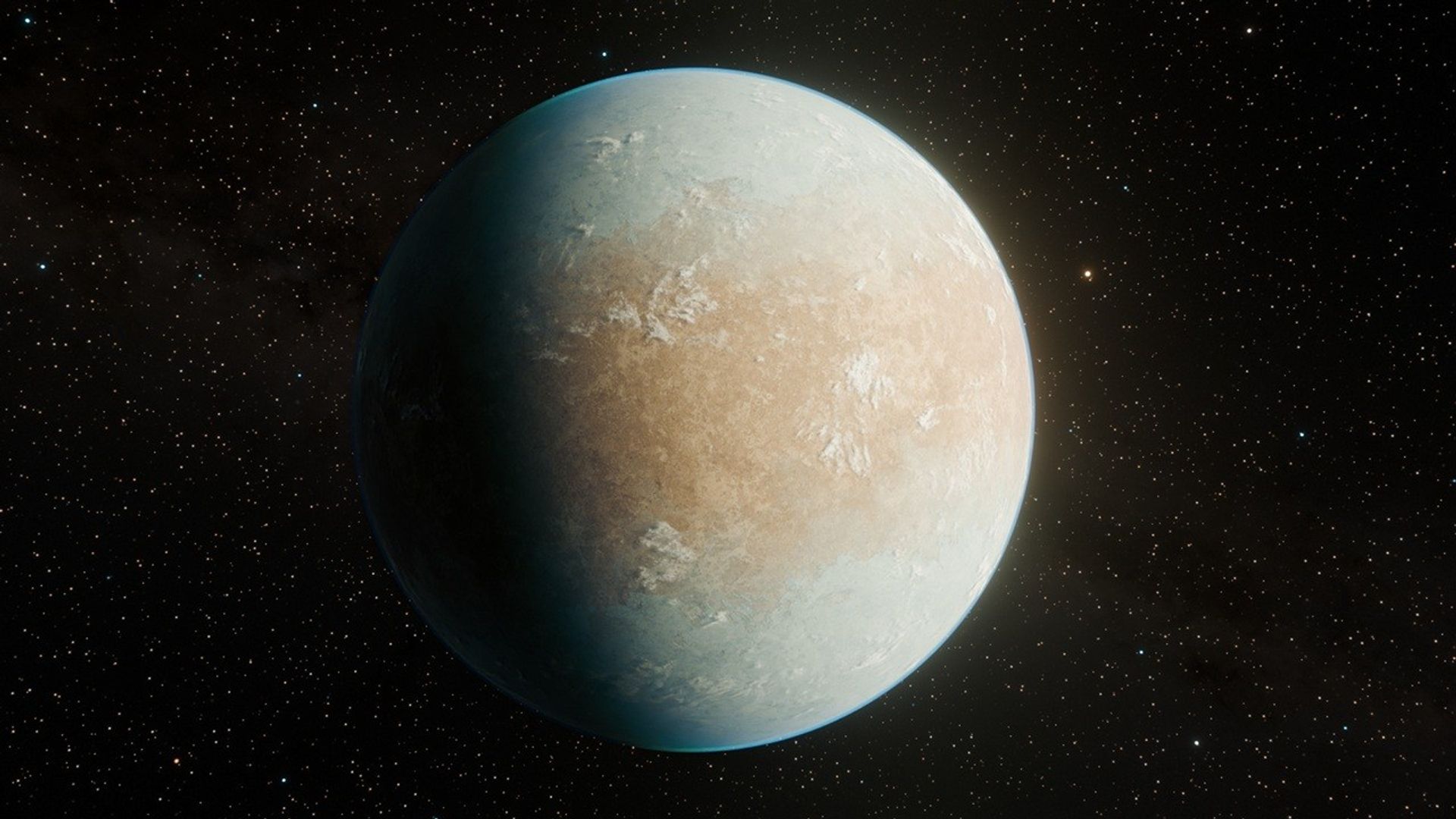
A candidate planet that might be remarkably similar to Earth, HD 137010 b, has one potentially big difference: It could be colder than perpetually frozen Mars.
Key FactsScientists continue to mine data gathered by NASA’s Kepler Space Telescope, retired in 2018, and continue to turn up surprises. A new paper reveals the latest: a possible rocky planet slightly larger than Earth, orbiting a Sun-like star about 146 light-years away.
The orbital period of the planet — listed as a “candidate” pending further confirmation — is likely to be similar to Earth’s, around one year. Planet HD 137010 b also might fall just within the outer edge of its star’s “habitable zone,” the orbital distance that could allow liquid water to form on the planet’s surface under a suitable atmosphere.
Planets orbiting other stars are known as “exoplanets.” And this could turn out to be the first exoplanet with Earth-like properties that, from our vantage point, crosses the face of a Sun-like star that is near enough and bright enough for meaningful follow-up observations.
DetailsNow the bad news. The amount of heat and light such a planet would receive from its star is less than a third of what Earth receives from the Sun. Although of a stellar type similar to our Sun, the star, HD 137010, is cooler and dimmer. That could mean a planetary surface temperature no higher than minus 90 degrees Fahrenheit (minus 68 degrees Celsius). By comparison, the average surface temperature on Mars runs about minus 85 degrees Fahrenheit (minus 65 degrees Celsius).
Planet HD 137010 b also will need follow-up observations to be promoted from “candidate” to “confirmed.” Exoplanet scientists use a variety of techniques to identify planets, and this discovery comes from a single “transit” — only one instance of the planet crossing its star’s face in a kind of miniature eclipse — detected during Kepler’s second mission, known as K2. Even with just one transit, the study’s authors were able to estimate the candidate planet’s orbital period. They tracked the time it took for the planet’s shadow to move across the star’s face — in this case 10 hours, while Earth takes about 13 — then compared it to orbital models of the system itself. Still, though the precision of that single detection is much higher than most transits captured by space-based telescopes, astronomers need to see these transits repeat regularly in order to confirm that they are caused by a real planet.
And capturing more transits is going to be tricky. The planet’s orbital distance, so similar to Earth’s, means such transits happen far less often than for planets in tighter orbits around their stars (it’s a big reason why exoplanets with Earth-like orbits are so hard to detect in the first place). With luck, confirmation could come from further observation by the successor to Kepler/K2, NASA’s TESS (the Transiting Exoplanet Survey Satellite), the still-functioning workhorse for planetary detection, or from the European Space Agency’s CHEOPS (CHaracterising ExOPlanets Satellite). Otherwise, gathering further data on planet HD 137010 b might have to wait for the next generation of space telescopes.
To view this video please enable JavaScript, and consider upgrading to a web browser that supports HTML5 video
An artist’s concept animation of exoplanet candidate HD 137010 b, which gives a view as if flying above this possible rocky planet slightly larger than Earth, thought to orbit a Sun-like star about 146 light-years away. This view also creates an effect similar to a transit, as the planet’s star disappears and then reappears from behind HD 137010 b.NASA/JPL-Caltech/Keith Miller (Caltech/IPAC) Fun FactsDespite the possibility of a frigid climate, HD 137010 b also could turn out to be a temperate or even a watery world, say the authors of the paper on this exoplanet. It would just need an atmosphere richer in carbon dioxide than our own. The science team, based on modeling of the planet’s possible atmospheres, gives it a 40% chance of falling within the “conservative” habitable zone around the star, and a 51% chance of falling within the broader “optimistic” habitable zone. On the other hand, the authors of the study say the planet has about a 50-50 chance of falling beyond the habitable zone entirely.
The DiscoverersAn international science team published a paper on the discovery, “A Cool Earth-sized Planet Candidate Transiting a Tenth Magnitude K-dwarf From K2,” in The Astrophysical Journal Letters on Jan. 27, 2026. The team was led by astrophysics Ph.D. student Alexander Venner of the University of Southern Queensland, Toowoomba, Australia, now a postdoctoral researcher at the Max Planck Institute for Astronomy, Heidelberg, Germany.
Explore More 3 min read NASA, Partners Advance LISA Prototype Hardware Article 8 hours ago 4 min read AI Unlocks Hundreds of Cosmic Anomalies in Hubble Archive Article 8 hours ago 4 min read TESS Status Updates Article 4 days ago Share Details Last Updated Jan 27, 2026 Related TermsDiscovery Alert: An Ice-Cold Earth?
- Universe Home
- Basics
- Galaxies
- Black Holes
- Stars
- Exoplanets
- Exploration
- More
A candidate planet that might be remarkably similar to Earth, HD 137010 b, has one potentially big difference: It could be colder than perpetually frozen Mars.
Key FactsScientists continue to mine data gathered by NASA’s Kepler Space Telescope, retired in 2018, and continue to turn up surprises. A new paper reveals the latest: a possible rocky planet slightly larger than Earth, orbiting a Sun-like star about 146 light-years away.
The orbital period of the planet — listed as a “candidate” pending further confirmation — is likely to be similar to Earth’s, around one year. Planet HD 137010 b also might fall just within the outer edge of its star’s “habitable zone,” the orbital distance that could allow liquid water to form on the planet’s surface under a suitable atmosphere.
Planets orbiting other stars are known as “exoplanets.” And this could turn out to be the first exoplanet with Earth-like properties that, from our vantage point, crosses the face of a Sun-like star that is near enough and bright enough for meaningful follow-up observations.
DetailsNow the bad news. The amount of heat and light such a planet would receive from its star is less than a third of what Earth receives from the Sun. Although of a stellar type similar to our Sun, the star, HD 137010, is cooler and dimmer. That could mean a planetary surface temperature no higher than minus 90 degrees Fahrenheit (minus 68 degrees Celsius). By comparison, the average surface temperature on Mars runs about minus 85 degrees Fahrenheit (minus 65 degrees Celsius).
Planet HD 137010 b also will need follow-up observations to be promoted from “candidate” to “confirmed.” Exoplanet scientists use a variety of techniques to identify planets, and this discovery comes from a single “transit” — only one instance of the planet crossing its star’s face in a kind of miniature eclipse — detected during Kepler’s second mission, known as K2. Even with just one transit, the study’s authors were able to estimate the candidate planet’s orbital period. They tracked the time it took for the planet’s shadow to move across the star’s face — in this case 10 hours, while Earth takes about 13 — then compared it to orbital models of the system itself. Still, though the precision of that single detection is much higher than most transits captured by space-based telescopes, astronomers need to see these transits repeat regularly in order to confirm that they are caused by a real planet.
And capturing more transits is going to be tricky. The planet’s orbital distance, so similar to Earth’s, means such transits happen far less often than for planets in tighter orbits around their stars (it’s a big reason why exoplanets with Earth-like orbits are so hard to detect in the first place). With luck, confirmation could come from further observation by the successor to Kepler/K2, NASA’s TESS (the Transiting Exoplanet Survey Satellite), the still-functioning workhorse for planetary detection, or from the European Space Agency’s CHEOPS (CHaracterising ExOPlanets Satellite). Otherwise, gathering further data on planet HD 137010 b might have to wait for the next generation of space telescopes.
To view this video please enable JavaScript, and consider upgrading to a web browser that supports HTML5 video
An artist’s concept animation of exoplanet candidate HD 137010 b, which gives a view as if flying above this possible rocky planet slightly larger than Earth, thought to orbit a Sun-like star about 146 light-years away. This view also creates an effect similar to a transit, as the planet’s star disappears and then reappears from behind HD 137010 b.NASA/JPL-Caltech/Keith Miller (Caltech/IPAC) Fun FactsDespite the possibility of a frigid climate, HD 137010 b also could turn out to be a temperate or even a watery world, say the authors of the paper on this exoplanet. It would just need an atmosphere richer in carbon dioxide than our own. The science team, based on modeling of the planet’s possible atmospheres, gives it a 40% chance of falling within the “conservative” habitable zone around the star, and a 51% chance of falling within the broader “optimistic” habitable zone. On the other hand, the authors of the study say the planet has about a 50-50 chance of falling beyond the habitable zone entirely.
The DiscoverersAn international science team published a paper on the discovery, “A Cool Earth-sized Planet Candidate Transiting a Tenth Magnitude K-dwarf From K2,” in The Astrophysical Journal Letters on Jan. 27, 2026. The team was led by astrophysics Ph.D. student Alexander Venner of the University of Southern Queensland, Toowoomba, Australia, now a postdoctoral researcher at the Max Planck Institute for Astronomy, Heidelberg, Germany.
Explore More 3 min read NASA, Partners Advance LISA Prototype Hardware Article 8 hours ago 4 min read AI Unlocks Hundreds of Cosmic Anomalies in Hubble Archive Article 8 hours ago 4 min read TESS Status Updates Article 4 days ago Share Details Last Updated Jan 27, 2026 Related TermsNASA Science Flights Venture to Improve Severe Winter Weather Warnings
4 min read
Preparations for Next Moonwalk Simulations Underway (and Underwater)A team of NASA scientists deployed on an international mission designed to better understand severe winter storms. The North American Upstream Feature-Resolving and Tropopause Uncertainty Reconnaissance Experiment, or NURTURE, is an airborne campaign that uses a suite of remote sensing instruments to collect atmospheric data on winter weather with a goal of improving the models that feed storm forecasts. This combination of instruments will also serve as a proxy to demonstrate the potential to collect similar observations from space.
NASA’s G-III aircraft in the hangar at NASA’s Langley Research Center as science and flight crews install remote sensing instruments inside and onto the body of the plane.NASA/Ryan Hill
On Jan. 24, the research team departed from NASA’s Langley Research Center in Hampton, Virginia, aboard the center’s Gulfstream III aircraft (G-III) en route to Goose Bay, Canada. For nearly a month, the plane will be making flights stretching from the Northern Atlantic Ocean over Canada through the Northeast United States, measuring moisture, clouds, and ozone as winter storms develop.
The second phase of the campaign, scheduled to fly out of Langley next year, will serve as the inaugural mission of NASA’s new airborne science laboratory, a Boeing 777 These flights will cover a larger range of 3,100 miles (5,000 kilometers) and use a larger suite of instruments. Researchers will collect detailed observations of the atmosphere over Europe, Greenland, the North Atlantic Ocean, Canada, the majority of of the U.S., and much of the Arctic Ocean.
“Part of NASA’s role is to leverage our expertise and resources for the benefit of humankind – with innovation always being at our core,” said Will McCarty, weather program manager and program scientist at NASA’s Headquarters in Washington. “The NURTURE campaign is doing exactly that by outfitting our aircraft with one-of-a-kind instruments designed to put our science data into action to understand dangerous weather events before, and as they form.”
Research scientist and co-investigator for the NURTURE mission, Amin Nehrir, installing and testing the High Altitude and Lidar Observatory (HALO) instrument aboard the G-III aircraft before deploying.NASA/Ryan Hill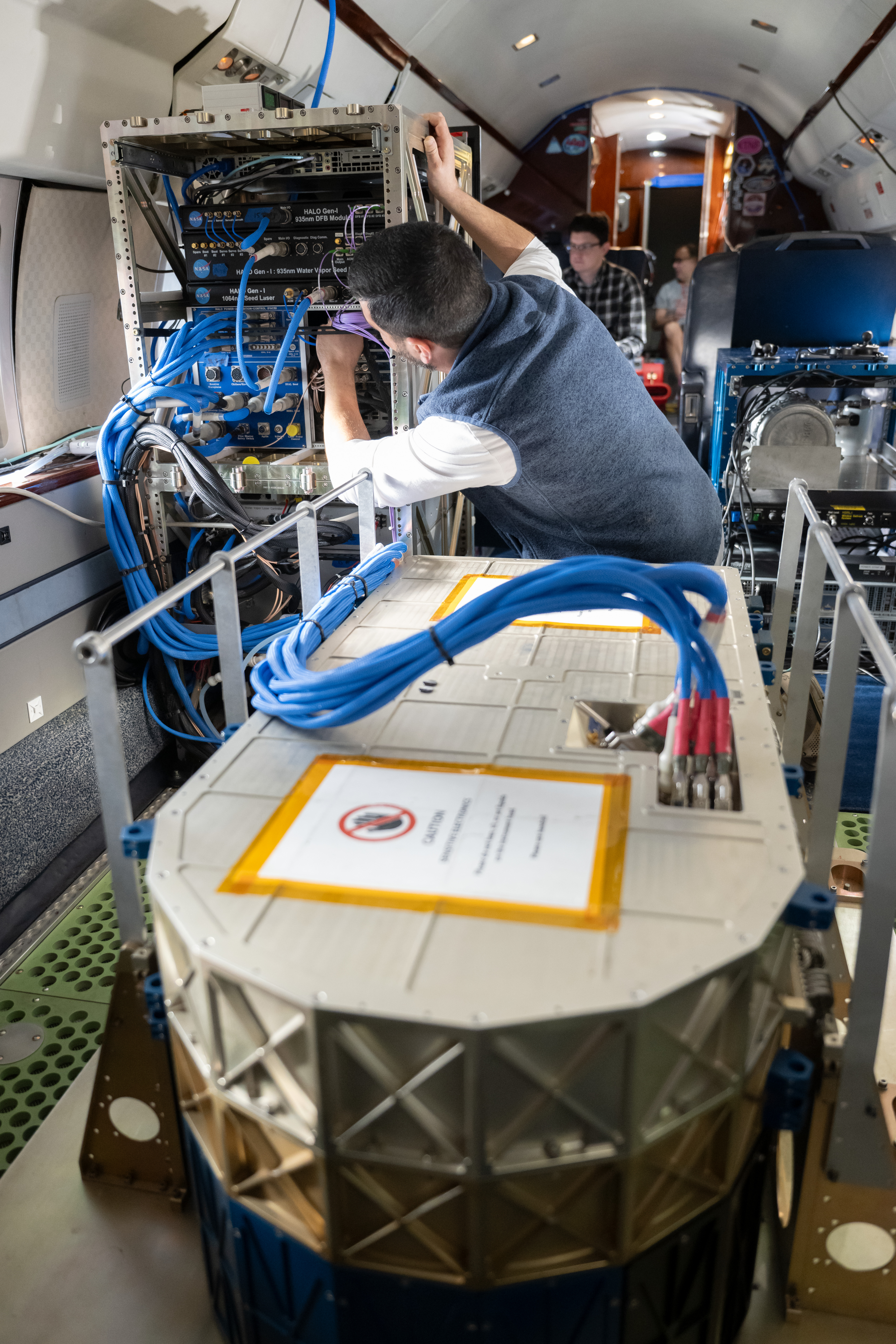
As the NASA G-III flies over Canada, a parallel companion mission led by a team of international partners called the North Atlantic Waveguide, Dry Intrusion, and Downstream Impact Campaign (NAWDIC) will be operating out of Shannon, Ireland. Meanwhile, a third airborne mission led by the National Oceanic and Atmospheric Administration (NOAA) will be studying how moisture is transported from the tropics to the Western U.S. By combining the data collected during these campaigns, scientists will be able to track weather systems as they interact and intersect globally to understand the large-scale flows and small-scale features that drive high-impact winter weather events.
Software and instrument checks taking place pre-deployment on board the G-III aircraft. HALO and other instruments, like the CloudCube radar, combine to form a specialized suite of atmospheric sensors.NASA/Ryan Hill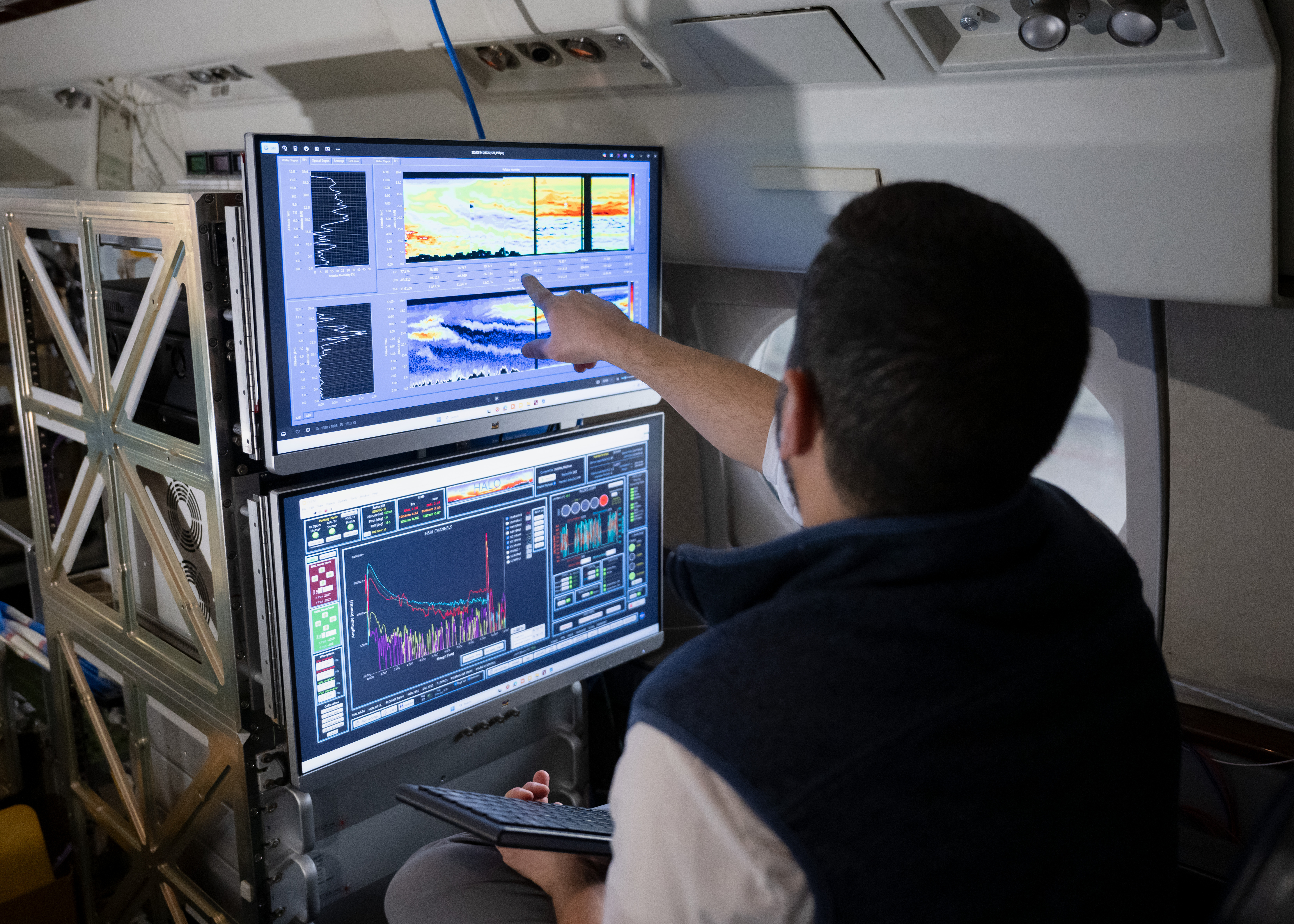
“These storms are not forecasted very accurately,” said Amin Nehrir, a research scientist at NASA Langley and co-investigator for the NURTURE mission. “Space observations of high latitudes in the Arctic lack the sensitivity needed to gather accurate data in such a dry, atmospheric environment. In lower latitudes, we benefit from observations from radiosondes, surface networks, and satellite observations. We are using cutting-edge technology beyond those that we have in space to get a better snapshot of atmospheric dynamics.”
A map showing the two flight paths of the NURTURE mission phases – the G-III aircraft marked in green in 2026 and the NASA 777 aircraft in blue planned for 2027.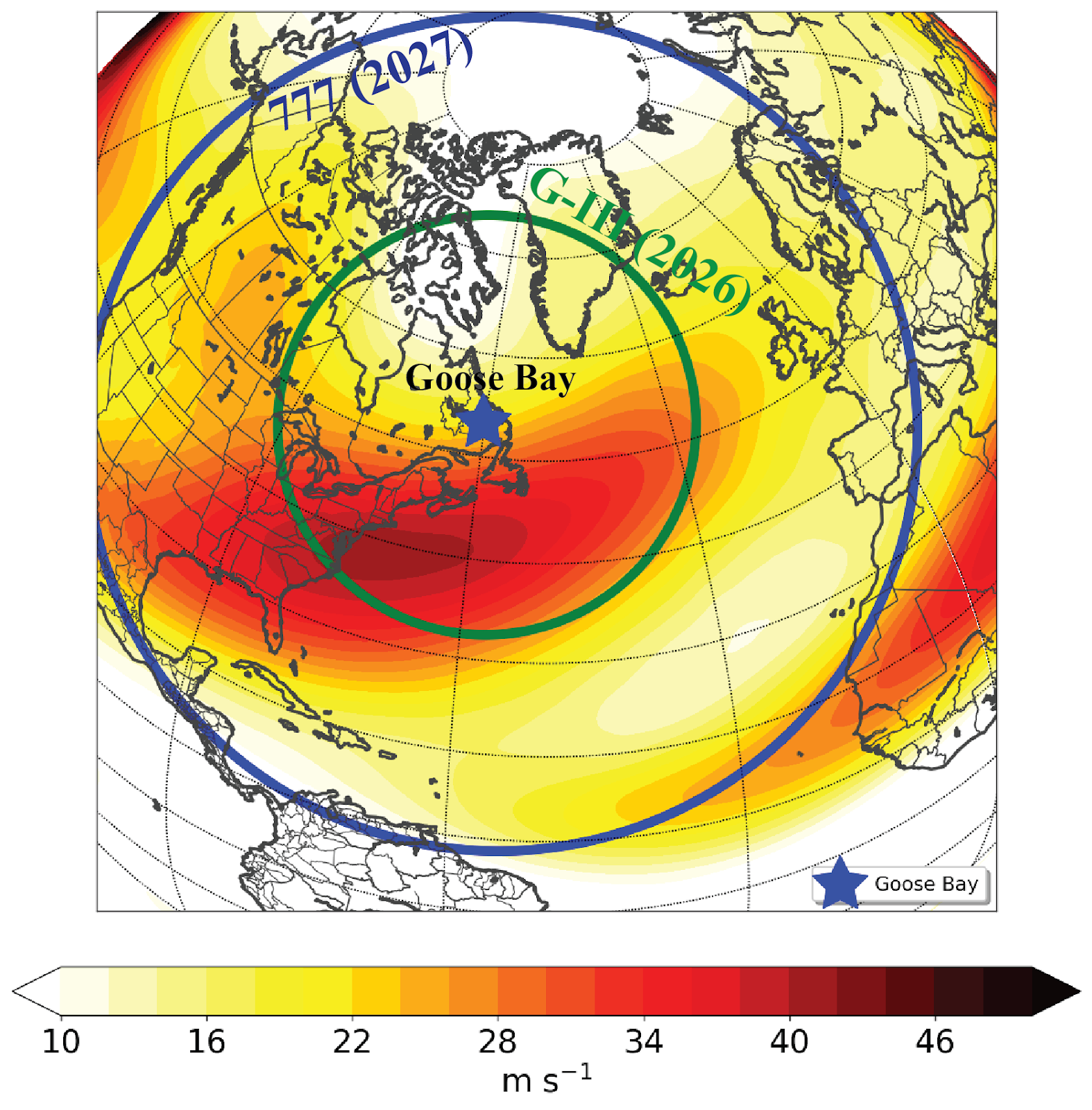
Examples of severe winter weather events include cold air outbreaks, windstorms, hazardous seas, snow and ice storms, sea ice breakup, and extreme precipitation. Data from the NURTURE mission will be used to inform first responders, decision makers, and the public sooner while also demonstrating the potential for NASA’s remote weather sensor capabilities to be developed for use on future space-based missions.
“Effects from severe weather have significant costs that threaten lives and national security by destabilizing supply chains and damaging infrastructure,” said Steven Cavallo, principal investigator for NURTURE and lead scientist at the University of Oklahoma, School of Meteorology.
The NURTURE mission is funded by NASA’s Earth Science Division and managed by researchers at NASA Langley and NASA Ames in collaboration with the University of Oklahoma.
To learn more about NURTURE, visit:
Share Details Last Updated Jan 27, 2026 Related Terms Explore More 3 min read NASA Launches Its Most Powerful, Efficient Supercomputer Article 19 hours ago 4 min read AI Unlocks Hundreds of Cosmic Anomalies in Hubble ArchiveA team of astronomers has employed a cutting-edge, artificial intelligence-assisted technique to uncover rare astronomical…
Article 21 hours ago 5 min read NASA’s Chandra Releases Deep Cut From Catalog of Cosmic Recordings Article 5 days ago Keep Exploring Discover Related TopicsMissions
Humans in Space
Climate Change
Solar System
NASA Science Flights Venture to Improve Severe Winter Weather Warnings
4 min read
Preparations for Next Moonwalk Simulations Underway (and Underwater)A team of NASA scientists deployed on an international mission designed to better understand severe winter storms. The North American Upstream Feature-Resolving and Tropopause Uncertainty Reconnaissance Experiment, or NURTURE, is an airborne campaign that uses a suite of remote sensing instruments to collect atmospheric data on winter weather with a goal of improving the models that feed storm forecasts. This combination of instruments will also serve as a proxy to demonstrate the potential to collect similar observations from space.
NASA’s G-III aircraft in the hangar at NASA’s Langley Research Center as science and flight crews install remote sensing instruments inside and onto the body of the plane.NASA/Ryan HillOn Jan. 24, the research team departed from NASA’s Langley Research Center in Hampton, Virginia, aboard the center’s Gulfstream III aircraft (G-III) en route to Goose Bay, Canada. For nearly a month, the plane will be making flights stretching from the Northern Atlantic Ocean over Canada through the Northeast United States, measuring moisture, clouds, and ozone as winter storms develop.
The second phase of the campaign, scheduled to fly out of Langley next year, will serve as the inaugural mission of NASA’s new airborne science laboratory, a Boeing 777. These flights will cover a larger range of 3,100 miles (5,000 kilometers) and use a larger suite of instruments. Researchers will collect detailed observations of the atmosphere over Europe, Greenland, the North Atlantic Ocean, Canada, the majority of of the U.S., and much of the Arctic Ocean.
“Part of NASA’s role is to leverage our expertise and resources for the benefit of humankind – with innovation always being at our core,” said Will McCarty, weather program manager and program scientist at NASA’s Headquarters in Washington. “The NURTURE campaign is doing exactly that by outfitting our aircraft with one-of-a-kind instruments designed to put our science data into action to understand dangerous weather events before, and as they form.”
Research scientist and co-investigator for the NURTURE mission, Amin Nehrir, installing and testing the High Altitude and Lidar Observatory (HALO) instrument aboard the G-III aircraft before deploying.NASA/Ryan HillAs the NASA G-III flies over Canada, a parallel companion mission led by a team of international partners called the North Atlantic Waveguide, Dry Intrusion, and Downstream Impact Campaign (NAWDIC) will be operating out of Shannon, Ireland. Meanwhile, a third airborne mission led by the National Oceanic and Atmospheric Administration (NOAA) will be studying how moisture is transported from the tropics to the Western U.S. By combining the data collected during these campaigns, scientists will be able to track weather systems as they interact and intersect globally to understand the large-scale flows and small-scale features that drive high-impact winter weather events.
Software and instrument checks taking place pre-deployment on board the G-III aircraft. HALO and other instruments, like the CloudCube radar, combine to form a specialized suite of atmospheric sensors.NASA/Ryan Hill“These storms are not forecasted very accurately,” said Amin Nehrir, a research scientist at NASA Langley and co-investigator for the NURTURE mission. “Space observations of high latitudes in the Arctic lack the sensitivity needed to gather accurate data in such a dry, atmospheric environment. In lower latitudes, we benefit from observations from radiosondes, surface networks, and satellite observations. We are using cutting-edge technology beyond those that we have in space to get a better snapshot of atmospheric dynamics.”
A map showing the two flight paths of the NURTURE mission phases – the G-III aircraft marked in green in 2026 and the NASA 777 aircraft in blue planned for 2027.Examples of severe winter weather events include cold air outbreaks, windstorms, hazardous seas, snow and ice storms, sea ice breakup, and extreme precipitation. Data from the NURTURE mission will be used to inform first responders, decision makers, and the public sooner while also demonstrating the potential for NASA’s remote weather sensor capabilities to be developed for use on future space-based missions.
“Effects from severe weather have significant costs that threaten lives and national security by destabilizing supply chains and damaging infrastructure,” said Steven Cavallo, principal investigator for NURTURE and lead scientist at the University of Oklahoma, School of Meteorology.
The NURTURE mission is funded by NASA’s Earth Science Division and managed by researchers at NASA Langley and NASA Ames in collaboration with the University of Oklahoma.
To learn more about NURTURE, visit:
Share Details Last Updated Jan 28, 2026 Related Terms Explore More 3 min read NASA Launches Its Most Powerful, Efficient Supercomputer Article 1 day ago 4 min read AI Unlocks Hundreds of Cosmic Anomalies in Hubble ArchiveA team of astronomers has employed a cutting-edge, artificial intelligence-assisted technique to uncover rare astronomical…
Article 2 days ago 5 min read NASA’s Chandra Releases Deep Cut From Catalog of Cosmic Recordings Article 5 days ago Keep Exploring Discover Related TopicsMissions
Humans in Space
Climate Change
Solar System
Mapping the Invisible
Dark matter remains invisible to our telescopes, yet its gravitational fingerprints pervade the universe. Using NASA's James Webb Space Telescope, scientists have produced one of the most detailed dark maps ever created, revealing with unprecedented clarity how dark matter and ordinary matter have grown up together. The map shows that wherever galaxies cluster in their thousands, equally massive concentrations of dark matter occupy the same space, a close alignment that confirms dark matter's gravity has been shepherding regular matter into stars, galaxies, and ultimately the complex planets capable of supporting life.
Webb Data Reveals Dark Matter
PNG (42.87 MB)
This image from NASA’s James Webb Space Telescope, containing nearly 800,000 galaxies, is overlaid with a map of dark matter, represented in blue. Brighter blue areas indicate a higher density of dark matter. Researchers used Webb data to find the dark matter — which is invisible — via its gravitational influence on regular matter.
The area of sky shown here is 0.54 square degrees (about 2½ times the size of the full Moon) and located in the constellation Sextans. Webb’s Near-Infrared Camera (NIRCam) peered at this region for a total of about 255 hours.
Dark matter doesn’t emit, reflect, absorb, or even block light, and is therefore not visible to the human eye or traditional telescopes. But it does interact with the universe through gravity, and large clumps or clusters of dark matter have enough mass to curve space itself. Light traveling to Earth from distant galaxies becomes slightly distorted as it passes through the curved fabric of spacetime. In some cases, the warping is significant enough that it is apparent to the naked eye, almost as if the galaxy were being viewed through a warped windowpane, an effect called strong gravitational lensing. In the case of the dark matter map shown here, scientists inferred dark matter’s distribution by relying instead on an effect called weak gravitational lensing, which leads to much more subtle distortions of the light from thousands of galaxies.
The dark matter in this area of sky was also mapped in 2007 using data from NASA’s Hubble Space Telescope. The Webb map contains about 10 times more galaxies than do maps of the area made by ground-based observatories and twice as many as Hubble’s map. It reveals new clumps of dark matter and captures a higher-resolution view compared to the Hubble map.
Both the Hubble and Webb dark matter maps are part of a project called the Cosmic Evolution Survey (COSMOS). The full COSMOS “field” is 2 square degrees (about 10 times the size of the full Moon) and has been imaged by at least 15 telescopes in space and on the ground. Observing the same region with many different telescopes allows scientists to combine complementary views to understand how galaxies grow and how dark matter influences their evolution. Only Webb and Hubble data have been used to map dark matter in the region.
To refine measurements of the distance to many galaxies for the map, the team used Webb’s Mid-Infrared Instrument (MIRI), designed and managed through launch by the agency’s Jet Propulsion Laboratory, along with other space- and ground-based telescopes. The wavelengths that MIRI detects also make it adept at detecting galaxies obscured by cosmic dust clouds.
The James Webb Space Telescope is solving mysteries in our solar system, looking beyond to distant worlds around other stars, and probing the mysterious structures and origins of our universe and our place in it. Webb is an international program led by NASA with its partners, ESA (European Space Agency) and CSA (Canadian Space Agency).
Webb’s MIRI was developed through a 50-50 partnership between NASA and ESA. A division of Caltech in Pasadena, California, JPL led the U.S. contribution to MIRI. JPL also led development of MIRI’s cryocooler, done in collaboration with Northrop Grumman in Redondo Beach, California, and NASA’s Goddard Space Flight Center in Greenbelt, Maryland.
To learn more about Webb, visit: https://science.nasa.gov/webb
Keep Exploring Discover More Topics From PhotojournalPhotojournal
Search Photojournal
Photojournal’s Latest Content
Feedback
Webb Data Reveals Dark Matter
PNG (42.87 MB)
This image from NASA’s James Webb Space Telescope, containing nearly 800,000 galaxies, is overlaid with a map of dark matter, represented in blue. Brighter blue areas indicate a higher density of dark matter. Researchers used Webb data to find the dark matter — which is invisible — via its gravitational influence on regular matter.
The area of sky shown here is 0.54 square degrees (about 2½ times the size of the full Moon) and located in the constellation Sextans. Webb’s Near-Infrared Camera (NIRCam) peered at this region for a total of about 255 hours.
Dark matter doesn’t emit, reflect, absorb, or even block light, and is therefore not visible to the human eye or traditional telescopes. But it does interact with the universe through gravity, and large clumps or clusters of dark matter have enough mass to curve space itself. Light traveling to Earth from distant galaxies becomes slightly distorted as it passes through the curved fabric of spacetime. In some cases, the warping is significant enough that it is apparent to the naked eye, almost as if the galaxy were being viewed through a warped windowpane, an effect called strong gravitational lensing. In the case of the dark matter map shown here, scientists inferred dark matter’s distribution by relying instead on an effect called weak gravitational lensing, which leads to much more subtle distortions of the light from thousands of galaxies.
The dark matter in this area of sky was also mapped in 2007 using data from NASA’s Hubble Space Telescope. The Webb map contains about 10 times more galaxies than do maps of the area made by ground-based observatories and twice as many as Hubble’s map. It reveals new clumps of dark matter and captures a higher-resolution view compared to the Hubble map.
Both the Hubble and Webb dark matter maps are part of a project called the Cosmic Evolution Survey (COSMOS). The full COSMOS “field” is 2 square degrees (about 10 times the size of the full Moon) and has been imaged by at least 15 telescopes in space and on the ground. Observing the same region with many different telescopes allows scientists to combine complementary views to understand how galaxies grow and how dark matter influences their evolution. Only Webb and Hubble data have been used to map dark matter in the region.
To refine measurements of the distance to many galaxies for the map, the team used Webb’s Mid-Infrared Instrument (MIRI), designed and managed through launch by the agency’s Jet Propulsion Laboratory, along with other space- and ground-based telescopes. The wavelengths that MIRI detects also make it adept at detecting galaxies obscured by cosmic dust clouds.
The James Webb Space Telescope is solving mysteries in our solar system, looking beyond to distant worlds around other stars, and probing the mysterious structures and origins of our universe and our place in it. Webb is an international program led by NASA with its partners, ESA (European Space Agency) and CSA (Canadian Space Agency).
Webb’s MIRI was developed through a 50-50 partnership between NASA and ESA. A division of Caltech in Pasadena, California, JPL led the U.S. contribution to MIRI. JPL also led development of MIRI’s cryocooler, done in collaboration with Northrop Grumman in Redondo Beach, California, and NASA’s Goddard Space Flight Center in Greenbelt, Maryland.
To learn more about Webb, visit: https://science.nasa.gov/webb
Keep Exploring Discover More Topics From PhotojournalPhotojournal
Search Photojournal
Photojournal’s Latest Content
Feedback
Researchers Use AI To Find Astronomical Anomalies Buried In Archives
AI faces strong skepticism due to its potential for misuse, its drain on resources, and even its potential dumbing down of students. But new results illustrate its uses. A team of astronomers have used a new AI-assisted method to search for rare astronomical objects in the Hubble Legacy Archive. The team sifted through nearly 100 million image cutouts in just two and a half days, uncovering nearly 1400 anomalous objects, more than 800 of which had never been documented before.
The Dark Energy Survey Weighs in on Cosmic Tensions
The final release of data from the Dark Energy Survey widens tensions in our understanding of the cosmic evolution.
The post The Dark Energy Survey Weighs in on Cosmic Tensions appeared first on Sky & Telescope.
AI reveals 800 never-before-seen ‘cosmic anomalies’ in old Hubble images
Scientists analyzed more than 100 million image cutouts from a Hubble Space Telescope archive and found hundreds of previously undiscovered objects
NASA’s Juno Measures Thickness of Europa’s Ice Shell
5 min read
Preparations for Next Moonwalk Simulations Underway (and Underwater) Jupiter’s moon Europa was captured by the JunoCam instrument aboard NASA’s Juno spacecraft during the mission’s close flyby on Sept. 29, 2022. The images show the fractures, ridges, and bands that crisscross the moon’s surface.Image data: NASA/JPL-Caltech/SwRI/MSSS Image processing: Björn Jónsson (CC BY 3.0)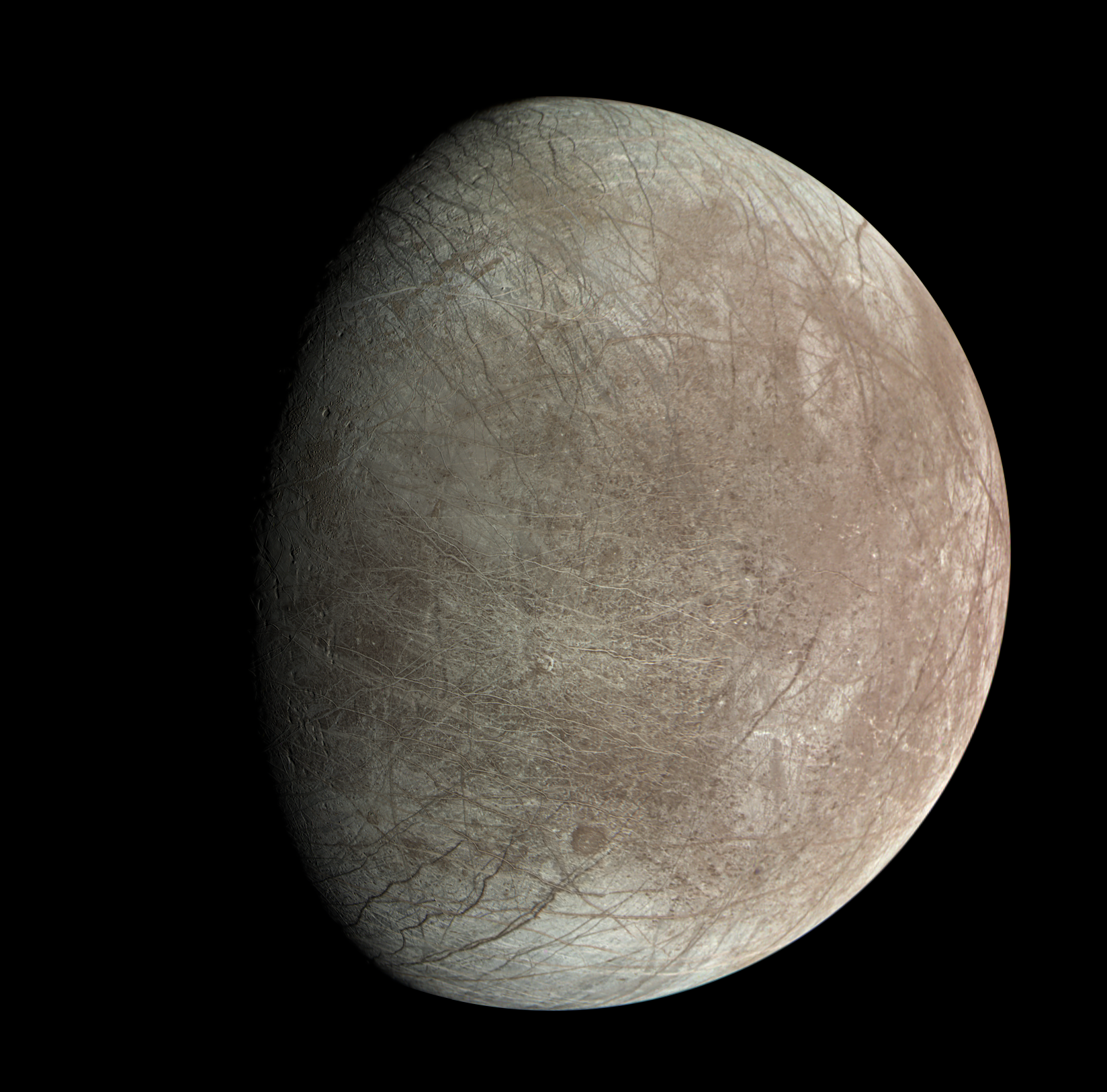
Results from the solar-powered spacecraft provide a new measurement of the thickness of the ice shell encasing the Jovian moon’s ocean.
Data from NASA’s Juno mission has provided new insights into the thickness and subsurface structure of the icy shell encasing Jupiter’s moon Europa. Using the spacecraft’s Microwave Radiometer (MWR), mission scientists determined that the shell averages about 18 miles (29 kilometers) thick in the region observed during Juno’s 2022 flyby of Europa. The Juno measurement is the first to discriminate between thin and thick shell models that have suggested the ice shell is anywhere from less than half a mile to tens of miles thick.
Slightly smaller than Earth’s moon, Europa is one of the solar system’s highest-priority science targets for investigating habitability. Evidence suggests that the ingredients for life may exist in the saltwater ocean that lies beneath its ice shell. Uncovering a variety of characteristics of the ice shell, including its thickness, provides crucial pieces of the puzzle for understanding the moon’s internal workings and the potential for the existence of a habitable environment.
The new estimate on the ice thickness in the near-surface icy crust was published on Dec. 17 in the journal Nature Astronomy.
This artist’s concept depicts a cutaway view showing Europa’s ice shell. Data used to generate a new result on the ice thickness and structure was collected by the microwave radiometer instrument on NASA’s Juno during a close flyby of the Jovian moon on Sept. 29, 2022.NASA/JPL-Caltech/SwRI/Koji Kuramura/ Gerald Eichstädt (CC BY) Catching waves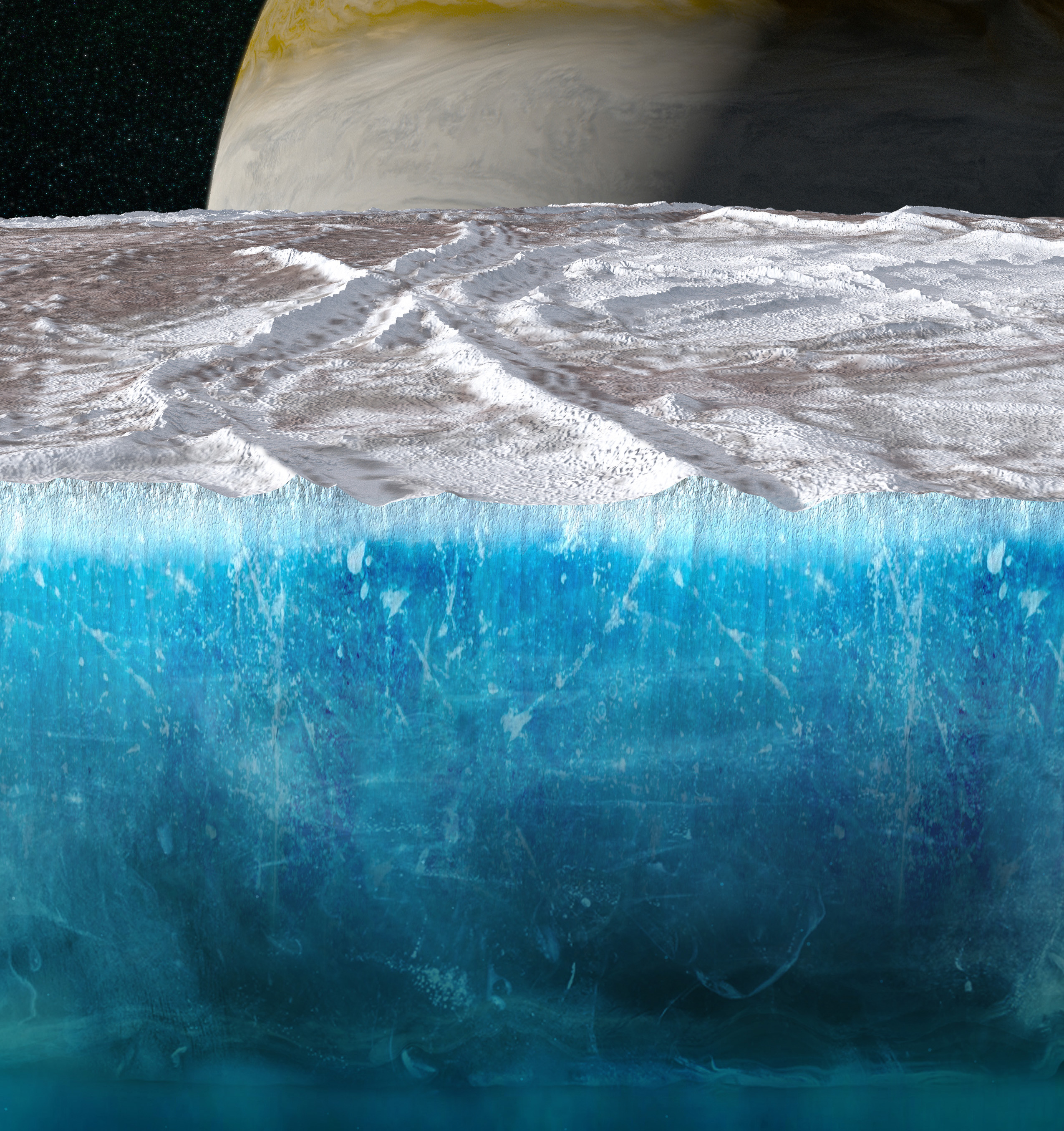
Although the MWR instrument was designed to investigate Jupiter’s atmosphere below the cloud tops, the novel instrument has proven valuable for studying the gas giant’s icy and volcanic moons as well.
On Sept. 29, 2022, Juno came within about 220 miles (360 kilometers) of Europa’s frozen surface. During the flyby, MWR collected data on about half the moon’s surface, peering beneath the ice to measure its temperatures at various depths.
“The 18-mile estimate relates to the cold, rigid, conductive outer-layer of a pure water ice shell,” said Steve Levin, Juno project scientist and co-investigator from NASA’s Jet Propulsion Laboratory in Southern California, which manages the mission. “If an inner, slightly warmer convective layer also exists, which is possible, the total ice shell thickness would be even greater. If the ice shell contains a modest amount of dissolved salt, as suggested by some models, then our estimate of the shell thickness would be reduced by about 3 miles.”
The thick shell, as suggested by the MWR data, implies a longer route that oxygen and nutrients would have to travel to connect Europa’s surface with its subsurface ocean. Understanding this process may be relevant to future studies of Europa’s habitability.
Cracks, poresThe MWR data also provides new insights into the makeup of the ice just below Europa’s surface. The instrument revealed the presence of “scatterers” — irregularities in the near-surface ice such as cracks, pores, and voids that scatter the instrument’s microwaves reflecting off the ice (similar to how visible light is scattered in ice cubes). These scatterers are estimated to be no bigger than a few inches in diameter and appear to extend to depths of hundreds of feet below Europa’s surface.
The small size and shallow depth of these features, as modeled in this study, suggest they are unlikely to be a significant pathway for oxygen and nutrients to travel from Europa’s surface to its salty ocean.
“How thick the ice shell is and the existence of cracks or pores within the ice shell are part of the complex puzzle for understanding Europa’s potential habitability,” said Scott Bolton, principal investigator of Juno from the Southwest Research Institute in San Antonio. “They provide critical context for NASA’s Europa Clipper and the ESA (European Space Agency) Juice (JUpiter ICy moons Explorer) spacecraft — both of which are on their way to the Jovian system.” Europa Clipper will arrive there in 2030, while Juice will arrive the year after.
Juno will carry out its 81st flyby of Jupiter on Feb. 25.
More about JunoA division of Caltech in Pasadena, California, JPL manages the Juno mission for the principal investigator, Scott Bolton, of the Southwest Research Institute in San Antonio. Juno is part of NASA’s New Frontiers Program, managed at NASA’s Marshall Space Flight Center in Huntsville, Alabama, for the agency’s Science Mission Directorate in Washington.
To learn more about Juno, go to:
https://science.nasa.gov/mission/juno
News Media Contacts
DC Agle
Jet Propulsion Laboratory
818-393-9011
agle@jpl.nasa.gov
Karen Fox / Molly Wasser
NASA Headquarters, Washington
240-285-5155 / 240-419-1732
karen.c.fox@nasa.gov / molly.l.wasser@nasa.gov
Deb Schmid
Southwest Research Institute, San Antonio
210-522-2254
dschmid@swri.org
2026-004
Share Details Last Updated Jan 27, 2026 Related Terms Explore More 6 min read NASA’s Pandora Satellite, CubeSats to Explore Exoplanets, BeyondEditor’s Note, Jan. 13, 2026: Mission controllers received full acquisition of signal from the Pandora…
Article 3 weeks ago 6 min read NASA’s SPHEREx Observatory Completes First Cosmic Map Like No Other Article 1 month ago 6 min read NASA’s Perseverance Mars Rover Ready to Roll for Miles in Years Ahead Article 1 month ago Keep Exploring Discover Related TopicsJupiter: Exploration
JunoNASA’s Juno spacecraft has explored Jupiter, its moons, and rings since 2016, gathering breakthrough science and breathtaking imagery.
Jupiter Moons
EuropaEyes on the Solar System: Europa