
Feed aggregator
Starless Gas Cloud Might Harbor Dark Matter
Astronomers discovered a cloud of hydrogen gas that’s devoid of stars. Held together by an invisible halo of dark matter, the starless cloud may elucidate its nature.
The post Starless Gas Cloud Might Harbor Dark Matter appeared first on Sky & Telescope.
NASA Starts Up Gateway’s Power System for First Time
1 min read
Preparations for Next Moonwalk Simulations Underway (and Underwater) The primary structure of Gateway’s Power and Propulsion Element (PPE) undergoing assembly, integration, and testing at Lanteris Space Systems in Palo Alto, California, on September 29, 2025. Lanteris Space Systems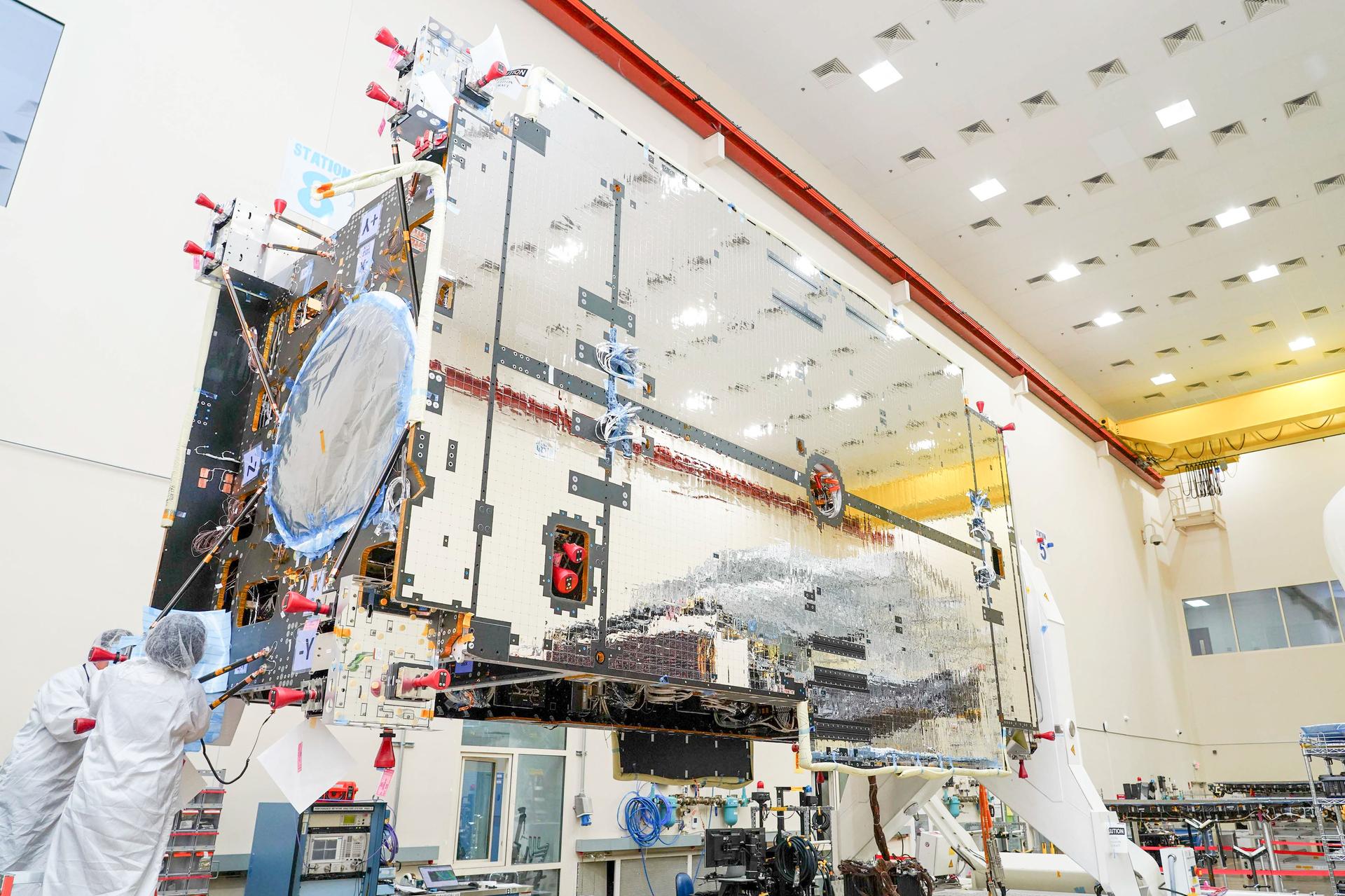
Development continues on NASA’s Power and Propulsion Element, a solar electric propulsion spacecraft designed to provide power for Gateway in lunar orbit.
Able to generate 60 kilowatts of power, the element was successfully powered on earlier last year. The milestone demonstrates the element can provide the spacecraft with power, high-rate communications, attitude control, as well as the ability to maintain and maneuver between orbits.
The Power and Propulsion Element is managed by NASA’s Glenn Research Center in Cleveland and built by industry partner Lanteris Space Systems in Palo Alto, California, where teams have secured the element’s main electrical system inside protective exterior panels. On deck for installation at Lanteris Space Systems are three 12-kilowatt advanced electric propulsion system thrusters, manufactured by L3Harris, and four 6-kilowatt Busek-built BHT-6000 thrusters. The roll-out solar arrays for Gateway are complete and moving through testing at Redwire’s facility in Goleta, California.
For more information about NASA’s lunar exploration missions, visit:
Share Details Last Updated Jan 08, 2026 ContactJacqueline Minerdjacqueline.minerd@nasa.govLocationGlenn Research Center Related Terms Explore More 3 min read Lunar Space Station Module for NASA’s Artemis Campaign to Begin Final Outfitting Article 9 months ago 2 min read Gateway Tops OffGateway’s Power and Propulsion Element is now equipped with its xenon and liquid fuel tanks.
Article 1 year ago Keep Exploring Discover More Topics From NASAMissions
Humans in Space
Climate Change
Solar System
NASA Starts Up Gateway’s Power System for First Time
1 min read
Preparations for Next Moonwalk Simulations Underway (and Underwater) The primary structure of Gateway’s Power and Propulsion Element (PPE) undergoing assembly, integration, and testing at Lanteris Space Systems in Palo Alto, California, on September 29, 2025. Lanteris Space SystemsDevelopment continues on NASA’s Power and Propulsion Element, a solar electric propulsion spacecraft designed to provide power for Gateway in lunar orbit.
Able to generate 60 kilowatts of power, the element was successfully powered on earlier last year. The milestone demonstrates the element can provide the spacecraft with power, high-rate communications, attitude control, as well as the ability to maintain and maneuver between orbits.
The Power and Propulsion Element is managed by NASA’s Glenn Research Center in Cleveland and built by industry partner Lanteris Space Systems in Palo Alto, California, where teams have secured the element’s main electrical system inside protective exterior panels. On deck for installation at Lanteris Space Systems are three 12-kilowatt advanced electric propulsion system thrusters, manufactured by L3Harris, and four 6-kilowatt Busek-built BHT-6000 thrusters. The roll-out solar arrays for Gateway are complete and moving through testing at Redwire’s facility in Goleta, California.
For more information about NASA’s lunar exploration missions, visit:
Share Details Last Updated Jan 08, 2026 ContactJacqueline Minerdjacqueline.minerd@nasa.govLocationGlenn Research Center Related Terms Explore More 3 min read Lunar Space Station Module for NASA’s Artemis Campaign to Begin Final Outfitting Article 9 months ago 2 min read Gateway Tops OffGateway’s Power and Propulsion Element is now equipped with its xenon and liquid fuel tanks.
Article 1 year ago Keep Exploring Discover More Topics From NASAMissions
Humans in Space
Climate Change
Solar System
Some quantum computers might need more power than supercomputers
Some quantum computers might need more power than supercomputers
Archeologists Just Found a 2,000-Year-Old Battle Trumpet That May Be Linked to Queen Boudica
This newly discovered Iron Age instrument may have been played in the Celtic resistance against the Roman Empire
NASA's Mars Sample Return Is Dead, Paving The Way For China
This year's funding for the Mars Sample Return mission has been cut. It seems unlikely that the mission will be revived in the coming years, barring some unforeseen development. This isn't a surprising development, so maybe NASA has some contingency plans.
Why Trump's Exit from Pivotal Climate Treaty Matters
In the latest effort to undermine climate action, President Trump pulled the U.S. out of the U.N. Framework Convention on Climate Change, which underpins global efforts to address rising temperatures
City-sized iceberg has turned into a giant swimming pool
City-sized iceberg has turned into a giant swimming pool
An extremely rare Callisto event on January 10th
Observers across America may witness a special transit and shadow event of Jupiter’s moon on opposition day.
The post An extremely rare Callisto event on January 10th appeared first on Sky & Telescope.
Red tattoo ink causes man to lose all his hair and stop sweating
Red tattoo ink causes man to lose all his hair and stop sweating
Jellyfish and Sea Anemones Sleep Just Like Us
Sea anemones and jellyfish don’t have brains, but the way their neurons behave during sleep shows some surprising similarities to humans
ESA Director General’s 2026 annual press briefing
Josef Aschbacher, Director General of the European Space Agency, briefed journalists on the main milestones for 2026, such as the launch of Smile, a mission that will give humankind its first complete look at how Earth reacts to streams of particles and bursts of radiation from the Sun. Later in 2026 should also see the arrival of BepiColombo at Mercury after its eight-year trip, where it will gather data to answer many perplexing questions about the least-explored planet of the inner Solar System. Many more exciting missions are expected, with ESA astronaut Sophie Adenot launching for the International Space Station, and various Earth Observation and Navigation launches from Europe’s Spaceport in French Guiana.
ESA preview 2026
As a new year begins, let’s take a look at what’s ahead for the European Space Agency in 2026. From Earth to the farthest reaches of the Solar System, 2026 marks a year of firsts that continue to shape the future of space.
ESA and Playmobil launch Mars mission collection
The European Space Agency (ESA) and Playmobil are expanding their successful partnership with a brand-new collection of space-themed toys, bringing a distinctly European vision of Mars exploration into the hands of young explorers.
Tiny patches of deforestation drive tropical carbon loss
Often called Earth’s green lungs, tropical forests pull down massive amounts of carbon dioxide from the atmosphere, release oxygen and help regulate the global climate. While the threat of large-scale deforestation is well known, new findings reveal a surprising culprit – the clearance of small areas of forest accounts for more than half of net carbon losses across the Tropics.
Meltwater Turns Iceberg A-23A Blue
- Earth
- Earth Observatory
- Image of the Day
- EO Explorer
- Topics
- More Content
- About