

Feed aggregator
Dust and water spotted close to giant black hole
Using the NASA/ESA/CSA James Webb Space Telescope, an international team of astronomers have discovered that dust and water can form and survive surprisingly close to the supermassive black hole at the centre of our Milky Way galaxy. The observations reveal that the evolved star IRS 3 continues to enrich its surroundings with newly formed material despite the intense radiation environment around Sagittarius A*.
Curiosity Blog, Sols 4968-4974: Rock Climbing Towards the Discontinuity
- Curiosity Home
- Science
- News and Features
- Multimedia
- Mars Missions
- Mars Home
3 min read
Curiosity Blog, Sols 4968-4974: Rock Climbing Towards the Discontinuity NASA’s Mars rover Curiosity acquired this image, a frame of the “Longquimay” mosaic showing fine-scale sedimentary textures in a bedrock block near the supersurface, using its Mars Hand Lens Imager (MAHLI), located on the turret at the end of the rover’s robotic arm. Curiosity acquired the image on Aug. 1, 2026 — Sol 4972, or Martian day 4,972 of the Mars Science Laboratory mission — at 23:35:43 UTC. NASA/JPL-Caltech/MSSS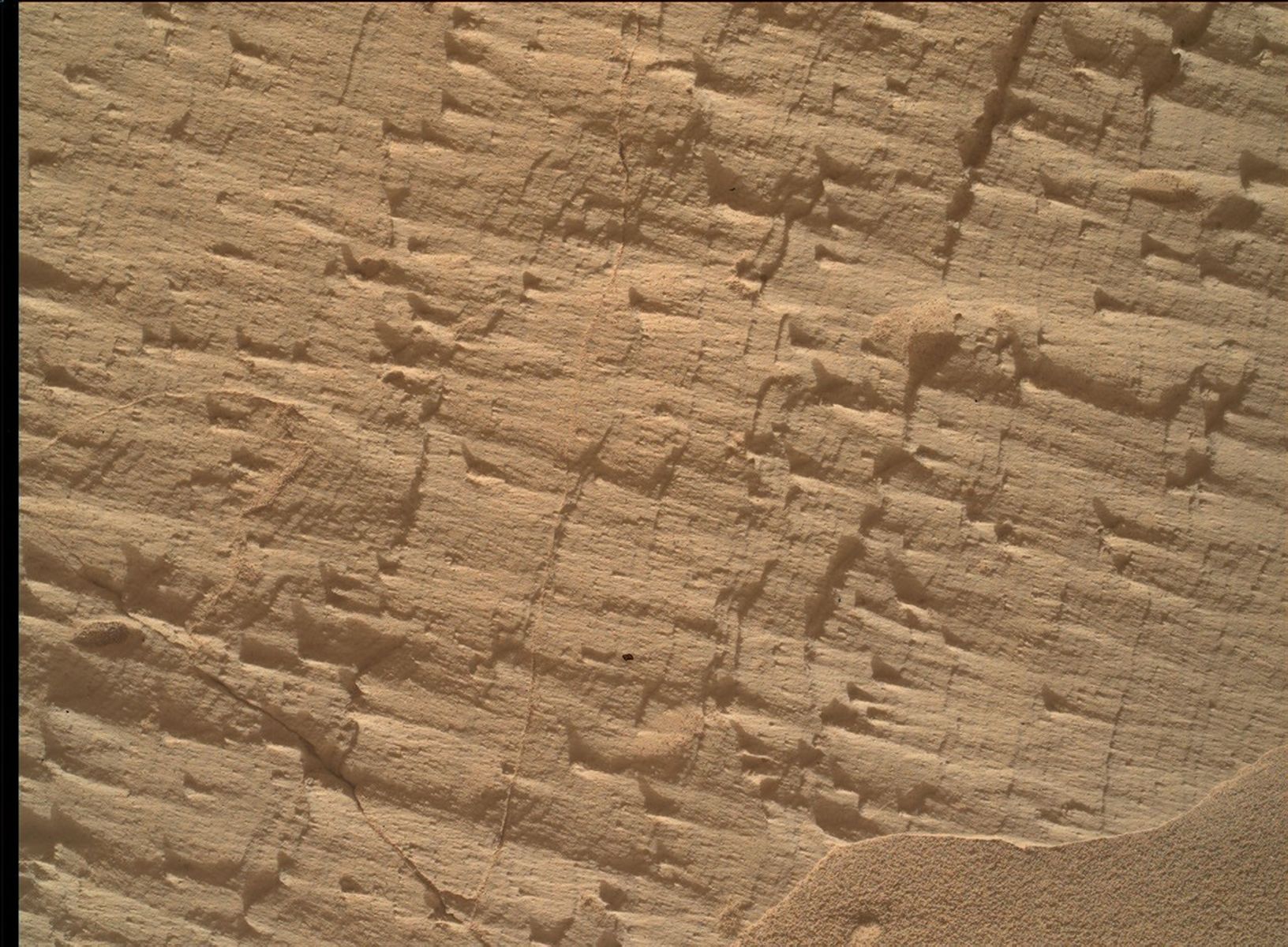
Written by Lucy Lim, Planetary Scientist at NASA’s Goddard Space Flight Center
Earth planning date: Friday, July 31, 2026
As mentioned in the previous blog, Curiosity has been exploring a large-scale feature in Gale’s sedimentary record suspected to be an “erosional supersurface.” The “supersurface” represents a period in time when a net depositional environment changed to a net erosional one before returning to a depositional regime, thus producing a discontinuity in the rock record. The erosion can involve wind, water, or both. Sometimes there are clues about these environmental changes in the layers below and above the supersurface. So far we’ve been seeing some patterns that look like aeolian features and also some “lens” deposits that sometimes appear consistent with fluvial origins. We need higher-resolution imaging of these features.
This week Curiosity came within detailed imaging range of a section of the “Cerro Paine Grande” vertical exposure just below the candidate supersurface before climbing on top of it. Mastcam was the star of the show on both planning days this week, capturing large stereo mosaics of the vertical face of the outcrop and a 360-degree panorama after the rover climbed on top of it.
NASA’s Mars rover Curiosity acquired this image, showing the rover arm in action in the “Longquimay” workspace at the top of a steep climb. Curiosity captured the image using its Right Navigation Camera on Aug. 2, 2026 — Sol 4972, or Martian day 4,972 of the Mars Science Laboratory mission — at 00:49:52 UTC. NASA/JPL-Caltech
Roving to the top took full advantage of Curiosity’s climbing capabilities, leaving the rover at an approximate 24-degree tilt in its final parking spot. The rover planners managed to reach the right posture for contact science at the same time — quite a feat, and one that approached the mission’s contact science tilt record of 27 degrees!
Meanwhile, MAHLI and our geochemical instruments provided detailed characterization of the rock layers beneath the discontinuity. I was the Geology and Mineralogy Theme Lead for the Sol 4968 (Monday) planning cycle, during which “Puyehue” in the light-toned bedrock block of the workspace was co-targeted with APXS, MAHLI, and ChemCam LIBS. The other two targeted LIBS observations in the plan went to a similar-looking nearby bedrock block (“Lago Palena”) and an intriguing layered block off to the side of the workspace (“Piedras Juntas”). Another APXS measurement went to a sand target, “Cormudesi,” which will help us assess the consistency of sand compositions along the rover’s traverse.
In the Sol 4972 workspace atop the slope, the bedrock was sharply divided between a smooth bedding-parallel surface on the local top of the outcrop and the darker-toned, rougher, angled exposure of the same rocks. The light-toned top surface was measured by MAHLI, APXS, and the LIBS at target “Sierra de Sangre,” whereas the darker-toned laminated face was targeted by APXS and MAHLI at “Laguna del Laja.” The fine-scale sedimentary structures in the textured material were also documented by a MAHLI mosaic (“Longquimay”) supported by Mastcam M100 imaging.
Rounding out the week’s science observations were several long-distance ChemCam RMI mosaics on more distant targets such as sedimentary structures above the rover’s current stratigraphic position, and finally our regular cadence measurements of the modern Martian environment, including atmospheric opacity and a ChemCam passive-sky survey to monitor abundances of minor atmospheric gases.
-
Want to read more posts from the Curiosity team?
-
Want to learn more about Curiosity’s science instruments?
Article
2 weeks ago
3 min read Curiosity Blog, Sols 4954–4960: Celebrating Our Rover Engineers Past and Present
Article
3 weeks ago
3 min read Curiosity Blog, Sols 4947-4953: Gale Crater Then and Now
Article
4 weeks ago
Keep Exploring Discover More Topics From NASA Mars
Mars is the fourth planet from the Sun, and the seventh largest. It’s the only planet we know of inhabited…
All Mars Resources
Explore this collection of Mars images, videos, resources, PDFs, and toolkits. Discover valuable content designed to inform, educate, and inspire,…
Rover Basics
Each robotic explorer sent to the Red Planet has its own unique capabilities driven by science. Many attributes of a…
Mars Exploration: Science Goals
The key to understanding the past, present or future potential for life on Mars can be found in NASA’s four…
Curiosity Blog, Sols 4968-4974: Rock Climbing Towards the Discontinuity
- Curiosity Home
- Science
- News and Features
- Multimedia
- Mars Missions
- Mars Home
3 min read
Curiosity Blog, Sols 4968-4974: Rock Climbing Towards the Discontinuity NASA’s Mars rover Curiosity acquired this image, a frame of the “Longquimay” mosaic showing fine-scale sedimentary textures in a bedrock block near the supersurface, using its Mars Hand Lens Imager (MAHLI), located on the turret at the end of the rover’s robotic arm. Curiosity acquired the image on Aug. 1, 2026 — Sol 4972, or Martian day 4,972 of the Mars Science Laboratory mission — at 23:35:43 UTC. NASA/JPL-Caltech/MSSSWritten by Lucy Lim, Planetary Scientist at NASA’s Goddard Space Flight Center
Earth planning date: Friday, July 31, 2026
As mentioned in the previous blog, Curiosity has been exploring a large-scale feature in Gale’s sedimentary record suspected to be an “erosional supersurface.” The “supersurface” represents a period in time when a net depositional environment changed to a net erosional one before returning to a depositional regime, thus producing a discontinuity in the rock record. The erosion can involve wind, water, or both. Sometimes there are clues about these environmental changes in the layers below and above the supersurface. So far we’ve been seeing some patterns that look like aeolian features and also some “lens” deposits that sometimes appear consistent with fluvial origins. We need higher-resolution imaging of these features.
This week Curiosity came within detailed imaging range of a section of the “Cerro Paine Grande” vertical exposure just below the candidate supersurface before climbing on top of it. Mastcam was the star of the show on both planning days this week, capturing large stereo mosaics of the vertical face of the outcrop and a 360-degree panorama after the rover climbed on top of it.
NASA’s Mars rover Curiosity acquired this image, showing the rover arm in action in the “Longquimay” workspace at the top of a steep climb. Curiosity captured the image using its Right Navigation Camera on Aug. 2, 2026 — Sol 4972, or Martian day 4,972 of the Mars Science Laboratory mission — at 00:49:52 UTC. NASA/JPL-CaltechRoving to the top took full advantage of Curiosity’s climbing capabilities, leaving the rover at an approximate 24-degree tilt in its final parking spot. The rover planners managed to reach the right posture for contact science at the same time — quite a feat, and one that approached the mission’s contact science tilt record of 27 degrees!
Meanwhile, MAHLI and our geochemical instruments provided detailed characterization of the rock layers beneath the discontinuity. I was the Geology and Mineralogy Theme Lead for the Sol 4968 (Monday) planning cycle, during which “Puyehue” in the light-toned bedrock block of the workspace was co-targeted with APXS, MAHLI, and ChemCam LIBS. The other two targeted LIBS observations in the plan went to a similar-looking nearby bedrock block (“Lago Palena”) and an intriguing layered block off to the side of the workspace (“Piedras Juntas”). Another APXS measurement went to a sand target, “Cormudesi,” which will help us assess the consistency of sand compositions along the rover’s traverse.
In the Sol 4972 workspace atop the slope, the bedrock was sharply divided between a smooth bedding-parallel surface on the local top of the outcrop and the darker-toned, rougher, angled exposure of the same rocks. The light-toned top surface was measured by MAHLI, APXS, and the LIBS at target “Sierra de Sangre,” whereas the darker-toned laminated face was targeted by APXS and MAHLI at “Laguna del Laja.” The fine-scale sedimentary structures in the textured material were also documented by a MAHLI mosaic (“Longquimay”) supported by Mastcam M100 imaging.
Rounding out the week’s science observations were several long-distance ChemCam RMI mosaics on more distant targets such as sedimentary structures above the rover’s current stratigraphic position, and finally our regular cadence measurements of the modern Martian environment, including atmospheric opacity and a ChemCam passive-sky survey to monitor abundances of minor atmospheric gases.
-
Want to read more posts from the Curiosity team?
-
Want to learn more about Curiosity’s science instruments?
Article
2 weeks ago
3 min read Curiosity Blog, Sols 4954–4960: Celebrating Our Rover Engineers Past and Present
Article
3 weeks ago
3 min read Curiosity Blog, Sols 4947-4953: Gale Crater Then and Now
Article
4 weeks ago
Keep Exploring Discover More Topics From NASA Mars
Mars is the fourth planet from the Sun, and the seventh largest. It’s the only planet we know of inhabited…
All Mars Resources
Explore this collection of Mars images, videos, resources, PDFs, and toolkits. Discover valuable content designed to inform, educate, and inspire,…
Rover Basics
Each robotic explorer sent to the Red Planet has its own unique capabilities driven by science. Many attributes of a…
Mars Exploration: Science Goals
The key to understanding the past, present or future potential for life on Mars can be found in NASA’s four…
APOD: 2026 August 11 – Six Moons of Saturn
APOD
Astronomy Picture of the Day
Discover the cosmos! Each day a different image or photograph of our fascinating universe is featured, along with a brief explanation written by a professional astronomer.
Six Moons of Saturn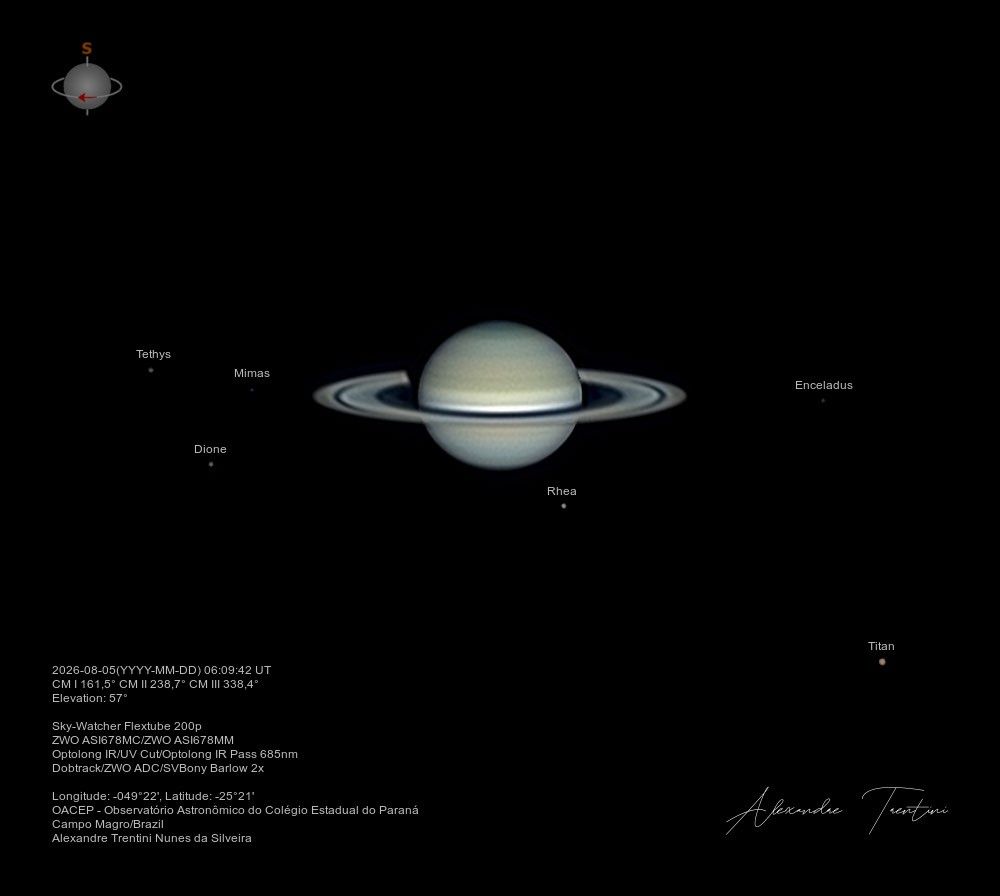
Explanation: How many moons does Saturn have? While the total will likely continue to grow, as of June 2026 the ringed gas giant had 293 confirmed moons. That’s easily more than any other planet of the Solar System, including ruling gas giant Jupiter with a mere 115 confirmed moons. Most of Saturn’s known moons are small, irregular satellites. Many are only few kilometers to a fraction of a kilometer across and grouped in tilted outer orbits. Six of its largest satellites can be seen here, though, in this sharp telescopic Saturnian family portrait taken on August 5. Larger than Earth’s Moon and even slightly larger than inner planet Mercury, Titan, with a diameter of 5,150 kilometers, is at lower right. You can also spot icy major moons Mimas, Tethys, Enceladus, Dione, and Rhea in the frame. Saturn’s first known natural satellite, Titan was discovered in 1655 by Dutch astronomer Christiaan Huygens. During the space age Voyager and Cassini discoveries have added to the swelling ranks of Saturnian moons.
NASA Stream: August 12 Total Solar Eclipse.
Tomorrow’s picture: pixels in space
NASA Science Activation & Michigan Tech. U.
Random APOD Generator
Yesterday’s Image APOD: 2026 August 10 – Three Galaxy Pairs
Tomorrow’s Image
APOD: 2026 August 11 – Six Moons of Saturn
APOD
Astronomy Picture of the Day
Discover the cosmos! Each day a different image or photograph of our fascinating universe is featured, along with a brief explanation written by a professional astronomer.
Six Moons of SaturnExplanation: How many moons does Saturn have? While the total will likely continue to grow, as of June 2026 the ringed gas giant had 293 confirmed moons. That’s easily more than any other planet of the Solar System, including ruling gas giant Jupiter with a mere 115 confirmed moons. Most of Saturn’s known moons are small, irregular satellites. Many are only few kilometers to a fraction of a kilometer across and grouped in tilted outer orbits. Six of its largest satellites can be seen here, though, in this sharp telescopic Saturnian family portrait taken on August 5. Larger than Earth’s Moon and even slightly larger than inner planet Mercury, Titan, with a diameter of 5,150 kilometers, is at lower right. You can also spot icy major moons Mimas, Tethys, Enceladus, Dione, and Rhea in the frame. Saturn’s first known natural satellite, Titan was discovered in 1655 by Dutch astronomer Christiaan Huygens. During the space age Voyager and Cassini discoveries have added to the swelling ranks of Saturnian moons.
NASA Stream: August 12 Total Solar Eclipse.
Tomorrow’s picture: pixels in space
NASA Science Activation & Michigan Tech. U.
Random APOD Generator
Yesterday’s Image APOD: 2026 August 10 – Three Galaxy Pairs
Tomorrow’s Image
Bountiful Roebuck Bay
- Earth
- Earth Observatory
- Image of the Day
- EO Explorer
- Topics
- More Content
- About
Bountiful Roebuck Bay
- Earth
- Earth Observatory
- Image of the Day
- EO Explorer
- Topics
- More Content
- About
Seven Needles, 800,000 Haystacks
A quasar is a supermassive black hole in the act of feeding, and it’s so bright that it drowns out the galaxy it sits in. That is a nuisance if you want to weigh the galaxy and weighing it is exactly what you need to do to understand how black holes and the host galaxies grew up together. There is a way round it however, catch a quasar whose galaxy happens to be bending the light of something further away, and the bending betrays the mass. The catch is that such alignments are vanishingly rare, and the survey that might contain them holds 800,000 quasars. A team at Ohio State set a neural network on the pile and it came back with seven.
The Odds of Finding Water on Mars
Mars has plenty of water, and almost all of it is in the wrong place. The poles are rich in ice, the equator, where you would actually want to land, has none within reach. That leaves the mid-latitudes, and until now the honest answer about what lies beneath them has been a bit of a shrug. Two new studies from the Planetary Science Institute have changed the shape of that answer. Rather than simply asking whether the data are consistent with buried ice, they have started calculating the odds and can now say, of a given patch of Martian ground, that there is a 64 per cent chance of finding ice if you dig there.
The Telescope That Points Itself
Time on a large professional telescope is one of the scarcest resources in science. Astronomers wait months for a few hours, and every one of those hours is a running argument with the weather, the Moon and the atmosphere. Point at the wrong target at the wrong moment and the data comes back soft, washed out, or useless, with the next chance half a year away. A team has now handed that argument to a machine. Their system was trained not on the rules astronomers use but on what astronomers actually did, night after night, for years.
Interstellar Travel III: Antimatter to the Rescue?
With the end of the Space Age and the winding down of the Cold War, scientists again returned to the question of interstellar flight. Having failed to realize a working concept that could be realized in the near term, more exotic ideas began to be considered, reflecting further breakthroughs in theoretical physics.
Scientists are using AI to design new viruses. Should they be?
Research is outpacing regulation to govern artificial-intelligence-designed biology
Trump issues executive order aimed at rewriting childhood vaccine schedule
The president called for the combined measles, mumps and rubella (MMR) vaccine to be split into separate shots, despite decades of research showing that the MMR vaccine is safe and effective
Community College Instructors Bring Astronomy Textbook Into 21st Century
2 min read
Community College Instructors Bring Astronomy Textbook Into 21st Century Students studying the celestial sphere at Jackson College, Michigan. Credit: Steven Tuckey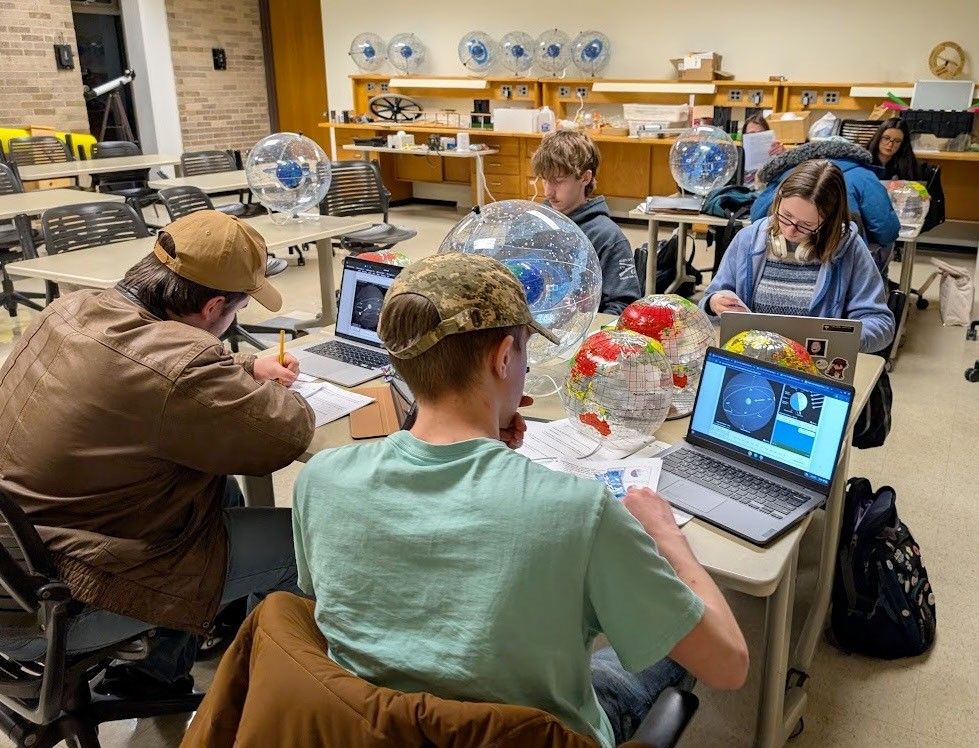
Teaching the beautiful and inspirational science of astronomy using only the conceptual framework offered by a traditional textbook – without incorporating the wealth of incredible resources, images and activities from NASA – falls short of the more modern, active learning experience that could better serve students evolving learning strategies. Three project teams from the NASA Science Activation (SciAct) program – NASA Community College Network (NCCN, led by the SETI Institute) and five of their expert community college instructors; Infiniscope (led by Arizona State University, ASU); and NASA Treks – set out to address this challenge.
In June 2026, these teams gathered for a virtual workshop to lay the groundwork for incorporating active learning components drawn from NASA’s extensive education and visualization resource pool and the widely used but traditionally structured OpenStax Astronomy 101 textbook into Relevant Engaging Active Learning (REAL) courseware for introductory Astronomy, while preserving the core content and clear explanatory narrative of the text.
Over the following two weeks, the instructors each adopted one of the opening five chapters of OpenStax, enhancing the content with active learning modules with an emphasis on materials developed by SciAct project teams, such as NASA Treks, Universe of Learning, and Cosmic Data Stories, to name a few. The results of their efforts were presented in a wrap-up presentation in July and will be field-tested in community college classrooms in Fall 2026.
This workshop served as a proof of concept for exploring whether an existing textbook can be effectively adapted into an active learning tool that will enhance students’ understanding of fundamental astronomical concepts. Next steps will include expanding the program and diving back into OpenStax to systematically reimagine the material into an active learning tool that covers the entire book – and therefore, the entire Universe! Importantly, this effort highlights new and highly impactful possibilities for the dissemination of NASA SciAct resources.
Special thanks to the five community college instructors and their invaluable wisdom, experience, and skills: Carver Bierson (Scottsdale Community College, Scottsdale Arizona), Dan Chase (Modesto Community College, Modesto, California), Dennis Just (Pima Community College, Pima, Arizona), Steve Tuckey (Jackson College, Jackson, Michigan) and Sally Watt (Glendale Community College, Glendale, Arizona).
NCCN, Infiniscope, NASA Treks, and many of the projects that contributed learning materials are supported by NASA cooperative agreement awards and are part of the NASA Science Activation Program portfolio, which connects learners with authentic NASA science experiences through partnerships with educators and community organizations.
Share Details Last Updated Aug 10, 2026 Editor NASA Science Editorial Team Related Terms Explore More 4 min read Educators & Teens Get Hands-On With TEMPO Data to Help Investigate Local Air QualityArticle
4 days ago
3 min read Students Connect NASA Science With Indigenous Knowledge to Study Coastal Erosion
For the Pleasant Point Passamaquoddy Reservation, or Sipayik, the ocean has always been a teacher.…
Article
1 month ago
4 min read Northwest Earth and Space Science Pathways Project Celebrates Student Innovation Through ROADS from Earth to Venus National Challenge
Article
1 month ago
Keep Exploring Discover More Topics From NASA James Webb Space Telescope
Webb is the premier observatory of the next decade, serving thousands of astronomers worldwide. It studies every phase in the…
Perseverance Rover
This rover and its aerial sidekick were assigned to study the geology of Mars and seek signs of ancient microbial…
Parker Solar Probe
On a mission to “touch the Sun,” NASA’s Parker Solar Probe became the first spacecraft to fly through the corona…
Juno
NASA’s Juno spacecraft entered orbit around Jupiter in 2016, the first explorer to peer below the planet’s dense clouds to…
Community College Instructors Bring Astronomy Textbook Into 21st Century
2 min read
Community College Instructors Bring Astronomy Textbook Into 21st Century Students studying the celestial sphere at Jackson College, Michigan. Credit: Steven TuckeyTeaching the beautiful and inspirational science of astronomy using only the conceptual framework offered by a traditional textbook – without incorporating the wealth of incredible resources, images and activities from NASA – falls short of the more modern, active learning experience that could better serve students evolving learning strategies. Three project teams from the NASA Science Activation (SciAct) program – NASA Community College Network (NCCN, led by the SETI Institute) and five of their expert community college instructors; Infiniscope (led by Arizona State University, ASU); and NASA Treks – set out to address this challenge.
In June 2026, these teams gathered for a virtual workshop to lay the groundwork for incorporating active learning components drawn from NASA’s extensive education and visualization resource pool and the widely used but traditionally structured OpenStax Astronomy 101 textbook into Relevant Engaging Active Learning (REAL) courseware for introductory Astronomy, while preserving the core content and clear explanatory narrative of the text.
Over the following two weeks, the instructors each adopted one of the opening five chapters of OpenStax, enhancing the content with active learning modules with an emphasis on materials developed by SciAct project teams, such as NASA Treks, Universe of Learning, and Cosmic Data Stories, to name a few. The results of their efforts were presented in a wrap-up presentation in July and will be field-tested in community college classrooms in Fall 2026.
This workshop served as a proof of concept for exploring whether an existing textbook can be effectively adapted into an active learning tool that will enhance students’ understanding of fundamental astronomical concepts. Next steps will include expanding the program and diving back into OpenStax to systematically reimagine the material into an active learning tool that covers the entire book – and therefore, the entire Universe! Importantly, this effort highlights new and highly impactful possibilities for the dissemination of NASA SciAct resources.
Special thanks to the five community college instructors and their invaluable wisdom, experience, and skills: Carver Bierson (Scottsdale Community College, Scottsdale Arizona), Dan Chase (Modesto Community College, Modesto, California), Dennis Just (Pima Community College, Pima, Arizona), Steve Tuckey (Jackson College, Jackson, Michigan) and Sally Watt (Glendale Community College, Glendale, Arizona).
NCCN, Infiniscope, NASA Treks, and many of the projects that contributed learning materials are supported by NASA cooperative agreement awards and are part of the NASA Science Activation Program portfolio, which connects learners with authentic NASA science experiences through partnerships with educators and community organizations.
Share Details Last Updated Aug 10, 2026 Editor NASA Science Editorial Team Related Terms Explore More 4 min read Educators & Teens Get Hands-On With TEMPO Data to Help Investigate Local Air QualityArticle
4 days ago
3 min read Students Connect NASA Science With Indigenous Knowledge to Study Coastal Erosion
For the Pleasant Point Passamaquoddy Reservation, or Sipayik, the ocean has always been a teacher.…
Article
1 month ago
4 min read Northwest Earth and Space Science Pathways Project Celebrates Student Innovation Through ROADS from Earth to Venus National Challenge
Article
1 month ago
Keep Exploring Discover More Topics From NASA James Webb Space Telescope
Webb is the premier observatory of the next decade, serving thousands of astronomers worldwide. It studies every phase in the…
Perseverance Rover
This rover and its aerial sidekick were assigned to study the geology of Mars and seek signs of ancient microbial…
Parker Solar Probe
On a mission to “touch the Sun,” NASA’s Parker Solar Probe became the first spacecraft to fly through the corona…
Juno
NASA’s Juno spacecraft entered orbit around Jupiter in 2016, the first explorer to peer below the planet’s dense clouds to…
Colombia rocked by 7.4 magnitude earthquake—its largest in the past decade
This seismic event is of a similar magnitude to the pair of earthquakes that hit Venezuela in June
NASA+ Debuts on discovery+, Coming Soon to HBO Max
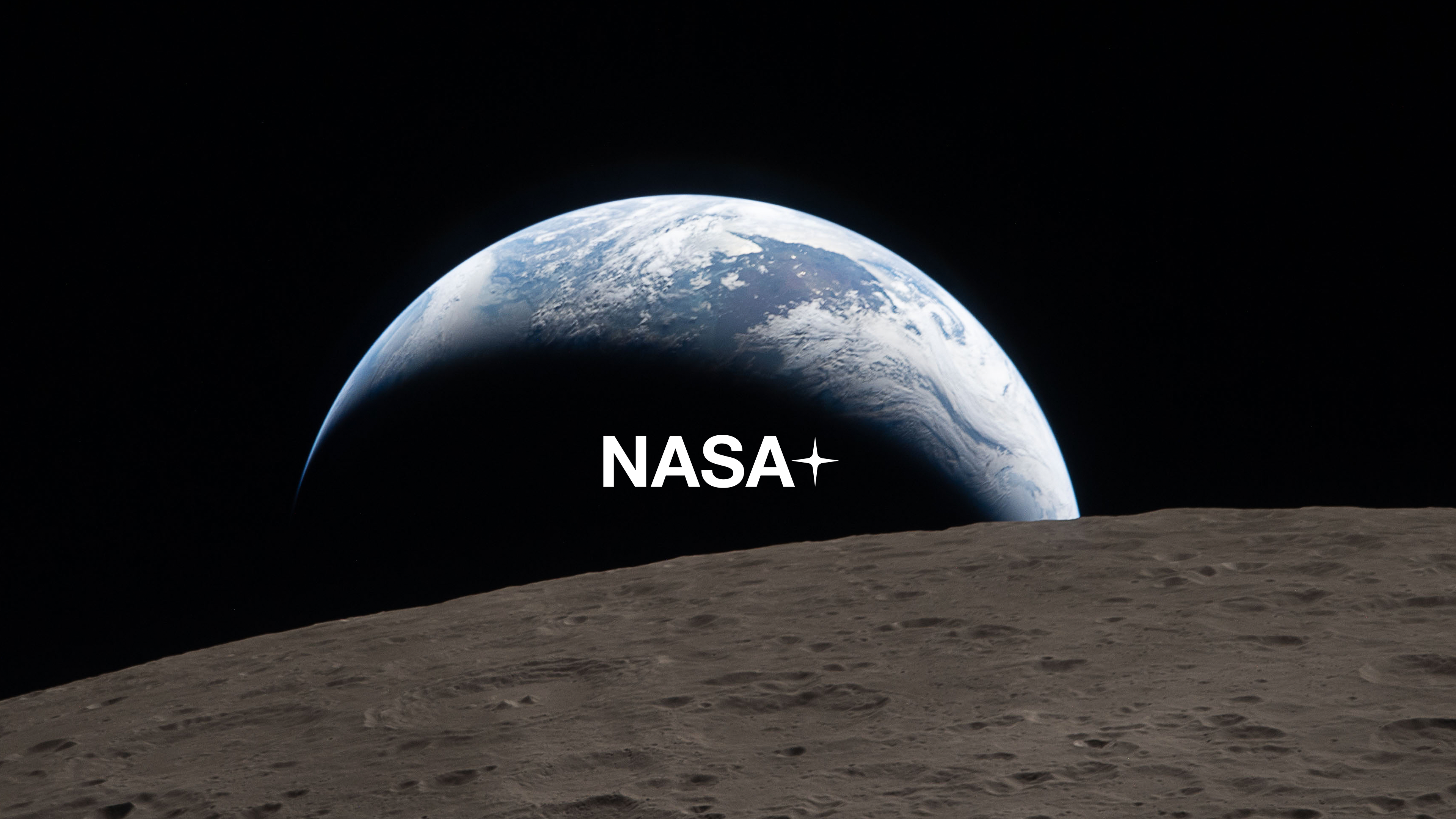
As NASA+ continues its expansion across multiple streaming platforms to bring space closer to home, NASA announced Monday programming is next heading to discovery+ and HBO Max. A continuous live feed of NASA+ programming is streaming on discovery+ live channels, while HBO Max will stream NASA’s special events, including the Artemis III mission in 2027.
Viewers on those platforms can stream NASA+ content in Dolby Vision on supported devices, which will bring space exploration to life with vivid colors, sharper contrast, brighter imagery, and richer detail. This enhanced streaming experience will help viewers experience space coverage in a uniquely immersive way.
Future programming may include science mission launches, a test flight for rendezvous and docking with human landing systems, robotic lunar deliveries, the first crewed mission to the Moon under Artemis, and more. As always, NASA+ also remains available for free, with no ads, through the NASA app and on the agency’s website.
“The National Aeronautics and Space Act of 1958 calls on us to share our story of space exploration with the broadest possible audience and we continue to honor that commitment,” said Rebecca Sirmons, general manager of NASA+ at the agency’s Headquarters in Washington. “Artemis II captured the hearts and minds of viewers globally, inspiring the Artemis generation. As we return to the Moon to stay, our goal is to provide transparent, engaging content coverage every step of the way.”
Earlier this year during its Ignition event, NASA shared plans for a bold path forward for the agency, including increasing its cadence of Artemis missions to the lunar surface, and building the first Moon Base, among other agency priorities. These continuous streaming agreements strengthen NASA’s promise to public engagement, making the agency’s mission and educational content available on multiple devices for viewers on their preferred channels
For more about NASA’s missions, visit:
-end-
Jennifer Dooren / Lauren Low
Headquarters, Washington
202-358-1600
jennifer.m.dooren@nasa.gov / lauren.e.low@nasa.gov
NASA+ Debuts on discovery+, Coming Soon to HBO Max
As NASA+ continues its expansion across multiple streaming platforms to bring space closer to home, NASA announced Monday programming is next heading to discovery+ and HBO Max. A continuous live feed of NASA+ programming is streaming on discovery+ live channels, while HBO Max will stream NASA’s special events, including the Artemis III mission in 2027.
Viewers on those platforms can stream NASA+ content in Dolby Vision on supported devices, which will bring space exploration to life with vivid colors, sharper contrast, brighter imagery, and richer detail. This enhanced streaming experience will help viewers experience space coverage in a uniquely immersive way.
Future programming may include science mission launches, a test flight for rendezvous and docking with human landing systems, robotic lunar deliveries, the first crewed mission to the Moon under Artemis, and more. As always, NASA+ also remains available for free, with no ads, through the NASA app and on the agency’s website.
“The National Aeronautics and Space Act of 1958 calls on us to share our story of space exploration with the broadest possible audience and we continue to honor that commitment,” said Rebecca Sirmons, general manager of NASA+ at the agency’s Headquarters in Washington. “Artemis II captured the hearts and minds of viewers globally, inspiring the Artemis generation. As we return to the Moon to stay, our goal is to provide transparent, engaging content coverage every step of the way.”
Earlier this year during its Ignition event, NASA shared plans for a bold path forward for the agency, including increasing its cadence of Artemis missions to the lunar surface, and building the first Moon Base, among other agency priorities. These continuous streaming agreements strengthen NASA’s promise to public engagement, making the agency’s mission and educational content available on multiple devices for viewers on their preferred channels
For more about NASA’s missions, visit:
-end-
Jennifer Dooren / Lauren Low
Headquarters, Washington
202-358-1600
jennifer.m.dooren@nasa.gov / lauren.e.low@nasa.gov
NASA Astronaut Jessica Meir Uses VR Goggles
Can dogs read your facial expressions? It depends on your mood
Dogs are known to recognize and respond to human facial expressions, but a new study shows how deeply they understand our mood