

Feed aggregator
Black hole stars really do exist in the early universe
What I’ll be doing to help detox my brain in the new year
What I’ll be doing to help detox my brain in the new year
ESA's JUICE Mission Reveals More Activity from 3I/ATLAS
During November 2025, ESA’s Jupiter Icy Moons Explorer (JUICE) used five of its science instruments to observe 3I/ATLAS. The instruments collected information about how the comet is behaving and what it is made of.
Engineering the First Reusable Launchpads on the Moon
Engineers need good data to build lasting things. Even the designers of the Great Pyramids knew the limestone they used to build these massive structures would be steady when stacked on top of one another, even if they didn’t have tables of the compressive strength of those stones. But when attempting to build structures on other worlds, such as the Moon, engineers don’t yet know much about the local materials. Still, due to the costs of getting large amounts of materials off of Earth, they will need to learn to use those materials even for critical applications like a landing pad to support the landing / ascent of massive rockets used in re-supply operations. A new paper published in Acta Astronautica from Shirley Dyke and her team at Purdue University describes how to build a lunar landing pad with just a minimal amount of prior knowledge of the material properties of the regolith used to build it.
Year in images 2025
Year in images 2025
Our year through the lens: a selection of our favourite images for 2025
Astronomers Find the First Compelling Evidence of "Monster Stars" in the Early Universe
Using the James Webb Space Telescope, a team of international researchers has discovered chemical fingerprints of gigantic primordial stars that were among the first to form after the Big Bang.
Artemis II Crew Rehearse Launch Day Demonstration

The four astronauts set to fly around the Moon during NASA’s Artemis II test flight depart the Neil A. Armstrong Operations and Checkout Building at the agency’s Kennedy Space Center in Florida, during a dress rehearsal for launch day on Dec. 20, 2025. From left are CSA (Canadian Space Agency) astronaut Jeremy Hansen, NASA astronauts Victor Glover, Reid Wiseman, and Christina Koch.
The launch day rehearsal, called a countdown demonstration test, simulated the launch day timeline, including the crew suiting up in their spacesuits and climbing in and out of their Orion spacecraft. Because the SLS (Space Launch System) rocket upon which they will launch is not yet at the launch pad, the crew boarded Orion inside Kennedy’s Vehicle Assembly Building, where engineers are conducting final preparations on the spacecraft, rocket, and ground systems.
Through Artemis, NASA will send astronauts to explore the Moon for scientific discovery, economic benefits, and build the foundation for the first crewed missions to Mars.
Photo Credit: NASA/Jim Ross
Artemis II Crew Rehearse Launch Day Demonstration
The four astronauts set to fly around the Moon during NASA’s Artemis II test flight depart the Neil A. Armstrong Operations and Checkout Building at the agency’s Kennedy Space Center in Florida, during a dress rehearsal for launch day on Dec. 20, 2025. From left are CSA (Canadian Space Agency) astronaut Jeremy Hansen, NASA astronauts Victor Glover, Reid Wiseman, and Christina Koch.
The launch day rehearsal, called a countdown demonstration test, simulated the launch day timeline, including the crew suiting up in their spacesuits and climbing in and out of their Orion spacecraft. Because the SLS (Space Launch System) rocket upon which they will launch is not yet at the launch pad, the crew boarded Orion inside Kennedy’s Vehicle Assembly Building, where engineers are conducting final preparations on the spacecraft, rocket, and ground systems.
Through Artemis, NASA will send astronauts to explore the Moon for scientific discovery, economic benefits, and build the foundation for the first crewed missions to Mars.
Photo Credit: NASA/Jim Ross
U.S. Plan to Drop Some Childhood Vaccines to Align with Denmark Will Endanger Children, Experts Say
The U.S. reportedly plans to overhaul the country’s childhood vaccine schedule. The move could set public health back decades, experts say
IMAP's Instruments Are Coming Online
During the deployment of new space telescopes that are several critical steps each has to go through. Launch is probably the one most commonly thought of, another is “first light” of all of the instruments on the telescope. Ultimately, they’re responsible for the data the telescope is intended to collect - if they don’t work properly then the mission itself it a failure. Luckily, the Interstellar Mapping and Acceleration Probe (IMAP) recently collected first light on its 10 primary instruments, and everything seems to be in working order, according to a press release from the Southwest Research Institute who was responsible for ensuring the delivery of all 10 instruments went off without a hitch.
Disney and OpenAI Signal the Arrival of AI Video Streaming
Disney and OpenAI’s agreement hints at a future in which viewers don’t just choose what to watch but generate it on demand
The Last Meteor Shower of 2025 and the Winter Solstice Align This Weekend
Sky watchers may be tempted out this weekend, when an underappreciated meteor shower will coincide with a new moon and the longest night of year for the Northern Hemisphere
This Week's Sky at a Glance, December 19 – 28
We greet the winter solstice. Jupiter nears opposition. Will the two Dog Stars balance for you? And meet the House in the Hyades.
The post This Week's Sky at a Glance, December 19 – 28 appeared first on Sky & Telescope.
Wind-Sculpted Landscapes: Investigating the Martian Megaripple ‘Hazyview’
- Perseverance Home
- Science
- News and Features
- Multimedia
- Mars Missions
- Mars Home
Written by Noah Martin, Ph.D. student and Candice Bedford, Research Scientist at Purdue University
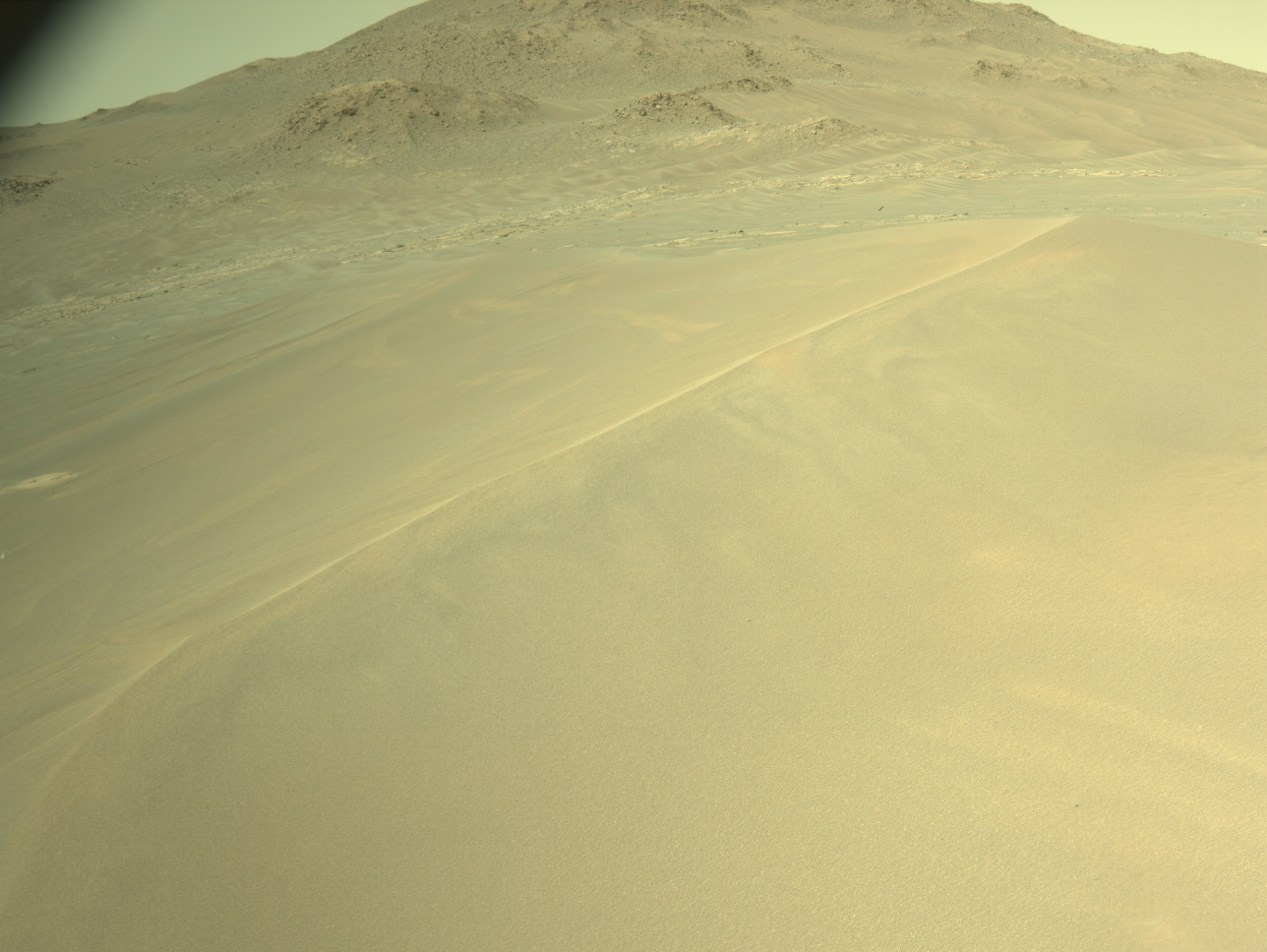
While much of Perseverance’s work focuses on ancient rocks that record Mars’ long-lost rivers and lakes, megaripples offer a rare opportunity to examine processes that are still shaping the surface today. Megaripples are sand ripples up to 2 meters (about 6.5 feet) tall that are mainly built and modified by wind. However, when water in the atmosphere interacts with dust on the ripple surface, a salty, dusty crust can form. When this happens, it is much harder for the wind to move or shape the megaripple. As such, megaripples on Mars are largely considered inactive, standing as records of past wind regimes and atmospheric water interactions over time. However, some have shown signs of movement, and it is possible that periods of high wind speeds may erode or reactivate these deposits again.
Despite Mars’ thin atmosphere today (2% of the Earth’s atmospheric density), wind is one of the main drivers of change at the surface, eroding local bedrock into sand-sized grains and transporting these grains across the ripple field. As a result, megaripple studies help us understand how wind has shaped the surface in Mars’ most recent history and support planning for future human missions, as the chemistry and cohesion of Martian soils will influence everything from mobility to resource extraction.
Following the successful investigation of the dusty, inactive megaripples at “Kerrlaguna,” Perseverance recently explored a more expansive field of megaripples called “Honeyguide.” This region hosts some of the largest megaripples Perseverance has seen along its traverse so far, making it an ideal location for a comprehensive study of these features. The megaripples at “Honeyguide” rise higher, extend farther, and have sharply defined crests with more uniform orientation compared to those at “Kerrlaguna.” The consistent orientation of the megaripples at “Honeyguide” suggests that winds in this area have blown predominantly from the same direction (north-south) for a long period of time.
At “Honeyguide,” Perseverance studied the “Hazyview” megaripple, where over 50 observations were taken across the SuperCam, Mastcam-Z, MEDA, PIXL and WATSON instruments, looking for grain movement, signs of early morning frost, and changes in mineralogy from crest to trough. The investigation of the “Hazyview” bedform builds directly on the results from “Kerrlaguna” and represents the most detailed look yet at these intriguing wind-formed deposits. As Perseverance continues its journey on the crater rim, these observations will provide a valuable reference for interpreting other wind-blown features and for understanding how Mars continues to change, one grain of sand at a time.
-
Want to read more posts from the Perseverance team?
-
Want to learn more about Perseverance’s science instruments?
Article
1 day ago
2 min read Hi ya! Hyha
Article
2 days ago
3 min read Curiosity Blog, Sols 4731-4742: Finishing Up at Nevado Sajama
Article
1 week ago
Keep Exploring Discover More Topics From NASA All Mars Resources
Explore this collection of Mars images, videos, resources, PDFs, and toolkits. Discover valuable content designed to inform, educate, and inspire,…
Rover Basics
Each robotic explorer sent to the Red Planet has its own unique capabilities driven by science. Many attributes of a…
Mars Exploration: Science Goals
The key to understanding the past, present or future potential for life on Mars can be found in NASA’s four…
Mars Perseverance Rover
The Mars Perseverance rover is the first leg the Mars Sample Return Campaign’s interplanetary relay team. Its job is to…
Wind-Sculpted Landscapes: Investigating the Martian Megaripple ‘Hazyview’
- Perseverance Home
- Science
- News and Features
- Multimedia
- Mars Missions
- Mars Home
Written by Noah Martin, Ph.D. student and Candice Bedford, Research Scientist at Purdue University
While much of Perseverance’s work focuses on ancient rocks that record Mars’ long-lost rivers and lakes, megaripples offer a rare opportunity to examine processes that are still shaping the surface today. Megaripples are sand ripples up to 2 meters (about 6.5 feet) tall that are mainly built and modified by wind. However, when water in the atmosphere interacts with dust on the ripple surface, a salty, dusty crust can form. When this happens, it is much harder for the wind to move or shape the megaripple. As such, megaripples on Mars are largely considered inactive, standing as records of past wind regimes and atmospheric water interactions over time. However, some have shown signs of movement, and it is possible that periods of high wind speeds may erode or reactivate these deposits again.
Despite Mars’ thin atmosphere today (2% of the Earth’s atmospheric density), wind is one of the main drivers of change at the surface, eroding local bedrock into sand-sized grains and transporting these grains across the ripple field. As a result, megaripple studies help us understand how wind has shaped the surface in Mars’ most recent history and support planning for future human missions, as the chemistry and cohesion of Martian soils will influence everything from mobility to resource extraction.
Following the successful investigation of the dusty, inactive megaripples at “Kerrlaguna,” Perseverance recently explored a more expansive field of megaripples called “Honeyguide.” This region hosts some of the largest megaripples Perseverance has seen along its traverse so far, making it an ideal location for a comprehensive study of these features. The megaripples at “Honeyguide” rise higher, extend farther, and have sharply defined crests with more uniform orientation compared to those at “Kerrlaguna.” The consistent orientation of the megaripples at “Honeyguide” suggests that winds in this area have blown predominantly from the same direction (north-south) for a long period of time.
At “Honeyguide,” Perseverance studied the “Hazyview” megaripple, where over 50 observations were taken across the SuperCam, Mastcam-Z, MEDA, PIXL and WATSON instruments, looking for grain movement, signs of early morning frost, and changes in mineralogy from crest to trough. The investigation of the “Hazyview” bedform builds directly on the results from “Kerrlaguna” and represents the most detailed look yet at these intriguing wind-formed deposits. As Perseverance continues its journey on the crater rim, these observations will provide a valuable reference for interpreting other wind-blown features and for understanding how Mars continues to change, one grain of sand at a time.
-
Want to read more posts from the Perseverance team?
-
Want to learn more about Perseverance’s science instruments?
Explore this collection of Mars images, videos, resources, PDFs, and toolkits. Discover valuable content designed to inform, educate, and inspire,…
Rover BasicsEach robotic explorer sent to the Red Planet has its own unique capabilities driven by science. Many attributes of a…
Mars Exploration: Science GoalsThe key to understanding the past, present or future potential for life on Mars can be found in NASA’s four…
Mars Perseverance RoverThe Mars Perseverance rover is the first leg the Mars Sample Return Campaign’s interplanetary relay team. Its job is to…