
Feed aggregator
New Scientist changed the UK's freedom of information laws in 2025
New Scientist changed the UK's freedom of information laws in 2025
The Solar System Loses an Ocean World
Saturn’s largest moon, Titan, may not have a subsurface ocean after all. That’s according to a re-examination of data captured by NASA’s Cassini mission, which flew by Titan dozens of times starting in 2004. By 2008, all the evidence suggested a subsurface ocean of liquid water waited beneath Titan’s geologically complex crust. But the latest analysis says the interior is more likely to be made of ice and slush, albeit with pockets of warm water that cycle from core to surface.
A Dance of Galaxies
A Dance of Galaxies
NASA’s James Webb Space Telescope captured two nearby dwarf galaxies interacting with each other in this image released on Dec. 2, 2025. Dwarf galaxies can give us insights into galaxies in the early universe, which were thought to have less mass than galaxies like the Milky Way, and also contain a lot of gas, relatively few stars, and typically have small amounts of elements heavier than helium. Observing dwarf galaxies merge can tell us how galaxies billions of years ago might have grown and evolved.
Read more about this cosmic pair.
Image credit: ESA/Webb, NASA & CSA, A. Adamo (Stockholm University), G. Bortolini, and the FEAST JWST team
A Dance of Galaxies
NASA’s James Webb Space Telescope captured two nearby dwarf galaxies interacting with each other in this image released on Dec. 2, 2025. Dwarf galaxies can give us insights into galaxies in the early universe, which were thought to have less mass than galaxies like the Milky Way, and also contain a lot of gas, relatively few stars, and typically have small amounts of elements heavier than helium. Observing dwarf galaxies merge can tell us how galaxies billions of years ago might have grown and evolved.
Read more about this cosmic pair.
Image credit: ESA/Webb, NASA & CSA, A. Adamo (Stockholm University), G. Bortolini, and the FEAST JWST team
NASA Armstrong Advances Flight Research and Innovation in 2025
12 min read
Preparations for Next Moonwalk Simulations Underway (and Underwater)In 2025, NASA’s Armstrong Flight Research Center in Edwards, California, advanced work across aeronautics, Earth science, exploration technologies, and emerging aviation systems, reinforcing its role as one of the agency’s primary test sites for aeronautics research. From early concept evaluations to full flight test campaigns, teams enhanced measurement tools, refined safety systems, and generated data that supported missions across NASA. Operating from the Mojave Desert, NASA Armstrong continued applying engineering design with real-world performance, carrying forward research that informs how aircraft operate today and how new systems may function in the future.
The year’s progress also reflects the people behind the work – engineers, technicians, pilots, operators, and mission support staff who navigate complex tests and ensure each mission advances safely and deliberately. Their efforts strengthened partnerships with industry, small businesses, and universities while expanding opportunities for students and early career professionals. Together they sustained NASA Armstrong’s long-standing identity as a center where innovation is proven in flight and where research helps chart the course for future aviation and exploration.
“We executed our mission work safely, including flight of the first piloted NASA X-plane in decades, while under challenging conditions,” said Brad Flick, center director of NASA Armstrong. “It tells me our people embrace the work we do and are willing to maintain high levels of professionalism while enduring personal stress and uncertainty. It’s a testimony to the dedication of our NASA and contractor workforce.”
Teams continued advancing key projects, supporting partners, and generating data that contributes to NASA’s broader mission.
Quiet supersonic flight and the Quesst mission NASA’s F-15D research aircraft conducts a calibration flight of a shock-sensing probe near NASA’s Armstrong Flight Research Center in Edwards, California. The shock-sensing probe is designed to measure the signature and strength of shock waves in flight. The probe was validated during dual F-15 flights and will be flown behind NASA’s X-59 to measure small pressure changes caused by shock waves in support of the agency’s Quesst mission.NASA/Jim Ross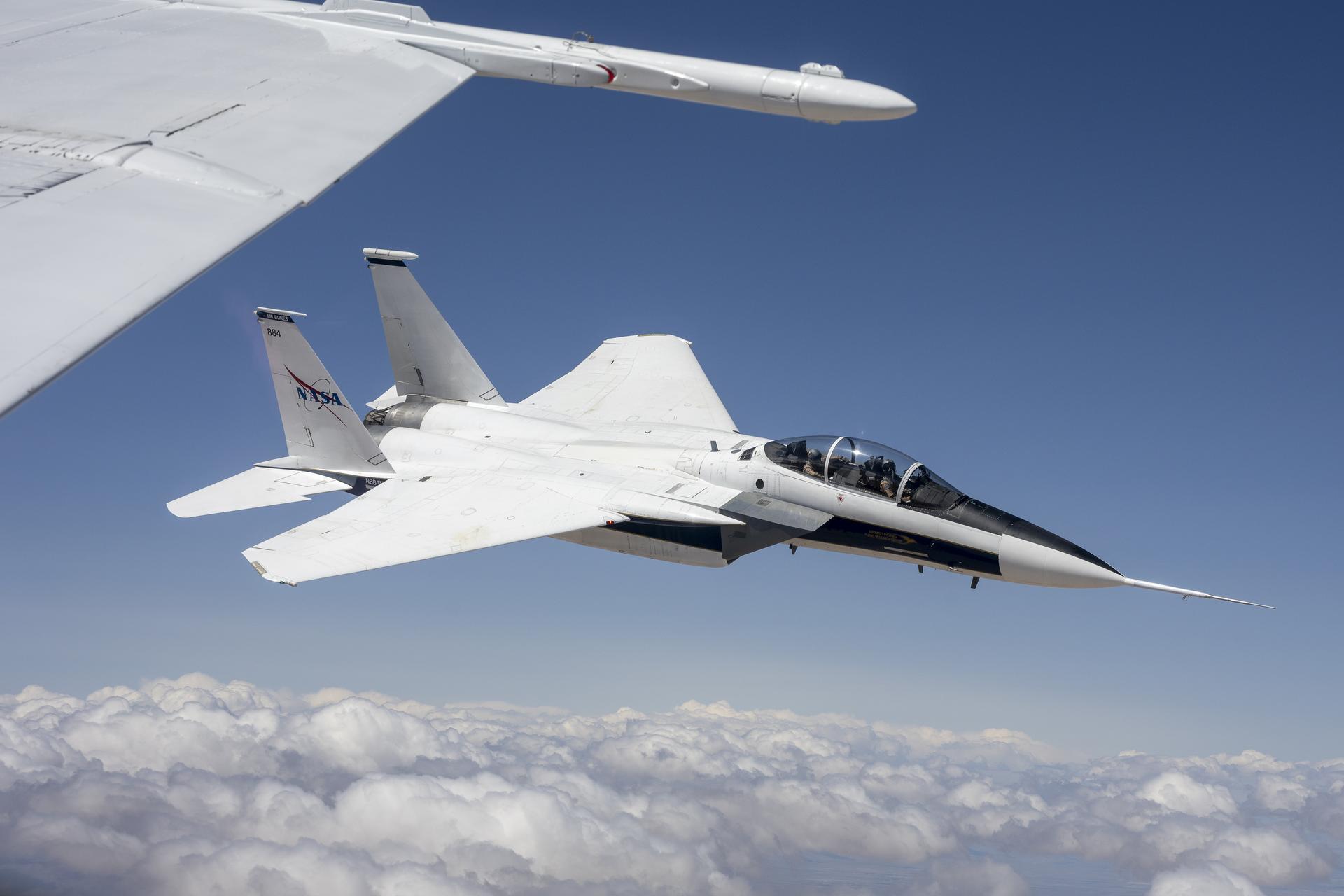
NASA Armstrong continued its quiet supersonic research, completing a series of activities in support of NASA’s Quesst mission. On the X-59 quiet supersonic research aircraft, the team performed electromagnetic interference tests and ran engine checks to prepare the aircraft for taxi tests. The Schlieren, Airborne Measurements, and Range Operations for Quesst (SCHAMROQ) team completed aircraft integration and shock-sensing probe calibration flights, refining the tools needed to characterize shock waves from the X-59. These efforts supported the aircraft’s progression toward its first flight on Oct. 28, marking a historic milestone and the beginning of its transition to NASA Armstrong for continued testing.
The center’s Commercial Supersonic Technology (CST) team also conducted airborne validation flights using NASA F-15s, confirming measurement systems essential for Quesst’s next research phase. Together, this work forms the technical backbone for upcoming community response studies, where NASA will evaluate whether quieter supersonic thumps could support future commercial applications.
- The X-59 team completed electromagnetic interference testing on the aircraft, verifying system performance and confirming that all its systems could reliably operate together.
- NASA’s X-59 engine testing concluded with a maximum afterburner test that demonstrated the engine’s ability to generate the thrust required for supersonic flight.
- Engineers conducted engine speed-hold evaluations to assess how the X-59’s engine responds under sustained throttle conditions, generating data used to refine control settings for upcoming flight profiles.
- NASA Armstrong’s SCHAMROQ team calibrated a second shock-sensing probe to expand measurement capability for future quiet supersonic flight research.
- NASA Armstrong’s CST team validated the tools that will gather airborne data in support the second phase of the agency’s Quesst mission.
- NASA’s X-59 team advanced preparations on the aircraft through taxi tests, ensuring aircraft handling systems performed correctly ahead of its first flight.
- NASA Armstrong’s photo and video team documented X-59 taxi tests as the aircraft moved under its own power for the first time.
- The X-59 team evaluated braking, steering, and integrated systems performance after the completion of the aircraft’s low-speed taxi tests marking one of the final steps before flight.
- NASA Armstrong teams advanced the X-59 toward first flight by prioritizing safety at every step, completing checks, evaluations, and system verifications to ensure the aircraft was ready when the team was confident it could move forward.
- NASA and the Lockheed Martin contractor team completed the X-59’s historic first flight, delivering the aircraft to NASA Armstrong for the start of its next phase of research.
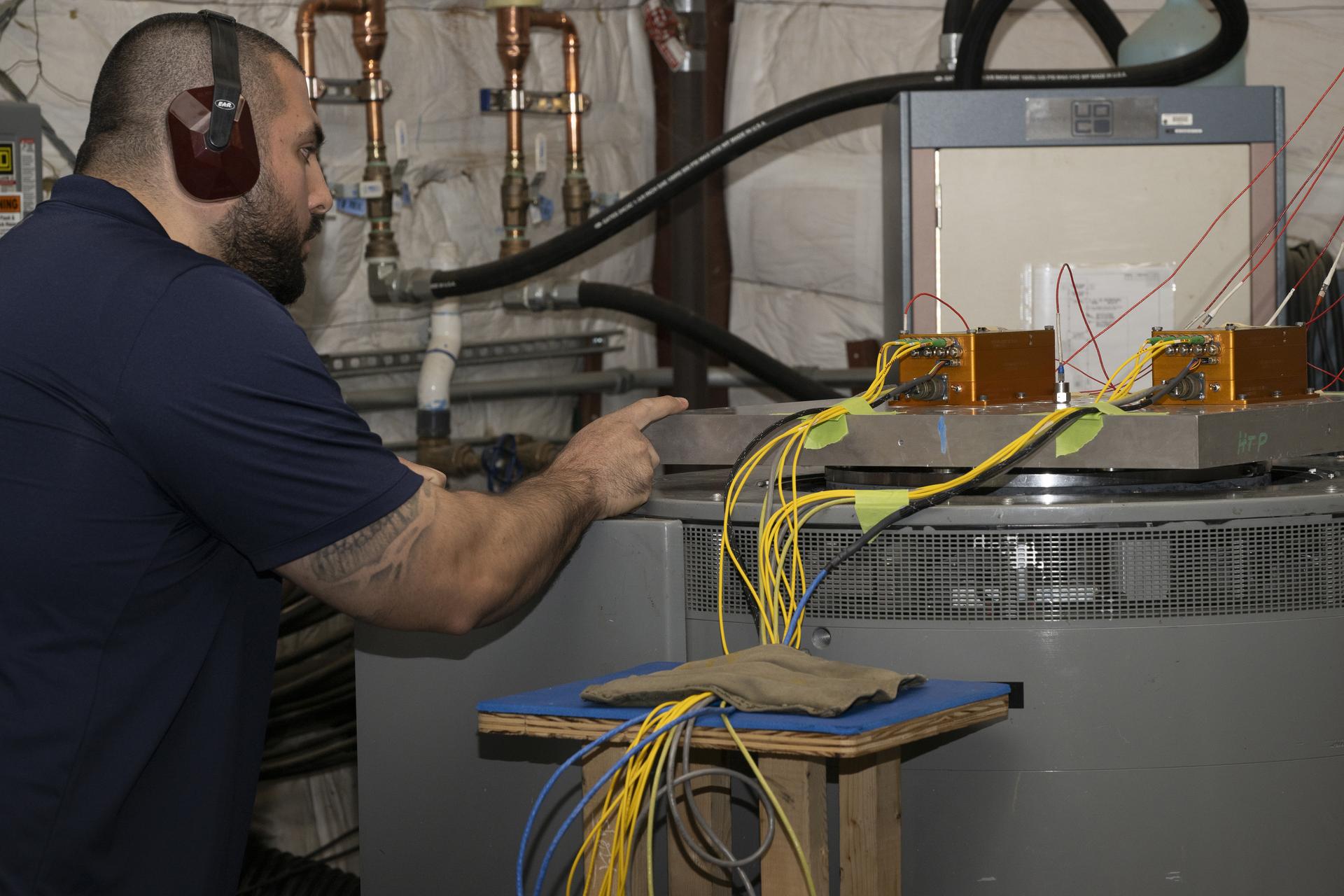
Across aeronautics programs, Armstrong supported work that strengthens NASA’s ability to study sustainable, efficient, and high-performance aircraft. Teams conducted aerodynamic measurements and improved test-article access for instrumentation, enabling more precise evaluations of advanced aircraft concepts. Engineers continued developing tools and techniques to study aircraft performance under high-speed and high-temperature conditions, supporting research in hypersonic flight.
- The Sustainable Flight Demonstrator research team measured airflow over key wing surfaces in a series of wind tunnel tests, generating data used to refine future sustainable aircraft designs.
- Technicians at NASA Armstrong installed a custom structural floor inside the X-66 demonstrator, improving access for instrumentation work and enabling more efficient modification and evaluation.
- Armstrong engineers advanced high-speed research by maturing an optical measurement system that tracks heat and structural strain during hypersonic flight, supporting future test missions.
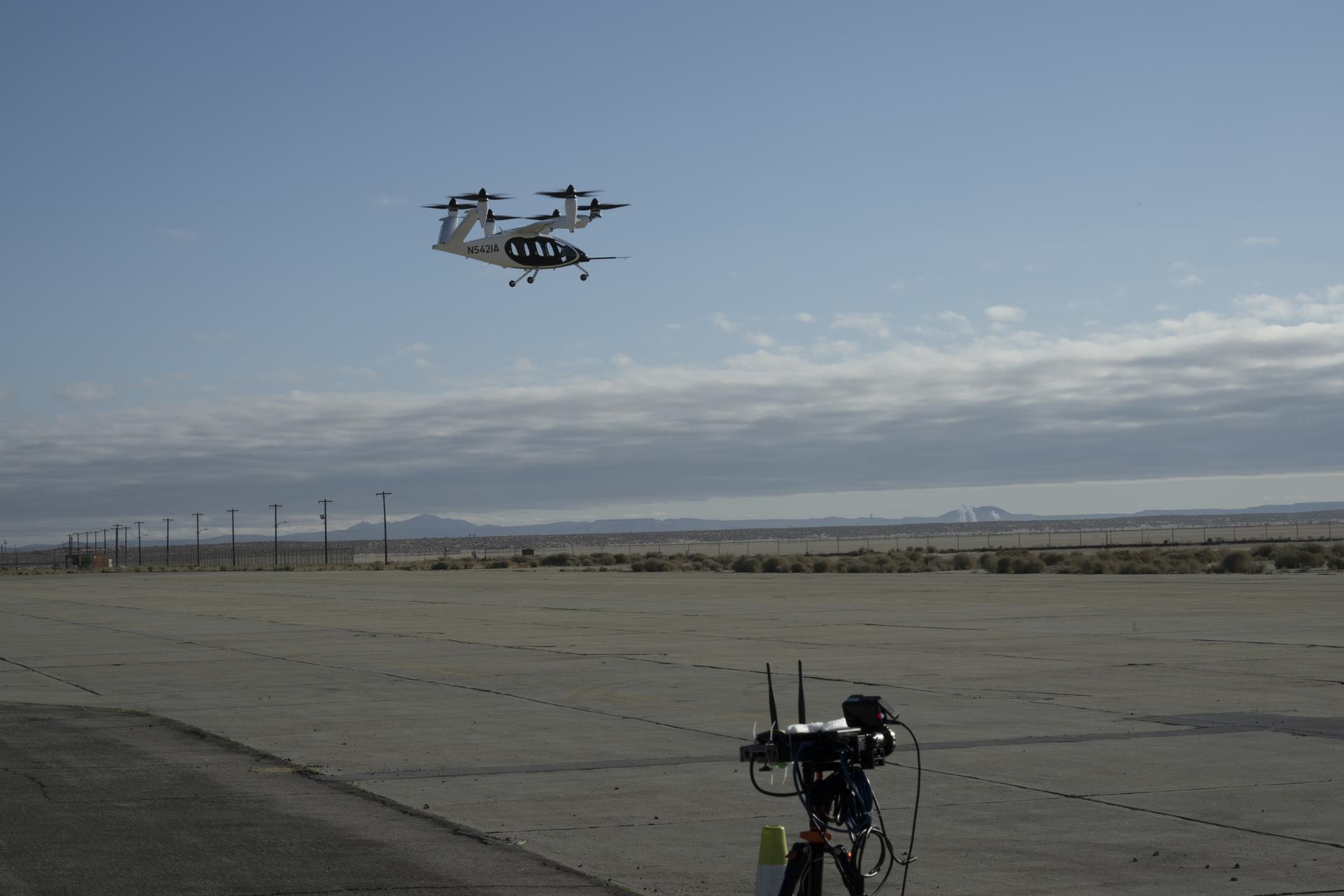
NASA Armstrong supported multiple aspects of the nation’s growing air mobility ecosystem. Researchers conducted tests and evaluations to better understand aircraft performance, airflow, and passenger experience. Additional work included assessing drone-based inspection techniques, developing advanced communication networks, performing drop tests, and refining methods to evaluate emerging mobility aircraft.
These studies support NASA’s broader goal of integrating new electric, autonomous, and hybrid aircraft safely into the national airspace.
- A small business partnership demonstrated drone-based inspection techniques that could reduce maintenance time and improve safety for commercial aircraft operations.
- NASA Armstrong researchers tested air traffic surveillance technology against the demands of air taxis flying at low altitudes through densely populated cities, using the agency’s Pilatus PC-12 to support safer air traffic operations.
- Researchers at NASA Armstrong collected airflow data from Joby using a ground array of sensors to examine how its circular wind patterns might affect electric air taxi performance in future urban operations.
- NASA Armstrong’s Ride Quality Laboratory conducted air taxi passenger comfort studies in support of the agency’s Advanced Air Mobility mission to better understand how motion, vibration, and other factors affect ride comfort, informing the industry’s development of electric air taxis and drones.
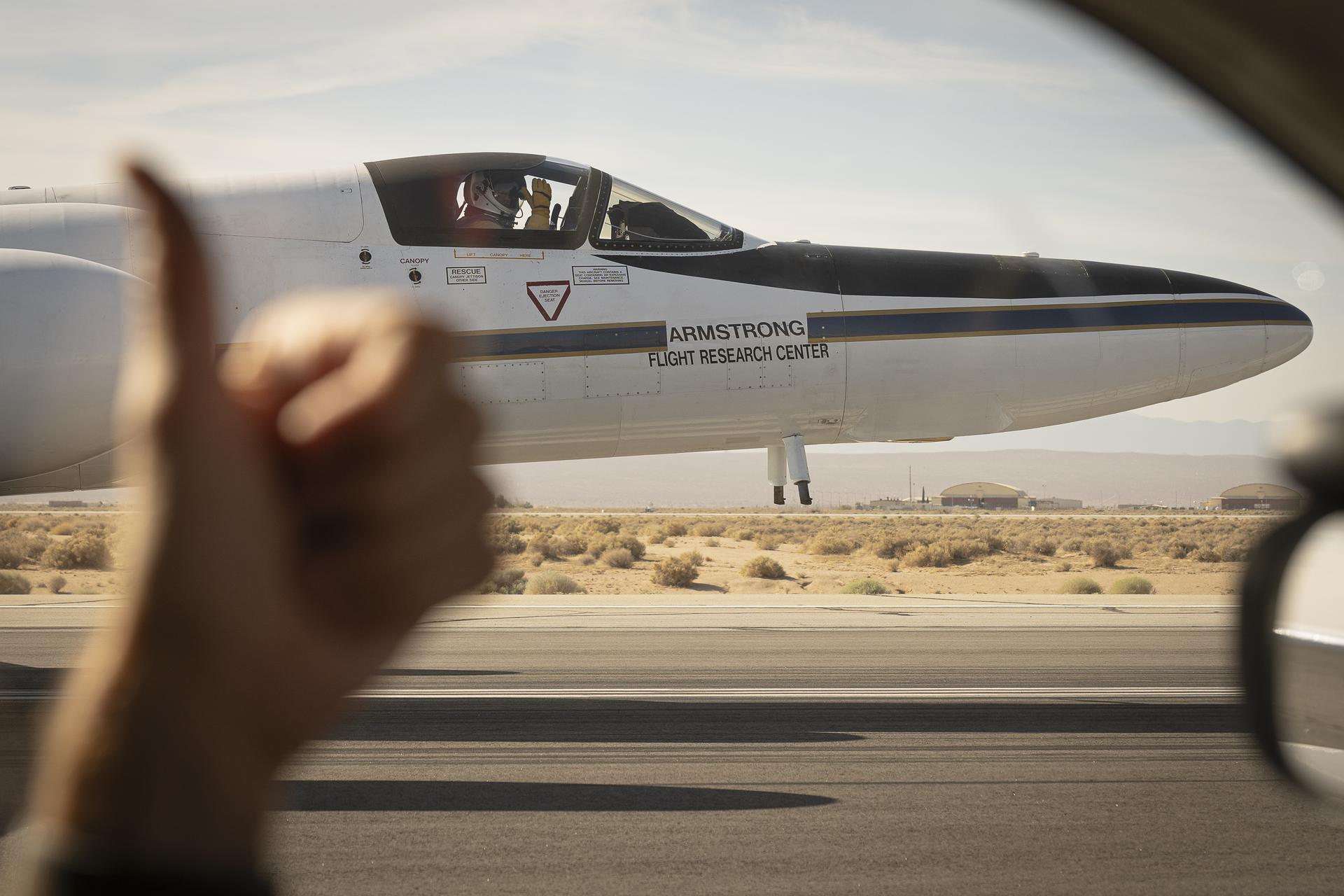
Earth science campaigns at NASA Armstrong contributed to the agency’s ability to monitor environmental changes and improve satellite data accuracy. Researchers tested precision navigation systems that keep high-speed aircraft on path, supporting more accurate atmospheric and climate surveys. Airborne measurements and drone flights documented wildfire behavior, smoke transport, and post-fire impacts while gathering temperature, humidity, and airflow data during controlled burns. These efforts also supported early-stage technology demonstrations, evaluating new wildfire sensing tools under real flight conditions to advance fire response research. High-altitude aircraft contributed to missions that improved satellite calibration, refined atmospheric measurements, and supported snowpack and melt studies to enhance regional water-resource forecasting.
- Researchers at NASA Armstrong tested a new precision‑navigation system that can keep high‑speed research aircraft on exact flight paths, enabling more accurate Earth science data collection during airborne environmental and climate‑survey missions.
- NASA’s B200 King Air flew over wildfire‑affected regions equipped with the Compact Fire Infrared Radiance Spectral Tracker (c‑FIRST), collecting thermal‑infrared data to study wildfire behavior, smoke spread, and post‑fire ecological impacts in near real time.
- NASA Armstrong’s Alta X drone carried a 3D wind sensor and a radiosonde to measure temperature, pressure, humidity, and airflow during a prescribed burn in Geneva State Forest, gathering data to help improve wildland fire behavior models and support firefighting agencies.
- NASA’s ER‑2 aircraft carried the Airborne Lunar Spectral Irradiance (air-LUSI) instrument on night flights, measuring moonlight reflectance to generate calibration data – improving the accuracy of Earth‑observing satellite measurements.
- The center’s ER-2 also flew above cloud layers with specialized instrumentation to collect atmospheric and cloud measurements. These data help validate and refine Earth observing satellite retrievals, improving climate, weather, and aerosol observations.
- Airborne campaigns at NASA Armstrong measured snowpack and melt patterns in the western U.S., providing data to improve water-resource forecasting for local communities.
NASA Armstrong supported exploration technologies that will contribute to agency’s return to the Moon and future missions deeper into the solar system, including sending the first astronauts – American astronauts – to Mars. Teams advanced sensor systems and conducted high-altitude drop tests to capture critical performance data, supporting the need for precise entry, descent, and landing capabilities on future planetary missions.
Contributions from NASA Armstrong also strengthen the systems and technologies that help make Artemis – the agency’s top priority – safer, more reliable, and more scientifically productive, supporting a sustained human presence on the Moon and preparing for future human exploration of Mars.
- The EPIC team at NASA Armstrong conducted research flights to advance sensor technology for supersonic parachute deployments, evaluating performance during high-speed, high-altitude drops relevant to future planetary missions.
- Imagery from the EPIC test flights at NASA Armstrong highlights the parachute system’s high-altitude deployment sequence and demonstrated its potential for future Mars delivery concepts.
The center expanded outreach, education, and workforce development efforts throughout the year. Students visited NASA Armstrong for hands-on exposure to careers in aeronautics, while staff and volunteers supported a regional robotics competition that encouraged exploration of the field. Educators brought aeronautics concepts directly into classrooms across the region, and interns from around the country gained experience supporting real flight research projects.
NASA Armstrong also highlighted unique career pathways and recognized employees whose work showcases the human side of NASA missions. A youth aviation program launched with a regional museum provided additional opportunities for young learners to explore flight science, further strengthening the center’s community impact:
- Students from Palmdale High School Engineering Club visited NASA Armstrong, where staff engaged with them to explore facilities, discuss aerospace work, and promote STEM careers as part of the center’s community outreach.
- NASA Armstrong staff and volunteers mentored high school teams at the 2025 Aerospace Valley FIRST Robotics Competition, helping students build and test robots and providing hands-on experience with engineering to foster interest in STEM careers.
- In April, NASA Armstrong expanded outreach in 2025 by bringing aeronautics concepts to students through classroom workshops, presentations, and hands-on activities, giving young learners direct exposure to NASA research and inspiring possible future careers in science and engineering.
- Students from across the country participated in internships at NASA Armstrong, gaining hands-on experience in flight research and operations while contributing to real-world aerospace projects.
- In May, a NASA Armstrong videographer earned national recognition for work that highlights the people behind the center’s research missions, showing how scientists, engineers, and flight crews collaborate to advance aeronautics and space exploration.
- Daniel Eng, a systems engineer with NASA’s Air Mobility Pathfinders project, shared his career path from the garment industry to aerospace, illustrating how diverse experiences contribute to the center’s technical workforce and support its advanced flight research and engineering projects.
- In June, NASA Armstrong recognized one of its interns for hands-on work with the center’s aircraft. With more than a decade in the auto industry, they demonstrated how early career engineers can gain real-world experience and develop skills for careers in aerospace and flight research.
- NASA Armstrong partnered with a regional museum to create a youth aviation program that introduces students to flight science and operations, providing hands-on learning opportunities and inspiring interest in aerospace and STEM careers.
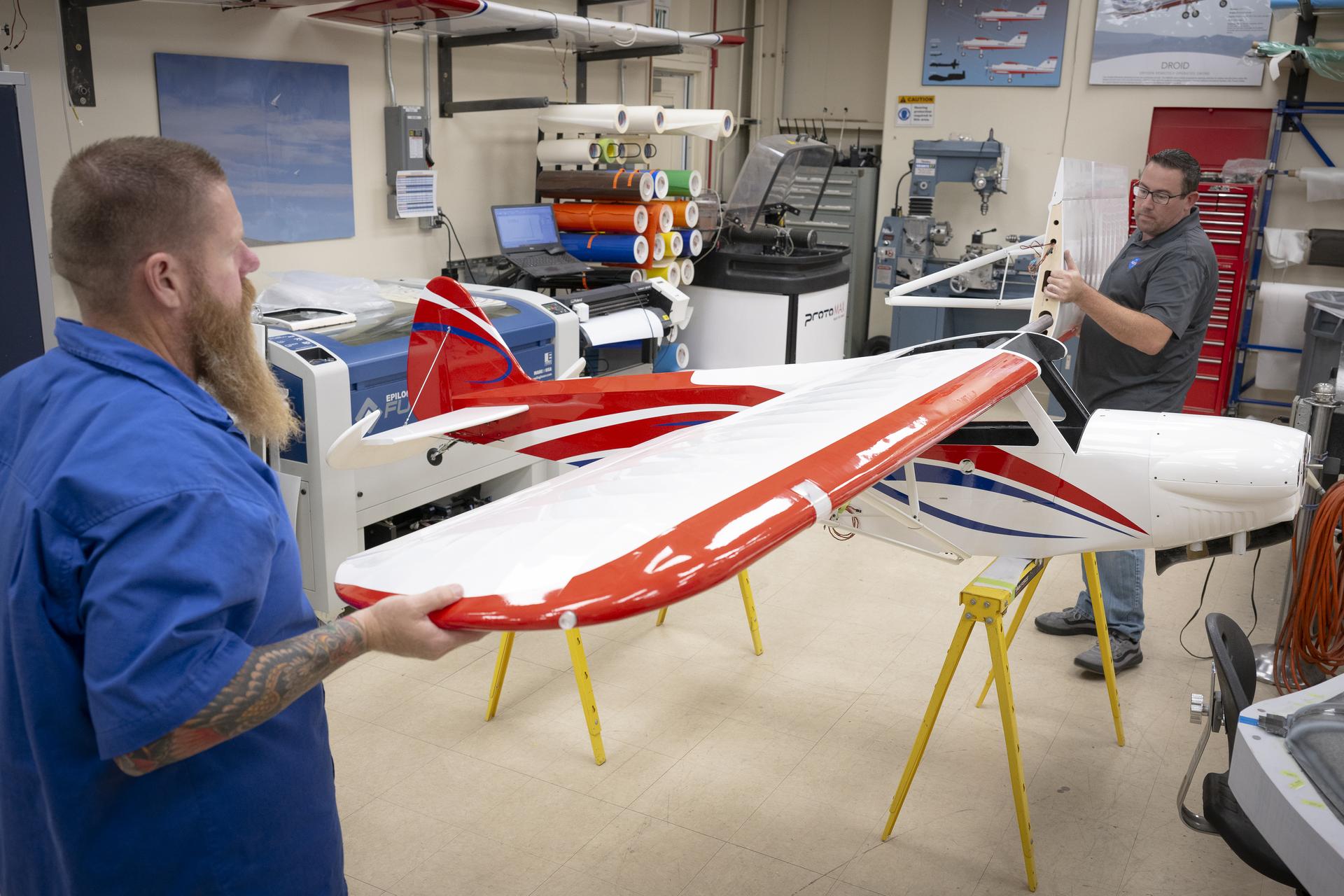
Facility improvements and new platforms strengthened NASA Armstrong’s research capabilities. A rooftop operation removed a historic telemetry pedestal to make way for updated infrastructure, while preserving an important artifact of the center’s flight test heritage. Engineers also completed a new subscale research aircraft, providing a flexible, cost-effective platform for evaluating aerodynamics, instrumentation, and flight control concepts in preparation for full-scale testing:
- The center improved workspace access and supported a re-roofing project during a helicopter crew operation that removed a 2,500-pound telemetry pedestal from a building rooftop, preserving a piece of the center’s flight history heritage.
- Engineers at NASA Armstrong built a new subscale experimental aircraft to replace the center’s aging MicroCub. The 14-foot wingspan, 60-pound aircraft provides a flexible, cost-effective platform for testing aerodynamics, instrumentation, and flight control concepts while reducing risk before full-scale or crewed flight tests.
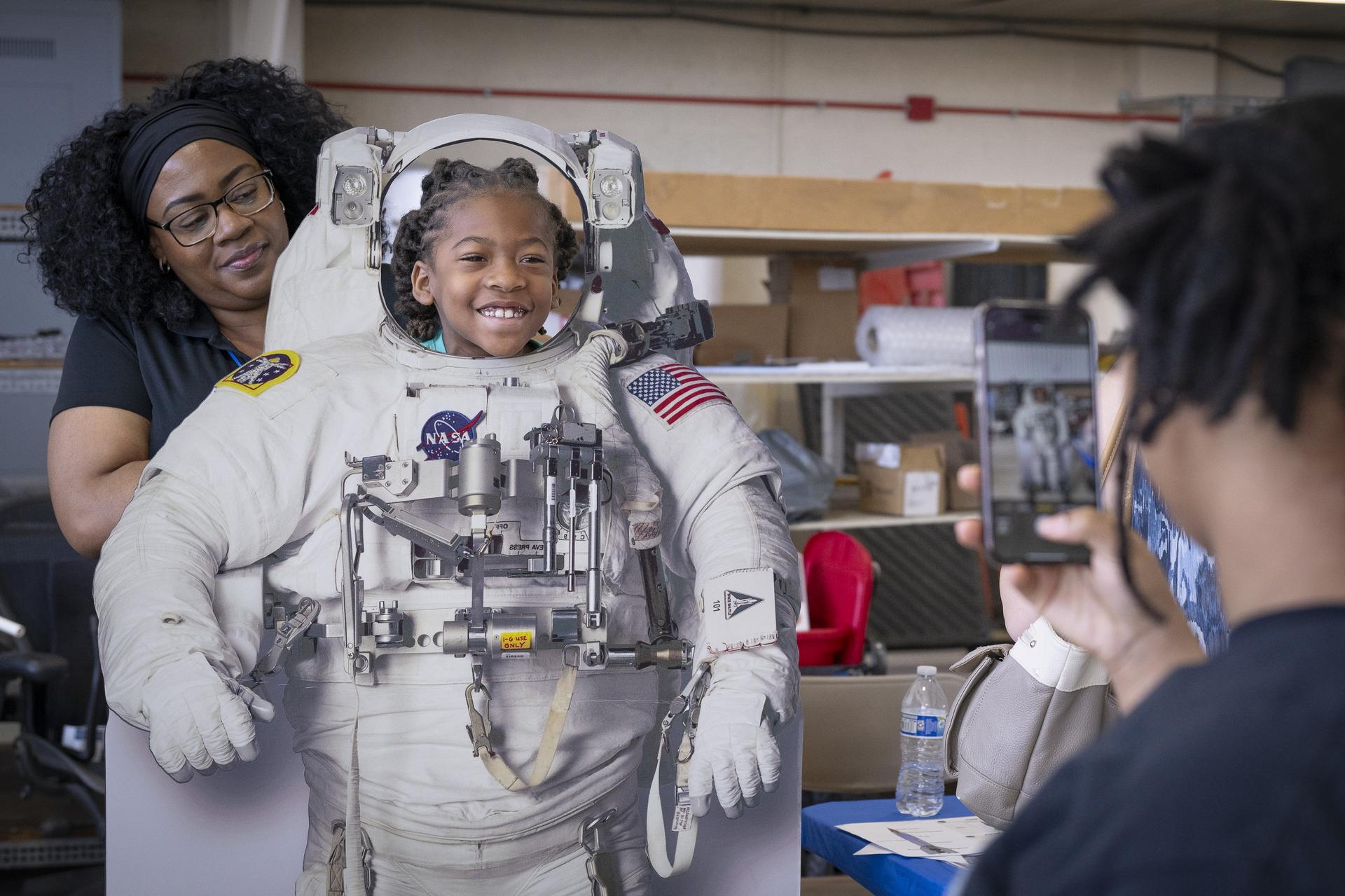
NASA Armstrong will continue advancing flight research across aeronautics and Earth science, building on this year’s achievements. Upcoming efforts include additional X-59 flights, expanded quiet supersonic studies, new air mobility evaluations, high-altitude science campaigns, and maturing technologies that support hypersonic research and the Artemis program for future planetary missions.
“Next year will be a year of continuity, but also change,” Flick said. “The agency’s new Administrator, Jared Isaacman, will bring a renewed mission-first focus to the agency, and NASA Armstrong will push the boundaries of what’s possible. But the most important thing we can do is safely and successfully execute our portfolio of work within budget and schedule.”
For more than seven decades, NASA Armstrong has strengthened the nation’s understanding of flight. This year’s work builds on that legacy, helping shape the future of aviation and exploration through research proven in the air.
To explore more about NASA Armstrong’s missions, research, and discoveries, visit:
https://www.nasa.gov/armstrong
Share Details Last Updated Dec 22, 2025 EditorDede DiniusContactNicolas Cholulanicolas.h.cholula@nasa.govLocationArmstrong Flight Research Center Related Terms Explore More 6 min read NASA Announces 2025 International Space Apps Challenge Global Winners Article 4 days ago 5 min read NASA, Boeing Test How to Improve Performance of Longer, Narrower Aircraft Wings Article 4 days ago 3 min read NASA Works with Boeing, Other Collaborators Toward More Efficient Global Flights Article 2 weeks ago Keep Exploring Discover More Topics From NASAArmstrong Flight Research Center
Humans in Space
Climate Change
Solar System
NASA Armstrong Advances Flight Research and Innovation in 2025
12 min read
Preparations for Next Moonwalk Simulations Underway (and Underwater)In 2025, NASA’s Armstrong Flight Research Center in Edwards, California, advanced work across aeronautics, Earth science, exploration technologies, and emerging aviation systems, reinforcing its role as one of the agency’s primary test sites for aeronautics research. From early concept evaluations to full flight test campaigns, teams enhanced measurement tools, refined safety systems, and generated data that supported missions across NASA. Operating from the Mojave Desert, NASA Armstrong continued applying engineering design with real-world performance, carrying forward research that informs how aircraft operate today and how new systems may function in the future.
The year’s progress also reflects the people behind the work – engineers, technicians, pilots, operators, and mission support staff who navigate complex tests and ensure each mission advances safely and deliberately. Their efforts strengthened partnerships with industry, small businesses, and universities while expanding opportunities for students and early career professionals. Together they sustained NASA Armstrong’s long-standing identity as a center where innovation is proven in flight and where research helps chart the course for future aviation and exploration.
“We executed our mission work safely, including flight of the first piloted NASA X-plane in decades, while under challenging conditions,” said Brad Flick, center director of NASA Armstrong. “It tells me our people embrace the work we do and are willing to maintain high levels of professionalism while enduring personal stress and uncertainty. It’s a testimony to the dedication of our NASA and contractor workforce.”
Teams continued advancing key projects, supporting partners, and generating data that contributes to NASA’s broader mission.
Quiet supersonic flight and the Quesst mission NASA’s F-15D research aircraft conducts a calibration flight of a shock-sensing probe near NASA’s Armstrong Flight Research Center in Edwards, California. The shock-sensing probe is designed to measure the signature and strength of shock waves in flight. The probe was validated during dual F-15 flights and will be flown behind NASA’s X-59 to measure small pressure changes caused by shock waves in support of the agency’s Quesst mission.NASA/Jim RossNASA Armstrong continued its quiet supersonic research, completing a series of activities in support of NASA’s Quesst mission. On the X-59 quiet supersonic research aircraft, the team performed electromagnetic interference tests and ran engine checks to prepare the aircraft for taxi tests. The Schlieren, Airborne Measurements, and Range Operations for Quesst (SCHAMROQ) team completed aircraft integration and shock-sensing probe calibration flights, refining the tools needed to characterize shock waves from the X-59. These efforts supported the aircraft’s progression toward its first flight on Oct. 28, marking a historic milestone and the beginning of its transition to NASA Armstrong for continued testing.
The center’s Commercial Supersonic Technology (CST) team also conducted airborne validation flights using NASA F-15s, confirming measurement systems essential for Quesst’s next research phase. Together, this work forms the technical backbone for upcoming community response studies, where NASA will evaluate whether quieter supersonic thumps could support future commercial applications.
- The X-59 team completed electromagnetic interference testing on the aircraft, verifying system performance and confirming that all its systems could reliably operate together.
- NASA’s X-59 engine testing concluded with a maximum afterburner test that demonstrated the engine’s ability to generate the thrust required for supersonic flight.
- Engineers conducted engine speed-hold evaluations to assess how the X-59’s engine responds under sustained throttle conditions, generating data used to refine control settings for upcoming flight profiles.
- NASA Armstrong’s SCHAMROQ team calibrated a second shock-sensing probe to expand measurement capability for future quiet supersonic flight research.
- NASA Armstrong’s CST team validated the tools that will gather airborne data in support the second phase of the agency’s Quesst mission.
- NASA’s X-59 team advanced preparations on the aircraft through taxi tests, ensuring aircraft handling systems performed correctly ahead of its first flight.
- NASA Armstrong’s photo and video team documented X-59 taxi tests as the aircraft moved under its own power for the first time.
- The X-59 team evaluated braking, steering, and integrated systems performance after the completion of the aircraft’s low-speed taxi tests marking one of the final steps before flight.
- NASA Armstrong teams advanced the X-59 toward first flight by prioritizing safety at every step, completing checks, evaluations, and system verifications to ensure the aircraft was ready when the team was confident it could move forward.
- NASA and the Lockheed Martin contractor team completed the X-59’s historic first flight, delivering the aircraft to NASA Armstrong for the start of its next phase of research.
Across aeronautics programs, Armstrong supported work that strengthens NASA’s ability to study sustainable, efficient, and high-performance aircraft. Teams conducted aerodynamic measurements and improved test-article access for instrumentation, enabling more precise evaluations of advanced aircraft concepts. Engineers continued developing tools and techniques to study aircraft performance under high-speed and high-temperature conditions, supporting research in hypersonic flight.
- The Sustainable Flight Demonstrator research team measured airflow over key wing surfaces in a series of wind tunnel tests, generating data used to refine future sustainable aircraft designs.
- Technicians at NASA Armstrong installed a custom structural floor inside the X-66 demonstrator, improving access for instrumentation work and enabling more efficient modification and evaluation.
- Armstrong engineers advanced high-speed research by maturing an optical measurement system that tracks heat and structural strain during hypersonic flight, supporting future test missions.
NASA Armstrong supported multiple aspects of the nation’s growing air mobility ecosystem. Researchers conducted tests and evaluations to better understand aircraft performance, airflow, and passenger experience. Additional work included assessing drone-based inspection techniques, developing advanced communication networks, performing drop tests, and refining methods to evaluate emerging mobility aircraft.
These studies support NASA’s broader goal of integrating new electric, autonomous, and hybrid aircraft safely into the national airspace.
- A small business partnership demonstrated drone-based inspection techniques that could reduce maintenance time and improve safety for commercial aircraft operations.
- NASA Armstrong researchers tested air traffic surveillance technology against the demands of air taxis flying at low altitudes through densely populated cities, using the agency’s Pilatus PC-12 to support safer air traffic operations.
- Researchers at NASA Armstrong collected airflow data from Joby using a ground array of sensors to examine how its circular wind patterns might affect electric air taxi performance in future urban operations.
- NASA Armstrong’s Ride Quality Laboratory conducted air taxi passenger comfort studies in support of the agency’s Advanced Air Mobility mission to better understand how motion, vibration, and other factors affect ride comfort, informing the industry’s development of electric air taxis and drones.
Earth science campaigns at NASA Armstrong contributed to the agency’s ability to monitor environmental changes and improve satellite data accuracy. Researchers tested precision navigation systems that keep high-speed aircraft on path, supporting more accurate atmospheric and climate surveys. Airborne measurements and drone flights documented wildfire behavior, smoke transport, and post-fire impacts while gathering temperature, humidity, and airflow data during controlled burns. These efforts also supported early-stage technology demonstrations, evaluating new wildfire sensing tools under real flight conditions to advance fire response research. High-altitude aircraft contributed to missions that improved satellite calibration, refined atmospheric measurements, and supported snowpack and melt studies to enhance regional water-resource forecasting.
- Researchers at NASA Armstrong tested a new precision‑navigation system that can keep high‑speed research aircraft on exact flight paths, enabling more accurate Earth science data collection during airborne environmental and climate‑survey missions.
- NASA’s B200 King Air flew over wildfire‑affected regions equipped with the Compact Fire Infrared Radiance Spectral Tracker (c‑FIRST), collecting thermal‑infrared data to study wildfire behavior, smoke spread, and post‑fire ecological impacts in near real time.
- NASA Armstrong’s Alta X drone carried a 3D wind sensor and a radiosonde to measure temperature, pressure, humidity, and airflow during a prescribed burn in Geneva State Forest, gathering data to help improve wildland fire behavior models and support firefighting agencies.
- NASA’s ER‑2 aircraft carried the Airborne Lunar Spectral Irradiance (air-LUSI) instrument on night flights, measuring moonlight reflectance to generate calibration data – improving the accuracy of Earth‑observing satellite measurements.
- The center’s ER-2 also flew above cloud layers with specialized instrumentation to collect atmospheric and cloud measurements. These data help validate and refine Earth observing satellite retrievals, improving climate, weather, and aerosol observations.
- Airborne campaigns at NASA Armstrong measured snowpack and melt patterns in the western U.S., providing data to improve water-resource forecasting for local communities.
NASA Armstrong supported exploration technologies that will contribute to agency’s return to the Moon and future missions deeper into the solar system, including sending the first astronauts – American astronauts – to Mars. Teams advanced sensor systems and conducted high-altitude drop tests to capture critical performance data, supporting the need for precise entry, descent, and landing capabilities on future planetary missions.
Contributions from NASA Armstrong also strengthen the systems and technologies that help make Artemis – the agency’s top priority – safer, more reliable, and more scientifically productive, supporting a sustained human presence on the Moon and preparing for future human exploration of Mars.
- The EPIC team at NASA Armstrong conducted research flights to advance sensor technology for supersonic parachute deployments, evaluating performance during high-speed, high-altitude drops relevant to future planetary missions.
- Imagery from the EPIC test flights at NASA Armstrong highlights the parachute system’s high-altitude deployment sequence and demonstrated its potential for future Mars delivery concepts.
The center expanded outreach, education, and workforce development efforts throughout the year. Students visited NASA Armstrong for hands-on exposure to careers in aeronautics, while staff and volunteers supported a regional robotics competition that encouraged exploration of the field. Educators brought aeronautics concepts directly into classrooms across the region, and interns from around the country gained experience supporting real flight research projects.
NASA Armstrong also highlighted unique career pathways and recognized employees whose work showcases the human side of NASA missions. A youth aviation program launched with a regional museum provided additional opportunities for young learners to explore flight science, further strengthening the center’s community impact:
- Students from Palmdale High School Engineering Club visited NASA Armstrong, where staff engaged with them to explore facilities, discuss aerospace work, and promote STEM careers as part of the center’s community outreach.
- NASA Armstrong staff and volunteers mentored high school teams at the 2025 Aerospace Valley FIRST Robotics Competition, helping students build and test robots and providing hands-on experience with engineering to foster interest in STEM careers.
- In April, NASA Armstrong expanded outreach in 2025 by bringing aeronautics concepts to students through classroom workshops, presentations, and hands-on activities, giving young learners direct exposure to NASA research and inspiring possible future careers in science and engineering.
- Students from across the country participated in internships at NASA Armstrong, gaining hands-on experience in flight research and operations while contributing to real-world aerospace projects.
- In May, a NASA Armstrong videographer earned national recognition for work that highlights the people behind the center’s research missions, showing how scientists, engineers, and flight crews collaborate to advance aeronautics and space exploration.
- Daniel Eng, a systems engineer with NASA’s Air Mobility Pathfinders project, shared his career path from the garment industry to aerospace, illustrating how diverse experiences contribute to the center’s technical workforce and support its advanced flight research and engineering projects.
- In June, NASA Armstrong recognized one of its interns for hands-on work with the center’s aircraft. With more than a decade in the auto industry, they demonstrated how early career engineers can gain real-world experience and develop skills for careers in aerospace and flight research.
- NASA Armstrong partnered with a regional museum to create a youth aviation program that introduces students to flight science and operations, providing hands-on learning opportunities and inspiring interest in aerospace and STEM careers.
Facility improvements and new platforms strengthened NASA Armstrong’s research capabilities. A rooftop operation removed a historic telemetry pedestal to make way for updated infrastructure, while preserving an important artifact of the center’s flight test heritage. Engineers also completed a new subscale research aircraft, providing a flexible, cost-effective platform for evaluating aerodynamics, instrumentation, and flight control concepts in preparation for full-scale testing:
- The center improved workspace access and supported a re-roofing project during a helicopter crew operation that removed a 2,500-pound telemetry pedestal from a building rooftop, preserving a piece of the center’s flight history heritage.
- Engineers at NASA Armstrong built a new subscale experimental aircraft to replace the center’s aging MicroCub. The 14-foot wingspan, 60-pound aircraft provides a flexible, cost-effective platform for testing aerodynamics, instrumentation, and flight control concepts while reducing risk before full-scale or crewed flight tests.
NASA Armstrong will continue advancing flight research across aeronautics and Earth science, building on this year’s achievements. Upcoming efforts include additional X-59 flights, expanded quiet supersonic studies, new air mobility evaluations, high-altitude science campaigns, and maturing technologies that support hypersonic research and the Artemis program for future planetary missions.
“Next year will be a year of continuity, but also change,” Flick said. “The agency’s new Administrator, Jared Isaacman, will bring a renewed mission-first focus to the agency, and NASA Armstrong will push the boundaries of what’s possible. But the most important thing we can do is safely and successfully execute our portfolio of work within budget and schedule.”
For more than seven decades, NASA Armstrong has strengthened the nation’s understanding of flight. This year’s work builds on that legacy, helping shape the future of aviation and exploration through research proven in the air.
To explore more about NASA Armstrong’s missions, research, and discoveries, visit:
https://www.nasa.gov/armstrong
Share Details Last Updated Dec 22, 2025 EditorDede DiniusContactNicolas Cholulanicolas.h.cholula@nasa.govLocationArmstrong Flight Research Center Related Terms Explore More 6 min read NASA Announces 2025 International Space Apps Challenge Global Winners Article 5 days ago 5 min read NASA, Boeing Test How to Improve Performance of Longer, Narrower Aircraft Wings Article 5 days ago 3 min read NASA Works with Boeing, Other Collaborators Toward More Efficient Global Flights Article 2 weeks ago Keep Exploring Discover More Topics From NASAArmstrong Flight Research Center
Humans in Space
Climate Change
Solar System
The essential guide to proving we’ve found alien life
The essential guide to proving we’ve found alien life
Five New Planets and the Battle for Their Atmospheres
One of the primary goals of the James Webb Space Telescope (JWST) is to detect atmospheres around exoplanets, to try to suss out whether or not they could potentially support life. But, in order to do that, scientists have to know where to look, and the exoplanet has to actually have an atmosphere. While scientists know the location of about 6000 exoplanets currently, they also believe that many of them don’t have atmospheres and that, of the ones that do, many aren’t really Earth-sized. And of those, many are around stars that are too bright for our current crop of telescopes to see their atmosphere. All those restrictions mean, ultimately, even with 6000 potential candidates, the number of Earth-sized ones that we could find an atmosphere for is relatively small. So a new paper available on arXiv from Jonathan Barrientos of Cal Tech and his co-authors that describes five new exoplanets around M-dwarf stars - two of which may have an atmosphere - is big news for astrobiologists and exoplanet hunters alike.
You can upgrade your immune system, but not in the way you think
You can upgrade your immune system, but not in the way you think
Will There Be a White Christmas This Year? It Depends on Where You Live
Are you dreaming of a white Christmas? The odds of snow on the big day comes down to a mix of climate and weather, scientists explain
The Best Space Photos of 2025 Reveal the Most Jaw-Dropping Views of the Cosmos
From an interstellar comet to breathtaking auroras and from brand-new rockets to iconic space telescopes, here are some of our favorite images from the cosmos in 2025
Hopes of finding aliens were raised in 2025 – but quickly faded
Hopes of finding aliens were raised in 2025 – but quickly faded
2025’s Scientific Landscape Upended as Federal Overhauls, Public Health Setbacks, Climate Rollbacks and Cosmic Surprises Collide
A look back at 2025’s biggest science stories—from federal upheaval and public health setbacks to climate policy reversals and groundbreaking discoveries in space.