
Feed aggregator
NASA Hubble Helps Detect ‘Wake’ of Betelgeuse’s Elusive Companion Star
- Hubble Home
- Overview
- Impact & Benefits
- Science
- Observatory
- Team
- Multimedia
- News
- More
Artwork: NASA, ESA, Elizabeth Wheatley (STScI); Science: Andrea Dupree (CfA)
Using new observations from NASA’s Hubble Space Telescope and ground-based observatories, astronomers tracked the influence of a recently discovered companion star, Siwarha, on the gas around Betelgeuse. The research, from scientists at the Center for Astrophysics | Harvard & Smithsonian (CfA), reveals a trail of dense gas swirling through Betelgeuse’s vast, extended atmosphere, shedding light on why the giant star’s brightness and atmosphere have changed in strange and unusual ways.
The results of the new study were presented Monday at a news conference at the 247th meeting of the American Astronomical Society in Phoenix and are accepted for publication in The Astrophysical Journal.
The team detected Siwarha’s wake by carefully tracking changes in the star’s light over nearly eight years. These changes show the effects of the previously unconfirmed companion as it plows through the outer atmosphere of Betelgeuse. This discovery resolves one of the biggest mysteries about the giant star, helping scientists to explain how it behaves and evolves while opening new doors to understanding other massive stars nearing the end of their lives.
Located roughly 650 light-years away from Earth in the constellation Orion, Betelgeuse is a red supergiant star so large that more than 400 million Suns could fit inside. Because of its enormous size and proximity, Betelgeuse is one of the few stars whose surface and surrounding atmosphere can be directly observed by astronomers, making it an important and accessible laboratory for studying how giant stars age, lose mass, and eventually explode as supernovae.
This artist’s concept shows the red supergiant star Betelgeuse and an orbiting companion star. The companion, which is orbiting clockwise from this point of view, generates a dense wake of gas that expands outward. It is so close to Betelgeuse that it is passing through the extended outer atmosphere of the supergiant. The companion star is not to scale; it would be a pinprick compared to Betelgeuse, which is hundreds of times larger. The companion’s distance from Betelgeuse is to scale relative to the diameter of Betelgeuse. Artwork: NASA, ESA, Elizabeth Wheatley (STScI); Science: Andrea Dupree (CfA)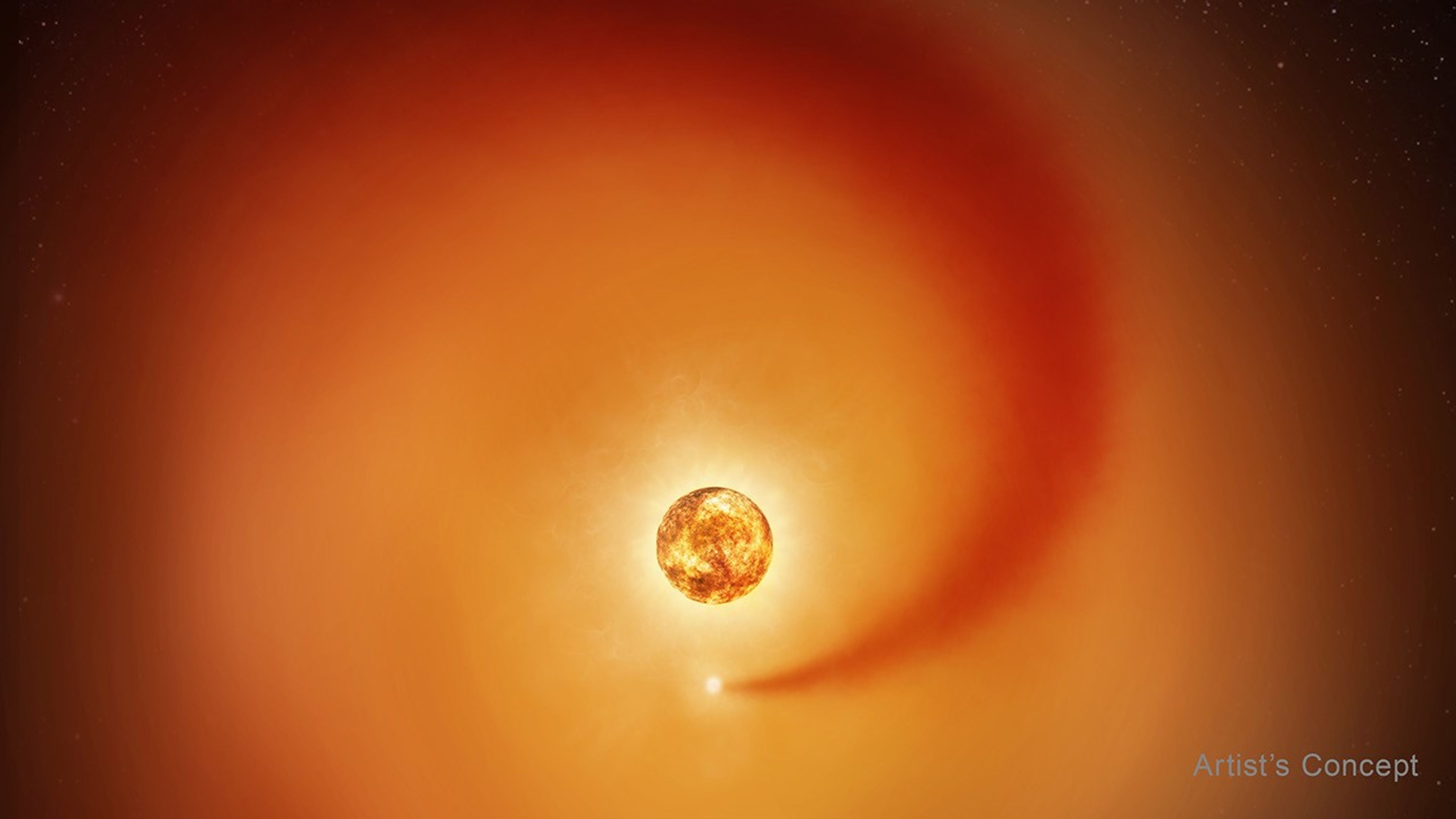
Using NASA’s Hubble and ground-based telescopes at the Fred Lawrence Whipple Observatory and Roque de Los Muchachos Observatory, the team was able to see a pattern of changes in Betelgeuse, which provided clear evidence of a long-suspected companion star and its impact on the red supergiant’s outer atmosphere. Those include changes in the star’s spectrum, or the specific colors of light given off by different elements, and the speed and direction of gases in the outer atmosphere due to a trail of denser material, or wake. This trail appears just after the companion crosses in front of Betelgeuse every six years, or about 2,100 days, confirming theoretical models.
“It’s a bit like a boat moving through water. The companion star creates a ripple effect in Betelgeuse’s atmosphere that we can actually see in the data,” said Andrea Dupree, an astronomer at the CfA, and the lead study author. “For the first time, we’re seeing direct signs of this wake, or trail of gas, confirming that Betelgeuse really does have a hidden companion shaping its appearance and behavior.”
For decades, astronomers have tracked changes in Betelgeuse’s brightness and surface features in hopes of figuring out why the star behaves the way it does. Curiosity intensified after the giant star appeared to “sneeze” and became unexpectedly faint in 2020. Two distinct periods of variation in the star were especially puzzling for scientists: a short 400-day cycle, recently attributed to pulsations within the star itself, and the long, 2,100-day secondary period.
Scientists used NASA’s Hubble Space Telescope to look for evidence of a wake being generated by a companion star orbiting Betelgeuse. The team found a noticeable difference in light shown in the lefthand peak when the companion star was at different points in its orbit. Illustration: NASA, ESA, Elizabeth Wheatley (STScI); Science: Andrea Dupree (CfA)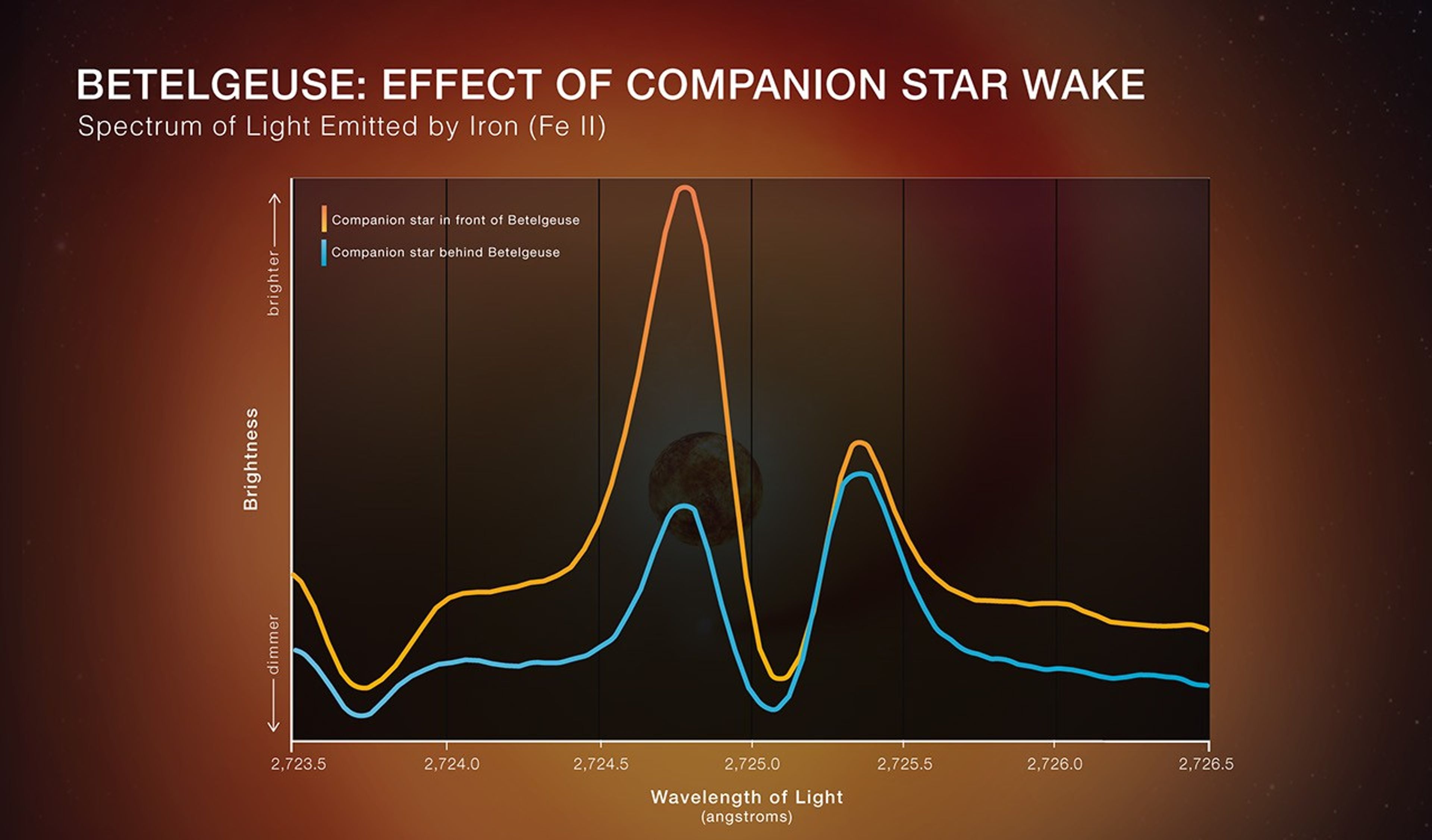
Until now, scientists have considered everything from large convection cells and clouds of dust to magnetic activity, and the possibility of a hidden companion star. Recent studies concluded that the long secondary period was best explained by the presence of a low-mass companion orbiting deep within Betelgeuse’s atmosphere, and another team of scientists reported a possible detection, but until now, astronomers lacked the evidence to prove what they believed was happening. Now, for the first time, they have firm evidence that a companion is disrupting the atmosphere of this supergiant star.
“The idea that Betelgeuse had an undetected companion has been gaining in popularity for the past several years, but without direct evidence, it was an unproven theory,” said Dupree. “With this new direct evidence, Betelgeuse gives us a front-row seat to watch how a giant star changes over time. Finding the wake from its companion means we can now understand how stars like this evolve, shed material, and eventually explode as supernovae.”
With Betelgeuse now eclipsing its companion from our point of view, astronomers are planning new observations for its next emergence in 2027. This breakthrough may also help explain similar mysteries in other giant and supergiant stars.
The Hubble Space Telescope has been operating for over three decades and continues to make ground-breaking discoveries that shape our fundamental understanding of the universe. Hubble is a project of international cooperation between NASA and ESA (European Space Agency). NASA’s Goddard Space Flight Center in Greenbelt, Maryland, manages the telescope and mission operations. Lockheed Martin Space, based in Denver, also supports mission operations at Goddard. The Space Telescope Science Institute in Baltimore, which is operated by the Association of Universities for Research in Astronomy, conducts Hubble science operations for NASA.
Facebook logo @NASAHubble @NASAHubble Instagram logo @NASAHubble Related Images & Videos Betelgeuse and Wake of its Companion Star (Artist’s Concept)This artist’s concept shows the red supergiant star Betelgeuse and an orbiting companion star. The companion, which is orbiting clockwise from this point of view, generates a dusty wake that expands outward.
Betelgeuse: Effect of Companion Star Wake
Scientists used NASA’s Hubble Space Telescope to look for evidence of a wake being generated by a companion star orbiting Betelgeuse. The team found a noticeable difference in light shown in the lefthand peak when the companion star was at different points in its orbit.
Contact Media
Claire Andreoli
NASA’s Goddard Space Flight Center
Greenbelt, Maryland
claire.andreoli@nasa.gov
Amy Oliver
Center for Astrophysics | Harvard & Smithsonian
Cambridge, Massachusetts
Christine Pulliam
Space Telescope Science Institute
Baltimore, Maryland
Related Terms Keep Exploring Discover More Topics From Hubble Hubble Space Telescope
Since its 1990 launch, the Hubble Space Telescope has changed our fundamental understanding of the universe.
Hubble Science Highlights
Hubble Images
Hubble News
NASA Hubble Helps Detect ‘Wake’ of Betelgeuse’s Elusive Companion Star
- Hubble Home
- Overview
- Impact & Benefits
- Science
- Observatory
- Team
- Multimedia
- News
- More
Artwork: NASA, ESA, Elizabeth Wheatley (STScI); Science: Andrea Dupree (CfA)
Using new observations from NASA’s Hubble Space Telescope and ground-based observatories, astronomers tracked the influence of a recently discovered companion star, Siwarha, on the gas around Betelgeuse. The research, from scientists at the Center for Astrophysics | Harvard & Smithsonian (CfA), reveals a trail of dense gas swirling through Betelgeuse’s vast, extended atmosphere, shedding light on why the giant star’s brightness and atmosphere have changed in strange and unusual ways.
The results of the new study were presented Monday at a news conference at the 247th meeting of the American Astronomical Society in Phoenix and are accepted for publication in The Astrophysical Journal.
The team detected Siwarha’s wake by carefully tracking changes in the star’s light over nearly eight years. These changes show the effects of the previously unconfirmed companion as it plows through the outer atmosphere of Betelgeuse. This discovery resolves one of the biggest mysteries about the giant star, helping scientists to explain how it behaves and evolves while opening new doors to understanding other massive stars nearing the end of their lives.
Located roughly 650 light-years away from Earth in the constellation Orion, Betelgeuse is a red supergiant star so large that more than 400 million Suns could fit inside. Because of its enormous size and proximity, Betelgeuse is one of the few stars whose surface and surrounding atmosphere can be directly observed by astronomers, making it an important and accessible laboratory for studying how giant stars age, lose mass, and eventually explode as supernovae.
This artist’s concept shows the red supergiant star Betelgeuse and an orbiting companion star. The companion, which is orbiting clockwise from this point of view, generates a dense wake of gas that expands outward. It is so close to Betelgeuse that it is passing through the extended outer atmosphere of the supergiant. The companion star is not to scale; it would be a pinprick compared to Betelgeuse, which is hundreds of times larger. The companion’s distance from Betelgeuse is to scale relative to the diameter of Betelgeuse. Artwork: NASA, ESA, Elizabeth Wheatley (STScI); Science: Andrea Dupree (CfA)Using NASA’s Hubble and ground-based telescopes at the Fred Lawrence Whipple Observatory and Roque de Los Muchachos Observatory, the team was able to see a pattern of changes in Betelgeuse, which provided clear evidence of a long-suspected companion star and its impact on the red supergiant’s outer atmosphere. Those include changes in the star’s spectrum, or the specific colors of light given off by different elements, and the speed and direction of gases in the outer atmosphere due to a trail of denser material, or wake. This trail appears just after the companion crosses in front of Betelgeuse every six years, or about 2,100 days, confirming theoretical models.
“It’s a bit like a boat moving through water. The companion star creates a ripple effect in Betelgeuse’s atmosphere that we can actually see in the data,” said Andrea Dupree, an astronomer at the CfA, and the lead study author. “For the first time, we’re seeing direct signs of this wake, or trail of gas, confirming that Betelgeuse really does have a hidden companion shaping its appearance and behavior.”
For decades, astronomers have tracked changes in Betelgeuse’s brightness and surface features in hopes of figuring out why the star behaves the way it does. Curiosity intensified after the giant star appeared to “sneeze” and became unexpectedly faint in 2020. Two distinct periods of variation in the star were especially puzzling for scientists: a short 400-day cycle, recently attributed to pulsations within the star itself, and the long, 2,100-day secondary period.
Scientists used NASA’s Hubble Space Telescope to look for evidence of a wake being generated by a companion star orbiting Betelgeuse. The team found a noticeable difference in light shown in the lefthand peak when the companion star was at different points in its orbit. Illustration: NASA, ESA, Elizabeth Wheatley (STScI); Science: Andrea Dupree (CfA)Until now, scientists have considered everything from large convection cells and clouds of dust to magnetic activity, and the possibility of a hidden companion star. Recent studies concluded that the long secondary period was best explained by the presence of a low-mass companion orbiting deep within Betelgeuse’s atmosphere, and another team of scientists reported a possible detection, but until now, astronomers lacked the evidence to prove what they believed was happening. Now, for the first time, they have firm evidence that a companion is disrupting the atmosphere of this supergiant star.
“The idea that Betelgeuse had an undetected companion has been gaining in popularity for the past several years, but without direct evidence, it was an unproven theory,” said Dupree. “With this new direct evidence, Betelgeuse gives us a front-row seat to watch how a giant star changes over time. Finding the wake from its companion means we can now understand how stars like this evolve, shed material, and eventually explode as supernovae.”
With Betelgeuse now eclipsing its companion from our point of view, astronomers are planning new observations for its next emergence in 2027. This breakthrough may also help explain similar mysteries in other giant and supergiant stars.
The Hubble Space Telescope has been operating for over three decades and continues to make ground-breaking discoveries that shape our fundamental understanding of the universe. Hubble is a project of international cooperation between NASA and ESA (European Space Agency). NASA’s Goddard Space Flight Center in Greenbelt, Maryland, manages the telescope and mission operations. Lockheed Martin Space, based in Denver, also supports mission operations at Goddard. The Space Telescope Science Institute in Baltimore, which is operated by the Association of Universities for Research in Astronomy, conducts Hubble science operations for NASA.
Facebook logo @NASAHubble @NASAHubble Instagram logo @NASAHubble Related Images & Videos Betelgeuse and Wake of its Companion Star (Artist’s Concept)This artist’s concept shows the red supergiant star Betelgeuse and an orbiting companion star. The companion, which is orbiting clockwise from this point of view, generates a dusty wake that expands outward.
Betelgeuse: Effect of Companion Star Wake
Scientists used NASA’s Hubble Space Telescope to look for evidence of a wake being generated by a companion star orbiting Betelgeuse. The team found a noticeable difference in light shown in the lefthand peak when the companion star was at different points in its orbit.
Contact Media
Claire Andreoli
NASA’s Goddard Space Flight Center
Greenbelt, Maryland
claire.andreoli@nasa.gov
Amy Oliver
Center for Astrophysics | Harvard & Smithsonian
Cambridge, Massachusetts
Christine Pulliam
Space Telescope Science Institute
Baltimore, Maryland
Related Terms Keep Exploring Discover More Topics From Hubble Hubble Space Telescope
Since its 1990 launch, the Hubble Space Telescope has changed our fundamental understanding of the universe.
Hubble Science Highlights
Hubble Images
Hubble News
#777: The Eddington Limit
How big can a star get? This is a calculation made by one of the original pioneers of modern astronomy, Sir Arthur Eddington. And it’s named after him, the Eddington Limit. Now, astronomers are finding examples of giant black holes early in the Universe, calling into question some of Eddington’s assumptions. Let’s explore this fascinating concept! Why are stars sphere-ish? Why do blackholes not eat everything? Why do pulsating stars pulsate? It all comes down to work done by Eddington at the beginning of the last century, and today we’re going to look back at Eddington’s work and all its applications in modern Astronomy.
Show Notes- What the Eddington Limit is
- Gravity vs radiation pressure in stars
- Why star growth has an upper limit
- How black holes accrete matter
- Quasars and galaxy-scale feedback
- Evidence for super-Eddington growth
- Why modern observations challenge theory
Fraser Cain:
AstronomyCast, Episode 777, The Eddington Limit. Welcome to AstronomyCast, our weekly facts-based journey through the Cosmos, where we help you understand not only what we know, but how we know what we know. I’m Fraser Cain, I’m the publisher of Universe Today.
With me, as always, is Dr. Pamela Gay, a Senior Scientist for the Planetary Science Institute and the Director of Cosmic Quest. Hey Pamela, how are you doing?
Dr. Pamela Gay:
I am doing well. The howling wind is tremendous. If you hear what sounds like ghosts in the background, that is the wind, people.
That is the wind.
Fraser Cain:
Now, as usual, I can’t hear it because we use Zoom to record and the modern technology has made it so, when your dogs are barking, I don’t hear it. And so I’m definitely not going to hear the wind. But yeah, here we are.
Now I’m going to do something kind of mean, but it’s for the best. And that is I’m going to say nice things about you, and you’re just going to have to take it. Which is, you know, I think a lot of people, when they reach out to us about Astronomy Cast and they talk about like our scripts and sort of how we prepare, they don’t realize that there is no script, that this is entirely off of the top of our heads, that I go in and what’s nice is for me, I don’t really even have to prepare at all.
Like I write the intro, which is sort of like my token donation to the cause. And I usually come up with the idea, but, you know, often Pamela has ideas that she wants to express, but then she has to prepare and she doesn’t have to prepare just for whatever is going to be the script. She literally has to prepare for anything that I might ask and I don’t know what I’m going to ask.
So how can she know what I’m going to ask? And so Pamela, you are amazing for being able to gather and prepare so much information. Be ready, sort of on your toes, nimble on your toes to handle whatever comes your way.
And in this case, there’s going to be a lot of information about the Eddington Limit. And I don’t know what I’m going to talk about. You don’t know what I’m going to talk about.
You don’t know what you’re going to talk about. And yet you were always poised and prepared. So amazing job.
Dr. Pamela Gay:
This is a favorite topic. So hopefully I will not disappoint. Great.
Okay.
Fraser Cain:
How big can a star get? This is a calculation made by one of the original pioneers of modern astronomy, Sir Arthur Eddington, and it’s named after him, the Eddington Limit. Now astronomers are finding examples of giant black holes early in the Universe, calling into question some of Eddington’s assumptions.
Let’s explore this fascinating concept. Okay, so the Eddington Limit. What is this calculation that Eddington came up with?
Dr. Pamela Gay:
So back in like circa 1916, that’s when the paper came out. So he’d been working on this. Yeah.
This is fairly modern, but not so modern, because at this point in the history of astronomy, we didn’t actually know how stars worked. Like people had realized they weren’t burning coal, or they hadn’t figured out galaxies existed yet. So yeah, Eddington was trying, like so many other people, to figure out what it was that allowed stars to exist.
And we were at a point in geology and paleontology that we were also realizing, planet is old. And so that meant the star had to be old, that meant stars had to be burning for a long period of time. And they still hadn’t fully figured out all the ins and outs of nuclear fusion.
But Eddington started to propose, okay, so what if we have nuclear something going on in the center of a star?
Fraser Cain:
Not coal.
Dr. Pamela Gay:
Correct.
Fraser Cain:
Correct. As people were perhaps assuming, or would.
Dr. Pamela Gay:
Yeah, it wasn’t any kind of chemical exothermic reaction. They knew that much. It had to be something else.
And we were starting to understand nuclear reactions at this point. And so what he proposed was something was going on, and we were really struggling to figure it out, because electrons were like, no, we won’t allow this. And so they had to figure out electron tunneling and quantum mechanics and stuff like that.
So before we even fully understood the quantum mechanics that would allow the center of a star to do the things it needs to do, Eddington proposed, what if stars are balanced between light pressure pushing outwards and gravity pushing inwards?
Fraser Cain:
And like light pushing?
Dr. Pamela Gay:
Are you mad? It was absolutely amazing. And I mean, it’s more complicated than that.
We have to look at what are the electron pressures involved? What are all the other atomic reactions involved? And we’re still working to figure out the details of stars.
And in coming up with this idea, it was realized, well, shoot, if a star is producing too much light, it’s going to overcome gravity and just blow things apart. If anything is producing too much light, it’s just going to blow things apart. So there is some kind of a limit on how much energy can be presented while at the same time gravity is trying to hold things together.
Fraser Cain:
And this idea, I mean, I think even now, you know, we look at stars, we know they’re in hydrostatic equilibrium and say, well, yeah, it’s the light pressure that is keeping the star from folding in on itself. Explain that idea of just like even the light pressure.
Dr. Pamela Gay:
I love this. And if you ever want to see beautifully, cleanly done maths on this, Chandrasekhar put together a stellar evolution book that was published, I want to say in the 1930s or 40s. And there’s copies of it still floating around.
It’s a little penguin book, Penguin Publishers. And the maths for this is entirely straightforward. It is all algebra.
And so the idea is light has, it doesn’t have mass, but it has energy. And energy in motion has momentum. And so when photons hit things, they transfer momentum.
And so every time you zot something with a photon, it can absorb the photon and it also has a transfer of momentum in the process. And so in the core of a star, we have all of these nuclear reactions taking place. And in the process, photons are being produced.
These photons work their way outwards and they random walk, they’re transferring energy in all directions as they go, which is good because that random walk without any specific direction supports a sphere quite nicely. And because they can escape outwards, you end up with the bulk of the motion on average being outwards balanced against gravity. So in the center, you have this radiation pressure, it goes out, then you have convective zones that are supported through the old fashioned pressure laws and all these different things.
You can just work through the math for each area of the star, figuring out where do these different pressures end up dominating. And this is actually like an undergraduate homework assignment that I still remember both hating doing and really enjoying the fact that I was capable of doing it without getting help.
Fraser Cain:
But that idea, I mean, I think when you think about, say, steam rising or filling up a balloon and you sort of think about the sort of thermodynamic, the movement of the molecules bouncing into each other, that would probably, and people were probably examining this at the time and that was probably their first instinct, well, it’s a giant blob of gas and the gas is hot and here’s how much sort of, you know, entropy is going on. We use that to calculate the star, but no, Eddington said, no, no, it’s the light.
It’s the photons, not just particles bouncing into each other in the way we experience this in steam engines and things like that.
Dr. Pamela Gay:
And what’s wild is it takes all of these things working together. So the light is heating the gas, there’s gas pressure added. So you have light pressure, you have light transferring heat, creating gas pressure.
You have different atomic reactions going on, which are ionizing things and creating an electron pressure. And the classical Eddington didn’t include all the electrons properly. And so we’ve had to modify the equations over the years to better and better represent what’s going on in stars.
It’s super complicated, but Eddington was the first person to really realize what was going on. And this is where having Chandrasekhar coming and being his graduate student made so much sense. Between the two of them, they were able to figure out and Chandrasekhar did surpass his advisor.
And this did lead to a great deal of chaos that we talked about in our episode about Chandrasekhar years ago. But the two of them together were able to explain all the different phases in a star’s life and what keeps stars going the way they’re going.
Fraser Cain:
So, OK, so this is kind of the limit, this hydrostatic equilibrium, but it also sort of defines how quickly a star can accrete mass to grow. Yes. So sort of help me understand this.
Dr. Pamela Gay:
So what you end up with is as stars get more and more massive, it puts more and more pressure on the center of the star, which accelerates the rate at which light is being produced. At a certain point, the light pressure exceeds the gravitational force holding the star together. And so the light pushing outwards starts to push at a rate greater than what gravity can pull inwards.
It’s this balancing of forces that allows a star to start to blow things apart. It’s the slow-mo version of what happens in a supernova. In a supernova, the star’s core stops producing light.
You run out of balance. It collapses violently. In the collapse, you end up with new nuclear reactions going on, releasing energy, and that blasts what’s falling inwards, outwards.
It’s a much slower process or at least a much less violent process that goes on in young stars, in massive stars, as material tries to fall into them. But it’s the exact same physics. And I love the fact that we’re dealing with the same equations, just implemented in different limits for all these different cases.
Fraser Cain:
So then where does this kind of get us in the limits of how big stars can get?
Dr. Pamela Gay:
This is where we keep being like, oh, shoot, our observations don’t match our equations. So we keep finding new ways that stars find to produce things that generate pressure and don’t create pressure. So we think that the limits are somewhere below 200 solar masses.
And I’m going to put it that vaguely because the universe likes to keep going, no, you were wrong. I’m going to make bigger stars. How about this star over here?
Yeah, yeah. And quantum mechanics is incomplete. We know this because particles don’t do what we thought they were supposed to do.
We don’t know the underlying physics to the standard model. We just know the standard model is there may not even be underlying physics, which is super annoying to think about. But at some point below 200 solar masses, you are adding material to a star and it just starts blasting light to the point that it clears the area around it.
Fraser Cain:
And is that sort of separate? Like I sort of I think about the Eddington limit core first, that you’re kind of imagining that you’re you’re adding material to the star. The star is getting hotter both in its core and at its surface.
And like the level of heat is kind of ridiculous. Like say a star like our sun, 15 million at the Kelvin, I think, at the center, while say 5,800 Kelvin at the at the surface. But you take a star like the hottest star, like one of those like 200 times solar masses, and you’re at millions of degrees even on the surface.
I mean, they’re ludicrous. Yeah. And and so if you try to add more material, then this thing is going to you know, it’s going to its age will decrease and it’s going to go through some of its phases of dying almost instantly.
Right. Because it’s just but then I think where you’re getting at next is that not only that, but then you have all of the incredibly intense solar wind that’s coming out, all of the radiation that’s coming off of the star, this is heating up the gas that’s around it. You need cold gas to get a star to form, not hot gas.
But the brightest stars heat up the gas, they make ionized gas. And then that doesn’t want to add to the star. So so in addition to sort of the internal limits of how big a star can get, you also have it sort of interaction with its environment, preventing additional material from falling in.
Dr. Pamela Gay:
And and this is just one of the many super cool things that happens as we we literally live in the realm where we’re looking at the quantum mechanics of how atoms change as a function of temperature, pressure, and everything is balanced between these things. Temperature and pressure defines all these characteristics. And the pressure is coming both from gravity inwards and light outwards.
But some of the energy can go into ionization. And and this starts to lead to really weird things. And and I’m going to take a moment and say variable stars, we have to remember the variable stars.
Because one of the super cool things that Ennikton realized while doing this work is in a star’s atmosphere, you have light going through all these different parts of the star that are at different temperatures, different pressures. And because of this, they have gases at different states. And gases in different states have different optical properties.
And one of the weird ones is helium. So helium one light goes through it. So neutral helium light goes through it.
Helium two, helium with no electrons attached is like I shall not let light pass. And an opacity means that when the photons hit a cloud of fully ionized hydrogen, it is more likely to cause pressure instead of to pass through. It acts like a wall.
So in a star, as it heats up, it hits a point as it’s heating up, heating up, heating up that the helium goes from singly ionized to doubly ionized and it becomes opaque. And it’s like, I’m going to expand instead of getting hotter at this point. And so you have a star’s atmosphere starts expanding instead of heating up the same way.
Now, as gas expands, it cools. So as the star is expanding, it eventually hits the point where it’s like, I’m going to become singly ionized again. And then the light can just pass right back through.
And so now you have a star that doesn’t have the same amount of light pressure because it’s now singly ionized helium and it’s also cooler. And so there’s less light pressure in general. And so it begins to collapse as it collapses.
It heats up and it eventually hits the point where it heats up enough where it starts to expand because it’s heating. But it’s also heating faster than it’s expanding until it hits that doubly ionized helium again. This is the Kappa mechanism, and it’s entirely driven by quantum mechanics playing an extra role with the ionization of helium.
So it’s the little physics like this where things decide instead of cooling, expanding, heating, they’re going to ionize and just do something completely different with all that energy. These are the kinds of things that we keep realizing we’ve left something out of our equations. And this is why stars can be bigger and stuff like that.
Fraser Cain:
You just talked a mini episode about variable stars into this episode.
Dr. Pamela Gay:
I did. I hid variable stars in the episode.
Fraser Cain:
That’s amazing. All right. So now I think we need to kind of pull this all together, which is when you take this law, this limit, and use this to calculate how stars grow in the early on in the early universe.
And then you can kind of apply this to the growth of black holes. You get a certain sort of limit for how big a black hole should be.
Dr. Pamela Gay:
And to be clear, the limit is not the feeding of the black hole. The limit is the accretion disk around the black hole, which acts like a star. And so so you can sneak up on bigger and bigger black holes, but it’s trickstery.
So so the situation that we’re looking at is take black hole. This works for stellar mass black holes. This works for supermassive black holes.
It does not matter what size black hole you have. When the black hole is feeding, because angular momentum is a insert naughty word here, as material attempts to fly in towards that black hole, the angular momentum is like, no, you shall go spiraling around.
Fraser Cain:
Right.
Dr. Pamela Gay:
And so material builds up in a disk of spiraling material that is trying to shed its angular momentum through friction and light and other forces.
Fraser Cain:
And how this works is still a bit of a mystery.
Dr. Pamela Gay:
It’s a good homework equation. Another thing I’ve really enjoyed, but this is a graduate school. Right.
Fraser Cain:
Right. But how this.
Dr. Pamela Gay:
Yeah.
Fraser Cain:
Yeah. I mean, just like how you can get material and how you can get, say, black holes to merge is still a bit, you know, this sort of last part of the momentum is is this is where gravity waves you’re now getting rid of energy through gravity, gravitation instead.
Dr. Pamela Gay:
It’s super cool. Yeah, I love this part of physics. So so you have your black hole.
You have an accretion disk around it. And as the material builds up in the accretion disk, it gets thicker and denser and has super high pressure and temperature and pressure are the two things you need to have that are high in order for nuclear reactions to start occurring.
Fraser Cain:
Right.
Dr. Pamela Gay:
And it’s not identical physics to what’s happening in stars other than like it’s nuclear reactions the same way. But you’re not going to get like the CNO cycle that is is working in the same way as in an accretion disk. It’s slightly different, but also the same physics.
Right. Yeah.
Fraser Cain:
But I guess what your point is, is that this disk around the black hole generates gas is being mushed together and the temperature is increasing and is starting to behave like the interior of a star falls under the Eddington limit. Time to calculate how big these accretion disks can be around various black holes before they’re too hot. They start to blow themselves apart.
The same physics is happening in this situation.
Dr. Pamela Gay:
And with supermassive black holes, the ones in the hearts of galaxies that like to be what we call quasars and active galactic nuclei. But once you start hitting the quasar side of that equation, the black holes can have accretion disks so large that they start generating light pressures that empty out the cores of galaxies.
Fraser Cain:
Right.
Dr. Pamela Gay:
At which point there’s nothing there for the black hole to eat anymore. So it chows down on that accretion disk and then sits there going, I am starving. There is nothing I can do about this.
I have done this to myself.
Fraser Cain:
But so then the math, when you sort of think about it, is like you start at the very beginning. You say, OK, we’ve got the primordial hydrogen and helium. Yeah, we know how big a star can get.
So let’s calculate the bit for the first stars. Great. That tells us the stars.
Let’s say those leave behind black holes. Great. Now we know how big those black holes were.
Now the black holes try to pull in mass.
Dr. Pamela Gay:
And I need to put numbers on this because we are starting to realize that these first stars could have been between a thousand and ten thousand solar masses.
Fraser Cain:
Because now you’re long. I’m trying to follow the standard line here.
Dr. Pamela Gay:
And then obviously it’s not the first stars, the second generation of stars.
Fraser Cain:
But even the first, sure. But even the like, even the first stars, like like you’ve got hot cores, they’re going to, you know, you’re going to reach a limit how big the star can get. Yeah.
You know, maybe it can get bigger because it has less metal that’s poisoning it or whatever. But anyway. So then you get those those first stars die. You get black holes, remnants of black holes, feed the black holes, get accretion discs. You’re limited by how big the black holes can get.
But and so that defines how rapidly this these black holes can add on mass. Their accretion discs get bigger, then they can feed faster. There is a limit.
And astronomers have gone back. They’ve made all these calculations, string them together. They’ve reached the sort of the size of the black hole that you should expect at certain ages of the universe.
And the problem is the ones that we see are too big.
Dr. Pamela Gay:
Yes.
Fraser Cain:
Too massive.
Dr. Pamela Gay:
Yes.
Fraser Cain:
That they broke the rules that at some point they either violated the Eddington limit in terms of stars or they violated the Eddington limit in terms of black holes. But now we’re in a we live in a universe with black holes that at some point took Eddington’s careful calculations, tore them up, stomped on them and said, ha.
Dr. Pamela Gay:
Or they just found another process.
Fraser Cain:
Right. And so now, please, let’s hear. Let’s go through where we think the universe has potentially violated the Eddington limit.
Dr. Pamela Gay:
So and the Eddington limit is is limited to this is what happens when gas is doing the infalling. And it’s because light pressure can push on gas, but light pressure pushing on bigger objects is is going than atoms and gas particles and dust particles is going to have a different kind of effect. So when you start looking at two black holes merging together, the Eddington limit plays a different kind of role.
And also with accretion disks, if you look at the situation of supermassive black hole feeding on the gas and dust around it, feeding on the gas and dust around it empties its area. Now, you merge two galaxies together, you rearrange where all the dust, dust and gas is, and you get to start over. Now, where we start running into problems is we expect all of these things to have time scales.
And the time scales are like, nope, you haven’t had enough time in the universe. And we keep finding this over and over and over. So we need to figure out how to reset the time that it takes for things to happen to be different.
And and this is where like new research just in the past few months, I think time has no meaning. It still has no meaning.
Fraser Cain:
Yeah.
Dr. Pamela Gay:
Is starting to point towards the first generation of stars were far more massive than we had envisioned. And they’re actually starting to come out with, well, if you make it this big, you get this chemical ratio. And we actually see nebulae filled with that chemical ratio exactly as expected at less than a billion years of of the universe being in existence.
Fraser Cain:
Right. And so it might be that if you have that first star, just hydrogen, helium, no metals. Right.
They’re able to get much bigger.
Dr. Pamela Gay:
We know that is true. And it’s true because you don’t have all the additional lines that electrons can go into to change how light is held back. You end up with with a lot more of this helium being it’s opaque, self-allowing stars just get big and hot and stuff like that.
Fraser Cain:
And like you mentioned, some recent research and there has been examples of observations that have been made with X-ray observatories and things like that, where they’re literally watching black holes feed at super Eddington rates.
Dr. Pamela Gay:
And that we’re still trying to figure out what what did we miss? And this is where we’re starting to realize, oh, shoot, you have to include electrons in ways that we didn’t originally. You have to include what is the chemical constituency of the accretion disk in ways that we hadn’t thought of before.
Fraser Cain:
Magnetic fields.
Dr. Pamela Gay:
Yeah. So you have to balance every single force. You have to balance every single quantum reaction and trying to figure out what did we forget.
This is where creativity is a part of science that we don’t acknowledge nearly enough because it’s it’s one thing to go through and do our homework where we’re like, let’s just worry about what hydrogen and helium are doing. They’re the bulk of the universe. And then you start realizing, OK, so to explain stars like our sun, you have to start including heavier atoms.
Otherwise, it doesn’t work at the mass it’s at. OK. And so we’re getting more and more complex in a lot of cases.
But the computer power and also the creativity of the person running all of the maths sometimes means we just don’t think of things or our computers aren’t powerful enough for us to include all those things. Both factors are at play. There are a lot of times where you’re like, shoot, if I run this the way I have it written, it’s going to take four months.
So let’s simplify the equations. And then there’s also the human willingness of, well, I could figure out all of those atomic quantum mechanic electrons bouncing around doing their thing. And I do not want to.
So I’m going to simplify. I’m going to do this in one dimension instead of three dimensions. I’m there’s so many ways that we simplify things because that makes the math doable.
And there’s so many ways that we simplify things because we don’t have computational power yet.
Fraser Cain:
Yeah, but you sort of hold that the most complicated field of science is magneto hydrodynamics, plasma dynamics.
Dr. Pamela Gay:
Yeah, yeah. And that’s exactly what this is.
Fraser Cain:
And this is one of those problems that you have. You have magnetic fields. You have magnetic fields, you have plasma, you have moving fluids, charged particles moving like a fluid in this environment, and it is one of the most complicated things. And then it also brings aspects of general relativity and also brings on a whole bunch of quantum mechanics.
What I love about this, though, is that we, it’s kind of like, you know, when you’re like doing homework assignments, you’ve got some complicated problem that you’re trying to do.
Dr. Pamela Gay:
Yeah.
Fraser Cain:
And you do your math, but you know the answer. You go and you look at the answer key, but it just gives you one number. It just says, 45 meters per second.
And you go back in your calculation, you got 31 meters per second. You’re like, how, where did I go wrong? And then you examine every single part of the calculation to get you to go, like, I know what the answer has to be.
And so I have to sort of revisit all of my assumptions and try and figure this out. The universe has told us what the reality is. The Eddington limit works very well most of the time, and yet we live in this universe that is slightly different.
And so it’s those assumptions somewhere that we’re off track and that, but you, but you know, you’re not just like completely moving in an area where you have no idea where you’re going. So it has structure.
Dr. Pamela Gay:
What’s so amazing about this is when Eddington first did this, when Chandrasekhar expanded on this, when I did it as a homework assignment, we were looking at a line through a star from the center to the surface, looking for all of the places where changes in pressure and temperature changed what physics was dominant. So in the core, you have nuclear reactions. At what point as you move away from the core, does the pressure and temperature hit a limit where you switch from one mode to the next?
It’s a straight line calculation through a star and it’s good enough. As we now look at accretion disks around supermassive black holes, we’re still largely trying to figure out how to do it by taking a cut through that disk, looking both up and down and also center outwards. So now it’s two dimensions.
We’re still simplifying and now because of all the rotations and because of everything else, it’s no longer something you can do with pen and paper. We have gone from 1916 working on a chalkboard to 2020s working on a supercomputer and it’s the exact same physics. We’re just changing where we’re applying it.
Fraser Cain:
Yeah. Well, it’s a fascinating concept and, you know, I think we’re going to see a lot of work and thanks to James Webb and other big observatories, we’re making a lot of progress. So stay tuned for maybe someone coming up with the answer.
Thanks, Pamela.
Dr. Pamela Gay:
Thank you, Fraser. And thank you so much to everyone out there on Patreon who allows us to keep the show going. Rich is able to make us sound good.
Aviva is able to keep the website updated. Everything works because of you. This week, I would like to thank the following $10 and up patrons.
Alex Cohen, Andrew Palestra, Arctic Fox, Boré Andro-Lovesville, Benjamin Davies, Boogie Net, Brian Kilby, Kami Rassian, Cooper, David, Davius Rosetta, Don Mundus, Elliot Walker, Father Prax, Frank Stewart, Gerhard Schweitzer, Gordon Dewis, Hal McKinney, James Signovich, Jean-Baptiste Lemontier, Jim McGean, Joanne Mulvey, John M, JP Sullivan, Katie Byrne, Kimberly Rake, Larry Dzat, Lou Zeeland, Mark Phillips, Matt Rucker, Michael Prashada, Michelle Cullen, Name, Olga, Paul Jarman, Philip Grant, R.J. Basque, Ron Thorson, Sam Brooks and his mom, Scott Bieber, Subhana, Stephen Coffey, The Big Squish Squash, Tiffany Rogers, Tricor, Wanderer M101, and Zach Coquindal. Thank you all so very much.
Fraser Cain:
All right. Thanks, everyone. And we will see you all next week.
Dr. Pamela Gay:
Bye-bye, everyone.
Live ShowTo Understand Exoplanet Habitability, We Need A Better Understanding Of Stellar Flaring
Without a better grasp of stellar flaring, our understanding of exoplanet habitability is at an impasse. Red dwarfs are the most numerous type of star in the galaxy, and they host many rocky exoplanets in their habitable zones. The problem is, they're known to flare so violently that it may negate their habitable zones. A group of researchers propose a new telescope designed solely to study stellar flaring.
I Am Artemis: Jacki Mahaffey
Listen to this audio excerpt from Jacki Mahaffey, Artemis II chief training officer:
0:00 / 0:00
Your browser does not support the audio element.When the Artemis II crew travels around the Moon aboard the Orion spacecraft, they will have spent countless hours training for their lunar mission, and Jacki Mahaffey will have played a role in preparing them for their journey.
As the Artemis II chief training officer at NASA’s Johnson Space Center in Houston, Mahaffey manages the planning, development, and implementation of the astronauts’ training and integrated simulations. Her job is to ensure that when the Artemis II crew travels around the Moon inside Orion, the astronauts and flight controllers are ready for every moment — expected and unexpected.
Training is all risk mitigation for the mission. By preparing the astronauts and flight controllers for what they might encounter, we enable mission success.Jacki Mahaffey
Artemis II Chief Training Officer
The Artemis II crew began their rigorous training in 2023, but the work of Mahaffey and her team started long before that. Years before the training began, her team gathered the experts on how to operate the different aspects of Orion, and what the crew will need to know to execute their mission.
“One of my favorite moments from that process was when we all got together in one room, and everyone brought a piece of paper for every single lesson or training event that they expected to do with the crew,” Mahaffey said. “And we laid the entire thing out to figure out what’s the most logical order to put all of this training in, to help build that big picture for the crew.”
Training for Artemis II began shortly after the crew was announced, with Mahaffey and her team introducing the astronauts to Orion’s systems and operational basics. Once the necessary simulators and mockups were ready, the crew transitioned into hands-on training to build familiarity with their spacecraft.
At Johnson, Mahaffey’s team utilizes a range of specialized facilities, including the Space Vehicle Mockup Facility, where astronauts rehearse living and working inside the Orion mockup; the Orion Mission Simulator, which replicates flight software and displays; and the Neutral Buoyancy Laboratory, where the crew practices water survival techniques for post-splashdown scenarios.
Jacki Mahaffey, Artemis II Chief Training Officer at NASA’s Johnson Space Center in Houston, stands in front of the Orion mockup in Johnson’s Space Vehicle Mockup Facility.NASA/Rad Sinyak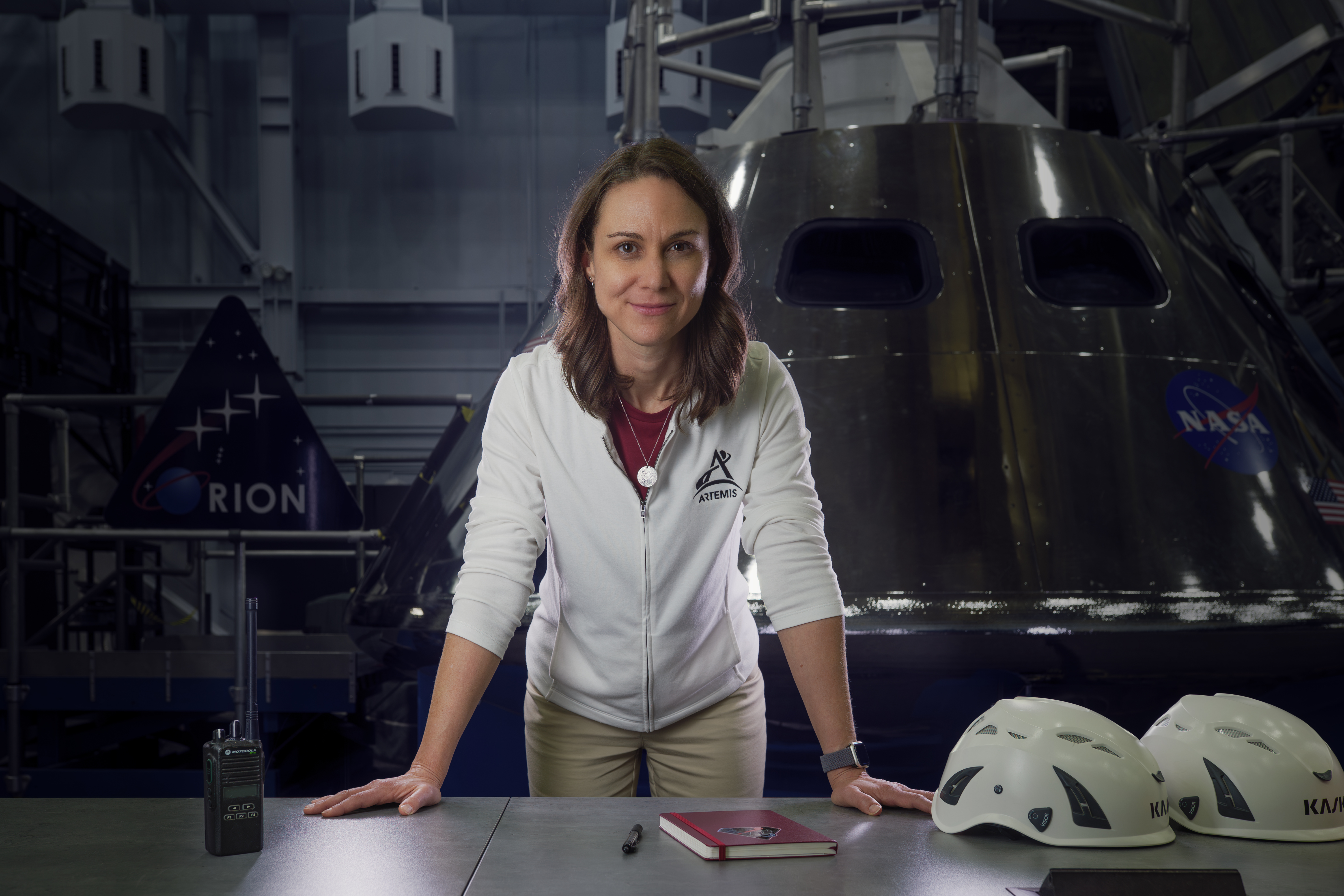
“We try to simulate as much as we can here on Earth,” said Mahaffey. “But we still have gravity, so we rely on the crew’s experience to imagine how they’ll use the space in microgravity”
Three of the four Artemis II astronauts have flown in space before, and Mahaffey sees their experience as a powerful asset. They bring insights that shape procedures and training plans, and they learn from each other’s unique problem-solving styles.
“They are teaching us back about how to have that crew perspective of working in space and the things that are going to matter most,” she said.
Mahaffey’s journey began with a love for engineering and a role as a flight controller in Johnson’s Mission Control Center. She found joy in training others and eventually transitioned into a full-time training role. Now, she leads a team of about 100 contributors, all working to prepare the crew for their historic mission.
“I didn’t start out wanting to be a trainer — I studied engineering because I loved physics and math,” she said. “But as the job shifted toward applying that engineering knowledge, communicating, and planning how to operate a spacecraft, the natural next step was teaching others.”
In our organization, once you’ve learned to fish, you teach someone else to fish.Jacki Mahaffey
Artemis II Chief Training Officer
For Mahaffey, Artemis is a bridge connecting her family’s legacy with the future of space exploration. Her grandfather worked on control systems for Apollo, and she sees her work as a continuation of that story, now with more advanced technology and new frontiers.
“We’re doing some of the same things Apollo did, but expanding on them,” she said. “We’re learning more about the Moon, our Earth’s history, and how we’ll get to Mars.”
Her role during Artemis II also includes serving as an Artemis capcom, short for capsule communicator, the position in mission control that directly communicates with the crew members. Mahaffey plans to work the entry shift for Artemis II — helping to guide the crew to splashdown and ensuring their safe recovery. The moment will be a culmination of her entire team’s hard work.
“I’ll feel good when the recovery forces report that the hatch is open,” Mahaffey said. “That moment will be incredible.”
The Artemis II crew’s Chief Training Officer Jacki Mahaffey smiles during post insertion and deorbit preparation training at Johnson’s Space Vehicle Mockup Facility in Houston, Texas. The crew practiced getting the Orion spacecraft configured once in orbit, how to make it habitable, and suited up in their entry pressure suits to prepare for their return from the Moon. Credit: NASA/Mark Sowa About the AuthorErika Peters Share Details Last Updated Jan 05, 2026 Related Terms Explore More 3 min read I Am Artemis: Jen Madsen and Trey Perryman Article 1 week ago 3 min read Get In, We’re Going Moonbound: Meet NASA’s Artemis Closeout Crew Article 2 weeks ago 4 min read Artemis II Flight Crew, Teams Conduct Demonstration Ahead of Launch Article 2 weeks ago Keep Exploring Discover More Topics From NASA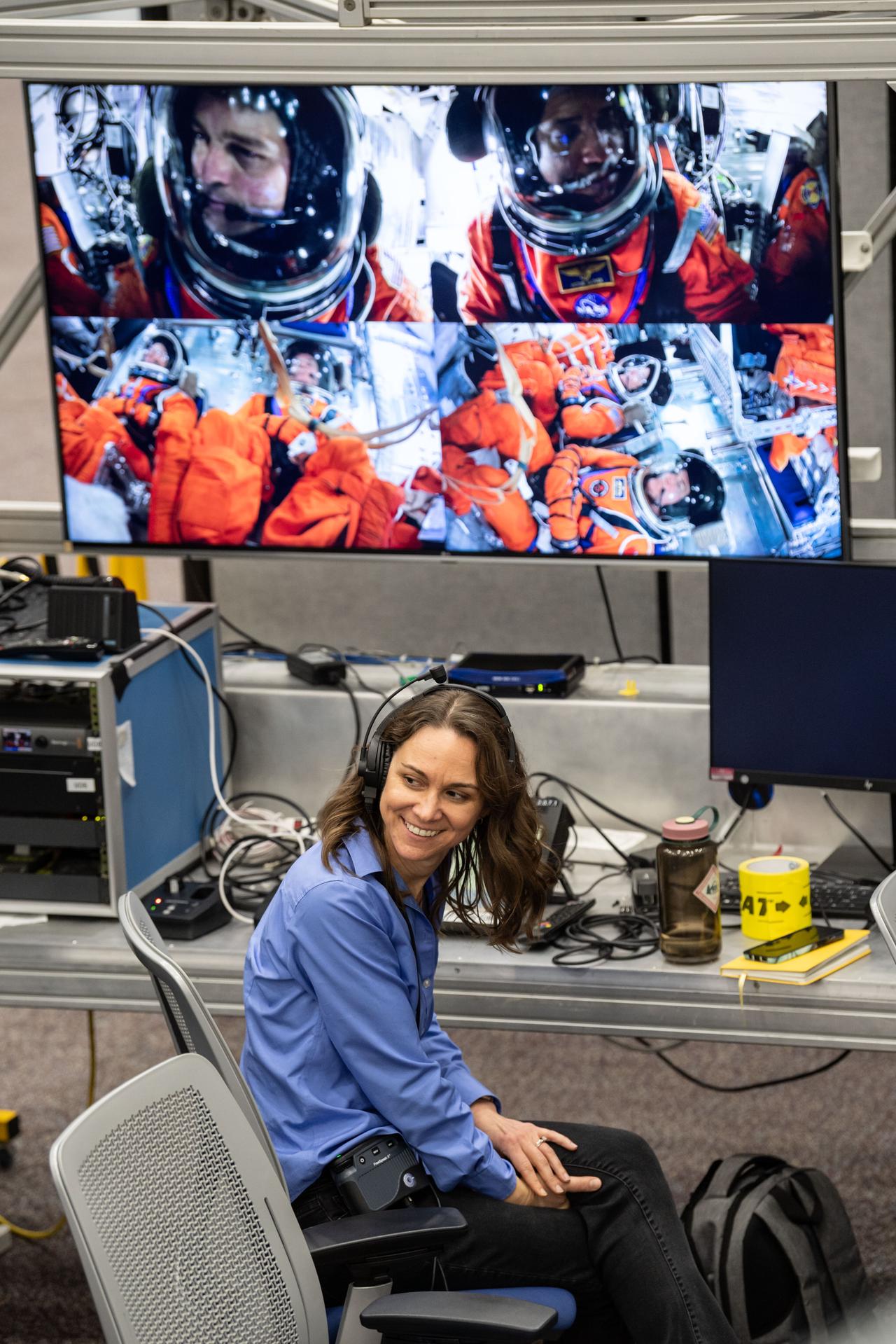
Missions
Humans in Space
Climate Change
Solar System
I Am Artemis: Jacki Mahaffey
Listen to this audio excerpt from Jacki Mahaffey, Artemis II chief training officer:
0:00 / 0:00
Your browser does not support the audio element.When the Artemis II crew travels around the Moon aboard the Orion spacecraft, they will have spent countless hours training for their lunar mission, and Jacki Mahaffey will have played a role in preparing them for their journey.
As the Artemis II chief training officer at NASA’s Johnson Space Center in Houston, Mahaffey manages the planning, development, and implementation of the astronauts’ training and integrated simulations. Her job is to ensure that when the Artemis II crew travels around the Moon inside Orion, the astronauts and flight controllers are ready for every moment — expected and unexpected.
Training is all risk mitigation for the mission. By preparing the astronauts and flight controllers for what they might encounter, we enable mission success.Jacki Mahaffey
Artemis II Chief Training Officer
The Artemis II crew began their rigorous training in 2023, but the work of Mahaffey and her team started long before that. Years before the training began, her team gathered the experts on how to operate the different aspects of Orion, and what the crew will need to know to execute their mission.
“One of my favorite moments from that process was when we all got together in one room, and everyone brought a piece of paper for every single lesson or training event that they expected to do with the crew,” Mahaffey said. “And we laid the entire thing out to figure out what’s the most logical order to put all of this training in, to help build that big picture for the crew.”
Training for Artemis II began shortly after the crew was announced, with Mahaffey and her team introducing the astronauts to Orion’s systems and operational basics. Once the necessary simulators and mockups were ready, the crew transitioned into hands-on training to build familiarity with their spacecraft.
At Johnson, Mahaffey’s team utilizes a range of specialized facilities, including the Space Vehicle Mockup Facility, where astronauts rehearse living and working inside the Orion mockup; the Orion Mission Simulator, which replicates flight software and displays; and the Neutral Buoyancy Laboratory, where the crew practices water survival techniques for post-splashdown scenarios.
Jacki Mahaffey, Artemis II Chief Training Officer at NASA’s Johnson Space Center in Houston, stands in front of the Orion mockup in Johnson’s Space Vehicle Mockup Facility.NASA/Rad Sinyak“We try to simulate as much as we can here on Earth,” said Mahaffey. “But we still have gravity, so we rely on the crew’s experience to imagine how they’ll use the space in microgravity”
Three of the four Artemis II astronauts have flown in space before, and Mahaffey sees their experience as a powerful asset. They bring insights that shape procedures and training plans, and they learn from each other’s unique problem-solving styles.
“They are teaching us back about how to have that crew perspective of working in space and the things that are going to matter most,” she said.
Mahaffey’s journey began with a love for engineering and a role as a flight controller in Johnson’s Mission Control Center. She found joy in training others and eventually transitioned into a full-time training role. Now, she leads a team of about 100 contributors, all working to prepare the crew for their historic mission.
“I didn’t start out wanting to be a trainer — I studied engineering because I loved physics and math,” she said. “But as the job shifted toward applying that engineering knowledge, communicating, and planning how to operate a spacecraft, the natural next step was teaching others.”
In our organization, once you’ve learned to fish, you teach someone else to fish.Jacki Mahaffey
Artemis II Chief Training Officer
For Mahaffey, Artemis is a bridge connecting her family’s legacy with the future of space exploration. Her grandfather worked on control systems for Apollo, and she sees her work as a continuation of that story, now with more advanced technology and new frontiers.
“We’re doing some of the same things Apollo did, but expanding on them,” she said. “We’re learning more about the Moon, our Earth’s history, and how we’ll get to Mars.”
Her role during Artemis II also includes serving as an Artemis capcom, short for capsule communicator, the position in mission control that directly communicates with the crew members. Mahaffey plans to work the entry shift for Artemis II — helping to guide the crew to splashdown and ensuring their safe recovery. The moment will be a culmination of her entire team’s hard work.
“I’ll feel good when the recovery forces report that the hatch is open,” Mahaffey said. “That moment will be incredible.”
The Artemis II crew’s Chief Training Officer Jacki Mahaffey smiles during post insertion and deorbit preparation training at Johnson’s Space Vehicle Mockup Facility in Houston, Texas. The crew practiced getting the Orion spacecraft configured once in orbit, how to make it habitable, and suited up in their entry pressure suits to prepare for their return from the Moon. Credit: NASA/Mark Sowa About the AuthorErika Peters Share Details Last Updated Jan 05, 2026 Related Terms Explore More 3 min read I Am Artemis: Jen Madsen and Trey Perryman Article 1 week ago 3 min read Get In, We’re Going Moonbound: Meet NASA’s Artemis Closeout Crew Article 2 weeks ago 4 min read Artemis II Flight Crew, Teams Conduct Demonstration Ahead of Launch Article 2 weeks ago Keep Exploring Discover More Topics From NASAMissions
Humans in Space
Climate Change
Solar System
U.S. Axes Number of Recommended Childhood Vaccines in Blow to Public Health
The U.S. Centers for Disease Control and Prevention is reducing the recommended number of vaccines for children to those that protect against 11 diseases instead of the protections against 17 illnesses that it recommended previously
NASA to Cover US Spacewalks 94, 95 at International Space Station
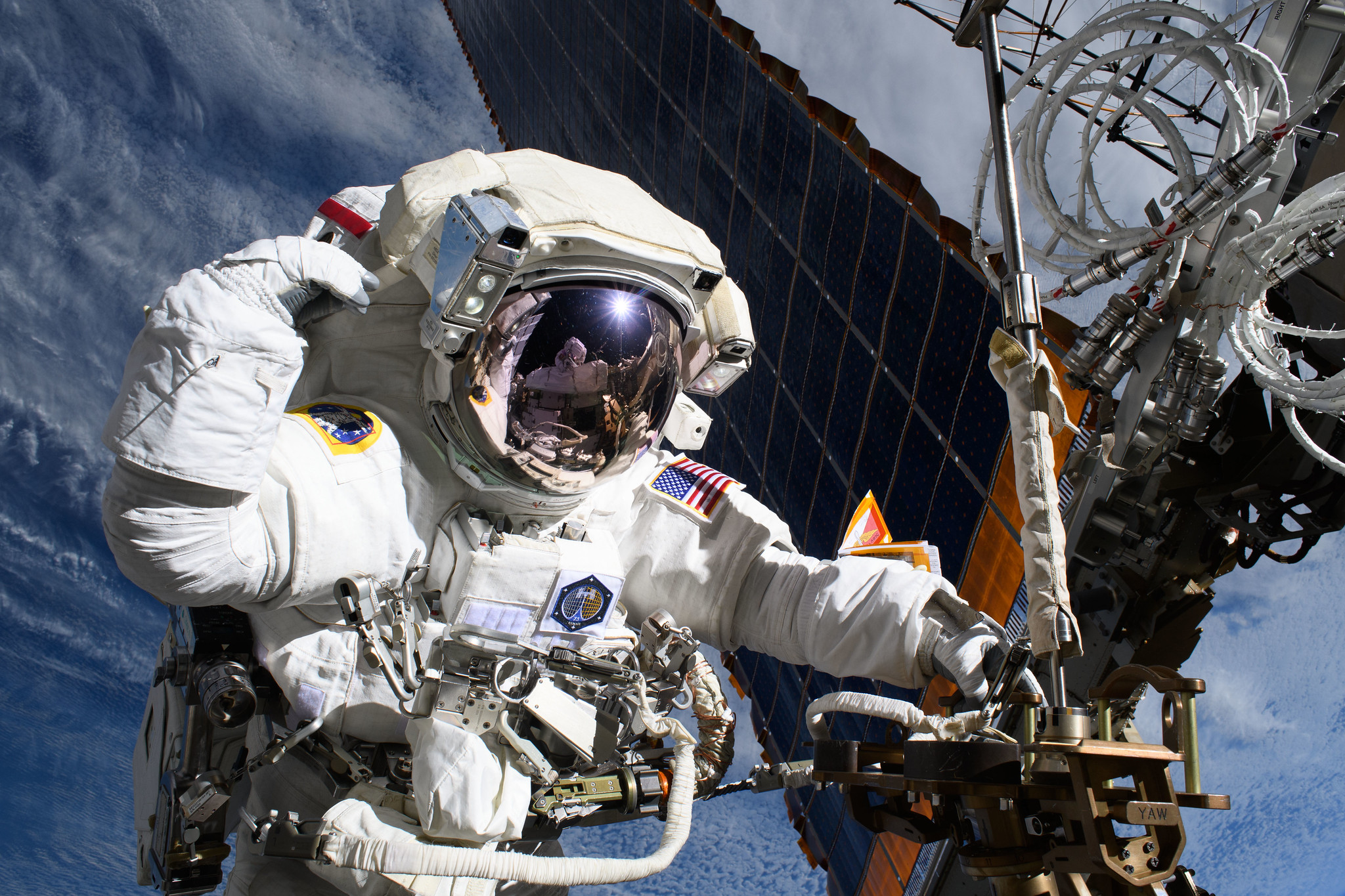
NASA astronauts will conduct two spacewalks Thursday, Jan. 8, and Thursday, Jan. 15, outside the International Space Station, and the agency will provide comprehensive coverage.
The first spacewalk is scheduled to begin at 8 a.m. EST on Jan. 8 and last about six hours and 30 minutes. NASA will provide live coverage beginning at 6:30 a.m. on NASA+, Amazon Prime, and the agency’s YouTube channel. Learn how to stream NASA content through a variety of online platforms, including social media.
During U.S. spacewalk 94, NASA astronauts Mike Fincke and Zena Cardman will exit the station’s Quest airlock to prepare the 2A power channel for future installation of International Space Station Roll-Out Solar Arrays. Once installed, the array will provide additional power for the orbital laboratory, including critical support of its safe and controlled deorbit.
Fincke will serve as spacewalk crew member 1 and will wear a suit with red stripes, while Cardman will serve as spacewalk crew member 2 and will wear an unmarked suit. This spacewalk will be Cardman’s first and Fincke’s 10th, tying him for the most spacewalks by a NASA astronaut.
The second spacewalk is scheduled to begin at 7:10 a.m. on Jan. 15 and last about 6 hours and 30 minutes. NASA will provide live coverage beginning at 5:40 a.m. on NASA+, Amazon Prime, and the agency’s YouTube channel.
During U.S. spacewalk 95, two NASA astronauts will replace a high-definition camera on camera port 3, install a new navigational aid for visiting spacecraft, called a planar reflector, on the Harmony module’s forward port, and relocate an early ammonia servicer jumper — a flexible hose assembly that connects parts of a fluid system — along with other jumpers on the station’s S6 and S4 truss.
NASA will announce which astronauts are scheduled for the second spacewalk after the Jan. 8 spacewalk.
The spacewalks will be the 278th and 279th in support of space station assembly, maintenance and upgrades. Also, they are the first two International Space Station spacewalks of 2026, and the first by Expedition 74.
Learn more about International Space Station research and operations at:
-end-
Josh Finch / Jimi Russell
Headquarters, Washington
202-358-1100
joshua.a.finch@nasa.gov / james.j.russell@nasa.gov
Sandra Jones
Johnson Space Center, Houston
281-483-5111
sandra.p.jones@nasa.gov
NASA to Cover US Spacewalks 94, 95 at International Space Station
NASA astronauts will conduct two spacewalks Thursday, Jan. 8, and Thursday, Jan. 15, outside the International Space Station, and the agency will provide comprehensive coverage.
The first spacewalk is scheduled to begin at 8 a.m. EST on Jan. 8 and last about six hours and 30 minutes. NASA will provide live coverage beginning at 6:30 a.m. on NASA+, Amazon Prime, and the agency’s YouTube channel. Learn how to stream NASA content through a variety of online platforms, including social media.
During U.S. spacewalk 94, NASA astronauts Mike Fincke and Zena Cardman will exit the station’s Quest airlock to prepare the 2A power channel for future installation of International Space Station Roll-Out Solar Arrays. Once installed, the array will provide additional power for the orbital laboratory, including critical support of its safe and controlled deorbit.
Fincke will serve as spacewalk crew member 1 and will wear a suit with red stripes, while Cardman will serve as spacewalk crew member 2 and will wear an unmarked suit. This spacewalk will be Cardman’s first and Fincke’s 10th, tying him for the most spacewalks by a NASA astronaut.
The second spacewalk is scheduled to begin at 7:10 a.m. on Jan. 15 and last about 6 hours and 30 minutes. NASA will provide live coverage beginning at 5:40 a.m. on NASA+, Amazon Prime, and the agency’s YouTube channel.
During U.S. spacewalk 95, two NASA astronauts will replace a high-definition camera on camera port 3, install a new navigational aid for visiting spacecraft, called a planar reflector, on the Harmony module’s forward port, and relocate an early ammonia servicer jumper — a flexible hose assembly that connects parts of a fluid system — along with other jumpers on the station’s S6 and S4 truss.
NASA will announce which astronauts are scheduled for the second spacewalk after the Jan. 8 spacewalk.
The spacewalks will be the 278th and 279th in support of space station assembly, maintenance and upgrades. Also, they are the first two International Space Station spacewalks of 2026, and the first by Expedition 74.
Learn more about International Space Station research and operations at:
-end-
Josh Finch / Jimi Russell
Headquarters, Washington
202-358-1100
joshua.a.finch@nasa.gov / james.j.russell@nasa.gov
Sandra Jones
Johnson Space Center, Houston
281-483-5111
sandra.p.jones@nasa.gov
Stunningly Hot Galaxy Cluster Puts New Spin on How These Cosmic Behemoths Evolved
Scientists detected gas at least five times hotter than previous theories had predicted inside a galaxy cluster from the early universe
Northern Greenland ice dome melted before and could melt again
Northern Greenland ice dome melted before and could melt again
NASA’s Hubble Examines Cloud-9, First of New Type of Object
- Hubble Home
- Overview
- Impact & Benefits
- Science
- Observatory
- Team
- Multimedia
- News
- More
NASA, ESA, VLA, Gagandeep Anand (STScI), Alejandro Benitez-Llambay (University of Milano-Bicocca); Image Processing: Joseph DePasquale (STScI)
A team using NASA’s Hubble Space Telescope has uncovered a new type of astronomical object — a starless, gas-rich, dark-matter cloud considered a “relic” or remnant of early galaxy formation. Nicknamed “Cloud-9,” this is the first confirmed detection of such an object in the universe — a finding that furthers the understanding of galaxy formation, the early universe, and the nature of dark matter itself.
“This is a tale of a failed galaxy,” said the program’s principal investigator, Alejandro Benitez-Llambay of the Milano-Bicocca University in Milan, Italy. “In science, we usually learn more from the failures than from the successes. In this case, seeing no stars is what proves the theory right. It tells us that we have found in the local universe a primordial building block of a galaxy that hasn’t formed.”
The results, published in The Astrophysical Journal Letters, were presented at a press conference Monday at the 247th meeting of the American Astronomical Society in Phoenix.
“This cloud is a window into the dark universe,” said team member Andrew Fox of the Association of Universities for Research in Astronomy/Space Telescope Science Institute (AURA/STScI) for the European Space Agency. “We know from theory that most of the mass in the universe is expected to be dark matter, but it’s difficult to detect this dark material because it doesn’t emit light. Cloud-9 gives us a rare look at a dark-matter-dominated cloud.”
This image shows the location of Cloud-9, which is 14 million light-years from Earth. The diffuse magenta is radio data from the ground-based Very Large Array (VLA) showing the presence of the cloud. The dashed circle marks the peak of radio emission, which is where researchers focused their search for stars. Follow-up observations by the Hubble Space Telescope’s Advanced Camera for Surveys found no stars within the cloud. The few objects that appear within its boundaries are background galaxies. Before the Hubble observations, scientists could argue that Cloud-9 is a faint dwarf galaxy whose stars could not be seen with ground-based telescopes due to the lack of sensitivity. Hubble’s Advanced Camera for Surveys shows that, in reality, the failed galaxy contains no stars. Science: NASA, ESA, VLA, Gagandeep Anand (STScI), Alejandro Benitez-Llambay (University of Milano-Bicocca); Image Processing: Joseph DePasquale (STScI)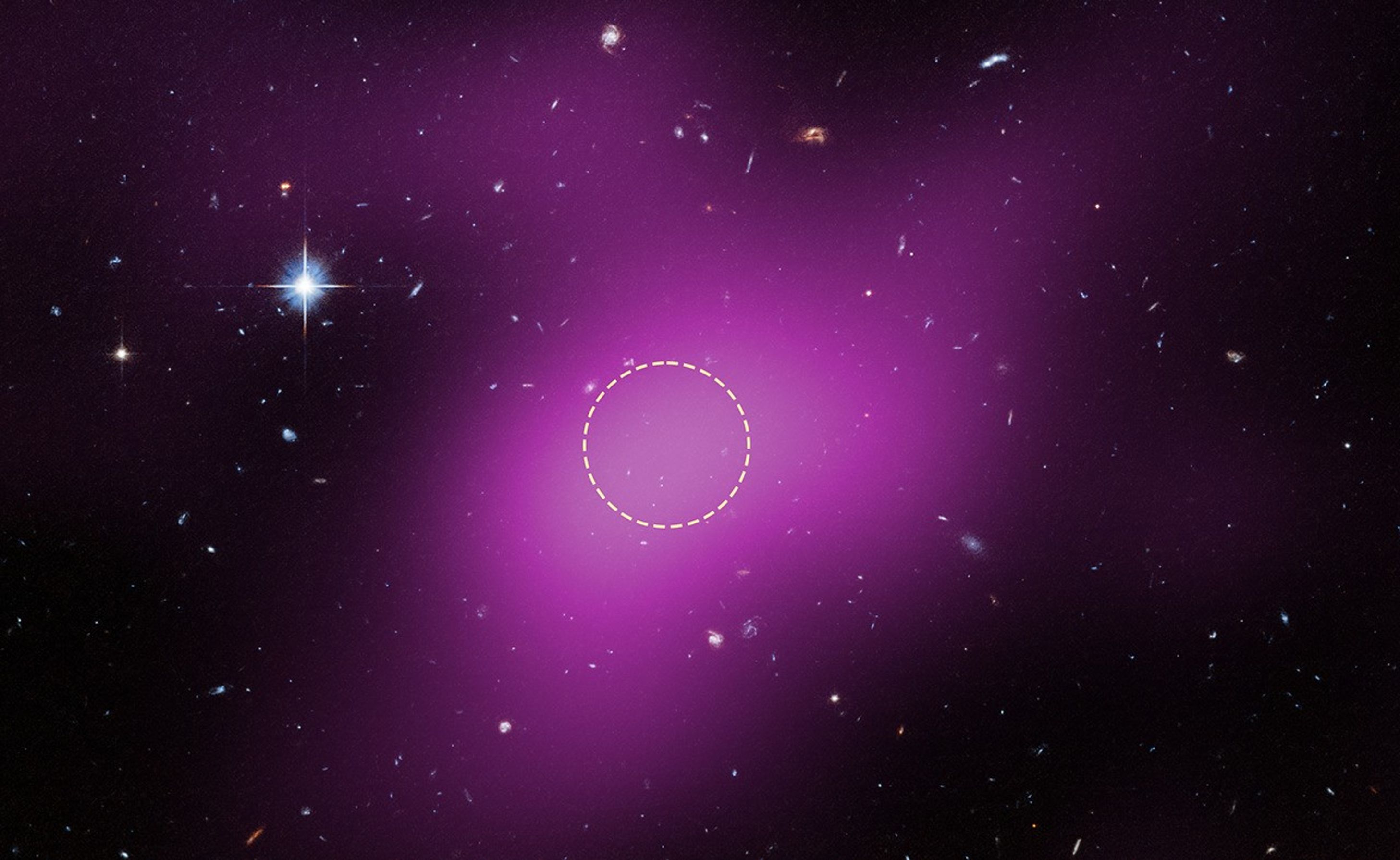
The object is called a Reionization-Limited H I Cloud, or “RELHIC.” The term “H I” refers to neutral hydrogen, and “RELHIC” describes a natal hydrogen cloud from the universe’s early days, a fossil leftover that has not formed stars. For years, scientists have looked for evidence of such a theoretical phantom object. It wasn’t until they turned Hubble toward the cloud, confirming that it is indeed starless, that they found support for the theory.
“Before we used Hubble, you could argue that this is a faint dwarf galaxy that we could not see with ground-based telescopes. They just didn’t go deep enough in sensitivity to uncover stars,” said lead author Gagandeep Anand of STScI. “But with Hubble’s Advanced Camera for Surveys, we’re able to nail down that there’s nothing there.”
The discovery of this relic cloud was a surprise. “Among our galactic neighbors, there might be a few abandoned houses out there,” said STScI’s Rachael Beaton, who is also on the research team.
Astronomers think RELHICs are dark matter clouds that couldn’t accumulate enough gas to form stars. They represent a window into the early stages of galaxy formation. Cloud-9 suggests the existence of many other small, dark matter-dominated structures in the universe — other failed galaxies. This discovery provides new insights into the dark components of the universe that are difficult to study through traditional observations, which focus on bright objects like stars and galaxies.
Scientists have studied hydrogen clouds near the Milky Way for many years, but these clouds tend to be much bigger and more irregular than Cloud-9. Compared with other observed hydrogen clouds, Cloud-9 is smaller, more compact, and highly spherical, making it look very different from the others.
The core of this object is composed of neutral hydrogen and is about 4,900 light-years in diameter. Researchers measured the hydrogen gas in Cloud-9 by the radio waves it emits, measuring it to be approximately one million times the mass of the Sun. Assuming that the gas pressure is balancing the dark matter cloud’s gravity, which appears to be the case, researchers calculated Cloud-9’s dark matter must be about five billion solar masses.
Cloud-9 is an example of structures and mysteries that don’t involve stars. Just looking at stars doesn’t give the full picture. Studying the gas and dark matter helps provide a more complete understanding of what’s going on in these systems that would otherwise be unknown.
Observationally, identifying these failed galaxies is challenging because nearby objects outshine them. Such systems are also vulnerable to environmental effects like ram-pressure stripping, which can remove gas as the cloud moves through intergalactic space. These factors further reduce their expected numbers.
The starless relic was discovered three years ago as part of a radio survey by the Five-hundred-meter Aperture Spherical Telescope (FAST) in Guizhou, China, a finding later confirmed by the Green Bank Telescope and the Very Large Array facilities in the United States. But only with Hubble could researchers definitively determine that the failed galaxy contains no stars.
Cloud-9 was simply named sequentially, having been the ninth gas cloud identified on the outskirts of a nearby spiral galaxy, Messier 94 (M94). The cloud is close to M94 and appears to have a physical association with the galaxy. High-resolution radio data shows slight gas distortions, possibly indicating interaction between the cloud and galaxy.
The cloud may eventually form a galaxy in the future, provided it grows more massive — although how that would occur is under speculation. If it were much bigger, say, more than 5 billion times the mass of our Sun, it would have collapsed, formed stars, and become a galaxy that would be no different than any other galaxy we see. If it were much smaller than that, the gas could have been dispersed and ionized and there wouldn’t be much left. But it’s in a sweet spot where it could remain as a RELHIC.
The lack of stars in this object provides a unique window into the intrinsic properties of dark matter clouds. The rarity of such objects and the potential for future surveys is expected to enhance the discovery of more of these “failed galaxies” or “relics,” resulting in insights into the early universe and the physics of dark matter.
The Hubble Space Telescope has been operating for more than three decades and continues to make ground-breaking discoveries that shape our fundamental understanding of the universe. Hubble is a project of international cooperation between NASA and ESA (European Space Agency). NASA’s Goddard Space Flight Center in Greenbelt, Maryland, manages the telescope and mission operations. Lockheed Martin Space, based in Denver, also supports mission operations at Goddard. The Space Telescope Science Institute in Baltimore, which is operated by the Association of Universities for Research in Astronomy, conducts Hubble science operations for NASA.
Facebook logo @NASAHubble @NASAHubble Instagram logo @NASAHubble Related Images & Videos Cloud 9, Starless Gas CloudMagenta is radio data from the ground-based Very Large Array (VLA) showing the presence of Cloud-9. The dashed circle marks the area where researchers focused their search for stars. Hubble found no stars within Cloud-9. The few objects within its boundaries are background galaxies.
Cloud 9, Starless Gas Cloud Compass Image
This is an annotated composite image of Cloud-9, a Reionization-Limited H I Cloud (RELHIC), as captured by the Hubble Space Telescope’s ACS (Advanced Camera for Surveys) and the ground-based Very Large Array (VLA) radio telescope.
Cloud 9, Starless Gas Cloud Video
This annotated video shows the location of Cloud-9 on the sky. As the video zooms into this gas-rich, dark-matter cloud, it becomes evident that there are no stars within it. Only background galaxies appear behind Cloud-9, which has survived since the universe’s early days….
Claire Andreoli
NASA’s Goddard Space Flight Center
Greenbelt, Maryland
claire.andreoli@nasa.gov
Ann Jenkins, Christine Pulliam
Space Telescope Science Institute
Baltimore, Maryland
- Science Paper: “The First RELHIC? Cloud-9 is a Starless Gas Cloud” by G. Anand et al., PDF (15.34 MB)
- Release on ESA/Hubble website
Keep Exploring Discover More Topics From Hubble Hubble Space Telescope
Since its 1990 launch, the Hubble Space Telescope has changed our fundamental understanding of the universe.
Hubble Science Highlights
Hubble Images
Hubble News
NASA’s Hubble Examines Cloud-9, First of New Type of Object
- Hubble Home
- Overview
- Impact & Benefits
- Science
- Observatory
- Team
- Multimedia
- News
- More
NASA, ESA, VLA, Gagandeep Anand (STScI), Alejandro Benitez-Llambay (University of Milano-Bicocca); Image Processing: Joseph DePasquale (STScI)
A team using NASA’s Hubble Space Telescope has uncovered a new type of astronomical object — a starless, gas-rich, dark-matter cloud considered a “relic” or remnant of early galaxy formation. Nicknamed “Cloud-9,” this is the first confirmed detection of such an object in the universe — a finding that furthers the understanding of galaxy formation, the early universe, and the nature of dark matter itself.
“This is a tale of a failed galaxy,” said the program’s principal investigator, Alejandro Benitez-Llambay of the Milano-Bicocca University in Milan, Italy. “In science, we usually learn more from the failures than from the successes. In this case, seeing no stars is what proves the theory right. It tells us that we have found in the local universe a primordial building block of a galaxy that hasn’t formed.”
The results, published in The Astrophysical Journal Letters, were presented at a press conference Monday at the 247th meeting of the American Astronomical Society in Phoenix.
“This cloud is a window into the dark universe,” said team member Andrew Fox of the Association of Universities for Research in Astronomy/Space Telescope Science Institute (AURA/STScI) for the European Space Agency. “We know from theory that most of the mass in the universe is expected to be dark matter, but it’s difficult to detect this dark material because it doesn’t emit light. Cloud-9 gives us a rare look at a dark-matter-dominated cloud.”
This image shows the location of Cloud-9, which is 14 million light-years from Earth. The diffuse magenta is radio data from the ground-based Very Large Array (VLA) showing the presence of the cloud. The dashed circle marks the peak of radio emission, which is where researchers focused their search for stars. Follow-up observations by the Hubble Space Telescope’s Advanced Camera for Surveys found no stars within the cloud. The few objects that appear within its boundaries are background galaxies. Before the Hubble observations, scientists could argue that Cloud-9 is a faint dwarf galaxy whose stars could not be seen with ground-based telescopes due to the lack of sensitivity. Hubble’s Advanced Camera for Surveys shows that, in reality, the failed galaxy contains no stars. Science: NASA, ESA, VLA, Gagandeep Anand (STScI), Alejandro Benitez-Llambay (University of Milano-Bicocca); Image Processing: Joseph DePasquale (STScI)The object is called a Reionization-Limited H I Cloud, or “RELHIC.” The term “H I” refers to neutral hydrogen, and “RELHIC” describes a natal hydrogen cloud from the universe’s early days, a fossil leftover that has not formed stars. For years, scientists have looked for evidence of such a theoretical phantom object. It wasn’t until they turned Hubble toward the cloud, confirming that it is indeed starless, that they found support for the theory.
“Before we used Hubble, you could argue that this is a faint dwarf galaxy that we could not see with ground-based telescopes. They just didn’t go deep enough in sensitivity to uncover stars,” said lead author Gagandeep Anand of STScI. “But with Hubble’s Advanced Camera for Surveys, we’re able to nail down that there’s nothing there.”
The discovery of this relic cloud was a surprise. “Among our galactic neighbors, there might be a few abandoned houses out there,” said STScI’s Rachael Beaton, who is also on the research team.
Astronomers think RELHICs are dark matter clouds that couldn’t accumulate enough gas to form stars. They represent a window into the early stages of galaxy formation. Cloud-9 suggests the existence of many other small, dark matter-dominated structures in the universe — other failed galaxies. This discovery provides new insights into the dark components of the universe that are difficult to study through traditional observations, which focus on bright objects like stars and galaxies.
Scientists have studied hydrogen clouds near the Milky Way for many years, but these clouds tend to be much bigger and more irregular than Cloud-9. Compared with other observed hydrogen clouds, Cloud-9 is smaller, more compact, and highly spherical, making it look very different from the others.
The core of this object is composed of neutral hydrogen and is about 4,900 light-years in diameter. Researchers measured the hydrogen gas in Cloud-9 by the radio waves it emits, measuring it to be approximately one million times the mass of the Sun. Assuming that the gas pressure is balancing the dark matter cloud’s gravity, which appears to be the case, researchers calculated Cloud-9’s dark matter must be about five billion solar masses.
Cloud-9 is an example of structures and mysteries that don’t involve stars. Just looking at stars doesn’t give the full picture. Studying the gas and dark matter helps provide a more complete understanding of what’s going on in these systems that would otherwise be unknown.
Observationally, identifying these failed galaxies is challenging because nearby objects outshine them. Such systems are also vulnerable to environmental effects like ram-pressure stripping, which can remove gas as the cloud moves through intergalactic space. These factors further reduce their expected numbers.
The starless relic was discovered three years ago as part of a radio survey by the Five-hundred-meter Aperture Spherical Telescope (FAST) in Guizhou, China, a finding later confirmed by the Green Bank Telescope and the Very Large Array facilities in the United States. But only with Hubble could researchers definitively determine that the failed galaxy contains no stars.
Cloud-9 was simply named sequentially, having been the ninth gas cloud identified on the outskirts of a nearby spiral galaxy, Messier 94 (M94). The cloud is close to M94 and appears to have a physical association with the galaxy. High-resolution radio data shows slight gas distortions, possibly indicating interaction between the cloud and galaxy.
The cloud may eventually form a galaxy in the future, provided it grows more massive — although how that would occur is under speculation. If it were much bigger, say, more than 5 billion times the mass of our Sun, it would have collapsed, formed stars, and become a galaxy that would be no different than any other galaxy we see. If it were much smaller than that, the gas could have been dispersed and ionized and there wouldn’t be much left. But it’s in a sweet spot where it could remain as a RELHIC.
The lack of stars in this object provides a unique window into the intrinsic properties of dark matter clouds. The rarity of such objects and the potential for future surveys is expected to enhance the discovery of more of these “failed galaxies” or “relics,” resulting in insights into the early universe and the physics of dark matter.
The Hubble Space Telescope has been operating for more than three decades and continues to make ground-breaking discoveries that shape our fundamental understanding of the universe. Hubble is a project of international cooperation between NASA and ESA (European Space Agency). NASA’s Goddard Space Flight Center in Greenbelt, Maryland, manages the telescope and mission operations. Lockheed Martin Space, based in Denver, also supports mission operations at Goddard. The Space Telescope Science Institute in Baltimore, which is operated by the Association of Universities for Research in Astronomy, conducts Hubble science operations for NASA.
Facebook logo @NASAHubble @NASAHubble Instagram logo @NASAHubble Related Images & Videos Cloud 9, Starless Gas CloudMagenta is radio data from the ground-based Very Large Array (VLA) showing the presence of Cloud-9. The dashed circle marks the area where researchers focused their search for stars. Hubble found no stars within Cloud-9. The few objects within its boundaries are background galaxies.
Cloud 9, Starless Gas Cloud Compass Image
This is an annotated composite image of Cloud-9, a Reionization-Limited H I Cloud (RELHIC), as captured by the Hubble Space Telescope’s ACS (Advanced Camera for Surveys) and the ground-based Very Large Array (VLA) radio telescope.
Cloud 9, Starless Gas Cloud Video
This annotated video shows the location of Cloud-9 on the sky. As the video zooms into this gas-rich, dark-matter cloud, it becomes evident that there are no stars within it. Only background galaxies appear behind Cloud-9, which has survived since the universe’s early days….
Claire Andreoli
NASA’s Goddard Space Flight Center
Greenbelt, Maryland
claire.andreoli@nasa.gov
Ann Jenkins, Christine Pulliam
Space Telescope Science Institute
Baltimore, Maryland
- Science Paper: “The First RELHIC? Cloud-9 is a Starless Gas Cloud” by G. Anand et al., PDF (15.34 MB)
- Release on ESA/Hubble website
Keep Exploring Discover More Topics From Hubble Hubble Space Telescope
Since its 1990 launch, the Hubble Space Telescope has changed our fundamental understanding of the universe.
Hubble Science Highlights
Hubble Images
Hubble News
Cloud-9: a new celestial object found by Hubble
A team using the NASA/ESA Hubble Space Telescope has uncovered a new type of astronomical object – a starless, gas-rich, dark-matter cloud that is considered a 'relic' or remnant of early galaxy formation. Nicknamed 'Cloud-9,' this is the first confirmed detection of such an object in the Universe.
Ultramassive Black Holes and Their Galaxies: A Matter of Scale
There is a strong relation between the size of a galaxy's black hole and the motion of stars in the galaxy's core, known as the M-sigma relation. It turns out this relation doesn't work well for galaxies with ultramassive black holes.
5 Tips to Craft a Standout NASA Internship Application
3 min read
Preparations for Next Moonwalk Simulations Underway (and Underwater) Four NASA interns pose in front of the NASA Pavilion at the EAA AirVenture Oshkosh, an annual airshow in Oshkosh, Wisconsin.NASA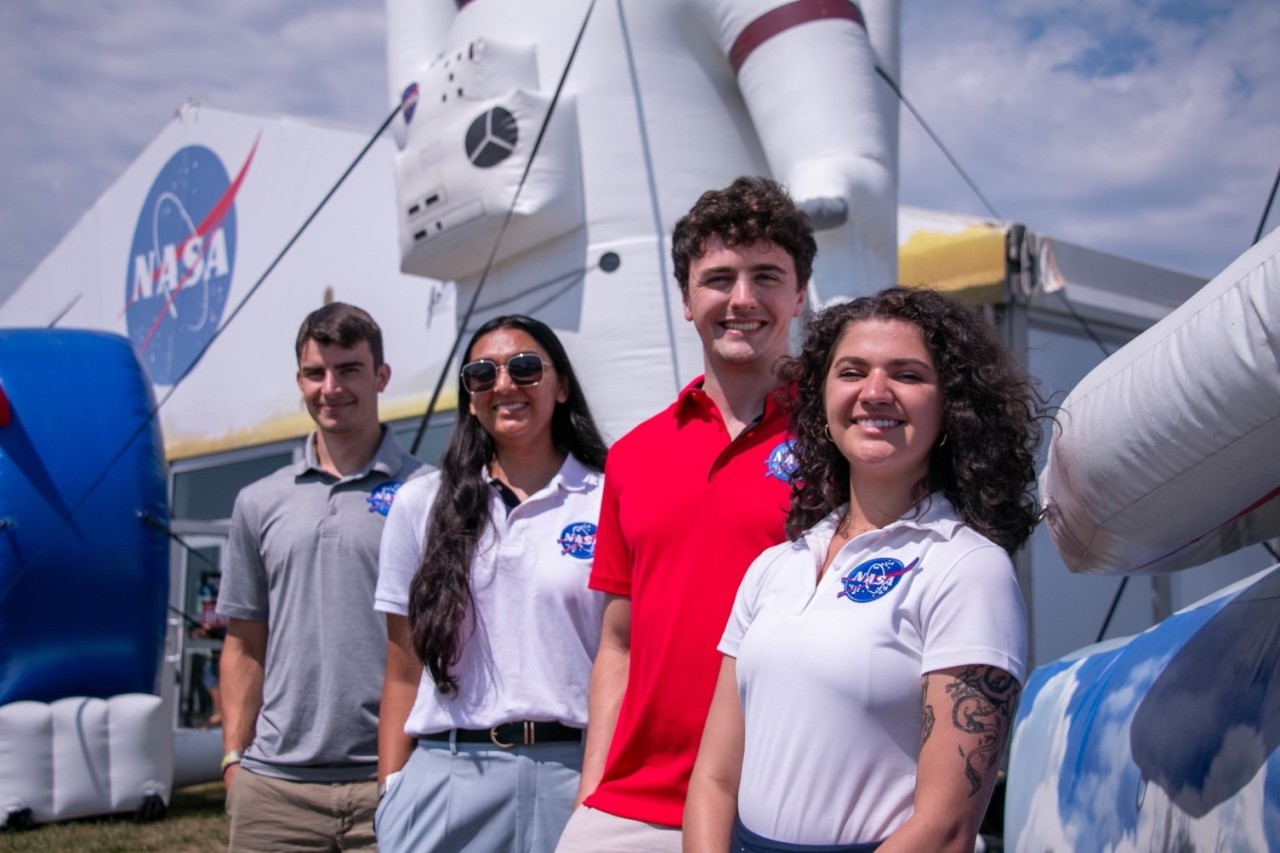
A NASA internship provides a stellar opportunity to launch your future as part of America’s aerospace workforce. NASA interns take on meaningful work and contribute to exciting agency projects with the guidance of a supportive mentor. The agency’s internship program regularly ranks as the nation’s most prestigious and competition is steep: in fiscal year 2025, NASA’s Office of STEM Engagement received about 250,000 internship applications for its roughly 1,800 internship opportunities.
To give you the best shot at a NASA internship, we’ve compiled a list of tips mentors say can make an application stand out from the crowd. It is NASA’s mentors who create internship project descriptions, review applications, and take the lead in choosing candidates to work on their specific internship projects. Here’s what they had to say:
1. Your personal statement is your chance to make a lasting impression.Mentors pay close attention to personal statements to identify the best candidate for their project and team. A powerful personal statement shares personal background, experience, and goals, and how they relate to the needs of the project.
NASA mentors are looking for interns who will enjoy the work and fit in with the team culture. Beyond your academic background, grades, and interests, this is your chance to share your curiosity, enthusiasm, passion, or resilience. Show us who you are and what you can do!
2. Show off your academic achievements.Mentors love to see what academic expertise and hands-on experience you can bring to the internship project. Your transcripts, grade point average, coursework, research, academic projects, awards, and accomplishments are valuable highlights in your application.
3. Tell us about your extracurriculars, too!Who are you outside the classroom?
Mentors like to see well-rounded candidates whose interests take them beyond their chosen academic and career path. Include any extracurricular activities you participate in, such as a club or team at school or an organization in your community. Whether you’re involved in a local rocketry club, a school athletic team, or a musical ensemble, these pursuits may demonstrate academic skills or soft skills such as collaboration. Shared hobbies can also be a great point of personal connection with a future mentor.
4. Include as many of your skills as possible.Share the valuable skills that you can bring to an internship project. These could be technical skills, such as experience with specific tools or computer programming languages, and non-technical skills, which may include communications skills or leadership experience. Mentors search for skills that meet their project requirements and, match with the role, but also for unique skills that might be an added asset.
5. Give yourself a chance.Don’t count yourself out before you get started! If you have a passion for spaceflight or aviation, it’s worth applying for a NASA internship – even if you’re not a math, science, engineering, or technology major. That’s because NASA achieves its exploration goals with the support of a nationwide team with a wide variety of skills: communicators, creatives, business specialists, legal experts, and so many more. Take a look at NASA’s internship opportunities and you’ll find projects in a wide range of fields.
Yes, competition is fierce. But someone is going to land that internship – and that person could be you!
Learn MoreCheck eligibility requirements, see current deadlines, and launch your internship journey at https://intern.nasa.gov.
5 Tips to Craft a Standout NASA Internship Application
3 min read
Preparations for Next Moonwalk Simulations Underway (and Underwater) Four NASA interns pose in front of the NASA Pavilion at the EAA AirVenture Oshkosh, an annual airshow in Oshkosh, Wisconsin.NASAA NASA internship provides a stellar opportunity to launch your future as part of America’s aerospace workforce. NASA interns take on meaningful work and contribute to exciting agency projects with the guidance of a supportive mentor. The agency’s internship program regularly ranks as the nation’s most prestigious and competition is steep: in fiscal year 2025, NASA’s Office of STEM Engagement received about 250,000 internship applications for its roughly 1,800 internship opportunities.
To give you the best shot at a NASA internship, we’ve compiled a list of tips mentors say can make an application stand out from the crowd. It is NASA’s mentors who create internship project descriptions, review applications, and take the lead in choosing candidates to work on their specific internship projects. Here’s what they had to say:
1. Your personal statement is your chance to make a lasting impression.Mentors pay close attention to personal statements to identify the best candidate for their project and team. A powerful personal statement shares personal background, experience, and goals, and how they relate to the needs of the project.
NASA mentors are looking for interns who will enjoy the work and fit in with the team culture. Beyond your academic background, grades, and interests, this is your chance to share your curiosity, enthusiasm, passion, or resilience. Show us who you are and what you can do!
2. Show off your academic achievements.Mentors love to see what academic expertise and hands-on experience you can bring to the internship project. Your resume, transcripts, grade point average, coursework, research, academic projects, awards, and accomplishments are valuable highlights in your application.
3. Tell us about your extracurriculars, too!Who are you outside the classroom?
Mentors like to see well-rounded candidates whose interests take them beyond their chosen academic and career path. Include any extracurricular activities you participate in, such as a club or team at school or an organization in your community. Whether you’re involved in a local rocketry club, a school athletic team, or a musical ensemble, these pursuits may demonstrate academic skills or soft skills such as collaboration. Shared hobbies can also be a great point of personal connection with a future mentor.
4. Include as many of your skills as possible.Share the valuable skills that you can bring to an internship project. These could be technical skills, such as experience with specific tools or computer programming languages, and non-technical skills, which may include communications skills or leadership experience. Mentors search for skills that meet their project requirements and, match with the role, but also for unique skills that might be an added asset.
5. Give yourself a chance.Don’t count yourself out before you get started! If you have a passion for spaceflight or aviation, it’s worth applying for a NASA internship – even if you’re not a math, science, engineering, or technology major. That’s because NASA achieves its exploration goals with the support of a nationwide team with a wide variety of skills: communicators, creatives, business specialists, legal experts, and so many more. Take a look at NASA’s internship opportunities and you’ll find projects in a wide range of fields.
Yes, competition is fierce. But someone is going to land that internship – and that person could be you!
Learn More- Check eligibility requirements, see current deadlines, and launch your internship journey at https://intern.nasa.gov.
- Click here to find NASA resume tips.
Scientific Balloon Begins Antarctic Ascent
Scientific Balloon Begins Antarctic Ascent
A scientific balloon starts its ascent into the air as it prepares to launch carrying NASA’s Payload for Ultrahigh Energy Observations (PUEO) mission. The mission lifted off from Antarctica at 5:56 a.m. NZST, Saturday, Dec. 20 (11:56 a.m., Friday, Dec. 19 in U.S. Eastern Time).
The PUEO mission is designed to detect radio signals created when highly energetic particles called neutrinos from space hit the ice. The PUEO payload will collect data that give us insight into events like the creation of black holes and neutron star mergers. Alongside the PUEO mission are two other balloons carrying calibration equipment sending test signals to help scientists make sure the payload equipment is working correctly when it tries to detect real signals from space.
Track the balloons in realtime.
Image credit: NASA/Scott Battaion