
Feed aggregator
How to Keep Your New Year’s Resolutions—Behavioral Science Tips That Work
Behavioral economist Katy Milkman explains why most New Year’s resolutions fail and shares how science-backed strategies can build habits that last.
The best new science fiction books of January 2026
The best new science fiction books of January 2026
From roots to rocket
On 5 January 2026, the European Astronaut Centre (EAC) in Cologne, Germany, hosted a special tradition: the planting of an astronaut tree by ESA astronaut Sophie Adenot in honour of her first mission to space, εpsilon. This symbolic gesture celebrates her achievements and future mission while reinforcing the deep connection between space explorers and the planet they call home.
Ghostly particles might just break our understanding of the universe
Ghostly particles might just break our understanding of the universe
An Amphitheater of Rock at Cedar Breaks
- Earth
- Earth Observatory
- Image of the Day
- EO Explorer
- Topics
- More Content
- About
XRISM Provides the Sharpest Image to Date of a Rapidly Spinning Black Hole
The first results on the iconic active galactic nucleus MCG–6-30-15 captured with the XRISM mission show the most precise signatures yet of its supermassive black hole’s extreme gravity and the outflows that shape its galaxy.
New Research Reveals how Gravitational Waves Could be Used to Decode Dark Matter
A new study by researchers at the University of Amsterdam shows how gravitational waves from black holes can be used to reveal the presence of dark matter and help determine its properties. The key is a new model, based on Einstein’s theory of general relativity, that tracks in detail how a black hole interacts with the surrounding matter.
Earth-like Planets Need a Cosmic-Ray Bath
Terrestrial planets such as Earth need an early solar system rich in short-lived radioisotopes. But the supernovae that create these elements would tend to rip an early system apart. A new study suggests that these isotopes are produced by a bath of cosmic rays from more distant supernovae.
Using Webb, Canadian Astronomers Shed Light on the Milky Way's Turbulent Past
A team of Canadian astronomers has used Webb's observations of "Milky Way twins" in the early Universe to learn more about our galaxy's turbulent youth.
Was our earliest ancestor a knuckle-dragger, or did it walk upright?
Was our earliest ancestor a knuckle-dragger, or did it walk upright?
Earliest Human Ancestor May Have Walked on Two Legs
A fossil belonging to an ancient hominin that lived seven million years ago bears the hallmarks of bipedalism, according to a new study
Hubble Glimpses Galactic Gas Making a Getaway
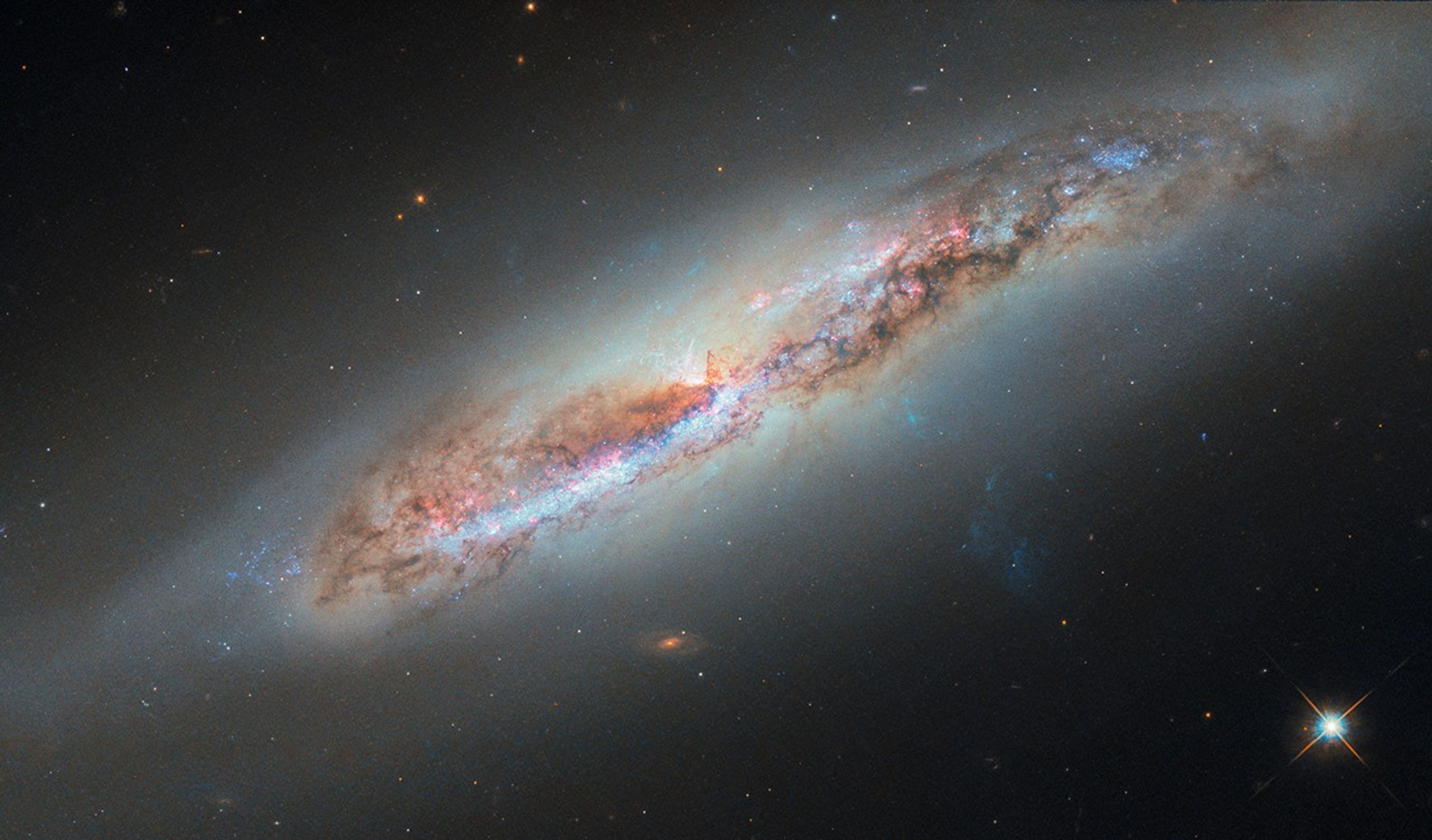
A sideways spiral galaxy shines in this NASA/ESA Hubble Space Telescope image. Located about 60 million light-years away in the constellation Virgo (the Maiden), NGC 4388 is a resident of the Virgo galaxy cluster. This enormous cluster of galaxies contains more than a thousand members and is the nearest large galaxy cluster to the Milky Way.
NGC 4388 appears to tilt at an extreme angle relative to our point of view, giving us a nearly edge-on prospect of the galaxy. This perspective reveals a curious feature that wasn’t visible in a previous Hubble image of this galaxy released in 2016: a plume of gas from the galaxy’s nucleus, here seen billowing out from the galaxy’s disk toward the lower-right corner of the image. But where did this outflow come from, and why does it glow?
The answer likely lies in the vast stretches of space that separate the galaxies of the Virgo cluster. Though the space between galaxies appears empty, this space is occupied by hot wisps of gas called the intracluster medium. As NGC 4388 moves within the Virgo cluster, it plunges through the intracluster medium. Pressure from hot intracluster gas whisks away gas from within NGC 4388’s disk, causing it to trail behind as NGC 4388 moves.
The source of the ionizing energy that causes this gas cloud to glow is more uncertain. Researchers suspect that some of the energy comes from the center of the galaxy, where a supermassive black hole spins gas around it into a superheated disk. The blazing radiation from this disk might ionize the gas closest to the galaxy, while shock waves might be responsible for ionizing filaments of gas farther out.
This image incorporates new data, including several additional wavelengths of light, that bring the ionized gas cloud into view. The image holds data from several observing programs that aim to illuminate galaxies with active black holes at their centers.
Image credit: ESA/Hubble & NASA, S. Veilleux, J. Wang, J. Greene
Hubble Glimpses Galactic Gas Making a Getaway
A sideways spiral galaxy shines in this NASA/ESA Hubble Space Telescope image. Located about 60 million light-years away in the constellation Virgo (the Maiden), NGC 4388 is a resident of the Virgo galaxy cluster. This enormous cluster of galaxies contains more than a thousand members and is the nearest large galaxy cluster to the Milky Way.
NGC 4388 appears to tilt at an extreme angle relative to our point of view, giving us a nearly edge-on prospect of the galaxy. This perspective reveals a curious feature that wasn’t visible in a previous Hubble image of this galaxy released in 2016: a plume of gas from the galaxy’s nucleus, here seen billowing out from the galaxy’s disk toward the lower-right corner of the image. But where did this outflow come from, and why does it glow?
The answer likely lies in the vast stretches of space that separate the galaxies of the Virgo cluster. Though the space between galaxies appears empty, this space is occupied by hot wisps of gas called the intracluster medium. As NGC 4388 moves within the Virgo cluster, it plunges through the intracluster medium. Pressure from hot intracluster gas whisks away gas from within NGC 4388’s disk, causing it to trail behind as NGC 4388 moves.
The source of the ionizing energy that causes this gas cloud to glow is more uncertain. Researchers suspect that some of the energy comes from the center of the galaxy, where a supermassive black hole spins gas around it into a superheated disk. The blazing radiation from this disk might ionize the gas closest to the galaxy, while shock waves might be responsible for ionizing filaments of gas farther out.
This image incorporates new data, including several additional wavelengths of light, that bring the ionized gas cloud into view. The image holds data from several observing programs that aim to illuminate galaxies with active black holes at their centers.
Image credit: ESA/Hubble & NASA, S. Veilleux, J. Wang, J. Greene