
Feed aggregator
Bonobo's pretend tea party shows capacity for imagination
Bonobo's pretend tea party shows capacity for imagination
South Carolina measles outbreak is triggering dangerous brain swelling in some children
The South Carolina measles outbreak has triggered rare but serious brain swelling in some children
NASA’s SpaceX Crew-12 to Study Adaptation to Altered Gravity
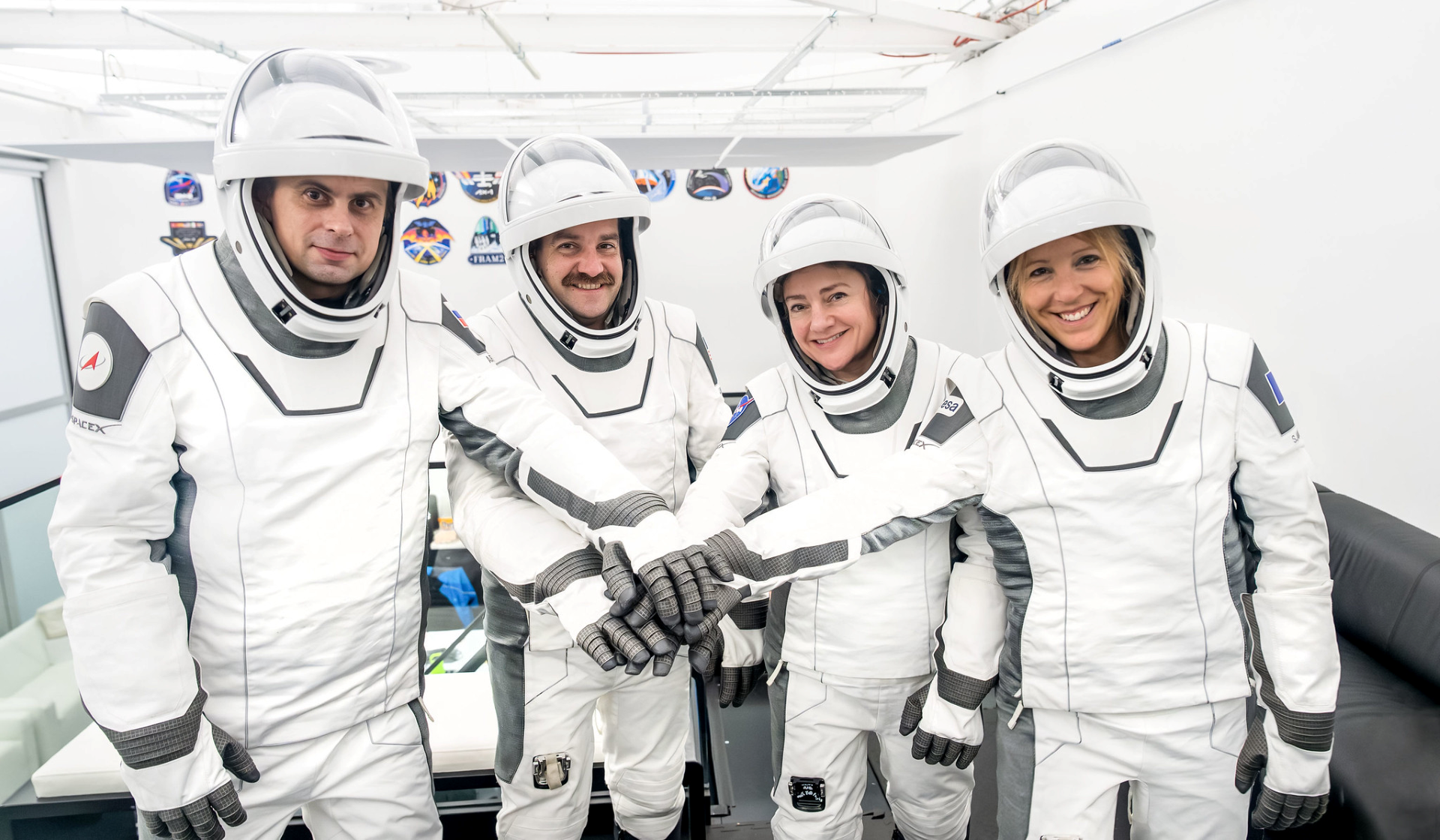
NASA’s SpaceX Crew-12 mission is preparing to launch for a long-duration science mission aboard the International Space Station. During the mission, select crew members will participate in human health studies focused on understanding how astronauts’ bodies adapt to the low-gravity environment of space, including a new study examining subtle changes in blood flow.
The experiments, led by NASA’s Human Research Program, include astronauts performing ultrasounds of their blood vessels to study altered circulation and completing simulated lunar landings to assess disorientation during gravitational transitions, among other tasks. The results will help NASA plan for extended stays in space and future exploration missions.
The new study, called Venous Flow, will examine whether time aboard the space station increases the chance of crew members developing blood clots. In weightlessness, blood and other bodily fluids can move toward the head, potentially altering circulation. Any resulting blood clots could pose serious health risks, including strokes.
“Our goal is to use this information to better understand how fluid shifts affect clotting risk, so that when astronauts go on long-duration missions to the Moon and Mars, we can build the best strategies to keep them safe,” said Dr. Jason Lytle, a physiologist at NASA’s Johnson Space Center in Houston who is leading the study.
To learn more, crew members in this study will undergo preflight and postflight MRIs, ultrasound scans, blood draws, and blood pressure checks. During the flight, crew members also will capture their own jugular vein ultrasounds, take blood pressure readings, and draw blood samples for scientists to analyze after their return to Earth.
In another study, called Manual Piloting, select crew members will perform multiple simulated Moon landings before, during, and after the mission. Designed to assess their piloting and decision-making skills, participants attempt to fly a virtual spacecraft toward the lunar South Pole region — the same area future Artemis crews plan to explore.
“Astronauts may experience disorientation during gravitational transitions, which can make tasks like landing a spacecraft challenging,” said Dr. Scott Wood, a neuroscientist at NASA Johnson who is coordinating the investigation.
While spacecraft landings on the Moon and Mars are expected to be automated, crews must be prepared to take over and pilot the vehicle if necessary.
“This study will help us examine astronauts’ ability to operate a spacecraft after adapting from one gravity environment to another, and whether training near the end of their spaceflight can help prepare crews for landing,” said Wood. “We’ll monitor their ability to manually override, redirect, and control a vehicle, which will guide our strategy for training Artemis crews for future Moon missions.”
The risk of astronauts experiencing disorientation from gravitational transitions increases the longer they’re in space. For this study, which debuted during the agency’s SpaceX Crew-11 mission, researchers plan to recruit seven astronauts for short-term private missions lasting up to 30 days and 14 astronauts for long-duration missions lasting at least 106 days. A control group performing the same tasks as the astronauts will provide a basis of comparison.
A different study will investigate potential treatments for spaceflight associated neuro-ocular syndrome, or SANS, which causes vision and eye changes. Researchers will examine whether taking a daily B vitamin supplement can help relieve SANS symptoms.
After returning to Earth, select crew members will participate in a study that documents any injuries, such as scrapes or bruises that may occur during landing. Transitioning from weightlessness to Earth’s gravity can increase the injury risk without proper safeguards. The data will help researchers improve spacecraft design to better protect crews from landing forces.
____
NASA’s Human Research Program
NASA’s Human Research Program pursues methods and technologies to support safe, productive human space travel. Through science conducted in laboratories, ground-based analogs, commercial missions, the International Space Station and Artemis missions, the program scrutinizes how spaceflight affects human bodies and behaviors. Such research drives the program’s quest to innovate ways that keep astronauts healthy and mission ready as human space exploration expands to the Moon, Mars, and beyond.
Explore More 4 min read NASA Selects Participants to Track Artemis II Mission Article 2 weeks ago 5 min read Out of This World Discoveries: Space Station Research in 2025 Article 3 weeks ago 4 min read NASA’s SpaceX Crew-11 Wraps Up Space Station Science Article 3 weeks ago Keep Exploring Discover More Topics From NASALiving in Space
Artemis
Human Research Program
Space Station Research and Technology
NASA’s SpaceX Crew-12 to Study Adaptation to Altered Gravity
NASA’s SpaceX Crew-12 mission is preparing to launch for a long-duration science mission aboard the International Space Station. During the mission, select crew members will participate in human health studies focused on understanding how astronauts’ bodies adapt to the low-gravity environment of space, including a new study examining subtle changes in blood flow.
The experiments, led by NASA’s Human Research Program, include astronauts performing ultrasounds of their blood vessels to study altered circulation and completing simulated lunar landings to assess disorientation during gravitational transitions, among other tasks. The results will help NASA plan for extended stays in space and future exploration missions.
The new study, called Venous Flow, will examine whether time aboard the space station increases the chance of crew members developing blood clots. In weightlessness, blood and other bodily fluids can move toward the head, potentially altering circulation. Any resulting blood clots could pose serious health risks, including strokes.
“Our goal is to use this information to better understand how fluid shifts affect clotting risk, so that when astronauts go on long-duration missions to the Moon and Mars, we can build the best strategies to keep them safe,” said Dr. Jason Lytle, a physiologist at NASA’s Johnson Space Center in Houston who is leading the study.
To learn more, crew members in this study will undergo preflight and postflight MRIs, ultrasound scans, blood draws, and blood pressure checks. During the flight, crew members also will capture their own jugular vein ultrasounds, take blood pressure readings, and draw blood samples for scientists to analyze after their return to Earth.
In another study, called Manual Piloting, select crew members will perform multiple simulated Moon landings before, during, and after the mission. Designed to assess their piloting and decision-making skills, participants attempt to fly a virtual spacecraft toward the lunar South Pole region — the same area future Artemis crews plan to explore.
“Astronauts may experience disorientation during gravitational transitions, which can make tasks like landing a spacecraft challenging,” said Dr. Scott Wood, a neuroscientist at NASA Johnson who is coordinating the investigation.
While spacecraft landings on the Moon and Mars are expected to be automated, crews must be prepared to take over and pilot the vehicle if necessary.
“This study will help us examine astronauts’ ability to operate a spacecraft after adapting from one gravity environment to another, and whether training near the end of their spaceflight can help prepare crews for landing,” said Wood. “We’ll monitor their ability to manually override, redirect, and control a vehicle, which will guide our strategy for training Artemis crews for future Moon missions.”
The risk of astronauts experiencing disorientation from gravitational transitions increases the longer they’re in space. For this study, which debuted during the agency’s SpaceX Crew-11 mission, researchers plan to recruit seven astronauts for short-term private missions lasting up to 30 days and 14 astronauts for long-duration missions lasting at least 106 days. A control group performing the same tasks as the astronauts will provide a basis of comparison.
A different study will investigate potential treatments for spaceflight associated neuro-ocular syndrome, or SANS, which causes vision and eye changes. Researchers will examine whether taking a daily B vitamin supplement can help relieve SANS symptoms.
After returning to Earth, select crew members will participate in a study that documents any injuries, such as scrapes or bruises that may occur during landing. Transitioning from weightlessness to Earth’s gravity can increase the injury risk without proper safeguards. The data will help researchers improve spacecraft design to better protect crews from landing forces.
____
NASA’s Human Research Program
NASA’s Human Research Program pursues methods and technologies to support safe, productive human space travel. Through science conducted in laboratories, ground-based analogs, commercial missions, the International Space Station and Artemis missions, the program scrutinizes how spaceflight affects human bodies and behaviors. Such research drives the program’s quest to innovate ways that keep astronauts healthy and mission ready as human space exploration expands to the Moon, Mars, and beyond.
Explore More 3 min read Space Station Research Contributes to Artemis II Article 5 hours ago 4 min read NASA Selects Participants to Track Artemis II Mission Article 2 weeks ago 5 min read Out of This World Discoveries: Space Station Research in 2025 Article 3 weeks ago Keep Exploring Discover More Topics From NASALiving in Space
Artemis
Human Research Program
Space Station Research and Technology
Epstein files show a complicated relationship with science and journalism
Jeffrey Epstein aggressively sought access to publishers, mentions of Scientific American and other media in Department of Justice files show
Katharine Burr Blodgett’s brilliant career began at the ‘House of Magic’
When a young Katharine Burr Blodgett joined future Nobel Prize winner Irving Langmuir at the General Electric Company’s industrial research laboratory in Schenectady, N.Y, it was the start of her brilliant career
Where did Luna 9 land on the moon?
Scientists have spent decades searching for the final resting place of Luna 9, the first spacecraft to soft-land on the moon. Now they’re on the cusp of finding it
Menstrual blood can be used to detect HPV, hinting at broader uses
A new study shows that blood collected on a sanitary pad can be used for cervical cancer screening, opening the door to new diagnostics
Fast-charging quantum battery built inside a quantum computer
Fast-charging quantum battery built inside a quantum computer
Hubble Spots Lens-Shaped Galaxy
Hubble Spots Lens-Shaped Galaxy
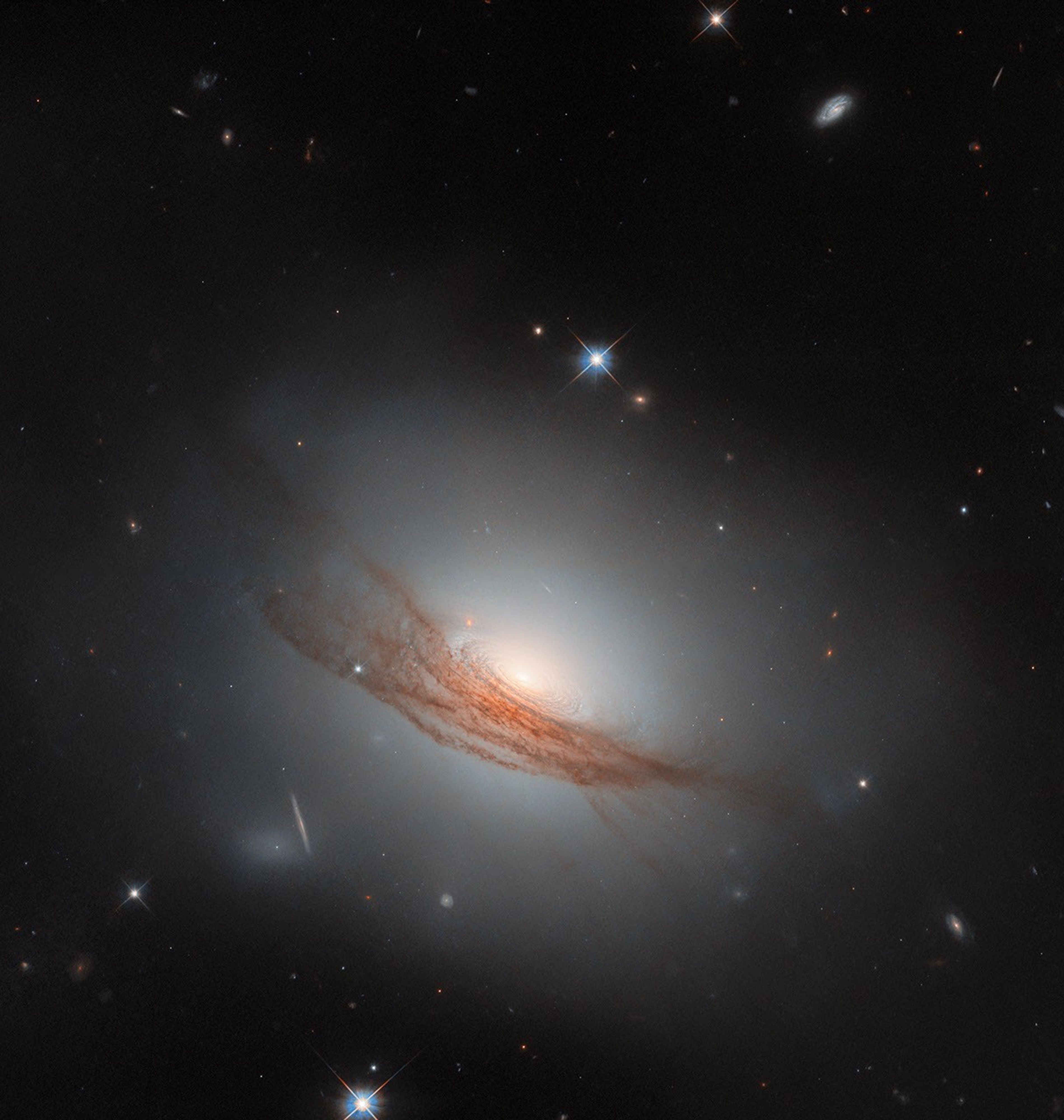
This new Hubble image, released on Jan. 30, 2026, is the sharpest taken of NGC 7722, a lenticular galaxy located about 187 million light-years away in the constellation Pegasus. A lenticular, meaning “lens-shaped,” galaxy is a type whose classification sits between more familiar spiral galaxies and elliptical galaxies. It is also less common than spirals and ellipticals — partly because these galaxies have a somewhat ambiguous appearance, making it hard to determine if it is a spiral, an elliptical, or something in between.
Learn more about this observation.
Image credit: ESA/Hubble & NASA, R. J. Foley (UC Santa Cruz), Dark Energy Survey/DOE/FNAL/DECam/CTIO/NOIRLab/NSF/AURA; Acknowledgment: Mehmet Yüksek
Hubble Spots Lens-Shaped Galaxy
This new Hubble image, released on Jan. 30, 2026, is the sharpest taken of NGC 7722, a lenticular galaxy located about 187 million light-years away in the constellation Pegasus. A lenticular, meaning “lens-shaped,” galaxy is a type whose classification sits between more familiar spiral galaxies and elliptical galaxies. It is also less common than spirals and ellipticals — partly because these galaxies have a somewhat ambiguous appearance, making it hard to determine if it is a spiral, an elliptical, or something in between.
Learn more about this observation.
Image credit: ESA/Hubble & NASA, R. J. Foley (UC Santa Cruz), Dark Energy Survey/DOE/FNAL/DECam/CTIO/NOIRLab/NSF/AURA; Acknowledgment: Mehmet Yüksek
‘X-ray dot’ discovery fuels JWST ‘black hole star’ debate
Researchers have found what might be a little red dot transitioning into its final state, where x-rays burst through its gas cocoon. Others argue the object is nothing special
These two habits are linked to more than a third of all cancer cases
More than one-third of cancer cases are preventable, a massive study finds
Vegan toddlers can grow at the same rate as omnivores
Vegan toddlers can grow at the same rate as omnivores
The AI data center boom could cause a Nintendo Switch 2 memory shortage
Data centers are eating up computing resources and pushing chipmakers toward AI-grade memory, tightening supply for Nintendo and other hardware makers
A presidential greeting ahead of Sophie Adenot's first spaceflight
ESA Director General Josef Aschbacher joined French President Emmanuel Macron at the Élysée Palace for an event celebrating the first spaceflight of ESA astronaut Sophie Adenot.