Nothing is the bridge between the future and the further future. Nothing is certainty. Nothing is any definition of anything.

— Peter Hammill

Feed aggregator

Hubble Spots Lens-Shaped Galaxy

NASA - Breaking News - Thu, 02/05/2026 - 11:39am
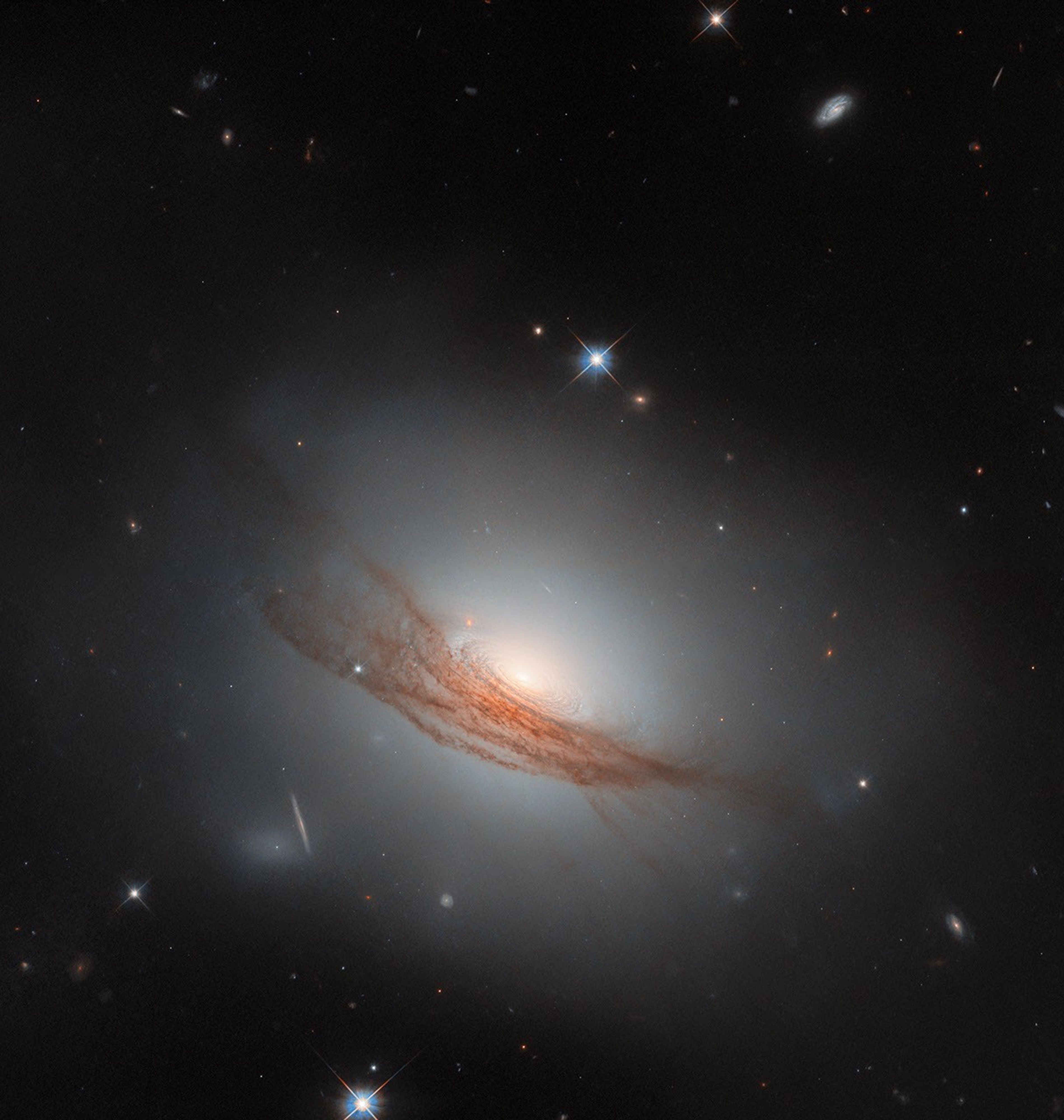
This NASA/ESA Hubble Space Telescope image of NGC 7722, a lenticular galaxy located about 187 million light-years away, features concentric rings of dust and gas that appear to swirl around its bright nucleus.ESA/Hubble & NASA, R. J. Foley (UC Santa Cruz), Dark Energy Survey/DOE/FNAL/DECam/CTIO/NOIRLab/NSF/AURA; Acknowledgment: Mehmet Yüksek

This new Hubble image, released on Jan. 30, 2026, is the sharpest taken of NGC 7722, a lenticular galaxy located about 187 million light-years away in the constellation Pegasus. A lenticular, meaning “lens-shaped,” galaxy is a type whose classification sits between more familiar spiral galaxies and elliptical galaxies. It is also less common than spirals and ellipticals — partly because these galaxies have a somewhat ambiguous appearance, making it hard to determine if it is a spiral, an elliptical, or something in between.

Learn more about this observation.

Image credit:  ESA/Hubble & NASA, R. J. Foley (UC Santa Cruz), Dark Energy Survey/DOE/FNAL/DECam/CTIO/NOIRLab/NSF/AURA; Acknowledgment: Mehmet Yüksek

Categories: NASA

Hubble Spots Lens-Shaped Galaxy

NASA News - Thu, 02/05/2026 - 11:39am
This NASA/ESA Hubble Space Telescope image of NGC 7722, a lenticular galaxy located about 187 million light-years away, features concentric rings of dust and gas that appear to swirl around its bright nucleus.ESA/Hubble & NASA, R. J. Foley (UC Santa Cruz), Dark Energy Survey/DOE/FNAL/DECam/CTIO/NOIRLab/NSF/AURA; Acknowledgment: Mehmet Yüksek

This new Hubble image, released on Jan. 30, 2026, is the sharpest taken of NGC 7722, a lenticular galaxy located about 187 million light-years away in the constellation Pegasus. A lenticular, meaning “lens-shaped,” galaxy is a type whose classification sits between more familiar spiral galaxies and elliptical galaxies. It is also less common than spirals and ellipticals — partly because these galaxies have a somewhat ambiguous appearance, making it hard to determine if it is a spiral, an elliptical, or something in between.

Learn more about this observation.

Image credit:  ESA/Hubble & NASA, R. J. Foley (UC Santa Cruz), Dark Energy Survey/DOE/FNAL/DECam/CTIO/NOIRLab/NSF/AURA; Acknowledgment: Mehmet Yüksek

Categories: NASA

‘X-ray dot’ discovery fuels JWST ‘black hole star’ debate

Scientific American.com - Thu, 02/05/2026 - 11:35am

Researchers have found what might be a little red dot transitioning into its final state, where x-rays burst through its gas cocoon. Others argue the object is nothing special

Categories: Astronomy

These two habits are linked to more than a third of all cancer cases

Scientific American.com - Thu, 02/05/2026 - 11:30am

More than one-third of cancer cases are preventable, a massive study finds

Categories: Astronomy

Vegan toddlers can grow at the same rate as omnivores

New Scientist Space - Cosmology - Thu, 02/05/2026 - 11:06am
Two-year-olds raised in vegan or vegetarian households don't necessarily have restricted growth, according to a study of 1.2 million children
Categories: Astronomy

Vegan toddlers can grow at the same rate as omnivores

New Scientist Space - Space Headlines - Thu, 02/05/2026 - 11:06am
Two-year-olds raised in vegan or vegetarian households don't necessarily have restricted growth, according to a study of 1.2 million children
Categories: Astronomy

The AI data center boom could cause a Nintendo Switch 2 memory shortage

Scientific American.com - Thu, 02/05/2026 - 11:00am

Data centers are eating up computing resources and pushing chipmakers toward AI-grade memory, tightening supply for Nintendo and other hardware makers

Categories: Astronomy

A presidential greeting ahead of Sophie Adenot's first spaceflight

ESO Top News - Thu, 02/05/2026 - 10:55am

ESA Director General Josef Aschbacher joined French President Emmanuel Macron at the Élysée Palace for an event celebrating the first spaceflight of ESA astronaut Sophie Adenot.

Categories: Astronomy

Review: Dwarf Lab's New Dwarf Mini Smart Telescope

Universe Today - Thu, 02/05/2026 - 10:29am

Telescopes are getting smaller. It’s strange to think: smartscopes have been with us for over half a decade now. Since 2020, we’ve tested units from Vaonis, Unistellar and more. In a short time, these smartscopes have revolutionized amateur astronomy, putting deep-sky imaging within reach of causal users. Recently, we had a chance to put Dwarf Lab’s latest unit the Dwarf Mini through its paces.

Categories: Astronomy

#780: When Asteroids & Comets Attack!

Astronomy Cast - Thu, 02/05/2026 - 10:17am

We live in a cosmic shooting gallery. It’s not a matter of “if” but “when”! Dinosaurs, blah, blah, blah. You know the drill. But seriously, folks, it’s raining rocks & ice out there! How seriously should we take it? What happens when a variety of different objects hit the Earth? Different kinds of objects affect Earth very differently when they impact. Let’s discuss what makes an impactor more or less dangerous.

Show Notes
  • Upcoming launches: Artemis II, New Glenn, Starship, and more
  • Why asteroid impacts are inevitable, and how often they happen
  • How size and composition change impact outcomes (rock vs rubble pile)
  • Airbursts, tidal breakup, and “shotgun” impact scenarios
  • Tunguska, Chelyabinsk, and lessons from past events
  • Comets vs asteroids: speed, volatility, and risk
  • Finding the threats: NEO surveys, ATLAS, and Vera Rubin
  • Fireball prediction, meteorite recovery, and rapid-response observing
Transcript

Fraser Cain: 

AstronomyCast, Episode 780, When Asteroids and Comets Attack. Welcome to AstronomyCast, our weekly facts-based journey through the cosmos, where we help you understand not only what we know, but how we know what we know.

I’m Fraser Cain, I’m the publisher of Universe Today. With me as always is Dr. Pamela Gay, a senior scientist for the Planetary Science Institute and the director of CosmoQuest. Hey Pamela, how are you doing?

Dr. Pamela Gay: 

I am doing well. I am deeply confused by what February could bring us in terms of rockets. And very, very sad that I went on vacation, which means that I don’t have the ability to go watch rockets.

Fraser Cain: 

By the time people are listening to this, in theory, Artemis 2 could launch within days of when you’re listening.

Dr. Pamela Gay: 

So we’re looking at Artemis 2, we are looking at New Glenn 2, we’re looking at a variety of other rockets, because why not? There’s a whole bunch of stuff around the globe that’s pioneering this month. I’m going to try and stream a bunch of it, and you usually do interviews with Scott Manley, and I forgot the other human’s name.

And those interviews are wonderful. Go check them out, humans. We’re going back, and I’m really feeling like Blue Origin is going to be able to deliver Viper, and that’s what I’m really excited about.

Fraser Cain: 

It feels very bizarre to me to put these words in a sentence, Blue Origin launches rockets.

Dr. Pamela Gay: 

I know.

Fraser Cain: 

I know. And yet, they appear to be doing such a thing.

Dr. Pamela Gay: 

Yeah.

Fraser Cain: 

Slow and steady. Yeah. Well, slow?

I’m not sure about steady or slow. We have been reporting on their launch delays for almost my entire journalism career.

Dr. Pamela Gay: 

That’s fair. Yeah. But look at where Starship is, and it’s feeling kind of like the turtle and the rabbit right now.

Fraser Cain: 

Yeah.

Dr. Pamela Gay: 

I’m hoping both cross the finish.

Fraser Cain: 

Yeah. Yeah. I mean, New Glenn is not a fully reusable two-stage rocket.

It’s only reusing the first stage. SLS is a non-reusable rocket in every way, shape or form, but it is a monster, while Starship is the one that is actually trying to make full reusability function, and they’re having their challenges as well. Yeah.

So we are definitely in the cutting edge across the world of, you know, China is rushing forward.

Dr. Pamela Gay: 

Yeah. They’re trying it too. They’re trying with the reusable.

Fraser Cain: 

Yeah.

Dr. Pamela Gay: 

Yeah.

Fraser Cain: 

With reusable rockets as well. So yeah, everything is going to be changing. But we’re not going to talk at all about rockets today.

Dr. Pamela Gay: 

No.

Fraser Cain: 

No. We live in a cosmic shooting gallery. It’s not a matter of if, but when.

Dinosaurs. Blah, blah, blah. You know the drill.

But seriously, folks, it’s raining rocks and ice out there. How seriously should we take it? What happens when a variety of different objects hit the Earth?

So you know, we think about objects in space, you know, I’m just like, right now everybody’s listening to this. Imagine an asteroid in your mind, like just like picture that asteroid. You know, the worst science fiction has filled your brain with what an asteroid looks like.

Okay, great. Now imagine a comet. Again, that’s a little better.

Dr. Pamela Gay:

Yeah.

Fraser Cain: 

But still possibly not completely accurate. Now we’re going to sort of explode all of those preconceived notions about what these things actually look like and what they might do to our planet if various ones hit, even if we attempt to prevent them. So let’s just like start with your straight up regular asteroid.

Yes. And you know, again, my, you know, the audience is probably, you know, my imagination is, okay, it’s this sort of potato-like rock. And I sort of think about like Eros and I think about a couple of the other asteroids we’ve got images of.

Dr. Pamela Gay: 

Carbonaceous chondrite.

Fraser Cain: 

Itokawa. Right.

Dr. Pamela Gay: 

Yeah. Itokawa is a great example. It’s a few hundred meters across.

It’s cashew shaped. It appears to be a solid object. And yeah, so you send that kind of a several hundred meter asteroid at the planet Earth and you’re looking at a global catastrophe.

It is 20,000 megatons of energy, assuming your typical impact rate of about 20 kilometers per second. Ouch. But those kinds of impacts appear to happen about every 200,000 years.

Fraser Cain: 

Right. That a multi hundred meter object that will have global consequences appears to happen every few hundred thousand years. And like, unless I’m wrong, like we’re all very familiar with the meteor crater impact and that one doesn’t even qualify for those bigger impacts.

Dr. Pamela Gay: 

Yeah. So meteor crater is about a kilometer across. That’s the kind of thing that you get from something that depending on what it’s made of, what the density of the impactor is, could be anywhere from 50 to a hundred meters.

And so yeah, meteor crater was still caused by something fairly large, but in the grand scheme of things, not that large. And it’s wild to consider all the different possibilities. Itokawa is a great one to consider because it appears to be a fairly solid object.

It’s the not solid ones that deeply worry me.

Fraser Cain: 

And that’s where we got new images of asteroids from Hayabusa2 as well as OSIRIS-REx. And that looks nothing like that solid rock object that is, you know, what we see in all of the artwork of asteroids as the dinosaurs are looking up and watching this multi cratered thing blazing in the sky above them.

Dr. Pamela Gay: 

So with Bennu, you have an object that is roughly the density of a ball pit of basically gravel and rock and boulders loosely held together such that the pull of gravity, if you were on the surface, you would feel like how a piece of paper feels on your hand. So this is a very loosely held together object. And as it approaches the earth, it’s going to get loosened up further and further.

And there is the potential for that to end up being a series of objects impacting our planet depending on how much they get slowed down or not, how much it gets disrupted or not. Yeah, yeah.

Fraser Cain: 

So, you know, we think about this idea of the Roche limit, which is how close objects have to be where the tidal forces of the earth will tear it apart into chunks and then those chunks will be torn apart into chunks and then you’ll get, you know, if it becomes really close and you’ll get something like a ring, which is always a bad day. You never want to see a ring around the earth. That is trouble.

But if it does get relatively close and it’s still going to hit, it will get torn apart as it’s getting closer, especially since it has absolutely nothing holding it together beyond the mutual gravity and it’s almost done. And so you get it turning into this smear of gravel and various boulders and rocks.

Dr. Pamela Gay: 

As the world turns, different parts get impacted. Now, on one hand, there’s the good news that smaller things are just going to get completely obliterated in the atmosphere. Anything under 10 meters, it’s not going to hit the surface.

But all that kinetic energy is going to end up in the atmosphere. And all of that kinetic energy is going to heat up the atmosphere. And our atmosphere becomes an easy bake oven.

And this is not a good way for us to combat global warming.

Fraser Cain: 

Right. Of course. Yeah.

Instantaneously, we’ve got ourselves a problem. I think about the impacts of Shoemaker-Levy 9 on Jupiter back in the late 90s. A tidally disrupted comet.

Yeah, a tidally disrupted comet. Sorry, 94. It was 94.

Yeah. You see these bruises across Jupiter. And so imagine if some rock was getting close to the Earth, the tidal forces, as it was getting closer and closer, started to separate it out a bit.

And then you get this string of impacts across some larger area. And so what would have been constrained down to just a single spot, boom, mushroom cloud. Yeah.

Big impact turns into this long stream. And so when we look at the impacts like Meteor Crater, we know now that it actually was a metallic meteorite held together.

Dr. Pamela Gay: 

Yes.

Fraser Cain: 

But that’s not going to be the behavior. When you look at Bennu or Ryugu, they are… What were they?

How many were they? Like a kilometer across?

Dr. Pamela Gay: 

500 and I think 900. They’re almost a factor of two difference in size.

Fraser Cain: 

Yeah.

Dr. Pamela Gay: 

Meters.

Fraser Cain: 

Yeah, so way bigger. Yeah. And it’s a shotgun hit on the Earth.

Dr. Pamela Gay: 

And this is where we have to start worrying about what is the continuum that we have to deal with. So on one end, you have… We learned last week, two weeks ago, time has no meaning, that the Rubin Observatory has discovered some fast rotating asteroids where you have things that are rotating fast enough that if you stood just inside their surface, you’d experience one sixth G.

So it’d be loosely like standing on the surface of the moon if you were at the equator of one of these naturally rotating, holding themselves together quite nicely asteroids. They’re super exciting. So we have these nice solid objects that when they hit can cause catastrophic massive craters and even worse if they hit the ocean, catastrophic tidal waves that can destroy far more area because of how far the water rushes in.

If you want to read a… It shows its age, but it’s still a good book about this. Lucifer’s Hammer is one that I highly recommend.

It gets the science right, even though it’s an older book.

Fraser Cain: 

And a guy tries to surf the tsunami wave.

Dr. Pamela Gay: 

Yeah, which you know would happen. You know that would happen.

Fraser Cain: 

Yeah. All right. So we’ve been kind of rambling around a bit.

So let’s now put it all together. So let’s start with, first, let’s start with asteroids. We’ll start smallest and go to biggest possible impact that we can envision.

Dr. Pamela Gay: 

All right. So assuming solid objects here.

Fraser Cain: 

Yes.

Dr. Pamela Gay: 

Up to 10 meters, it’s just going to be an explosion in the atmosphere that’s pretty. Around 25, 30 meters, it starts to be able to survive close enough to the surface that when it explodes, it’s like Chelyabinsk, where you end up with the flash of light that causes everyone to run to their windows, which is not what you should do. And then the shockwave hits the window, shatters it in your face, and you go to the hospital.

Do not approach the window when there’s a flash of light. Do not. But you will.

Yeah, yeah. So once you start getting over 100 meters, depending on the substance, again, this all depends on the density of the object. This is where you start to get craters of anywhere from house-sized to let’s form the Yucatan Peninsula.

Fraser Cain: 

Right, right, sure. But like Tunguska, people are familiar with the Tunguska impact, although that’s probably an airbursting thing, but you’re getting a five megaton explosion and crater forming.

Dr. Pamela Gay: 

And with Tunguska, this is where we have to start considering composition. If you have something that’s full of volatiles, it’s going to behave differently as it heats up than if you have something that is made of carbon and deteriorates and burns up at that temperature versus something that is iron that just gets slightly melty, encrusted, and makes it to the surface and ruins someone’s day. So as we consider, is it solid or not?

If it’s solid, solid crater. If it’s solid and dirt, it burns up. If it’s solid and ice, it goes boom.

If it’s solid and metal, it meets the surface. Now, as you end up with something like… We keep finding these snowball-shaped contact binary asteroids.

They’re super cool. They’re barely held together. They become two separate objects during this kind of an impact event because the neck breaks.

It’s the reality. And so now you have two incoming rocks that depending on how much they separate during impact, you can either end up with very close together craters, or you can end up just taking out two radically different parts of the planet. And this is one of those things where the movie Deep Impact and the movie Armageddon came out just, I want to say either weeks or months apart.

I don’t remember, but it was the same year.

Fraser Cain: 

It was months apart for sure. Same year.

Dr. Pamela Gay: 

And Deep Impact is like, yeah, it blew up. It’s going to hit a whole lot of places. We’re in trouble.

Whereas Armageddon is like, it blew up. We’re fine. We’re safe.

No, Deep Impact got that one right. And you want your asteroid to stay together and hit land somewhere in the middle of nowhere and just get melted, like hit a big desert, take out a desert. Do not hit a glacier.

Do not hit volcanoes. Do not hit opposite volcanoes. Do not hit water.

This is a take out a desert and turn it to glass. That would be awesome. Thank you very much.

Fraser Cain: 

Yeah. At what point does NASA, you know, NASA has various scales that they look at and there’s these other sort of international collaborations, the Torino scale, the Palermo scale. At what point do we see, like what size of an object gives us?

Dr. Pamela Gay: 

50 meters. Anything over 50 meters, you really start to worry.

Fraser Cain: 

Yeah. But what gives us like a hemispheres amount of damage and what gives us global damage?

Dr. Pamela Gay: 

Okay. So anything over 300 meters, just average carbonaceous chondroit. Anything over 300 meters is the potential for, yeah, Australia would definitely go boom.

Europe would go boom. Right. Probably stretching it for Asia.

It depends on the size of your continent. Pick wisely.

Fraser Cain: 

Yeah.

Dr. Pamela Gay: 

But then once you start to get like one kilometer and above, this is where like global catastrophe.

Fraser Cain: 

Yeah.

Dr. Pamela Gay: 

10 kilometers, mass extinction.

Fraser Cain: 

Right. That’s the dinosaurs where every plant on earth lights on fire because of the rock raining back down, the hot rock raining back down.

Dr. Pamela Gay: 

Yeah.

Fraser Cain: 

It’s a very bad day. It’s interesting. There was a study that we reported on, you know, people think, well, like a kilometer.

Dr. Pamela Gay: 

Was this the fossils with glass in the gills?

Fraser Cain: 

Oh no. I hadn’t heard that, but these fish had gone to space, right?

Dr. Pamela Gay: 

Yeah.

Fraser Cain: 

Yeah.

Dr. Pamela Gay: 

Well, okay. So there’s multiple stories on this. I love this far too much.

I’m sorry. I’m going to geek out and interrupt you. All right.

So it hit with enough force that the shock wave moving through land was able to send at escape velocities, land, trees and dinosaurs at escape velocities. So the first animals to go into space were actually dinosaur era critters.

Fraser Cain: 

Right.

Dr. Pamela Gay: 

That were very much not alive by the time they reached space.

Fraser Cain: 

Yeah.

Dr. Pamela Gay: 

Then the shock wave went around the world multiple times, massive tsunamis heading up rivers. And there are fossils that have been found in the Western part of the United States, somewhere that begins with the letter T. I have forgotten the exact name of the place where these fossils are from the day of the destruction where they like found one that had its leg torn off.

They found fish that had the glass that formed from the hot materials in the atmosphere, in the gills. And the fact that we actually found a field of fossils that are associated with this impact is just not something I think most of us thought would ever happen. And it has been done and it is amazing.

Fraser Cain: 

Okay.

Dr. Pamela Gay: 

I’m done squeeing.

Fraser Cain: 

No, no, no. It’s fine. Your tendency to being a supervillain is just revealed one more time.

That’s true. All right. So we’ve talked about asteroids.

Let’s talk about comets. How are comets different in their potential for destruction?

Dr. Pamela Gay: 

It’s a whole lot of what is the density. And so comets do include organics. They do include gravel.

They do include dirt. All of that is in there, but they are mostly volatiles. They are mostly stuff that is just going to go boom in the atmosphere as it suddenly converts itself from ice to gas, which is terrible in many different ways.

So if you think about it, you have something that is, again, anywhere from tens of meters to tens of kilometers is the range you’re looking at for comets that is approaching the atmosphere and the small ones that sudden increase in volume as solid nitrogen, as solid water suddenly goes to vapor and expands greatly. That’s where your danger is coming from. And there’s a lot of researchers who think that Tunguska was a chunk of comet that just came in over Siberia.

And as it was coming down, it had that phase change. And that sudden pressure wave flattened all of the trees except for the ones in the very center, killed some reindeer, killed a few reindeer hunters, and left nothing behind. This is one of the most enigmatic events in measured history where there are photos of what occurred, and they have searched and searched and searched that landscape, and there’s just no chunks to be found.

And with that much destruction, it would have to be complete obliteration, which you can get with an air-bursting comet.

Fraser Cain: 

Right, right. And I think the other challenge, of course, is the comets can come in a lot faster. So, you know, you always use that 20 kilometers per second for asteroids.

Energy, yeah, the amount of energy that is delivered is proportional to the velocity squared. And so the higher the velocity, the more damage can be done. A smaller comet can do more damage if it’s coming in fast.

And so think about interstellar objects. Like, think about something like 3i Atlas at the speed that it was going. At some point, it was upwards of a 10-kilometer object.

People were thinking, now it’s probably a little smaller than that. But still, going at, oh, 50, 60 kilometers per second?

Dr. Pamela Gay: 

Yikes. And this is where part of the justification for building the Vera Rubin Observatory was to go out and find the unknowns of these things. So it’s estimated that there’s more than 500 million near-Earth objects that are 4 meters and smaller, and we’ve only found a tenth of a percent of them.

So there’s a whole bunch of baby stuff out there that Atlas keeps finding just as it enters the atmosphere and obliterates itself. It’s estimated that there are 900, 1,000-meter or 1-kilometer or larger asteroids out there, and we’re only at the 95 percent. That’s good news.

It’s good, but 95 percent is not 100 percent.

Fraser Cain: 

For sure. But there’s only 50-ish global destructive asteroids in our vicinity that we are not aware of yet.

Dr. Pamela Gay: 

That’s all. And comets are their own rogue thing.

Fraser Cain: 

Yes.

Dr. Pamela Gay: 

So the probability of getting hit by a large comet is exceedingly tiny because there’s not going to be that many. There’s not that many getting sent in. There’s definitely not that many alien ones coming in.

But there’s still the potential, and where we don’t know all the details on what’s out in the Oort cloud waiting to get sent this way, you always have to wonder, is there a 10-kilometer one out there waiting to come in? Is a Sedna going to somehow get jettisoned our direction?

Fraser Cain: 

Thank you.

Dr. Pamela Gay: 

There’s no reason to think that at some point in our orbit around the galaxy, a close pass with a red dwarf won’t send in a Sedna-sized object to wreck the inner solar system.

Fraser Cain: 

Yes. So we have a very long-lived audience. You all take very good care of yourselves.

And so can you give people a sense of, in their lifetimes or in hypothetical lifetimes where they get their robot bodies, how often they should expect to see various sizes of impacts?

Dr. Pamela Gay: 

So we should expect Chelyabinsk or Tunguska-type things about once a century.

Fraser Cain: 

Those are two separate creatures, right?

Dr. Pamela Gay: 

We should expect a large air burst capable of causing havoc to a city-sized area in one form or another, roughly every century. Right.

Fraser Cain: 

So another is a natural Hiroshima. Yeah. Once a century.

Dr. Pamela Gay: 

Yeah. The others, so 25 meters is once every 100 years. 140 meters is every 20,000 years.

Wow. Okay. That 1,000 meters, one kilometer, it depends on what you’re looking at, 200,000 to 500,000 years.

Fraser Cain: 

And the dinosaur killer, that’s like in the tens of millions of years. The 10-kilometer object.

Dr. Pamela Gay: 

10 kilometers, 100 to 200 million years.

Fraser Cain: 

Yeah. Yeah. When you think about it, it was whatever, 65 million years ago that the one that took out the…

And it’s funny because when you think about the movie Armageddon and the sort of classic, like, how big is it? It’s the size of Texas, sir. What?

No.

Dr. Pamela Gay: 

There are none.

Fraser Cain: 

There are no… Like maybe, what, Ceres? Ceres is that size, yeah.

And Vesta are the size of Texas? Maybe a large moon of Saturn? That, as you said, there is nothing that is the size of Texas that could hit us.

So don’t worry about…

Dr. Pamela Gay: 

No.

Fraser Cain: 

And if it did…

Dr. Pamela Gay: 

That would be so bad.

Fraser Cain: 

You would get the moon. It’s true. You would get an impact so catastrophic.

That it would recreate the conditions that formed the moon.

Dr. Pamela Gay: 

Much smaller, much, much smaller. The moon was formed by an impact with something that was roughly Mars-sized.

Fraser Cain: 

Sure, still. But still, you would get a ring. Yeah, you would get…

I mean, the entire surface of the planet would be flipped over. It would be molten. There would be no…

Dr. Pamela Gay: 

It would be bad. There’s nothing left. But you wouldn’t get a moon the size of our moon.

That’s all I’m saying. We’ll destroy everything.

Fraser Cain: 

Right, fine. The point is, did not some astronomer look at… Of course, no astronomers were involved in the making of that movie at all.

Dr. Pamela Gay: 

No, they had astronomers involved in Deep Impact and that shows. And unfortunately, it didn’t get as good a rating.

Fraser Cain: 

Yeah, yeah. So I think it’s funny. We were there and I remember you called me…

Yeah, when Chelyabinsk happened. When Chelyabinsk went off in 2013.

Dr. Pamela Gay: 

Yep.

Fraser Cain: 

When we had been doing this for quite a while back then. And you were like, something just exploded in Russia.

Dr. Pamela Gay: 

Yeah, he called me on the phone.

Fraser Cain: 

Which is a thing you never do.

Dr. Pamela Gay: 

Yeah, maybe once every three years.

Fraser Cain: 

I get a phone call from Pamela like, uh-oh, right? And then, yeah, we got the Chelyabinsk and that was a thing. And…

It was amazing. Yeah, yeah.

Dr. Pamela Gay: 

Also terrible, but also amazing.

Fraser Cain: 

Yeah, yeah. Again, you’re a super villain.

Dr. Pamela Gay: 

Good science, bad humanity.

Fraser Cain: 

Yeah, your super villain side is starting to show. And that was, I think it was whatever, it was about 15 meters across. It was house-sized, right?

Compared to whatever it was that caused Tunguska. And we all experienced it. And it’s funny because there are probably two, say, five meter impacts that happen every year.

Like the airbursts happen randomly.

Dr. Pamela Gay: 

Yeah. And Atlas is really good at finding them and figuring out where they came down. And what I’m loving is we’ll get usually a few hours notice.

And so you’ll see things often out of ESA of be prepared, go watch, report your images, and then they go find the shrapnel from you. There was a team from SETI that was able to take the data from Atlas, security camera footage, and find the meteorite in a Nairobi animal preserve. And it’s just sort of like…

Fraser Cain: 

Yeah.

Dr. Pamela Gay: 

How? How did… I’m…

it’s amazing.

Fraser Cain: 

Yes. I mean, where things are at now, as you said, is we have this defense network where various automated telescopes are scanning the sky. And Atlas has multiple telescopes.

Yes. And when they detect some object that is on course with Earth, then other telescopes jump in, in some cases automatically, make further observations. They then pin down when the object is going to strike the atmosphere and where and what trajectory it’s going to take so that astronomers are prepared and can observe it.

And so we’ve entered this realm where… How many fireballs have you seen in your life? I’ve seen one.

Dr. Pamela Gay: 

Oh, I’ve seen more than that. But I think it’s because I got really lucky with the August meteor shower and the November meteor shower.

Fraser Cain: 

Right. So you can now get a notification as an astronomer to go outside, where to look. You could even drive a bit to reach the point where the impact is going to happen.

Yes. So you can watch it. It’s crazy that we’re at this point now that we can predict these things with enough accuracy that you can go out and watch a fireball on command, which is just amazing to me.

Dr. Pamela Gay: 

On command of us, not on command of the fireball. We can’t yet order up fireballs.

Fraser Cain: 

No, we can’t do that. But the point being that before it was all random. You just happen to be outside.

You happen to be looking up. Now you can know where to go, where to look, what to see. And it just shows up right on schedule.

All right. Notice we didn’t talk about at all about how to stop these things, but we’ve talked about this in the past.

Dr. Pamela Gay: 

It’s true.

Fraser Cain: 

You all know the score. All right.

Dr. Pamela Gay: 

Thanks, Pamela. Hope for the solid objects to impact. Never go with the loose ones.

Fraser Cain: 

Right. Hit the land. Don’t hit the ocean.

Dr. Pamela Gay: 

All right, everyone. Thank you very much, and especially thank you to all of our patrons. This week, we would like to thank the following $10 a month and up patrons.

Alan Gross, Alexis, Andrew Stevenson, Arctic Fox, Astro Sets, Bebop Apocalypse, Benjamin Mueller, Bob Crail, Brett Mormon, Brian Cook, Burry Gowen, Christian Berghold, Conrad Haling, Daniel Loosley, David Bogarty, David Rossetter, Dr. Whoa, Dwight Ilk, Yaron Zegrev, Fairchild, Flower Guy, Frodo Tanenbach, Jeff McDonald, Glenn McDavid, Greg Davis, Hal McKinney, J. Alex Anderson, Janelle, Jean-Baptiste Lamartine, Jeremy Kerwell, Jim of Everett, Joe McTee, John Herman, Jonathan H. Staver, J.P. Sullivan, Kate Sendretto, Keith Murray, Kimberly Rake, Lab Rat Matt, Lee Harbourn, Lana Spencer, Mark Schindler, Matt Rucker, Matthias Hayden, Michael Purcell, Michelle Cullen, Nala, Noah Albertson, Pauldi Disney, Pauline Middleink, Philip Walker, Red Bar Is Watching, R.J. Basque, Robert Hindle, Ruben McCarthy, Sergio Cinsevro, Sam Brooks and His Mom, Scone, Sean Matts, Shabhana, Steve Rutley, Taz Tolley, The Brain, Tiffany Rogers, Travis C. Porco, Van Ruckman, Will Field, and Zach Krukendall.

Thank you so very much. And if you want your name in the next set of episodes, I will be pulling the names and recording next Monday for February. So go hit us up on patreon.com slash astronomycast. All right. Thanks, everyone. And we’ll see you next week.

Bye-bye, everyone.

Live Show
Categories: Astronomy

NASA’s next space suit for Artemis has out-of-this-world mobility

Scientific American.com - Thu, 02/05/2026 - 8:00am

Astronauts are flying to the moon for the first time since 1972, and scientists are preparing specialized space suits for the next milestone—landing there

Categories: Astronomy

Virginia Trimble, Memory Keeper of Modern Astronomy

Sky & Telescope Magazine - Thu, 02/05/2026 - 8:00am

Virginia Trimble collected "shiny things" in astronomy — and her curated collections fascinated astronomers around the world.

The post Virginia Trimble, Memory Keeper of Modern Astronomy appeared first on Sky & Telescope.

Categories: Astronomy

Turning Forgotten Telescope Data into New Discoveries

Universe Today - Thu, 02/05/2026 - 7:14am

Astronomers have been collecting data for generations, and the sad fact is that not all of it has yet been fully analyzed. There are still discoveries hiding in the dark recesses of data archives strewn throughout the astronomical world. Some of them are harder to access than others, such as actual physical plates containing star positions from more than a hundred years ago. But as more and more of this data is archived, astronomers also keep coming up with ever more impressive tools to analyze it. A recent paper from Cyril Tasse of the Paris Observatory and his co-authors, published recently in Nature Astronomy describes an algorithm that analyzes hundreds of thousands of previously unknown data points in radio telescope archives - and they found some interesting features in it.

Categories: Astronomy

NASA's Artemis II Spacecraft on the Launch Pad

Universe Today - Wed, 02/04/2026 - 10:08pm

NASA’s Orion spacecraft, which will carry the Artemis II crew around the Moon, sits at the launch pad on Jan. 17, 2026, after rollout. It rests atop the SLS (Space Launch System) rocket. Orion can provide living space on missions for four astronauts for up to 21 days without docking to another spacecraft. Advances in technology […]

Categories: Astronomy

NGC 2442: Galaxy in Volans

APOD - Wed, 02/04/2026 - 8:00pm

NGC 2442: Galaxy in Volans


Categories: Astronomy, NASA

Women and men are almost equally as likely to be diagnosed as autistic by adulthood, new study finds

Scientific American.com - Wed, 02/04/2026 - 6:31pm

Boys are more likely to be diagnosed as autistic as children—but by adulthood, that trend changes, according to a new study in Sweden

Categories: Astronomy

Curiosity Blog, Sols 4788-4797: Welcome Back from Conjunction

NASA - Breaking News - Wed, 02/04/2026 - 6:05pm
Curiosity Navigation

2 min read

Curiosity Blog, Sols 4788-4797: Welcome Back from Conjunction NASA’s Mars rover Curiosity acquired this image using its Mast Camera (Mastcam); it shows the “Nevado Sajama” drill site from November, right next to the location of this weekend’s drill. The new drill site will be to the upper left of the existing hole. Curiosity captured the image on Jan. 25, 2026 — Sol 4789, or Martian day 4,789 of the Mars Science Laboratory mission — at 19:20:37 UTC. NASA/JPL-Caltech/MSSS

Written by Alex Innanen, Atmospheric Scientist at York University, Toronto

Earth planning date: Friday, Jan. 30, 2026

Mars has emerged from its holiday behind the Sun, and we here on Earth have been able to reconnect with Curiosity and get back to work on Mars. Our first planning day last Friday gave Curiosity a full weekend of activities, which wrapped up with getting us ready for our next drill. We checked out a broken white rock in the workspace with APXS, MAHLI, and ChemCam’s laser spectrometer and finished up imaging a sandy area we’ve kept an eye on during conjunction to see if we could catch any wind motion, before taking a small drive to our drill location about 2 meters away (about 6 feet).

This location may look familiar — our next drill will be only a few centimeters away from “Nevado Sajama,” which we drilled back in November. The reason we’ve returned here is to do a rare SAM experiment the instrument’s last container of tetramethylammonium hydroxide (or TMAH, for less of a mouthful). TMAH is a chemical that we can mix with our sample from Nevado Sajama to help identify any organic molecules. SAM had only two containers of TMAH (the first of which we used almost six years ago, so we want to be very certain that everything will go well with this experiment. As a result, we did a rehearsal of the handoff of the sample to SAM in Wednesday’s plan, before we drill this weekend.

The TMAH experiment takes up a lot of Curiosity’s energy, so there isn’t a ton to spare for other science activities. Luckily, we’ve spent a lot of time in this area and have collected plenty of images of our surroundings. Because of that, we’ve used our little bit of extra time in the second half of the week for environmental observations. We’re well into the dusty season now, so we’re keeping an eye on dust both near (looking out for dust devils) and far (keeping track of how much dust is in the crater and wider atmosphere).

NASA’s Mars rover Curiosity at the base of Mount Sharp NASA/JPL-Caltech/MSSS

Share

Details

Last Updated

Feb 05, 2026

Related Terms Explore More

3 min read Curiosity Blog, Sols 4750-4762: See You on the Other Side of the Sun

Article


1 month ago

3 min read Wind-Sculpted Landscapes: Investigating the Martian Megaripple ‘Hazyview’

Article


2 months ago

3 min read Curiosity Blog, Sols 4743-4749:  Polygons in the Hollow

Article


2 months ago

Keep Exploring Discover More Topics From NASA

Mars

Mars is the fourth planet from the Sun, and the seventh largest. It’s the only planet we know of inhabited…


All Mars Resources

Explore this collection of Mars images, videos, resources, PDFs, and toolkits. Discover valuable content designed to inform, educate, and inspire,…


Rover Basics

Each robotic explorer sent to the Red Planet has its own unique capabilities driven by science. Many attributes of a…


Mars Exploration: Science Goals

The key to understanding the past, present or future potential for life on Mars can be found in NASA’s four…

Categories: NASA

Curiosity Blog, Sols 4788-4797: Welcome Back from Conjunction

NASA News - Wed, 02/04/2026 - 6:05pm
Curiosity Navigation

2 min read

Curiosity Blog, Sols 4788-4797: Welcome Back from Conjunction NASA’s Mars rover Curiosity acquired this image using its Mast Camera (Mastcam); it shows the “Nevado Sajama” drill site from November, right next to the location of this weekend’s drill. The new drill site will be to the upper left of the existing hole. Curiosity captured the image on Jan. 25, 2026 — Sol 4789, or Martian day 4,789 of the Mars Science Laboratory mission — at 19:20:37 UTC. NASA/JPL-Caltech/MSSS

Written by Alex Innanen, Atmospheric Scientist at York University, Toronto

Earth planning date: Friday, Jan. 30, 2026

Mars has emerged from its holiday behind the Sun, and we here on Earth have been able to reconnect with Curiosity and get back to work on Mars. Our first planning day last Friday gave Curiosity a full weekend of activities, which wrapped up with getting us ready for our next drill. We checked out a broken white rock in the workspace with APXS, MAHLI, and ChemCam’s laser spectrometer and finished up imaging a sandy area we’ve kept an eye on during conjunction to see if we could catch any wind motion, before taking a small drive to our drill location about 2 meters away (about 6 feet).

This location may look familiar — our next drill will be only a few centimeters away from “Nevado Sajama,” which we drilled back in November. The reason we’ve returned here is to do a rare SAM experiment the instrument’s last container of tetramethylammonium hydroxide (or TMAH, for less of a mouthful). TMAH is a chemical that we can mix with our sample from Nevado Sajama to help identify any organic molecules. SAM had only two containers of TMAH (the first of which we used almost six years ago, so we want to be very certain that everything will go well with this experiment. As a result, we did a rehearsal of the handoff of the sample to SAM in Wednesday’s plan, before we drill this weekend.

The TMAH experiment takes up a lot of Curiosity’s energy, so there isn’t a ton to spare for other science activities. Luckily, we’ve spent a lot of time in this area and have collected plenty of images of our surroundings. Because of that, we’ve used our little bit of extra time in the second half of the week for environmental observations. We’re well into the dusty season now, so we’re keeping an eye on dust both near (looking out for dust devils) and far (keeping track of how much dust is in the crater and wider atmosphere).

NASA’s Mars rover Curiosity at the base of Mount Sharp NASA/JPL-Caltech/MSSS

Share

Details

Last Updated

Feb 05, 2026

Related Terms Explore More

3 min read Curiosity Blog, Sols 4750-4762: See You on the Other Side of the Sun

Article


1 month ago

3 min read Wind-Sculpted Landscapes: Investigating the Martian Megaripple ‘Hazyview’

Article


2 months ago

3 min read Curiosity Blog, Sols 4743-4749:  Polygons in the Hollow

Article


2 months ago

Keep Exploring Discover More Topics From NASA

Mars

Mars is the fourth planet from the Sun, and the seventh largest. It’s the only planet we know of inhabited…


All Mars Resources

Explore this collection of Mars images, videos, resources, PDFs, and toolkits. Discover valuable content designed to inform, educate, and inspire,…


Rover Basics

Each robotic explorer sent to the Red Planet has its own unique capabilities driven by science. Many attributes of a…


Mars Exploration: Science Goals

The key to understanding the past, present or future potential for life on Mars can be found in NASA’s four…

Categories: NASA