

Feed aggregator
Student Team Finds One of the Oldest Stars in the Universe that Migrated to the Milky Way
A class of undergraduate students at University of Chicago has used data from the Sloan Digital Sky Survey (SDSS) to discover one of the oldest stars in the universe, a star that formed in a companion galaxy and migrated to the Milky Way.
Tweaking the smell of cat food can encourage fussy felines to eat
Tweaking the smell of cat food can encourage fussy felines to eat
Why Does Jupiter Have More Large Moons than Saturn?
The two largest planets in our Solar System, Jupiter and Saturn, have the largest systems of moons. However, Jupiter has more large moons than Saturn, which has only one. Since both planets are gas giants, the reasons for the differences in these satellite systems have long puzzled astronomers. This motivated a collaborative team of researchers from Japan and China to develop a physically consistent model that can explain this.
Hidden fossils reveal secrets of oceans before major mass extinction
Hidden fossils reveal secrets of oceans before major mass extinction
It's Not Supposed To Be Like This: A Giant Planet Orbits A Small Star
According to theory and models of planet formation, large gas giants should form around massive stars. That's because massive stars have more massive protoplanetary disks. But astronomers have the opposite arrangement in some cases. New research highlights a massive gas giant on a close-in orbit around a low-mass M-dwarf, and it poses another challenge to our understanding planet formation.
New Perspective of Home
New Perspective of Home
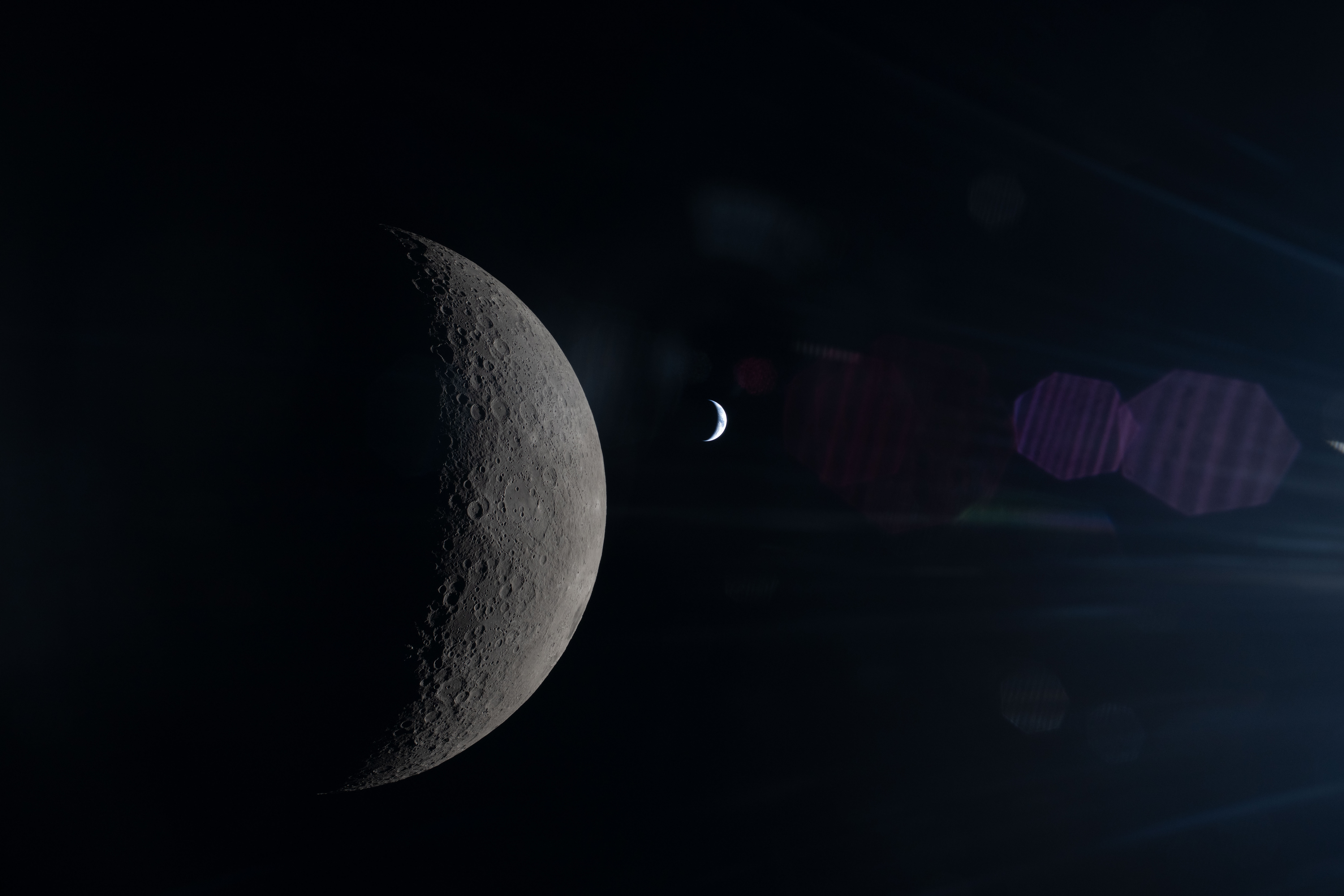
Seen during Artemis II’s lunar flyby on April 6, 2026, the Moon and Earth align in the same frame, each partially illuminated by the Sun. The Moon’s surface appears in sharp detail in the foreground, while Earth sits much farther away, smaller and softly lit in the background. A faint reflection in the spacecraft window is also visible, subtly overlaying the scene. Though their phases differ, both are shaped by the same sunlight, revealing the geometry of the Sun–Earth–Moon system from deep space.
NASA astronauts Reid Wiseman, Christina Koch, and Victor Glover, and CSA (Canadian Space Agency) astronaut Jeremy Hansen are set to return to Earth, splashing down in the Pacific Ocean around 8:07 p.m. EDT. Watch their return with NASA.
Image credit: NASA
New Perspective of Home
Seen during Artemis II’s lunar flyby on April 6, 2026, the Moon and Earth align in the same frame, each partially illuminated by the Sun. The Moon’s surface appears in sharp detail in the foreground, while Earth sits much farther away, smaller and softly lit in the background. A faint reflection in the spacecraft window is also visible, subtly overlaying the scene. Though their phases differ, both are shaped by the same sunlight, revealing the geometry of the Sun–Earth–Moon system from deep space.
NASA astronauts Reid Wiseman, Christina Koch, and Victor Glover, and CSA (Canadian Space Agency) astronaut Jeremy Hansen are set to return to Earth, splashing down in the Pacific Ocean around 8:07 p.m. EDT. Watch their return with NASA.
Image credit: NASA
The secret project to settle controversial maths proof with a computer
The secret project to settle controversial maths proof with a computer
The Expanse authors James S. A. Corey explore alien war in new book The Faith of Beasts
Award winning duo James S. A. Corey show humanity’s struggle with staggering alien power in their latest installment of the Captive’s War series
New particle mass measurement deepens quantum mystery
A new calculation helps narrow down the mass of the W boson, one of the heaviest fundamental particles in the universe
NASA’s Artemis II crew returns to Earth
On Friday these four astronauts and their Orion spacecraft will splash down in the Pacific Ocean after a 10-day mission around the moon
Rubin Observatory Announces 11,000 New Asteroids
The Vera C. Rubin Observatory will discover up to 500,000 solar system objects every year. It’s already starting to deliver on that promise.
The post Rubin Observatory Announces 11,000 New Asteroids appeared first on Sky & Telescope.
ESA Launches 7 New Missions to Supercharge Space Data Transfer
Space is getting crowded - and not just with satellites, but with the massive amounts of data they’re generating. The amount of information being generated and passed through orbit is exploding. From high-resolution Earth observation images to global maritime monitoring, it’s also become a critical link in our infrastructure. But there’s another space this growing crowd of satellites is dependent on that is also filling up fast - the radio frequency spectrum. If we want to keep expanding our orbital infrastructure, we need to rethink how we move data around. On March 30, 2026, the European Space Agency (ESA) supported a series of eight CubeSats and one specialized payload on SpaceX’s Transporter-16 rideshare mission with the overarching goals of testing high-throughput laser communication, inter-satellite networking, and in-orbit artificial intelligence processing to make space data transfer faster, more secure, and vastly more efficient.
Week in images: 06-10 April 2026
Week in images: 06-10 April 2026
Discover our week through the lens
NASA’s Artemis II crew returns today—here’s what to know ahead of splashdown
After a 10-day mission around the moon, the Artemis II astronauts will have traveled nearly 700,000 miles