
Who are we? We find that we live on an insignificant planet of a humdrum star lost in a galaxy tucked away in some forgotten corner of a universe in which there are far more galaxies than people

— Carl Sagan

Feed aggregator

Hello, World
NASA News - Fri, 04/03/2026 - 9:34am
NASA/Reid Wiseman

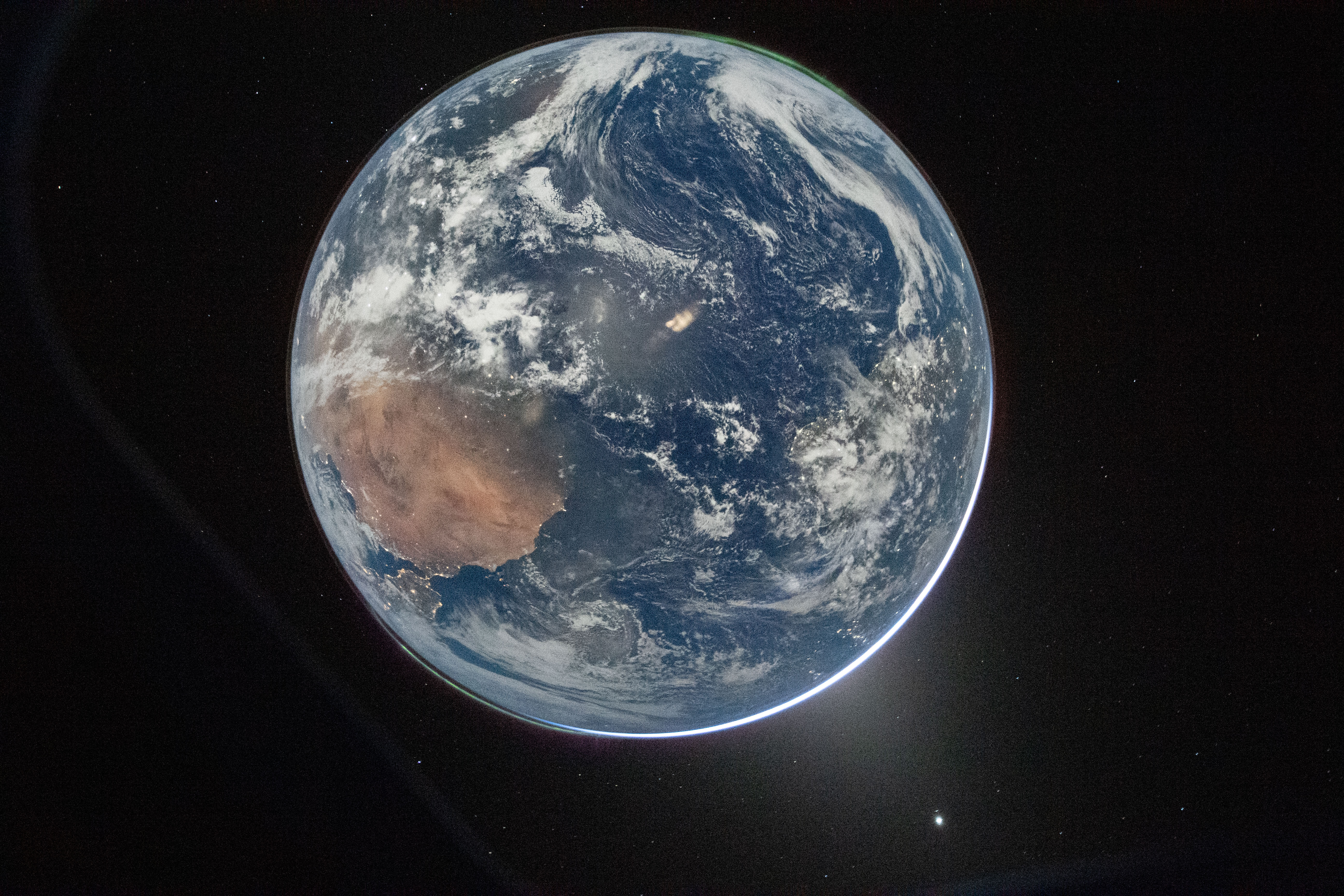
NASA astronaut and Artemis II Commander Reid Wiseman took this picture of Earth from the Orion spacecraft’s window after completing the translunar injection burn. There are two auroras (top right and bottom left) and zodiacal light (bottom right) is visible as the Earth eclipses the Sun.

This and another photo of Earth are the first downlinked images from the Artemis II astronauts. See more photos from Orion as they are shared.

See and hear what the astronauts do with our 24/7 feed.

Image credit: NASA/Reid Wiseman

Categories: NASA

Hello, World

NASA Image of the Day - Fri, 04/03/2026 - 9:34am
This nighttime picture of Earth was taken on April 2, 2026, by an Artemis II crew member aiming a camera through a window of the Orion spacecraft. The image was captured after Orion completed its translunar injection burn, the critical maneuver that sent the spacecraft on its path toward the Moon and back.
Categories: Astronomy, NASA

The Habitable Worlds Observatory Will Need Astrometry To Find Life

Universe Today - Fri, 04/03/2026 - 9:10am

We’re getting closer and closer to finding a real Earth-like exoplanet. But finding one is only half the battle. To truly know if we’re looking at an Earth analog somewhere else in the galaxy, we have to directly image it too. That’s a job for the Habitable Worlds Observatory (HWO), a planned space-based telescope whose primary job is to do precisely that. But even capturing a picture and a planet and getting spectral readings of its atmospheric chemistry still isn’t enough, according to a new paper available in pre-print on arXiv by Kaz Gary of Ohio State and their co-authors. HWO will need to figure out how much a planet weighs first.

Categories: Astronomy

Week in images: 30 March - 03 April 2026

ESO Top News - Fri, 04/03/2026 - 9:10am

Week in images: 30 March - 03 April 2026

Discover our week through the lens

Categories: Astronomy

How worried should you be about an AI apocalypse?

New Scientist Space - Cosmology - Fri, 04/03/2026 - 8:00am
Fears that artificial intelligence could rise up to wipe out humanity are understandable given our steady diet of sci-fi stories depicting just that, but what is the real risk? Matthew Sparkes looks at what the experts say
Categories: Astronomy

How worried should you be about an AI apocalypse?

New Scientist Space - Space Headlines - Fri, 04/03/2026 - 8:00am
Fears that artificial intelligence could rise up to wipe out humanity are understandable given our steady diet of sci-fi stories depicting just that, but what is the real risk? Matthew Sparkes looks at what the experts say
Categories: Astronomy

Where did the ‘Oh-My-God’ particle come from?

Scientific American.com - Fri, 04/03/2026 - 6:45am

A single subatomic particle from deep space had the same energy as a baseball pitch, and scientists still don’t know how it got here

Categories: Astronomy

See the first stunning images of a massive coral reef that has lain hidden for decades

Scientific American.com - Fri, 04/03/2026 - 6:30am

These incredible corals form what may be one of the world’s largest reef systems—and researchers have a plan to restore it

Categories: Astronomy

NASA’s Artemis II astronauts put spacecraft systems to the test on 10‑day mission

Scientific American.com - Fri, 04/03/2026 - 6:00am

Artemis II blasts off on a high‑stakes lunar flyby, marking NASA’s first crewed mission to the moon in decades

Categories: Astronomy

Multipurpose anti-viral pill may treat colds, norovirus, flu and covid

New Scientist Space - Cosmology - Fri, 04/03/2026 - 5:00am
AI predicted that a forgotten breast cancer drug could be repurposed to treat many respiratory and gastrointestinal viruses, and subsequent animal tests suggests it may be right
Categories: Astronomy

Multipurpose anti-viral pill may treat colds, norovirus, flu and covid

New Scientist Space - Space Headlines - Fri, 04/03/2026 - 5:00am
AI predicted that a forgotten breast cancer drug could be repurposed to treat many respiratory and gastrointestinal viruses, and subsequent animal tests suggests it may be right
Categories: Astronomy

How a DIY worm farm can compost food scraps, paper or a whole kangaroo

New Scientist Space - Cosmology - Fri, 04/03/2026 - 5:00am
For those who want a little help composting, take a cue from James Woodford’s experience raising worms – both the small colony of wrigglers he keeps in a sensible bin in his city garden and the dumpster-sized worm farm he has that can turn even animal carcasses into nutrient-dense soil
Categories: Astronomy

How a DIY worm farm can compost food scraps, paper or a whole kangaroo

New Scientist Space - Space Headlines - Fri, 04/03/2026 - 5:00am
For those who want a little help composting, take a cue from James Woodford’s experience raising worms – both the small colony of wrigglers he keeps in a sensible bin in his city garden and the dumpster-sized worm farm he has that can turn even animal carcasses into nutrient-dense soil
Categories: Astronomy

This Week's Sky at a Glance, April 3 – 12

Sky & Telescope Magazine - Fri, 04/03/2026 - 4:47am

Arcturus, the Spring Star, is on its way up in the east. Vega, the Summer Star, rises later in the evening. Jupiter shines high toward the southwest.

The post This Week's Sky at a Glance, April 3 – 12 appeared first on Sky & Telescope.

Categories: Astronomy

A pair of planet-forming discs

ESO Top News - Fri, 04/03/2026 - 4:00am
Image: A pair of planet-forming discs
Categories: Astronomy

Earth from Space: Eyes on our Moon

ESO Top News - Fri, 04/03/2026 - 4:00am
Image: In an unusual perspective for an Earth-observing satellite, the Copernicus Sentinel-2 mission captures this image of Earth’s only natural satellite.
Categories: Astronomy

Do the Moon’s Poles Hold Less Water Than We Thought?

Sky & Telescope Magazine - Fri, 04/03/2026 - 3:00am

New observations reveal that permanently shadowed regions at the lunar poles might contain less water ice than astronauts were hoping for.

The post Do the Moon’s Poles Hold Less Water Than We Thought? appeared first on Sky & Telescope.

Categories: Astronomy

<p><a href="https://apod.nasa.gov/apod

APOD - Fri, 04/03/2026 - 12:00am


Categories: Astronomy, NASA

<p><a href="https://apod.nasa.gov/apod

APOD - Fri, 04/03/2026 - 12:00am

Scanning the skies for galaxies, Canadian astronomer


Categories: Astronomy, NASA