

Feed aggregator
The invisibility cloak inventor now has better tricks up his sleeve
How well GLP-1 weight loss drugs work may depend on your genetics
The weight you lose and the nausea you experience from GLP-1 drugs may be linked to common gene variants, but they can’t fully explain why some people lose more weight than others
NASA’s Artemis moon missions are a game changer for astronomy
After decades of planning, NASA’s Artemis program is giving astronomers their long-awaited moonshot
Meet Orpheus - A Hopper Mission Built To Hunt For Life In Martian Volcanoes
We’ve spent decades scratching the surface of Mars trying to uncover life there. But we’ve been searching a barren wasteland bombarded by radiation and bathed in toxic perchlorates. The entire time, it's likely that it’s been too hostile to harbor extant life. So if we want a better shot at finding currently living life on Mars, we need to go underground. That is exactly the purpose of Orpheus, a proposed Mars vertical takeoff and landing (VTOL) hopper mission put forth by Connor Bunn and Pascal Lee of the SETI Institute at the 57th Lunar and Planetary Science Conference (LPSC).
Tracking Artemis II—after its historic lunar flyby, NASA’s moon mission heads home
The astronauts of Artemis II phoned home—and the International Space Station—between stretches of well-earned rest on day seven of the mission
Particles seen emerging from empty space for first time
Particles seen emerging from empty space for first time
Why The Double Helix is such an extraordinary but infuriating book
Why The Double Helix is such an extraordinary but infuriating book
NASA’s Artemis program has sparked a race to land U.S. rovers on the moon
A hidden milestone lurks in the U.S.’s Artemis-focused lunar ambitions—the nation’s first-ever successful robotic moon rover
Do people see robots as having race? New studies clash as humanoids enter the real world
As humanoid robots enter the real world, new studies suggest that people project human racial biases onto them—but the research is divided on whether those biases persist outside the lab and in real-world interactions
Health experts warn of rising measles cases in undervaccinated communities
A sharp rise in U.S. measles cases is linked to falling MMR vaccination rates and growing immunity gaps
A Volcanic Medley Near Mammoth Lakes
- Earth
- Earth Observatory
- Image of the Day
- EO Explorer
- Topics
- More Content
- About
A Volcanic Medley Near Mammoth Lakes
- Earth
- Earth Observatory
- Image of the Day
- EO Explorer
- Topics
- More Content
- About
Celestial Wonders in Leo
NASA, ESA and the Hubble Heritage (STScI/AURA)-ESA/Hubble Collaboration; Acknowledgment: Davide De Martin and Robert Gendler
Leo is a prominent sight for stargazers in April. Its famous sickle, punctuated by the bright star Regulus, draws many a beginning stargazer’s eyes, inviting deeper looks into some of Leo’s celestial delights, including a great double star and a famous galactic trio.
The constellation, Leo. You can find this constellation in the springtime skies. Stellarium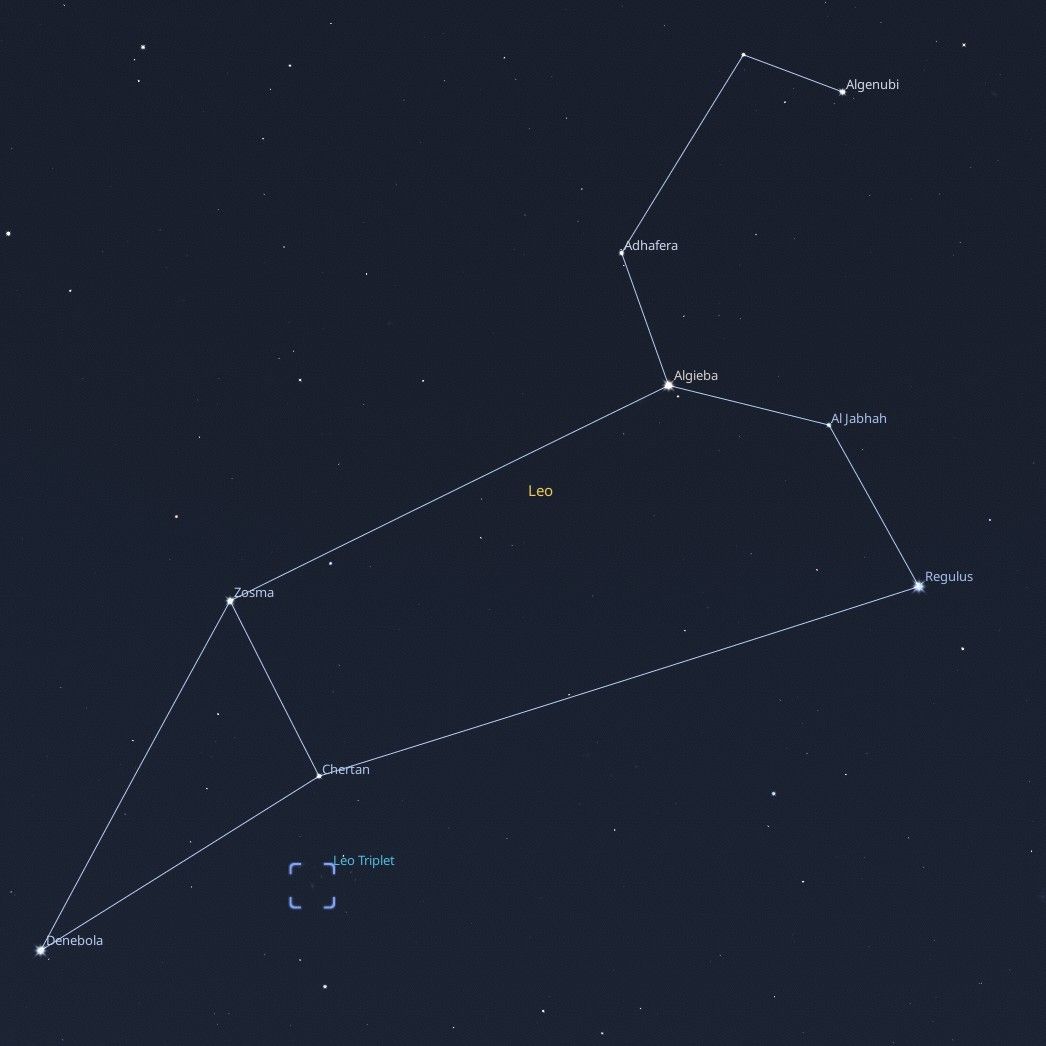
Leo’s distinctive forward sickle, or “reverse question mark,” is easy to spot as it climbs the skies in the southeast after sunset. If you are having a difficult time spotting the sickle, look for bright Sirius and Procyon in Canis Major and Canis Minor. Complete a triangle by drawing two lines to the east, joining at the bright star Regulus, the “period” in the reverse question mark. Trailing them is a trio of bright stars forming an isosceles triangle, the brightest star in that formation named Denebola. Connecting these two patterns together forms the constellation of Leo the Lion, with the forward-facing sickle being the lion’s head and mane, and the rear triangle its hindquarters. Can you see this mighty feline? It might help to imagine Leo proudly sitting up and staring straight ahead, like a celestial Sphinx. To help find these objects, you can use online tools like Stellarium Web.
If you peer deeper into Leo with a small telescope or binoculars, you’ll find a notable double star! Look in the sickle of Leo for its second-brightest star, Algieba, also called Gamma Leonis. This star splits into two bright yellow stars even with a small magnification. You can make this “split” with binoculars, but it’s more apparent with a telescope. Compare the color and intensity of these two stars: do you notice any differences? There are other multiple-star systems in Leo; spend a few minutes scanning with your instrument of choice, and see what you discover.
The Leo Triplet – three galaxies that appear to be close together under the star Chertan in the Leo constellation. Stellarium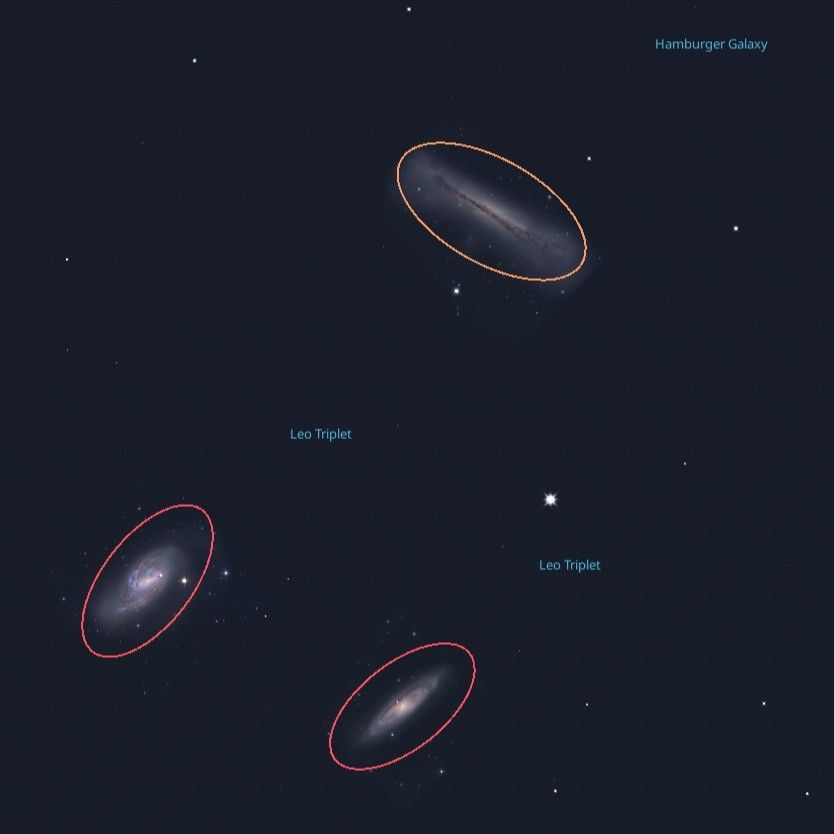
One of the most famous sights in Leo is the “Leo Triplet”: three galaxies that appear to be close together. They are indeed gravitationally bound to one another, around 30 million light-years away! You’ll need a telescope to spot them, and use an eyepiece with a wide field of view to see all three galaxies at once! Look below the star Chertan to find galaxies M65, M66, and NGC 3628 – The Hamburger Galaxy. Compare and contrast the appearance of each galaxy – while they are all spiral galaxies, each one is tilted at different angles to our point of view! Do they all look like spiral galaxies to you?
April is Citizen Science Month, and there are some fun Leo-related activities you can participate in! If you enjoy
comparing the Triplets, the Galaxy Zoo project could use your eyes to help classify different galaxies from sky survey data! Looking at Leo itself can even help measure light pollution: the Globe at Night project uses Leo as their target constellation for sky quality observations from the Northern Hemisphere. Find and participate in many more NASA community science programs at NASA Citizen Science. Happy observing!
Originally posted by Dave Prosper: April 2021
Last Updated by Kat Troche: April 2026
Celestial Wonders in Leo
NASA, ESA and the Hubble Heritage (STScI/AURA)-ESA/Hubble Collaboration; Acknowledgment: Davide De Martin and Robert Gendler
Leo is a prominent sight for stargazers in April. Its famous sickle, punctuated by the bright star Regulus, draws many a beginning stargazer’s eyes, inviting deeper looks into some of Leo’s celestial delights, including a great double star and a famous galactic trio.
The constellation, Leo. You can find this constellation in the springtime skies. StellariumLeo’s distinctive forward sickle, or “reverse question mark,” is easy to spot as it climbs the skies in the southeast after sunset. If you are having a difficult time spotting the sickle, look for bright Sirius and Procyon in Canis Major and Canis Minor. Complete a triangle by drawing two lines to the east, joining at the bright star Regulus, the “period” in the reverse question mark. Trailing them is a trio of bright stars forming an isosceles triangle, the brightest star in that formation named Denebola. Connecting these two patterns together forms the constellation of Leo the Lion, with the forward-facing sickle being the lion’s head and mane, and the rear triangle its hindquarters. Can you see this mighty feline? It might help to imagine Leo proudly sitting up and staring straight ahead, like a celestial Sphinx. To help find these objects, you can use online tools like Stellarium Web.
If you peer deeper into Leo with a small telescope or binoculars, you’ll find a notable double star! Look in the sickle of Leo for its second-brightest star, Algieba, also called Gamma Leonis. This star splits into two bright yellow stars even with a small magnification. You can make this “split” with binoculars, but it’s more apparent with a telescope. Compare the color and intensity of these two stars: do you notice any differences? There are other multiple-star systems in Leo; spend a few minutes scanning with your instrument of choice, and see what you discover.
The Leo Triplet – three galaxies that appear to be close together under the star Chertan in the Leo constellation. StellariumOne of the most famous sights in Leo is the “Leo Triplet”: three galaxies that appear to be close together. They are indeed gravitationally bound to one another, around 30 million light-years away! You’ll need a telescope to spot them, and use an eyepiece with a wide field of view to see all three galaxies at once! Look below the star Chertan to find galaxies M65, M66, and NGC 3628 – The Hamburger Galaxy. Compare and contrast the appearance of each galaxy – while they are all spiral galaxies, each one is tilted at different angles to our point of view! Do they all look like spiral galaxies to you?
April is Citizen Science Month, and there are some fun Leo-related activities you can participate in! If you enjoy
comparing the Triplets, the Galaxy Zoo project could use your eyes to help classify different galaxies from sky survey data! Looking at Leo itself can even help measure light pollution: the Globe at Night project uses Leo as their target constellation for sky quality observations from the Northern Hemisphere. Find and participate in many more NASA community science programs at NASA Citizen Science. Happy observing!
Originally posted by Dave Prosper: April 2021
Last Updated by Kat Troche: April 2026
SuperCDM Experiment Reaches Critical Temperature, Bringing it One Step Closer to Detecting Dark Matter
The Super Cryogenic Dark Matter Search (SuperCDMS) experiment has reached its coldest operating temperature, hundreds of times colder than outer space.
NASA’s Artemis II Crew Beams Official Moon Flyby Photos to Earth
Editor’s note: Some photo captions were updated on April 8, 2026, to reflect ongoing scientific observations and discussion about the images.
The first flyby images of the Moon captured by NASA’s Artemis II astronauts during their historic test flight reveal some regions no human has seen, including a rare in-space solar eclipse. Released Tuesday, astronauts captured the images April 6 during the mission’s seven-hour flyby of the lunar far side, showing humanity’s return to the Moon’s vicinity and opening a trove of scientific data.
NASA astronauts Reid Wiseman, Victor Glover, Christina Koch, and CSA (Canadian Space Agency) astronaut Jeremy Hansen, have used a fleet of cameras to take thousands of photos. The agency released several images, with more expected in the coming days as the crew members are more than halfway through their journey and now headed home toward Earth.
“Our four Artemis II astronauts — Reid, Victor, Christina, and Jeremy — took humanity on an incredible journey around the Moon and brought back images so exquisite and brimming with science, they will inspire generations to come,” said Dr. Nicky Fox, associate administrator, Science Mission Directorate, NASA Headquarters in Washington.
During the lunar flyby, the crew documented impact craters, ancient lava flows, and surface fractures that will help scientists study the Moon’s geologic evolution. They monitored color, brightness, and texture differences across the terrain, observed an earthset and earthrise, and captured solar‑eclipse views of the Sun’s corona. The crew also reported six meteoroid impact flashes on the darkened lunar surface.
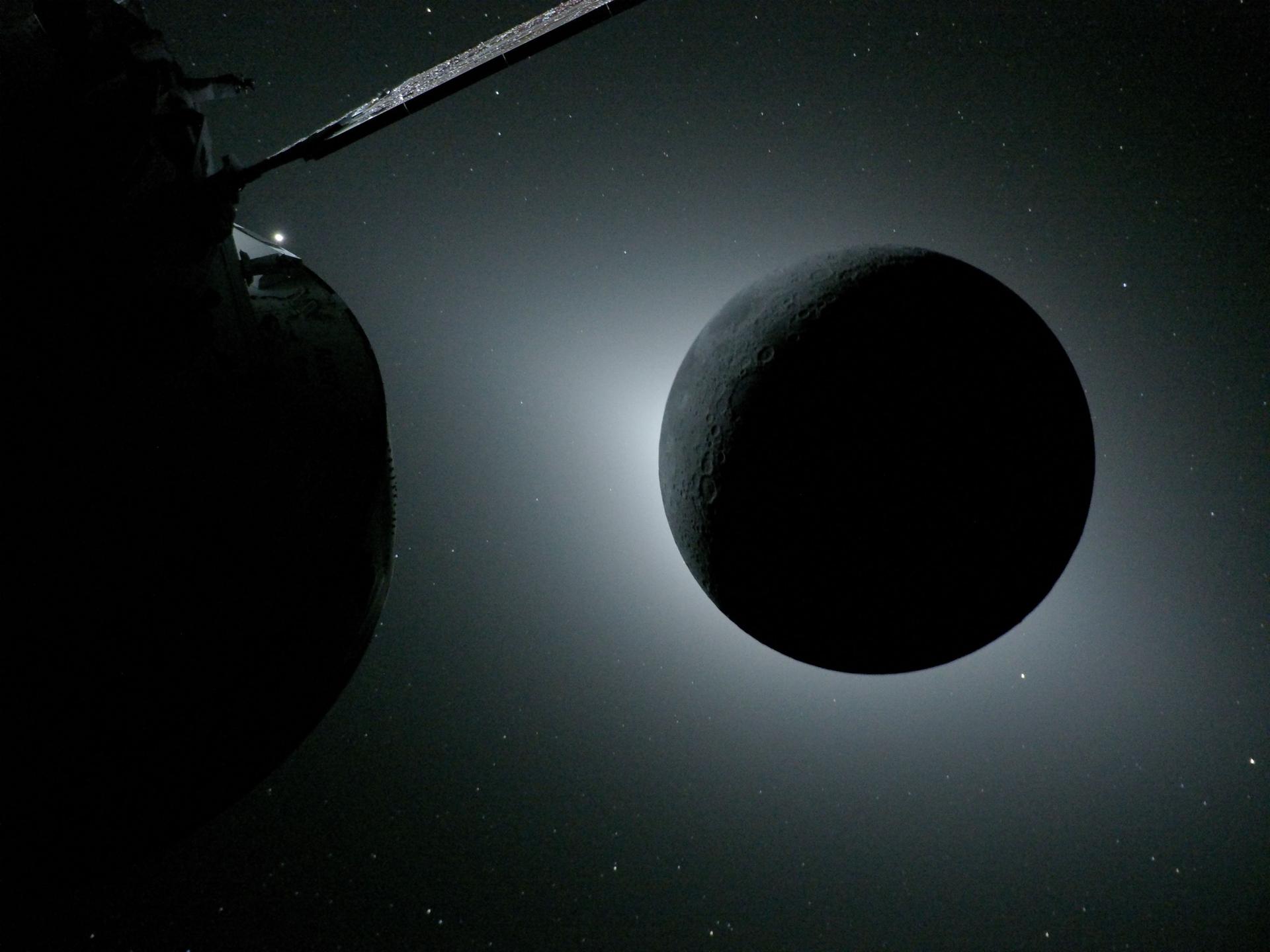
Peeking at EarthAs NASA’s Artemis II crew came close to passing behind the Moon and experiencing a planned loss of signal on Monday, April 6, 2026, they captured this image of a crescent Earth setting on the Moon’s limb. In this photo, the dark portion of Earth is experiencing nighttime, while Australia and Oceania are in the daylight. In the foreground, the Ohm crater is visible, with terraced edges and a flat floor interrupted by central peaks. Peaks such as these form in complex craters when the lunar surface is liquified on impact, and the liquefied surface splashes upward during the crater’s formation.Credit: NASA Setting EarthThe lunar surface fills the frame in sharp detail, as seen during NASA’s Artemis II lunar flyby, while a distant Earth sets in the background. This image was captured at 6:41 p.m. EDT, on April 6, 2026, just three minutes before the Orion spacecraft and its crew went behind the Moon and lost contact with Earth for 40 minutes before emerging on the other side. In this image, the dark portion of Earth is experiencing nighttime, while on its day side, swirling clouds are visible over the Australia and Oceania region. In the foreground, Ohm crater shows terraced edges and a relatively flat floor marked by central peaks — formed when the surface rebounded upward during the impact that created the crater.Credit: NASA Shadows Across Vavilov CraterA close-up view taken by the Artemis II crew of Vavilov Crater on the rim of the older and larger Hertzsprung basin on Monday, April 6, 2026. The right portion of the image shows the transition from smooth material within an inner ring of mountains to more rugged terrain around the rim. Vavilov and other craters and their ejecta are accentuated by long shadows at the terminator, the boundary between lunar day and night. The image was captured with a handheld camera at a focal length of 400 mm, as the crew flew around the far side of the Moon.Credit: NASA Artemis Era EarthriseEarthrise captured through the Orion spacecraft window at 7:22 p.m. EDT on Monday, April 6, 2026, during the Artemis II crew’s flyby of the Moon’s far side. Earth appears as a delicate crescent, with only its upper edge illuminated. The planet’s soft blue hue and scattered white cloud systems stand out against the blackness of space, while the lower portion fades into night. Taken with a 400 mm lens, the image, Earthrise, reveals a striking alignment of Earth and Moon, with the Moon in the top foreground and the Earth below. Along the lunar horizon, rugged terrain is silhouetted against the bright crescent Earth. Both bodies are oriented with their north poles to the left and south poles to the right, offering a unique perspective of our home planet from deep space. This photo was rotated 90 degrees clockwise for standard viewing orientation. Credit: NASA Artemis II in EclipseCaptured by the Artemis II crew during their lunar flyby on Monday, April 6, 2026, this image shows the Moon fully eclipsing the Sun. From the crew’s perspective, the Moon appears large enough to completely block the Sun, creating nearly 54 minutes of totality and extending the view far beyond what is possible from Earth. We see a glowing halo around the dark lunar disk. The science community is investigating whether this effect is due to the corona, zodiacal light, or a combination of the two. Also visible are stars, typically too faint to see when imaging the Moon, but with the Moon in darkness stars are readily imaged. This unique vantage point provides both a striking visual and a valuable opportunity for astronauts to document their observations during humanity’s return to deep space. The faint glow of the nearside of the Moon is visible in this image, having been illuminated by light reflected off the Earth.Credit: NASA Artemis II Total Solar Eclipse, Partial FrameA close-up view from the Orion spacecraft during the Artemis II crew’s lunar flyby on Monday, April 6, 2026, captures a total solar eclipse, with only part of the Moon visible in the frame as it fully obscures the Sun. We see a glowing halo around the dark lunar disk. The science community is investigating whether this effect is due to the corona, zodiacal light, or a combination of the two. From this deep-space vantage point, the Moon appeared large enough to sustain nearly 54 minutes of totality, far longer than total solar eclipses typically seen from Earth. The bright silver glint on the left edge of the image is the planet Venus. The round, dark gray feature visible along the Moon’s horizon between the 9 and 10 o’clock positions is Mare Crisium, a feature visible from Earth. We see faint lunar features because light reflected off of Earth provides a source of illumination.Credit: NASA EarthsetEarthset captured through the Orion spacecraft window at 6:41 p.m. EDT, April 6, 2026, during the Artemis II crew’s flyby of the Moon. A muted blue Earth with bright white clouds sets behind the cratered lunar surface. The dark portion of Earth is experiencing nighttime. On Earth’s day side, swirling clouds are visible over the Australia and Oceania region. In the foreground, Ohm crater has terraced edges and a flat floor interrupted by central peaks. Central peaks form in complex craters when the lunar surface, liquefied on impact, splashes upwards during the crater’s formation.Credit: NASA Final Flyby PreparationsNASA astronauts Victor Glover and Reid Wiseman, and CSA (Canadian Space Agency) astronaut Jeremy Hansen prepare for their journey around the far side of the Moon by configuring their camera equipment shortly before beginning the Artemis II lunar flyby observations.Credit: NASA Ready for Close UpCaptured by the Artemis II crew, the heavily cratered terrain of the eastern edge of the South Pole-Aitken basin is seen with the shadowed terminator – the boundary between lunar day and night – at the top of the image. The South Pole-Aitken basin is the largest and oldest basin on the Moon, providing a glimpse into an ancient geologic history built up over billions of years.Credit: NASAScientists already are analyzing the downlinked images, audio, and data to refine the timing and locations of these events and compare them with observations from amateur astronomers. The new imagery also will help NASA better understand the Moon’s geology and inform future exploration and science missions that will lay the foundation for an enduring presence on the Moon ahead of future astronaut missions to Mars.
“It was remarkable listening to the crew describe the stunning views during the flyby,” said Jacob Bleacher, NASA’s chief exploration scientist at the agency’s headquarters. “At first, their descriptions didn’t quite match what we were seeing on our screens. Now that higher resolution images are coming down, we can finally experience the moments they were trying to share and truly appreciate the scientific return provided by these images and our other research on this mission.”
Official NASA imagery for viewing and download is available on the agency website and digital platforms, including:
Media should follow NASA’s media usage guidelines for all publication and distribution of these images.
NASA is targeting 8:07 p.m. EDT (5:07 p.m. PDT) Friday, April 10, for the return of Artemis II off the coast of San Diego. NASA+ live return coverage begins at 6:30 p.m. and will continue until NASA and Department of War personnel safely assist the crew out of Orion and transport them to the USS John P. Murtha.
Briefings, events, and 24/7 mission coverage are streaming on NASA’s YouTube channel and events will each have their own stream closer to their start time. Learn how to watch NASA content through a variety of online platforms, including social media.
As part of Golden Age of innovation and exploration, NASA will send Artemis astronauts on increasingly difficult missions to explore more of the Moon for scientific discovery, economic benefits, and to build on our foundation for the first crewed missions to Mars.
To learn more about the Artemis program, visit:
-end-
Cheryl Warner / Katherine Rohloff
Headquarters, Washington
202-358-1100
cheryl.m.warner@nasa.gov / katherine.a.rohloff@nasa.gov
NASA’s Artemis II Crew Beams Official Moon Flyby Photos to Earth
Editor’s note: Some photo captions were updated on April 8, 2026, to reflect ongoing scientific observations and discussion about the images.
The first flyby images of the Moon captured by NASA’s Artemis II astronauts during their historic test flight reveal some regions no human has seen, including a rare in-space solar eclipse. Released Tuesday, astronauts captured the images April 6 during the mission’s seven-hour flyby of the lunar far side, showing humanity’s return to the Moon’s vicinity and opening a trove of scientific data.
NASA astronauts Reid Wiseman, Victor Glover, Christina Koch, and CSA (Canadian Space Agency) astronaut Jeremy Hansen, have used a fleet of cameras to take thousands of photos. The agency released several images, with more expected in the coming days as the crew members are more than halfway through their journey and now headed home toward Earth.
“Our four Artemis II astronauts — Reid, Victor, Christina, and Jeremy — took humanity on an incredible journey around the Moon and brought back images so exquisite and brimming with science, they will inspire generations to come,” said Dr. Nicky Fox, associate administrator, Science Mission Directorate, NASA Headquarters in Washington.
During the lunar flyby, the crew documented impact craters, ancient lava flows, and surface fractures that will help scientists study the Moon’s geologic evolution. They monitored color, brightness, and texture differences across the terrain, observed an earthset and earthrise, and captured solar‑eclipse views of the Sun’s corona. The crew also reported six meteoroid impact flashes on the darkened lunar surface.
Peeking at EarthAs NASA’s Artemis II crew came close to passing behind the Moon and experiencing a planned loss of signal on Monday, April 6, 2026, they captured this image of a crescent Earth setting on the Moon’s limb. In this photo, the dark portion of Earth is experiencing nighttime, while Australia and Oceania are in the daylight. In the foreground, the Ohm crater is visible, with terraced edges and a flat floor interrupted by central peaks. Peaks such as these form in complex craters when the lunar surface is liquified on impact, and the liquefied surface splashes upward during the crater’s formation.Credit: NASA Setting EarthThe lunar surface fills the frame in sharp detail, as seen during NASA’s Artemis II lunar flyby, while a distant Earth sets in the background. This image was captured at 6:41 p.m. EDT, on April 6, 2026, just three minutes before the Orion spacecraft and its crew went behind the Moon and lost contact with Earth for 40 minutes before emerging on the other side. In this image, the dark portion of Earth is experiencing nighttime, while on its day side, swirling clouds are visible over the Australia and Oceania region. In the foreground, Ohm crater shows terraced edges and a relatively flat floor marked by central peaks — formed when the surface rebounded upward during the impact that created the crater.Credit: NASA Shadows Across Vavilov CraterA close-up view taken by the Artemis II crew of Vavilov Crater on the rim of the older and larger Hertzsprung basin on Monday, April 6, 2026. The right portion of the image shows the transition from smooth material within an inner ring of mountains to more rugged terrain around the rim. Vavilov and other craters and their ejecta are accentuated by long shadows at the terminator, the boundary between lunar day and night. The image was captured with a handheld camera at a focal length of 400 mm, as the crew flew around the far side of the Moon.Credit: NASA Artemis Era EarthriseEarthrise captured through the Orion spacecraft window at 7:22 p.m. EDT on Monday, April 6, 2026, during the Artemis II crew’s flyby of the Moon’s far side. Earth appears as a delicate crescent, with only its upper edge illuminated. The planet’s soft blue hue and scattered white cloud systems stand out against the blackness of space, while the lower portion fades into night. Taken with a 400 mm lens, the image, Earthrise, reveals a striking alignment of Earth and Moon, with the Moon in the top foreground and the Earth below. Along the lunar horizon, rugged terrain is silhouetted against the bright crescent Earth. Both bodies are oriented with their north poles to the left and south poles to the right, offering a unique perspective of our home planet from deep space. This photo was rotated 90 degrees clockwise for standard viewing orientation. Credit: NASA Artemis II in EclipseCaptured by the Artemis II crew during their lunar flyby on Monday, April 6, 2026, this image shows the Moon fully eclipsing the Sun. From the crew’s perspective, the Moon appears large enough to completely block the Sun, creating nearly 54 minutes of totality and extending the view far beyond what is possible from Earth. We see a glowing halo around the dark lunar disk. The science community is investigating whether this effect is due to the corona, zodiacal light, or a combination of the two. Also visible are stars, typically too faint to see when imaging the Moon, but with the Moon in darkness stars are readily imaged. This unique vantage point provides both a striking visual and a valuable opportunity for astronauts to document their observations during humanity’s return to deep space. The faint glow of the nearside of the Moon is visible in this image, having been illuminated by light reflected off the Earth.Credit: NASA Artemis II Total Solar Eclipse, Partial FrameA close-up view from the Orion spacecraft during the Artemis II crew’s lunar flyby on Monday, April 6, 2026, captures a total solar eclipse, with only part of the Moon visible in the frame as it fully obscures the Sun. We see a glowing halo around the dark lunar disk. The science community is investigating whether this effect is due to the corona, zodiacal light, or a combination of the two. From this deep-space vantage point, the Moon appeared large enough to sustain nearly 54 minutes of totality, far longer than total solar eclipses typically seen from Earth. The bright silver glint on the left edge of the image is the planet Venus. The round, dark gray feature visible along the Moon’s horizon between the 9 and 10 o’clock positions is Mare Crisium, a feature visible from Earth. We see faint lunar features because light reflected off of Earth provides a source of illumination.Credit: NASA EarthsetEarthset captured through the Orion spacecraft window at 6:41 p.m. EDT, April 6, 2026, during the Artemis II crew’s flyby of the Moon. A muted blue Earth with bright white clouds sets behind the cratered lunar surface. The dark portion of Earth is experiencing nighttime. On Earth’s day side, swirling clouds are visible over the Australia and Oceania region. In the foreground, Ohm crater has terraced edges and a flat floor interrupted by central peaks. Central peaks form in complex craters when the lunar surface, liquefied on impact, splashes upwards during the crater’s formation.Credit: NASA Final Flyby PreparationsNASA astronauts Victor Glover and Reid Wiseman, and CSA (Canadian Space Agency) astronaut Jeremy Hansen prepare for their journey around the far side of the Moon by configuring their camera equipment shortly before beginning the Artemis II lunar flyby observations.Credit: NASA Ready for Close UpCaptured by the Artemis II crew, the heavily cratered terrain of the eastern edge of the South Pole-Aitken basin is seen with the shadowed terminator – the boundary between lunar day and night – at the top of the image. The South Pole-Aitken basin is the largest and oldest basin on the Moon, providing a glimpse into an ancient geologic history built up over billions of years.Credit: NASAScientists already are analyzing the downlinked images, audio, and data to refine the timing and locations of these events and compare them with observations from amateur astronomers. The new imagery also will help NASA better understand the Moon’s geology and inform future exploration and science missions that will lay the foundation for an enduring presence on the Moon ahead of future astronaut missions to Mars.
“It was remarkable listening to the crew describe the stunning views during the flyby,” said Jacob Bleacher, NASA’s chief exploration scientist at the agency’s headquarters. “At first, their descriptions didn’t quite match what we were seeing on our screens. Now that higher resolution images are coming down, we can finally experience the moments they were trying to share and truly appreciate the scientific return provided by these images and our other research on this mission.”
Official NASA imagery for viewing and download is available on the agency website and digital platforms, including:
Media should follow NASA’s media usage guidelines for all publication and distribution of these images.
NASA is targeting 8:07 p.m. EDT (5:07 p.m. PDT) Friday, April 10, for the return of Artemis II off the coast of San Diego. NASA+ live return coverage begins at 6:30 p.m. and will continue until NASA and Department of War personnel safely assist the crew out of Orion and transport them to the USS John P. Murtha.
Briefings, events, and 24/7 mission coverage are streaming on NASA’s YouTube channel and events will each have their own stream closer to their start time. Learn how to watch NASA content through a variety of online platforms, including social media.
As part of Golden Age of innovation and exploration, NASA will send Artemis astronauts on increasingly difficult missions to explore more of the Moon for scientific discovery, economic benefits, and to build on our foundation for the first crewed missions to Mars.
To learn more about the Artemis program, visit:
-end-
Cheryl Warner / Katherine Rohloff
Headquarters, Washington
202-358-1100
cheryl.m.warner@nasa.gov / katherine.a.rohloff@nasa.gov
In a first, Artemis II moon mission astronauts make ‘ship to ship’ call to ISS
This exchange between the Artemis II crew and astronauts onboard the International Space Station marks the first time a moon mission has called an orbital habitat