

Feed aggregator
NASA’s Universe of Learning Unveils Fresh Facilitator Guides Inspired by Community Feedback
3 min read
NASA’s Universe of Learning Unveils Fresh Facilitator Guides Inspired by Community Feedback NASA’s Universe of Learning Program Facilitator Guides provide educators with detailed resources, including background information, activities, and slide decks to engage audiences in exploring astrophysics themes such as Stars, Data & Image Processing, the Electromagnetic Spectrum, and Finding Exoplanets.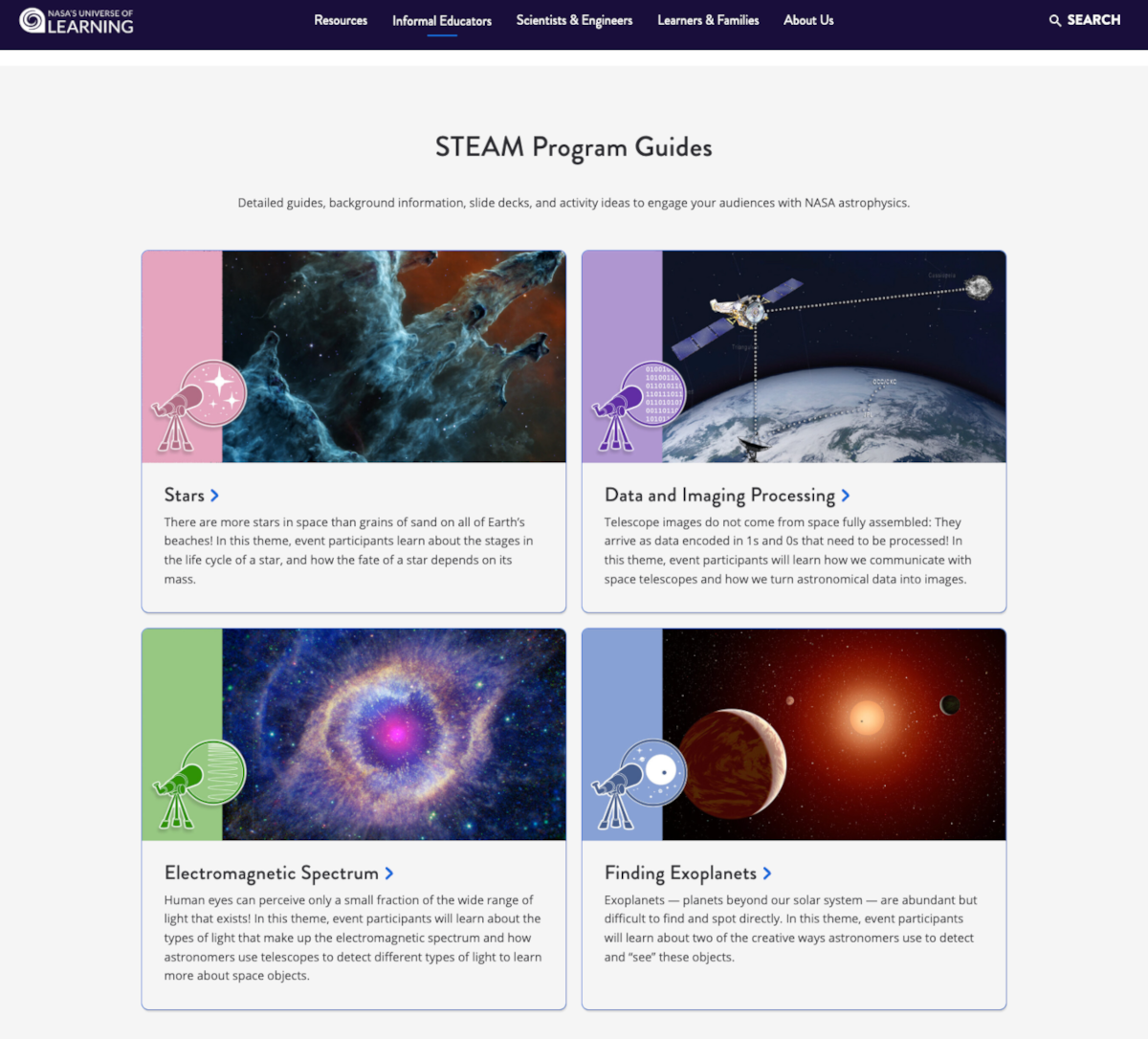
The goal of NASA’s Universe of Learning (UoL) is to connect the public to the data, discoveries, and experts that span NASA’s Astrophysics missions. To make this possible, the NASA’s UoL team creates engaging STEM experiences that let people explore data and discoveries from NASA’s Astrophysics missions and learn from the experts behind them.
Our science center does a lot of work with after school groups weekly. I can’t wait to use this program guide [Finding Exoplanets] to help run some programs for our ‘space week’ this fall. I also appreciate the adaptations for different age groups.Facilitator
Southern Arizona
One example is the Program Facilitator Guides—a series of resources for informal educators that cover different astrophysics themes and empower organizations to share NASA science with their audiences. Since their introduction, these guides have supported libraries and community centers in delivering engaging STEM learning experiences. “”The Programming Guide is just amazing … that resource alone is really great for planning. There’s so many opportunities for programs… and there’s room for your own creativity as well,”” shared one educator.
The NASA’s UoL team is excited to announce the refresh of several Program Facilitator Guides, along with the introduction of a new guide. These resources have been updated based on feedback from the informal education community, collected through evaluation surveys, focus groups, and webinars. From events held last year before the updates, the guides received a highly favorable rating—91% of educators found them useful as a resource, emphasizing their value in supporting informal STEM education. To make them more effective, we implemented the following updates:
- Easy and direct access to all Program Facilitator Guides through a dedicated web page under the “Informal Educators” menu on NASA’s Universe of Learning.
- Creating an easy-to-access URL for the Program Facilitator Guides: https://universe-of-learning.org/program-guides.
- Making available PowerPoint slides and Kahoot Quizzes for the facilitator to complement the Program Facilitator Guide themes.
- Moving activity guides to a more user-friendly and standard template.
- Designing a set of resources around some of the methods astronomers use to find exoplanets — worlds beyond the solar system — in collaboration with a NASA Science Mission Directorate Community of Practice for Education (SCoPE) grantee:
- The “Finding Exoplanets” Program Facilitator Guide.
- The “Lights, Coronagraph, Action!” Activity Guide that demonstrates how astronomers find exoplanets via direct imaging.
- The “Exoplanet Detectives” Activity Guide that shows how astronomers find exoplanets by measuring the amount of light that gets blocked when a planet transits its host star.
The new and updated resources are available now through the following URL: https://www.universe-of-learning.org/program-guides.
For any questions or suggestions, please contact:The NASA’s Universe of Learning team
Email: info@universe-of-learning.org
Website: https://www.universe-of-learning.org/
In fall 2025, more than 50 educators and over 1,500 young people across Maine and…
Article
19 hours ago
5 min read NASA Webb Finds Young Sun-Like Star Forging, Spewing Common Crystals
Article
22 hours ago
4 min read Intricacies of Helix Nebula Revealed With NASA’s Webb
Article
2 days ago
Keep Exploring Discover More Topics From NASA James Webb Space Telescope
Webb is the premier observatory of the next decade, serving thousands of astronomers worldwide. It studies every phase in the…
Perseverance Rover
This rover and its aerial sidekick were assigned to study the geology of Mars and seek signs of ancient microbial…
Parker Solar Probe
On a mission to “touch the Sun,” NASA’s Parker Solar Probe became the first spacecraft to fly through the corona…
Juno
NASA’s Juno spacecraft entered orbit around Jupiter in 2016, the first explorer to peer below the planet’s dense clouds to…
NASA’s Universe of Learning Unveils Fresh Facilitator Guides Inspired by Community Feedback
3 min read
NASA’s Universe of Learning Unveils Fresh Facilitator Guides Inspired by Community Feedback NASA’s Universe of Learning Program Facilitator Guides provide educators with detailed resources, including background information, activities, and slide decks to engage audiences in exploring astrophysics themes such as Stars, Data & Image Processing, the Electromagnetic Spectrum, and Finding Exoplanets.The goal of NASA’s Universe of Learning (UoL) is to connect the public to the data, discoveries, and experts that span NASA’s Astrophysics missions. To make this possible, the NASA’s UoL team creates engaging STEM experiences that let people explore data and discoveries from NASA’s Astrophysics missions and learn from the experts behind them.
Our science center does a lot of work with after school groups weekly. I can’t wait to use this program guide [Finding Exoplanets] to help run some programs for our ‘space week’ this fall. I also appreciate the adaptations for different age groups.Facilitator
Southern Arizona
One example is the Program Facilitator Guides—a series of resources for informal educators that cover different astrophysics themes and empower organizations to share NASA science with their audiences. Since their introduction, these guides have supported libraries and community centers in delivering engaging STEM learning experiences. “”The Programming Guide is just amazing … that resource alone is really great for planning. There’s so many opportunities for programs… and there’s room for your own creativity as well,”” shared one educator.
The NASA’s UoL team is excited to announce the refresh of several Program Facilitator Guides, along with the introduction of a new guide. These resources have been updated based on feedback from the informal education community, collected through evaluation surveys, focus groups, and webinars. From events held last year before the updates, the guides received a highly favorable rating—91% of educators found them useful as a resource, emphasizing their value in supporting informal STEM education. To make them more effective, we implemented the following updates:
- Easy and direct access to all Program Facilitator Guides through a dedicated web page under the “Informal Educators” menu on NASA’s Universe of Learning.
- Creating an easy-to-access URL for the Program Facilitator Guides: https://universe-of-learning.org/program-guides.
- Making available PowerPoint slides and Kahoot Quizzes for the facilitator to complement the Program Facilitator Guide themes.
- Moving activity guides to a more user-friendly and standard template.
- Designing a set of resources around some of the methods astronomers use to find exoplanets — worlds beyond the solar system — in collaboration with a NASA Science Mission Directorate Community of Practice for Education (SCoPE) grantee:
- The “Finding Exoplanets” Program Facilitator Guide.
- The “Lights, Coronagraph, Action!” Activity Guide that demonstrates how astronomers find exoplanets via direct imaging.
- The “Exoplanet Detectives” Activity Guide that shows how astronomers find exoplanets by measuring the amount of light that gets blocked when a planet transits its host star.
The new and updated resources are available now through the following URL: https://www.universe-of-learning.org/program-guides.
For any questions or suggestions, please contact:The NASA’s Universe of Learning team
Email: info@universe-of-learning.org
Website: https://www.universe-of-learning.org/
In fall 2025, more than 50 educators and over 1,500 young people across Maine and…
Article
19 hours ago
5 min read NASA Webb Finds Young Sun-Like Star Forging, Spewing Common Crystals
Article
22 hours ago
4 min read Intricacies of Helix Nebula Revealed With NASA’s Webb
Article
2 days ago
Keep Exploring Discover More Topics From NASA James Webb Space Telescope
Webb is the premier observatory of the next decade, serving thousands of astronomers worldwide. It studies every phase in the…
Perseverance Rover
This rover and its aerial sidekick were assigned to study the geology of Mars and seek signs of ancient microbial…
Parker Solar Probe
On a mission to “touch the Sun,” NASA’s Parker Solar Probe became the first spacecraft to fly through the corona…
Juno
NASA’s Juno spacecraft entered orbit around Jupiter in 2016, the first explorer to peer below the planet’s dense clouds to…
Mystery Prototaxites tower fossils may represent a newly discovered kind of life
Towering Prototaxites ruled Earth before trees—and they may have been a form of life entirely new to science
NASA Tests Technology Offering Potential Fuel Savings for Commercial Aviation
4 min read
Preparations for Next Moonwalk Simulations Underway (and Underwater) NASA’s Cross Flow Attenuated Natural Laminar Flow test article is mounted beneath the agency’s F-15 research aircraft ahead of the design’s high-speed taxi test on Tuesday, Jan. 12, 2026, at NASA’s Armstrong Flight Research Center in Edwards, California. The 3-foot-tall scale model is designed to increase a phenomenon known as laminar flow and reduce drag, improving efficiency in large, swept wings like those found on most commercial aircraft.NASA/Christopher LC Clark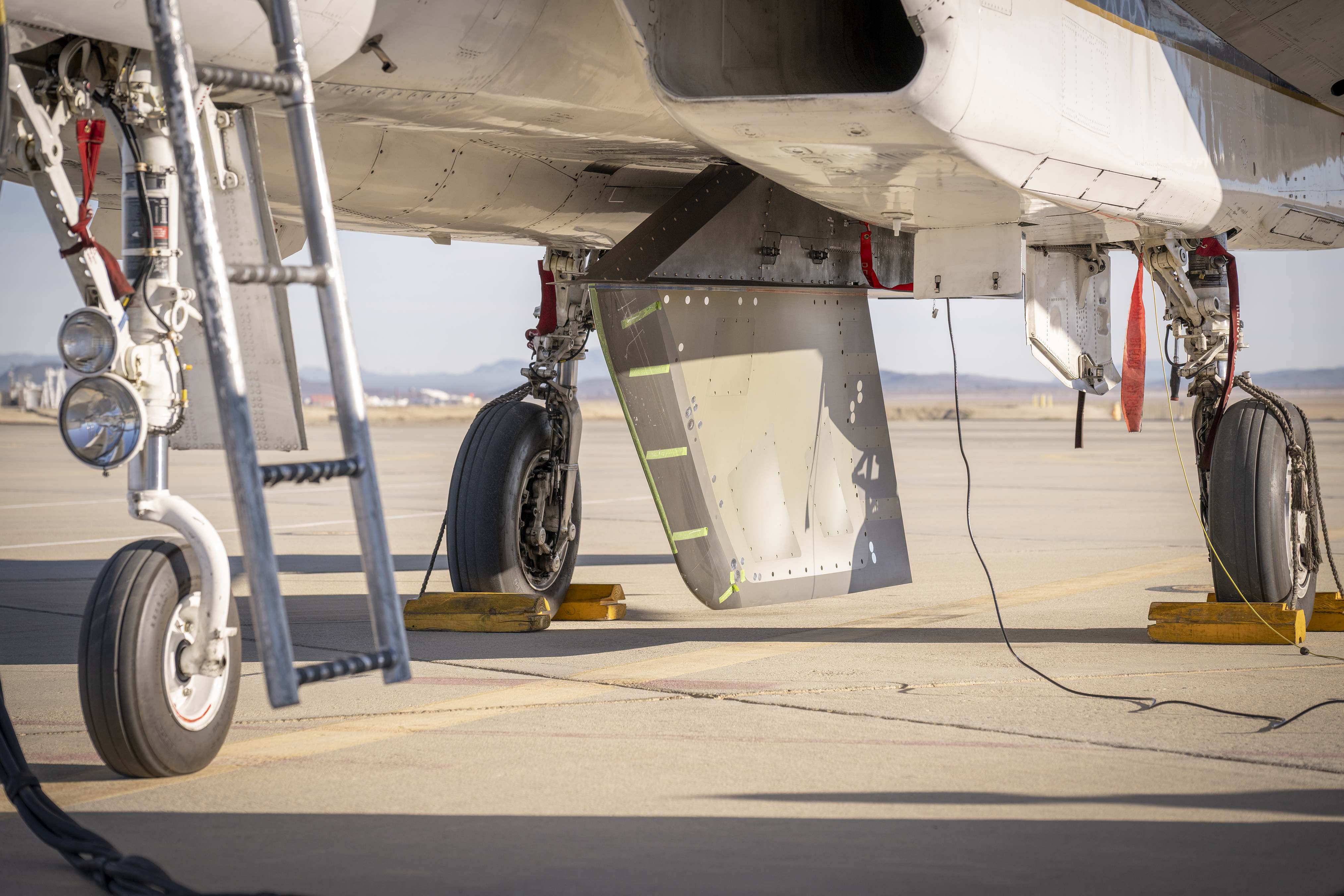
NASA researchers successfully completed a high-speed taxi test of a scale model of a design that could make future aircraft more efficient by improving how air flows across a wing’s surface, saving fuel and money.
On Jan. 12, the Crossflow Attenuated Natural Laminar Flow (CATNLF) test article reached speeds of approximately 144 mph, marking its first major milestone. The 3-foot-tall scale model looks like a fin mounted under the belly of one of the agency’s research F-15B testbed jets. However, it’s a scale model of a wing, mounted vertically instead of horizontally. The setup allows NASA to flight-test the wing design using an existing aircraft.
The CATNLF concept aims to increase a phenomenon known as laminar flow and reduce wind resistance, also known as drag.
A NASA computational study conducted between 2014 and 2017 estimated that applying a CATNLF wing design to a large, long-range aircraft like the Boeing 777 could achieve annual fuel savings of up to 10%. Although quantifying the exact savings this technology could achieve is difficult, the study indicates it could approach millions of dollars per aircraft each year.
NASA’s Cross Flow Attenuated Natural Laminar Flow test article is mounted beneath the agency’s F-15 research aircraft ahead of the design’s high-speed taxi test on Tuesday, Jan. 12, 2026, at NASA’s Armstrong Flight Research Center in Edwards, California. The 3-foot-tall scale model is designed to increase a phenomenon known as laminar flow and reduce drag, improving efficiency in large, swept wings like those found on most commercial aircraft.NASA/Christopher LC Clark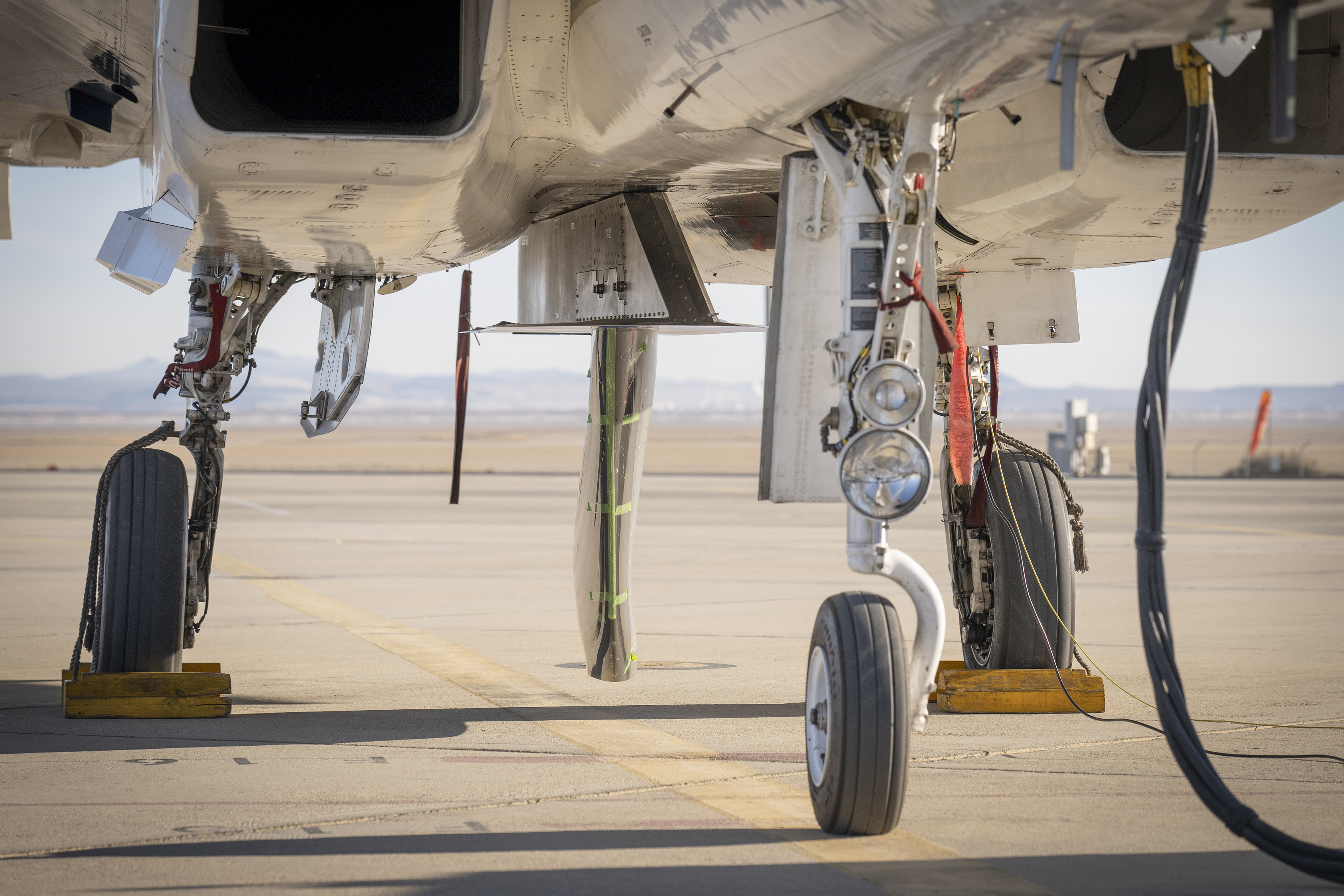
“Even small improvements in efficiency can add up to significant reductions in fuel burn and emissions for commercial airlines,” said Mike Frederick, principal investigator for CATNLF at NASA’s Armstrong Flight Research Center in Edwards, California.
Reducing drag is key to improving efficiency. During flight, a thin cover of air known as the boundary layer forms very near an aircraft’s surface. In this area, most aircraft experience increasing friction, also known as turbulent flow, where air abruptly changes direction. These abrupt changes increase drag and fuel consumption. CATNLF increases laminar flow, or the smooth motion of air, within the boundary layer. The result is more efficient aerodynamics, reduced friction, and less fuel burn.
The CATNLF testing falls under NASA’s Flight Demonstrations and Capabilities project, a part of the agency’s Integrated Aviation Systems Program under the Aeronautics Research Mission Directorate. The concept of was first developed by NASA’s Advanced Air Transport Technology project, and in 2019, NASA Armstrong researchers developed the initial shape and parameters of the model. The design was later refined for efficiency at NASA’s Langley Research Center in Hampton, Virginia.
“Laminar flow technology has been studied and used on airplanes to reduce drag for many decades now, but laminar flow has historically been limited in application,” said Michelle Banchy, Langley principal investigator for CATNLF.
NASA ground crew prepares the agency’s F-15 research aircraft and Cross Flow Attenuated Natural Laminar Flow (CATNLF) test article ahead of its first high-speed taxi test on Tuesday, Jan. 12, 2026, at NASA’s Armstrong Flight Research Center in Edwards, California. The CATNLF design aims to reduce drag on wing surfaces to improve efficiency and, in turn, reduce fuel burn.NASA/Christopher LC Clark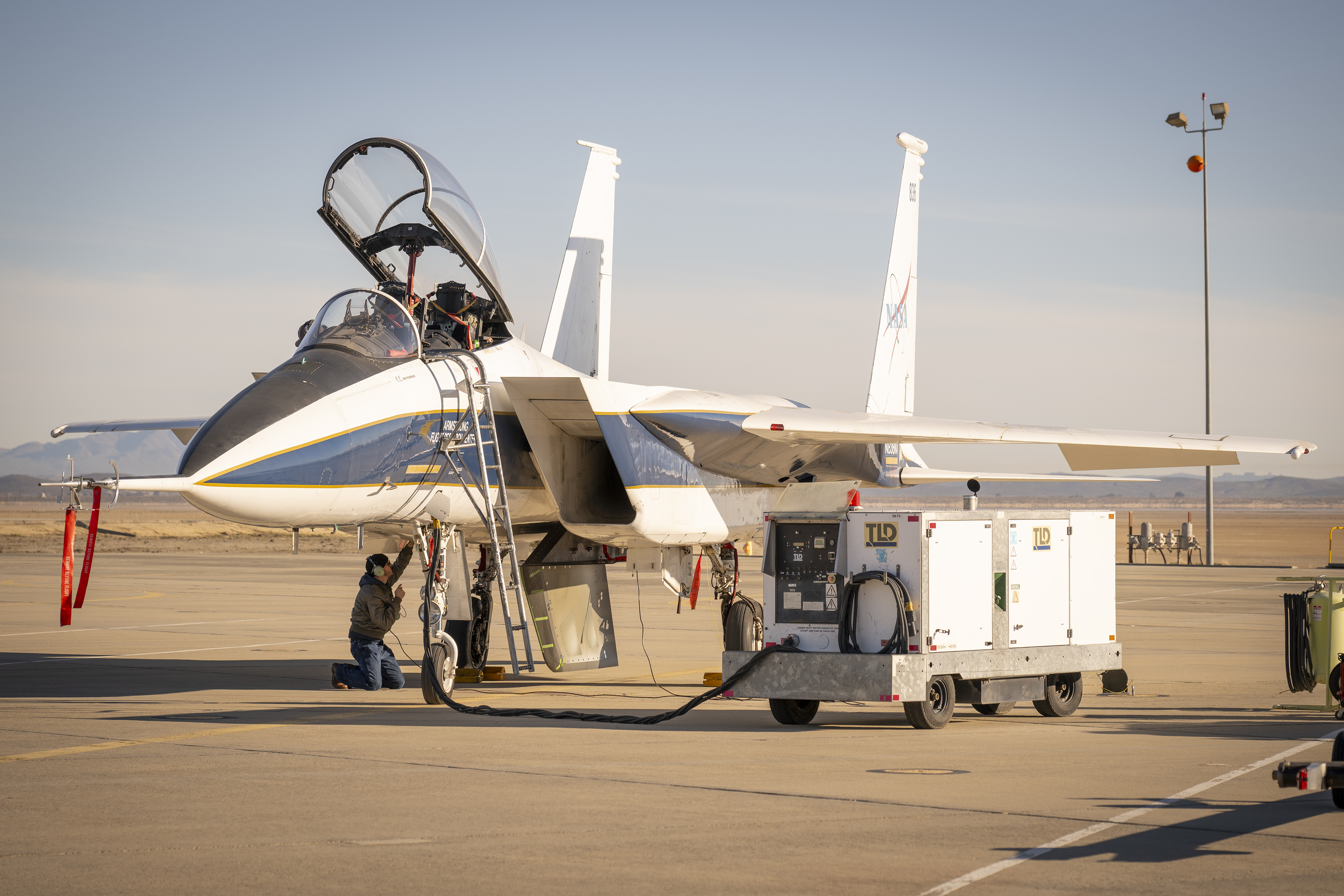
This limitation is due to crossflow, an aerodynamic phenomenon on angled surfaces that can prematurely end laminar flow. While large, swept wings like those found on most commercial aircraft provide aerodynamic efficiencies, crossflow tendencies remain.
In a 2018 wind tunnel test at Langley, researchers confirmed that the CATNLF design successfully achieved prolonged laminar flow.
“After the positive results in the wind tunnel test, NASA saw enough promise in the technology to progress to flight testing,” Banchy said. “Flight testing allows us to increase the size of the model and fly in air that has less turbulence than a wind tunnel environment, which are great things for studying laminar flow.”
NASA Armstrong’s F-15B testbed aircraft provides the necessary flight environment for laminar flow testing, Banchy said. The aircraft enables researchers to address fundamental questions about the technology while keeping costs lower than alternatives, such as replacing a test aircraft’s wing with a full-scale CATNLF model or building a dedicated demonstrator aircraft.
NASA’s Cross Flow Attenuated Natural Laminar Flow (CATNLF) scale model completes its first major milestone – high-speed taxi test – Tuesday, Jan. 12, 2026, at Edwards Air Force Base in California. NASA’s F-15 research aircraft, with the 3-foot-tall test article mounted on its underside, reached speeds of approximately 144 mph during testing. If successful, the technology could be applied to future commercial aircraft to improve efficiency and potentially reduce fuel consumption.NASA/Christopher LC Clark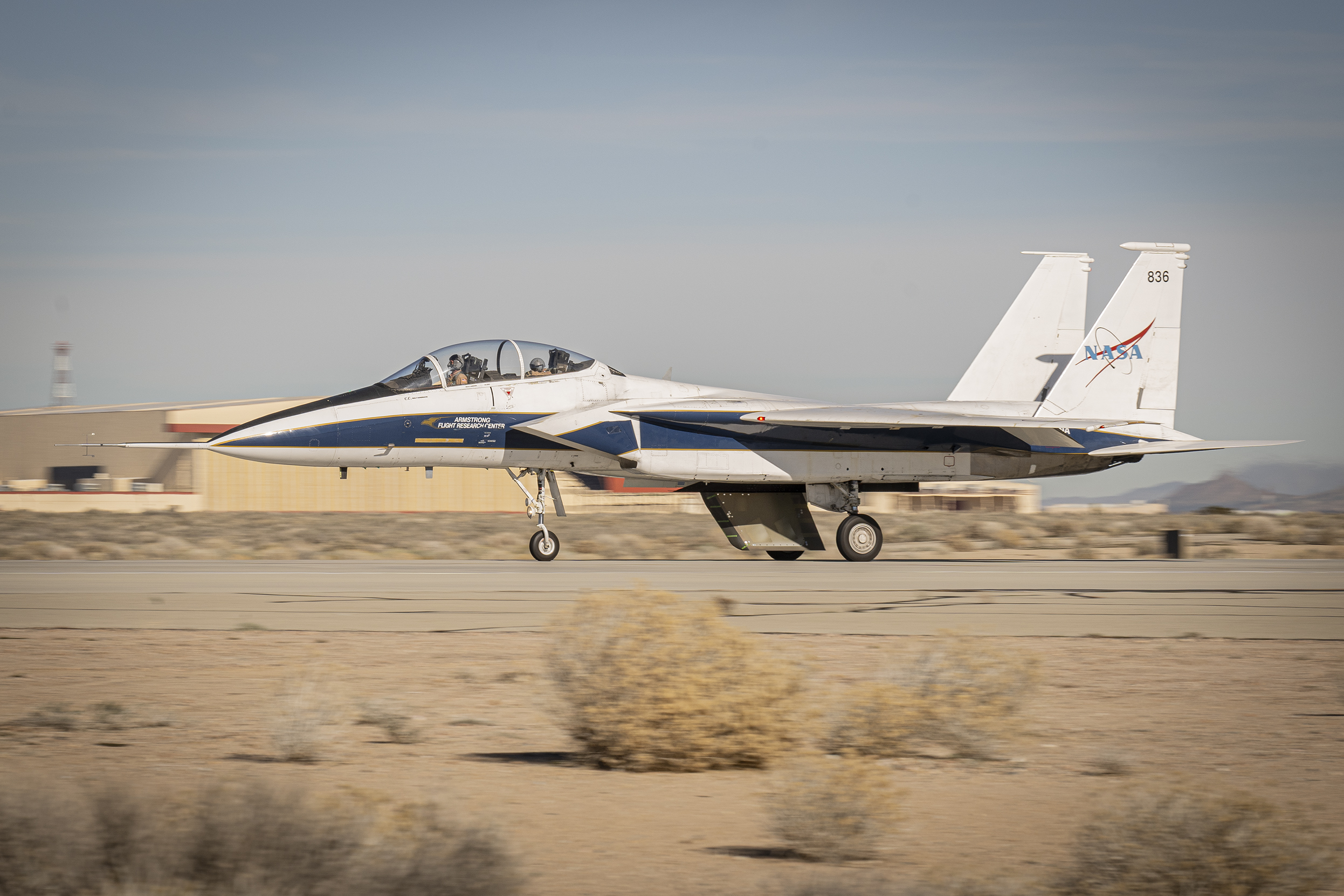
CATNLF currently focuses on commercial aviation, which has steadily increased over the past 20 years, with passenger numbers expected to double in the next 20, according to the International Civil Aviation Organization. Commercial passenger aircraft fly at subsonic speeds, or slower than the speed of sound.
“Most of us fly subsonic, so that’s where this technology would have the greatest impact right now,” Frederick said. NASA’s previous computational studies also confirmed that technology like CATNLF could be adapted for supersonic application.
In the coming weeks, CATNLF is expected to begin its first flight, kicking off a series of test flights designed to evaluate the design’s performance and capabilities in flight.
Looking ahead, NASA’s work on CATNLF could lay the groundwork for more efficient commercial air travel and might one day extend similar capabilities to supersonic flight, improving fuel efficiency at even higher speeds.
“The CATNLF flight test at NASA Armstrong will bring laminar technology one step closer to being implemented on next-generation aircraft,” Banchy said.
Share Details Last Updated Jan 21, 2026 EditorDede DiniusContactNicolas Cholulanicolas.h.cholula@nasa.govLocationArmstrong Flight Research Center Related Terms Explore More 5 min read NASA Chase Aircraft Ensures X-59’s Safety in Flight Article 2 days ago 3 min read NASA Develops Blockchain Technology to Enhance Air Travel Safety and SecurityThrough a drone flight test at NASA’s Ames Research Center, researchers tested a blockchain-based system…
Article 6 days ago 6 min read Flight Engineers Give NASA’s Dragonfly Lift Article 2 weeks ago Keep Exploring Discover More Topics From NASAMissions
Humans in Space
Climate Change
Armstrong Flight Research Center
NASA Tests Technology Offering Potential Fuel Savings for Commercial Aviation
4 min read
Preparations for Next Moonwalk Simulations Underway (and Underwater) NASA’s Cross Flow Attenuated Natural Laminar Flow test article is mounted beneath the agency’s F-15 research aircraft ahead of the design’s high-speed taxi test on Tuesday, Jan. 12, 2026, at NASA’s Armstrong Flight Research Center in Edwards, California. The 3-foot-tall scale model is designed to increase a phenomenon known as laminar flow and reduce drag, improving efficiency in large, swept wings like those found on most commercial aircraft.NASA/Christopher LC ClarkNASA researchers successfully completed a high-speed taxi test of a scale model of a design that could make future aircraft more efficient by improving how air flows across a wing’s surface, saving fuel and money.
On Jan. 12, the Crossflow Attenuated Natural Laminar Flow (CATNLF) test article reached speeds of approximately 144 mph, marking its first major milestone. The 3-foot-tall scale model looks like a fin mounted under the belly of one of the agency’s research F-15B testbed jets. However, it’s a scale model of a wing, mounted vertically instead of horizontally. The setup allows NASA to flight-test the wing design using an existing aircraft.
The CATNLF concept aims to increase a phenomenon known as laminar flow and reduce wind resistance, also known as drag.
A NASA computational study conducted between 2014 and 2017 estimated that applying a CATNLF wing design to a large, long-range aircraft like the Boeing 777 could achieve annual fuel savings of up to 10%. Although quantifying the exact savings this technology could achieve is difficult, the study indicates it could approach millions of dollars per aircraft each year.
NASA’s Cross Flow Attenuated Natural Laminar Flow test article is mounted beneath the agency’s F-15 research aircraft ahead of the design’s high-speed taxi test on Tuesday, Jan. 12, 2026, at NASA’s Armstrong Flight Research Center in Edwards, California. The 3-foot-tall scale model is designed to increase a phenomenon known as laminar flow and reduce drag, improving efficiency in large, swept wings like those found on most commercial aircraft.NASA/Christopher LC Clark“Even small improvements in efficiency can add up to significant reductions in fuel burn and emissions for commercial airlines,” said Mike Frederick, principal investigator for CATNLF at NASA’s Armstrong Flight Research Center in Edwards, California.
Reducing drag is key to improving efficiency. During flight, a thin cover of air known as the boundary layer forms very near an aircraft’s surface. In this area, most aircraft experience increasing friction, also known as turbulent flow, where air abruptly changes direction. These abrupt changes increase drag and fuel consumption. CATNLF increases laminar flow, or the smooth motion of air, within the boundary layer. The result is more efficient aerodynamics, reduced friction, and less fuel burn.
The CATNLF testing falls under NASA’s Flight Demonstrations and Capabilities project, a part of the agency’s Integrated Aviation Systems Program under the Aeronautics Research Mission Directorate. The concept of was first developed by NASA’s Advanced Air Transport Technology project, and in 2019, NASA Armstrong researchers developed the initial shape and parameters of the model. The design was later refined for efficiency at NASA’s Langley Research Center in Hampton, Virginia.
“Laminar flow technology has been studied and used on airplanes to reduce drag for many decades now, but laminar flow has historically been limited in application,” said Michelle Banchy, Langley principal investigator for CATNLF.
NASA ground crew prepares the agency’s F-15 research aircraft and Cross Flow Attenuated Natural Laminar Flow (CATNLF) test article ahead of its first high-speed taxi test on Tuesday, Jan. 12, 2026, at NASA’s Armstrong Flight Research Center in Edwards, California. The CATNLF design aims to reduce drag on wing surfaces to improve efficiency and, in turn, reduce fuel burn.NASA/Christopher LC ClarkThis limitation is due to crossflow, an aerodynamic phenomenon on angled surfaces that can prematurely end laminar flow. While large, swept wings like those found on most commercial aircraft provide aerodynamic efficiencies, crossflow tendencies remain.
In a 2018 wind tunnel test at Langley, researchers confirmed that the CATNLF design successfully achieved prolonged laminar flow.
“After the positive results in the wind tunnel test, NASA saw enough promise in the technology to progress to flight testing,” Banchy said. “Flight testing allows us to increase the size of the model and fly in air that has less turbulence than a wind tunnel environment, which are great things for studying laminar flow.”
NASA Armstrong’s F-15B testbed aircraft provides the necessary flight environment for laminar flow testing, Banchy said. The aircraft enables researchers to address fundamental questions about the technology while keeping costs lower than alternatives, such as replacing a test aircraft’s wing with a full-scale CATNLF model or building a dedicated demonstrator aircraft.
NASA’s Cross Flow Attenuated Natural Laminar Flow (CATNLF) scale model completes its first major milestone – high-speed taxi test – Tuesday, Jan. 12, 2026, at Edwards Air Force Base in California. NASA’s F-15 research aircraft, with the 3-foot-tall test article mounted on its underside, reached speeds of approximately 144 mph during testing. If successful, the technology could be applied to future commercial aircraft to improve efficiency and potentially reduce fuel consumption.NASA/Christopher LC ClarkCATNLF currently focuses on commercial aviation, which has steadily increased over the past 20 years, with passenger numbers expected to double in the next 20, according to the International Civil Aviation Organization. Commercial passenger aircraft fly at subsonic speeds, or slower than the speed of sound.
“Most of us fly subsonic, so that’s where this technology would have the greatest impact right now,” Frederick said. NASA’s previous computational studies also confirmed that technology like CATNLF could be adapted for supersonic application.
In the coming weeks, CATNLF is expected to begin its first flight, kicking off a series of test flights designed to evaluate the design’s performance and capabilities in flight.
Looking ahead, NASA’s work on CATNLF could lay the groundwork for more efficient commercial air travel and might one day extend similar capabilities to supersonic flight, improving fuel efficiency at even higher speeds.
“The CATNLF flight test at NASA Armstrong will bring laminar technology one step closer to being implemented on next-generation aircraft,” Banchy said.
Share Details Last Updated Jan 21, 2026 EditorDede DiniusContactNicolas Cholulanicolas.h.cholula@nasa.govLocationArmstrong Flight Research Center Related Terms Explore More 5 min read NASA Chase Aircraft Ensures X-59’s Safety in Flight Article 2 days ago 3 min read NASA Develops Blockchain Technology to Enhance Air Travel Safety and SecurityThrough a drone flight test at NASA’s Ames Research Center, researchers tested a blockchain-based system…
Article 6 days ago 6 min read Flight Engineers Give NASA’s Dragonfly Lift Article 2 weeks ago Keep Exploring Discover More Topics From NASAMissions
Humans in Space
Climate Change
Armstrong Flight Research Center
Stunning images reveal the rich biodiversity of remotest Tanzania
Stunning images reveal the rich biodiversity of remotest Tanzania
Peter F. Hamilton's latest is an epic slice of sci-fi – with one flaw
Peter F. Hamilton's latest is an epic slice of sci-fi – with one flaw
New Scientist recommends Avatar: Fire and Ash – especially the whale
Can we battle the downsides of a rule-based world, asks a new book
New Scientist recommends Avatar: Fire and Ash – especially the whale
Can we battle the downsides of a rule-based world, asks a new book
The internet feels super lonely right now. Here's why
The internet feels super lonely right now. Here's why
We were wrong about being able to 'nudge' people to improve the world
We were wrong about being able to 'nudge' people to improve the world
New JWST images show Helix Nebula in astonishing clarity
A fresh look at the Helix Nebula captures new details of the cycle of stellar life and death
NASA’s Artemis II Rocket and Spacecraft Make Their Way to Launch Pad
NASA’s Artemis II Rocket and Spacecraft Make Their Way to Launch Pad
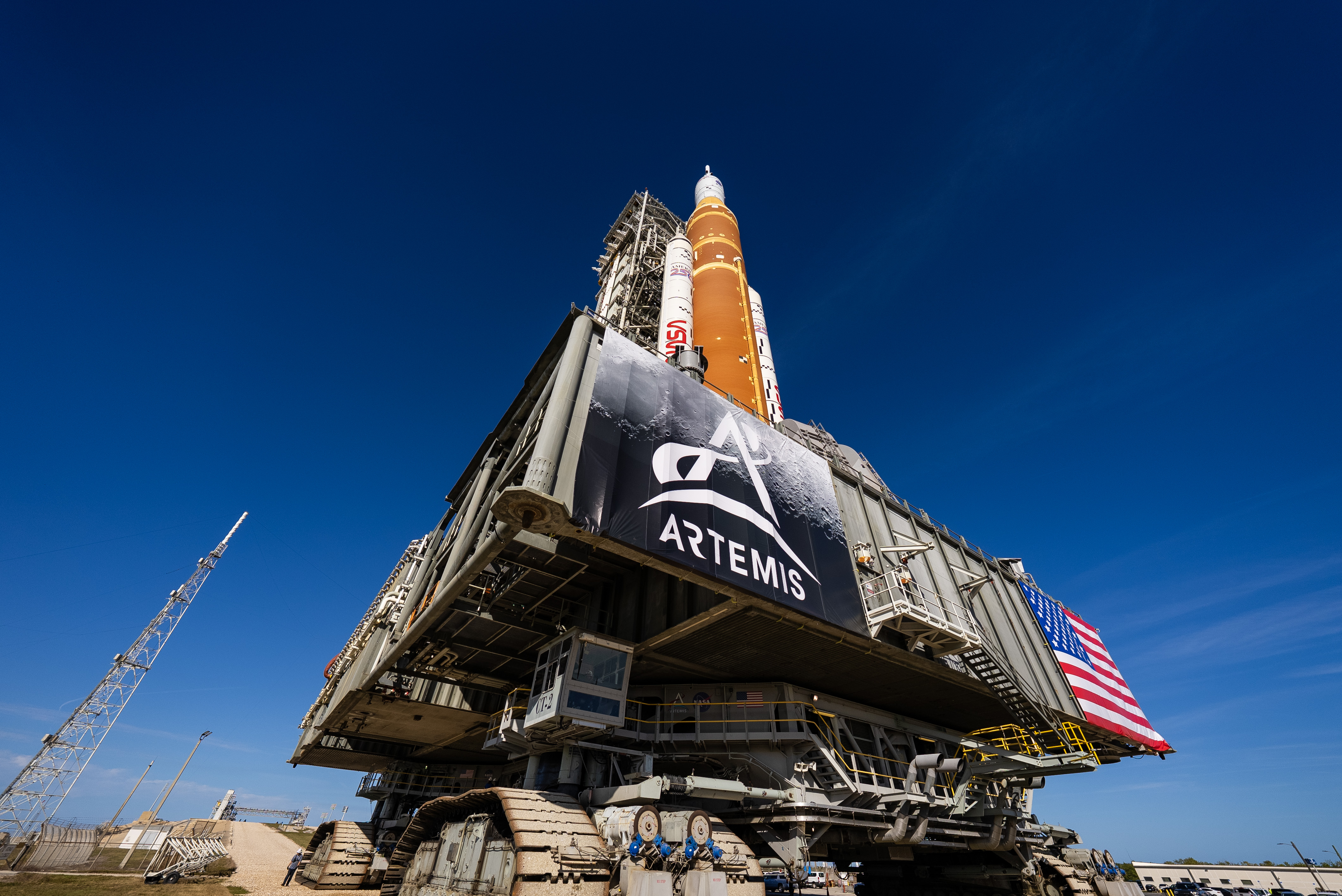
This Jan. 17, 2026, image shows NASA’s SLS (Space Launch System) and Orion spacecraft rolling out of the Vehicle Assembly Building at NASA’s Kennedy Space Center in Florida. NASA’s massive Crawler-Transporter, upgraded for the Artemis program, carries the powerful SLS rocket and Orion spacecraft to Launch Pad 39B in preparation for the Artemis II mission.
Moving at a maximum speed of just 0.82 mph, the crawler carried the towering Moon rocket and spacecraft slowly but surely toward the pad, reaching its destination at 6:42 p.m. EST after a nearly 12-hour journey. The Artemis II test flight will send NASA astronauts Reid Wiseman, Victor Glover, and Christina Koch, and CSA (Canadian Space Agency) astronaut Jeremy Hansen on an approximately 10-day journey around the Moon and back. It is another step toward new U.S.-crewed missions to the Moon’s surface, leading to a sustained presence on the Moon that will help the agency prepare to send the first astronauts – Americans – to Mars.
See more photos from the rollout.
Image credit: NASA/Sam Lott