NASA - Breaking News

Fire’s Footprint on Santa Rosa Island
- Earth
- Earth Observatory
- Image of the Day
- EO Explorer
- Topics
- More Content
- About
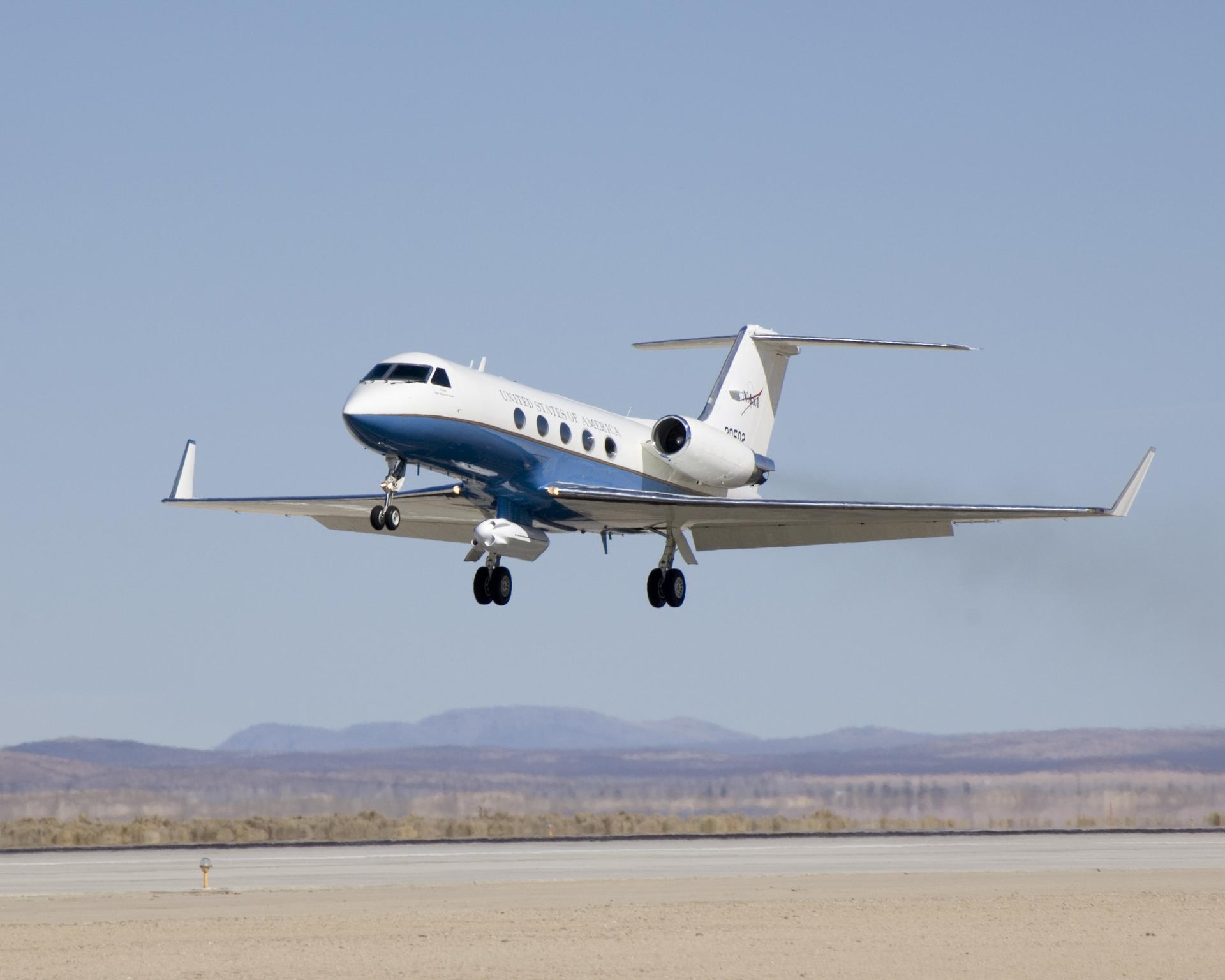
NASA Awards Modification Contract for Reduced Gravity Test Aircraft
1 min read
Preparations for Next Moonwalk Simulations Underway (and Underwater) NASANASA selected Denmar Technical Services of Nevada to provide aircraft modifications, maintenance, and testing services to the Human Spaceflight Mission Directorate at NASA’s Armstrong Flight Research Center in Edwards, California, and Johnson Space Center in Houston.
The award is a firm-fixed-price contract and will be time and material for any over and above and unforeseen work. This contract has a maximum potential value of $8.4 million, which runs through Feb. 1, 2027.
The contractor will modify a Boeing 737-700 aircraft to perform lunar-gravity parabolic flights to test NASA space equipment. Once modifications are complete, NASA Armstrong will own the aircraft and oversee aircraft operations out of NASA Johnson.
The aircraft will be used to validate astronaut lunar suits and associated crew systems required to support Artemis mission objectives. This can be done with the modified 737 aircraft in an operationally relevant, reduced-gravity environment prior to lunar mission execution.
For information about NASA and agency programs, visit:
-end-
Dede Dinius
Armstrong Flight Research Center, Edwards, Calif.
661-276-5701
darin.l.dinius@nasa.gov
NASA Invites Media to See Roman Space Telescope Arrive at Kennedy
Registration is open for media to cover the arrival of NASA’s Nancy Grace Roman Space Telescope at the agency’s Kennedy Space Center in Florida in the coming weeks.
The observatory will arrive aboard NASA’s Pegasus barge from NASA’s Goddard Space Flight Center in Greenbelt, Maryland, where teams completed its construction, assembly, and testing. Credentialed media will be able to witness the arrival and unloading of the space telescope in its transport container at NASA Kennedy’s turn basin. From there, technicians will move the telescope to the center’s Payload Hazardous Servicing Facility for launch processing.
NASA subject matter experts will be available on site to answer questions about the arrival.
Media interested in participating must apply for credentials at:
To receive credentials, media must apply by 11:59 p.m. EDT on Thursday, June 4. This opportunity is open to U.S. citizens only.
Once approved, credentialed media will receive a confirmation email. Additional information, including the specific date of arrival activities, will follow. NASA’s media accreditation policy is available online. For questions about accreditation, please email ksc-media-accreditat@mail.nasa.gov. For other questions, please contact Kennedy’s newsroom at: 321-867-2468.
Named after NASA’s first chief astronomer, the Nancy Grace Roman Space Telescope will have a deep, panoramic view of the cosmos, generating never-before-seen pictures that will revolutionize our understanding of the universe. The observatory will usher in a new era of cosmic surveys, unveiling troves of celestial objects, and shedding light on some of the universe’s most profound mysteries, including phenomena we can’t see. Roman also will showcase a test of the most advanced technology ever flown in space to directly image planets around nearby stars, a key step in NASA’s search for life on other worlds.
The Roman telescope is managed at NASA Goddard with participation by NASA’s Jet Propulsion Laboratory in Southern California; Caltech/IPAC in Pasadena, California; the Space Telescope Science Institute in Baltimore; and a science team of scientists from various research institutions. The primary industrial partners are BAE Systems Inc., L3Harris Technologies, and Teledyne Scientific & Imaging. Contributions to Roman also are made by ESA (European Space Agency), JAXA (Japan Aerospace Exploration Agency), the French space agency CNES (Centre National d’Études Spatiales), and the Max Planck Institute for Astronomy in Germany.
The agency’s Launch Services Program, based at NASA Kennedy, manages the launch service for the Roman Space Telescope, which will lift off as soon as early September on a SpaceX Falcon Heavy rocket from Launch Complex 39A.
For more information about NASA’s Roman telescope, visit:
-end-
Karen Fox / Alise Fisher
Headquarters, Washington
202-385-1287 / 202-358-2546
karen.c.fox@nasa.gov / alise.m.fisher@nasa.gov
Leejay Lockhart / Danielle Sempsrott
Kennedy Space Center, Fla.
321-747-8310 / 321-298-8990
leejay.lockhart@nasa.gov / danielle.c.sempsrott@nasa.gov
Claire Andreoli
Goddard Space Flight Center, Greenbelt, Md.
301-286-1940
claire.andreoli@nasa.gov
NASA to Conduct Low-Altitude Flights Near Houston
Five research aircraft will support a Student Airborne Research Program (SARP) mission out of Ellington Field in Houston. Flights are expected from Wednesday, June 3 to Saturday, June 13. During the mission, select maneuvers will be conducted at low altitudes over the Houston area.
Pilots will fly remote sensing payloads in raster patterns, or parallel back-and-forth lines. The instruments flown could help researchers map the movement of the gases and particles that make up Earth’s atmosphere, changes to the lowest part of the atmosphere near the coastline, and the natural processes affecting the land and water in that area. The flights will primarily take place in the Houston area, with some extending over the Gulf of America.
While many of the flights will operate at higher altitudes, a WP-3D Orion will conduct maneuvers as low as 1,000 feet above ground level. Owned and operated by the National Oceanic and Atmospheric Administration (NOAA), this aircraft is used as a hurricane hunter and has supported several airborne science missions for NASA. It is equipped with a multitude of scientific instrumentation, radars, and recording systems for both in-flight and remote sensing measurements of the atmosphere, the Earth, and its environment.
The NASA-operated aircraft participating in the mission also are equipped with a variety of remote sensing instruments, including two lidars, a synthetic-aperture radar, an imaging spectrometer, and two spectrometers.
The operations will involve the agency’s Gulfstream V (N95NA), Gulfstream C-20A (N802NA), and Gulfstream III (N520NA), as well as NOAA’s WP-3D Orion (N43RF) and a King Air B200 aircraft (N46L) owned by Dynamic Aviation and contracted by NASA. The flights can be tracked in real time at NASA Airborne Science Program Tracker.
The SARP effort is an eight-week summer internship program that provides undergraduate students with hands-on experience by engaging in field research and data analysis and with access to one or more NASA Airborne Science Program flying science laboratories.
For more information about the NASA Airborne Science program, visit:
https://airbornescience.nasa.gov
Explore More 6 min read Spacewalking With Scott Wray, Artemis EVA Training Lead Article 19 hours ago 4 min read Contractor to Civil Servant: NASA Welcomes Kenny Heckle Article 5 days ago 2 min read Growing Stem Cells in Space to Improve Cancer and Disease Treatments Article 6 days agoWhat’s Up: June 2026 Skywatching Tips from NASA
Venus and Jupiter meet after sunset, the Moon passes in front of Venus, summer begins, and deep-sky treasures rise into view.
Skywatching Highlights- June 9: Venus and Jupiter conjunction
- June 11–15: Mercury joins Venus and Jupiter after sunset
- June 17: Moon passes in front of Venus & close Moon and Venus pairing
- June 21: June solstice & start of astronomical summer
- June: Summer Triangle and deep-sky observing targets rise into view
Planets gather after sunset, the Moon passes in front of Venus, summer officially begins and deep sky treasures rise into view. That’s What’s Up for June.
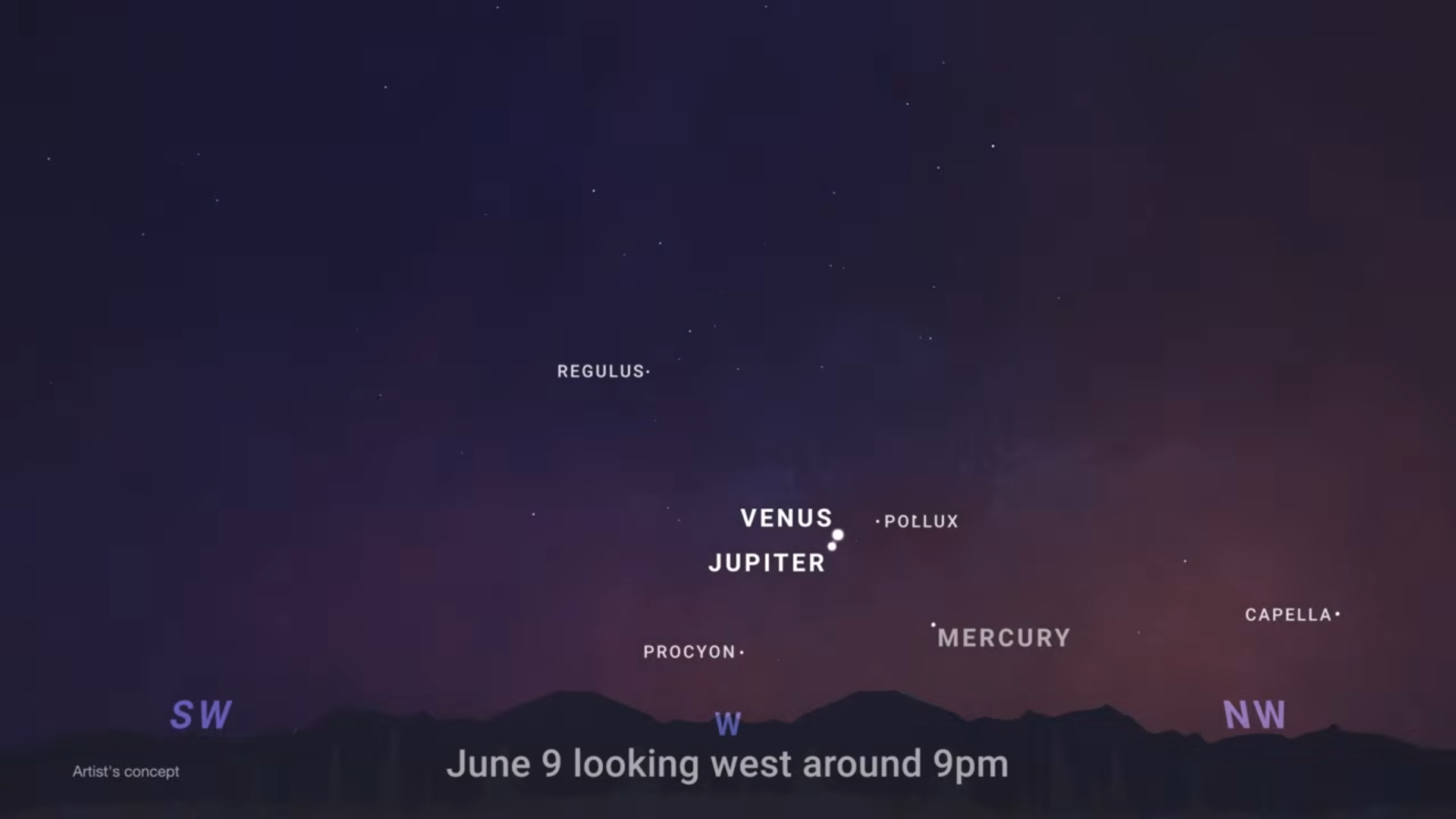
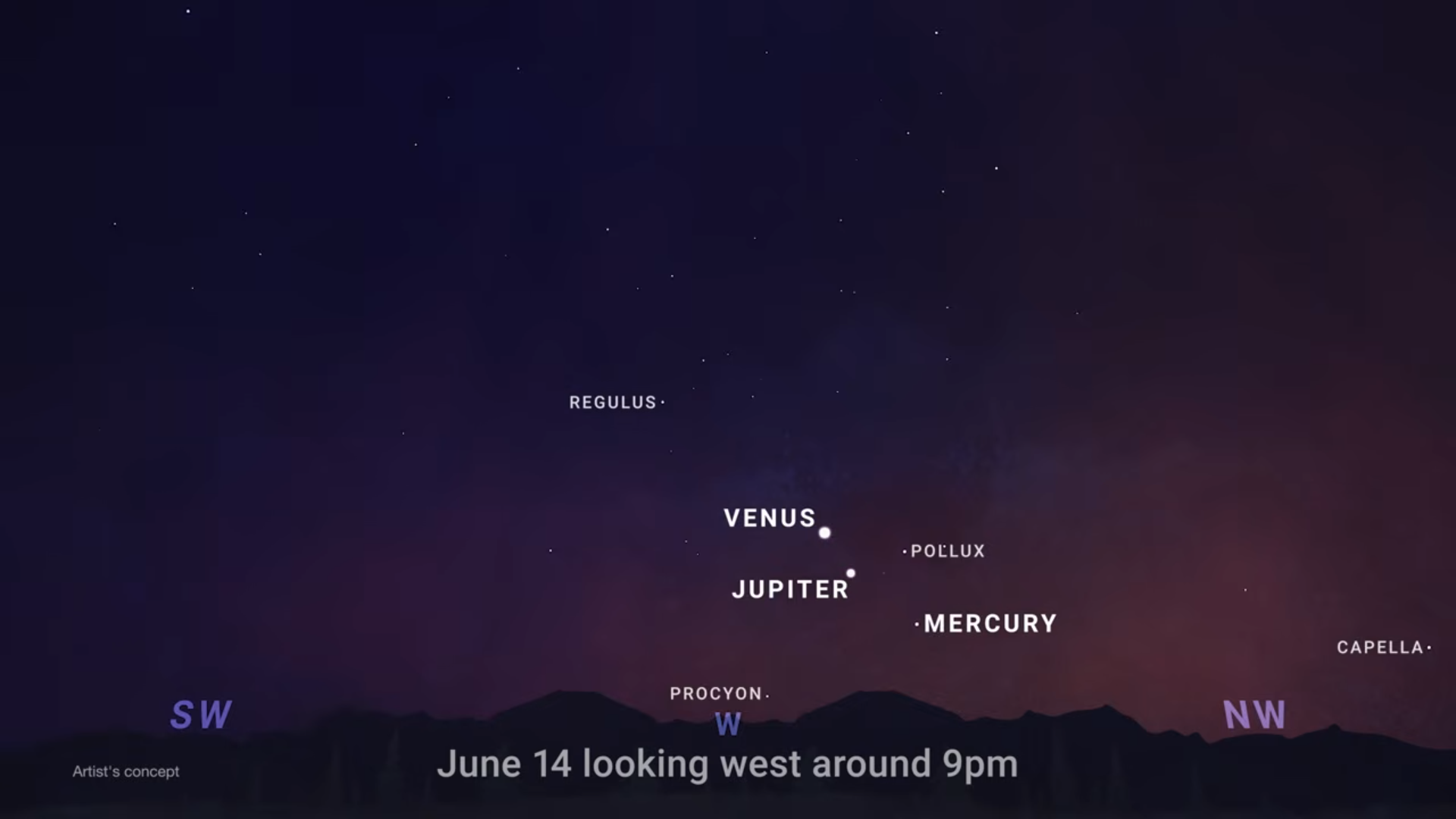
Early this month, look west shortly after sunset to see Venus and Jupiter. They are two of the brightest planets in our sky and around June 9th, they’ll appear close together after sunset. This is called a planetary conjunction—when two planets appear near each other from our point of view on Earth, even though they’re still millions of miles apart in space.
NASA/JPL-CaltechFrom June 11th through June 15th, Mercury joins the scene, creating a mini parade of planets low in the western sky. This happens because the planets orbit the sun along nearly the same path in our sky, called the ecliptic. So from our point of view on Earth, they sometimes appear to gather in the same part of the sky.
NASA/JPL-CaltechVenus will be the brightest and easiest to spot with Jupiter nearby. Mercury will sit lower toward the horizon, so you will need a clear view to the west to catch it in the glow of twilight.
On June 17th, from some locations the Moon will pass in front of Venus. This is called a lunar occultation. For viewers in the right viewing path, Venus will look like it disappears behind the Moon, then reappears later. The event will be visible from parts of the United States, Canada, Brazil and Venezuela. Outside of the exact viewing path, many skywatchers may still see a close pairing of the Moon and Venus, but this comes with an important safety note. For many viewers this will happen during the daytime.
If you’re trying to observe the occultation, do not point binoculars, a telescope, or a camera near the sun unless you’re using proper solar safety equipment. Looking at or near the sun through optics can cause serious eye injury.
June also brings the summer solstice. In the Northern Hemisphere, the June solstice marks the start of the astronomical summer. In Pacific time, it happens on Sunday, June 21st at 1:24 a.m.
Around the solstice, the Northern Hemisphere gets its longest days and shortest nights of the year.
But here’s a fun fact, the longest day does not usually line up exactly with the earliest sunrise or latest sunset. For example, in Los Angeles, the earliest sunrise comes before the solstice, while the latest sunset comes after it.
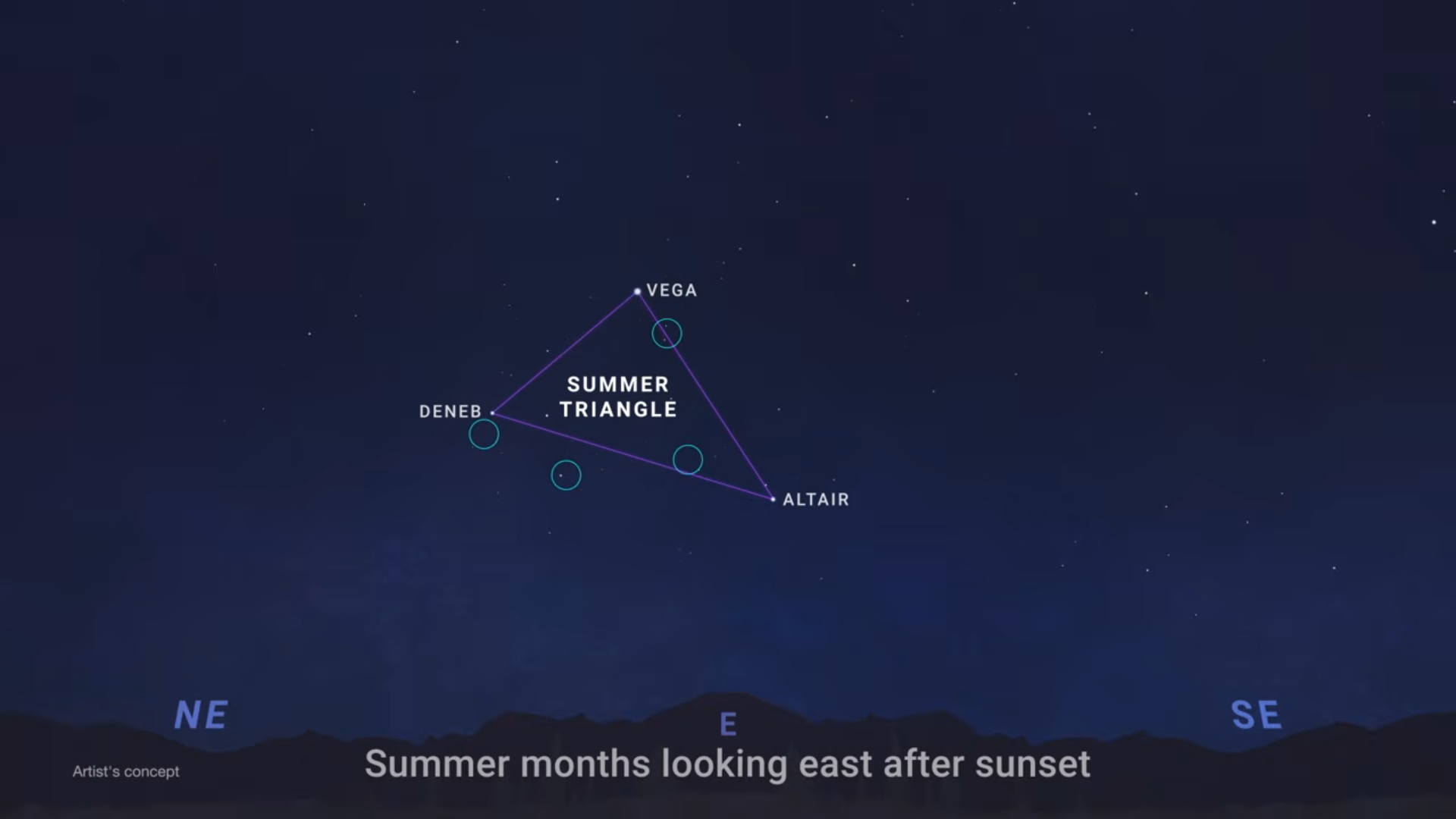
And once the sky gets dark, summer brings some favorite targets for telescope users and astrophotographers. First, look for the Summer Triangle, formed by the bright stars Vega, Altair, and Deneb. Inside and around this region are deep sky objects like the Dumbbell Nebula, the Ring Nebula, the North America Nebula, and the Veil Nebula. The Dumbbell Nebula, also known as Messier 27, was the first planetary nebula ever discovered.
These objects are not bright like planets, but with telescopes or long exposure photography, they reveal glowing gas, dying stars, and stellar nurseries in our galaxy.
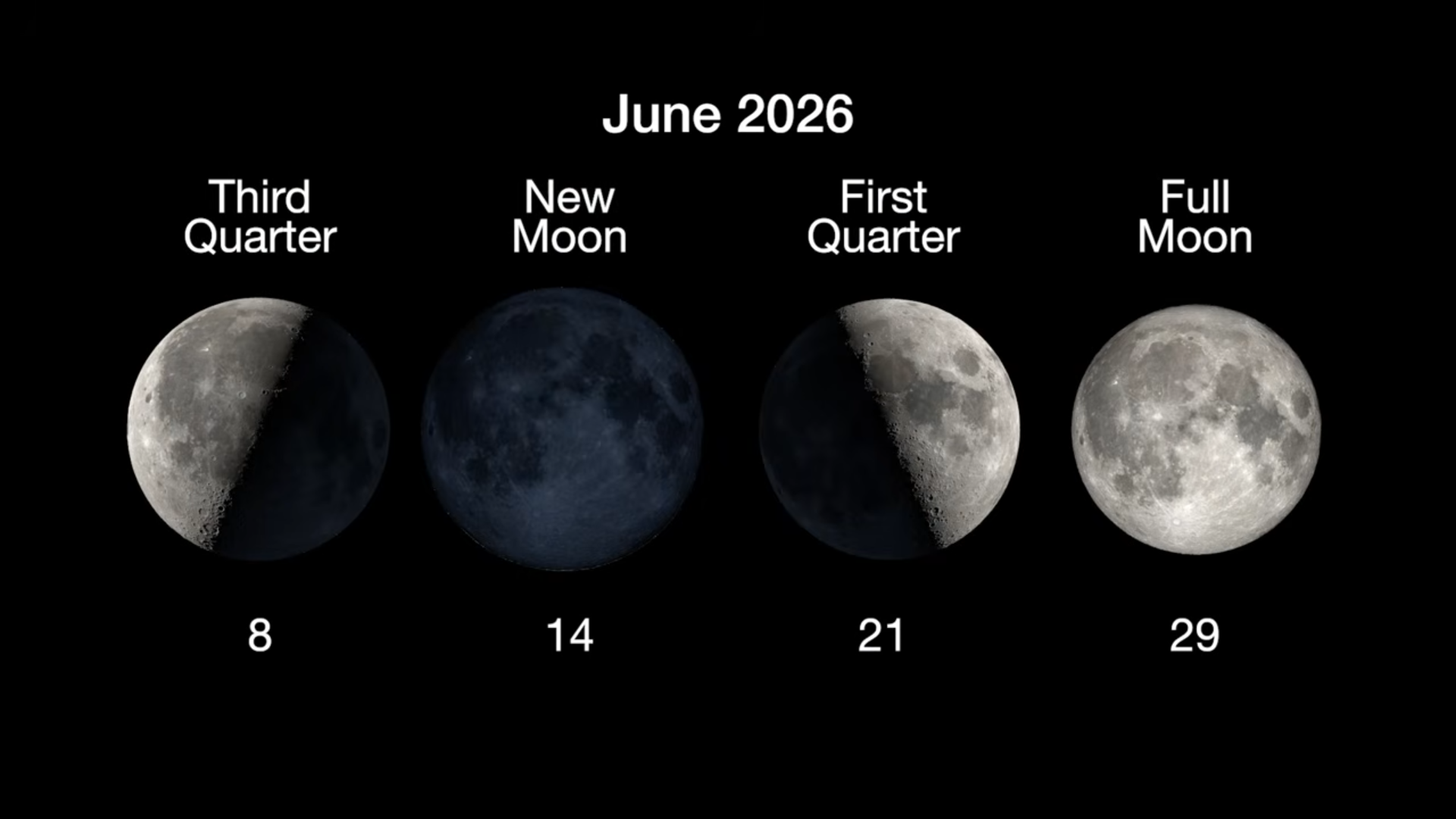
NASA/JPL-CaltechHere are the phases of the Moon for June. You can stay up to date on all of NASA’s missions exploring the solar system and beyond at science.nasa.gov. I’m Raquel Villanueva from NASA’s Jet Propulsion Laboratory, and that’s What’s Up this month.
NASA/JPL-Caltech Keep Exploring Discover More Topics From NASA
What’s Up
Skywatching
Galaxies
Stars
Pretty in Pink
This image of Westerlund 2 released on March 19, 2026, features Chandra X-ray Observatory data (pink) and infrared data from NASA’S James Webb Space Telescope (red, orange, green, cyan, and blue). Scores of gleaming stars ringed in neon pink stretch across the frame, highlighting a cluster where stars are between one and three million years old. Brick-orange dust clouds along the bottom edge illustrate the raw materials of this active stellar nursery.
Westerlund 2 resides in a raucous stellar breeding ground known as Gum 29, located 20,000 light-years away from Earth in the constellation Carina.
See a different view of Westerlund 2.
Image credit: X-ray: NASA/CXC/SAO/Sejong Univ./Hur et al; JWST: ESA/Webb, NASA & CSA, V. Almendros-Abad, M. Guarcello, K. Monsch, and the EWOCS team. Image Processing: NASA/CXC/SAO/L. Frattare and K. Arcand
Space Out This Summer with Variety of NASA STEM Activities
Summer is “Go” for launch, and NASA has a universe of ways to help you to jump in, explore, and create! Whether you prefer to spend this season fueling your creativity, going outdoors into nature, or daydreaming about your future, NASA offers ways to take your interests to the next level.
Here are some opportunities to level up your skills with NASA STEM this summer.
Rise to Stardance ChallengeFrom Monday, June 1, through Sept. 30, students ages 13 to 18 are invited to flex their creativity in the online Stardance Challenge, a partnership between NASA and the education non-profit Hack Club. Whether you’re into space, coding, hardware, or just love building cool things, this is your chance to work with real NASA mission data from programs like Artemis, the James Webb Space Telescope, and more.
Participants can create anything from code and apps to electronics, circuit boards, models, and simulations. Hack Club will offer peer and expert reviews, prizes, and plenty of opportunities to show off your work. Meanwhile, NASA will provide access to publicly available datasets, mission materials, multimedia, and virtual sessions with subject matter experts who can share insights on space science, engineering, and careers. Ready to start brainstorming? Visit the Hack Club: Stardance Challenge website to explore project options, check out prizes, and RSVP to get a reminder when the challenge opens
NASA Astronaut Megan McArthur is conducting a technology demonstration with Astrobee flying robots.Credit: NASA Go Behind Scenes of NASA CareersThink NASA is only for astronauts, scientists, and tech experts? Think again. It takes a wide range of professionals and specialists to bring the nation’s aerospace goals to life. Summer is the perfect time to discover how your skills and interests could make a difference at NASA.
Connect directly with NASA experts through online events designed to spark your curiosity and help you explore real STEM career paths. These virtual sessions provide a behind‑the‑scenes look at NASA’s workforce, plus the chance to ask questions.
- Tuesday, June 2: NASA’s Career Technical Education Day at Goddard Space Flight Center dives into robotics, AI, autonomous systems, and the skilled technical careers that keep NASA missions running. Register by May 26.
- Thursday, June 11: Virtual Career Connection: Aviation Technology and Maintenance introduces you to aircraft mechanics and technicians who support NASA’s flight programs and explores pathways into aviation technology careers. Register by June 2.
Looking for more? Check out the Next Gen STEM for Careers web page for videos, articles, and more ways to learn about the variety of jobs at NASA.
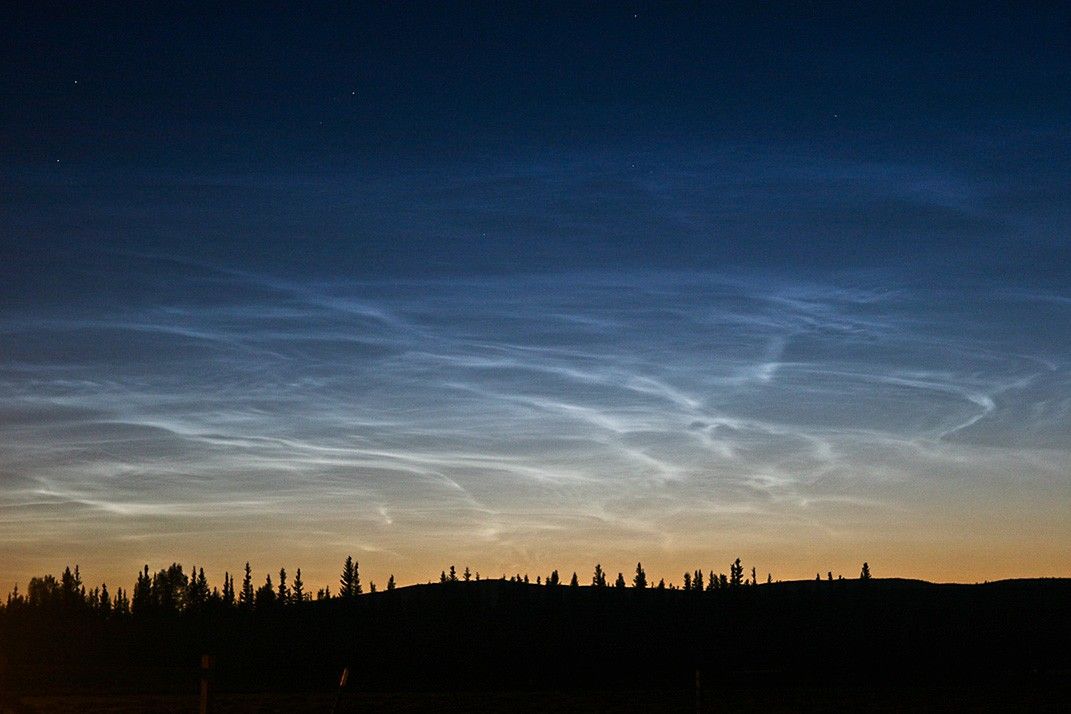
Noctilucent clouds seen from Fairbanks, Alaska.Credit: Patrick Cobb – Photovoltaic designer, photographer Dive into NASA Research Through Citizen ScienceNASA invites people of all ages and backgrounds to do NASA science as a part of real science projects that rely on volunteers. Citizen Science is a great way to make new friends, meet some scientists, and help NASA solve mysteries of the universe this summer – using just a phone or computer. You can join from anywhere, participate on your own schedule, and dive right into real research using actual mission data. Here are two examples:
- Through Space Cloud Watch, you can help NASA study noctilucent clouds. Noctilucent means “night-shining,” and that’s exactly what they do! During summer twilight at high latitudes, these clouds catch sunlight and appear to glow even in a darkened sky. Take a photo and submit a report to help scientists track how these rare clouds are changing.
- Take your cloud‑watching to another planet with Cloudspotting on Mars, where you review real NASA images to identify clouds above the Red Planet and help scientists understand Martian weather.
Curious about what other projects you might enjoy? See all current Citizen Science opportunities available through NASA’s Science Mission Directorate.
No matter how you spend your summer – building projects like the Hack Club’s Stardance Challenge, jumping into real NASA research through citizen science, or exploring possible NASA career paths – there’s a launch pad waiting for you. And remember, NASA’s STEM Resources website is available year-round to serve as your one-stop hub for hands-on activities, videos, articles, and more to spark curiosity and fuel big ideas.
Keep Exploring Discover More Topics From NASAFor Students Grades 9-12
Mobile and Desktop Apps
Games and Interactives
NASA STEM Opportunities and Activities For Students
Gravity Waves From Super Typhoon Sinlaku
- Earth
- Earth Observatory
- Image of the Day
- EO Explorer
- Topics
- More Content
- About
NASA Awards Contract for Johnson Space Center Infrastructure
NASA has selected seven companies to provide construction, revitalization, and infrastructure improvements at the agency’s Johnson Space Center in Houston.
The Johnson Space Center Multiple Award Construction Contract supports up to $300 million in upgrades to mission‑support facilities, utilities, and equipment across the NASA Johnson campus. All funds must be obligated by Sept. 30, 2026.
The indefinite-delivery/indefinite-quantity award enables rapid execution of facility projects essential to sustaining astronaut crew training, engineering development, and mission readiness. Task orders will be competed among awardees to ensure fair opportunity and best value to the government.
Contract awardees are:
- Coho Construction Management, LLC
- Conti Federal Services, LLC
- Healtheon, Inc.
- HITT Contracting, Inc.
- Ross Group Construction Corporation, LLC
- Energy EPC Solutions, LLC, doing business as S&B Services
- Sauer Construction, LLC
For more information about NASA and its missions, visit:
-end-
Jennifer Dooren / Jessica Taveau
Headquarters, Washington
202-358-1600
jennifer.m.dooren@nasa.gov / jessica.c.taveau@nasa.gov
Chelsey Ballarte
Johnson Space Center, Houston
281-483-5111
chelsey.n.ballarte@nasa.gov
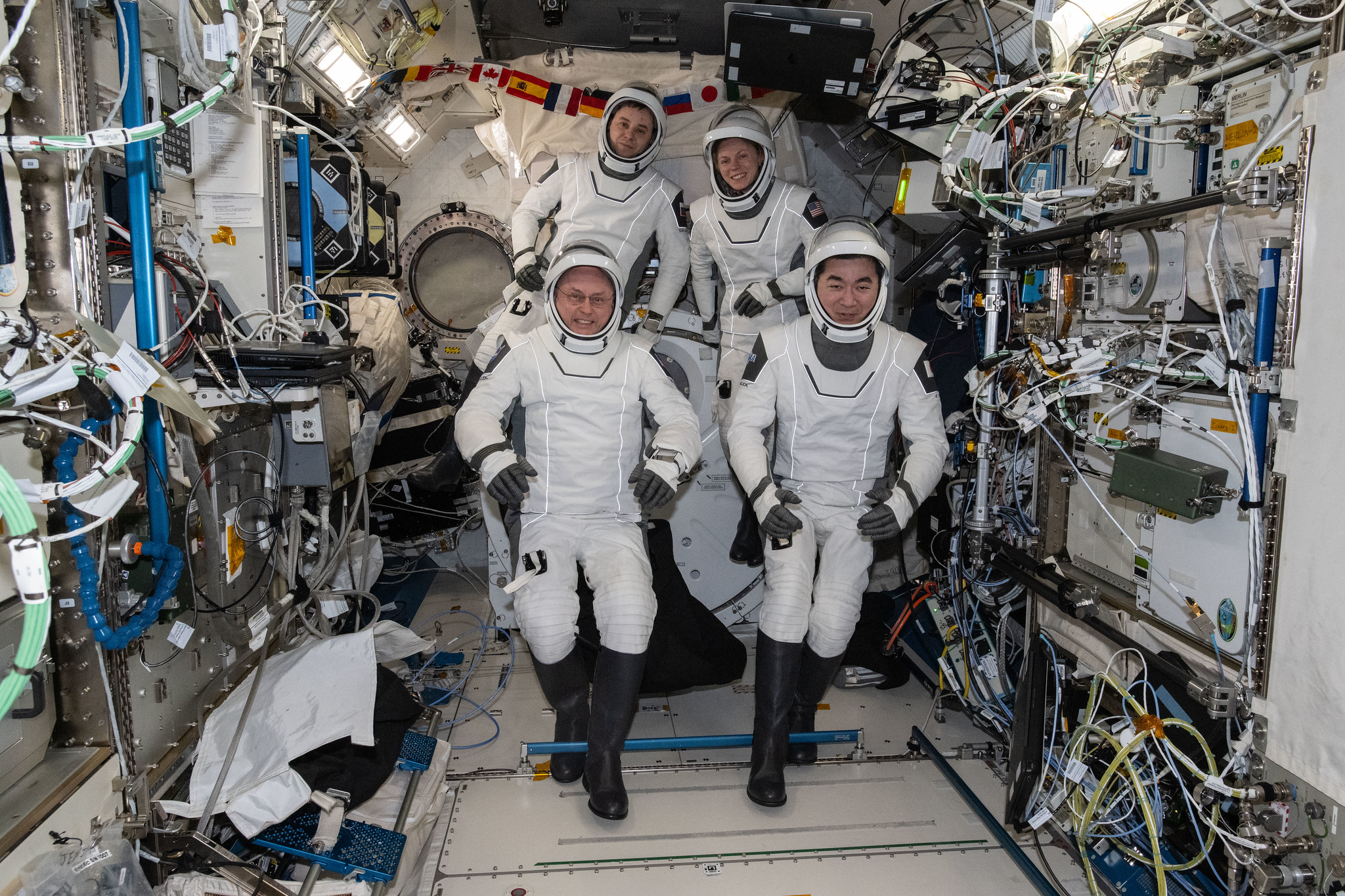
NASA Hosts SpaceX Crew-11 Astronauts for Public Event at Headquarters
NASA will host a public event featuring three crew members from the agency’s SpaceX Crew-11 mission at 11 a.m. EDT Monday, June 1. The event, which takes place during the crew’s standard postflight visit, will be held in the Webb Auditorium at NASA Headquarters in the Mary W. Jackson building, 300 E. Street SW in Washington.
The crew members, including NASA astronauts Zena Cardman and Mike Fincke and JAXA (Japan Aerospace Exploration Agency) astronaut Kimiya Yui, will discuss their recent 167-day mission aboard the International Space Station, where they conducted a wide range of science experiments to benefit life on Earth and advance human space exploration as part of International Space Station Expedition 73/74.
The Crew-11 mission lifted off on Aug.1, 2025, from Launch Complex 39A at NASA’s Kennedy Space Center in Florida. The crew’s SpaceX Dragon spacecraft docked to the orbital outpost on Aug. 2.
During their mission, the three astronauts, along with crewmate Roscosmos cosmonaut Oleg Platonov, traveled nearly 71 million miles and completed more than 2,670 orbits around Earth. The Crew-11 mission was Fincke’s fourth spaceflight, Yui’s second, and the first for Cardman and Platonov. Fincke has logged 549 days in space, ranking him fourth among all NASA astronauts for cumulative days in space. The crew members returned to Earth on Jan. 15, splashing down off the coast of San Diego.
Along the way, Crew-11 logged hundreds of hours of research, maintenance, and technology demonstrations. The crew members also celebrated the 25th anniversary of continuous human presence aboard the orbiting laboratory on Nov. 2, 2025. Research conducted aboard the space station advances scientific knowledge and demonstrates new technologies that enable us to prepare for human exploration of the Moon and Mars.
Media interested in attending the event must RSVP by 8 a.m., June 1, by emailing the NASA Headquarters newsroom at hq-media@mail.nasa.gov. NASA’s media accreditation policy is online. Based on the crew’s schedule, NASA will not be able to accommodate interviews.
This opportunity also is part of NASA’s Frontiers Forum: Voices Shaping the Future of Space speaking series designed to convene bold thinkers and senior leaders at the forefront of exploration and innovation. The series will spotlight mission-critical priorities from advancing the Artemis campaign and strengthening commercial partnerships to shaping the future workforce and accelerating breakthrough technologies. The agency will share more details soon.
To learn more about the International Space Station and its research and crews, visit:
-end-
Gerelle Dodson
Headquarters, Washington
202-358-1600
gerelle.q.dodson@nasa.gov
NASA’s Roman Space Telescope Primary Mirror Gets Last Look
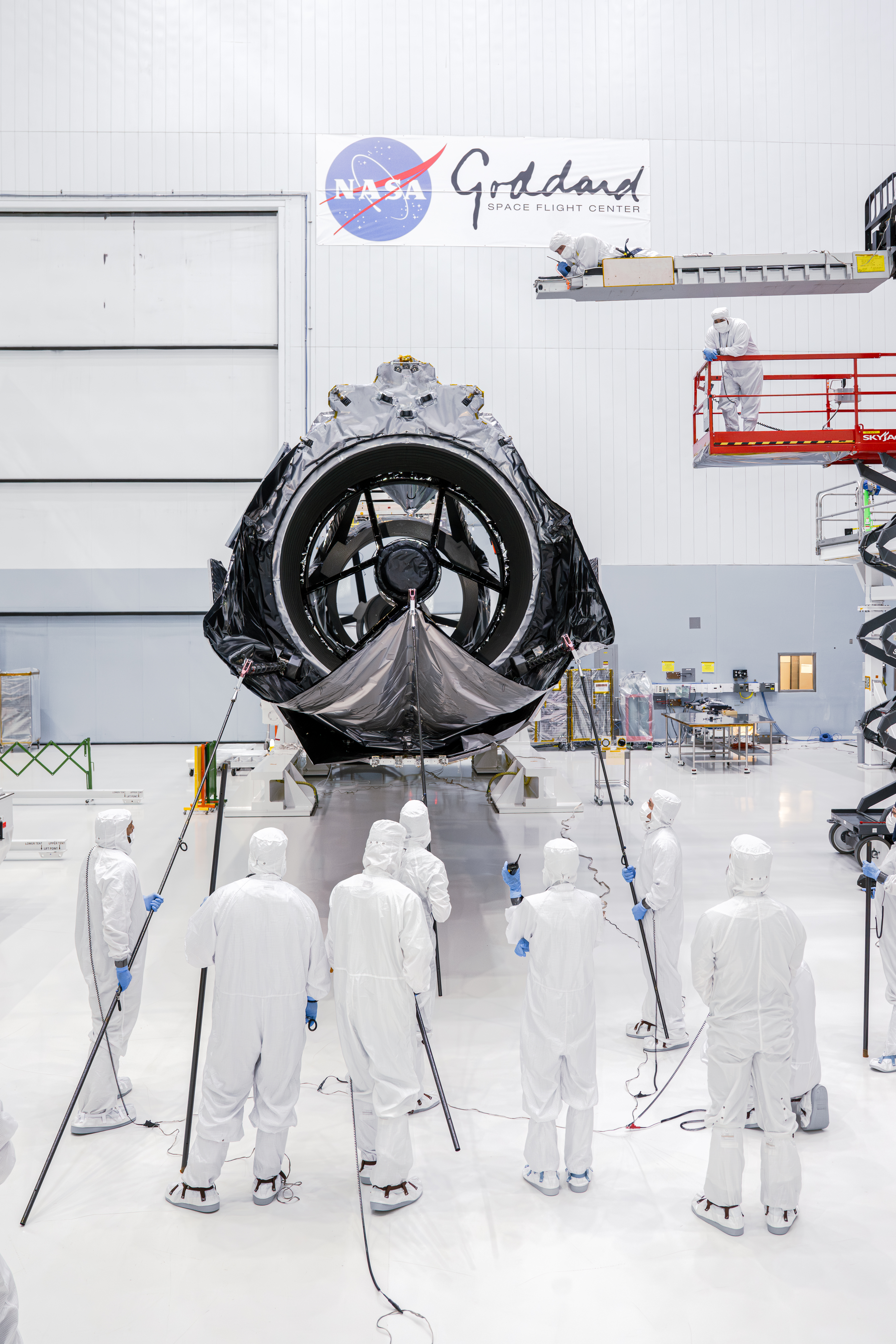
Engineers at NASA’s Goddard Space Flight Center in Greenbelt, Maryland, have completed their final inspection of a key element for the agency’s Nancy Grace Roman Space Telescope: the primary mirror. This 7.9-foot (2.4-meter) mirror will collect and focus light from cosmic objects near and far, helping Roman capture stunning panoramas of space.
The primary mirror for NASA’s Nancy Grace Roman Space Telescope has passed its final inspection. On May 20 and 21, engineers at NASA’s Goddard Space Flight Center in Greenbelt, Md., confirmed that no specks fell onto the mirrors during testing and that there are no changes in the mirror path and alignment. With this milestone complete, the primary mirror is ready for its next view: space.NASA’s Goddard Space Flight Center
“The Roman engineering team laid eyes on the telescope for the final time before it, in turn, becomes the eyes of humanity, revealing the wonders of the cosmos,” said J. Scott Smith, the Roman telescope manager at NASA Goddard. “It is a profoundly humbling moment to witness the culmination of hard work from so many dedicated individuals, teams, and partner organizations, including L3Harris.”
On May 20, engineers turned the Roman observatory onto its side and deployed the “hood” that will be stowed for launch to protect the mirror. Then the team conducted a meticulous visual inspection to ensure no specks fell onto the mirrors during testing and confirm there are no changes in the mirror path and alignment.
“We developed a method of using a high-resolution camera equipped with a very powerful zoom lens to do a multi-purpose inspection,” said Bente Eegholm, optics lead for Roman’s Optical Telescope Assembly at NASA Goddard. “The mirror passed with flying colors, keeping the mission on track for an early September launch.”
Technicians stow Roman’s deployable aperture cover, a large sunshade designed to keep unwanted light out of the telescope.NASA/Sydney RohdeThe team carefully observed the optics along the path light will follow to the Wide Field Instrument detector array and confirmed it remains in proper alignment following the observatory shake test.
“In order to gather very sensitive measurements of objects strewn throughout space, all of Roman’s components have to be ultraprecise,” Eegholm said. “The primary mirror certainly delivers on that precision.”
Roman’s primary mirror sports a layer of silver less than 400 nanometers thick — about 200 times thinner than a human hair. The silver coating was specifically chosen for Roman because of how well it reflects near-infrared light. By contrast, the Hubble Space Telescope’s mirror is coated with layers of aluminum and magnesium fluoride to optimize visible and ultraviolet light reflectivity. Likewise, the James Webb Space Telescope’s mirrors have a gold coating to suit its longer wavelength infrared observations.
The Roman mirror is so finely polished that the average bump on its surface is only 1.2 nanometers tall — more than twice as smooth as the mission requires. If the mirror were scaled up to Earth’s size, these bumps would be just a quarter of an inch high.
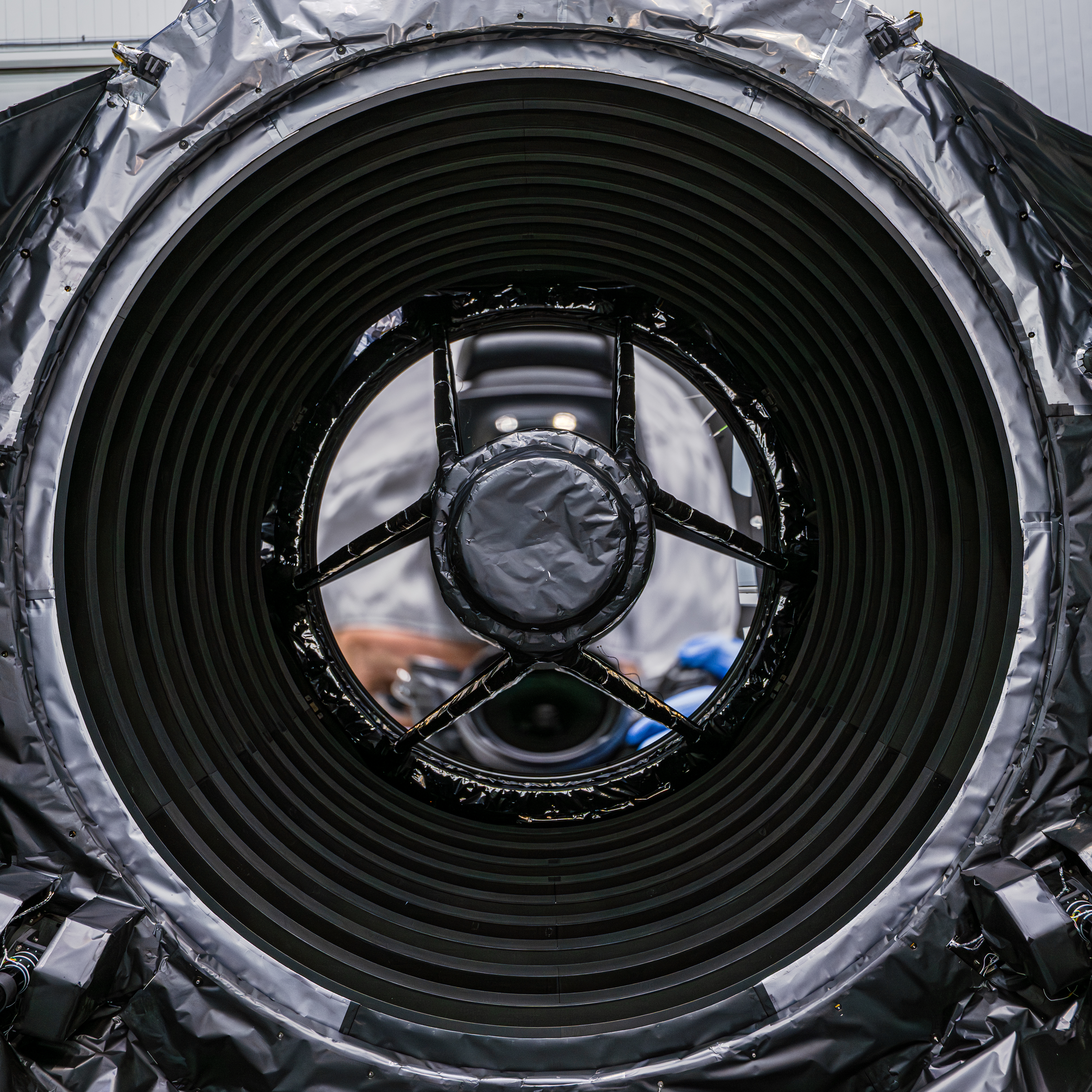
In this photo, which peers directly down the barrel of Roman’s telescope, the photographer’s camera is reflected in the primary mirror.NASA/Sydney RohdeSince it’s made of a specialty ultralow-expansion glass, the mirror will resist flexing, which can happen to materials during temperature changes (like going from balmy Earth conditions to the deep freeze of space). This preserves Roman’s image quality, because if the primary mirror changed shape, it would distort the images from the telescope.
“We’re really proud of the amazing optical system we’ve delivered for the Roman mission alongside our partners at L3Harris,” said Josh Abel, lead Optical Telescope Assembly systems engineer at NASA Goddard. “Now that it’s assembled, aligned, and all shined up, we’re ready to go.”
Now, the Roman team is preparing to ship the observatory to the launch site at NASA’s Kennedy Space Center in Florida in the coming weeks. NASA expects the mission to begin returning incredible cosmic vistas within several months after launch.
To learn more about NASA’s Roman mission, visit:
The Nancy Grace Roman Space Telescope is managed at NASA’s Goddard Space Flight Center in Greenbelt, Maryland, with participation by NASA’s Jet Propulsion Laboratory and Caltech/IPAC in Southern California, the Space Telescope Science Institute (STScI) in Baltimore, and scientists from various research institutions.
Media contact:
Claire Andreoli
NASA’s Goddard Space Flight Center, Greenbelt, Md.
301-286-1940
Ashley is the lead science writer for NASA's Nancy Grace Roman Space Telescope.
Share Details Last Updated May 30, 2026 EditorAshley BalzerContactAshley Balzerashley.m.balzer@nasa.govLocationGoddard Space Flight Center Related Terms Explore More 6 min read NASA’s Roman Mission Preps to Unveil New Populations of Faraway Worlds Article 4 days ago 4 min read NASA’s Roman Observatory Passes Final Major Prelaunch Tests Article 2 months ago 7 min read NASA Announces Plan to Map Milky Way With Roman Space Telescope Article 6 months ago Keep Exploring Discover More Topics From NASAMissions
Humans in Space
Climate Change
Solar System
Hubble Spies Faint Irregular Galaxy
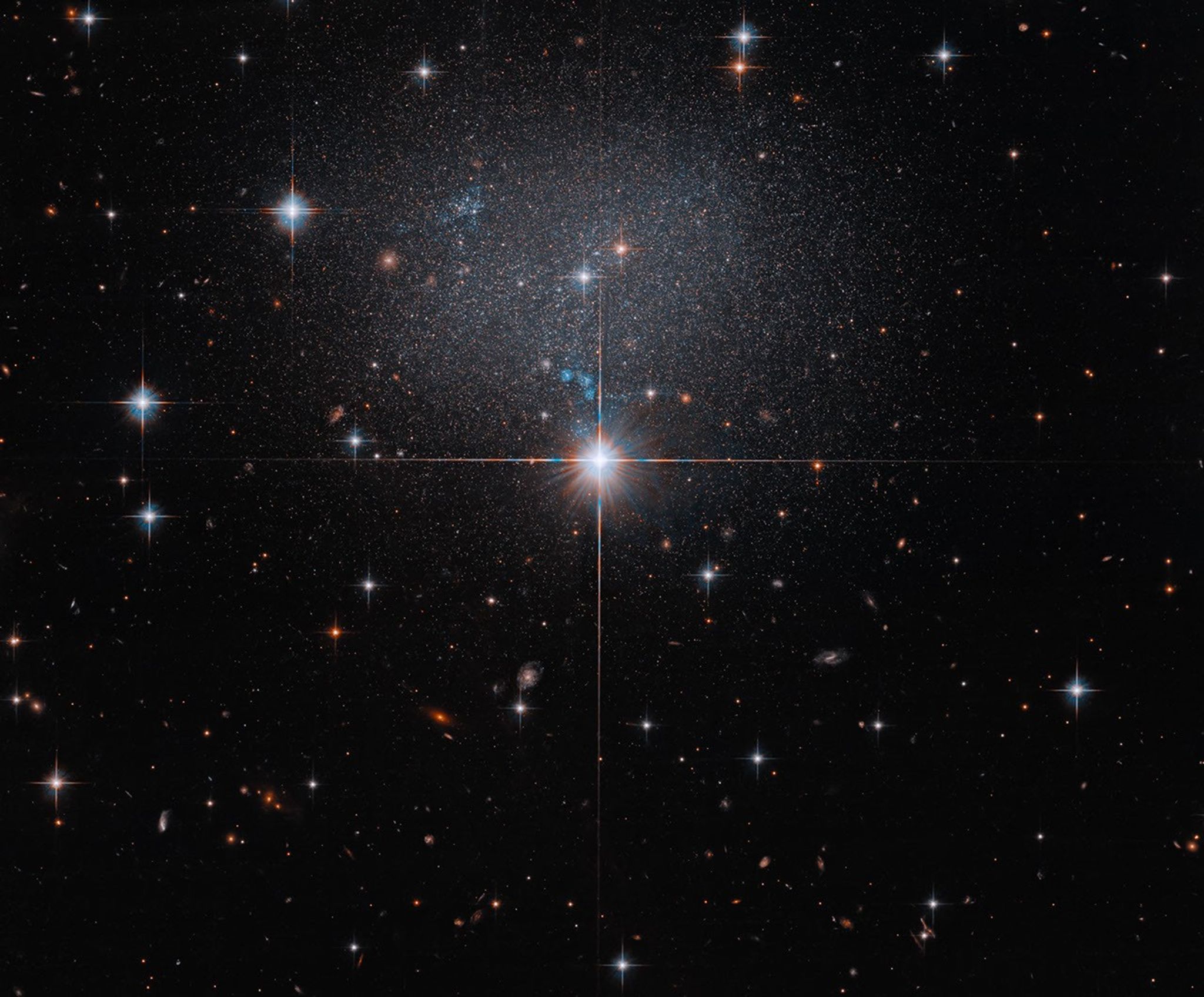
This NASA Hubble Space Telescope image released on May 27, 2026, features the dwarf irregular galaxy ESO 490-017, roughly 12,000 light-years in diameter and some 23 million light-years away in the constellation Canis Major. The galaxy’s low surface brightness makes it appear as a faint, starry swarm behind brighter foreground stars that are easily recognized by their diffraction spikes. Numerous red, orange, and beige dots are distant galaxies peppering the black background, many exhibiting distinct spiral structure.
The data in this image of ESO 490-017 was part of a Hubble observing program that looked at the movement of galaxies and galaxy clusters through space. Matter in the universe is distributed unevenly, and the gravitational influence of that matter drives the “cosmic flow” or movement of large-scale structures in the universe.
Image credit: NASA, ESA, R. Tully (University of Hawaii); Image Processing: G. Kober (NASA/Catholic University of America)
Hubble Captures M88 on Journey to Center of Virgo Cluster
- Hubble Home
- Overview
- Impact & Benefits
- Science
- Observatory
- Team
- Multimedia
- News
- More
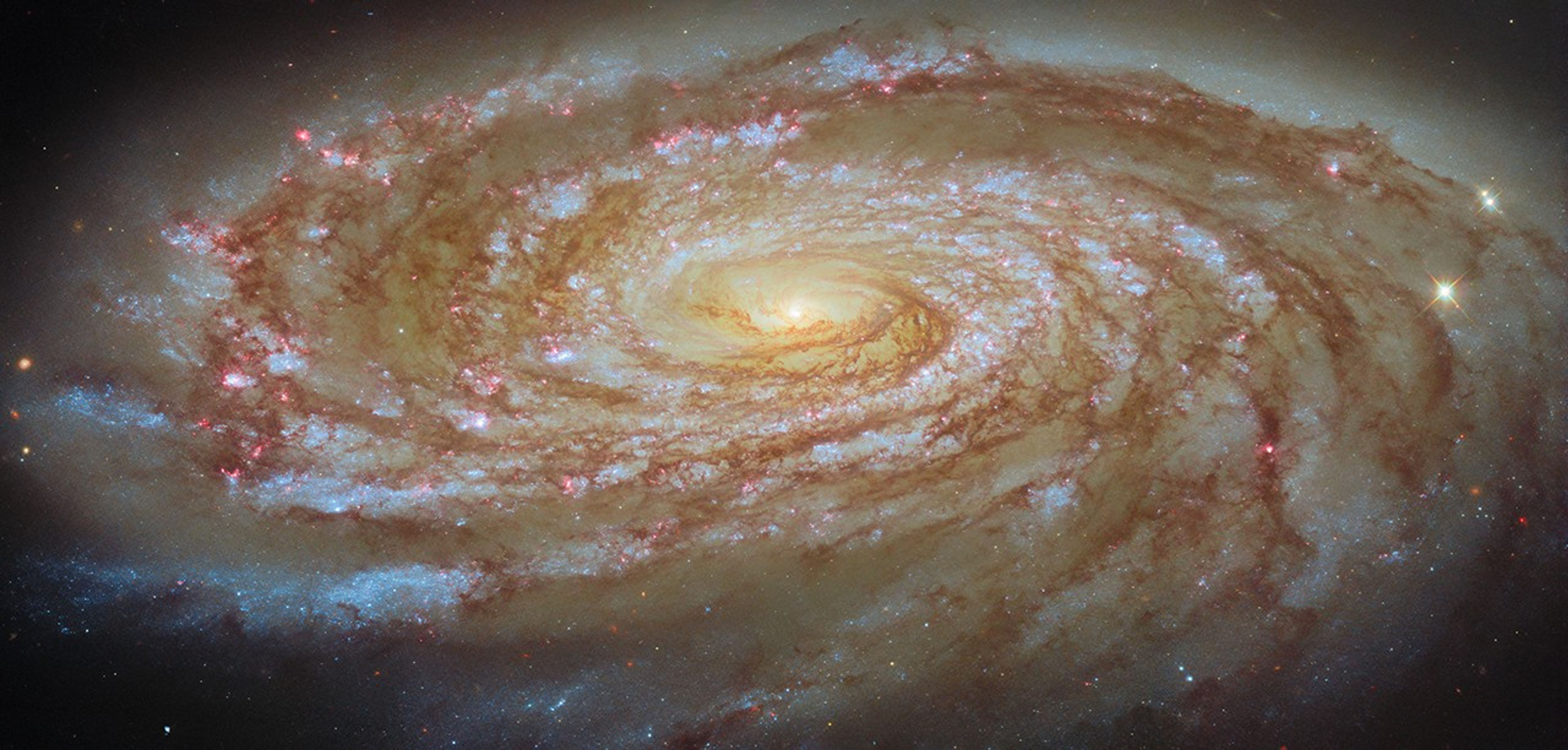
The focus of this NASA/ESA Hubble Space Telescope image is an active spiral galaxy on a journey lasting hundreds of millions of years. The galaxy Messier 88 (M88), also known as NGC 4501, is located about 63 million light-years away in the constellation Coma Berenices (Berenice’s Hair).
M88 is an active galaxy, which means that its center harbors a supermassive black hole that is snacking on gas and dust. Astronomers estimate the black hole is around 100 million times as massive as the Sun, and it appears to be powering outflows of gas from the galaxy’s center.
A population of old, reddish stars around the black hole give M88 its warmly glowing heart. Spreading out from the galaxy’s center are several tightly wound, symmetrical spiral arms, each outlined by sparkling pink and blue star clusters and knotted clouds of dust. We see M88 from an angle that makes it appear elongated, and its spiral arms delicately fan out before it.
M88 is a member of the Virgo Cluster, a collection of more than a thousand galaxies held together by gravity. As this massive galaxy group moves through space, the galaxies themselves are in constant motion as they orbit the cluster’s center of gravity. M88 itself is on a long and somewhat perilous cosmic journey that will bring it to the innermost reaches of the cluster.
As is the case with any epic journey, M88 will be fundamentally changed by its trek to the center of the Virgo Cluster, about two million light-years from where it is today. In 200–300 million years, M88 will make its closest approach to Messier 87, the massive elliptical galaxy that anchors the entire cluster. As it draws close to this gravitational behemoth, M88 will experience intense ram pressure stripping. Ram pressure stripping is a process through which a galaxy’s gas is swept away as it pushes through the ever-present gas between the galaxies in a cluster.
Researchers have already seen this process at work in M88. The galaxy’s swirling disk of gas is truncated and appears compressed on the leading edge of the galaxy, piling up gas and dust like snow before a plough. In fact, M88 appears to have considerably less cold gas — the raw fuel for star formation — than expected for a galaxy of its size, especially in its outer regions. This is a clear sign that M88 will be altered by its journey, which will affect its ability to form stars and alter the course of its evolution.
Astronomers observed M88 with Hubble as part of an observing program (#18103; PI: D. Thilker) dedicated to understanding the lives of spiral galaxies in crowded environments. This program uses Hubble’s Wide Field Camera 3, which can finely resolve individual star clusters and nebulae in galaxies tens of millions of light-years away. By studying galaxies on these scales, astronomers can understand how a journey through a cluster impacts a galaxy’s evolution and ability to form new stars.
Text credit: ESA/Hubble
Facebook logo @NASAHubble @NASAHubble Instagram logo @NASAHubbleMedia Contact:
Claire Andreoli
NASA’s Goddard Space Flight Center, Greenbelt, MD
claire.andreoli@nasa.gov
Since its 1990 launch, the Hubble Space Telescope has changed our fundamental understanding of the universe.
Messier 88
This galaxy’s core holds supermassive black hole roughly 100 million times more massive than our Sun.
Hubble Science Highlights
Hubble e-Books
Painting the Growing Season in the Maize Triangle
- Earth
- Earth Observatory
- Image of the Day
- EO Explorer
- Topics
- More Content
- About
NASA’s X-59 Prepares for First Supersonic Flight
6 min read
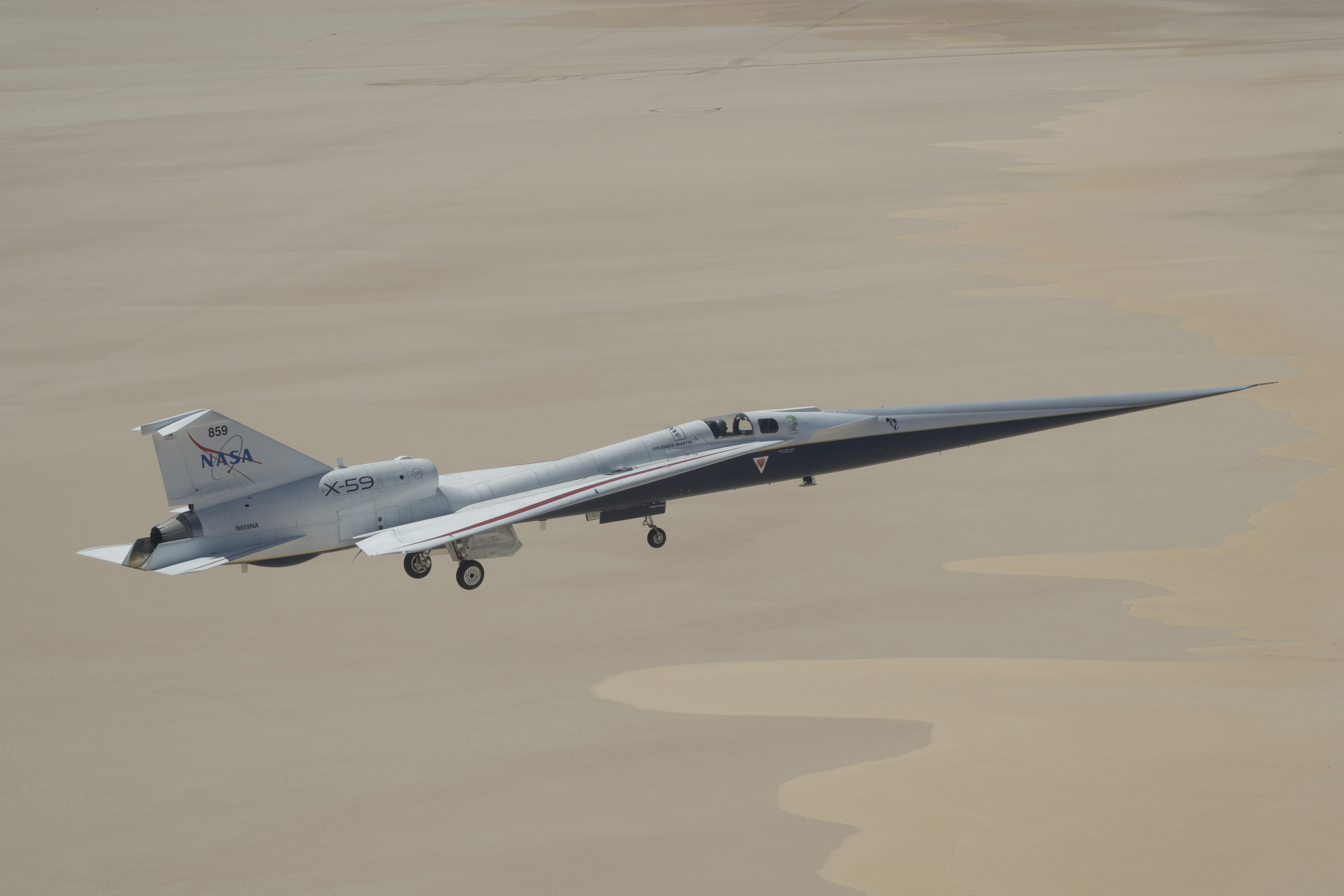
Preparations for Next Moonwalk Simulations Underway (and Underwater) NASA’s X-59 quiet supersonic research aircraft flies over Rogers Dry Lake near NASA’s Armstrong Flight Research Center in Edwards, California, on Tuesday, May 12, 2026. NASA continues expanding the aircraft’s flight envelope through a series of lower-altitude and slower-speed flights ahead of upcoming flight tests at speeds faster than the speed of sound.NASA/Jim RossNASA’s X-59 quiet supersonic research aircraft is preparing for some of its most significant flights yet. The X-plane is about to begin a new block of test flights that will include its first time flying faster than the speed of sound and other mission-critical objectives.
“What comes next is the first time this one-of-a-kind aircraft will fly supersonic,” said Cathy Bahm, project manager for NASA’s Low Boom Flight Demonstrator. “We are starting toward the mission conditions test point that X-59 was designed for.”
After months of flights, the X-59 team reviewed their progress in late May and now look toward the aircraft’s next series of flight tests, including higher altitudes and faster speeds. This will give engineers a look at how the X-59 handles under required operational conditions for NASA’s Quesst mission to eventually gather data on quiet supersonic flight.
The team expects the X-59 to fly supersonic – over 630 mph – for the first time at approximately 43,000 feet altitude during a series of test flights in early June, a major milestone for the aircraft. After that, it will conduct a “mission conditions” flight, where it will hit Mach 1.4 (925 mph) at approximately 55,000 feet. That speed and altitude are important because they’re NASA’s performance targets for the X-59 to eventually fly over U.S. communities to demonstrate quiet supersonic flight and collect feedback data about the aircraft’s quiet sonic “thump” from the public.
While the X-59 is designed to fly at supersonic speeds without producing a loud sonic boom, these early flights are not yet intended to demonstrate its quiet supersonic capabilities. The X-59 will be accompanied by a traditional supersonic chase plane, so any quiet thump it produces in the current phase of testing will be obscured by louder, traditional sonic booms from the chase. In supersonic flights this summer, the chase aircraft will also be outfitted with a specialized shock-sensing probe to take initial measurements of the X-59’s shock waves.
Completed flightsThe X-59’s first block of flights successfully met several test goals, generating data for its team to analyze. After making its first flight in October 2025, it entered a scheduled period of maintenance before returning to the skies in March 2026. It has since completed 14 additional flights, marking milestones including:
- Its first gear swing, or the retraction of its landing gear to show off its sleek design for the first time.
- Reaching altitudes up to 43,000 feet and near supersonic speeds at Mach 0.95, approximately 627 mph.
- Marking its first dual-flight day and then making those increasingly routine as the X-59 team increased flight cadence.
- After a period of moving higher and faster, transitioning into lower and slower test flight conditions so engineers could gather information on the X-59’s behavior across a range of flight conditions.
Data collected during the X-59’s first block of test flights helped teams better assess critical systems, including fuel, hydraulics, environmental controls, and the eXternal Vision System, which is the aircraft’s unique series of cameras that feed into a monitor that allows the pilot to see forward instead of using a traditional windshield. Teams monitored how the aircraft behaved during takeoff, landing, and throughout flight. Strain gauges installed throughout the X-59 collected detailed information on the forces it experienced, and how its structure responded to them.
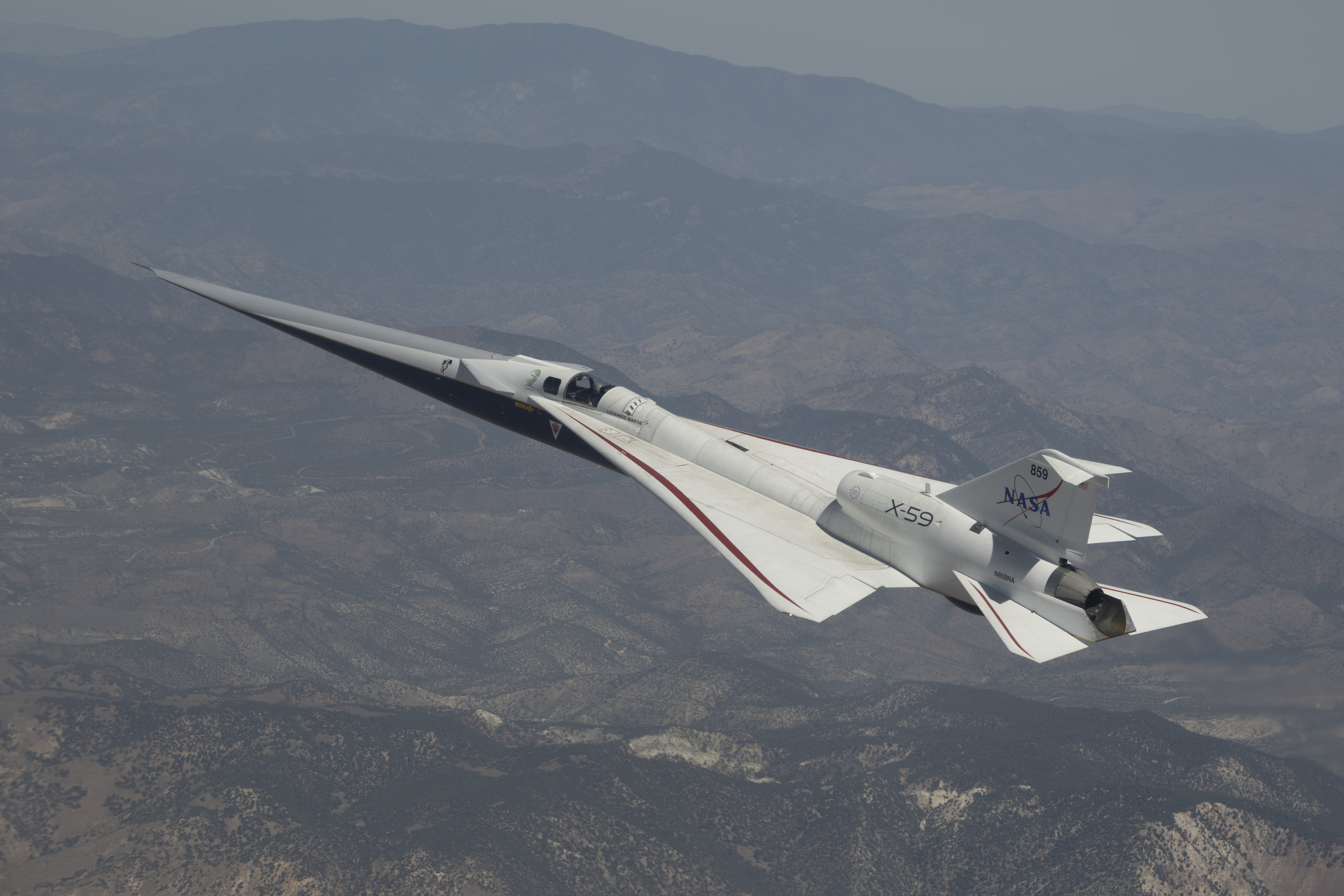
NASA’s X-59 quiet supersonic research aircraft flies above mountains near NASA’s Armstrong Flight Research Center in Edwards, California, on Tuesday, May 12, 2026. NASA continues expanding the aircraft’s flight envelope to evaluate how it performs across a range of flight conditions ahead of upcoming flight tests at speeds faster than the speed of sound in support of the agency’s Quesst mission.NASA/Jim Ross Next stepsDuring the X-59’s upcoming flights, pilots will run through test points while engineers watch the aircraft’s performance — but now in supersonic flight conditions.
“Flying at supersonic speeds is a major milestone for the X-59 team,” Bahm said. “Every step of envelope expansion brings us closer to demonstrating the quiet supersonic capability that is at the heart of the Quesst mission. Completing the first mission-conditions flight is especially meaningful – it’s the moment where we begin validating the aircraft in the environment it was designed for.”
In addition to reaching mission condition during this block of flight tests, the X-59 will also achieve its maximum speed of Mach 1.6 (1,218 mph) and altitude of 60,000 feet.
But just because the aircraft can go that fast doesn’t mean it always will fly supersonic. Testing will continue, including a mix of subsonic and lower-altitude flights so the team can continue monitoring it in varied conditions.
“These flights not only deepen our confidence in the X-59’s performance – they mark our progression toward the future phases of the mission that will ultimately help shape the future of supersonic travel,” Bahm said.
All flights so far and in the upcoming test block are part of Phase 1 of the X-59’s Quesst mission, focused on proving the performance and airworthiness of the aircraft. Some of those flights will include early deployment of equipment, including a probe mounted to one of NASA’s F-15 research aircraft that can measure the X-59’s unique shock wave signature.
Data gathered during those early probing flights will allow engineers to prepare for a new stage of work set to begin later this year: Quesst Phase 2, when teams will begin to measure the aircraft’s supersonic flight signature to verify that it’s producing a quiet supersonic thump, as designed.
“Aviation pioneer Otto Lilienthal said, ‘To design a flying machine is nothing. To build one is something. But to fly is everything.’ The 15 X-59 flights we’ve accomplished since March have been everything to this team and the mission,” Bahm said. “Every flight has pushed the boundaries of what’s possible, steadily expanding the envelope and strengthening our confidence in the aircraft.”
But, she said, rather than focusing on past progress, the team is already looking ahead.
“As we look ahead to the upcoming flights, we’re poised to open the envelope even further – moving boldly toward the mission test point this aircraft was built to achieve,” Bahm said. “Flying supersonic and reaching these milestones isn’t just progress; it’s the realization of years of perseverance, innovation, and teamwork. Each step brings us closer to Phase 2, and to the future of commercial supersonic flight.”
Share Details Last Updated May 28, 2026 EditorDede DiniusContactNicolas Cholulanicolas.h.cholula@nasa.govLocationArmstrong Flight Research Center Related Terms Explore More 5 min read NASA Uses Mineralogical Marker to Understand Ancient Martian ClimateScientists analyzed 20 Martian samples collected by NASA’s Curiosity Rover and found that differences in…
Article 4 days ago 5 min read NASA Develops Sensor to Improve Firefighter Safety Article 5 days ago 4 min read Keeping NASA Flying: Ground Crews Ensure Aircraft Readiness Article 1 week ago Keep Exploring Discover More Topics From NASAArmstrong Flight Research Center
Ames Research Center
Glenn Research Center
Langley Research Center
I Am Artemis: Daniel Stubbs
Listen to this audio excerpt from Daniel Stubbs, NASA aerospace engineer:
0:00 / 0:00
Your browser does not support the audio element.If you’ve driven through a cloud of dust and dirt that temporarily obscured your view, you’ve gotten a partial picture of a potential problem that NASA’s human landing systems for Artemis will face when they land on the Moon. Daniel Stubbs, an aerospace engineer with the Plume and Aero Environments team in the Spacecraft and Vehicle Systems office at NASA’s Marshall Space Flight Center in Huntsville, Alabama, studies and models the interaction between plumes of rocket exhaust and the regolith on the surface of the Moon, paving the way for crew safety and Artemis mission success.
Stubbs, a native of Trussville, Alabama, who earned a bachelor’s, master’s, and doctoral degree in aerospace engineering from Auburn University in Alabama, decided early in his college career he wanted to work for NASA, but he didn’t see a clear path at the time to reach his goal. In graduate school, he had the opportunity to work on plume-surface interaction modeling as part of a NASA Early Stage Innovations grant. Now, Stubbs is continuing some of the work he first started as a graduate student.
NASA’s Daniel Stubbs, seen here at the Lunar Regolith Terrain field at Marshall Space Flight Center, used his experience as a graduate student at in aerospace engineering at Auburn University modeling lunar regolith plumes into a position with NASA Marshall’s Plume and Aero Environments team working to characterize interactions between clouds of lunar regolith and commercial human landing systems. NASA/Charles BeasonNASA’s Apollo missions uncovered the risks lunar regolith presents to astronauts, spacecraft, spacesuits, and other assets on the Moon’s surface. Lunar regolith consists of meteoroids and micrometeoroids that, over millennia, have been ground up into razor-sharp, abrasive particles. Future lunar explorers and their landers, rovers, and vehicles will face similar challenges. Landers in development are larger, heavier, and incorporate more rocket engines than the Lunar Module that landed astronauts on the Moon during the Apollo missions of the 1960s and 1970s. And, unlike Apollo Lunar Modules that left descent stages on the Moon, the new lunar landers will take off directly from the surface using the same engines, thrusters, and other systems that they used for the initial landing. Accurate prediction of the plume-surface interaction between the systems and the lunar regolith during landing will help ensure the lander hardware can survive that environment, and that it is ready to take off to meet Orion and astronauts in lunar orbit to return safely home to Earth.
As the engines’ exhaust plumes interact with the Moon’s surface, they could erode the surface, potentially forming a crater and a large cloud of lunar regolith.”Daniel StuBBs
NASA aerospace engineer
“The dust and regolith plume can make it difficult for instruments on the landers to see the surface of the Moon,” Stubbs said. “If these instruments don’t report correct readings to the guidance computers, it could affect a lunar landing. Also, when a lander takes off from the surface to return astronauts to Orion, the lunar regolith blown away from the landing site by the rocket plumes could damage scientific instruments or other assets that have been deployed on the surface of the Moon.”
NASA’s Human Landing System program is spearheading a major ground-based study of rocket engine exhaust plumes and lunar dust and regolith. Testing in the 60-foot space simulator chamber at NASA’s Langley Research Center in Hampton, Virginia, will represent the conditions the lunar landers may experience, and create, when landing on the Moon.
The research will help engineers understand the aerodynamic forces landers will experience during descent and ascent from the surface, heating at a lander’s base, the potential for a large lunar lander to tip over as a result of crater formation or surface instability.
When the dust settles and NASA has landed American astronauts on the Moon in 2028, Daniel Stubbs will be able to reflect on his work modeling plumes of lunar dust and regolith that rocket engines will stir up.
Through the Artemis program, NASA will send astronauts to explore the Moon for scientific discovery, economic benefits, and to build the foundation for the first crewed missions to Mars – for the benefit of all.
For more on NASA’s human landing systems, visit:
https://www.nasa.gov/humans-in-space/human-landing-system/
About the AuthorBeverly PerryCommunications Strategist Share Details Last Updated May 29, 2026 EditorLee MohonContactCorinne M. Beckingercorinne.m.beckinger@nasa.govLocationMarshall Space Flight Center Related Terms Explore More 7 min read NASA’s 2026 Lunabotics: Winning Student Teams Engineering Lunar Future Article 3 days ago 3 min read Jaclyn Kagey Shapes Humanity’s Return to the Moon Article 4 days ago 2 min read NASA Seeks Interest for Artemis Mission CubeSats Article 1 week ago Keep Exploring Discover More Topics From NASAMissions
Humans in Space
Climate Change
Solar System
New Landsat Science Team Holds First In-Person Meeting
- Landsat Home
- Missions
- News
- Data
- Benefits
- Outreach
- Multimedia
- About
- Search
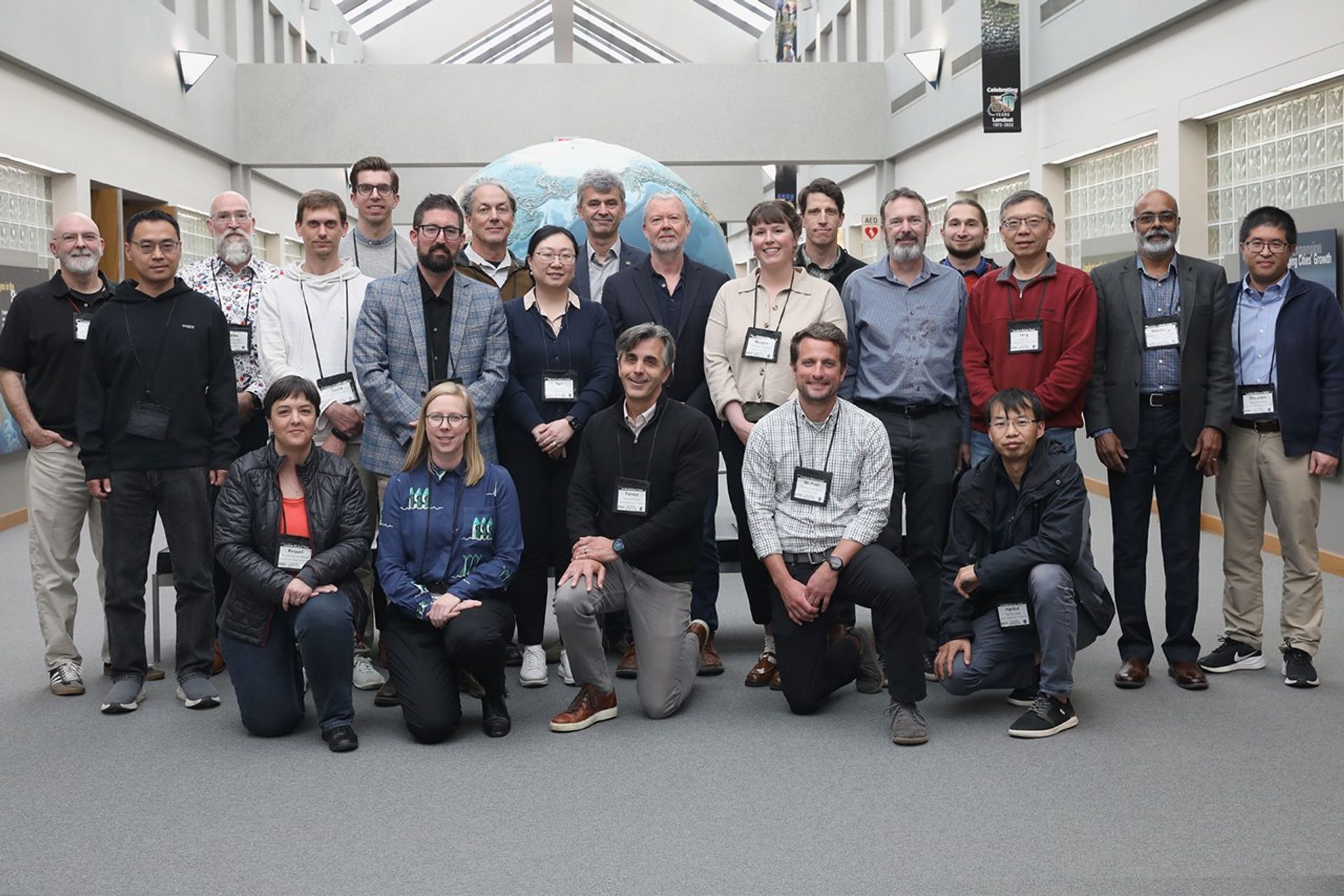
Front Row: Raquel De Los Reyes, Courtney Bright, Forrest Melton, Michael Campbell , Hankui Zhang
Standing: Greg Vaughan, Lin Yan, Mike Wulder, David Frantz, Kyle Knipper, Nimrod Carmon, Dean Hively, Yun Yang, Peter Strobl, David Roy, Morgan Crowley, Ned Bair, Phillip Dennison, Ryan O’Shea, Feng Gao, Medhavy Thankappan, Zhuosen Wang. Not pictured: Martha Anderson, Kimberlee Baldry, Eric Vermote. USGS
From May 5 to 7, the 2026–2030 Landsat Science Team met for their first in-person meeting at the Earth Resources Observation and Science (EROS) Center in Sioux Falls, SD. The three-day event, co-moderated by Landsat 8, 9, and 10 Project Scientist Chris Neigh, allowed leaders from USGS and NASA to begin work on a vision for the upcoming five-year period.
Attendees shared their current work and a vision for the future of the Landsat program. Participants received comprehensive status updates on the upcoming Landsat 10 project, the ongoing interagency and international collaboration on the Harmonized Landsat and Sentinel-2 (HLS) data products, and detailed plans for Collection 3 (C3).
Throughout the event, team members representing funded, international, and federal programs showcased the far-reaching impact of Landsat data across various Earth science disciplines, spanning snow cover mapping, atmospheric correction, water quality monitoring, evapotranspiration, agricultural applications, volcanic monitoring, and more.
The meeting culminated in focused breakout sessions, where experts drafted vital recommendations across four key technical areas to guide future mission data processing:
Surface ReflectanceThe surface reflectance working group identified several priorities, including topography and adjacency corrections, Bidirectional Reflectance Distribution Function (BRDF) correction, and enhanced cloud masking with consistent approaches for HLS data products. Key recommendations included incorporating CMIX2 cloud masking results into future collections and mapping out C3 toolkit dependencies for user-applied corrections.
Temperature and EmissivityDiscussions on land surface temperature and emissivity centered heavily on maintaining archive consistency. The team recommended either maintaining native resolution or standardizing to 60 meters, with additional testing specifically for volcano studies. They endorsed using ASTER GED/CAMEL emissivity datasets and preparing for Landsat 10’s five thermal bands through ECOSTRESS comparison. They also called for better quantification of how atmospheric inputs impact harmonization efforts through collaboration between NASA’s Jet Propulsion Laboratory (JPL), RIT, and EROS.
Aquatic ReflectanceAquatic reflectance experts raised critical concerns regarding Landsat 10’s planned 18-day repeat cycle, noting that it severely limits the monitoring of highly dynamic processes such as harmful algal blooms. The group called for increased investment in validation infrastructure for inland waters coordinated with international CEOS efforts. They also strongly advised against pixelwise algorithm switching to prevent data discontinuities and emphasized the need for strict compliance with CEOS Aquatic Reflectance V2.0 standards.
Projections, Tiling, and the PixelFinally, the group reviewing projection and tiling endorsed the USGS pixel grid nesting plan (which spans 10, 15, 20, 30, 60, and 120 meters). However, they recommended further trade analysis to optimize pixel replication errors, manage storage costs, and ensure proper coordination with Sentinel-2 Next Generation. The working group strongly recommended that if these complex grid issues remain unresolved, the program should maintain the Collection 2 approach (UTM and polar stereographic) while continuing to refine Analysis Ready Data (ARD) products for CONUS, Hawaii, and Alaska.
The recommendations generated during these breakout sessions created a roadmap for the new Landsat Science Team, ensuring that the global scientific community continues to receive high-quality, actionable Earth observation data through the end of the decade.
Explore More
New Landsat Science Team Holds First In-Person Meeting
3 min read
From May 5 to 7, the Landsat Science Team meeting convened at the Earth Resources Observation and Science (EROS) Center…
May 28, 2026 ArticleA Shift in What’s Shaping U.S. Landscapes
5 min read
Wild disturbances are on the rise, while land disturbed by human activity has been decreasing.
May 28, 2026 ArticleReleased: NASA Goddard Issues Draft Request for Proposal for the Landsat 10 Spacecraft
2 min read
The Landsat 10 Spacecraft Draft Request for Proposal (DRFP) is available for review via SAM.gov.
May 27, 2026 Article1
2
3
…
311
Next