NASA - Breaking News

For NASA’s TESS, Stellar Eclipses Shed Light on Possible New Worlds
4 min read
For NASA’s TESS, Stellar Eclipses Shed Light on Possible New WorldsA study of NASA’s TESS (Transiting Exoplanet Survey Satellite) data on stellar pairs undergoing mutual eclipses has uncovered more than two dozen candidate exoplanets, or worlds beyond our solar system. This method allows the mission to locate planets it couldn’t otherwise detect.
A gas giant planet looms in the foreground at right, illuminated by a pair of stars, in this artist’s concept of a world in a binary system. NASA’s TESS (Transiting Exoplanet Survey Satellite) has found planets in two binary star systems by looking for stellar dimming as the planets cross in front of one of the stars. Astronomers have now demonstrated a new method of finding planets in these systems by focusing on the timing of the stars’ mutual eclipses. NASA’s Goddard Space Flight Center/Chris Smith (USRA)To date, TESS has discovered 885 confirmed exoplanets and identified more than 7,900 candidates, nearly all found because the planets pass in front of their stars from our perspective. These events, called transits, produce a small, regular dip in the brightness of the planet’s host star. TESS also observes tens of thousands of eclipsing binary stars — two orbiting stars that alternately eclipse each other from our vantage point. Astronomers can detect the gravitational tug of exoplanets in these systems by carefully measuring the exact timing of many eclipses. Prior to the new study, discoveries by NASA’s retired Kepler mission and other facilities had recorded 16 transiting worlds around binary stars, while TESS had found an additional two.
“Identifying transits in binary systems clearly is challenging, but we’d like to know more about the range of planets that can form around two gravitationally bound stars,” said study lead Margo Thornton, a doctoral candidate at UNSW (University of New South Wales) in Sydney. “So we developed a survey to search for planets using stellar eclipses that is not limited to the orientation of the planet’s orbit.”
A paper describing the findings published May 4 in the journal Monthly Notices of the Royal Astronomical Society.
For planets located in binary systems, the orientation of the planet’s orbit can tell us about how that system formed. Some models of planet formation in binary systems suggest planets mainly form near the plane formed by the two orbiting stars, increasing the likelihood of binaries hosting transiting worlds. But other models indicate a much more disorderly formation process, with the stellar pair stirring its young planets into wider and more tilted paths much less likely to undergo transits.
The timing of stellar eclipses can gradually change through tidal and rotational interactions between the stars, the effects of general relativity, and the presence of other unseen masses, such as planets, in the system. All of these forces cause the entire orbital plane of the binary to rotate, or precess, and this in turn alters the eclipse timing.
“The key to calculating all of these different influences is the long, rich set of observations available from TESS,” said co-author Benjamin Montet, a Scientia associate professor at UNSW Sydney. “After analyzing 1,590 binaries with at least two years of TESS data, we found 27 with candidate planets that now await confirmation.”
Explore how observations of stellar eclipses can expand the capabilities of NASA’s TESS, leading to the discovery of new candidate planets it couldn’t otherwise detect. NASA’s Goddard Space Flight Center/Francis ReddySince science operations began in 2018, TESS has tiled the sky by observing large swaths, called sectors, for nearly a month. Currently, the mission’s cameras capture a single image of the entire sector, measuring 24 by 96 degrees, about every 3 minutes, with even faster observations of selected targets.
The masses of the new candidates remain uncertain, but the team estimates the smallest world may hold as little 12 Earth masses, with the largest topping out around 3,200 Earths, or about 10 times Jupiter’s mass. Confirming these planets will require future ground-based observations that precisely measure the velocities of the host stars, which will reveal the slight gravitational tugs of any possible planets.
“The TESS mission was built to find transiting planets, and it’s great to see how the same measurements are driving discoveries far beyond its original mission,” said Allison Youngblood, the TESS project scientist at NASA’s Goddard Space Flight Center in Greenbelt, Maryland. “The mission’s continuing data collection is a treasure trove that enables new findings across a wide range of astronomical topics, from asteroids in the solar system to active galaxies powered by black holes in the distant universe.”
You could discover the next exoplanet! Join the Planet Hunters TESS citizen science project, and you’ll learn how to read light curves — plots of light data from distant stars — to find telltale signals from orbiting exoplanets.
By Francis Reddy
NASA’s Goddard Space Flight Center, Greenbelt, Md.
Media Contact:
Claire Andreoli
301-286-1940
claire.andreoli@nasa.gov
NASA’s Goddard Space Flight Center, Greenbelt, Md.
UNSW Sydney: New Star Wars-like planet candidates with two suns discovered
Share Details Last Updated May 04, 2026 Related TermsLAGEOS: An Earth Science Mission Built for Enduring Precision
2 min read
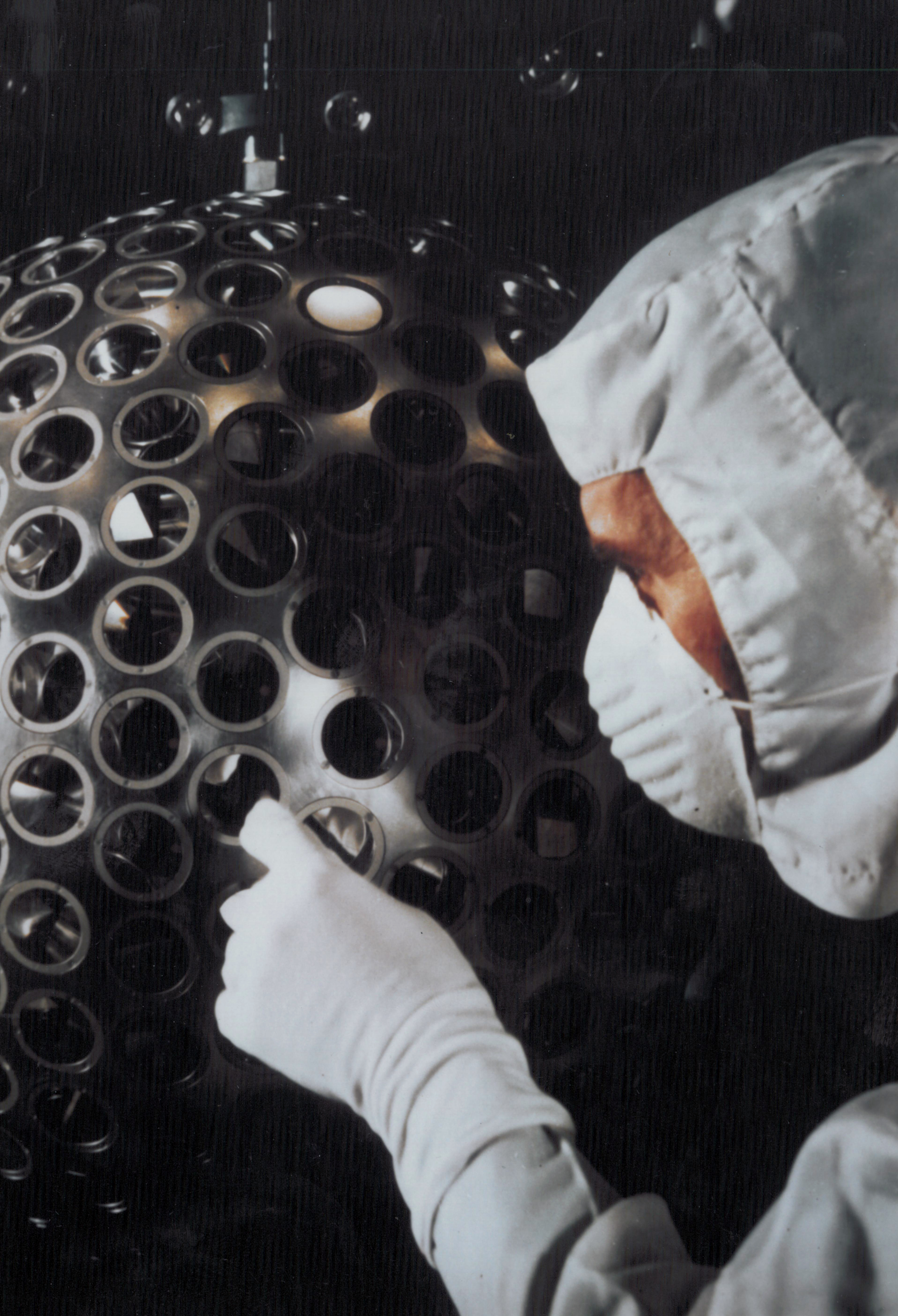
Preparations for Next Moonwalk Simulations Underway (and Underwater) Technicians at NASA’s Goddard Space Flight Center helped complete prelaunch testing of the Laser Geodynamic Satellite (LAGEOS). LAGEOS was the first satellite devoted exclusively to laser ranging studies.NASA/Goddard Space Flight CenterOn May 4, 1976, a spacecraft resembling a disco ball entered orbit almost 3,700 miles (6,000 kilometers) above Earth. This shiny, two‑foot‑wide (60‑centimeter) sphere called the Laser Geodynamics Satellite, or LAGEOS, is covered with 426 retroreflectors—small mirrored prisms designed to bounce laser light directly back to where it came from. Beneath its aluminum exterior sits a dense brass core that makes LAGEOS incredibly heavy (900 pounds or 400 kilograms) for its size.
That weight was intentional. The satellite’s high mass and compact, spherical design allow it to follow an exceptionally stable orbit, perfect for satellite laser ranging. From stations around the world, scientists fire pulses of laser light at LAGEOS and measure how long the light takes to return. Because the speed of light is known so precisely, researchers can calculate the distance to the satellite within just a few millimeters.
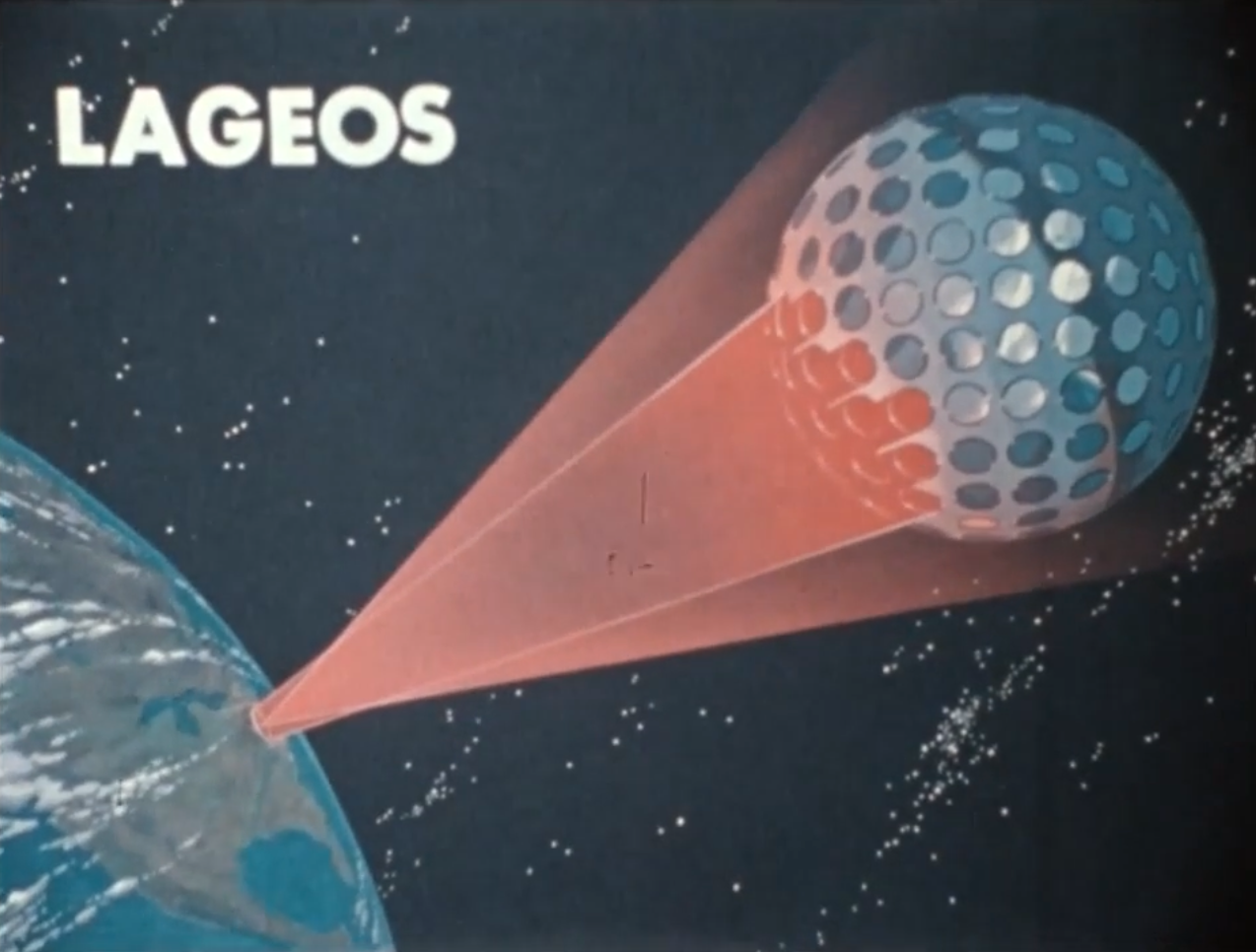
Historic concept art illustrating how the LAGEOS satellite reflects laser light emitted from a ground station on Earth.NASAOver these last 50 years, these ultra‑precise measurements have helped track the slow movements of Earth’s tectonic plates, monitor tiny shifts in the planet’s crust, and measure motion along major fault lines. LAGEOS’s data have sharpened our understanding of Earth’s shape and refined models of the planet’s gravity field. LAGEOS has even contributed to tests of Einstein’s theory of general relativity by helping confirm predicted effects on the orbits of massive bodies around Earth.
In 1992, the Italian Space Agency–built LAGEOS II, a near‑twin of the original LAGEOS satellite, was launched aboard space shuttle Columbia. With two satellites to compare, scientists could make even more accurate measurements. Together, they have become long-term benchmarks for Earth science.
Despite being among the oldest scientific satellites still in service, LAGEOS is still going strong. Its simple, maintenance-free design, along with minimal drag in its high orbit, means that it will likely continue to circle the globe for millions of years.
Get details of the history, design, and scientific results of LAGEOS See Carl Sagan's message to the future hidden inside LAGEOS Explore More 6 min read Now 40, NASA’s LAGEOS Set the Bar for Studies of Earth Article 10 years ago 19 min read Every Flight is a Mission to Planet EarthObserving Earth from space is one of the NASA’s longest-standing science experiments. This photo essay…
Article 15 years ago 5 min read The Legacy of NASA’s Voyager Mission Article 9 years agoRecord-Setting Retreat of Hektoria Glacier
- Earth
- Earth Observatory
- Image of the Day
- EO Explorer
- Topics
- More Content
- About
NASA Kennedy Center Director Announces Plans to Retire
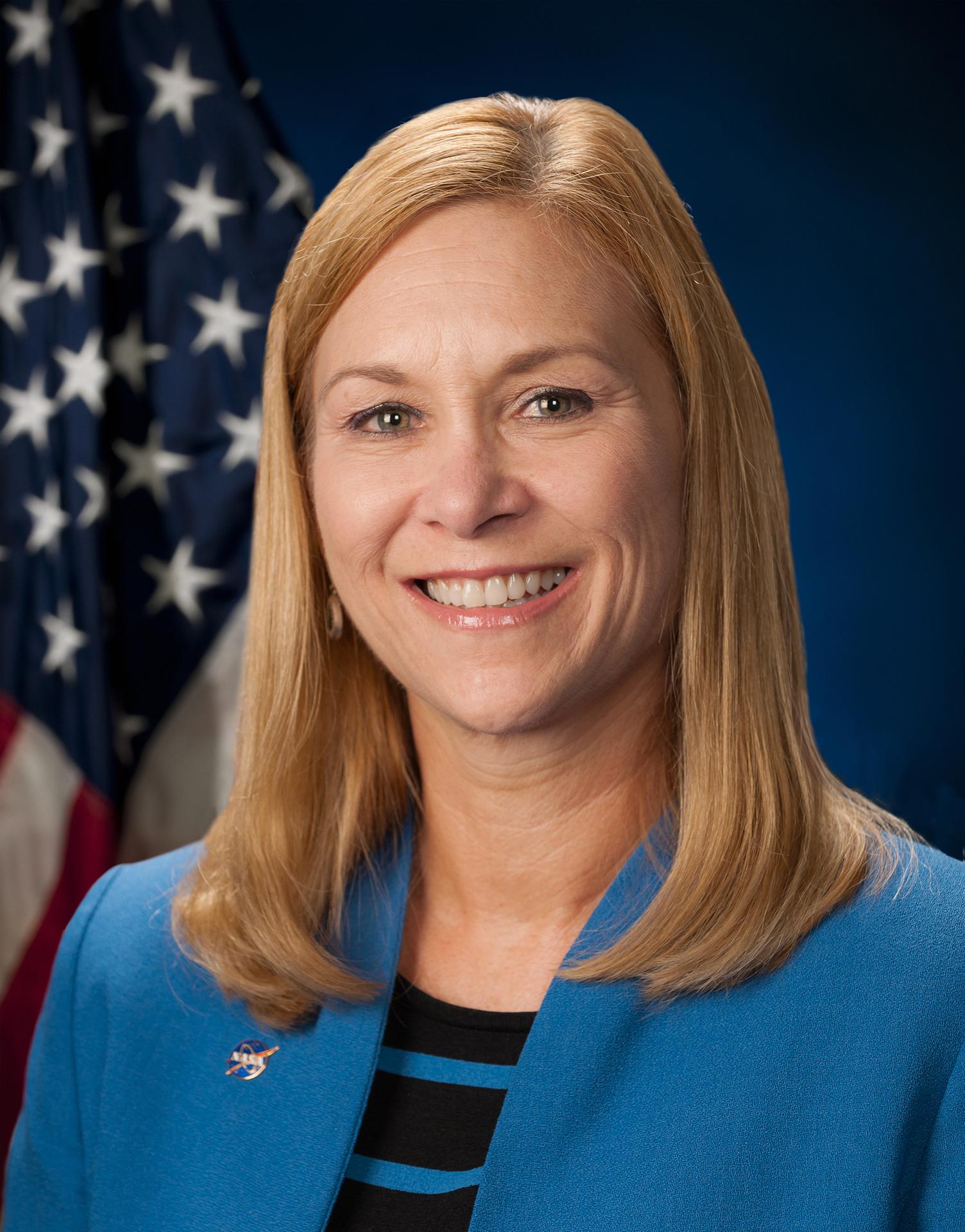
NASA announced Friday Janet Petro, center director for the agency’s Kennedy Space Center in Florida, is retiring.
Prior to joining NASA, Petro worked in a variety of military and industry positions, ultimately beginning her career at the agency in 2007 and working her way up to center director, as well as serving as acting administrator from January to July 2025.
“From the outset of her distinguished tenure at NASA, Janet has served as a profoundly influential leader, guiding both the agency and our Kennedy Space Center through some of the most significant transitions in our shared history, including playing a central role in reshaping NASA Kennedy into the nation’s premier multiuser spaceport,” said NASA Administrator Jared Isaacman. “As NASA has been charged, once again, with accomplishing the near impossible, I’m grateful for Janet for always embracing the challenge of discovering what could be and for pushing the boundaries to deliver the missions that enable NASA to lead the way into a new era of space.”
As NASA Kennedy’s 11th director, Petro manages a team of civil service and contractor employees, determining and implementing center policy and managing and executing the spaceport’s missions and agency program responsibilities. Previously, Petro served as acting director and NASA Kennedy’s deputy director. During her time as deputy director, she helped the center transition into a multi-user spaceport, leading cross-agency initiatives with the FAA (Federal Aviation Administration) and U.S. Air Force to streamline government processes and support commercial space operations to increase government efficiency and limit redundancy.
Petro also has served numerous roles at Kennedy and NASA Headquarters in Washington, including as the program executive on an agencywide initiative to restructure mission support functions, helping NASA become more efficient and effective in its work.
Outside of the agency, Petro has served in various management positions for Science Applications International Corporation, or SAIC, and McDonnell Douglas Aerospace Corporation, interfacing with NASA, U.S. military, and commercial entities on numerous aerospace and military programs.
Petro began her professional career as a commissioned officer in the U.S. Army after graduating in 1981 from the U.S. Military Academy at West Point, New York, with a bachelor of science degree in engineering. She was in the second class of West Point graduates to include women. Petro also holds a master of science degree in business administration from Boston University’s Metropolitan College.
Petro is the recipient of numerous service and performance awards, including a President’s Distinguished executive award, and has received the astronaut-selected Silver Snoopy award for outstanding performance, contributing to flight safety and mission success. In 2018, Petro was selected by Florida Governor Rick Scott for induction in the Florida Women’s Hall of Fame, and she helped lead the senior management team awarded the 2019 Samuel J. Heyman Service to America Sammies Management Excellence Medal. She received the 2022 Dr. Kurt H. Debus Award by the National Space Club Florida Committee for her contributions to America’s aerospace efforts within the state of Florida.
Effective Friday, Kelvin Manning now is stepping into the role of acting center director, bringing more than 32 years of leadership and technical expertise. He has previously served as deputy center director.
For more about NASA’s missions, visit:
-end-
Bethany Stevens / Cheryl Warner
Headquarters, Washington
202-358-1600
bethany.c.stevens@nasa.gov / cheryl.m.warner@nasa.gov
Amanda Griffin
Kennedy Space Center, Fla.
321-593-6244
amanda.griffin@nasa.gov
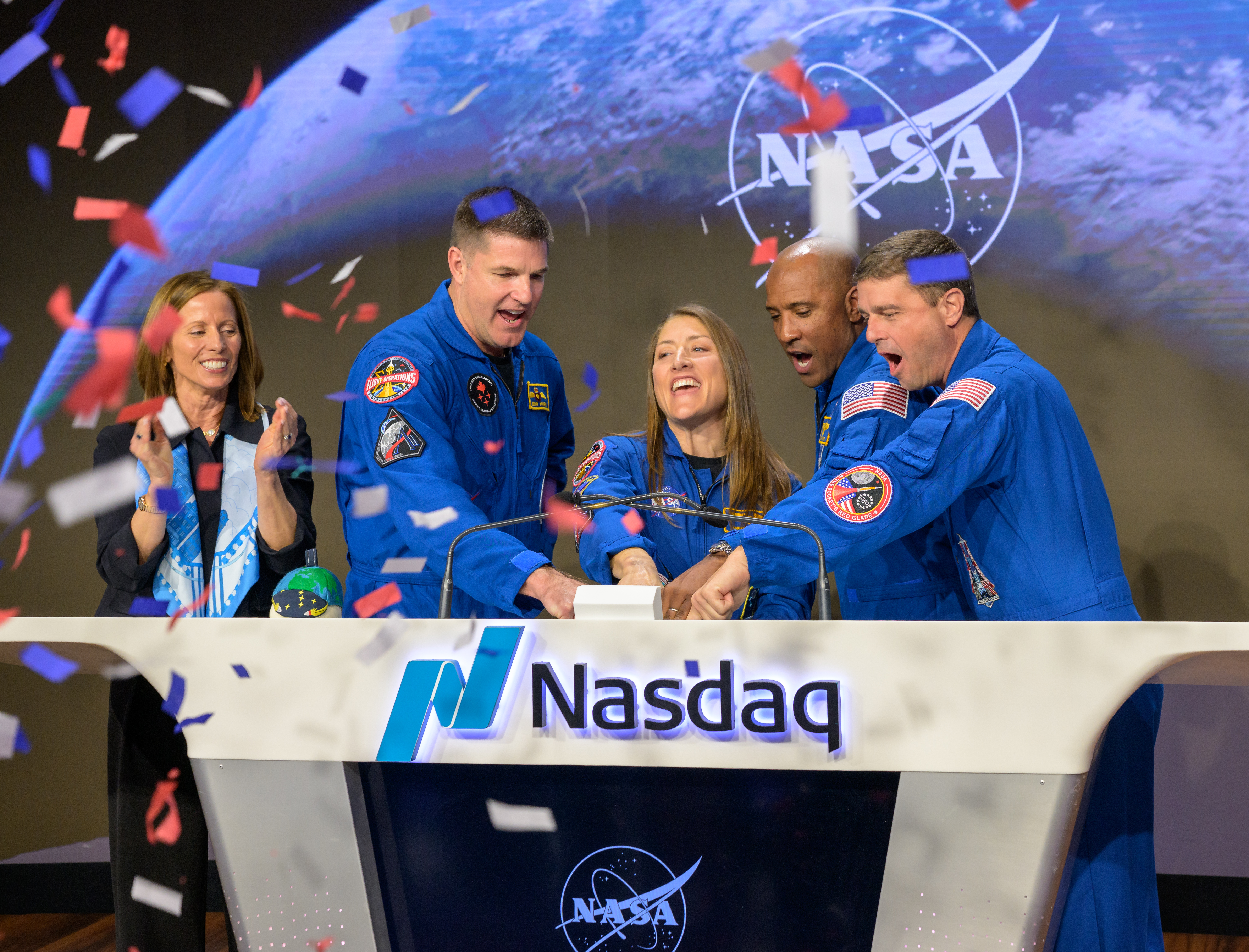
NASA Artemis II Crew Rings Nasdaq Closing Bell
Nasdaq Chair and Chief Executive Officer Adena T. Friedman, left, and NASA’s Artemis II crewmembers CSA (Canadian Space Agency) astronaut Jeremy Hansen, and NASA astronauts Christina Koch, Victor Glover, and Reid Wiseman, right, ring the closing bell of the Nasdaq market session, Thursday, April 30, 2026.
NASA’s Artemis II mission took Wiseman, Glover, Koch, and Hansen on a nearly 10-day journey around the Moon and back to Earth earlier in April 2026.
Image credit: NASA/Bill Ingalls
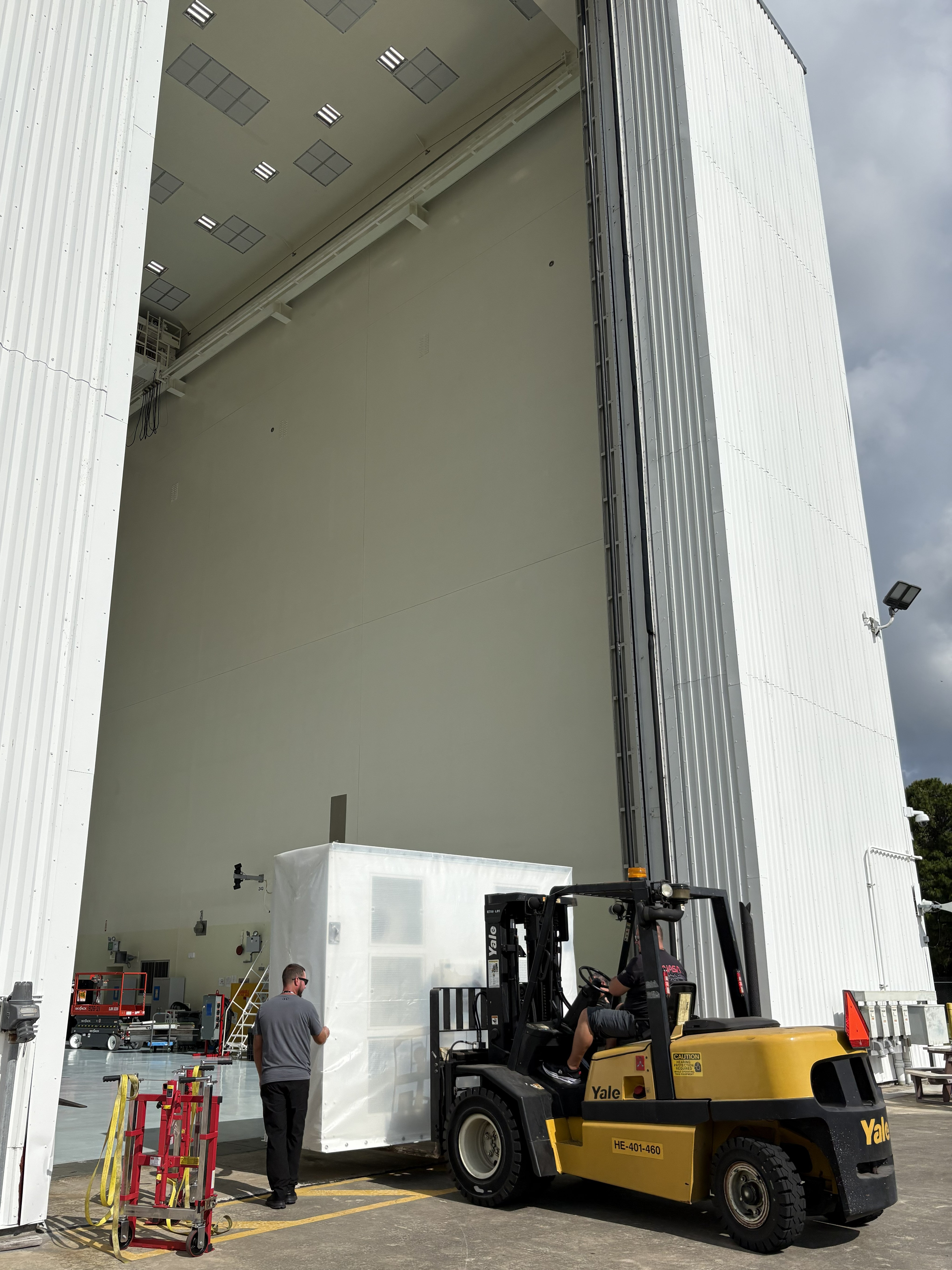
Key Support Equipment Arrives at Kennedy for Roman Space Telescope
Technicians at NASA’s Payload Hazardous Servicing Facility (PHSF) at the agency’s Kennedy Space Center in Florida offloaded eight high-efficiency particulate air (HEPA) wall modules and other ground support equipment on April 27. The equipment will support launch processing of the agency’s Nancy Grace Roman Space Telescope.
Each 1,800-pound module enhances the PHSF’s clean room systems, helping meet the telescope’s stringent cleanliness requirements during its time in the facility, where the observatory will undergo key tasks such as spacecraft fueling prior to liftoff.
Roman will observe the universe in infrared light using its Wide Field Instrument and a Coronagraph Instrument technology demonstration. Its wide field of view will produce panoramic images that help astronomers investigate some of the greatest mysteries in the cosmos, including why the universe’s expansion appears to be accelerating.
By using multiple complementary techniques, Roman will chart how the universe has evolved over cosmic time and provide new insights into the nature of dark energy. Roman also will advance the study of exoplanets and map the structure and distribution of normal matter and dark matter across space and time.
Teams are targeting launch as soon as early September aboard a SpaceX Falcon Heavy rocket from Launch Complex 39A at NASA Kennedy.
Photo credit: NASA/Leejay Lockhart
NASA’s STORIE Mission to Tell Tale of Earth’s Ring Current
5 min read
NASA’s STORIE Mission to Tell Tale of Earth’s Ring CurrentEarth’s magnetic field is like a powerful trap. It lures electrically charged particles in space, near our planet, and snares them in an invisible, doughnut-shaped pen around Earth known as the ring current.
This captive swarm of charged particles plays an important role in how Earth reacts to changing conditions in space, called space weather, which can affect the technology we rely on, such as satellites and power grids. Yet there is still a lot we do not know about the ring current.
NASA is preparing to launch a mission designed to provide a unique, inside-out view of the ring current. Called STORIE (Storm Time O+ Ring current Imaging Evolution), it is scheduled to launch in May aboard the 34th SpaceX commercial resupply services mission to the International Space Station for NASA. The mission is flying as part of the Space Test Program – Houston 11 (STP-H11) payload, a partnership between the U.S. Space Force and NASA. Once it is robotically installed on the exterior of the space station (expected a few days after its arrival), STORIE will look outward at the ring current, helping scientists answer longstanding questions about how it grows and shrinks and what kind of particles it’s made of.
The ring current is an invisible, doughnut-shaped swarm of charged particles around Earth (shown here in blue). It overlaps the outer of two Van Allen radiation belts (which are shown in green), but the ring current contains lower-energy particles than the radiation belts. In the ring current, positively charged particles and negatively charged particles flow in opposite directions, creating electrical currents. Changes in the ring current influence how our planet responds to solar storms and can have impacts on our technology. NASA/Mary Pat Hrybyk-Keith/Kristen Perrin“These particles have important space weather impacts,” said Alex Glocer, STORIE’s principal investigator at NASA’s Goddard Space Flight Center in Greenbelt, Maryland, where the instrument was designed and constructed. “We want to understand how that trapped population is built up, and where it comes from.”
These details are especially important during solar storms, when outbursts from the Sun can lead to magnetic disturbances at Earth. Similar to Earth’s Van Allen radiation belts but filled with lower-energy particles, the ring current tends to fluctuate in size, shape, and intensity more dramatically than the radiation belts do during solar storms. Plus, in the ring current, positively charged particles and negatively charged particles flow in opposite directions, creating electrical currents. So, changes there can lead to magnetic fluctuations and induced currents on the ground, potentially affecting pipelines and power lines. The ring current can also contribute to charge buildup on the surface of Earth-orbiting satellites, which can spark spacecraft glitches. Additionally, when energy ramps up in the ring current, some of that energy gets transferred to the upper atmosphere, making it heat up, puff out, and create more drag on satellites, which can cause the spacecraft to deorbit sooner than expected.
To view this video please enable JavaScript, and consider upgrading to a web browser that
supports HTML5 video
However, it’s difficult to study the ring current directly because the particles within it are invisible. “You can’t just image them with a camera,” Glocer explained.
Instead, STORIE will scan for the glow of energetic neutral atoms, or ENAs, that are formed when charged particles trapped in the ring current manage to escape. The particles earn their freedom by stealing an electron from Earth’s outer atmosphere, known as the exosphere, and become neutral.
“Once those charged particles become neutral, they no longer feel the effects of Earth’s magnetic field, and they are no longer trapped,” Glocer said. “They can just fly off in any direction.”
By measuring the speed and direction of the ENAs, STORIE could help answer longstanding questions about the origins of particles in the ring current — whether they are supplied by a stream of particles flowing out from the Sun, known as the solar wind, or from Earth.
NASA’s STORIE (Storm Time O+ Ring current Imaging Evolution) instrument is shown here installed on the Space Test Program – Houston 11 (STP-H11) payload, a partnership between the U.S. Space Force and NASA. It is covered in blanketing material to protect STORIE from the space environment. After launch, the STP-H11 payload and STORIE will be installed on the outside of the International Space Station’s Columbus module. U.S. Space ForceThe STORIE team designed the instrument to pay special attention to positively charged oxygen atoms (O+) because, according to Glocer, “When you see oxygen, that comes from the atmosphere. You get very little of that from the solar wind.” If STORIE finds a lot of oxygen atoms, scientists will know the ring current is largely supplied by Earth’s atmosphere, rather than the solar wind.
Glocer and other scientists also want to find out whether the ring current’s population of charged particles build up in quick bursts or slowly and gradually. “Is it like filling a lake with the steady flow of a waterfall or a bunch of raindrops?” Glocer said.
NASA is launching a new experiment, called STORIE (Storm Time O+ Ring current Imaging Evolution), to track charged particles in a “space doughnut” that encircles our planet.NASA’s Goddard Space Flight Center
Previous NASA missions — such as IMAGE (Imager for Magnetopause-to-Aurora Global Exploration) and TWINS (Two Wide-angle Imaging Neutral-atom Spectrometers) — have looked at ring current ENAs before using a top-down view, which allowed them to see the whole ring current at once. However, from that perspective, ultraviolet light reflected by Earth — in the center of the ring — can interfere with the ENA observations, and the viewing geometry makes it hard to see trapped particles in the ring current near Earth’s equator.
“From STORIE’s inside-out perspective, you have Earth behind you, and you can see this trapped population near the equator that was hard for other missions to observe,” Glocer said.
To view this video please enable JavaScript, and consider upgrading to a web browser that
supports HTML5 video
Some sounding rocket experiments have gotten brief, inside-out views of the ring current in the past, but they only had a few minutes to observe and could only see a portion of the ring current during each flight. The view from STORIE will reveal one slice of the ring current at a time, but as the space station orbits Earth, STORIE will build up a complete picture of the ring current roughly every 90 minutes.
Over its six-month mission, STORIE will monitor how the ring current evolves over time and allow scientists to compare its behavior during solar storms versus when the Sun is quiet. Insights from STORIE will help us better understand how Earth responds to solar storms, improve space weather predictions, and help mitigate the effects of space weather on the technology humanity depends on.
By Vanessa Thomas
NASA’s Goddard Space Flight Center, Greenbelt, Md.
Article
4 hours ago
3 min read Belts of Green in the Washington Suburbs
Along the northeast side of the Capital Beltway in Maryland, green spaces weave through the…
Article
1 week ago
1 min read New NASA Views of Earth, From (S)PACE
NASA has a fleet of satellites in orbit, gathering data around the clock, to explore…
Article
1 week ago
Keep Exploring Discover More Topics From NASA
Missions
Humans in Space
Climate Change
Solar System
Space Out This Summer with Variety of NASA STEM Activities
Summer is “Go” for launch, and NASA has a universe of ways to help you to jump in, explore, and create! Whether you prefer to spend this season fueling your creativity, going outdoors into nature, or daydreaming about your future, NASA offers ways to take your interests to the next level.
Here are some opportunities to level up your skills with NASA STEM this summer.
Rise to Stardance ChallengeFrom Monday, June 1, through Sept. 30, students ages 13 to 18 are invited to flex their creativity in the online Stardance Challenge, a partnership between NASA and the education non-profit Hack Club. Whether you’re into space, coding, hardware, or just love building cool things, this is your chance to work with real NASA mission data from programs like Artemis, the James Webb Space Telescope, and more.
Participants can create anything from code and apps to electronics, circuit boards, models, and simulations. Hack Club will offer peer and expert reviews, prizes, and plenty of opportunities to show off your work. Meanwhile, NASA will provide access to publicly available datasets, mission materials, multimedia, and virtual sessions with subject matter experts who can share insights on space science, engineering, and careers. Ready to start brainstorming? Visit the Hack Club: Stardance Challenge website to explore project options, check out prizes, and RSVP to get a reminder when the challenge opens
NASA Astronaut Megan McArthur is conducting a technology demonstration with Astrobee flying robots.Credit: NASA Go Behind Scenes of NASA CareersThink NASA is only for astronauts, scientists, and tech experts? Think again. It takes a wide range of professionals and specialists to bring the nation’s aerospace goals to life. Summer is the perfect time to discover how your skills and interests could make a difference at NASA.
Connect directly with NASA experts through online events designed to spark your curiosity and help you explore real STEM career paths. These virtual sessions provide a behind‑the‑scenes look at NASA’s workforce, plus the chance to ask questions.
- Tuesday, June 2: NASA’s Career Technical Education Day at Goddard Space Flight Center dives into robotics, AI, autonomous systems, and the skilled technical careers that keep NASA missions running. Register by May 26.
- Thursday, June 11: Virtual Career Connection: Aviation Technology and Maintenance introduces you to aircraft mechanics and technicians who support NASA’s flight programs and explores pathways into aviation technology careers. Register by June 2.
Looking for more? Check out the Next Gen STEM for Careers web page for videos, articles, and more ways to learn about the variety of jobs at NASA.
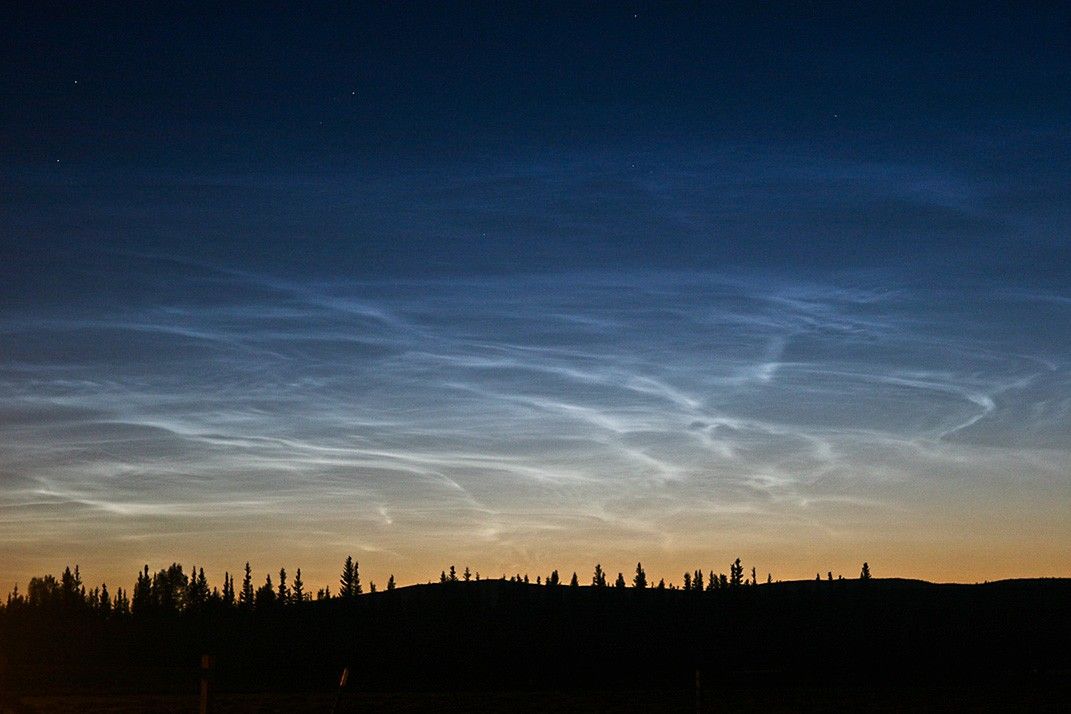
Noctilucent clouds seen from Fairbanks, Alaska.Credit: Patrick Cobb – Photovoltaic designer, photographer Dive into NASA Research Through Citizen ScienceNASA invites people of all ages and backgrounds to do NASA science as a part of real science projects that rely on volunteers. Citizen Science is a great way to make new friends, meet some scientists, and help NASA solve mysteries of the universe this summer – using just a phone or computer. You can join from anywhere, participate on your own schedule, and dive right into real research using actual mission data. Here are two examples:
- Through Space Cloud Watch, you can help NASA study noctilucent clouds. Noctilucent means “night-shining,” and that’s exactly what they do! During summer twilight at high latitudes, these clouds catch sunlight and appear to glow even in a darkened sky. Take a photo and submit a report to help scientists track how these rare clouds are changing.
- Take your cloud‑watching to another planet with Cloudspotting on Mars, where you review real NASA images to identify clouds above the Red Planet and help scientists understand Martian weather.
Curious about what other projects you might enjoy? See all current Citizen Science opportunities available through NASA’s Science Mission Directorate.
No matter how you spend your summer – building projects like the Hack Club’s Stardance Challenge, jumping into real NASA research through citizen science, or exploring possible NASA career paths – there’s a launch pad waiting for you. And remember, NASA’s STEM Resources website is available year-round to serve as your one-stop hub for hands-on activities, videos, articles, and more to spark curiosity and fuel big ideas.
Keep Exploring Discover More Topics From NASAFor Students Grades 9-12
Mobile and Desktop Apps
Games and Interactives
NASA STEM Opportunities and Activities For Students
Hubble Spots a Starry Spiral
- Hubble Home
- Overview
- Impact & Benefits
- Science
- Observatory
- Team
- Multimedia
- News
- More
3 min read
Hubble Spots a Starry Spiral This NASA Hubble Space Telescope image features the glittering spiral galaxy NGC 3137, located 53 million light-years away in the constellation Antlia (the Air Pump). ESA/Hubble & NASA, D. Thilker and the PHANGS-HST TeamIn this new picture from NASA’s Hubble Space Telescope, a spiral galaxy glittering with star clusters is the center of attention. NGC 3137 is located 53 million light-years away in the constellation Antlia (the Air Pump). As a nearby spiral galaxy, this target offers astronomers an excellent opportunity to study the cycle of stellar birth and death, as well as giving researchers a glimpse of a galactic system similar to our own.
NGC 3137 is of particular interest to astronomers because it travels through space with a group of galaxies that is thought to be similar to the Local Group, the galaxy group that contains our Milky Way. Similar to the Local Group, the NGC 3175 group contains two large spiral galaxies: NGC 3137 and NGC 3175, which Hubble has also observed. In the Local Group, the largest members are the Milky Way galaxy and Andromeda, another spiral galaxy. In addition to two large spiral galaxies, both groups also contain a number of smaller dwarf galaxies, although it’s not yet known how many of these tiny companions the NGC 3175 group has; researchers have found more than 500 dwarf galaxy candidates. By studying this nearby galaxy group, astronomers can learn about the dynamics of our own galactic home.
NGC 3137 is revealed in fantastic detail by Hubble. This image is crafted from observations in six different color bands, creating a view that highlights several facets of this beautiful spiral. The galaxy’s center, which is encircled by a network of fine, dusty clouds, hosts a black hole estimated to be 60 million times more massive than the Sun. NGC 3137 is highly inclined from our point of view, giving a unique perspective on its loose, feathery spiral structure. A couple of photobombing Milky Way stars and a smattering of far more distant background galaxies complete the image.
As stunning as each of these features may be, it’s the galaxy’s brilliant star clusters that steal the show. The galaxy is peppered with dense clusters of bright blue stars and glowing red gas clouds, which signal the presence of hot, young stars still encased in their birth nebulae.
Unsurprisingly, these star clusters are exactly what has drawn Hubble’s keen eye. Researchers are using Hubble to carry out an observing program (#17502; PI: D. Thilker) focusing on star clusters in 55 nearby galaxies. The data collected will help astronomers identify star clusters and the glowing nebulae that surround them, providing a way to measure the ages of stars in galaxies like NGC 3137. These observations give an in-depth view of stellar life in spiral galaxies, from the young stars still in the process of forming to the ancient stellar populations that grew up in the early years of their galactic hosts.
The PHANGS (Physics at High Angular Resolution in Nearby Galaxies)-HST program for which these observations were taken is part of a larger effort by some of the most powerful observatories on (and around) Earth. Hubble contributes greatly to this massive undertaking, which combines Hubble data with observations from the NASA/ESA/CSA James Webb Space Telescope and the Atacama Large Millimeter/submillimeter Array (ALMA). Together, Hubble’s powerful optical and ultraviolet capabilities, Webb’s sensitive infrared eyes, and ALMA’s broad network of radio dishes bring us an unmatched view of star formation in the local universe.
Text credit: ESA/Hubble
Facebook logo @NASAHubble @NASAHubble Instagram logo @NASAHubbleMedia Contact:
Claire Andreoli
NASA’s Goddard Space Flight Center, Greenbelt, MD
claire.andreoli@nasa.gov
Since its 1990 launch, the Hubble Space Telescope has changed our fundamental understanding of the universe.
Hubble’s Galaxies
Hubble Mission Operations
Hubble News
Cyclone Rains Spur Papua New Guinea Landslides
- Earth
- Earth Observatory
- Image of the Day
- EO Explorer
- Topics
- More Content
- About
NASA Invites Media to Ireland Artemis Accords Signing
Ireland will sign the Artemis Accords during a ceremony at 3 p.m. EDT Monday, May 4, at NASA Headquarters in Washington.
NASA Administrator Jared Isaacman will host Ambassador of Ireland to the United States of America Geraldine Byrne Nason; Minister for Enterprise, Tourism and Employment Peter Burke, T.D., of Ireland; and U.S. Department of State officials for the ceremony.
This event is in person only. Media interested in attending must RSVP no later than 12 p.m. on May 4 to: hq-media@mail.nasa.gov. NASA’s media accreditation policy is online.
In 2020, during the first Trump Administration, the United States, led by NASA and the State Department, joined with seven other founding nations to establish the Artemis Accords, responding to the growing interest in lunar activities by both governments and private companies.
The accords introduced the first set of practical principles aimed at enhancing the safety, transparency, and coordination of civil space exploration on the Moon, Mars, and beyond.
Learn more about the Artemis Accords at:
https://www.nasa.gov/artemis-accords
-end-
Camille Gallo / Elizabeth Shaw
Headquarters, Washington
202-358-1600
camille.m.gallo@nasa.gov / elizabeth.a.shaw@nasa.gov
Odyssey Team Celebrates on a Global Map of Mars
NASA/JPL-Caltech Photojournal Navigation Downloads Odyssey Team Celebrates on a Global Map of Mars
JPEG (18.11 MB)
Description
Team members past and present from NASA’s 2001 Mars Odyssey orbiter mission gathered on April 15, 2026, to celebrate 25 years since the spacecraft’s launch, which took place April 7, 2001. For the occasion, the team rolled out a giant global map of Mars created using imagery from Odyssey’s THEMIS (Thermal Emission Imaging System) infrared camera. The celebration took place at NASA’s Jet Propulsion Laboratory in Southern California, which leads the mission.
Keep Exploring Discover More Topics From Photojournal
Photojournal
Search Photojournal
Photojournal’s Latest Content
Feedback
What’s Up: May 2026 Skywatching Tips from NASA
The Eta Aquarid meteor shower brings shooting stars before dawn, the Moon meets brilliant Venus after sunset, and May wraps up with a rare Blue Moon.
Skywatching Highlights- May 5 + 6 : Best time to see the Eta Aquarids
- May 18: Moon and Venus conjunction
- May 31: Blue moon
Shooting stars before dawn, a brilliant meetup between the Moon and Venus, and a rare “Blue Moon” to end the month.
That’s What’s Up this May.
First up: the Eta Aquarid meteor shower, which peaks in early May.
These shooting stars come from Halley’s Comet. Every year, Earth passes through the comet’s dusty trail, and those tiny particles burn up in our atmosphere. That’s what creates those bright streaks across the sky.
Halley’s Comet last passed through the inner solar system in 1986, and won’t return until 2061.
The Eta Aquarids appear to come from the constellation Aquarius. That’s where the shower gets its name.
NASA/JPL-CaltechThese meteors are fast, racing into Earth’s atmosphere at about 40 miles per second. And because they’re moving so quickly, they can leave behind glowing trails that linger for a moment after the flash.
At peak, the shower can produce up to about 50 meteors an hour under ideal skies. The best time to watch? In the hours before dawn, looking generally toward the eastern sky.
For the best chance of seeing meteor showers, go somewhere dark, let your eyes adjust for about 20 to 30 minutes, and avoid bright lights, including your phone screen.
The peak is expected around May 5th to 6th, but bright moonlight this year may wash out some of the fainter meteors.
On May 18th, look west just after sunset.
NASA/JPL-CaltechThe Moon gets a bright little sidekick as Venus shines nearby. The crescent Moon helps point the way, making this an easy one to spot.
Venus is one of the brightest objects we can see from Earth, often called the Evening Star.
The Moon and Venus look close together because they line up from our point of view on Earth. But in reality, they’re separated by millions of miles in space.
Last month, Artemis II launched right around the time of the April 1st Full Moon, sending astronauts around the Moon for the first time in more than 50 years and giving us some spectacular new views of our closest neighbor.
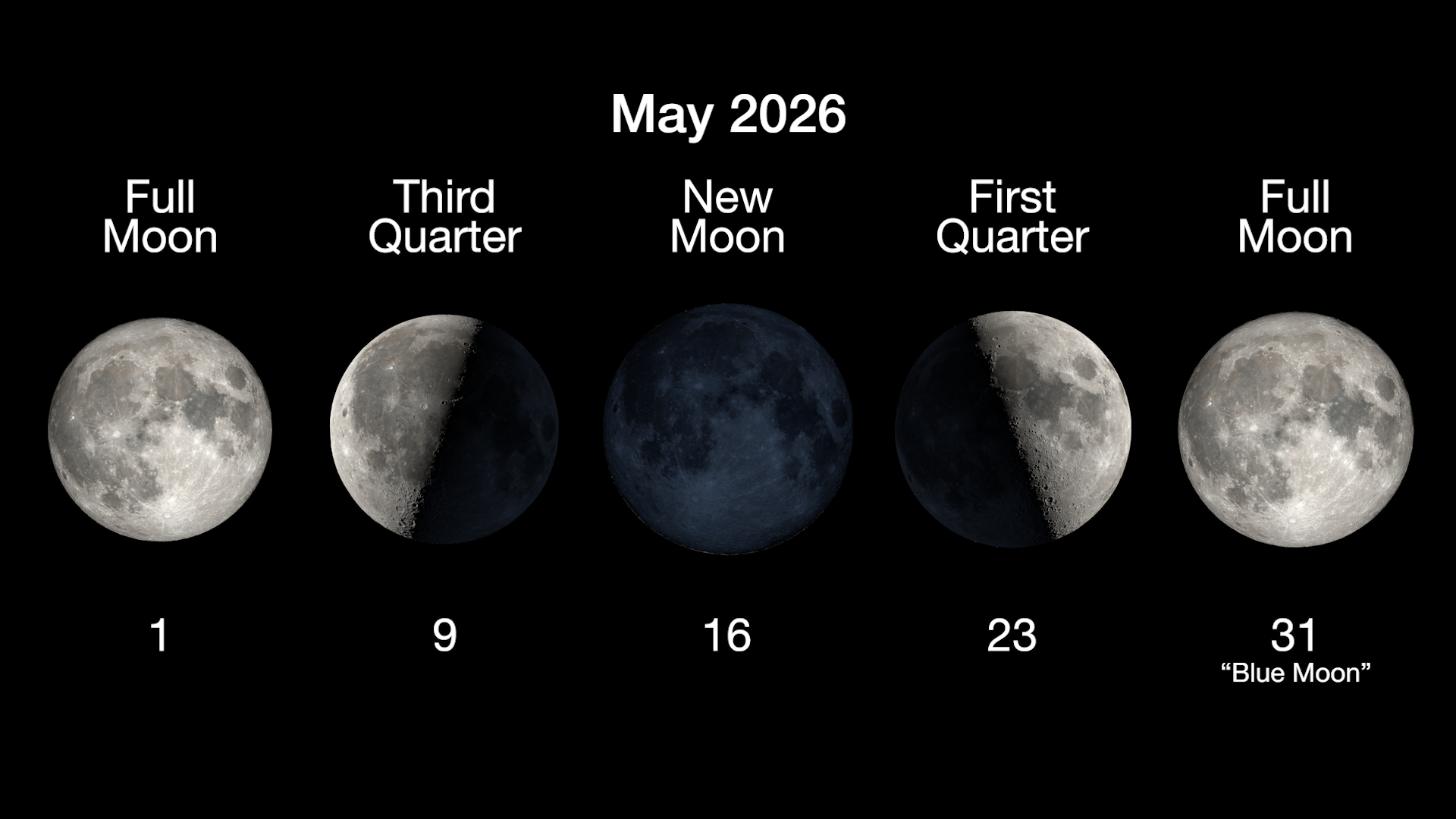
And now, May ends with another lunar moment: a Full Moon on May 31st. This one is a Blue Moon.
But it actually won’t look blue.
Blue Moon is the name given to the second Full Moon in a single calendar month. It’s a relatively rare event, hence the phrase “once in a blue moon.”
So whether you’re up before sunrise or out after sunset, May is a great time to look up.
Here are the phases of the Moon for May.
NASA/JPL-CaltechYou can stay up to date on all of NASA’s missions exploring the solar system and beyond at science.nasa.gov.
I’m Raquel Villanueva from NASA’s Jet Propulsion Laboratory, and that’s What’s Up for this month.
Keep Exploring Discover More Topics From NASA
What’s Up
Skywatching
Galaxies
Stars
Artemis III Moon Rocket Core Stage on the Move
Teams move the core stage, or largest section, of the SLS (Space Launch System) rocket for NASA’s Artemis III mission into the Vehicle Assembly Building at the agency’s Kennedy Space Center in Florida in this photo from April 27, 2026.
The SLS core stage traveled 900 miles on the Pegasus barge from NASA’s Michoud Assembly Facility in New Orleans where the stage is manufactured, to complete assembly of the massive rocket at NASA Kennedy.
This mission will launch crew aboard the Orion spacecraft on top of the SLS rocket to test rendezvous and docking capabilities between Orion and commercial spacecraft needed to land astronauts on the Moon.
Image credit: NASA/Glenn Benson
NASA Welcomes Morocco as 64th Artemis Accords Signatory
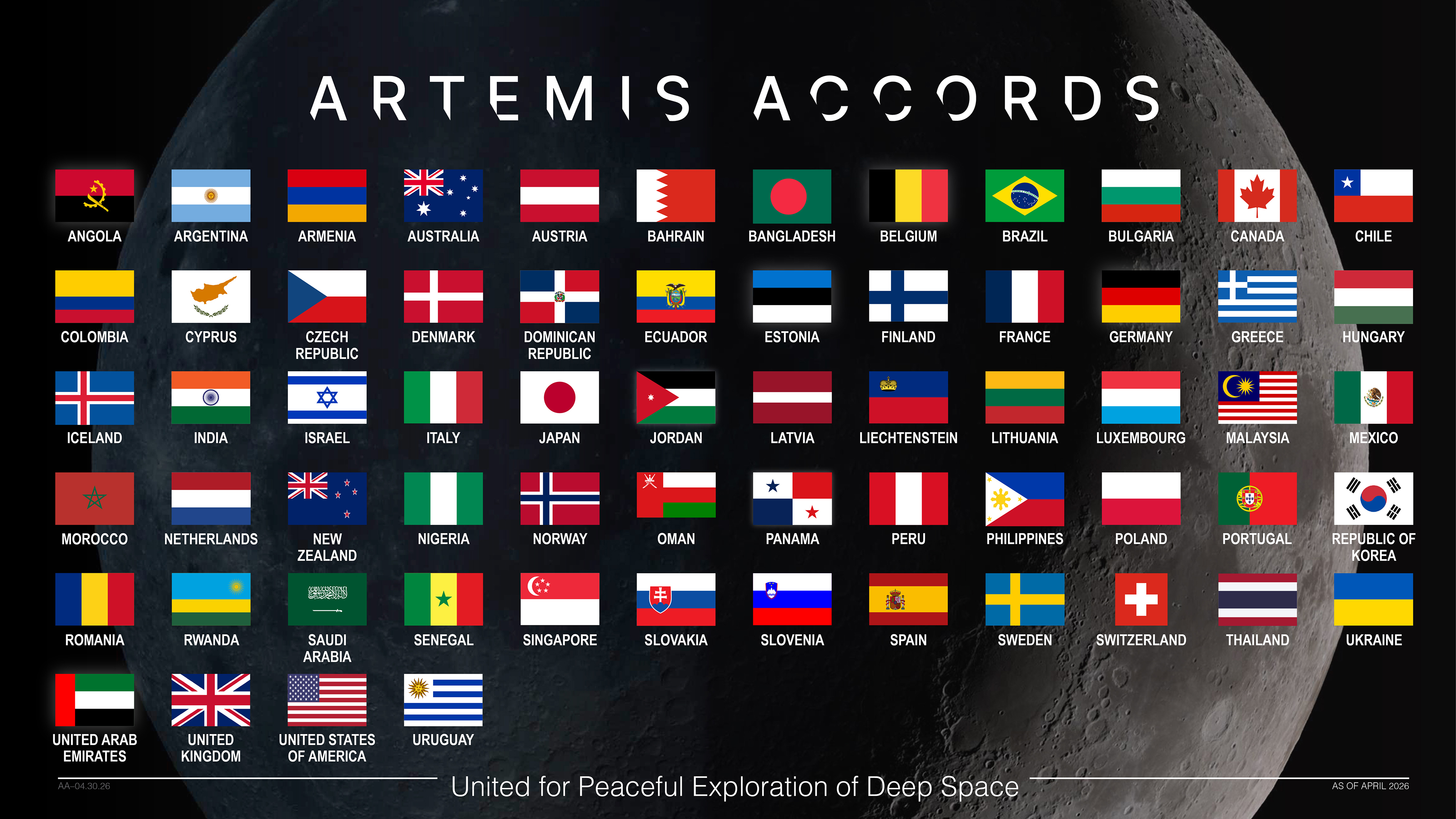
The Kingdom of Morocco signed the Artemis Accords on April 29th during a ceremony in the country’s capital, Rabat, becoming the latest nation to commit to the responsible exploration of space.
“It is my privilege to welcome the Kingdom of Morocco as the newest signatory to the Artemis Accords,” said NASA Administrator Jared Isaacman in recorded remarks. “The accords began as the framework for like-minded nations to come together for the peaceful exploration of space. But now, under President Trump’s vision for an enduring presence on the lunar surface, Artemis Accords partners will be able to make meaningful contributions to that collective effort. Citizens from every Artemis nation will play a pivotal role in humanity’s greatest adventure.”
Foreign Minister Nasser Bourita of Morocco signed the accords on behalf of the country. Bourita underscored Morocco’s commitment to shared values across a range of critical sectors.
The signing ceremony took place during the Deputy Secretary of State Christopher Landau’s official visit to Morocco with the U.S. Ambassador to Morocco Duke Buchan III also participating in the event.
In 2020, during the first Trump Administration, the United States, led by NASA and the State Department, joined with seven other founding nations to establish the Artemis Accords, responding to the growing interest in lunar activities by both governments and private companies. The accords introduced the first set of practical principles aimed at enhancing the safety and coordination between like-minded nations as they explore the Moon, Mars, and beyond.
Signing the Artemis Accords means committing to explore peaceably and transparently, to render aid to those in need, to enable access to scientific data that all of humanity can learn from, to ensure activities do not interfere with those of others, and to preserve historically significant sites and artifacts by developing best practices for space exploration for the benefit of all.
More countries are expected to sign the Artemis Accords in the months and years ahead, as NASA continues its work to establish a safe, peaceful, and prosperous future in space.
Learn more about the Artemis Accords at:
https://www.nasa.gov/artemis-accords
Share Details Last Updated Apr 30, 2026 LocationNASA Headquarters Related TermsNASA Goddard’s Greenbelt Visitor Center Marks 50th Anniversary
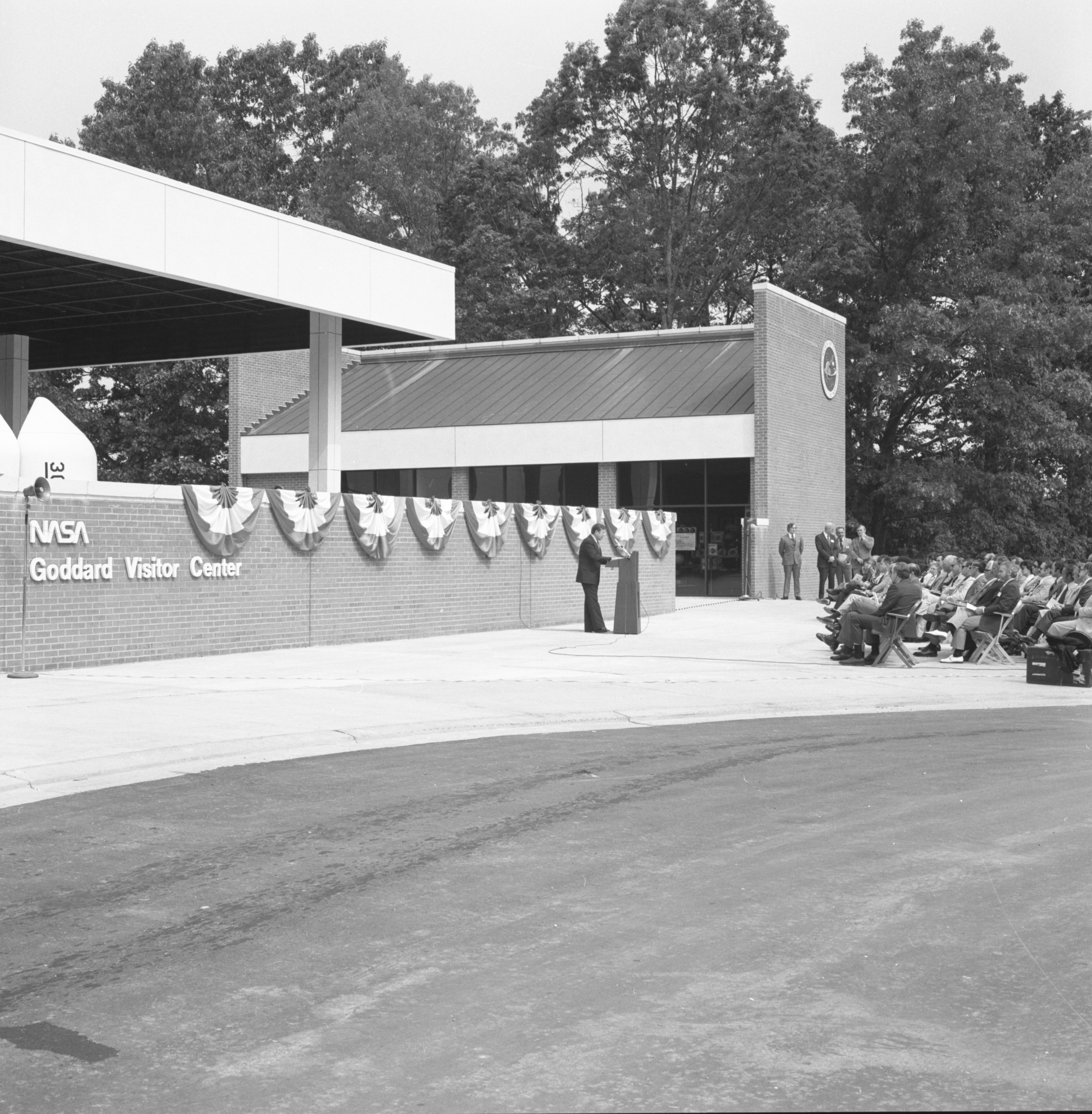
Trimmed in bicentennial pageantry, NASA opened a visitor center at its Goddard campus in Greenbelt, Maryland, in May 1976. Fifty years on, the Goddard Visitor Center continues to inspire through exhibits and programs on the past, present, and future of space exploration.
Dr. John Clark, then NASA Goddard’s center director, provides opening remarks at the visitor center ribbon cutting in May 1976.NASA“NASA’s 1958 charter tasks us with sharing our work as broadly as we can,” said NASA Goddard Center Director Cynthia Simmons. “The visitor centers we have maintained at our Greenbelt, Maryland, location and Wallops Flight Facility in Virginia are core to us meeting that charge and fostering the next generation of space explorers.”
When the visitor center first opened its doors (just a few weeks before the Smithsonian’s National Air and Space Museum in Washington), much of it was open-air. Instead of gilded scissors, a reenactment of Dr. Robert Goddard’s first rocket launch snapped the ribbon.
Initial exhibits featured a full-scale mockup of the Orbiting Astronomical Observatory (a Hubble telescope precursor), a phone station to transmit guests’ voices 45,000 miles round trip through Applications Technology Satellite-3, and an active meteorology station displaying satellite views of Western Hemisphere weather.
The Visitor Center at NASA’s Goddard Space Flight Center in Greenbelt, Md. (shown here in a 2010 aerial photo), opened its doors to the public for the first time in May 1976.NASA/Bill Hrybyk This aerial photograph from 1966 shows what was then the Bureau of Standards’ WWV radio station. After the station relocated to Colorado, NASA Goddard used the structure for facilities storage before converting it into a visitor center.NASA The Delta-B rocket at the NASA Goddard Visitor Center was originally displayed at the 1964 New York World’s Fair. NASA Goddard managed the highly successful Thor-Delta program throughout the 1960s and ’70s. In this photo from 1978, a keen eye will see a small model rocket just taking flight to the right of the Delta. Model rocket launches have been a mainstay at the visitor center. They now typically occur the first Saturday of the month.NASA The Orbiting Astronomical Observatory-3, also known as Copernicus, was a space telescope that operated for nearly a decade after its 1972 launch. It was a spiritual predecessor to the Hubble Space Telescope. This model was on display at the NASA Goddard Visitor Center in 1976.NASA A visitor center guest in 1977 learns about the Sun. NASA This late-1970s exhibit centered on Dr. Robert Goddard. In 1926, Goddard became the first person ever to successfully launch a liquid-fueled rocket. NASA named its first spaceflight complex in his honor in 1959.NASA A space shuttle model with payload doors open hangs from the ceiling in this mid-1990s visitor center exhibit. The right side of the image describes NASA’s Get Away Special (GAS) Program, which was an opportunity for researchers, students, and other groups to put small payloads in extra space aboard shuttles. Each was contained in a cylinder like those displayed here. The GAS Program can be thought of as a precursor to the CubeSat and other small satellite programs of today.NASA This photograph shows a crowd of guests at a NASA Goddard community day in 1993.NASA Longtime Goddard Visitor Center staffer “D.J.” Emmanuel stands by a Gemini capsule on display here in 2005.NASA During a May 2007 trip to the United States, Queen Elizabeth II and Prince Philip, The Duke of Edinburgh, visited NASA Goddard. Here, the queen and prince look on as then-Goddard Center Director Dr. Ed Weiler demonstrates “Science on a Sphere.” This system, developed by the National Oceanic and Atmospheric Administration (NOAA), uses computers and four video projectors to display animated images on the outside of a six-foot diameter sphere.NASA/Pat Izzo The “Moon Tree” in front of the visitor center at NASA’s Goddard Space Flight Center in Greenbelt, Md. This sycamore (shown in a 2009 file photo) grew from a seed carried to the Moon aboard Apollo 14 and was planted here on June 9, 1977.NASA/Pat Izzo This arched entryway of Hubble Space Telescope imagery greeted guests at the NASA Goddard visitor center in the 2010s.NASA/Debbie McCallum These three guests were among some 400 who attended a “Yuri’s Night” celebration at the visitor center on April 10, 2010. Yuri’s Night, a celebration of achievements in space exploration, was named in honor of cosmonaut Yuri Gagarin, the first human in space.NASA/Bill Hrybyk“The visitor center serves the community by providing engaging exhibits and programming focused on the work of NASA overall and NASA’s Goddard Space Flight Center in particular,” said Amanda Harvey, the visitor center’s engagement coordinator. “We are an important place for people to discover, explore, and experience what it is that NASA does.”
Longtime staffer “D.J.” Emmanuel is himself proof-positive of the sentiment: “The first time I actually got introduced to Goddard was at a talk to see the tools astronauts used during the first Hubble servicing mission in 1993.” He started volunteering his time at the visitor center and then transitioned to fulltime staff.
Harvey and Emmanuel are employees of the NASA Communication Services contract, and the two operate the visitor center with the help of a dedicated team of volunteers.
The original structure and grounds of the visitor center housed WWV, a radio station for what was then the Bureau of Standards (now the National Institute of Standards and Technology, NIST). The station relocated to Colorado in the mid-1960s — campus legend maintains that WWV’s broadcasts interfered with Apollo Program tests and necessitated the move. NASA Goddard used the transmitter building for facility maintenance storage until renovations for a visitor center began in earnest in 1975.
As space exploration has advanced and NASA Goddard’s contributions have evolved, so too has the visitor center, which today hosts a 4K science film movie theater, Hubble telescope artifacts, a custom-programmed Roman telescope video game arcade console — no quarters required — and several more displays and activities.
“I keep going back and looking at the exhibits and reading something new that I haven’t read before,” Emmanuel said. “It’s a great way to introduce kids to the world of science and to space.”
And as much as the visitor center enriches its guests, the reverse is also true: “My favorite memories usually involve young visitors dressed like astronauts,” Harvey said. “Their excitement is palpable and so inspiring. It makes me want to have more programs and serve my community the best that I can!”
Over its first decade of operations, the visitor center hosted just shy of 600,000 guests. Thousands upon thousands more have come in the years since, with virtual field trips now also helping bring NASA Goddard beyond the local community.
Some things, though, have not changed since that rocket-powered ribbon-cutting 50 years ago: Now as then, a towering, 100-foot-tall Delta-B rocket still watches over the grounds. A seed taken to the Moon aboard Apollo 14 grew into the sycamore that has stood by the main entrance for decades.
And just as it was in 1976, the cost of admission is free.
The NASA Goddard Visitor Center will celebrate its 50th on Saturday, May 2, from 1 p.m. to 3 p.m. No RSVP is required.
For more information on events and programs:
https://www.nasa.gov/visitgoddard
Research and multimedia assistance for this story was provided by the NASA Goddard Archives. Researchers may direct reference requests to history@mail.nasa.gov.
By Rob Garner
NASA’s Goddard Space Flight Center, Greenbelt, Md.
Goddard Visitor Center
Goddard Events & Programs
Onsite Field Trips and Facility Tours
Goddard Visitor Center Virtual Field Trips
Share Details Last Updated Apr 30, 2026 EditorRob GarnerContactRob Garnerrob.garner@nasa.govLocationGoddard Space Flight Center Related TermsNASA Explores Prioritizing First Response Drones in Crowded Skies
3 min read
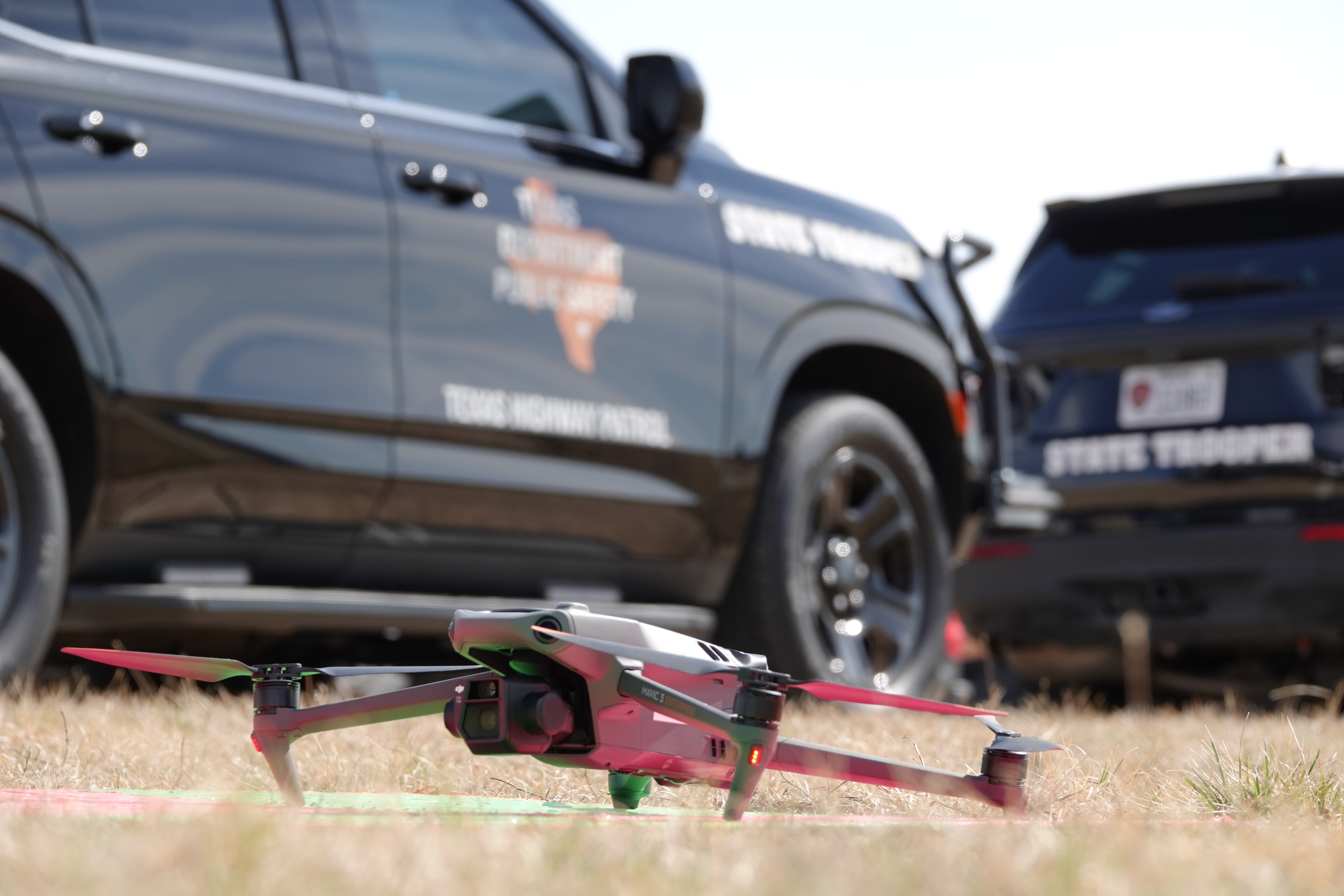
Preparations for Next Moonwalk Simulations Underway (and Underwater) Partners from NASA, Texas public safety organizations, industry partners, and the Federal Aviation Administration gathered in the region of North Texas Feb. 18 to understand how public safety drones can operate alongside commercial drones safely and effectively.Credit: Texas Department of Public SafetyOur streets are crowded with commuters and delivery vehicles, but when a police car or fire engine approaches with its lights and sirens on, drivers clear the way. In the coming years, drones for deliveries and other commercial tasks will become common in the skies over our communities, and NASA is working to ensure first responder vehicles in the air get the same kind of clearance that they do on the ground.
A recent flight exercise in the North Texas region showed how airspace prioritization tools could help first responder drones move quickly and safely through crowded skies. Researchers from NASA’s Ames Research Center in California’s Silicon Valley teamed up with local and state public safety agencies, industry partners, and the Federal Aviation Administration (FAA) to test how emergency crews could get priority airspace access in real time. The exercise is the latest collaboration between NASA and FAA in the area. North Texas is an FAA-designated region that allows for commercial drone deliveries to fly daily.
When a police, fire, or rescue drone launched during the exercise, other drones would move aside. When multiple public safety organizations responded to simulated emergencies, their officials communicated to prioritize access for the right drones.
“Just as ambulances use lights and sirens to signal vehicles to move out of the way, public safety operators require the ability to share airspace safely,” said Abhay Borade, a research lead for the Air Traffic Management and Safety project at NASA Ames. “The key is to prioritize safety of flight operations, while balancing the efficient use of the airspace for all operators.”
The Texas testing helped NASA better understand how commercial flights differ from public safety drone missions – emergency crews rarely fly predictable routes. During a search, a pursuit, or when scanning a dangerous environment, they may need to change direction suddenly.
Researchers collected data on how unpredictable vehicle movements – demonstrated by having a drone follow an officer driving an SUV erratically, simulating a fleeing suspect in a vehicle chase – might affect nearby commercial drone activity. The result demonstrated NASA’s development of air traffic systems and tools to prioritize public safety operators as commercial drone usage increases.
“By working closely with industry and federal partners, we’re helping build the data, tools, and traffic management frameworks needed to ensure the future of drone operations is safe, responsible, and scalable for everyone,” said Shivanjli Sharma, Air Traffic Management and Safety project manager at NASA Ames. Participants involved in the demonstration included the drone airspace management companies Drone Sense, Avision, ANRA Technologies, as well as the FAA, the Texas Department of Public Safety, and the police departments from the Texas cities of Fort Worth, Arlington, and Irving.
Share Details Last Updated Apr 30, 2026 Related Terms Explore More 4 min read There’s No Place Like NASA’s New X-59 Hangar Home Article 2 days ago 8 min read NASA Celebrates Decade of University Innovation in Aeronautics Article 6 days ago 4 min read NASA Releases Powerful LAVA Software to US Aerospace Industry Article 1 week ago Keep Exploring Discover More Topics From NASAAeronautics Research Mission Directorate
Ames Research Center
Airspace Operations and Safety Program
Air Traffic Management and Safety Project
Winter’s End Is Written in the Clouds
- Earth
- Earth Observatory
- Image of the Day
- EO Explorer
- Topics
- More Content
- About
I Am Artemis: Ryan Schulte
Listen to this audio excerpt from Ryan Schulte, Orion flywheel project manager:
0:00 / 0:00
Your browser does not support the audio element.As the four Artemis II astronauts traveled on a 694,481-mile journey around the Moon and back, the Orion spacecraft provided them with all the essentials for deep space life, including daily exercise. The crew used an exercise device called the flywheel throughout their mission to maintain their physical and mental health, and Ryan Schulte, Orion flywheel project manager, led the team responsible for developing the flywheel for the historic flight.
At NASA’s Johnson Space Center in Houston, Schulte oversees the team that designed, built, tested, and flew the flywheel used on Artemis II, and currently develops a fleet of more reusable exercise devices for future Artemis missions.
What we’re doing with this exercise device has a direct impact on the crew’s safety, health, and their mission success. I feel lucky to work on hardware that the crew is physically using, interacting with, and benefiting from on a daily basis.Ryan Schulte
Orion Flywheel Project Manager
The flywheel is a compact, multi-functional device about the size of a large shoebox that provides the crew with a range of aerobic and resistive workouts without requiring any electrical power from the spacecraft.
“It works kind of like an inertial yo-yo,” said Schulte.
The user can select different gear ratios for different resistance modes, and the flywheel can provide ultimately up to 500 pounds of resistance.
“It’s really all dependent upon how much effort you put in. The crew can do squats, deadlifts, bent rows, high-pulls, curls, heel raises, and aerobic rowing all in one device.”
Developing the flywheel for Orion posed unique challenges for Schulte’s team, ranging from limited space and crew mobility to reducing noise generation for easy crew communication during workouts.
“One of the biggest challenges was trying to fit everything into this compact box, and also to be able to have enough space inside the rest of the capsule for someone to fully stand up and fully extend at high rates of speed and repetitions,” said Schulte.
The team’s successful response to these challenges was displayed during the approximately 10-day Artemis II mission, where the crew members exercised for roughly 30 minutes per day with the flywheel. The sessions helped to counteract both the physical and mental effects induced by a microgravity environment, which on future, longer-duration Artemis missions, will become an increasingly important component for astronauts.
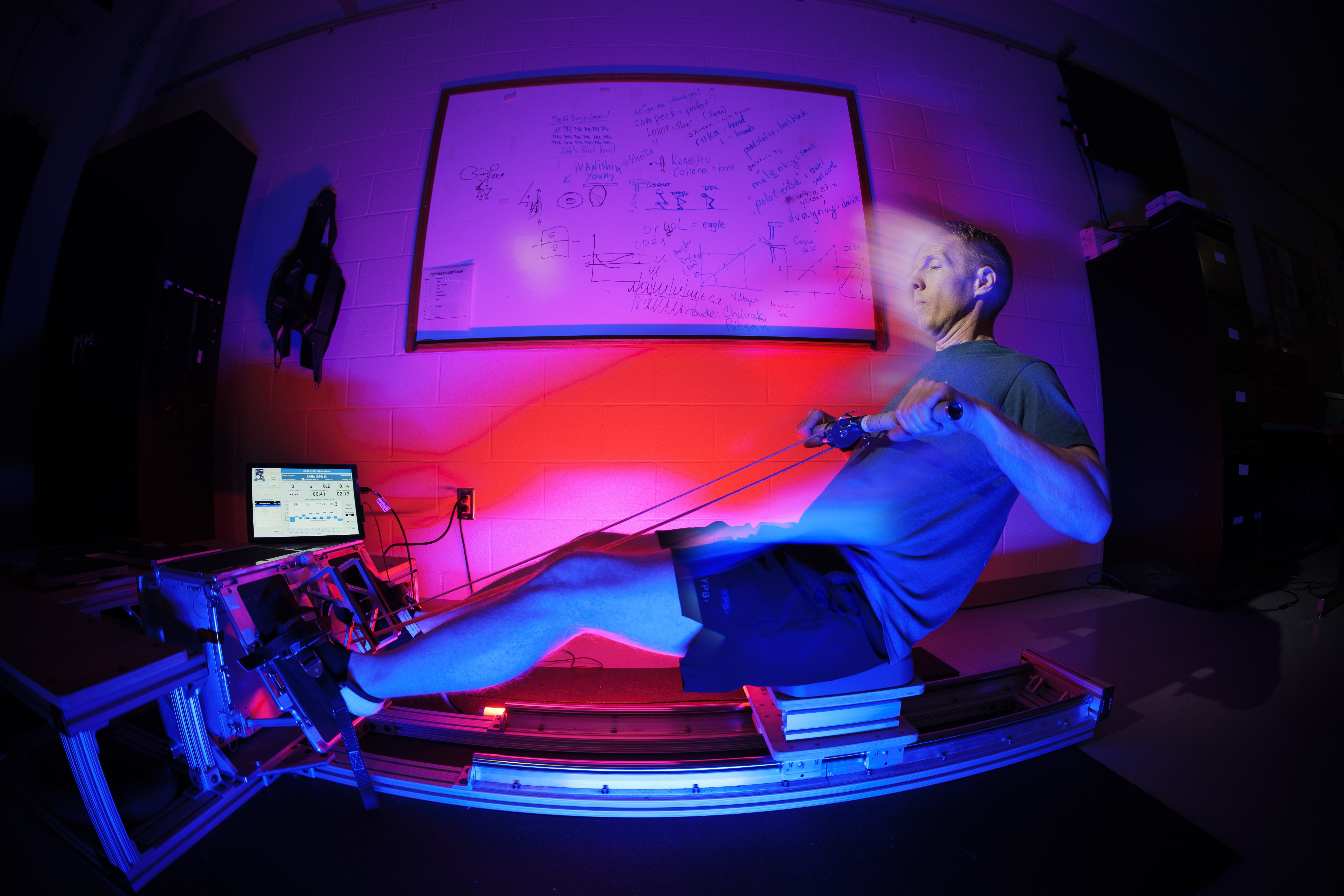
Ryan Schulte, Orion flywheel project manager, demonstrates a rowing exercise on the Orion flywheel in the Exercise Countermeasures Lab at NASA’s Johnson Space Center in Houston.NASA/Rad Sinyak“Without Earth’s gravity, the crew’s muscles, bones, and stamina all begin to atrophy, or weaken,” Schulte said. “Exercise will help prevent injury as crews need to perform long lunar spacewalks on the surface or for emergency egress out of the capsule.”
Exercise with the flywheel also supports the crew’s mental health, providing psychological benefits while living in a compact space inside Orion.
“It’s a great form of stress relief,” Schulte said. “It improves their mental clarity by getting their fluids and their blood flowing, which can stagnate in your head in zero gravity. We’ve talked to some of the crew about how much clearer their minds feel after exercise in flight.”
Schulte began his career as a co-op at Johnson in 2007, then joined NASA full-time as a test engineer for pyrotechnics, propulsion, and power systems. He later transitioned to NASA’s Human Health and Performance Directorate and began working in the Human Research Program, where his interest in human interfaces with engineering grew, eventually leading him to his current role as the flywheel project manager.
With the success of Artemis II and the promise of future missions ahead, Schulte’s work on the flywheel and next generation exercise devices will play a vital role in keeping astronauts safe, healthy, and mission ready on the lunar surface and beyond.
I feel incredibly lucky to be doing what I get to do. There’s not a lot of people out there that get to do this type of work. It is really just an honor and a privilege to be able to serve my country in this way.Ryan Schulte
Orion Flywheel Project Manager
About the AuthorPenelope Lauren Garcia-Galan Share Details Last Updated Apr 29, 2026 Related Terms Explore More 2 min read NASA Welcomes Morocco as 64th Artemis Accords Signatory Article 6 hours ago 4 min read NASA Laser Terminal Enhances Views During Artemis II Mission Article 2 days ago 3 min read I Am Artemis: Peter Rossoni Article 6 days ago Keep Exploring Discover More Topics From NASAMissions
Humans in Space
Climate Change
Solar System
US-Indian Spacecraft Captures Mexico City Subsidence
JPEG (32.05 MB)
PIA26709 Figure APNG (4.38 MB)
DescriptionA scientist produced this map of land subsidence (sinking) in Mexico City using data from the NISAR (NASA-ISRO Synthetic Aperture Radar) mission captured between Oct. 25, 2025, and Jan. 17, 2026. The region has been a well-known hot spot of subsidence for decades, and images like this help confirm that NISAR is performing as expected in its first year of operation.
The dark blue color indicates areas found to be subsiding by more than half an inch (more than 2 centimeters) per month, due in large part to groundwater pumping, which has led to compaction of the dry, ancient lakebed on which the city was built. The yellow and red areas are likely residual noise signals that are expected to decrease as NISAR collects more data and refines its measurements.
Two marshy ecosystems with ties to the country’s past can be seen in the image. The dark green oblong to the northeast of the airport is Nabor Carrillo, an artificial lake constructed over the now-extinct Lake Texcoco. Chalco Lake, a wetland located in a historically fertile region to the south, shares its name with a major body of water that was drained over a period of centuries to reduce flooding in the city. The ancient lake was a primary natural habitat of the Mexican Axolotl, an endangered species of salamander with the ability to regrow limbs.
Another landmark pinpointed in the image — the Angel of Independence along the Paseo de la Reforma — was built in 1910 to commemorate 100 years of Mexico’s independence. Standing over 100 feet (30 meters) tall, the monument has had 14 steps added to its base over the years as the land around it has gradually sunk.
Figure AFigure A is a version of the image extending further south and with no labels, scale, or compass.
The images were created with data from NISAR’s L-band radar instrument, which uses a 9-inch (24-centimeter) wavelength that enables its signal to penetrate dense vegetation such as forest canopies.
The satellite’s S-band radar, provided by the Indian Space Research Organisation’s Space Applications Centre, uses a 4-inch (10-centimeter) microwave signal that’s more sensitive to small vegetation, which makes it effective at monitoring certain types of agriculture and grassland ecosystems. Launched in 2025, NISAR is the first satellite to carry two SAR instruments at different wavelengths.
Data from NISAR will benefit humanity by helping researchers around the world better understand changes across our planet’s surface, from cities to forests and glaciers. The global and rapid coverage from NISAR will also provide unprecedented support for disaster response, producing data to assist in mitigating and assessing damage, with observations before and after catastrophic events available in short time frames.
Find more information about NISAR here: https://science.nasa.gov/mission/nisar/
Keep Exploring Discover More Topics From PhotojournalPhotojournal
Search Photojournal
Photojournal’s Latest Content
Feedback