NASA - Breaking News

A Galactic Embrace
Mid-infrared data from NASA’s James Webb Space Telescope (in white, gray, and red) and X-ray data from NASA’s Chandra X-ray Observatory (in blue) come together in this photo of colliding spiral galaxies released on Dec. 1, 2025. The pair grazed one another millions of years ago; billions of years in the future, they will merge into a single galaxy.
Image credit: X-ray: NASA/CXC/SAO; Infrared: NASA/ESA/CSA/STScI/Webb; Image Processing: NASA/CXC/SAO/L. Frattare
I Am Artemis: Jen Madsen and Trey Perryman
Listen to this audio excerpt from Jen Madsen and Trey Perryman, leads of the Orion Mission Evaluation Room for the Artemis II mission:
0:00 / 0:00
Your browser does not support the audio element.During NASA’s Artemis II mission, Jen Madsen and Trey Perryman will be leading a team monitoring the Orion spacecraft as it carries four astronauts around the Moon. The team works in the Orion Mission Evaluation Room where they will monitor and analyze Orion’s systems and performance in real time to help ensure crew safety and mission success.
As the leaders of the Orion Mission Evaluation Room located inside the Mission Control Center at NASA’s Johnson Space Center in Houston, Madsen and Perryman are responsible for ensuring that the dozens of NASA, Lockheed Martin, ESA (European Space Agency), and Airbus expert engineers that staff the room’s consoles are ready for Artemis II.
Jen and I are responsible for the organization, training, and execution of the entire team. We’ll also play a key role in communicating the findings of the Mission Evaluation Room to our program and agency leadership.Trey Perryman
Lead for Orion Mission and Systems Integration
The flight control team operating Orion from mission control’s White Flight Control Room will rely on the Mission Evaluation Room’s crucial findings to help with unexpected spacecraft behaviors that may arise and help analyze Orion’s performance data during the mission.
With crew aboard Orion, Artemis II brings new challenges, new opportunities, and a new space in mission control for the Orion Mission Evaluation Room. More spacecraft systems will be put to the test, requiring more evaluation room expertise and new consoles to monitor systems not previously flown, like life support.
“There’s loads of excitement — for the new capabilities, the mission, and having a new, wonderful space to operate in,” said Perryman.
Besides leading the Mission Evaluation Room, Perryman is also the lead for Orion Mission and Systems Integration, and Madsen is deputy manager for Orion’s Avionics, Power, and Software. Their co-leadership styles complement each other — Perryman leads with energy and team spirit, while Madsen brings a steadiness and structure.
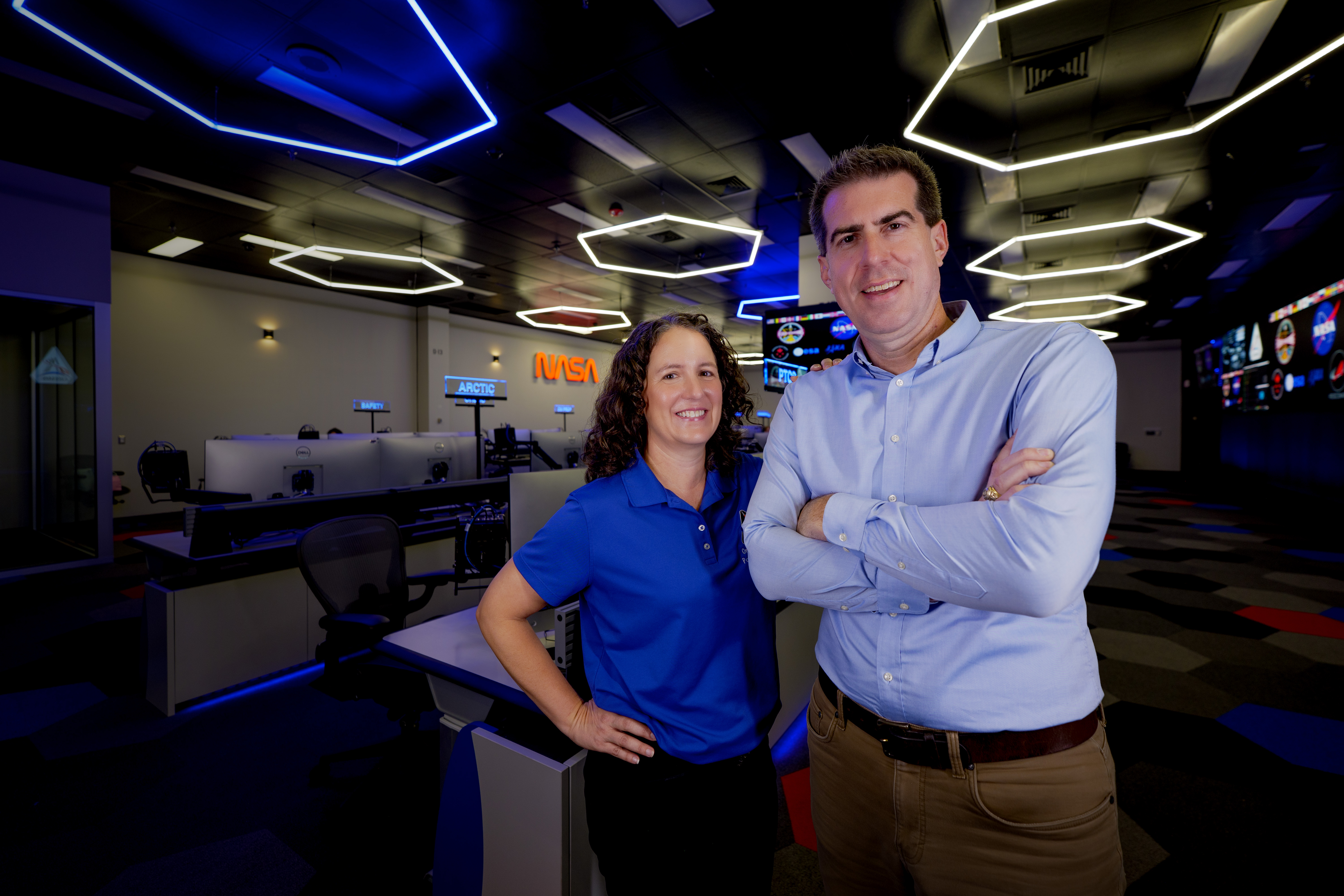
Artemis II Orion Mission Evaluation Room Leads Jen Madsen and Trey Perryman stand in the Orion Mission Evaluation Room in the Mission Control Center at NASA’s Johnson Space Center in Houston.NASA/Rad Sinyak“We balance each other out,” Madsen said. “And that balance is reflected in our team.”
For Perryman, a former flight controller with a background in space shuttle and space station operations, the MER represents the culmination of a career in human spaceflight that’s personal.
“I couldn’t imagine being anywhere else right now,” Perryman said. “My wife and I have four boys, and my boys are very excited about Artemis…that’s meaningful to me. And they like seeing a father who’s really connected to this mission.”
Madsen began her NASA career in engineering, designing and simulating Orion’s guidance, navigation, and control systems early on in the program.
I spent many years doing computer simulations, writing code, doing analysis… we designed, built, and tested Orion. So now it's amazing to me to get to be a part of the legacy of operating the vehicle.Jen Madsen
Deputy Manager for Orion’s Avionics, Power, and Software
For both leaders, the Artemis II mission is more than technical. With crew flying aboard the spacecraft, it’s deeply human.
“I do feel an extra sense of importance and mindfulness about what we’re doing in this building,” Perryman said, “making sure — specifically in the Orion MER — that we understand how the vehicle supports the crew, because it is so important to return them home safely.”
“We all feel like Reid, Victor, Christina, and Jeremy are part of the Orion family,” Madsen said. “When we have discussions about risk, from design all the way through operations, we’re thinking about our friends aboard the spacecraft.”
About the AuthorErika Peters Share Details Last Updated Dec 29, 2025 Related Terms Explore More 3 min read Get In, We’re Going Moonbound: Meet NASA’s Artemis Closeout Crew Article 6 days ago 4 min read Artemis II Flight Crew, Teams Conduct Demonstration Ahead of Launch Article 7 days ago 3 min read I Am Artemis: Grace Lauderdale Article 7 days ago Keep Exploring Discover More Topics From NASAMissions
Humans in Space
Climate Change
Solar System
Studying Physics in Microgravity
In this Oct. 20, 2025, photo, tiny ball bearings surround a larger central bearing during the Fluid Particles experiment, conducted inside the Microgravity Science Glovebox (MSG) aboard the International Space Station’s Destiny laboratory module. A bulk container installed in the MSG, filled with viscous fluid and embedded particles, is subjected to oscillating frequencies to observe how the particles cluster and form larger structures in microgravity. Insights from this research may advance fire suppression, lunar dust mitigation, and plant growth in space. On Earth, the findings could inform our understanding of pollen dispersion, algae blooms, plastic pollution, and sea salt transport during storms.
In addition to uncovering potential benefits on Earth, research done aboard the space station helps inform long-duration missions like Artemis and future human expeditions to Mars.
Image credit: NASA/Zena Cardman