Feed aggregator
Week in images: 17-21 November 2025
Week in images: 17-21 November 2025
Discover our week through the lens
Ancient tracks may record stampede of turtles disturbed by earthquake
Ancient tracks may record stampede of turtles disturbed by earthquake
Quantum computers need classical computing to be truly useful
Quantum computers need classical computing to be truly useful
Illegal Wildlife Trade Tied to Drugs, Arms and Human Trafficking
Criminals around the world are increasingly mixing trade in illegal animal parts with trafficking of arms, humans, and more—even exchanging wildlife for drugs
Hubble Seeks Clusters in ‘Lost Galaxy’
- Hubble Home
- Overview
- Impact & Benefits
- Science
- Observatory
- Team
- Multimedia
- News
- More
2 min read
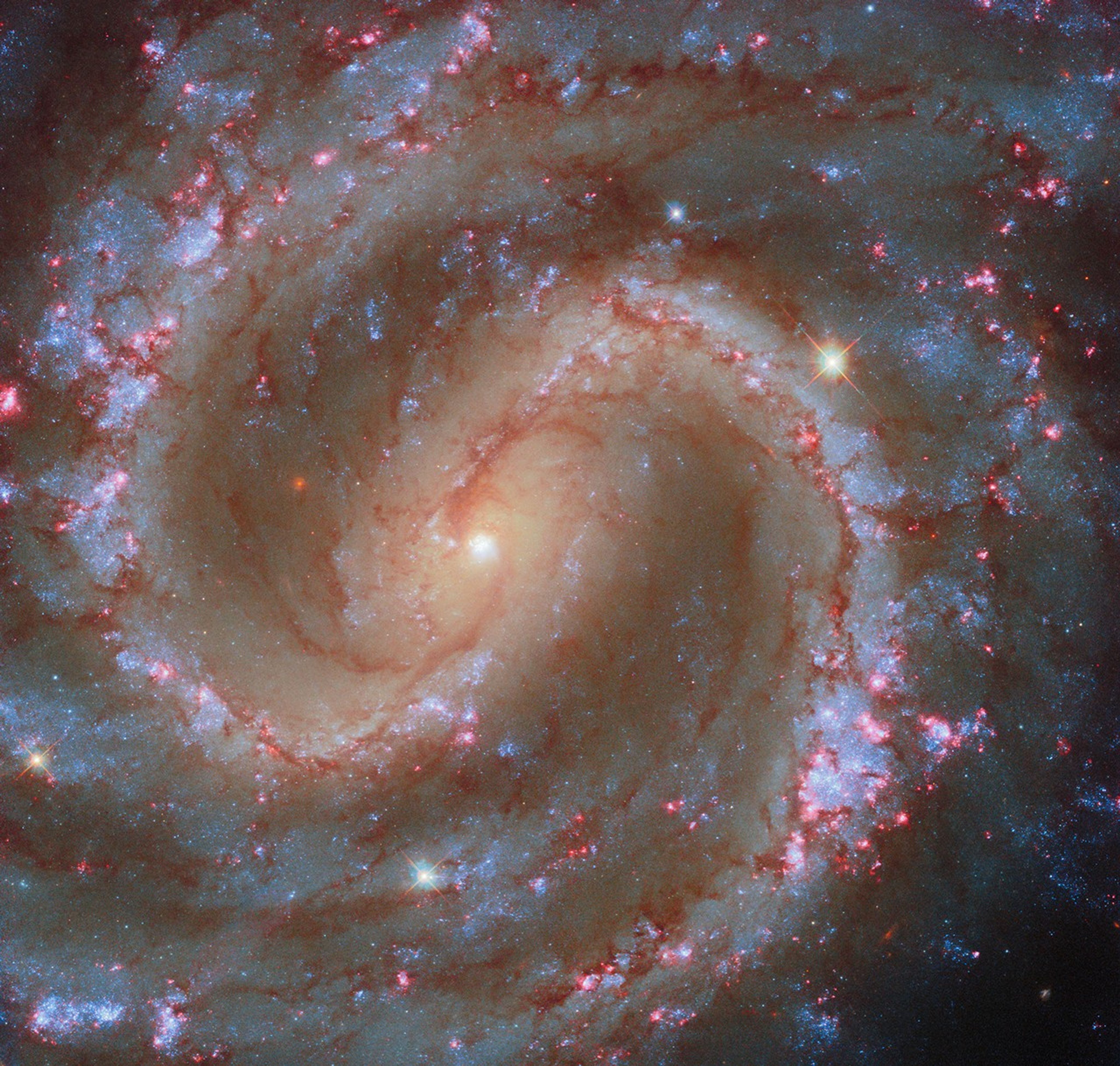
Hubble Seeks Clusters in ‘Lost Galaxy’ This NASA/ESA Hubble Space Telescope image features the spiral galaxy NGC 4535. ESA/Hubble & NASA, F. Belfiore, J. Lee and the PHANGS-HST TeamToday’s NASA/ESA Hubble Space Telescope image features the spiral galaxy NGC 4535, which is situated about 50 million light-years away in the constellation Virgo (the Maiden). Through a small telescope, this galaxy appears extremely faint, giving it the nickname ‘Lost Galaxy’. With a mirror spanning nearly eight feet (2.4 meters) across and its location above Earth’s light-obscuring atmosphere, Hubble can easily observe dim galaxies like NGC 4535 and pick out features like its massive spiral arms and central bar of stars.
This image features NGC 4535’s young star clusters, which dot the galaxy’s spiral arms. Glowing-pink clouds surround many of these bright-blue star groupings. These clouds, called H II (‘H-two’) regions, are a sign that the galaxy is home to especially young, hot, and massive stars that blaze with high-energy radiation. Such massive stars shake up their surroundings by heating their birth clouds with powerful stellar winds, eventually exploding as supernovae.
The image incorporates data from an observing program designed to catalog roughly 50,000 H II regions in nearby star-forming galaxies like NGC 4535. Hubble released a previous image of NGC 4535 in 2021. Both the 2021 image and this new image incorporate observations from the PHANGS observing program, which seeks to understand the connections between young stars and cold gas. Today’s image adds a new dimension to our understanding of NGC 4535 by capturing the brilliant red glow of the nebulae that encircle massive stars in their first few million years of life.
Facebook logo @NASAHubble @NASAHubble Instagram logo @NASAHubbleMedia Contact:
Claire Andreoli (claire.andreoli@nasa.gov)
NASA’s Goddard Space Flight Center, Greenbelt, MD
Since its 1990 launch, the Hubble Space Telescope has changed our fundamental understanding of the universe.
Hubble Science Highlights
Hubble Images
Hubble News
Hubble Seeks Clusters in ‘Lost Galaxy’
- Hubble Home
- Overview
- Impact & Benefits
- Science
- Observatory
- Team
- Multimedia
- News
- More
2 min read
Hubble Seeks Clusters in ‘Lost Galaxy’ This NASA/ESA Hubble Space Telescope image features the spiral galaxy NGC 4535. ESA/Hubble & NASA, F. Belfiore, J. Lee and the PHANGS-HST TeamToday’s NASA/ESA Hubble Space Telescope image features the spiral galaxy NGC 4535, which is situated about 50 million light-years away in the constellation Virgo (the Maiden). Through a small telescope, this galaxy appears extremely faint, giving it the nickname ‘Lost Galaxy’. With a mirror spanning nearly eight feet (2.4 meters) across and its location above Earth’s light-obscuring atmosphere, Hubble can easily observe dim galaxies like NGC 4535 and pick out features like its massive spiral arms and central bar of stars.
This image features NGC 4535’s young star clusters, which dot the galaxy’s spiral arms. Glowing-pink clouds surround many of these bright-blue star groupings. These clouds, called H II (‘H-two’) regions, are a sign that the galaxy is home to especially young, hot, and massive stars that blaze with high-energy radiation. Such massive stars shake up their surroundings by heating their birth clouds with powerful stellar winds, eventually exploding as supernovae.
The image incorporates data from an observing program designed to catalog roughly 50,000 H II regions in nearby star-forming galaxies like NGC 4535. Hubble released a previous image of NGC 4535 in 2021. Both the 2021 image and this new image incorporate observations from the PHANGS observing program, which seeks to understand the connections between young stars and cold gas. Today’s image adds a new dimension to our understanding of NGC 4535 by capturing the brilliant red glow of the nebulae that encircle massive stars in their first few million years of life.
Facebook logo @NASAHubble @NASAHubble Instagram logo @NASAHubbleMedia Contact:
Claire Andreoli (claire.andreoli@nasa.gov)
NASA’s Goddard Space Flight Center, Greenbelt, MD
Since its 1990 launch, the Hubble Space Telescope has changed our fundamental understanding of the universe.
Hubble Science Highlights
Hubble Images
Hubble News
Alien Comets Swarm around Other Stars
Comets don’t just orbit our sun. “Exocomets” are common around other stars in the galaxy, too
Michael Benson’s Nanocosmos Explores Natural Design through Scanning Electron Microscopy
Artist Michael Benson reveals the hidden beauty of snowflakes, radiolarians and lunar rocks through stunning electron microscope images in his new book, Nanocosmos.
This Week's Sky at a Glance, November 21 – 30
Saturn's rings are now the closest to edge on that they'll get. The famous interstellar comet has become higher and easier for amateur telescopes before dawn.
The post This Week's Sky at a Glance, November 21 – 30 appeared first on Sky & Telescope.
Finding star clusters in the Lost Galaxy
Earth from Space: The Danakil Depression
Marking one year until BepiColombo reaches Mercury
The ESA/JAXA BepiColombo mission has been cruising towards Mercury since October 2018. With just one year to go until it arrives at its destination, what has the mission achieved so far? And what can we expect from its two spacecraft after they enter orbit around the Solar System’s smallest and least-explored rocky planet?
Partisanship Is Poisoning Public Health
States and universities must step up to preserve data, and Congress must act to preserve our nation’s health
Where Was the Big Bang?
Let’s start out with something that we can say for certain: we live in an expanding universe.
Tracking Mars' Ice Ages From Space
Travelling up from Mars’s equator towards its north pole, we find Coloe Fossae: a set of intriguing scratches within a region marked by deep valleys, speckled craters, and signs of an ancient ice age.