

Feed aggregator
NASA Releases Technology Priorities to Energize Space Industry
NASA released the 2026 Civil Space Shortfall Ranking list on Wednesday, which integrates more than 400 responses from stakeholders including industry organizations, government agencies, and academia. Shortfalls refer to technology areas requiring further development to meet future exploration, science, and other mission needs. The goal of this document is to rank the space community’s most pervasive shortfalls to help guide NASA’s space technology development and investments.
The greatest technological breakthroughs are built on shared vision. At the intersection of government and industry, we’re poised to use this feedback to accelerate high-risk, high-reward technologies, pushing NASA beyond the cutting edge to enable the near impossible.Greg Stover
Acting associate administrator for NASA’s Space Technology Mission Directorate at the agency’s headquarters in Washington
As NASA lays the foundation for long-term missions to the Moon and paves the way for human exploration on Mars, the top ranked shortfalls reflect the challenges industry is most eager to solve, such as developing infrastructure and capabilities for assets to operate for extended durations in the lunar environment, providing surface mobility and logistics for crew and assets on planetary surfaces, and developing on-board advanced computing capabilities for space operations.
From this year’s public call for feedback, NASA received 454 total external responses. Each response was considered the input of a single individual, not a consolidated response of the organization they represented. The cross-cutting nature of this feedback underscores the importance of public, private partnership to drive U.S. leadership in space technology and energize the space economy.
“This feedback provides an invaluable dataset,” said Angela Krenn, acting chief architect for NASA Technology. “As our process matures, each round of input helps target our resources, ensuring America’s space industry can tackle tomorrow’s greatest challenges. By tapping into the collective expertise of our stakeholders, we turn their insights into fuel for NASA’s next giant leap.”
The 2026 shortfalls process builds on NASA’s first shortfall ranking, which asked participants to rank 187 civil space shortfalls, resulting in an integrated list of technology priorities. Leveraging the feedback provided by stakeholders, this year’s exercise streamlined the process by consolidating the shortfalls into 32 broader, integrated categories. This restructuring maintains the original content’s depth while creating a more efficient and accessible feedback mechanism for participants.
Using the 2026 shortfalls results, NASA Technology selected 40 primary focus areas for its fiscal year 2026 investments. These focus areas combine the quantitative data of the shortfall rankings with considerations from NASA’s Ignition initiatives, science and technology, while establishing paths for collaboration with industry, ensuring relevance with academia, and leveraging overlaps in interests with other government agencies.
The 40 focus areas include several capabilities to enable NASA’s future lunar infrastructure including: landing at the lunar South Pole exploration sites in various illumination conditions with accuracy; excavating and transporting lunar regolith at a scale relevant for a demonstration mission; and providing low power, thermal management, and actuation for distributed surface assets to survive and operate in the lunar environment. The list of 40 focus areas is available on page 10 of the shortfalls document.
To learn more about the civil space shortfall feedback opportunity and results as well as monitor future feedback opportunities, visit:
www.nasa.gov/civilspaceshortfalls
Share Details Last Updated May 20, 2026 EditorLoura HallLocationNASA Headquarters Related Terms Explore More 3 min read NASA Bolsters Golden Age of Exploration with Technology Priorities Article 4 months ago 3 min read NASA Releases First Integrated Ranking of Civil Space Challenges Article 2 years agoExtreme Lunar Conditions Need an Extreme Test Rig
When people eventually head to the Moon for long-term exploration and habitation, they'll need equipment and habitats made of well-tested materials. That's where NASA's Lunar Environment Test Rig (LESTR) comes in handy. It simulates extreme cold lunar night conditions right here in a NASA Glenn lab, testing equipment in temperatures ranging from 40K to 125K (-233 C to -148 C) in a vacuum.
Putting CO2 into rocks and getting hydrogen out is climate double win
Putting CO2 into rocks and getting hydrogen out is climate double win
We could generate hydrogen from rocks while storing CO2 in them
We could generate hydrogen from rocks while storing CO2 in them
Vaccines for Bundibugyo Ebola virus outbreak are being developed, but none are ready yet
A decade after Ebola vaccines changed outbreak response, a new epidemic in central Africa is caused by a strain the world never fully prepared for
Inflight call with ESA astronaut Sophie Adenot
On 20 May, ESA astronaut Sophie Adenot conducted an in-flight call with selected media representatives live aboard the International Space Station. During the discussion, Sophie shared insights into life and research in orbit, including scientific experiments supporting human health, climate science and future space exploration.
Mergers, Mayhem, and the Milky Way
Galaxies grow through mergers and collisions, and astronomers want to know more about the mergers in the Milky Way's past. But mergers can stir up the stars in the resulting galaxy, making it difficult to determine exactly when an ancient merger occurred. A new study led by researchers at the Institute of Cosmos Sciences of the University of Barcelona (ICCUB) and the Institute of Space Studies of Catalonia (IEEC) may have overcome that challenge.
I Am Artemis: Tim Goddard
Listen to this audio excerpt from Tim Goddard, NASA open water lead:
0:00 / 0:00
Your browser does not support the audio element.At the end of their mission around the Moon, NASA’s Artemis II astronauts were recovered from their Orion spacecraft by a team of U.S. Navy divers and NASA personnel. This included Tim Goddard, NASA open water lead, who helped guide the complex open water recovery of both Orion and the crew members, once they safely splashed down in the Pacific Ocean off the coast of San Diego.
As the open water lead, Goddard is responsible for the design, certification, procurement, and training, for both the NASA and Navy team. He also oversees the hardware and operations that are needed to recover the crew and spacecraft from the open ocean and bring them to safety aboard an amphibious Navy ship after splashdown.
Tim Goddard, NASA open water lead, stands in the Neutral Buoyancy Laboratory (NBL) at NASA’s Johnson Space Center in Houston. Goddard conducts training in the NBL with NASA and U.S. Navy recovery teams to prepare for Orion spacecraft recovery operations. NASA/Rad Sinyak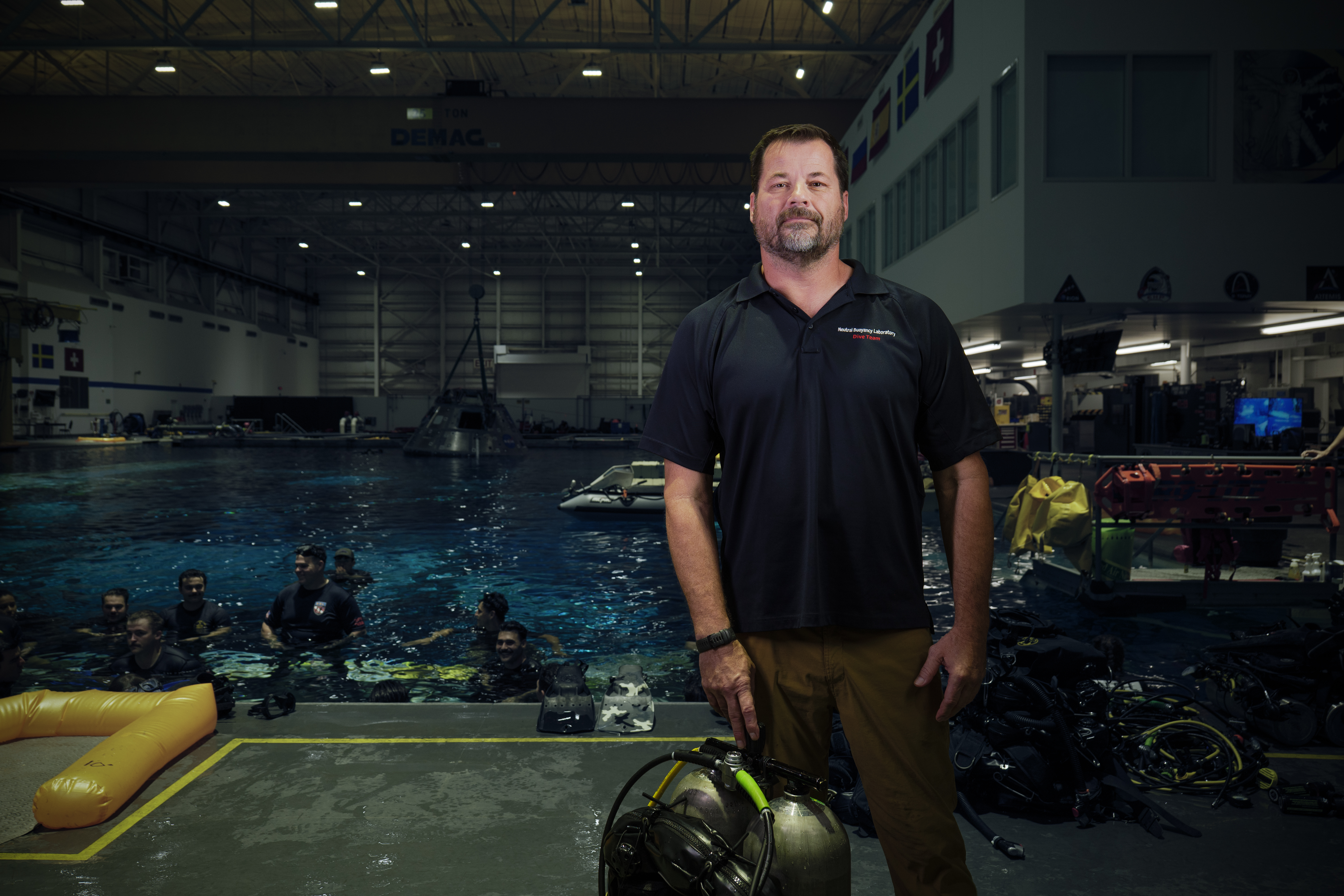
“This is a very complex set of operations,” said Goddard. “We have six small boats in the water. We’re relying on four separate helicopters and the host Navy ship at the same time. We have over 50 folks in the water and in different boats. I have team members underwater, on the surface, and small boats moving all around.”
And that’s just Goddard’s portion of the recovery — the larger operation entails coordination of activities that includes the Navy ship’s operations, communications, vessel traffic, medical needs, aviation operations, and more.
It’s a large orchestration of personnel and hardware to just enable recovery of the astronauts from the capsule — and then, we have to recover the spacecraft in the well deck of the Navy ship, which can be up to nine hours later.Tim Goddard
NASA Open Water Lead
Goddard and his team practice, practice, practice long before recovery day to ensure the complicated dance goes smoothly. They start by performing training runs with representative Orion hardware at the Neutral Buoyancy Laboratory at NASA’s Johnson Space Center in Houston, one of the world’s largest indoor pools that can support large-scale underwater and topside operations. The team then pushes out to San Diego, starting with bay operations and working their way up to open ocean conditions similar to what they’ll see on recovery day.
“By the time they do the real mission, they have hours and hours on each type of facet or each phase of that recovery,” said Goddard. “We bring them out and then we just go through repetition after repetition. When we do the real thing, it’s not their first time seeing it.”
NASA and U.S. Navy recovery teams, including NASA Open Water Lead Tim Goddard, prepare to transfer the crew to the USS John P. Murtha following the splashdown of the Orion spacecraft on April 10, 2026, marking the conclusion of the nearly 10‑day Artemis II mission around the Moon.NASA/Joel Kowsky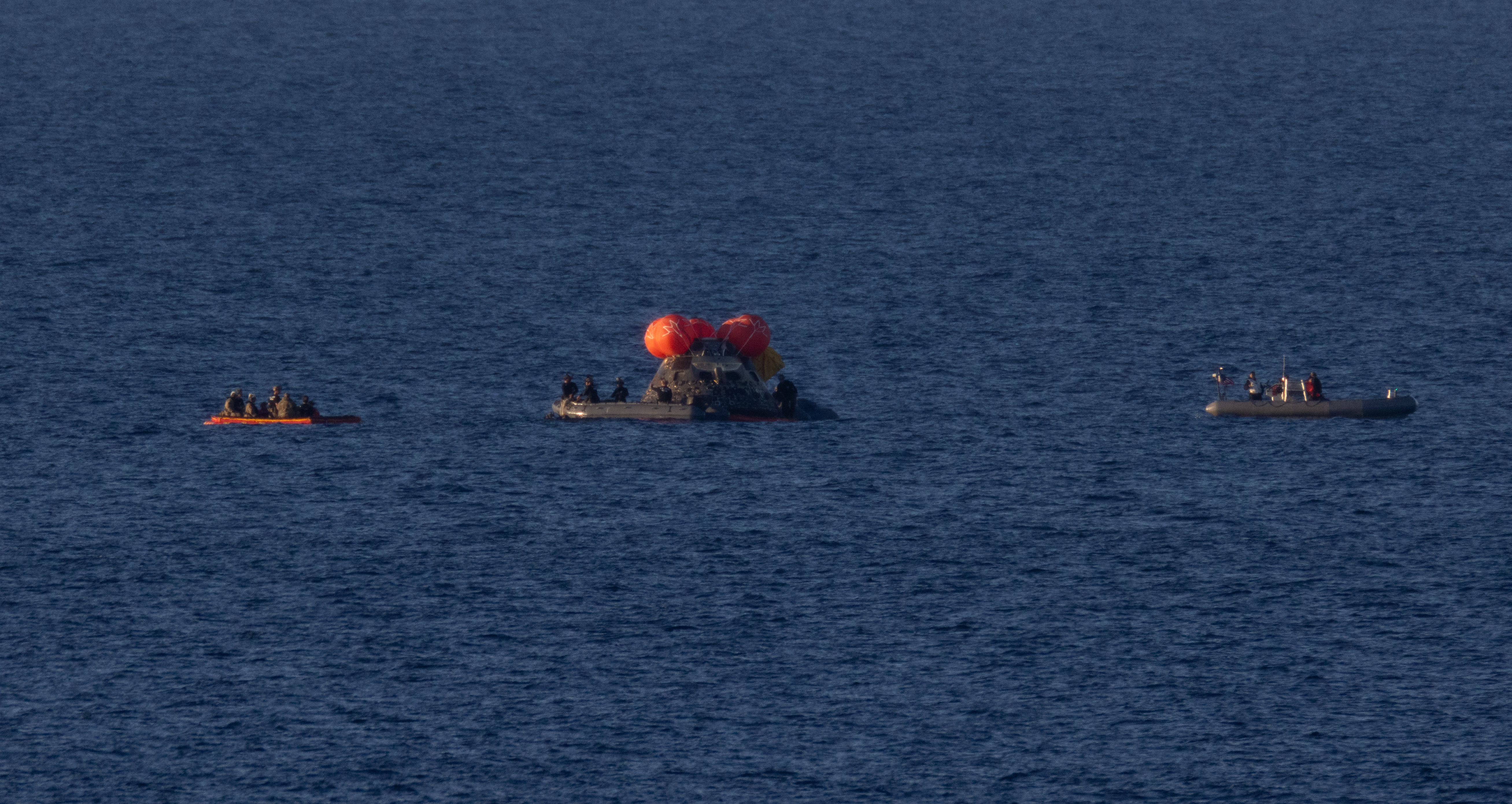
It’s actually Goddard’s third time recovering Orion — the team recovered the capsule on Orion’s first flight, Exploration Flight Test-1 in 2014, and Artemis I, Orion’s first uncrewed test flight around the Moon in 2022.
“We were strictly focused on capsule recovery for both of those flights,” said Goddard. “Now we introduced humans to the loop with a flight crew being in the capsule. Our primary focus has shifted from recovering the capsule to recovering the crew first. Once we get the crew safe and sound on the ship, we transfer our focus and shift our operations to the recovery of the capsule.”
Goddard joined the initial Orion recovery team in 2007, and has served as the open water lead for over 10 years. He joined NASA in the 1990s after a 27-year career as a Navy diver, initially serving in dive operations in the Neutral Buoyancy Lab and then pursuing mechanical engineering.
Over half of my time at NASA has been supporting this operation. That's a long time, and to finally have the Moon mission go off and bring the folks back — it's an immense pleasure. I am very excited and proud to be able to support this mission.Tim Goddard
NASA Open Water Lead
With crew aboard, there was an immense responsibility along with the pleasure of getting them home safely for Goddard.
“There was a lot of weight and stress that the other folks and I carried,” he said. “I can tell you under the previous two missions, once we set the capsule down, that was the moment of elation and ‘I can sleep now.’ That was tenfold when we recovered the crew. Once they were recovered and the capsule was back in San Diego, I had an immense feeling of relief.”
About the AuthorErika Peters Share Details Last Updated May 20, 2026 Related Terms Explore More 4 min read NASA Outlines Preliminary Artemis III Mission Plans Article 1 week ago 3 min read I Am Artemis: Kathleen Harmon Article 1 week ago 2 min read Nicholas Houghton: Engineering Crew Safety for NASA’s Artemis Missions Article 1 week ago Keep Exploring Discover More Topics From NASAMissions
Humans in Space
Climate Change
Solar System
I Am Artemis: Tim Goddard
Listen to this audio excerpt from Tim Goddard, NASA open water lead:
0:00 / 0:00
Your browser does not support the audio element.At the end of their mission around the Moon, NASA’s Artemis II astronauts were recovered from their Orion spacecraft by a team of U.S. Navy divers and NASA personnel. This included Tim Goddard, NASA open water lead, who helped guide the complex open water recovery of both Orion and the crew members, once they safely splashed down in the Pacific Ocean off the coast of San Diego.
As the open water lead, Goddard is responsible for the design, certification, procurement, and training, for both the NASA and Navy team. He also oversees the hardware and operations that are needed to recover the crew and spacecraft from the open ocean and bring them to safety aboard an amphibious Navy ship after splashdown.
Tim Goddard, NASA open water lead, stands in the Neutral Buoyancy Laboratory (NBL) at NASA’s Johnson Space Center in Houston. Goddard conducts training in the NBL with NASA and U.S. Navy recovery teams to prepare for Orion spacecraft recovery operations. NASA/Rad Sinyak“This is a very complex set of operations,” said Goddard. “We have six small boats in the water. We’re relying on four separate helicopters and the host Navy ship at the same time. We have over 50 folks in the water and in different boats. I have team members underwater, on the surface, and small boats moving all around.”
And that’s just Goddard’s portion of the recovery — the larger operation entails coordination of activities that includes the Navy ship’s operations, communications, vessel traffic, medical needs, aviation operations, and more.
It’s a large orchestration of personnel and hardware to just enable recovery of the astronauts from the capsule — and then, we have to recover the spacecraft in the well deck of the Navy ship, which can be up to nine hours later.Tim Goddard
NASA Open Water Lead
Goddard and his team practice, practice, practice long before recovery day to ensure the complicated dance goes smoothly. They start by performing training runs with representative Orion hardware at the Neutral Buoyancy Laboratory at NASA’s Johnson Space Center in Houston, one of the world’s largest indoor pools that can support large-scale underwater and topside operations. The team then pushes out to San Diego, starting with bay operations and working their way up to open ocean conditions similar to what they’ll see on recovery day.
“By the time they do the real mission, they have hours and hours on each type of facet or each phase of that recovery,” said Goddard. “We bring them out and then we just go through repetition after repetition. When we do the real thing, it’s not their first time seeing it.”
NASA and U.S. Navy recovery teams, including NASA Open Water Lead Tim Goddard, prepare to transfer the crew to the USS John P. Murtha following the splashdown of the Orion spacecraft on April 10, 2026, marking the conclusion of the nearly 10‑day Artemis II mission around the Moon.NASA/Joel KowskyIt’s actually Goddard’s third time recovering Orion — the team recovered the capsule on Orion’s first flight, Exploration Flight Test-1 in 2014, and Artemis I, Orion’s first uncrewed test flight around the Moon in 2022.
“We were strictly focused on capsule recovery for both of those flights,” said Goddard. “Now we introduced humans to the loop with a flight crew being in the capsule. Our primary focus has shifted from recovering the capsule to recovering the crew first. Once we get the crew safe and sound on the ship, we transfer our focus and shift our operations to the recovery of the capsule.”
Goddard joined the initial Orion recovery team in 2007, and has served as the open water lead for over 10 years. He joined NASA in the 1990s after a 27-year career as a Navy diver, initially serving in dive operations in the Neutral Buoyancy Lab and then pursuing mechanical engineering.
Over half of my time at NASA has been supporting this operation. That's a long time, and to finally have the Moon mission go off and bring the folks back — it's an immense pleasure. I am very excited and proud to be able to support this mission.Tim Goddard
NASA Open Water Lead
With crew aboard, there was an immense responsibility along with the pleasure of getting them home safely for Goddard.
“There was a lot of weight and stress that the other folks and I carried,” he said. “I can tell you under the previous two missions, once we set the capsule down, that was the moment of elation and ‘I can sleep now.’ That was tenfold when we recovered the crew. Once they were recovered and the capsule was back in San Diego, I had an immense feeling of relief.”
About the AuthorErika Peters Share Details Last Updated May 20, 2026 Related Terms Explore More 4 min read NASA Outlines Preliminary Artemis III Mission Plans Article 1 week ago 3 min read I Am Artemis: Kathleen Harmon Article 1 week ago 2 min read Nicholas Houghton: Engineering Crew Safety for NASA’s Artemis Missions Article 1 week ago Keep Exploring Discover More Topics From NASAMissions
Humans in Space
Climate Change
Solar System
NASA’s Psyche captures gorgeous Mars crescent photo on way to asteroid
NASA’s Psyche snapped images as it flew by Mars last week. The spacecraft used the planet’s gravity to give itself a boost on its journey toward its target asteroid
Is Dust the Best Thing in the Universe? Part 1: The Apology Begins
Years of grievance against dust. It ruins lungs, suits, rovers, and Mars missions. The first installment of an apology, sort of, to the most annoying substance in the cosmos.
The Selfish Gene at 50: Why Dawkins’s evolution classic still holds up
The Selfish Gene at 50: Why Dawkins’s evolution classic still holds up
Intoxicating and astonishing: Why 'The Selfish Gene' almost never was
Intoxicating and astonishing: Why 'The Selfish Gene' almost never was
After news about Oliver Sacks's "lies", we revisit his best-loved book
After news about Oliver Sacks's "lies", we revisit his best-loved book
The Colorado Avalanche is dominating the NHL—Denver’s high elevation could be the reason
Denver’s hockey team is studded with stars, but training and playing the game some 5,000 feet above sea level may give their athletic performance a boost over that of their rivals